Building Ethics into the Research
with Vulnerable Groups
La Zhuo
University of Guelph
EDRD 6000: QUALITATIVE ANALYSIS
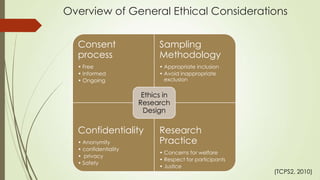
Overview of General Ethical Considerations
Consent
process
• Free
• Informed
• Ongoing
Sampling
Methodology
• Appropriate inclusion
• Avoid inappropriate
exclusion
Confidentiality
• Anonymity
• confidentiality
• privacy
• Safety
Research
Practice
• Concerns for welfare
• Respect for participants
• Justice
Ethics in
Research
Design
(TCPS2, 2010)
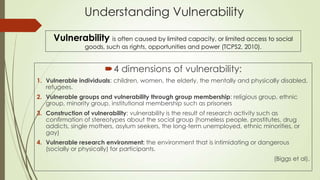
Understanding Vulnerability
4 dimensions of vulnerability:
1. Vulnerable individuals: children, women, the elderly, the mentally and physically disabled,
refugees.
2. Vulnerable groups and vulnerability through group membership: religious group, ethnic
group, minority group, institutional membership such as prisoners
3. Construction of vulnerability: vulnerability is the result of research activity such as
confirmation of stereotypes about the social group (homeless people, prostitutes, drug
addicts, single mothers, asylum seekers, the long-term unemployed, ethnic minorities, or
gay)
4. Vulnerable research environment: the environment that is intimidating or dangerous
(socially or physically) for participants.
(Biggs et al).
Vulnerability is often caused by limited capacity, or limited access to social
goods, such as rights, opportunities and power (TCPS2, 2010).
Sources of Vulnerability
 Economic Status and Geographic Location
 Health, Age, and Functional or Developmental Status
 Communication Barriers
 Unexplained Vulnerability Associated with Race, Ethnicity, Sex
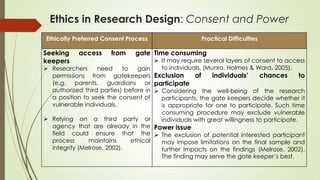
Ethics in Research Design: Consent and Power
Ethically Preferred Consent Process Practical Difficulties
Seeking access from gate
keepers
 Researchers need to gain
permissions from gatekeepers
(e.g. parents, guardians or
authorized third parties) before in
a position to seek the consent of
vulnerable individuals.
 Relying on a third party or
agency that are already in the
field could ensure that the
process maintains ethical
integrity (Melrose, 2002).
Time consuming
 It may require several layers of consent to access
to individuals. (Munro, Holmes & Ward, 2005).
Exclusion of individuals’ chances to
participate
 Considering the well-being of the research
participants, the gate keepers decide whether it
is appropriate for one to participate. Such time
consuming procedure may exclude vulnerable
individuals with great willingness to participate.
Power issue
 The exclusion of potential interested participant
may impose limitations on the final sample and
further impacts on the findings (Melrose, 2002).
The finding may serve the gate keeper‟s best.
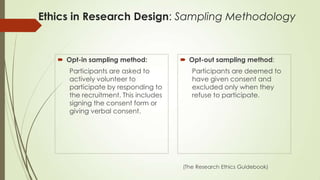
Ethics in Research Design: Sampling Methodology
 Opt-in sampling method:
Participants are asked to
actively volunteer to
participate by responding to
the recruitment. This includes
signing the consent form or
giving verbal consent.
 Opt-out sampling method:
Participants are deemed to
have given consent and
excluded only when they
refuse to participate.
(The Research Ethics Guidebook)
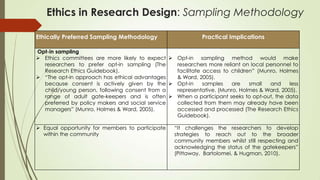
Ethics in Research Design: Sampling Methodology
Ethically Preferred Sampling Methodology Practical Implications
Opt-in sampling
 Ethics committees are more likely to expect
researchers to prefer opt-in sampling (The
Research Ethics Guidebook).
 “The opt-in approach has ethical advantages
because consent is actively given by the
child/young person, following consent from a
range of adult gate-keepers and is often
preferred by policy makers and social service
managers” (Munro, Holmes & Ward, 2005).
 Opt-in sampling method would make
researchers more reliant on local personnel to
facilitate access to children” (Munro, Holmes
& Ward, 2005).
 Opt-in samples are small and less
representative. (Munro, Holmes & Ward, 2005).
 When a participant seeks to opt-out, the data
collected from them may already have been
accessed and processed (The Research Ethics
Guidebook).
 Equal opportunity for members to participate
within the community
“It challenges the researchers to develop
strategies to reach out to the broader
community members whilst still respecting and
acknowledging the status of the gatekeepers”
(Pittaway, Bartolomei, & Hugman, 2010).
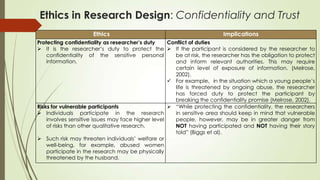
Ethics in Research Design: Confidentiality and Trust
Ethics Implications
Protecting confidentiality as researcher’s duty
 It is the researcher‟s duty to protect the
confidentiality of the sensitive personal
information.
Conflict of duties
 If the participant is considered by the researcher to
be at risk, the researcher has the obligation to protect
and inform relevant authorities. This may require
certain level of exposure of information. (Melrose,
2002).
 For example,in the situation which a young people‟s
life is threatened by ongoing abuse, the researcher
has forced duty to protect the participant by
breaking the confidentiality promise (Melrose, 2002).
Risks for vulnerable participants
 Individuals participate in the research
involves sensitive issues may face higher level
of risks than other qualitative research.
 Such risk may threaten individuals‟ welfare or
well-being, for example, abused women
participate in the research may be physically
threatened by the husband.
 “While protecting the confidentiality, the researchers
in sensitive area should keep in mind that vulnerable
people, however, may be in greater danger from
NOT having participated and NOT having their story
told” (Biggs et al).
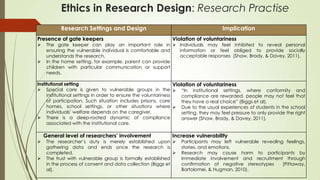
Ethics in Research Design: Research Practise
Research Settings and Design Implication
Presence of gate keepers
 The gate keeper can play an important role in
ensuring the vulnerable individual is comfortable and
understands the research.
 In the home setting, for example, parent can provide
children with particular communication or support
needs.
Violation of voluntariness
 Individuals may feel inhibited to reveal personal
information or feel obliged to provide socially
acceptable responses (Shaw, Brady, & Davey, 2011).
Institutional setting
 Special care is given to vulnerable groups in the
institutional settings in order to ensure the voluntariness
of participation. Such situation includes prisons, care
homes, school settings, or other situations where
individuals‟ welfare depends on the caregiver.
 There is a deep-rooted dynamic of compliance
associated with the institutional care.
Violation of voluntariness
 “In institutional settings, where conformity and
compliance are rewarded, people may not feel that
they have a real choice” (Biggs et al).
 Due to the usual experiences of students in the school
setting, they may feel pressure to only provide the right
answer (Shaw, Brady, & Davey, 2011).
General level of researchers’ involvement
 The researcher‟s duty is merely established upon
gathering data and ends once the research is
completed.
 The trust with vulnerable group is formally established
in the process of consent and data collection (Biggs et
al).
Increase vulnerability
 Participants may left vulnerable revealing feelings,
stories, and emotions.
 Research may cause harm to participants by
Immediate involvement and recruitment through
confirmation of negative stereotypes (Pittaway,
Bartolomei, & Hugman, 2010).
Practical Tactics
 Reporting back: vulnerable participants may be particularly sensitive with “hit
and run” situation. Researcher should extend the obligation beyond merely
gather data for own research.
 Follow-up support: research can sometimes cause additional harm to
vulnerable people when individuals‟ feeling and emotion are fully exploited.
 Narrative research method: with the research involves individuals experiencing
emotional crisis, direct questions are unethical, causing distress and anxious. The
narrative approach can be therapeutic for participants.
 Disguise information: in some case researchers can disguise the information of
personal identities or research location in order to effectively protect
confidentiality.
 Hidden involvement of participants: with the research may impose higher risks
for participants, it is important to ensure the participants are not seen or
contacted throughout the research.
References
Biggs, H, Clough, R, Esterhuizen, L., Hatton, C., Levitt, M, & Rennie, C. (n.d.). Vulnerable People and Groups.
Retrieved from http://www.lancaster.ac.uk/researchethics/4-3-infcons.html
Canadian Institutes of Health Research, Natural Sciences and Engineering Research Council of Canada, and
Social Sciences and Humanities Research Council of Canada, Tri-Council Policy Statement: Ethical Conduct for
Research Involving Humans, December 2010.
Munro, E. R., Holmes, L., & Ward, H. (2005). Researching vulnerable groups: Ethical issues and the effective
conduct of research in local authorities. British Journal of Social Work, 35(7), 1023-1038.
Pittaway, E., Bartolomei, L., & Hugman, R. (2010). „Stop stealing our stories‟: The ethics of research with vulnerable
groups. Journal of Human Rights Practice, 2(2), 229-251.
Shaw, C., Brady, L. M., & Davey, C. (2011). Guidelines for research with children and young people. London:
National Children‟s Bureau Research Centre.
The Research Ethics Guidebook. (n.d.). Opt-in and opt-out sampling. Retrieved from
http://www.ethicsguidebook.ac.uk/Opt-in-and-opt-out-sampling-94

Building Ethics into the Research with Vulnerable groups

  • 1.
    Building Ethics intothe Research with Vulnerable Groups La Zhuo University of Guelph EDRD 6000: QUALITATIVE ANALYSIS
  • 2.
    Overview of GeneralEthical Considerations Consent process • Free • Informed • Ongoing Sampling Methodology • Appropriate inclusion • Avoid inappropriate exclusion Confidentiality • Anonymity • confidentiality • privacy • Safety Research Practice • Concerns for welfare • Respect for participants • Justice Ethics in Research Design (TCPS2, 2010)
  • 3.
    Understanding Vulnerability 4 dimensionsof vulnerability: 1. Vulnerable individuals: children, women, the elderly, the mentally and physically disabled, refugees. 2. Vulnerable groups and vulnerability through group membership: religious group, ethnic group, minority group, institutional membership such as prisoners 3. Construction of vulnerability: vulnerability is the result of research activity such as confirmation of stereotypes about the social group (homeless people, prostitutes, drug addicts, single mothers, asylum seekers, the long-term unemployed, ethnic minorities, or gay) 4. Vulnerable research environment: the environment that is intimidating or dangerous (socially or physically) for participants. (Biggs et al). Vulnerability is often caused by limited capacity, or limited access to social goods, such as rights, opportunities and power (TCPS2, 2010).
  • 4.
    Sources of Vulnerability Economic Status and Geographic Location  Health, Age, and Functional or Developmental Status  Communication Barriers  Unexplained Vulnerability Associated with Race, Ethnicity, Sex
  • 5.
    Ethics in ResearchDesign: Consent and Power Ethically Preferred Consent Process Practical Difficulties Seeking access from gate keepers  Researchers need to gain permissions from gatekeepers (e.g. parents, guardians or authorized third parties) before in a position to seek the consent of vulnerable individuals.  Relying on a third party or agency that are already in the field could ensure that the process maintains ethical integrity (Melrose, 2002). Time consuming  It may require several layers of consent to access to individuals. (Munro, Holmes & Ward, 2005). Exclusion of individuals’ chances to participate  Considering the well-being of the research participants, the gate keepers decide whether it is appropriate for one to participate. Such time consuming procedure may exclude vulnerable individuals with great willingness to participate. Power issue  The exclusion of potential interested participant may impose limitations on the final sample and further impacts on the findings (Melrose, 2002). The finding may serve the gate keeper‟s best.
  • 6.
    Ethics in ResearchDesign: Sampling Methodology  Opt-in sampling method: Participants are asked to actively volunteer to participate by responding to the recruitment. This includes signing the consent form or giving verbal consent.  Opt-out sampling method: Participants are deemed to have given consent and excluded only when they refuse to participate. (The Research Ethics Guidebook)
  • 7.
    Ethics in ResearchDesign: Sampling Methodology Ethically Preferred Sampling Methodology Practical Implications Opt-in sampling  Ethics committees are more likely to expect researchers to prefer opt-in sampling (The Research Ethics Guidebook).  “The opt-in approach has ethical advantages because consent is actively given by the child/young person, following consent from a range of adult gate-keepers and is often preferred by policy makers and social service managers” (Munro, Holmes & Ward, 2005).  Opt-in sampling method would make researchers more reliant on local personnel to facilitate access to children” (Munro, Holmes & Ward, 2005).  Opt-in samples are small and less representative. (Munro, Holmes & Ward, 2005).  When a participant seeks to opt-out, the data collected from them may already have been accessed and processed (The Research Ethics Guidebook).  Equal opportunity for members to participate within the community “It challenges the researchers to develop strategies to reach out to the broader community members whilst still respecting and acknowledging the status of the gatekeepers” (Pittaway, Bartolomei, & Hugman, 2010).
  • 8.
    Ethics in ResearchDesign: Confidentiality and Trust Ethics Implications Protecting confidentiality as researcher’s duty  It is the researcher‟s duty to protect the confidentiality of the sensitive personal information. Conflict of duties  If the participant is considered by the researcher to be at risk, the researcher has the obligation to protect and inform relevant authorities. This may require certain level of exposure of information. (Melrose, 2002).  For example,in the situation which a young people‟s life is threatened by ongoing abuse, the researcher has forced duty to protect the participant by breaking the confidentiality promise (Melrose, 2002). Risks for vulnerable participants  Individuals participate in the research involves sensitive issues may face higher level of risks than other qualitative research.  Such risk may threaten individuals‟ welfare or well-being, for example, abused women participate in the research may be physically threatened by the husband.  “While protecting the confidentiality, the researchers in sensitive area should keep in mind that vulnerable people, however, may be in greater danger from NOT having participated and NOT having their story told” (Biggs et al).
  • 9.
    Ethics in ResearchDesign: Research Practise Research Settings and Design Implication Presence of gate keepers  The gate keeper can play an important role in ensuring the vulnerable individual is comfortable and understands the research.  In the home setting, for example, parent can provide children with particular communication or support needs. Violation of voluntariness  Individuals may feel inhibited to reveal personal information or feel obliged to provide socially acceptable responses (Shaw, Brady, & Davey, 2011). Institutional setting  Special care is given to vulnerable groups in the institutional settings in order to ensure the voluntariness of participation. Such situation includes prisons, care homes, school settings, or other situations where individuals‟ welfare depends on the caregiver.  There is a deep-rooted dynamic of compliance associated with the institutional care. Violation of voluntariness  “In institutional settings, where conformity and compliance are rewarded, people may not feel that they have a real choice” (Biggs et al).  Due to the usual experiences of students in the school setting, they may feel pressure to only provide the right answer (Shaw, Brady, & Davey, 2011). General level of researchers’ involvement  The researcher‟s duty is merely established upon gathering data and ends once the research is completed.  The trust with vulnerable group is formally established in the process of consent and data collection (Biggs et al). Increase vulnerability  Participants may left vulnerable revealing feelings, stories, and emotions.  Research may cause harm to participants by Immediate involvement and recruitment through confirmation of negative stereotypes (Pittaway, Bartolomei, & Hugman, 2010).
  • 10.
    Practical Tactics  Reportingback: vulnerable participants may be particularly sensitive with “hit and run” situation. Researcher should extend the obligation beyond merely gather data for own research.  Follow-up support: research can sometimes cause additional harm to vulnerable people when individuals‟ feeling and emotion are fully exploited.  Narrative research method: with the research involves individuals experiencing emotional crisis, direct questions are unethical, causing distress and anxious. The narrative approach can be therapeutic for participants.  Disguise information: in some case researchers can disguise the information of personal identities or research location in order to effectively protect confidentiality.  Hidden involvement of participants: with the research may impose higher risks for participants, it is important to ensure the participants are not seen or contacted throughout the research.
  • 11.
    References Biggs, H, Clough,R, Esterhuizen, L., Hatton, C., Levitt, M, & Rennie, C. (n.d.). Vulnerable People and Groups. Retrieved from http://www.lancaster.ac.uk/researchethics/4-3-infcons.html Canadian Institutes of Health Research, Natural Sciences and Engineering Research Council of Canada, and Social Sciences and Humanities Research Council of Canada, Tri-Council Policy Statement: Ethical Conduct for Research Involving Humans, December 2010. Munro, E. R., Holmes, L., & Ward, H. (2005). Researching vulnerable groups: Ethical issues and the effective conduct of research in local authorities. British Journal of Social Work, 35(7), 1023-1038. Pittaway, E., Bartolomei, L., & Hugman, R. (2010). „Stop stealing our stories‟: The ethics of research with vulnerable groups. Journal of Human Rights Practice, 2(2), 229-251. Shaw, C., Brady, L. M., & Davey, C. (2011). Guidelines for research with children and young people. London: National Children‟s Bureau Research Centre. The Research Ethics Guidebook. (n.d.). Opt-in and opt-out sampling. Retrieved from http://www.ethicsguidebook.ac.uk/Opt-in-and-opt-out-sampling-94