Vulnerability Management
Prepared by : Shriya Rai
Vulnerability
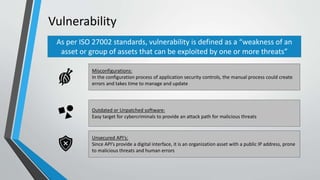
As per ISO 27002 standards, vulnerability is defined as a “weakness of an
asset or group of assets that can be exploited by one or more threats”
Misconfigurations:
In the configuration process of application security controls, the manual process could create
errors and takes time to manage and update
Unsecured API’s:
Since API’s provide a digital interface, it is an organization asset with a public IP address, prone
to malicious threats and human errors
Outdated or Unpatched software:
Easy target for cybercriminals to provide an attack path for malicious threats
Vulnerability
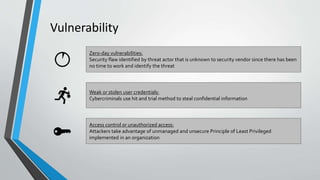
Weak or stolen user credentials:
Cybercriminals use hit and trial method to steal confidential information
Access control or unauthorized access:
Attackers take advantage of unmanaged and unsecure Principle of Least Privileged
implemented in an organization
Zero-day vulnerabilities:
Security flaw identified by threat actor that is unknown to security vendor since there has been
no time to work and identify the threat
CommonVulnerability
Scoring System(CVSS)
• The ranking and categorization of
vulnerabilities are based on the
characteristic of vulnerability and its
severity.
• CVSS provides a way of qualitative
representation of vulnerabilities
which helps organizations to
prioritize and assess the vulnerability
management process.
• The NVD (National Vulnerability
Database) has an updated library of
common vulnerabilities and
exposures (CVE’s)
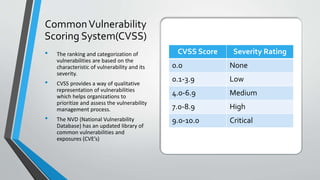
CVSS Score Severity Rating
0.0 None
0.1-3.9 Low
4.0-6.9 Medium
7.0-8.9 High
9.0-10.0 Critical
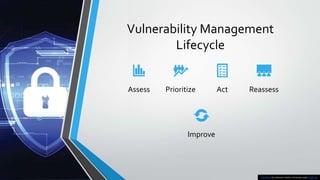
Vulnerability Management
Lifecycle
Assess Prioritize Act Reassess
Improve
This Photo by Unknown Author is licensed under CC BY-SA
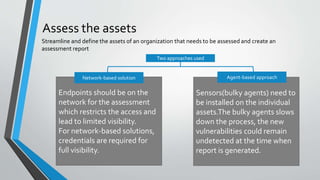
Assess the assets
Streamline and define the assets of an organization that needs to be assessed and create an
assessment report
Endpoints should be on the
network for the assessment
which restricts the access and
lead to limited visibility.
For network-based solutions,
credentials are required for
full visibility.
Sensors(bulky agents) need to
be installed on the individual
assets.The bulky agents slows
down the process, the new
vulnerabilities could remain
undetected at the time when
report is generated.
Network-based solution Agent-based approach
Two approaches used
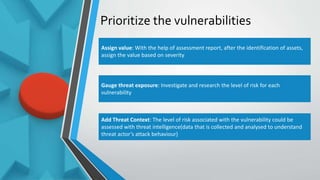
Prioritize the vulnerabilities
Assign value: With the help of assessment report, after the identification of assets,
assign the value based on severity
Gauge threat exposure: Investigate and research the level of risk for each
vulnerability
Add Threat Context: The level of risk associated with the vulnerability could be
assessed with threat intelligence(data that is collected and analysed to understand
threat actor’s attack behaviour)
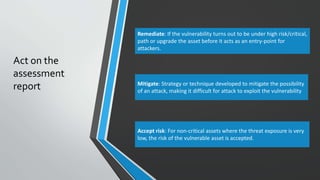
Act on the
assessment
report
Remediate: If the vulnerability turns out to be under high risk/critical,
path or upgrade the asset before it acts as an entry-point for
attackers.
Mitigate: Strategy or technique developed to mitigate the possibility
of an attack, making it difficult for attack to exploit the vulnerability
Accept risk: For non-critical assets where the threat exposure is very
low, the risk of the vulnerable asset is accepted.
Reassess
Rescan andValidate:The prioritized list of vulnerabilities needs to be cross examined and validated to
check if there are same issues or not, if not then the new ones are added in the report
Improve
The improvement scope in the vulnerability management lifecycle involves eliminating underlying
issues, evolving processes and evaluating the metrics
References
https://www.crowdstrike.com/cybersecurity-
101/vulnerability-management/
https://www.crowdstrike.com/cybersecurity-101/types-of-
cyber-vulnerabilities/
https://www.crowdstrike.com/cybersecurity-
101/vulnerability-management/vulnerability-management-
lifecycle/
ThankYou