THE
V-PROCESS
WHERE IT STARTED
The V-PROCESS (technically vacuum molding) was developed and patented in Japan in the late 1970's. Bill
Wilmont, President of the Herman Molding Machine Company in Zelienople, Pennsylvania, was
instrumental in bringing the process to the United States. Wilmont quickly saw the value of the process and
left his position to open Harmony Castings, Inc. in 1981.

Because of the recession in 1981, Harmony Castings experienced financial difficulties from the start. In
addition, there was virtually no technical expertise available in the United States. Despite these conditions
and with perseverance and a belief in the value of the process, the Company was able to quickly establish a
market. In 1986, Harmony was sold to the present management and a strong emphasis was placed on
upgrading the quality of the castings produced. At that time, the Company had 11 hourly employees. In the
succeeding 12 years, Harmony has grown to approximately 130 employees, with sales of more than $15
million projected for 2000. In July, 1999, Ligon Industries purchased Harmony Castings and within a couple
of years Ligon Industries purchased TPi.

The process has been used and accepted by companies ranging from Fortune 100 to start-ups and is proving
to be a very cost effective process for producing tight tolerance, esthetically pleasing, thin wall aluminum
castings. The value of the process has enabled many companies to minimize the cost of new designs and to
reduce the cost of current programs.

Major markets are in the medical, instrumentation, electronics, computer and tele-communication. We excel
at long term projects requiring accurate, high quality castings.

Harmony Castings and TPI continue to challenge the process, people, and systems to produce a product that
exceeds market and design expectations. Quality has been the vehicle for growth and V-PROCESS will
continue to satisfy the designs


                                       ZERO DRAFT
    The V-PROCESS is unique in that it DOES NOT REQUIRE ANY DRAFT ANGLE. This is due to
       the lubricity of the plastic film that allows for the mold to be stripped from the pattern without the
    friction of the sand against the pattern. The vacuum that is applied during the film forming operation is
       released and the vacuum is then applied to the mold. This causes a slight, controlled expansion or
                contraction of the mold features. The advantages of the zero draft capabilities are:
   Constant Wall Thickness for weight reductions and aesthetic appeal.
   Elimination of Machining off the draft for clearances for mating parts.
   Total Tolerance range remains for the actual feature, not the feature plus draft. Draft does not
                        use up the tolerance.
   Pattern Construction is more accurate and efficient.


                          For more information or a competitive quote please contact:
                                           TOM CLARK
                                  McCann Sales, Inc. Ph: 207-439-3747
                                     E-mail: tclark@maine.rr.com
HOW IT WORKS
First, we heat a thin plastic film and place it over a pattern. A vacuum tightly draws the film over the pattern,
which is then surrounded by a flask. Next, we fill the flask with dry, unbonded, extremely fine sand and
vibrate the sand so that it tightly packs the pattern. After a second sheet of film is placed on the flask, a
vacuum draws out the air, and the completed mold is then stripped from the pattern.

Each half of the mold is made in a similar fashion and then aluminum is poured directly from the furnace
into the closed halves. The mold is held under vacuum to retain its shape. After the mold cools, the vacuum
is released and the sand and completed castings fall free.

Simple in concept and far reaching in impact, V-PROCESS produces quick turn-around, high-value castings.
In order to provide the highest quality product, Harmony Castings continually strives to improve our systems
and raise the level of our performance. To achieve these standards, we maintain ongoing training programs
that teach our employees to accept responsibility and to act on their knowledge. The caliber of our people
and the quality of our V-PROCESS make it possible for Harmony Castings and TPi create a vision for the
future, and to establish our Company as a leader in the casting industry.

It is no accident that major companies in the medical, instrumentation, electronics, computer and tele-
communication industries rely on the V-PROCESS for their casting needs.


                                        MOLD SIZES
Between Harmony Castings and TPi they have the following basic mold sizes:

                                 36” x 36” x 12” / 12” ( 24 inch total height )

                                 36” x 48” x 14” / 12” ( 26 inch total height )

As a rule of thumb, we need a minimum of 2 – 5 inches in the length and width for the gating system
depending on the shape and size of the part. When in doubt, do not assume a part will fit. Send us the
drawing for evaluation.

                                                 CORING
    The V-PROCESS uses cores that are similar to a sand core with the exception that we coat the core with
     a ceramic wash. The purpose of this is to seal the coarser core sand so when a vacuum is pulled on the
                core the aluminum is not sucked into the core resulting in a “burn in” condition.


                           For more information or a competitive quote please contact:
                                            TOM CLARK
                                   McCann Sales, Inc. Ph: 207-439-3747
                                      E-mail: tclark@maine.rr.com
V – PROCESS BENEFITS

                     Very Smooth Surface Finish

•   125-150 RMS is the norm. Cast surface of 200 or better, based on The
    Aluminum Association of America STD AA-C5-E18.


                   Excellent Dimensional Accuracy

•   Typically +/-.010 up to 1 inch plus +/-.002 per additional inch. Certain
    details can be held closer.

•   +/-.010 across the parting line.

•   Cored areas may require additional tolerances.


                               Zero Draft

•   Eliminates the need for machining off draft to provide clearance for
    mating parts and assembly.

•   Provides consistent wall thickness for weight reduction and aesthetic
    appeal.

•   Allows for simple fixturing for machining and inspection.

•   Pattern construction becomes more accurate and efficient.

•   Total tolerance range becomes more accurate and efficient.

•   Geometry/tolerance of part is at its simplest form. Draft does not use
    up tolerance.

•   Design/drafting is less complex. Calculations and depictions related to
    draft are eliminated.


     For more information or a competitive quote please contact:
                        TOM CLARK
               McCann Sales, Inc. Ph: 207-439-3747
                  E-mail: tclark@maine.rr.com
V – PROCESS BENEFITS CONT.


                          Thin Wall Sections

•   Walls as low as .090 in some applications are possible.


                 Excellent Reproduction Of Details

•   Very small features and lettering are possible.


                          Consistent Quality

•   All molding is semi-automatic. Variable "human factor" has been
    reduced.


                         Superior Machining

•   Sound metal and no hidden sand in the castings means fewer setups,
    reduced scrap and longer tool life.


                          Low Tooling Costs

•   All patterns are made from epoxy, machined plastics, SLA or LDM.
    There is no need to retool for production quantities.


                        Unlimited Pattern Life

•   Patterns are protected by plastic film during each sand molding cycle.


     For more information or a competitive quote please contact:
                        TOM CLARK
               McCann Sales, Inc. Ph: 207-439-3747
                  E-mail: tclark@maine.rr.com
V – PROCESS BENEFITS CONT.


                     Easy Revisions To Patterns

•   No metal tooling to weld or mill. Great for prototypes.


                  Short-Run Production Capability

•   Excellent for short-run production while waiting for hard tooling. The
    V-PROCESS method can out produce traditional prototype methods
    such as plaster or investment castings.


                           Fast Turnaround

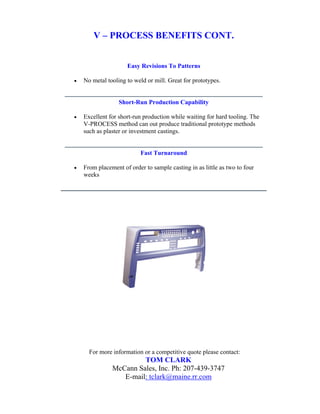
•   From placement of order to sample casting in as little as two to four
    weeks


      For more information or a competitive quote please contact:
                        TOM CLARK
               McCann Sales, Inc. Ph: 207-439-3747
                  E-mail: tclark@maine.rr.com
THE VACUUM PROCESS


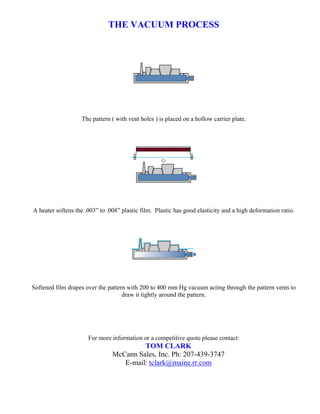
                   The pattern ( with vent holes ) is placed on a hollow carrier plate.


A heater softens the .003” to .008” plastic film. Plastic has good elasticity and a high deformation ratio.


Softened film drapes over the pattern with 200 to 400 mm Hg vacuum acting through the pattern vents to
                                    draw it tightly around the pattern.


                      For more information or a competitive quote please contact:
                                         TOM CLARK
                                McCann Sales, Inc. Ph: 207-439-3747
                                   E-mail: tclark@maine.rr.com
THE VACUUM PROCESS CONT.


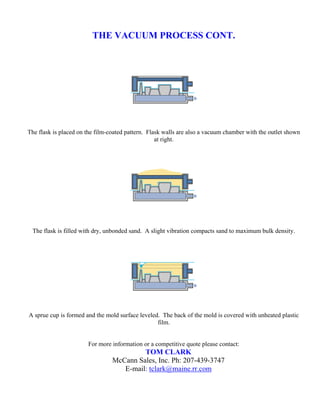
The flask is placed on the film-coated pattern. Flask walls are also a vacuum chamber with the outlet shown
                                                   at right.


 The flask is filled with dry, unbonded sand. A slight vibration compacts sand to maximum bulk density.


A sprue cup is formed and the mold surface leveled. The back of the mold is covered with unheated plastic
                                                  film.


                       For more information or a competitive quote please contact:
                                          TOM CLARK
                                 McCann Sales, Inc. Ph: 207-439-3747
                                    E-mail: tclark@maine.rr.com
THE VACUUM PROCESS CONT.


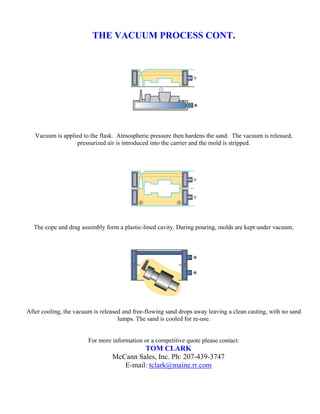
   Vacuum is applied to the flask. Atmospheric pressure then hardens the sand. The vacuum is released,
                  pressurized air is introduced into the carrier and the mold is stripped.


  The cope and drag assembly form a plastic-lined cavity. During pouring, molds are kept under vacuum.


After cooling, the vacuum is released and free-flowing sand drops away leaving a clean casting, with no sand
                                    lumps. The sand is cooled for re-use.


                        For more information or a competitive quote please contact:
                                          TOM CLARK
                                 McCann Sales, Inc. Ph: 207-439-3747
                                    E-mail: tclark@maine.rr.com
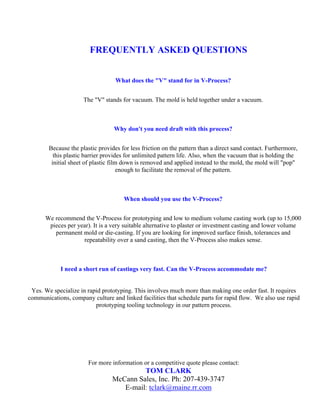
FREQUENTLY ASKED QUESTIONS


                                   What does the "V" stand for in V-Process?


                      The "V" stands for vacuum. The mold is held together under a vacuum.


                                  Why don't you need draft with this process?


        Because the plastic provides for less friction on the pattern than a direct sand contact. Furthermore,
          this plastic barrier provides for unlimited pattern life. Also, when the vacuum that is holding the
         initial sheet of plastic film down is removed and applied instead to the mold, the mold will "pop"
                                      enough to facilitate the removal of the pattern.


                                      When should you use the V-Process?


      We recommend the V-Process for prototyping and low to medium volume casting work (up to 15,000
       pieces per year). It is a very suitable alternative to plaster or investment casting and lower volume
         permanent mold or die-casting. If you are looking for improved surface finish, tolerances and
                    repeatability over a sand casting, then the V-Process also makes sense.


            I need a short run of castings very fast. Can the V-Process accommodate me?


 Yes. We specialize in rapid prototyping. This involves much more than making one order fast. It requires
communications, company culture and linked facilities that schedule parts for rapid flow. We also use rapid
                          prototyping tooling technology in our pattern process.


                        For more information or a competitive quote please contact:
                                           TOM CLARK
                                  McCann Sales, Inc. Ph: 207-439-3747
                                     E-mail: tclark@maine.rr.com
V-PROCESS CASTING

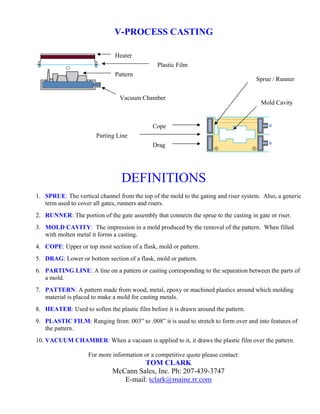
                               Heater
                                               Plastic Film
                               Pattern
                                                                                      Sprue / Runner


                                Vacuum Chamber
                                                                                        Mold Cavity


                                             Cope
                       Parting Line
                                             Drag


                                 DEFINITIONS
1. SPRUE: The vertical channel from the top of the mold to the gating and riser system. Also, a generic
   term used to cover all gates, runners and risers.
2. RUNNER: The portion of the gate assembly that connects the sprue to the casting in gate or riser.
3. MOLD CAVITY: The impression in a mold produced by the removal of the pattern. When filled
   with molten metal it forms a casting.
4. COPE: Upper or top most section of a flask, mold or pattern.
5. DRAG: Lower or bottom section of a flask, mold or pattern.
6. PARTING LINE: A line on a pattern or casting corresponding to the separation between the parts of
   a mold.
7. PATTERN: A pattern made from wood, metal, epoxy or machined plastics around which molding
   material is placed to make a mold for casting metals.
8. HEATER: Used to soften the plastic film before it is drawn around the pattern.
9. PLASTIC FILM: Ranging from .003” to .008” it is used to stretch to form over and into features of
   the pattern.
10. VACUUM CHAMBER: When a vacuum is applied to it, it draws the plastic film over the pattern.

                    For more information or a competitive quote please contact:
                                      TOM CLARK
                             McCann Sales, Inc. Ph: 207-439-3747
                                E-mail: tclark@maine.rr.com
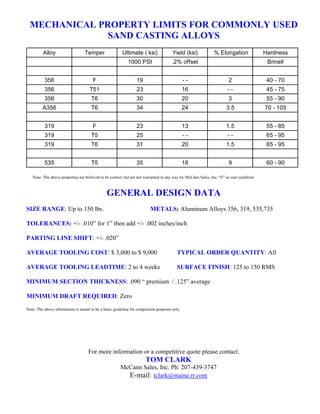
MECHANICAL PROPERTY LIMITS FOR COMMONLY USED
              SAND CASTING ALLOYS
         Alloy                    Temper                Ultimate ( ksi)              Yield (ksi)              % Elongation               Hardness
                                                           1000 PSI                  .2% offset                                           Brinell


          356                         F                         19                           --                        2                  40 - 70
          356                       T51                         23                           16                       --                  45 - 75
          356                        T6                         30                           20                        3                  55 - 90
         A356                        T6                         34                           24                      3.5                 70 - 105


          319                         F                         23                           13                      1.5                  55 - 85
          319                        T5                         25                           --                       --                  65 - 95
          319                        T6                         31                           20                      1.5                  65 - 95


          535                        T5                         35                           18                        9                  60 - 90

   Note: The above properties are believed to be correct, but are not warranted in any way by McCann Sales, Inc. “F” as cast condition


                                              GENERAL DESIGN DATA
SIZE RANGE: Up to 150 lbs.                                              METALS: Aluminum Alloys 356, 319, 535,735

TOLERANCES: +/- .010” for 1” then add +/- .002 inches/inch

PARTING LINE SHIFT: +/- .020”

AVERAGE TOOLING COST: $ 3,000 to $ 9,000                                                TYPICAL ORDER QUANTITY: All

AVERAGE TOOLING LEADTIME: 2 to 4 weeks                                                  SURFACE FINISH: 125 to 150 RMS

MINIMUM SECTION THICKNESS: .090 “ premium / .125” average

MINIMUM DRAFT REQUIRED: Zero
Note: The above information is meant to be a basic guideline for comparison purposes only.


                                    For more information or a competitive quote please contact:
                                                                     TOM CLARK
                                                      McCann Sales, Inc. Ph: 207-439-3747
                                                        E-mail: tclark@maine.rr.com

Vprocess

  • 1.
  • 2.
    WHERE IT STARTED TheV-PROCESS (technically vacuum molding) was developed and patented in Japan in the late 1970's. Bill Wilmont, President of the Herman Molding Machine Company in Zelienople, Pennsylvania, was instrumental in bringing the process to the United States. Wilmont quickly saw the value of the process and left his position to open Harmony Castings, Inc. in 1981. Because of the recession in 1981, Harmony Castings experienced financial difficulties from the start. In addition, there was virtually no technical expertise available in the United States. Despite these conditions and with perseverance and a belief in the value of the process, the Company was able to quickly establish a market. In 1986, Harmony was sold to the present management and a strong emphasis was placed on upgrading the quality of the castings produced. At that time, the Company had 11 hourly employees. In the succeeding 12 years, Harmony has grown to approximately 130 employees, with sales of more than $15 million projected for 2000. In July, 1999, Ligon Industries purchased Harmony Castings and within a couple of years Ligon Industries purchased TPi. The process has been used and accepted by companies ranging from Fortune 100 to start-ups and is proving to be a very cost effective process for producing tight tolerance, esthetically pleasing, thin wall aluminum castings. The value of the process has enabled many companies to minimize the cost of new designs and to reduce the cost of current programs. Major markets are in the medical, instrumentation, electronics, computer and tele-communication. We excel at long term projects requiring accurate, high quality castings. Harmony Castings and TPI continue to challenge the process, people, and systems to produce a product that exceeds market and design expectations. Quality has been the vehicle for growth and V-PROCESS will continue to satisfy the designs ZERO DRAFT The V-PROCESS is unique in that it DOES NOT REQUIRE ANY DRAFT ANGLE. This is due to the lubricity of the plastic film that allows for the mold to be stripped from the pattern without the friction of the sand against the pattern. The vacuum that is applied during the film forming operation is released and the vacuum is then applied to the mold. This causes a slight, controlled expansion or contraction of the mold features. The advantages of the zero draft capabilities are: Constant Wall Thickness for weight reductions and aesthetic appeal. Elimination of Machining off the draft for clearances for mating parts. Total Tolerance range remains for the actual feature, not the feature plus draft. Draft does not use up the tolerance. Pattern Construction is more accurate and efficient. For more information or a competitive quote please contact: TOM CLARK McCann Sales, Inc. Ph: 207-439-3747 E-mail: tclark@maine.rr.com
  • 3.
    HOW IT WORKS First,we heat a thin plastic film and place it over a pattern. A vacuum tightly draws the film over the pattern, which is then surrounded by a flask. Next, we fill the flask with dry, unbonded, extremely fine sand and vibrate the sand so that it tightly packs the pattern. After a second sheet of film is placed on the flask, a vacuum draws out the air, and the completed mold is then stripped from the pattern. Each half of the mold is made in a similar fashion and then aluminum is poured directly from the furnace into the closed halves. The mold is held under vacuum to retain its shape. After the mold cools, the vacuum is released and the sand and completed castings fall free. Simple in concept and far reaching in impact, V-PROCESS produces quick turn-around, high-value castings. In order to provide the highest quality product, Harmony Castings continually strives to improve our systems and raise the level of our performance. To achieve these standards, we maintain ongoing training programs that teach our employees to accept responsibility and to act on their knowledge. The caliber of our people and the quality of our V-PROCESS make it possible for Harmony Castings and TPi create a vision for the future, and to establish our Company as a leader in the casting industry. It is no accident that major companies in the medical, instrumentation, electronics, computer and tele- communication industries rely on the V-PROCESS for their casting needs. MOLD SIZES Between Harmony Castings and TPi they have the following basic mold sizes: 36” x 36” x 12” / 12” ( 24 inch total height ) 36” x 48” x 14” / 12” ( 26 inch total height ) As a rule of thumb, we need a minimum of 2 – 5 inches in the length and width for the gating system depending on the shape and size of the part. When in doubt, do not assume a part will fit. Send us the drawing for evaluation. CORING The V-PROCESS uses cores that are similar to a sand core with the exception that we coat the core with a ceramic wash. The purpose of this is to seal the coarser core sand so when a vacuum is pulled on the core the aluminum is not sucked into the core resulting in a “burn in” condition. For more information or a competitive quote please contact: TOM CLARK McCann Sales, Inc. Ph: 207-439-3747 E-mail: tclark@maine.rr.com
  • 4.
    V – PROCESSBENEFITS Very Smooth Surface Finish • 125-150 RMS is the norm. Cast surface of 200 or better, based on The Aluminum Association of America STD AA-C5-E18. Excellent Dimensional Accuracy • Typically +/-.010 up to 1 inch plus +/-.002 per additional inch. Certain details can be held closer. • +/-.010 across the parting line. • Cored areas may require additional tolerances. Zero Draft • Eliminates the need for machining off draft to provide clearance for mating parts and assembly. • Provides consistent wall thickness for weight reduction and aesthetic appeal. • Allows for simple fixturing for machining and inspection. • Pattern construction becomes more accurate and efficient. • Total tolerance range becomes more accurate and efficient. • Geometry/tolerance of part is at its simplest form. Draft does not use up tolerance. • Design/drafting is less complex. Calculations and depictions related to draft are eliminated. For more information or a competitive quote please contact: TOM CLARK McCann Sales, Inc. Ph: 207-439-3747 E-mail: tclark@maine.rr.com
  • 5.
    V – PROCESSBENEFITS CONT. Thin Wall Sections • Walls as low as .090 in some applications are possible. Excellent Reproduction Of Details • Very small features and lettering are possible. Consistent Quality • All molding is semi-automatic. Variable "human factor" has been reduced. Superior Machining • Sound metal and no hidden sand in the castings means fewer setups, reduced scrap and longer tool life. Low Tooling Costs • All patterns are made from epoxy, machined plastics, SLA or LDM. There is no need to retool for production quantities. Unlimited Pattern Life • Patterns are protected by plastic film during each sand molding cycle. For more information or a competitive quote please contact: TOM CLARK McCann Sales, Inc. Ph: 207-439-3747 E-mail: tclark@maine.rr.com
  • 6.
    V – PROCESSBENEFITS CONT. Easy Revisions To Patterns • No metal tooling to weld or mill. Great for prototypes. Short-Run Production Capability • Excellent for short-run production while waiting for hard tooling. The V-PROCESS method can out produce traditional prototype methods such as plaster or investment castings. Fast Turnaround • From placement of order to sample casting in as little as two to four weeks For more information or a competitive quote please contact: TOM CLARK McCann Sales, Inc. Ph: 207-439-3747 E-mail: tclark@maine.rr.com
  • 7.
    THE VACUUM PROCESS The pattern ( with vent holes ) is placed on a hollow carrier plate. A heater softens the .003” to .008” plastic film. Plastic has good elasticity and a high deformation ratio. Softened film drapes over the pattern with 200 to 400 mm Hg vacuum acting through the pattern vents to draw it tightly around the pattern. For more information or a competitive quote please contact: TOM CLARK McCann Sales, Inc. Ph: 207-439-3747 E-mail: tclark@maine.rr.com
  • 8.
    THE VACUUM PROCESSCONT. The flask is placed on the film-coated pattern. Flask walls are also a vacuum chamber with the outlet shown at right. The flask is filled with dry, unbonded sand. A slight vibration compacts sand to maximum bulk density. A sprue cup is formed and the mold surface leveled. The back of the mold is covered with unheated plastic film. For more information or a competitive quote please contact: TOM CLARK McCann Sales, Inc. Ph: 207-439-3747 E-mail: tclark@maine.rr.com
  • 9.
    THE VACUUM PROCESSCONT. Vacuum is applied to the flask. Atmospheric pressure then hardens the sand. The vacuum is released, pressurized air is introduced into the carrier and the mold is stripped. The cope and drag assembly form a plastic-lined cavity. During pouring, molds are kept under vacuum. After cooling, the vacuum is released and free-flowing sand drops away leaving a clean casting, with no sand lumps. The sand is cooled for re-use. For more information or a competitive quote please contact: TOM CLARK McCann Sales, Inc. Ph: 207-439-3747 E-mail: tclark@maine.rr.com
  • 10.
    FREQUENTLY ASKED QUESTIONS What does the "V" stand for in V-Process? The "V" stands for vacuum. The mold is held together under a vacuum. Why don't you need draft with this process? Because the plastic provides for less friction on the pattern than a direct sand contact. Furthermore, this plastic barrier provides for unlimited pattern life. Also, when the vacuum that is holding the initial sheet of plastic film down is removed and applied instead to the mold, the mold will "pop" enough to facilitate the removal of the pattern. When should you use the V-Process? We recommend the V-Process for prototyping and low to medium volume casting work (up to 15,000 pieces per year). It is a very suitable alternative to plaster or investment casting and lower volume permanent mold or die-casting. If you are looking for improved surface finish, tolerances and repeatability over a sand casting, then the V-Process also makes sense. I need a short run of castings very fast. Can the V-Process accommodate me? Yes. We specialize in rapid prototyping. This involves much more than making one order fast. It requires communications, company culture and linked facilities that schedule parts for rapid flow. We also use rapid prototyping tooling technology in our pattern process. For more information or a competitive quote please contact: TOM CLARK McCann Sales, Inc. Ph: 207-439-3747 E-mail: tclark@maine.rr.com
  • 11.
    V-PROCESS CASTING Heater Plastic Film Pattern Sprue / Runner Vacuum Chamber Mold Cavity Cope Parting Line Drag DEFINITIONS 1. SPRUE: The vertical channel from the top of the mold to the gating and riser system. Also, a generic term used to cover all gates, runners and risers. 2. RUNNER: The portion of the gate assembly that connects the sprue to the casting in gate or riser. 3. MOLD CAVITY: The impression in a mold produced by the removal of the pattern. When filled with molten metal it forms a casting. 4. COPE: Upper or top most section of a flask, mold or pattern. 5. DRAG: Lower or bottom section of a flask, mold or pattern. 6. PARTING LINE: A line on a pattern or casting corresponding to the separation between the parts of a mold. 7. PATTERN: A pattern made from wood, metal, epoxy or machined plastics around which molding material is placed to make a mold for casting metals. 8. HEATER: Used to soften the plastic film before it is drawn around the pattern. 9. PLASTIC FILM: Ranging from .003” to .008” it is used to stretch to form over and into features of the pattern. 10. VACUUM CHAMBER: When a vacuum is applied to it, it draws the plastic film over the pattern. For more information or a competitive quote please contact: TOM CLARK McCann Sales, Inc. Ph: 207-439-3747 E-mail: tclark@maine.rr.com
  • 12.
    MECHANICAL PROPERTY LIMITSFOR COMMONLY USED SAND CASTING ALLOYS Alloy Temper Ultimate ( ksi) Yield (ksi) % Elongation Hardness 1000 PSI .2% offset Brinell 356 F 19 -- 2 40 - 70 356 T51 23 16 -- 45 - 75 356 T6 30 20 3 55 - 90 A356 T6 34 24 3.5 70 - 105 319 F 23 13 1.5 55 - 85 319 T5 25 -- -- 65 - 95 319 T6 31 20 1.5 65 - 95 535 T5 35 18 9 60 - 90 Note: The above properties are believed to be correct, but are not warranted in any way by McCann Sales, Inc. “F” as cast condition GENERAL DESIGN DATA SIZE RANGE: Up to 150 lbs. METALS: Aluminum Alloys 356, 319, 535,735 TOLERANCES: +/- .010” for 1” then add +/- .002 inches/inch PARTING LINE SHIFT: +/- .020” AVERAGE TOOLING COST: $ 3,000 to $ 9,000 TYPICAL ORDER QUANTITY: All AVERAGE TOOLING LEADTIME: 2 to 4 weeks SURFACE FINISH: 125 to 150 RMS MINIMUM SECTION THICKNESS: .090 “ premium / .125” average MINIMUM DRAFT REQUIRED: Zero Note: The above information is meant to be a basic guideline for comparison purposes only. For more information or a competitive quote please contact: TOM CLARK McCann Sales, Inc. Ph: 207-439-3747 E-mail: tclark@maine.rr.com