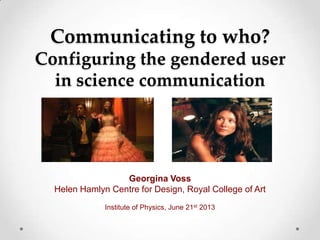
Communicating to who?
Configuring the gendered user
in science communication
Georgina Voss
Helen Hamlyn Centre for Design, Royal College of Art
Institute of Physics, June 21st 2013
Overview
• Many factors restrict the professional aspirations of girls
and young women, causing them to avoid high-status
careers in mathematics and science.
o …and what about the women who are already working professionally in STEM?
• Notion of „configuring the user‟ provides insights into
which people are seen as using STEM workplaces, and
how.
o Which „users‟ is STEM communication designed around?
• Problem of configuring the user according to
stereotypes and normative expectations of gender.
• Instead, consider configuring communication around
lived experience.
Context:
Self-confidence and efficacy
• A confidence gap between male and female STEM
students.
• Self-confidence: strength of belief in one‟s abilities, and
plays important role in academic experience of STEM.
o Positively associated with likelyhood of entry and later
success.
• Women exhibit lower confidence in their skills and
knowledge (despite higher academic achievement!).
o Downplay their educational and work experiences.
o Present themselves as „ready to work hard and
learn‟, eventually becoming a valuable asset.
• Men see themselves as already equipped and valuable
in their own right (Chachra and Kilgore 2009).
• How are these factors designed (or not) into STEM
communication?
Configuring the user
• Design cultures conceputualise the user sociologically
and semiotically (Oudshoorn et al 2004).
o Specific image of who the users are (or are not).
• Technologies become scripted to certain groups of
users, even if they are not involved in the design process
(Akrich 1992, Woolgar 1991).
o Preferences, motivations, tastes, competencies.
o May create new identities, or transform/reinforce existing
ones.
• Problem of configuring user as „everyone‟ – flattens
out real difference (and power).
o „Neutral‟ and„male‟ often default to each other.
‘Neutral’ users and technologies
• Not recognizing that how users are often
configured, by default, as male is problematic.
o Makes female an „add-on‟, different.
• “Not knowing” why fewer women participate in
STEM is a form of ignorance; gender and sexual
politics typically work through practices of invisibility
(Franzway et al 2009).
o Gender roles gain their power by appearing natural and
eternal.
• „Critical Mass‟ thesis is useless if it only allows for a
mass of female users who „fit‟ into the designed
system (Knights and Murray 1994).
o Assimilation can be survival.
Stereotypes and
hyperfemininity
• Targeting a stereotyped notion of „women‟ and girls‟ often results
in a demeaning „dumbing down‟ of the system so that women
can participate (Sommers 2008).
o Gender stereotypes remain present in many elements of education
reform.
• Media analysis:
o Shifts from attractive junior women in romantic relationships…to attractive
hardworking women in senior positions (and rarely working mothers)…
o …but still presents women being underestimated, objects of desire and
harassed by men (Bergman 2012, Steinke 2005).
Technologists vs workplaces
• Increased focus away from women as site of solutions, to
addressing workplace culture (Mills et al 2006)
• STEM workplaces can be seen as „value neutral‟ – once
barriers and discrimination removed, women free to compete
on equal terms.
o Outcome is emphasis on introduction and „remediation‟ of
women, not change in working practices (Blickenstaff 2005, Rosser
1998).
• „Family friendly‟ policies can stigmatise women as
„different‟, alienating women whose acceptance is conditional
on adapting to masculine norms within a „gender neutral‟
workplace.
Adaptation vs difference
• Women can align – or reject! – masculine values and
workplace norms (Bastalich et al 2007).
• Alignment: emphasis on need to fit in, ignoring
sexism, depersonalize emotion, confront masculine
modes of behaviour in direct and assertive
manner, succeed within accepted workplace norms.
o Depends on and recirculates ideas about women as
„emotional‟, ie.qualities associated with femininity and
devalued within this workplace culture.
• Difference: Were aware of need to be „one of the boys‟
and critical of female/tech contradictions. Strain of
work, over-compensating “female-ness” outside, ignored
if not conforming to male styles of communications.
The category of ‘female’
• Issue with associating masculinity with objectivity and science
o Femininity mutually exclusive with science….
o Science mutually exclusive within „feminine‟ traits –
subjectivity, emotion…
• BUT also propagates normative ideas of gender!! Masculinity
and femininity are cultural constructions, and not mutually
exclusive.
• Problematic to lump women together as homogenous group
(Brickhouse 2001, Gilbert and Calvert 2003).
o Low-income; race; sexuality; culture; children.
o Potential for different forms of exclusion, identity management.
Conclusions
• STEM culture not neutral: embody masculine values and identities.
• Critical awareness needed of which users are designed in – and
out – of STEM workplace and communication, and how..
• Avoid stereotypes and normative ideas of „women‟, and
associations with feminine tropes.
o Also notion that „women‟ are a homogenous group.
• Recognise STEM workplace culture, and which users are
rewarded within it.
o Recognise lived experience of women in STEM, especially around self-
confidence and efficacy.
o Reflect on success, be clear about flexibility.
Any questions?

Communicating to whom? Configuring the gendered user in science communication.

  • 1.
    Communicating to who? Configuringthe gendered user in science communication Georgina Voss Helen Hamlyn Centre for Design, Royal College of Art Institute of Physics, June 21st 2013
  • 2.
    Overview • Many factorsrestrict the professional aspirations of girls and young women, causing them to avoid high-status careers in mathematics and science. o …and what about the women who are already working professionally in STEM? • Notion of „configuring the user‟ provides insights into which people are seen as using STEM workplaces, and how. o Which „users‟ is STEM communication designed around? • Problem of configuring the user according to stereotypes and normative expectations of gender. • Instead, consider configuring communication around lived experience.
  • 3.
    Context: Self-confidence and efficacy •A confidence gap between male and female STEM students. • Self-confidence: strength of belief in one‟s abilities, and plays important role in academic experience of STEM. o Positively associated with likelyhood of entry and later success. • Women exhibit lower confidence in their skills and knowledge (despite higher academic achievement!). o Downplay their educational and work experiences. o Present themselves as „ready to work hard and learn‟, eventually becoming a valuable asset. • Men see themselves as already equipped and valuable in their own right (Chachra and Kilgore 2009). • How are these factors designed (or not) into STEM communication?
  • 4.
    Configuring the user •Design cultures conceputualise the user sociologically and semiotically (Oudshoorn et al 2004). o Specific image of who the users are (or are not). • Technologies become scripted to certain groups of users, even if they are not involved in the design process (Akrich 1992, Woolgar 1991). o Preferences, motivations, tastes, competencies. o May create new identities, or transform/reinforce existing ones. • Problem of configuring user as „everyone‟ – flattens out real difference (and power). o „Neutral‟ and„male‟ often default to each other.
  • 6.
    ‘Neutral’ users andtechnologies • Not recognizing that how users are often configured, by default, as male is problematic. o Makes female an „add-on‟, different. • “Not knowing” why fewer women participate in STEM is a form of ignorance; gender and sexual politics typically work through practices of invisibility (Franzway et al 2009). o Gender roles gain their power by appearing natural and eternal. • „Critical Mass‟ thesis is useless if it only allows for a mass of female users who „fit‟ into the designed system (Knights and Murray 1994). o Assimilation can be survival.
  • 7.
    Stereotypes and hyperfemininity • Targetinga stereotyped notion of „women‟ and girls‟ often results in a demeaning „dumbing down‟ of the system so that women can participate (Sommers 2008). o Gender stereotypes remain present in many elements of education reform. • Media analysis: o Shifts from attractive junior women in romantic relationships…to attractive hardworking women in senior positions (and rarely working mothers)… o …but still presents women being underestimated, objects of desire and harassed by men (Bergman 2012, Steinke 2005).
  • 8.
    Technologists vs workplaces •Increased focus away from women as site of solutions, to addressing workplace culture (Mills et al 2006) • STEM workplaces can be seen as „value neutral‟ – once barriers and discrimination removed, women free to compete on equal terms. o Outcome is emphasis on introduction and „remediation‟ of women, not change in working practices (Blickenstaff 2005, Rosser 1998). • „Family friendly‟ policies can stigmatise women as „different‟, alienating women whose acceptance is conditional on adapting to masculine norms within a „gender neutral‟ workplace.
  • 9.
    Adaptation vs difference •Women can align – or reject! – masculine values and workplace norms (Bastalich et al 2007). • Alignment: emphasis on need to fit in, ignoring sexism, depersonalize emotion, confront masculine modes of behaviour in direct and assertive manner, succeed within accepted workplace norms. o Depends on and recirculates ideas about women as „emotional‟, ie.qualities associated with femininity and devalued within this workplace culture. • Difference: Were aware of need to be „one of the boys‟ and critical of female/tech contradictions. Strain of work, over-compensating “female-ness” outside, ignored if not conforming to male styles of communications.
  • 10.
    The category of‘female’ • Issue with associating masculinity with objectivity and science o Femininity mutually exclusive with science…. o Science mutually exclusive within „feminine‟ traits – subjectivity, emotion… • BUT also propagates normative ideas of gender!! Masculinity and femininity are cultural constructions, and not mutually exclusive. • Problematic to lump women together as homogenous group (Brickhouse 2001, Gilbert and Calvert 2003). o Low-income; race; sexuality; culture; children. o Potential for different forms of exclusion, identity management.
  • 11.
    Conclusions • STEM culturenot neutral: embody masculine values and identities. • Critical awareness needed of which users are designed in – and out – of STEM workplace and communication, and how.. • Avoid stereotypes and normative ideas of „women‟, and associations with feminine tropes. o Also notion that „women‟ are a homogenous group. • Recognise STEM workplace culture, and which users are rewarded within it. o Recognise lived experience of women in STEM, especially around self- confidence and efficacy. o Reflect on success, be clear about flexibility.
  • 12.