VOICE OVER INTERNET PROTOCOL SHREETAM MOHANTY  ROLL # EC200118010 UNDER THE GUIDANCE OF N. SRINIVASU SUBMITTED BY
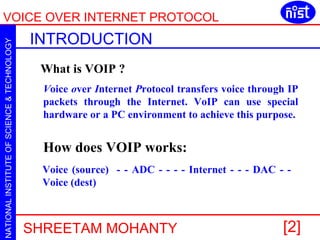
INTRODUCTION What is VOIP ? V oice  o ver  I nternet  P rotocol transfers voice through IP packets through the Internet. VoIP can use special hardware or a PC environment to achieve this purpose.  How does VOIP works: Voice (source)  - - ADC - - - - Internet - - - DAC - - Voice (dest)
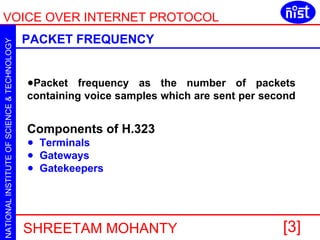
PACKET FREQUENCY  Packet frequency as the number of packets containing voice samples which are sent per second  Components of H.323 Terminals Gateways Gatekeepers
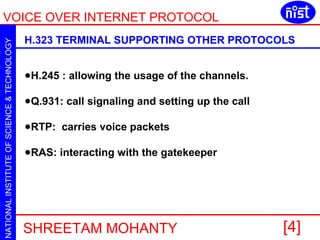
H.323 TERMINAL SUPPORTING OTHER PROTOCOLS H.245 : allowing the usage of the channels. Q.931: call signaling and setting up the call  RTP:  carries voice packets RAS: interacting with the gatekeeper
GATEWAYS Interface between the PSTN and the Internet  Translator :  H.225 to H.221 or audio to video
GATEKEEPERS Controls the end points under its zone Function Address Translation  Admissions Control  Call signaling  Call Authorization  Bandwidth Management
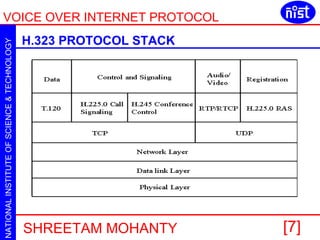
H.323 PROTOCOL STACK
DEFINITIONS Zone The  collection of a gatekeeper and the endpoints registered with it is called a zone   Network Address For each H.323 entity, a network address is assigned and this address uniquely identifies the H.323 entity  on the network  TSAP Identifier  These  TSAP identifiers allow multiplexing of several channels sharing the same network address
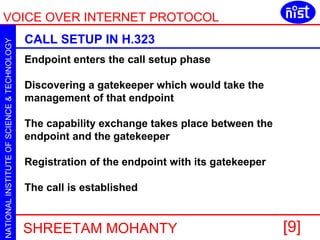
CALL SETUP IN H.323 Endpoint enters the call setup phase   Discovering a gatekeeper which would take the management of that endpoint The capability exchange takes place between the endpoint and the gatekeeper  Registration of the endpoint with its gatekeeper  The call is established
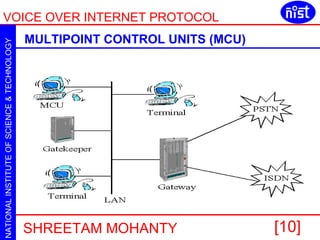
MULTIPOINT CONTROL UNITS (MCU)
SESSION INITIATION PROTOCOL (SIP) It is an application layer control protocol for  creating, modifying and terminating sessions  with one or more participants
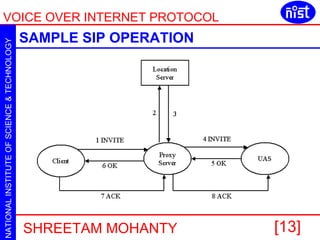
SIP MESSAGES INVITE:   for inviting a user to a call BYE:   for terminating a connection between the two end points   ACK:   invitation for reliable exchange of messages   OPTIONS :  for getting information about the capabilities of a call  REGISTER :  gives information about the location of a user to the SIP registration server .  CANCEL :  for terminating the search for a user
SAMPLE SIP OPERATION
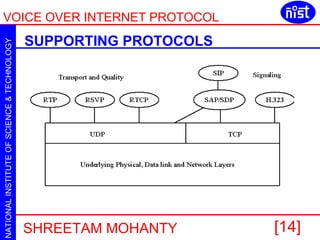
SUPPORTING PROTOCOLS
CONCLUSION Like everything else, as the technology changes so At first, only a few companies like Cisco and Lucent offered VoIP services, but the large telecommunications carriers – such as AT&T and  Sprint -- are catching on VoIP is predominately used for personal instead of enterprise-wide use, but will the people who use it.

Voice over internet_protocol

  • 1.
    VOICE OVER INTERNETPROTOCOL SHREETAM MOHANTY ROLL # EC200118010 UNDER THE GUIDANCE OF N. SRINIVASU SUBMITTED BY
  • 2.
    INTRODUCTION What isVOIP ? V oice o ver I nternet P rotocol transfers voice through IP packets through the Internet. VoIP can use special hardware or a PC environment to achieve this purpose. How does VOIP works: Voice (source) - - ADC - - - - Internet - - - DAC - - Voice (dest)
  • 3.
    PACKET FREQUENCY Packet frequency as the number of packets containing voice samples which are sent per second Components of H.323 Terminals Gateways Gatekeepers
  • 4.
    H.323 TERMINAL SUPPORTINGOTHER PROTOCOLS H.245 : allowing the usage of the channels. Q.931: call signaling and setting up the call RTP: carries voice packets RAS: interacting with the gatekeeper
  • 5.
    GATEWAYS Interface betweenthe PSTN and the Internet Translator : H.225 to H.221 or audio to video
  • 6.
    GATEKEEPERS Controls theend points under its zone Function Address Translation Admissions Control Call signaling Call Authorization Bandwidth Management
  • 7.
  • 8.
    DEFINITIONS Zone The collection of a gatekeeper and the endpoints registered with it is called a zone Network Address For each H.323 entity, a network address is assigned and this address uniquely identifies the H.323 entity on the network TSAP Identifier These TSAP identifiers allow multiplexing of several channels sharing the same network address
  • 9.
    CALL SETUP INH.323 Endpoint enters the call setup phase Discovering a gatekeeper which would take the management of that endpoint The capability exchange takes place between the endpoint and the gatekeeper Registration of the endpoint with its gatekeeper The call is established
  • 10.
  • 11.
    SESSION INITIATION PROTOCOL(SIP) It is an application layer control protocol for creating, modifying and terminating sessions with one or more participants
  • 12.
    SIP MESSAGES INVITE: for inviting a user to a call BYE: for terminating a connection between the two end points ACK: invitation for reliable exchange of messages OPTIONS : for getting information about the capabilities of a call REGISTER : gives information about the location of a user to the SIP registration server . CANCEL : for terminating the search for a user
  • 13.
  • 14.
  • 15.
    CONCLUSION Like everythingelse, as the technology changes so At first, only a few companies like Cisco and Lucent offered VoIP services, but the large telecommunications carriers – such as AT&T and Sprint -- are catching on VoIP is predominately used for personal instead of enterprise-wide use, but will the people who use it.