Vmware Horizon MirageEssentials Peter Von Oven
download
https://ebookbell.com/product/vmware-horizon-mirage-essentials-
peter-von-oven-4684674
Explore and download more ebooks at ebookbell.com
2.
Here are somerecommended products that we believe you will be
interested in. You can click the link to download.
Vmware Horizon Workspace Essentials 1st Edition Peter Von Oven
https://ebookbell.com/product/vmware-horizon-workspace-essentials-1st-
edition-peter-von-oven-4725334
Vmware Horizon 6 Desktop Virtualization Solutions Plan Design And
Secure Your Virtual Desktop Environments With Vmware Horizon 6 View
Ryan Cartwright
https://ebookbell.com/product/vmware-horizon-6-desktop-virtualization-
solutions-plan-design-and-secure-your-virtual-desktop-environments-
with-vmware-horizon-6-view-ryan-cartwright-5470144
Vmware Horizon Niew 53 Design Patterns And Best Practices Ventresco
https://ebookbell.com/product/vmware-horizon-niew-53-design-patterns-
and-best-practices-ventresco-5671616
Vmware Horizon View 6 Desktop Virtualization Cookbook Over 100 Handson
Recipes Demonstrating The Core As Well As Latest Features Of Your
Vmware Horizon View Infrastructure Ventresco
https://ebookbell.com/product/vmware-horizon-view-6-desktop-
virtualization-cookbook-over-100-handson-recipes-demonstrating-the-
core-as-well-as-latest-features-of-your-vmware-horizon-view-
infrastructure-ventresco-6636246
3.
Vmware Horizon ViewEssentials Peter Von Oven
https://ebookbell.com/product/vmware-horizon-view-essentials-peter-
von-oven-6676722
Vmware Horizon View 6 Desktop Virtualization Cookbook Jason Ventresco
Ventresco J
https://ebookbell.com/product/vmware-horizon-view-6-desktop-
virtualization-cookbook-jason-ventresco-ventresco-j-6568990
Mastering Vmware Horizon 8 An Advanced Guide To Delivering Virtual
Desktops And Virtual Apps 1st Edition Peter Von Oven
https://ebookbell.com/product/mastering-vmware-horizon-8-an-advanced-
guide-to-delivering-virtual-desktops-and-virtual-apps-1st-edition-
peter-von-oven-36179204
Mastering Vmware Horizon 78 Master Desktop Virtualization To Optimize
Your End User Third Peter Von Oven Barry Coombs
https://ebookbell.com/product/mastering-vmware-horizon-78-master-
desktop-virtualization-to-optimize-your-end-user-third-peter-von-oven-
barry-coombs-42664274
Implementing Vmware Horizon View 52 Jason Ventresco
https://ebookbell.com/product/implementing-vmware-horizon-
view-52-jason-ventresco-4449458
6.
VMware Horizon Mirage
Essentials
Manageyour entire desktop environment with a single
management tool – VMware Horizon Mirage
Peter von Oven
P U B L I S H I N G
professional expertise distilled
BIRMINGHAM - MUMBAI
Credits
Author
Peter von Oven
Reviewers
TimArenz
Lieven D'hoore
Acquisition Editor
Antony Lowe
Lead Technical Editor
Mohammed Fahad
Copy Editors
Alisha Arahna
Brandt D'mello
Gladson Monteiro
Karuna Narayanan
Kirti Pai
Shambhavi Pai
Lavina Pereira
Adithi Shetty
Technical Editors
Dennis John
Hardik B. Soni
Zainab Fatakdawala
Sebastian Rodrigues
Project Coordinator
Sherin Padayatty
Proofreader
Stephen Copestake
Indexer
Rekha Nair
Graphics
Ronak Dhruv
Production Coordinator
Aparna Bhagat
Cover Work
Aparna Bhagat
10.
Forewords
Technology is alwayschanging—it always has been and always will be. It is what
keeps most of us so driven and engaged in this field.
Now, almost unsurprisingly, we find that the norms of the last 30 years are being
turned on their head.
There is no doubt that we have entered the Post-PC Era but, in reality, the challenge
lies in defining what that actually means for all of us.
The classic client-server paradigm with central control and standardized hardware
is changing, and even the definition of what a PC is has become blurred. There is no
longer a distinct line between PCs and mobiles; they are all just clients taking many
forms now.
This in turn has rightly driven a shift in focus for some from devices and their
operating systems to the access and manipulation of data on any device.
Therein lies the challenge—how does IT stay in control of what it thinks it should
while enabling change and giving its consumers choice and flexibility?
The key is in driving transitional projects and technology with both these aims
in mind.
The strategy behind the Horizon Suite from VMware has been to enable choice with
a focus on giving access to applications and data anywhere on any device.
However, there are not many greenfield enterprises in this world. Even if you have
a clear vision of direction, the legacy of our industry has left a complex landscape to
navigate for any organization.
11.
As you willlearn in this book, Horizon Mirage is a key piece of that story—
something that can ultimately free you up from being locked to one physical device
and allows a user to have his/her choice while enabling a system administrator to
stay in control and manage the journey.
Joe Baguley
Chief Technology Officer, EMEA
jbaguley@vmware.com
+44 7971 27 21 26
@joebaguley
12.
Managing and deliveringdesktop images (the software that we load and run on PCs)
to users is a complex and difficult task. Using tools and processes developed over a
decade ago, most IT organizations today find themselves equipped to deal with very
standardized environments with little variety in hardware, usage styles, or system
images. Their management and security processes are based on the assumption
of predictable configurations, and each new configuration drives a variant of the
process—in other words, more work. Their operational reality is at odds with what's
actually happening to the tools that are getting ever more diverse and ever less
predictable in the hands of their users. Complexity is rising and the challenge for IT
is rising with it. What's needed is a next generation of management tools—one that
adapts current processes so that they can embrace all the "change" without driving
up work. VMware Horizon Mirage is just such a tool.
Horizon Mirage is a unique proposition, combining new capabilities with improved
versions of some already available capabilities from existing management tools. It
partly overlaps a number of other products but no other product wholly overlaps it.
Deployed with an existing PC Lifecycle Management (PCLM) tool, it will improve
the effectiveness of existing management processes and extend functionalities with
new process support. Added to an existing portfolio of PC management tools, it
will not only be a valuable new asset in its own right, it will also increase the value
returned by some of the other assets in use. In this way, it is also pretty unique.
At the center of the Horizon Mirage approach is a new approach to building and
delivering desktop images to users, whatever the type of device they are using
(desktop or laptop, physical or virtual). Horizon Mirage builds images in layers,
thus modularizing the build process and simplifying the requirements of delivery
to users. The lower layers in each image stack are always managed and delivered
from the center, but ownership of the upper layers can be given to users or groups of
users. This allows Horizon Mirage to accurately reflect a key attribute of real-world
PC deployment: federated governance. The result is a tool that helps optimize the
reach of centralized management processes and policies while accurately reflecting
the need for departmental autonomy in the way some applications are used.
Many IT organizations today are still in the final throes of a Windows migration—in
most cases, from Windows XP to Windows 7. As they complete that upgrade against
a backdrop of growing demand for improvement, an increasing choice of devices,
and of course, consumerization, it is very clear that the way they manage PCs today
has to improve. It is also clear that the requirement to manage and deliver desktop
images is not going away any time soon due to the breadth, depth, and criticality
of their desktop application portfolios. They can't just stop doing the things they do
now. This means they need to find better ways of doing those same things.
13.
The way userswork through technology (or enduser computing in VMware
terminology) is at a point of inflection. The previous generation of technologies,
represented by the PC, is slowly being deprecated from IT asset portfolios and
replaced with the next-generation mobile devices, social platforms, applications with
narrower focus, and cloud-based services. But there can be no rip-and-replace in
this shift—the different generations will need to coexist for some time to undergo a
gradual shift from one to the other at a rate reflecting our ability to change and invest
in new applications. Helping organizations manage their transformational journey
in enduser computing is central to the VMware approach, and we believe Horizon
Mirage will play a key role.
Brian Gammage
Chief Market Technologist, VWware
14.
About the Author
Petervon Oven is an experienced technical consultant and has spent the last 20
years of his IT career working with customers and partners in designing technology
solutions aimed at delivering true business value. During his career, Peter has been
involved in numerous large-scale enterprise projects and deployments presented
at key IT events and has worked in senior presales roles for some of the IT giants.
Over the last 8 years, he has focused his skills and experience within the desktop
virtualization market, and today he leads the End-User Computing SE team at
VMware in the UK&I, tasked with delivering the next generation of end-user
computing and workforce mobility solutions.
There are a number of people I want to thank for the support they
have given me during the writing of this book. Firstly and most
importantly, I would like to thank my family for their support
while I have spent many evenings and weekends at the keyboard;
and especially my two daughters, Eleanor and Charlotte who, at
an age where they are both learning to read and write, have been
fascinated by daddy writing a story about a computer; to the Packt
Publishing team for giving me the opportunity to write this book;
and particularly Mohammed Fahad whose advice and guidance
to me as a first-time author has been invaluable. Finally, I would
like to thank some of my colleagues, particularly Simon Townsend
who has supported me through this project and has also given me
the encouragement to achieve this, as well as Paul Whyton, Peter
Schraml, and Spencer Pitts who have all helped answer questions
along the way.
15.
About the Reviewers
TimArenz (@timarenz) has been involved in application and desktop
virtualization solutions for over 8 years and has designed and implemented many
solutions based on AppSense, Citrix, Microsoft, and VMware technologies with up
to 10,000 users. He is currently working as a consultant in the Professional Services
Organization at VMware in Germany. In his role, he is also specializing in end-user
computing with his main focus on ThinApp and Horizon Mirage but is also working
with customers and partners on Horizon View and Workspace projects.
On his personal blog http://horizonflux.com, he shares news and best practices
about VMware's End-User Computing product portfolio.
Lieven D'hoore is an IT infrastructure professional from Belgium, currently
working as a Senior Technical Account Manager at VMware in the BeNeLux region.
He has a Master's degree in Industrial Engineering Sciences, has obtained the
VMware Certified Professional certifications (VCP-3, VCP-4, and VCP-5), and has
recently been awarded by VMware as a VMware vExpert of 2013. ITuDA.com
is his personal blog about virtualization (mostly VMware-related).
He has over 20 years' industry experience managing IT infrastructures in large
enterprises. A majority of his time was spent in working as a freelance IT Infrastructure
consultant in the banking, telecommunications, and pharmaceutical sectors.
For the last few years his passion has been around large-scale virtualization
and virtual desktop infrastructure computing. He can be contacted via e-mail at
lieven.dhoore@ituda.com.
16.
www.PacktPub.com
Support files, eBooks,discount offers and more
You might want to visit www.PacktPub.com for support files and downloads related to
your book.
Did you know that Packt offers eBook versions of every book published, with PDF and ePub files
available? You can upgrade to the eBook version at www.PacktPub.com and as a print book
customer, you are entitled to a discount on the eBook copy. Get in touch with us at service@
packtpub.com for more details.
At www.PacktPub.com, you can also read a collection of free technical articles, sign up for a range
of free newsletters and receive exclusive discounts and offers on Packt books and eBooks.
TM
http://PacktLib.PacktPub.com
Do you need instant solutions to your IT questions? PacktLib is Packt's online digital book library.
Here, you can access, read and search across Packt's entire library of books.
Why Subscribe?
• Fully searchable across every book published by Packt
• Copy and paste, print and bookmark content
• On demand and accessible via web browser
Free Access for Packt account holders
If you have an account with Packt at www.PacktPub.com, you can use this to access PacktLib
today and view nine entirely free books. Simply use your login credentials for immediate access.
Instant Updates on New Packt Books
Get notified! Find out when new books are published by following @PacktEnterprise on
Twitter, or the Packt Enterprise Facebook page.
18.
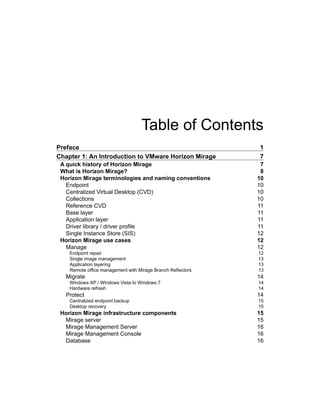
Table of Contents
Preface1
Chapter 1: An Introduction to VMware Horizon Mirage 7
A quick history of Horizon Mirage 7
What is Horizon Mirage? 8
Horizon Mirage terminologies and naming conventions 10
Endpoint 10
Centralized Virtual Desktop (CVD) 10
Collections 10
Reference CVD 11
Base layer 11
Application layer 11
Driver library / driver profile 11
Single Instance Store (SIS) 12
Horizon Mirage use cases 12
Manage 12
Endpoint repair 12
Single image management 13
Application layering 13
Remote office management with Mirage Branch Reflectors 13
Migrate 14
Windows XP / Windows Vista to Windows 7 14
Hardware refresh 14
Protect 14
Centralized endpoint backup 15
Desktop recovery 15
Horizon Mirage infrastructure components 15
Mirage server 15
Mirage Management Server 16
Mirage Management Console 16
Database 16
19.
Table of Contents
[ii ]
File Portal 16
Horizon Mirage Client 16
Branch Reflector 17
How to license Horizon Mirage 17
VMware Horizon Suite 17
Horizon Mirage standalone 17
Migration-only license 17
How does this book work? 18
What do you need? 18
Summary 19
Chapter 2: Design, Install, and Configure 21
Infrastructure overview and requirements 21
Overview of Horizon Mirage infrastructure 21
Horizon Mirage components up close 22
Horizon Mirage Management Server 22
Horizon Mirage Server 22
Horizon Mirage database 23
File Portal 23
Horizon Mirage Client 24
Horizon Mirage Management Console 24
Branch Reflector 24
Web Management Console 25
Hardware requirements 25
Horizon Mirage Server 25
Horizon Mirage Client 26
Storage requirements 26
Design considerations 26
Assessment first 26
Sizing the Horizon Mirage Server 27
Example – small-scale deployment 28
Example – medium-scale deployment 28
Example – large-scale deployment 29
Storage design considerations 30
Network design considerations 31
Installing and deploying Horizon Mirage 32
Before you start – the prerequisites 32
Installing the Horizon Mirage Management Server 34
Installing the Horizon Mirage Management Console 35
Installing the Horizon Mirage Server 38
Installing the Horizon Mirage File Portal / Web Access 40
Stage 1 – installing IIS 41
Stage 2 – installing the File Portal 43
20.
Table of Contents
[iii ]
Installing the Web Management Console 45
Installing the Horizon Mirage Client 46
Horizon Mirage Client – silent installation 48
Troubleshooting connection issues 49
Summary 50
Chapter 3: A Guided Tour of Management Consoles 51
The Horizon Mirage Management Console 51
A high-level overview of Horizon Mirage tasks 51
Common Wizards 52
Dashboard 53
Task Monitoring 54
Inventory 54
Image Composer 56
Driver Library 57
Reports 57
Logs 58
Users and Roles 58
System configuration 60
Web-based Management Consoles 61
Management Console overview – Web Help Desk role 61
Logging in 61
Searching and adding a device or user 62
Navigating the Web Help Desk Management Console 62
Management Console overview – the Protection Manager role 66
Logging in 66
Summary 70
Chapter 4: Getting Started with Horizon Mirage Layering
Technology 71
An introduction to layering technology 71
What is a Horizon Mirage layer? 71
What does a Mirage layer look like? 72
How to capture a base layer 73
Stage 1 – building a reference machine 74
What is a base layer? – a quick recap 74
What is a base layer used for? 74
Considerations when creating a base layer 75
Applications 75
Base layer use case examples 76
The departmental or individual use case scenario 77
Best practice and tips 78
Stage 2 – installing the Horizon Mirage Client 78
Stage 3 – centralizing the reference machine 79
Stage 4 – preparing the image before capture 82
21.
Table of Contents
[iv ]
Stage 5 – capturing the base layer 83
The base layer capture process 83
Updating an existing base layer 86
Capturing an application layer 86
The application capture process 87
Stage 1 – performing a pre-scan 87
Stage 2 – installing the application 90
Stage 3 – post-scan and application layer capture 90
App layer capture best practice 93
Managing device drivers 94
What is a Horizon Mirage driver library? 94
Driver library folder structure 94
Driver library components and structure 94
Creating a driver library 95
Building a driver profile 97
Summary 98
Chapter 5: Manage – Centralized Image Management and
Deployment 99
Horizon Mirage single image management 99
What is single image management? 100
Building an endpoint with a base layer and an application layer 100
Building an endpoint with a base layer and driver profiles 101
Building the complete endpoint 101
Assigning a new base layer 102
Assigning an application layer 104
Remote office management 107
What is a Branch Reflector? 107
Enabling a Branch Reflector 108
Branch Reflector configuration options 109
Summary 110
Chapter 6: Migrate – Operating System and Hardware
Migration Made Easy 113
Migrating Windows XP to Windows 7 114
Preparing for the migration – where do I start? 114
Microsoft USMT 115
A migration example based on a virtual machine 117
For VMware Workstation lab environments 118
For VMware ESX lab environments 120
The migration process 120
Hardware migration 126
The hardware migration process 126
Summary 128
My mother, whowas then a widow, brought her here to be company
to her. She has a couple of thousand pounds of her own, and saves
the interest of it every year, to add to the principal. There’s the
history of Miss Rosa Dartle for you.”
“And I have no doubt she loves you like a brother?” said I.
“Humph!” retorted Steerforth, looking at the fire. “Some brothers
are not loved over much; and some love—but help yourself,
Copperfield! We’ll drink the daisies of the field, in compliment to
you; and the lilies of the valley that toil not, neither do they spin, in
compliment to me—the more shame for me!” A moody smile that
had overspread his features cleared off as he said this merrily, and
he was his own frank, winning self again.
I could not help glancing at the scar with a painful interest when
we went in to tea. It was not long before I observed that it was the
most susceptible part of her face, and that, when she turned pale,
that mark altered first, and became a dull, lead-colored streak,
lengthening out to its full extent, like a mark in invisible ink brought
to the fire. There was a little altercation between her and Steerforth
about a cast of the dice at backgammon—when I thought her, for
one moment, in a storm of rage; and then I saw it start forth like the
old writing on the wall.
It was no matter of wonder to me to find Mrs. Steerforth devoted
to her son. She seemed to be able to speak or think about nothing
else. She showed me his picture as an infant, in a locket, with some
of his baby-hair in it; she showed me his picture as he had been
when I first knew him; and she wore at her breast his picture as he
was now. All the letters he had ever written to her, she kept in a
cabinet near her own chair by the fire; and she would have read me
some of them, and I should have been very glad to hear them too, if
he had not interposed, and coaxed her out of the design.
24.
“It was atMr. Creakle’s, my son tells me, that you first became
acquainted,” said Mrs. Steerforth, as she and I were talking at one
table, while they played backgammon at another. “Indeed, I recollect
his speaking, at that time, of a pupil younger than himself who had
taken his fancy there; but your name, as you may suppose, has not
lived in my memory.”
“He was very generous and noble to me in those days, I assure
you, ma’am,” said I, “and I stood in need of such a friend. I should
have been quite crushed without him.”
“He is always generous and noble,” said Mrs. Steerforth, proudly.
I subscribed to this with all my heart, God knows. She knew I did;
for the stateliness of her manner already abated towards me, except
when she spoke in praise of him, and then her air was always lofty.
“It was not a fit school generally for my son,” said she; “far from
it; but there were particular circumstances to be considered at the
time, of more importance even than that selection. My son’s high
spirit made it desirable that he should be placed with some man who
felt its superiority, and would be content to bow himself before it;
and we found such a man there.”
I knew that, knowing the fellow. And yet I did not despise him the
more for it, but thought it a redeeming quality in him—if he could be
allowed any grace for not resisting one so irresistible as Steerforth.
“My son’s great capacity was tempted on, there, by a feeling of
voluntary emulation and conscious pride,” the fond lady went on to
say. “He would have risen against all constraint; but he found
himself the monarch of the place, and he haughtily determined to be
worthy of his station. It was like himself.”
I echoed, with all my heart and soul, that it was like himself.
“So my son took, of his own will, and on no compulsion, to the
course in which he can always, when it is his pleasure, outstrip every
25.
competitor,” she pursued.“My son informs me, Mr. Copperfield, that
you were quite devoted to him, and that when you met yesterday
you made yourself known to him with tears of joy. I should be an
affected woman if I made any pretence of being surprised by my
son’s inspiring such emotions; but I cannot be indifferent to any one
who is so sensible of his merit, and I am very glad to see you here,
and can assure you that he feels an unusual friendship for you, and
that you may rely on his protection.”
Miss Dartle played backgammon as eagerly as she did everything
else. If I had seen her, first, at the board, I should have fancied that
her figure had got thin, and her eyes had got large, over that
pursuit, and no other in the world. But I am very much mistaken if
she missed a word of this, or lost a look of mine as I received it with
the utmost pleasure, and, honored by Mrs. Steerforth’s confidence,
felt older than I had done since I left Canterbury.
When the evening was pretty far spent, and a tray of glasses and
decanters came in, Steerforth promised, over the fire, that he would
seriously think of going down into the country with me. There was
no hurry, he said; a week hence would do; and his mother
hospitably said the same. While we were talking, he more than once
called me Daisy; which brought Miss Dartle out again.
“But really, Mr. Copperfield,” she asked, “is it a nick-name? And
why does he give it you? Is it—eh?—because he thinks you young
and innocent? I am so stupid in these things.”
I colored in replying that I believed it was.
“Oh!” said Miss Dartle. “Now I am glad to know that! I ask for
information, and I am glad to know it. He thinks you young and
innocent; and so you are his friend. Well, that’s quite delightful!”
She went to bed soon after this, and Mrs. Steerforth retired too.
Steerforth and I, after lingering for half an hour over the fire, talking
26.
about Traddles andall the rest of them at old Salem House, went
up-stairs together. Steerforth’s room was next to mine, and I went in
to look at it. It was a picture of comfort, full of easy chairs, cushions
and footstools, worked by his mother’s hand, and with no sort of
thing omitted that could help to render it complete. Finally, her
handsome features looked down on her darling from a portrait on
the wall, as if it were even something to her that her likeness should
watch him while he slept.
I found the fire burning clear enough in my room by this time, and
the curtains drawn before the windows and round the bed, giving it
a very snug appearance. I sat down in a great chair upon the hearth
to meditate on my happiness; and had enjoyed the contemplation of
it for some time, when I found a likeness of Miss Dartle looking
eagerly at me from above the chimney-piece.
It was a startling likeness, and necessarily had a startling look.
The painter hadn’t made the scar, but I made it; and there it was,
coming and going: now confined to the upper lip as I had seen it at
dinner, and now showing the whole extent of the wound inflicted by
the hammer, as I had seen it when she was passionate.
I wondered peevishly why they couldn’t put her anywhere else
instead of quartering her on me. To get rid of her, I undressed
quickly, extinguished my light, and went to bed. But, as I fell asleep,
I could not forget that she was still there looking, “Is it really,
though? I want to know;” and when I awoke in the night, I found
that I was uneasily asking all sorts of people in my dreams whether
it really was or not—without knowing what I meant.
27.
CHAPTER XXI.
LITTLE EM’LY.
Therewas a servant in that house, a man who, I understood, was
usually with Steerforth, and had come into his service at the
University, who was in appearance a pattern of respectability. I
believe there never existed in his station a more respectable-looking
man. He was taciturn, soft-footed, very quiet in his manner,
deferential, observant, always at hand when wanted, and never near
when not wanted; but his great claim to consideration was his
respectability. He had not a pliant face, he had rather a stiff neck,
rather a tight smooth head with short hair clinging to it at the sides,
a soft way of speaking, with a peculiar habit of whispering the letter
S so distinctly, that he seemed to use it oftener than any other man;
but every peculiarity that he had he made respectable. If his nose
had been upside-down, he would have made that respectable. He
surrounded himself with an atmosphere of respectability, and walked
secure in it. It would have been next to impossible to suspect him of
anything wrong, he was so thoroughly respectable. Nobody could
have thought of putting him in a livery, he was so highly respectable.
To have imposed any derogatory work upon him, would have been
to inflict a wanton insult on the feelings of a most respectable man.
And of this, I noticed the women-servants in the household were so
intuitively conscious, that they always did such work themselves,
and generally while he read the paper by the pantry fire.
Such a self-contained man I never saw. But in that quality, as in
every other he possessed, he only seemed to be the more
respectable. Even the fact that no one knew his Christian name,
28.
seemed to forma part of his respectability. Nothing could be
objected against his surname Littimer, by which he was known. Peter
might have been hanged, or Tom transported; but Littimer was
perfectly respectable.
It was occasioned, I suppose, by the reverend nature of
respectability in the abstract, but I felt particularly young in this
man’s presence. How old he was himself I could not guess—and that
again went to his credit on the same score; for in the calmness of
respectability he might have numbered fifty years as well as thirty.
Littimer was in my room in the morning before I was up, to bring
me that reproachful shaving-water, and to put out my clothes. When
I undrew the curtains and looked out of bed, I saw him, in an
equable temperature of respectability, unaffected by the east wind of
January, and not even breathing frostily, standing my boots right and
left in the first dancing position, and blowing specks of dust off my
coat as he laid it down like a baby.
I gave him good morning, and asked him what o’clock it was. He
took out of his pocket the most respectable hunting-watch I ever
saw, and preventing the spring with his thumb from opening far,
looked in at the face as if he were consulting an oracular oyster, shut
it up again, and said, if I pleased, it was halfpast eight.
“Mr. Steerforth will be glad to hear how you have rested, sir.”
“Thank you,” said I, “very well indeed. Is Mr. Steerforth quite
well?”
“Thank you, sir, Mr. Steerforth is tolerably well.” Another of his
characteristics,—no use of superlatives. A cool calm medium always.
“Is there anything more I can have the honor of doing for you,
sir? The warning-bell will ring at nine; the family take breakfast at
halfpast nine.”
“Nothing, I thank you.”
29.
“I thank you,sir, if you please;” and with that, and with a little
inclination of his head when he passed the bedside, as an apology
for correcting me, he went out, shutting the door as delicately as if I
had just fallen into a sweet sleep on which my life depended.
Every morning we held exactly this conversation: never any more,
and never any less: and yet, invariably, however far I might have
been lifted out of myself over-night, and advanced towards maturer
years, by Steerforth’s companionship, or Mrs. Steerforth’s
confidence, or Miss Dartle’s conversation, in the presence of this
most respectable man I became, as our smaller poets sing, “a boy
again.”
He got horses for us; and Steerforth, who knew every thing, gave
me lessons in riding. He provided foils for us, and Steerforth gave
me lessons in fencing—gloves, and I began, of the same master, to
improve in boxing. It gave me no manner of concern that Steerforth
should find me a novice in these sciences, but I never could bear to
show my want of skill before the respectable Littimer. I had no
reason to believe that Littimer understood such arts himself; he
never led me to suppose anything of the kind, by so much as the
vibration of one of his respectable eyelashes; yet whenever he was
by, while we were practising, I felt myself the greenest and most
inexperienced of mortals.
I am particular about this man, because he made a particular
effect on me at that time, and because of what took place thereafter.
The week passed away in a most delightful manner. It passed
rapidly, as may be supposed, to one entranced as I was; and yet it
gave me so many occasions for knowing Steerforth better, and
admiring him more in a thousand respects, that at its close I seemed
to have been with him for a much longer time. A dashing way he
had of treating me like a plaything, was more agreeable to me than
30.
any behaviour hecould have adopted. It reminded me of our old
acquaintance; it seemed the natural sequel of it; it showed me that
he was unchanged; it relieved me of any uneasiness I might have
felt, in comparing my merits with his, and measuring my claims upon
his friendship by any equal standard; above all, it was a familiar,
unrestrained, affectionate demeanor that he used towards no one
else. As he had treated me at school differently from all the rest, I
joyfully believed that he treated me in life unlike any other friend he
had. I believed that I was nearer to his heart than any other friend,
and my own heart warmed with attachment to him.
He made up his mind to go with me into the country, and the day
arrived for our departure. He had been doubtful at first whether to
take Littimer or not, but decided to leave him at home. The
respectable creature, satisfied with his lot whatever it was, arranged
our portmanteaus on the little carriage that was to take us into
London, as if they were intended to defy the shocks of ages; and
received my modestly proffered donation with perfect tranquillity.
We bade adieu to Mrs. Steerforth and Miss Dartle, with many
thanks on my part, and much kindness on the devoted mother’s.
The last thing I saw was Littimer’s unruffled eye; fraught, as I
fancied, with the silent conviction that I was very young indeed.
What I felt, in returning so auspiciously to the old familiar places, I
shall not endeavour to describe. We went down by the Mail. I was so
concerned, I recollect, even for the honor of Yarmouth, that when
Steerforth said, as we drove through its dark streets to the inn, that,
as well as he could make out, it was a good, queer, out-of-the-way
kind of hole, I was highly pleased. We went to bed on our arrival (I
observed a pair of dirty shoes and gaiters in connexion with my old
friend the Dolphin as we passed that door), and breakfasted late in
the morning. Steerforth, who was in great spirits, had been strolling
31.
about the beachbefore I was up, and had made acquaintance, he
said, with half the boatmen in the place. Moreover he had seen, in
the distance, what he was sure must be the identical house of Mr.
Peggotty, with smoke coming out of the chimney; and had had a
great mind, he told me, to walk in and swear he was myself grown
out of knowledge.
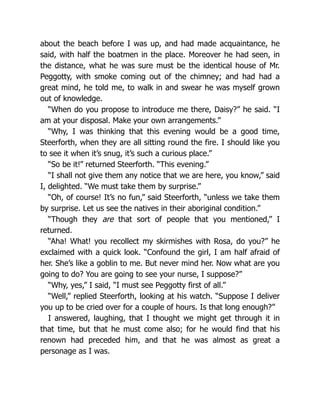
“When do you propose to introduce me there, Daisy?” he said. “I
am at your disposal. Make your own arrangements.”
“Why, I was thinking that this evening would be a good time,
Steerforth, when they are all sitting round the fire. I should like you
to see it when it’s snug, it’s such a curious place.”
“So be it!” returned Steerforth. “This evening.”
“I shall not give them any notice that we are here, you know,” said
I, delighted. “We must take them by surprise.”
“Oh, of course! It’s no fun,” said Steerforth, “unless we take them
by surprise. Let us see the natives in their aboriginal condition.”
“Though they are that sort of people that you mentioned,” I
returned.
“Aha! What! you recollect my skirmishes with Rosa, do you?” he
exclaimed with a quick look. “Confound the girl, I am half afraid of
her. She’s like a goblin to me. But never mind her. Now what are you
going to do? You are going to see your nurse, I suppose?”
“Why, yes,” I said, “I must see Peggotty first of all.”
“Well,” replied Steerforth, looking at his watch. “Suppose I deliver
you up to be cried over for a couple of hours. Is that long enough?”
I answered, laughing, that I thought we might get through it in
that time, but that he must come also; for he would find that his
renown had preceded him, and that he was almost as great a
personage as I was.
32.
“I’ll come anywhereyou like,” said Steerforth, “or do anything you
like. Tell me where to come to; and in two hours I’ll produce myself
in any state you please, sentimental or comical.”
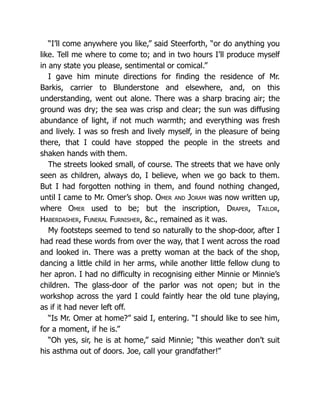
I gave him minute directions for finding the residence of Mr.
Barkis, carrier to Blunderstone and elsewhere, and, on this
understanding, went out alone. There was a sharp bracing air; the
ground was dry; the sea was crisp and clear; the sun was diffusing
abundance of light, if not much warmth; and everything was fresh
and lively. I was so fresh and lively myself, in the pleasure of being
there, that I could have stopped the people in the streets and
shaken hands with them.
The streets looked small, of course. The streets that we have only
seen as children, always do, I believe, when we go back to them.
But I had forgotten nothing in them, and found nothing changed,
until I came to Mr. Omer’s shop. Omer and Joram was now written up,
where Omer used to be; but the inscription, Draper, Tailor,
Haberdasher, Funeral Furnisher, &c., remained as it was.
My footsteps seemed to tend so naturally to the shop-door, after I
had read these words from over the way, that I went across the road
and looked in. There was a pretty woman at the back of the shop,
dancing a little child in her arms, while another little fellow clung to
her apron. I had no difficulty in recognising either Minnie or Minnie’s
children. The glass-door of the parlor was not open; but in the
workshop across the yard I could faintly hear the old tune playing,
as if it had never left off.
“Is Mr. Omer at home?” said I, entering. “I should like to see him,
for a moment, if he is.”
“Oh yes, sir, he is at home,” said Minnie; “this weather don’t suit
his asthma out of doors. Joe, call your grandfather!”
33.
The little fellow,who was holding her apron, gave such a lusty
shout, that the sound of it made him bashful, and he buried his face
in her skirts, to her great admiration. I heard a heavy puffing and
blowing coming towards us, and soon Mr. Omer, shorter-winded than
of yore, but not much older-looking, stood before me.
“Servant, sir,” said Mr. Omer. “What can I do for you, sir?”
“You can shake hands with me, Mr. Omer, if you please,” said I,
putting out my own. “You were very good-natured to me once, when
I am afraid I didn’t show that I thought so.”
“Was I though?” returned the old man. “I’m glad to hear it, but I
don’t remember when. Are you sure it was me?”
“Quite.”
“I think my memory has got as short as my breath,” said Mr. Omer,
looking at me and shaking his head; “for I don’t remember you.”
“Don’t you remember your coming to the coach to meet me, and
my having breakfast here, and our riding out to Blunderstone
together: you, and I, and Mrs. Joram, and Mr. Joram too—who
wasn’t her husband then?”
“Why, Lord bless my soul!” exclaimed Mr. Omer, after being thrown
by his surprise into a fit of coughing, “you don’t say so! Minnie, my
dear, you recollect? Dear me, yes—the party was a lady, I think?”
“My mother,” I rejoined.
“To—be—sure,” said Mr. Omer, touching my waistcoat with his
forefinger, “and there was a little child too! There was two parties.
The little party was laid along with the other party. Over at
Blunderstone it was, of course. Dear me! And how have you been
since?”
Very well, I thanked him, as I hoped he had been too.
“Oh! nothing to grumble at, you know,” said Mr. Omer. “I find my
breath gets short, but it seldom gets longer as a man gets older. I
34.
take it asit comes, and make the most of it. That’s the best way,
ain’t it?”
Mr. Omer coughed again, in consequence of laughing, and was
assisted out of his fit by his daughter, who now stood close beside
us, dancing her smallest child on the counter.
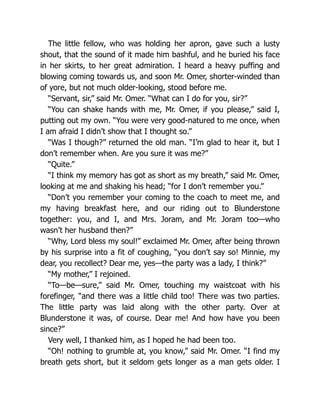
“Dear me!” said Mr. Omer. “Yes, to be sure. Two parties! Why, in
that very ride, if you’ll believe me, the day was named for my Minnie
to marry Joram. ‘Do name it, sir,’ says Joram. ‘Yes, do, father,’ says
Minnie. And now he’s come into the business. And look here! The
youngest!”
Minnie laughed, and stroked her banded hair upon her temples, as
her father put one of his fat fingers into the hand of the child she
was dancing on the counter.
“Two parties, of course!” said Mr. Omer, nodding his head
retrospectively. “Ex-actly so! And Joram’s at work, at this minute, on
a grey one with silver nails, not this measurement”—the
measurement of the dancing child upon the counter—“by a good
two inches.—Will you take something?”
I thanked him, but declined.
“Let me see,” said Mr. Omer. “Barkis’s the carrier’s wife—Peggotty’s
the boatman’s sister—she had something to do with your family?
She was in service there, sure?”
My answering in the affirmative gave him great satisfaction.
“I believe my breath will get long next, my memory’s getting so
much so,” said Mr. Omer. “Well, sir, we’ve got a young relation of
hers here, under articles to us, that has as elegant a taste in the
dressmaking business—I assure you I don’t believe there’s a
Duchess in England can touch her.”
“Not little Em’ly?” said I, involuntarily.
35.
“Em’ly’s her name,”said Mr. Omer, “and she’s little too. But if you’ll
believe me, she has such a face of her own that half the women in
this town are mad against her.”
“Nonsense, father!” cried Minnie.
“My dear,” said Mr. Omer, “I don’t say it’s the case with you,”
winking at me, “but I say that half the women in Yarmouth—ah! and
in five mile round—are mad against that girl.”
“Then she should have kept to her own station in life, father,” said
Minnie, “and not have given them any hold to talk about her, and
then they couldn’t have done it.”
“Couldn’t have done it, my dear!” retorted Mr. Omer. “Couldn’t
have done it! Is that your knowledge of life? What is there that any
woman couldn’t do, that she shouldn’t do—especially on the subject
of another woman’s good looks?”
I really thought it was all over with Mr. Omer, after he had uttered
this libellous pleasantry. He coughed to that extent, and his breath
eluded all his attempts to recover it with that obstinacy, that I fully
expected to see his head go down behind the counter, and his little
black breeches, with the rusty little bunches of ribbons at the knees,
come quivering up in a last ineffectual struggle. At length, however,
he got better, though he still panted hard, and was so exhausted
that he was obliged to sit on the stool of the shop-desk.
“You see,” he said, wiping his head, and breathing with difficulty,
“she hasn’t taken much to any companions here; she hasn’t taken
kindly to any particular acquaintances and friends, not to mention
sweethearts. In consequence, an ill-natured story got about, that
Em’ly wanted to be a lady. Now my opinion is, that it came into
circulation principally on account of her sometimes saying, at the
school, that if she was a lady she would like to do so and so for her
uncle—don’t you see?—and buy him such and such fine things.”
36.
“I assure you,Mr. Omer, she has said so to me,” I returned
eagerly, “when we were both children.”
Mr. Omer nodded his head and rubbed his chin. “Just so. Then out
of a very little, she could dress herself, you see, better than most
others could out of a deal, and that made things unpleasant.
Moreover, she was rather what might be called wayward—I’ll go so
far as to say what I should call wayward myself,” said Mr. Omer, “—
didn’t know her own mind quite—a little spoiled—and couldn’t, at
first, exactly bind herself down. No more than that was ever said
against her, Minnie?”
“No, father,” said Mrs. Joram. “That’s the worst, I believe.”
“So when she got a situation,” said Mr. Omer, “to keep a fractious
old lady company, they didn’t very well agree, and she didn’t stop.
At last she came here, apprenticed for three years. Nearly two of
’em are over, and she has been as good a girl as ever was. Worth
any six! Minnie, is she worth any six, now?”
“Yes, father,” replied Minnie. “Never say I detracted from her!”
“Very good,” said Mr. Omer. “That’s right. And so, young
gentleman,” he added, after a few moments’ further rubbing of his
chin, “that you may not consider me long-winded as well as short-
breathed, I believe that’s all about it.”
As they had spoken in a subdued tone, while speaking of Em’ly, I
had no doubt that she was near. On my asking now, if that were not
so, Mr. Omer nodded yes, and nodded towards the door of the
parlor. My hurried inquiry if I might peep in, was answered with a
free permission; and, looking through the glass, I saw her sitting at
her work. I saw her, a most beautiful little creature, with the
cloudless blue eyes, that had looked into my childish heart, turned
laughingly upon another child of Minnie’s who was playing near her;
with enough of wilfulness in her bright face to justify what I had
37.
heard; with muchof the old capricious coyness lurking in it; but with
nothing in her pretty looks, I am sure, but what was meant for
goodness and for happiness, and what was on a good and happy
course.
The tune across the yard that seemed as if it never had left off—
alas! it was the tune that never does leave off—was beating, softly,
all the while.
“Wouldn’t you like to step in,” said Mr. Omer, “and speak to her?
Walk in and speak to her, sir! Make yourself at home!”
I was too bashful to do so then—I was afraid of confusing her, and
I was no less afraid of confusing myself: but I informed myself of the
hour at which she left of an evening, in order that our visit might be
timed accordingly; and taking leave of Mr. Omer, and his pretty
daughter, and her little children, went away to my dear old
Peggotty’s.
Here she was, in the tiled kitchen, cooking dinner! The moment I
knocked at the door she opened it, and asked me what I pleased to
want. I looked at her with a smile, but she gave me no smile in
return. I had never ceased to write to her, but it must have been
seven years since we had met.
“Is Mr. Barkis at home, ma’am?” I said, feigning to speak roughly
to her.
“He’s at home, sir,” returned Peggotty, “but he’s bad abed with the
rheumatics.”
“Don’t he go over to Blunderstone now?” I asked.
“When he’s well, he do,” she answered.
“Do you ever go there, Mrs. Barkis?”
She looked at me more attentively, and I noticed a quick
movement of her hands towards each other.
38.
“Because I wantto ask a question about a house there, that they
call the—what is it?—the Rookery,” said I.
She took a step backward, and put out her hands in an undecided
frightened way, as if to keep me off.
“Peggotty!” I cried to her.
She cried, “My darling boy!” and we both burst into tears, and
were locked in one another’s arms.
What extravagancies she committed; what laughing and crying
over me; what pride she showed, what joy, what sorrow that she
whose pride and joy I might have been, could never hold me in a
fond embrace; I have not the heart to tell. I was troubled with no
misgiving that it was young in me to respond to her emotions. I had
never laughed and cried in all my life, I dare say—not even to her—
more freely than I did that morning.
“Barkis will be so glad,” said Peggotty, wiping her eyes with her
apron, “that it’ll do him more good than pints of liniment. May I go
and tell him you are here? Will you come up and see him, my dear?”
Of course I would. But Peggotty could not get out of the room as
easily as she meant to, for as often as she got to the door and
looked round at me, she came back again to have another laugh and
another cry upon my shoulder. At last, to make the matter easier, I
went up-stairs with her; and having waited outside for a minute,
while she said a word of preparation to Mr. Barkis, presented myself
before that invalid.
He received me with absolute enthusiasm. He was too rheumatic
to be shaken hands with, but he begged me to shake the tassel on
the top of his nightcap, which I did most cordially. When I sat down
by the side of the bed, he said that it did him a world of good to feel
as if he was driving me on the Blunderstone road again. As he lay in
bed, face upward, and so covered, with that exception, that he
39.
seemed to benothing but a face—like a conventional cherubim,—he
looked the queerest object I ever beheld.
“What name was it, as I wrote up, in the cart, sir?” said Mr. Barkis,
with a slow rheumatic smile.
“Ah! Mr. Barkis, we had some grave talks about that matter, hadn’t
we?”
“I was willin’ a long time, sir?” said Mr. Barkis.
“A long time,” said I.
“And I don’t regret it,” said Mr. Barkis. “Do you remember what
you told me once, about her making all the apple parsties and doing
all the cooking?”
“Yes, very well,” I returned.
“It was as true,” said Mr. Barkis, “as turnips is. It was as true,” said
Mr. Barkis, nodding his nightcap, which was his only means of
emphasis, “as taxes is. And nothing’s truer than them.”
Mr. Barkis turned his eyes upon me, as if for my assent to this
result of his reflections in bed; and I gave it.
“Nothing’s truer than them,” repeated Mr. Barkis; “a man as poor
as I am finds that out in his mind when he’s laid up. I’m a very poor
man, sir.”
“I am sorry to hear it, Mr. Barkis.”
“A very poor man, indeed I am,” said Mr. Barkis.
Here his right hand came slowly and feebly from under the
bedclothes, and with a purposeless uncertain grasp took hold of a
stick which was loosely tied to the side of the bed. After some
poking about with this instrument, in the course of which his face
assumed a variety of distracted expressions, Mr. Barkis poked it
against a box, an end of which had been visible to me all the time.
Then his face became composed.
“Old clothes,” said Mr. Barkis.
40.
“Oh!” said I.
“Iwish it was Money, sir,” said Mr. Barkis.
“I wish it was, indeed,” said I.
“But it AIN’T,” said Mr. Barkis, opening both his eyes as wide as he
possibly could.
I expressed myself quite sure of that, and Mr. Barkis, turning his
eyes more gently to his wife, said:
“She’s the usefullest and best of women, C. P. Barkis. All the
praise that any one can give to C. P. Barkis, she deserves, and more!
My dear, you’ll get a dinner to-day, for company; something good to
eat and drink, will you?”
I should have protested against this unnecessary demonstration in
my honor, but that I saw Peggotty, on the opposite side of the bed,
extremely anxious I should not. So I held my peace.
“I have got a trifle of money somewhere about me, my dear,” said
Mr. Barkis, “but I’m a little tired. If you and Mr. David will leave me
for a short nap, I’ll try and find it when I wake.”
We left the room, in compliance with this request. When we got
outside the door, Peggotty informed me that Mr. Barkis, being now
“a little nearer” than he used to be, always resorted to this same
device before producing a single coin from his store; and that he
endured unheard-of agonies in crawling out of bed alone, and taking
it from that unlucky box. In effect, we presently heard him uttering
suppressed groans of the most dismal nature, as this magpie
proceeding racked him in every joint; but while Peggotty’s eyes were
full of compassion for him, she said his generous impulse would do
him good, and it was better not to check it. So he groaned on, until
he had got into bed again, suffering, I have no doubt, a martyrdom;
and then called us in, pretending to have just woke up from a
refreshing sleep, and to produce a guinea from under his pillow. His
41.
satisfaction in whichhappy imposition on us, and in having
preserved the impenetrable secret of the box, appeared to be a
sufficient compensation to him for all his tortures.
I prepared Peggotty for Steerforth’s arrival, and it was not long
before he came. I am persuaded she knew no difference between
his having been a personal benefactor of hers, and a kind friend to
me, and that she would have received him with the utmost gratitude
and devotion in any case. But his easy, spirited, good humour; his
genial manner, his handsome looks, his natural gift of adapting
himself to whomsoever he pleased, and making direct, when he
cared to do it, to the main point of interest in anybody’s heart;
bound her to him wholly in five minutes. His manner to me, alone,
would have won her. But, through all these causes combined, I
sincerely believe she had a kind of adoration for him before he left
the house that night.
He stayed there with me to dinner—if I were to say willingly, I
should not half express how readily and gaily. He went into Mr.
Barkis’s room like light and air, brightening and refreshing it as if he
were healthy weather. There was no noise, no effort, no
consciousness, in anything he did; but in everything an indescribable
lightness, a seeming impossibility of doing anything else, or doing
anything better, which was so graceful, so natural, and agreeable,
that it overcomes me, even now, in the remembrance.
We made merry in the little parlor, where the Book of Martyrs,
unthumbed since my time, was laid out upon the desk as of old, and
where I now turned over its terrific pictures, remembering the old
sensations they had awakened, but not feeling them. When Peggotty
spoke of what she called my room, and of its being ready for me at
night, and of her hoping I would occupy it, before I could so much
42.
as look atSteerforth, hesitating, he was possessed of the whole
case.
“Of course,” he said. “You’ll sleep here, while we stay, and I shall
sleep at the hotel.”
“But to bring you so far,” I returned, “and to separate, seems bad
companionship, Steerforth.”
“Why, in the name of Heaven, where do you naturally belong!” he
said. “What is ‘seems,’ compared to that!” It was settled at once.
He maintained all his delightful qualities to the last, until we
started forth, at eight o’clock, for Mr. Peggotty’s boat. Indeed, they
were more and more brightly exhibited as the hours went on; for I
thought even then, and I have no doubt now, that the consciousness
of success in his determination to please, inspired him with a new
delicacy of perception, and made it, subtle as it was, more easy to
him. If any one had told me, then, that all this was a brilliant game,
played for the excitement of the moment, for the employment of
high spirits, in the thoughtless love of superiority, in a mere wasteful
careless course of winning what was worthless to him, and next
minute thrown away—I say, if any one had told me such a lie that
night, I wonder in what manner of receiving it my indignation would
have found a vent!
Probably only in an increase, had that been possible, of the
romantic feelings of fidelity and friendship with which I walked
beside him, over the dark wintry sands, towards the old boat; the
wind sighing around us even more mournfully, than it had sighed
and moaned upon the night when I first darkened Mr. Peggotty’s
door.
“This is a wild kind of place, Steerforth, is it not?”
“Dismal enough in the dark,” he said; “and the sea roars as if it
were hungry for us. Is that the boat, where I see a light yonder?”
43.
“That’s the boat,”said I.
“And it’s the same I saw this morning,” he returned. “I came
straight to it, by instinct, I suppose.”
We said no more as we approached the light, but made softly for
the door. I laid my hand upon the latch; and whispering Steerforth to
keep close to me, went in.
A murmur of voices had been audible on the outside, and, at the
moment of our entrance, a clapping of hands: which latter noise, I
was surprised to see, proceeded from the generally disconsolate
Mrs. Gummidge. But Mrs. Gummidge was not the only person there,
who was unusually excited. Mr. Peggotty, his face lighted up with
uncommon satisfaction, and laughing with all his might, held his
rough arms wide open, as if for little Em’ly to run into them; Ham,
with a mixed expression in his face of admiration, exultation, and a
lumbering sort of bashfulness that sat upon him very well, held little
Em’ly by the hand, as if he were presenting her to Mr. Peggotty; little
Em’ly herself, blushing and shy, but delighted with Mr. Peggotty’s
delight, as her joyous eyes expressed, was stopped by our entrance
(for she saw us first) in the very act of springing from Ham to nestle
in Mr. Peggotty’s embrace. In the first glimpse we had of them all,
and at the moment of our passing from the dark cold night into the
warm light room, this was the way in which they were all employed:
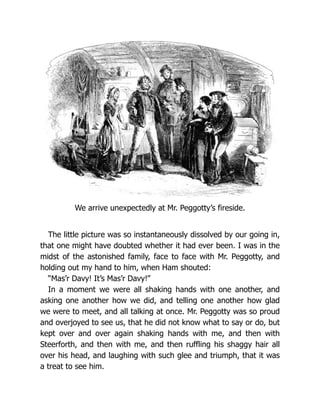
Mrs. Gummidge in the back ground, clapping her hands like a
madwoman.
44.
We arrive unexpectedlyat Mr. Peggotty’s fireside.
The little picture was so instantaneously dissolved by our going in,
that one might have doubted whether it had ever been. I was in the
midst of the astonished family, face to face with Mr. Peggotty, and
holding out my hand to him, when Ham shouted:
“Mas’r Davy! It’s Mas’r Davy!”
In a moment we were all shaking hands with one another, and
asking one another how we did, and telling one another how glad
we were to meet, and all talking at once. Mr. Peggotty was so proud
and overjoyed to see us, that he did not know what to say or do, but
kept over and over again shaking hands with me, and then with
Steerforth, and then with me, and then ruffling his shaggy hair all
over his head, and laughing with such glee and triumph, that it was
a treat to see him.
45.
“Why, that youtwo gent’lmen—gent’lmen growed—should come
to this here roof to-night, of all nights in my life,” said Mr. Peggotty,
“is such a thing as never happened afore, I do rightly believe! Em’ly,
my darling, come here! Come here, my little witch! There’s Mas’r
Davy’s friend, my dear! There’s the gent’lman as you’ve heerd on,
Em’ly. He comes to see you, along with Mas’r Davy, on the brightest
night of your uncle’s life as ever was or will be, Gorm the t’other
one, and horroar for it!”
After delivering this speech all in a breath, and with extraordinary
animation and pleasure, Mr. Peggotty put one of his large hands
rapturously on each side of his niece’s face, and kissing it a dozen
times, laid it with a gentle pride and love upon his broad chest, and
patted it as if his hand had been a lady’s. Then he let her go; and as
she ran into the little chamber where I used to sleep, looked round
upon us, quite hot and out of breath with his uncommon
satisfaction.
“If you two gent’lmen—gent’lmen growed now, and such
gent’lmen—” said Mr. Peggotty.
“So th’are, so th’are!” cried Ham. “Well said! So th’are. Mas’r Davy
bor—gent’lmen growed—so th’are!”
“If you two gent’lmen, gent’lmen growed,” said Mr. Peggotty,
“don’t ex-cuse me for being in a state of mind, when you understand
matters, I’ll arks your pardon. Em’ly, my dear!—She knows I’m a
going to tell,” here his delight broke out again, “and has made off.
Would you be so good as look arter her, Mawther, for a minute?”
Mrs. Gummidge nodded and disappeared.
“If this ain’t,” said Mr. Peggotty, sitting down among us by the fire,
“the brightest night o’ my life, I’m a shellfish—biled too—and more I
can’t say. This here little Em’ly, sir,” in a low voice to Steerforth, “—
her as you see a blushing here just now—”
46.
Welcome to ourwebsite – the perfect destination for book lovers and
knowledge seekers. We believe that every book holds a new world,
offering opportunities for learning, discovery, and personal growth.
That’s why we are dedicated to bringing you a diverse collection of
books, ranging from classic literature and specialized publications to
self-development guides and children's books.
More than just a book-buying platform, we strive to be a bridge
connecting you with timeless cultural and intellectual values. With an
elegant, user-friendly interface and a smart search system, you can
quickly find the books that best suit your interests. Additionally,
our special promotions and home delivery services help you save time
and fully enjoy the joy of reading.
Join us on a journey of knowledge exploration, passion nurturing, and
personal growth every day!
ebookbell.com









![Table of Contents
[ ii ]
File Portal 16
Horizon Mirage Client 16
Branch Reflector 17
How to license Horizon Mirage 17
VMware Horizon Suite 17
Horizon Mirage standalone 17
Migration-only license 17
How does this book work? 18
What do you need? 18
Summary 19
Chapter 2: Design, Install, and Configure 21
Infrastructure overview and requirements 21
Overview of Horizon Mirage infrastructure 21
Horizon Mirage components up close 22
Horizon Mirage Management Server 22
Horizon Mirage Server 22
Horizon Mirage database 23
File Portal 23
Horizon Mirage Client 24
Horizon Mirage Management Console 24
Branch Reflector 24
Web Management Console 25
Hardware requirements 25
Horizon Mirage Server 25
Horizon Mirage Client 26
Storage requirements 26
Design considerations 26
Assessment first 26
Sizing the Horizon Mirage Server 27
Example – small-scale deployment 28
Example – medium-scale deployment 28
Example – large-scale deployment 29
Storage design considerations 30
Network design considerations 31
Installing and deploying Horizon Mirage 32
Before you start – the prerequisites 32
Installing the Horizon Mirage Management Server 34
Installing the Horizon Mirage Management Console 35
Installing the Horizon Mirage Server 38
Installing the Horizon Mirage File Portal / Web Access 40
Stage 1 – installing IIS 41
Stage 2 – installing the File Portal 43](https://image.slidesharecdn.com/2342337-250524132908-15a1c68c/85/Vmware-Horizon-Mirage-Essentials-Peter-Von-Oven-19-320.jpg)
![Table of Contents
[ iii ]
Installing the Web Management Console 45
Installing the Horizon Mirage Client 46
Horizon Mirage Client – silent installation 48
Troubleshooting connection issues 49
Summary 50
Chapter 3: A Guided Tour of Management Consoles 51
The Horizon Mirage Management Console 51
A high-level overview of Horizon Mirage tasks 51
Common Wizards 52
Dashboard 53
Task Monitoring 54
Inventory 54
Image Composer 56
Driver Library 57
Reports 57
Logs 58
Users and Roles 58
System configuration 60
Web-based Management Consoles 61
Management Console overview – Web Help Desk role 61
Logging in 61
Searching and adding a device or user 62
Navigating the Web Help Desk Management Console 62
Management Console overview – the Protection Manager role 66
Logging in 66
Summary 70
Chapter 4: Getting Started with Horizon Mirage Layering
Technology 71
An introduction to layering technology 71
What is a Horizon Mirage layer? 71
What does a Mirage layer look like? 72
How to capture a base layer 73
Stage 1 – building a reference machine 74
What is a base layer? – a quick recap 74
What is a base layer used for? 74
Considerations when creating a base layer 75
Applications 75
Base layer use case examples 76
The departmental or individual use case scenario 77
Best practice and tips 78
Stage 2 – installing the Horizon Mirage Client 78
Stage 3 – centralizing the reference machine 79
Stage 4 – preparing the image before capture 82](https://image.slidesharecdn.com/2342337-250524132908-15a1c68c/85/Vmware-Horizon-Mirage-Essentials-Peter-Von-Oven-20-320.jpg)
![Table of Contents
[ iv ]
Stage 5 – capturing the base layer 83
The base layer capture process 83
Updating an existing base layer 86
Capturing an application layer 86
The application capture process 87
Stage 1 – performing a pre-scan 87
Stage 2 – installing the application 90
Stage 3 – post-scan and application layer capture 90
App layer capture best practice 93
Managing device drivers 94
What is a Horizon Mirage driver library? 94
Driver library folder structure 94
Driver library components and structure 94
Creating a driver library 95
Building a driver profile 97
Summary 98
Chapter 5: Manage – Centralized Image Management and
Deployment 99
Horizon Mirage single image management 99
What is single image management? 100
Building an endpoint with a base layer and an application layer 100
Building an endpoint with a base layer and driver profiles 101
Building the complete endpoint 101
Assigning a new base layer 102
Assigning an application layer 104
Remote office management 107
What is a Branch Reflector? 107
Enabling a Branch Reflector 108
Branch Reflector configuration options 109
Summary 110
Chapter 6: Migrate – Operating System and Hardware
Migration Made Easy 113
Migrating Windows XP to Windows 7 114
Preparing for the migration – where do I start? 114
Microsoft USMT 115
A migration example based on a virtual machine 117
For VMware Workstation lab environments 118
For VMware ESX lab environments 120
The migration process 120
Hardware migration 126
The hardware migration process 126
Summary 128](https://image.slidesharecdn.com/2342337-250524132908-15a1c68c/85/Vmware-Horizon-Mirage-Essentials-Peter-Von-Oven-21-320.jpg)