05th July 2021, 7:30 PM IST
MuleSoft Meetup
Anypoint Data Graph - Unify Data from Your APIs
Agenda
2
 Community Details!
 Introduction of Organizers and Speakers
 What is Anypoint Data Graph
 Anypoint Data Graph Overview
 Demo - Anypoint Data Graph - Unified Schema
 Restrictions and Limitations of Anypoint Data Graph
 Queries
 Trivia Quiz
Community Details
3
• Register for Meetups : https://meetups.mulesoft.com
•Register for Official Training platform : https://training.mulesoft.com
•MuleSoft forum : https://help.mulesoft.com
•For all blogs : https://blogs.mulesoft.com/
•Anypoint platform : https://anypoint.mulesoft.com
•Join Exam Readiness Sessions ! (Remind me to share at the end of the session)
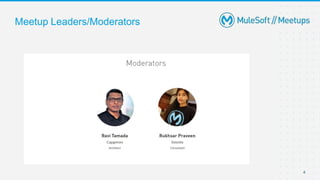
Meetup Leaders/Moderators
4
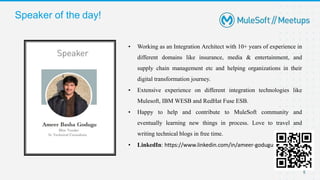
Speaker of the day!
• Working as an Integration Architect with 10+ years of experience in
different domains like insurance, media & entertainment, and
supply chain management etc and helping organizations in their
digital transformation journey.
• Extensive experience on different integration technologies like
Mulesoft, IBM WESB and RedHat Fuse ESB.
• Happy to help and contribute to MuleSoft community and
eventually learning new things in process. Love to travel and
writing technical blogs in free time.
• LinkedIn: https://www.linkedin.com/in/ameer-godugu
5
Anypoint Data Graph - Unify Data from Your
APIs
What is Anypoint Data Graph
7
Anypoint Data Graph enables you to leverage the existing capabilities of
your application network to drive productivity by unifying all the data within
your application network in a unified schema.
As a developer, you can dynamically query the unified schema and consume
the fields that you need to create new connected experiences.
You can improve your productivity and reduce operational costs by
discovering and reusing the existing data in your application network.
Anypoint Data Graph Prerequisites
Prerequisites
 Familiarity with Anypoint Platform and Exchange, including permissions to use
Exchange to publish and view RAML or OAS specifications in your business group
 An Anypoint Platform account
 Admin or Contribute permissions
 The correct number of vCores allocated to your business group or organization using
Anypoint DataGraph, as specified in your plan.
8
9
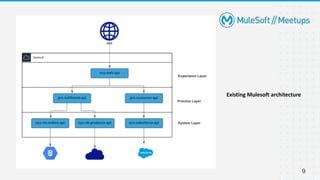
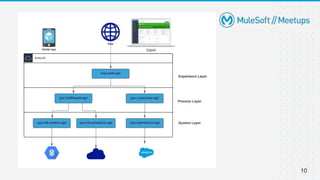
Existing Mulesoft architecture
10
11
With Anypoint DataGraph you can:
 Dynamically query data from a unified schema
 Explore your application network from a single UI
 Discover, reuse, and serve information from your application network without writing
new code
Features of Anypoint DataGraph
12
 Create a unified schema of your APIs to democratize data access across your org
 Run the DataGraph as a SaaS app to reduce overhead and maintenance
 Consume and reuse multiple APIs in a single GraphQL request to innovate faster
 Add APIs into a unified schema
 Unify APIs through linking and merging
 Consume multiple APIs in a single request
 Troubleshoot and monitor API performance
Anypoint Data Graph Overview
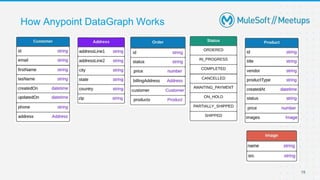
How Anypoint DataGraph Works
Every time you add a new API to your application network, Anypoint Platform
stores it as a graph of metadata.
Anypoint DataGraph enables you to connect those graphs into one unified schema
that runs as a single SaaS GraphQL endpoint and contains and links all of the fields
defined within all of your APIs.
As a result, you can query across the underlying APIs without needing to
understand all of the relationships or specific capabilities that exist within them.
14
How Anypoint DataGraph Works
15
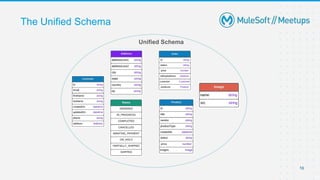
The Unified Schema
16
Unified Schema
The Unified Schema
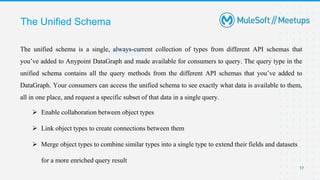
The unified schema is a single, always-current collection of types from different API schemas that
you’ve added to Anypoint DataGraph and made available for consumers to query. The query type in the
unified schema contains all the query methods from the different API schemas that you’ve added to
DataGraph. Your consumers can access the unified schema to see exactly what data is available to them,
all in one place, and request a specific subset of that data in a single query.
 Enable collaboration between object types
 Link object types to create connections between them
 Merge object types to combine similar types into a single type to extend their fields and datasets
for a more enriched query result
17
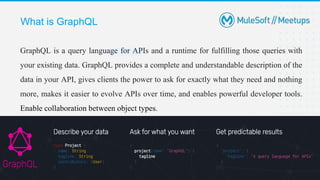
What is GraphQL
GraphQL is a query language for APIs and a runtime for fulfilling those queries with
your existing data. GraphQL provides a complete and understandable description of the
data in your API, gives clients the power to ask for exactly what they need and nothing
more, makes it easier to evolve APIs over time, and enables powerful developer tools.
Enable collaboration between object types.
18
15
Demo - Anypoint Data Graph - Unified Schema
Demo
20
Restrictions & Limitations of Anypoint Data
Graph
Restrictions & Limitations of Anypoint
Data Graph
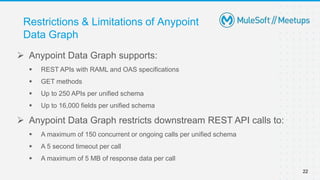
 Anypoint Data Graph supports:
 REST APIs with RAML and OAS specifications
 GET methods
 Up to 250 APIs per unified schema
 Up to 16,000 fields per unified schema
 Anypoint Data Graph restricts downstream REST API calls to:
 A maximum of 150 concurrent or ongoing calls per unified schema
 A 5 second timeout per call
 A maximum of 5 MB of response data per call
22
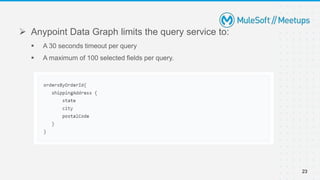
 Anypoint Data Graph limits the query service to:
 A 30 seconds timeout per query
 A maximum of 100 selected fields per query.
23
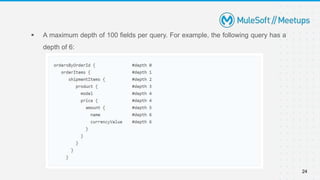
 A maximum depth of 100 fields per query. For example, the following query has a
depth of 6:
24
Queries?
Thank
you

Vizag mulesoft-meetup-6-anypoint-datagraph--v2

  • 1.
    05th July 2021,7:30 PM IST MuleSoft Meetup Anypoint Data Graph - Unify Data from Your APIs
  • 2.
    Agenda 2  Community Details! Introduction of Organizers and Speakers  What is Anypoint Data Graph  Anypoint Data Graph Overview  Demo - Anypoint Data Graph - Unified Schema  Restrictions and Limitations of Anypoint Data Graph  Queries  Trivia Quiz
  • 3.
    Community Details 3 • Registerfor Meetups : https://meetups.mulesoft.com •Register for Official Training platform : https://training.mulesoft.com •MuleSoft forum : https://help.mulesoft.com •For all blogs : https://blogs.mulesoft.com/ •Anypoint platform : https://anypoint.mulesoft.com •Join Exam Readiness Sessions ! (Remind me to share at the end of the session)
  • 4.
  • 5.
    Speaker of theday! • Working as an Integration Architect with 10+ years of experience in different domains like insurance, media & entertainment, and supply chain management etc and helping organizations in their digital transformation journey. • Extensive experience on different integration technologies like Mulesoft, IBM WESB and RedHat Fuse ESB. • Happy to help and contribute to MuleSoft community and eventually learning new things in process. Love to travel and writing technical blogs in free time. • LinkedIn: https://www.linkedin.com/in/ameer-godugu 5
  • 6.
    Anypoint Data Graph- Unify Data from Your APIs
  • 7.
    What is AnypointData Graph 7 Anypoint Data Graph enables you to leverage the existing capabilities of your application network to drive productivity by unifying all the data within your application network in a unified schema. As a developer, you can dynamically query the unified schema and consume the fields that you need to create new connected experiences. You can improve your productivity and reduce operational costs by discovering and reusing the existing data in your application network.
  • 8.
    Anypoint Data GraphPrerequisites Prerequisites  Familiarity with Anypoint Platform and Exchange, including permissions to use Exchange to publish and view RAML or OAS specifications in your business group  An Anypoint Platform account  Admin or Contribute permissions  The correct number of vCores allocated to your business group or organization using Anypoint DataGraph, as specified in your plan. 8
  • 9.
  • 10.
  • 11.
    11 With Anypoint DataGraphyou can:  Dynamically query data from a unified schema  Explore your application network from a single UI  Discover, reuse, and serve information from your application network without writing new code
  • 12.
    Features of AnypointDataGraph 12  Create a unified schema of your APIs to democratize data access across your org  Run the DataGraph as a SaaS app to reduce overhead and maintenance  Consume and reuse multiple APIs in a single GraphQL request to innovate faster  Add APIs into a unified schema  Unify APIs through linking and merging  Consume multiple APIs in a single request  Troubleshoot and monitor API performance
  • 13.
  • 14.
    How Anypoint DataGraphWorks Every time you add a new API to your application network, Anypoint Platform stores it as a graph of metadata. Anypoint DataGraph enables you to connect those graphs into one unified schema that runs as a single SaaS GraphQL endpoint and contains and links all of the fields defined within all of your APIs. As a result, you can query across the underlying APIs without needing to understand all of the relationships or specific capabilities that exist within them. 14
  • 15.
  • 16.
  • 17.
    The Unified Schema Theunified schema is a single, always-current collection of types from different API schemas that you’ve added to Anypoint DataGraph and made available for consumers to query. The query type in the unified schema contains all the query methods from the different API schemas that you’ve added to DataGraph. Your consumers can access the unified schema to see exactly what data is available to them, all in one place, and request a specific subset of that data in a single query.  Enable collaboration between object types  Link object types to create connections between them  Merge object types to combine similar types into a single type to extend their fields and datasets for a more enriched query result 17
  • 18.
    What is GraphQL GraphQLis a query language for APIs and a runtime for fulfilling those queries with your existing data. GraphQL provides a complete and understandable description of the data in your API, gives clients the power to ask for exactly what they need and nothing more, makes it easier to evolve APIs over time, and enables powerful developer tools. Enable collaboration between object types. 18 15
  • 19.
    Demo - AnypointData Graph - Unified Schema
  • 20.
  • 21.
    Restrictions & Limitationsof Anypoint Data Graph
  • 22.
    Restrictions & Limitationsof Anypoint Data Graph  Anypoint Data Graph supports:  REST APIs with RAML and OAS specifications  GET methods  Up to 250 APIs per unified schema  Up to 16,000 fields per unified schema  Anypoint Data Graph restricts downstream REST API calls to:  A maximum of 150 concurrent or ongoing calls per unified schema  A 5 second timeout per call  A maximum of 5 MB of response data per call 22
  • 23.
     Anypoint DataGraph limits the query service to:  A 30 seconds timeout per query  A maximum of 100 selected fields per query. 23
  • 24.
     A maximumdepth of 100 fields per query. For example, the following query has a depth of 6: 24
  • 25.
  • 26.