UNIT-6
VITAL SIGNS
Definition
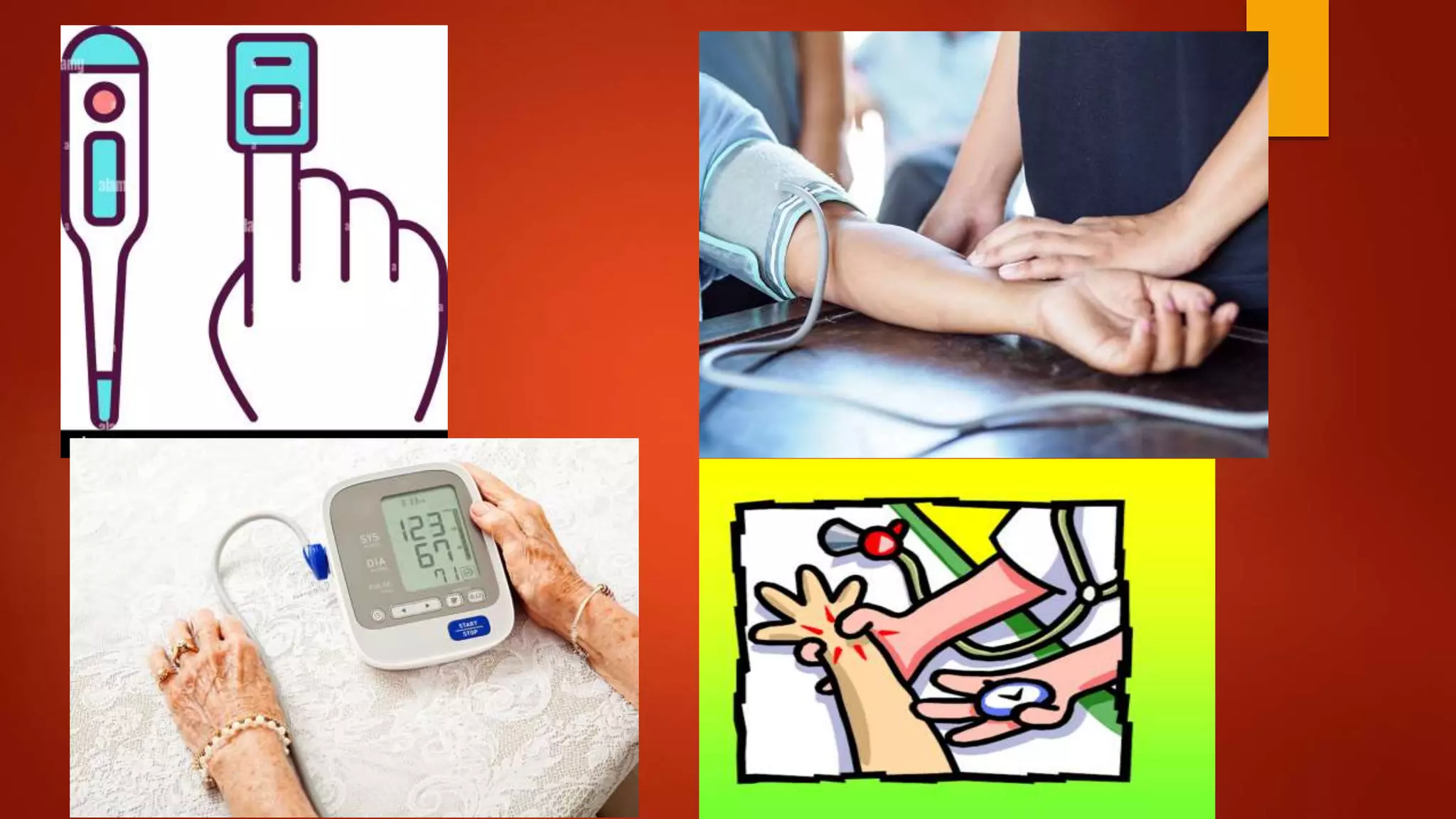
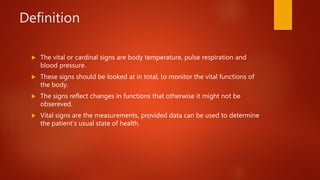
 The vital or cardinal signs are body temperature, pulse respiration and
blood pressure.
 These signs should be looked at in total, to monitor the vital functions of
the body.
 The signs reflect changes in functions that otherwise it might not be
obsereved.
 Vital signs are the measurements, provided data can be used to determine
the patient’s usual state of health.
Purposes
 To assess the health-satatus of an individual.
 To plan and implement the nursing care.
 To understand the effectiveness of the tretmnet.
 To modify or change the mode of treatment.
 Routine part of complete physical assessment.
 It helps to understand the present problem.
Timings of vital signs
 On patient’s admission
 Routine schedule
 During patient’s visit to clinic or physician’s office.
 Before and after and surgical procedure.
 Before and after any invasive diagnostic procedure.
 Before and after administration of medication that affect cardiovascular,
respiratory and temperarure control function.
 When the patient’s general physical condition changes, e.g. consciousness
or increase in intensity of pain.
 Before and after nursing interventions influencing any one of the vital
signs, e.g. before ambulating a patient previously on bed rest or before
patient performs range of motion exercises.
 Whenever patient reports to nurse any non-specific symptoms of physical
distress, e.g. “feeling funny or different.”
Methods of measurement
 Inspection : Inspection means observing with the eye and is associated
with light and seeing.
 Percussion : Percussion is tapping an area to elicit sounds.
 Auscultation : Auscultation is listening to sounds within the body with
stethoscope.
 Palpation : Palpation is the art of feeling with the hand.
Vital signs and normal values
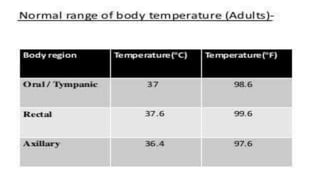
 Temperature : 98.6*F or 37*c
 Pulse: 72 beats/Minute in adults
 Respiration: 16 breaths/ minutes in adults.
 Blood pressure :120/80 mm hg in adults.
Guidelines for taking vital signs
 The primary nurse caring for the client is the best one to take vital
signs,interpret their significance, and make decision about care.
 Equipment used to measure vital signs must be appropriate and work
properly to ensure accurate finding.
 Knowing the normal range for all vital signs helps the nurse to detect
abnormalities.
 A clinet’s normal range may differ from the standard range for that age or
physical state.
 Normal values for the client’s serve as a baseline for comparing in
conditions in over time.
 Know the client’s medical history and therapies or medication, for viatl
changes.
 Control or minimize environmental factors that may affect vital signs.
 An organized, systematic apparoach when taking vital signs ensures,
accuracy of findings.
Temperature
 Temoerature is a measurement of heat expressed in degrees.
 Temperature means the degree of warmth or balance maintained between
the heat produced and heat lost in the body.
 Heat production in the body is called thermogenesis.
 Heat loss to the environment is called thermolysis.
 Temperature is defined as measuring/monitoring patient’s body
temperature using clinical thermometer.
Purpose
 To determine bosy temperature.
 To assist in diagnosis.
 To evaluate the patients recovery from illness.
 To plan immediate nursing interventions.
 To evaluate the patients response.
 To recognize any variation from the normal and its significant.
Factors influences heat production
 1. Metabolism –Oxidation of food.
 2. Muscle activity – Exercise
 3. Strong emotional – Excitement , anxiety and nervousness.
 4. Change in atmospheric temperature.
 5. Disease condition - Bacterial invasion
 6. Sympathetic stimulation –mEpinephrine and norepinephrine
Factors influences heat Loss
 Sleep-body temperature is low.
 Fasting – Leads to decreased heat production.
 Illness and lower vitality- due to decreased heat production.
 Prolonged exposure to cold.
 Use of narcotic drug.
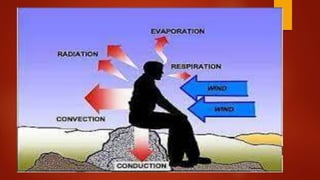
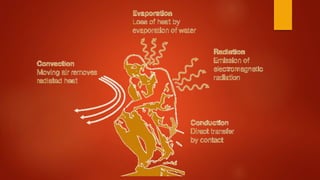
Body Heat is Lost through
 1. Conduction : Transfer of heat from body to substance (air,
water and clothes) directly in contact.
 2. Radiation : Transfer of heat from body to heat waves which
travel through space.
 3. Evaporation : Transfer of heat from body in form of vapors
(liquid is converted into vapors.
 4.Convection : it is transfer of heat from the surface of one
subject to the surface, such as skin by movements of heated
aair or fluid particles.
Preparation of equipment
 If a thermometer is included in the admission pack, keep it at the patient’s
bedside and, on discharge, allow him to take home.
 Otherwise , obtain a thermometer from the nurse’s station or central
supply department.
 If use an electronic thetmometer , make sure it has been recharged.
Equipment
 Mercury or electronic thermometer, chemical dot thermometer, or
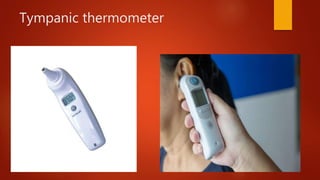
tympanic thermometer.
 Water soluble lubricant or petroleum jelly. (for rectal temperature)
 Facial tissue
 Disposable thermometer sheath or probe cover.
 Alchol sponge
Tympanic thermometer
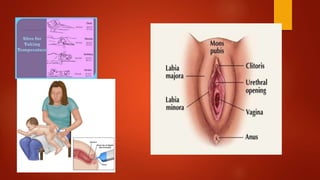
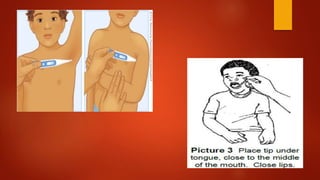
Common sites for taking body
temperature
 1. Mouth
 2. Axilla
 3. Groin
 4. Vagina
 5. Rectum
Thermometer
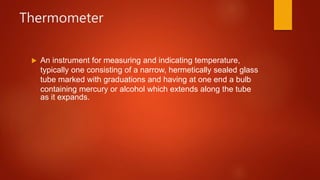
 An instrument for measuring and indicating temperature,
typically one consisting of a narrow, hermetically sealed glass
tube marked with graduations and having at one end a bulb
containing mercury or alcohol which extends along the tube
as it expands.
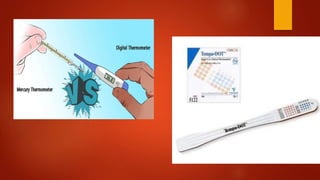
Types of thermometer
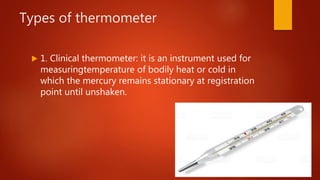
 1. Clinical thermometer: it is an instrument used for
measuringtemperature of bodily heat or cold in
which the mercury remains stationary at registration
point until unshaken.
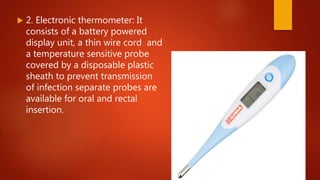
 2. Electronic thermometer: It
consists of a battery powered
display unit, a thin wire cord and
a temperature sensitive probe
covered by a disposable plastic
sheath to prevent transmission
of infection separate probes are
available for oral and rectal
insertion.
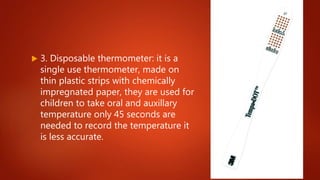
 3. Disposable thermometer: it is a
single use thermometer, made on
thin plastic strips with chemically
impregnated paper, they are used for
children to take oral and auxillary
temperature only 45 seconds are
needed to record the temperature it
is less accurate.
Scales of thermometer
 Centrigrade/Celsius –boiling point 100 degree and
freezing point 0 degree
 Farenheit – Boiling point 212 degree and freezing
point 32 degree
Parts of thermometer
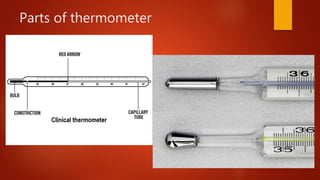
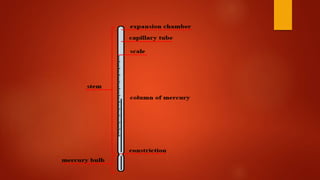
1. A bulb contains mercury and in a stem mercury rises. There is
graduated scale on the stem, which represents the degree of
temperature.
2. The bulbs rae of different size and shapes. The oral
thermometers are with along and slender bulbs. The rectal
thermometers are with short and fat bulbs.
3. The stem has a curved surface which magbifies the lines and
figures on the scale. The stem has flattened back with a sharp
ridge that nakes it easier to read the scale . The flat surface
prevents rolling.
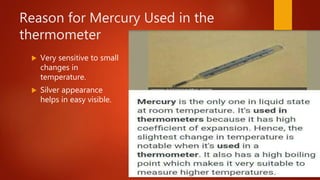
Reason for Mercury Used in the
thermometer
 Very sensitive to small
changes in
temperature.
 Silver appearance
helps in easy visible.
Care of thermometer
 Grasp the thermometer securely by the upper end of the stem, never hold
it by bulb.
 Shake it down by quick movement of the wrist.
 Move away from articles before shaking the thermometer.
 Becareful that the thermometer will not fall or strike against anything.
 Thermometer is never washed with hot water because heat expands the
mercury.
 The used thermometer should be washed with soap and water should be
disinfected with a disinfectant.
 Advantages of using mercury are low price, wide availability reliable
accuracy.
 Disadvantages are delay for recording and easy breakabilityNCP.
Regulation of body temp
 Body temp is regulated by hypothalamus which has 2
centers
 Heat loss center Situated in preoptic nucleus of anterior
hypothalamus . neurons are heat sensitive nerve cells
called thermoreceptors. It stimulate cutaneous ody
temp.
 Heat gain center; Otherwise called as heat production
center. Situated in posterior hypothalamic nucleus. If it
stimulated cause shivering. Removal or lesion lead fall in
body temp
Mechanism of temperature regulation
 When body temp ↑
 • blood temp also↑,
 • Blood stimulates thermoreceptor
 • Now it brings the temp to normal by two mechanisms.
a. Promotion of heat loss
 i. Increasing the secretion of sweat
 ii. Inhibiting the sympathetic center in posterior hypothalamus. ( this
cause cutaneous vasodilation, so blood flow through skin causing excess
sweating)
 b. Prevention of heat production By shivering and chemical reaction
 When body temp ↑
 2 mechanism activated to bring back to normal temp
 i. prevention of heat loss. ii. Promotion of heat
production.
 • Prevention of heat loss; When body temp decreases ,
the preoptic thermoreceptors are not inhibited.This
causes cutaneous vasoconstriction.The blood flow ↓, so
heat loss is prevented.
 ii. Promotion of heat production: Shivering .The primary
motor center for shivering is situated in posterior hypo
thalamus near the wall of the III ventricle.When body
temp is low, it is activated by heat gain center & shivering
occurs. Increased metabolic reaction. Sympathetic
center is stimulated by heat gain centerThis stimulates
adrenaline & noradreline, these hormones accelerating
cellular metabolism activities & produce heat.
 Hypothalamus secretes thyrotrophic releasing hormone,
it cause release of thyroid stimulating hormone from
pituitary gland, it in turn increases release of thyroxine
from thyroid, that also increases metabolic activities in
the body & increase heat production.
 Hypothalamus secretes thyrotrophic releasing hormone
it release thyroid stimulating hormone from pituitary
gland it increases release of thyroxine from thyroid
increases metabolic activities in the body increase heat
production
Principles of measuring body
temperature
 Explain the patient because any unfamiliar treatment procedure makes the
patient anxious and tense.
 The reliability of a temperature value depends on choosing the correct
equipments, selecting the most appropriate site and using the correct
placement of the thermometer and must leave it in place for the
appropriate length of time.
 The same site should be used when repeated measurements are
necessary.
 The thermometer should be disinfected in a proper disinfectant to prevent
cross infection.
 Choose the safest and most accurate site for the client.
 Never leave the patient alone with a thermometer in position.
 Wiping from an area where there is fewer number of organisms
to to an area where there is large number of organism are
present which minimizes the spread of infection. Before taking
the temperature , wipe the thermometer from th ebulb to the
stem and after taking the temperature from the stem to the
bulb.
 Never handle the thermometer by it sbulb as it mamy be easily
contaminated or broken.
 Lubricate the bulb of rectal thermometer before placing the
thermometer in the rectum to reduce the friction , facilitate easy
insertion and prevent injury to sphincter muscle.
 Use separate thermometer for each patient to prevent spread of infection.
 Read the thermometer at the eye level against light.

Vital Signs.pptx

  • 4.
  • 5.
    Definition  The vitalor cardinal signs are body temperature, pulse respiration and blood pressure.  These signs should be looked at in total, to monitor the vital functions of the body.  The signs reflect changes in functions that otherwise it might not be obsereved.  Vital signs are the measurements, provided data can be used to determine the patient’s usual state of health.
  • 7.
    Purposes  To assessthe health-satatus of an individual.  To plan and implement the nursing care.  To understand the effectiveness of the tretmnet.  To modify or change the mode of treatment.  Routine part of complete physical assessment.  It helps to understand the present problem.
  • 8.
    Timings of vitalsigns  On patient’s admission  Routine schedule  During patient’s visit to clinic or physician’s office.  Before and after and surgical procedure.  Before and after any invasive diagnostic procedure.  Before and after administration of medication that affect cardiovascular, respiratory and temperarure control function.  When the patient’s general physical condition changes, e.g. consciousness or increase in intensity of pain.
  • 9.
     Before andafter nursing interventions influencing any one of the vital signs, e.g. before ambulating a patient previously on bed rest or before patient performs range of motion exercises.  Whenever patient reports to nurse any non-specific symptoms of physical distress, e.g. “feeling funny or different.”
  • 10.
    Methods of measurement Inspection : Inspection means observing with the eye and is associated with light and seeing.  Percussion : Percussion is tapping an area to elicit sounds.  Auscultation : Auscultation is listening to sounds within the body with stethoscope.  Palpation : Palpation is the art of feeling with the hand.
  • 11.
    Vital signs andnormal values  Temperature : 98.6*F or 37*c  Pulse: 72 beats/Minute in adults  Respiration: 16 breaths/ minutes in adults.  Blood pressure :120/80 mm hg in adults.
  • 12.
    Guidelines for takingvital signs  The primary nurse caring for the client is the best one to take vital signs,interpret their significance, and make decision about care.  Equipment used to measure vital signs must be appropriate and work properly to ensure accurate finding.  Knowing the normal range for all vital signs helps the nurse to detect abnormalities.  A clinet’s normal range may differ from the standard range for that age or physical state.  Normal values for the client’s serve as a baseline for comparing in conditions in over time.
  • 13.
     Know theclient’s medical history and therapies or medication, for viatl changes.  Control or minimize environmental factors that may affect vital signs.  An organized, systematic apparoach when taking vital signs ensures, accuracy of findings.
  • 14.
    Temperature  Temoerature isa measurement of heat expressed in degrees.  Temperature means the degree of warmth or balance maintained between the heat produced and heat lost in the body.  Heat production in the body is called thermogenesis.  Heat loss to the environment is called thermolysis.  Temperature is defined as measuring/monitoring patient’s body temperature using clinical thermometer.
  • 15.
    Purpose  To determinebosy temperature.  To assist in diagnosis.  To evaluate the patients recovery from illness.  To plan immediate nursing interventions.  To evaluate the patients response.  To recognize any variation from the normal and its significant.
  • 17.
    Factors influences heatproduction  1. Metabolism –Oxidation of food.  2. Muscle activity – Exercise  3. Strong emotional – Excitement , anxiety and nervousness.  4. Change in atmospheric temperature.  5. Disease condition - Bacterial invasion  6. Sympathetic stimulation –mEpinephrine and norepinephrine
  • 18.
    Factors influences heatLoss  Sleep-body temperature is low.  Fasting – Leads to decreased heat production.  Illness and lower vitality- due to decreased heat production.  Prolonged exposure to cold.  Use of narcotic drug.
  • 19.
    Body Heat isLost through  1. Conduction : Transfer of heat from body to substance (air, water and clothes) directly in contact.  2. Radiation : Transfer of heat from body to heat waves which travel through space.  3. Evaporation : Transfer of heat from body in form of vapors (liquid is converted into vapors.  4.Convection : it is transfer of heat from the surface of one subject to the surface, such as skin by movements of heated aair or fluid particles.
  • 22.
    Preparation of equipment If a thermometer is included in the admission pack, keep it at the patient’s bedside and, on discharge, allow him to take home.  Otherwise , obtain a thermometer from the nurse’s station or central supply department.  If use an electronic thetmometer , make sure it has been recharged.
  • 23.
    Equipment  Mercury orelectronic thermometer, chemical dot thermometer, or tympanic thermometer.  Water soluble lubricant or petroleum jelly. (for rectal temperature)  Facial tissue  Disposable thermometer sheath or probe cover.  Alchol sponge
  • 25.
  • 29.
    Common sites fortaking body temperature  1. Mouth  2. Axilla  3. Groin  4. Vagina  5. Rectum
  • 31.
    Thermometer  An instrumentfor measuring and indicating temperature, typically one consisting of a narrow, hermetically sealed glass tube marked with graduations and having at one end a bulb containing mercury or alcohol which extends along the tube as it expands.
  • 32.
    Types of thermometer 1. Clinical thermometer: it is an instrument used for measuringtemperature of bodily heat or cold in which the mercury remains stationary at registration point until unshaken.
  • 33.
     2. Electronicthermometer: It consists of a battery powered display unit, a thin wire cord and a temperature sensitive probe covered by a disposable plastic sheath to prevent transmission of infection separate probes are available for oral and rectal insertion.
  • 34.
     3. Disposablethermometer: it is a single use thermometer, made on thin plastic strips with chemically impregnated paper, they are used for children to take oral and auxillary temperature only 45 seconds are needed to record the temperature it is less accurate.
  • 35.
    Scales of thermometer Centrigrade/Celsius –boiling point 100 degree and freezing point 0 degree  Farenheit – Boiling point 212 degree and freezing point 32 degree
  • 36.
  • 38.
    1. A bulbcontains mercury and in a stem mercury rises. There is graduated scale on the stem, which represents the degree of temperature. 2. The bulbs rae of different size and shapes. The oral thermometers are with along and slender bulbs. The rectal thermometers are with short and fat bulbs. 3. The stem has a curved surface which magbifies the lines and figures on the scale. The stem has flattened back with a sharp ridge that nakes it easier to read the scale . The flat surface prevents rolling.
  • 39.
    Reason for MercuryUsed in the thermometer  Very sensitive to small changes in temperature.  Silver appearance helps in easy visible.
  • 40.
    Care of thermometer Grasp the thermometer securely by the upper end of the stem, never hold it by bulb.  Shake it down by quick movement of the wrist.  Move away from articles before shaking the thermometer.  Becareful that the thermometer will not fall or strike against anything.  Thermometer is never washed with hot water because heat expands the mercury.  The used thermometer should be washed with soap and water should be disinfected with a disinfectant.
  • 41.
     Advantages ofusing mercury are low price, wide availability reliable accuracy.  Disadvantages are delay for recording and easy breakabilityNCP.
  • 42.
    Regulation of bodytemp  Body temp is regulated by hypothalamus which has 2 centers  Heat loss center Situated in preoptic nucleus of anterior hypothalamus . neurons are heat sensitive nerve cells called thermoreceptors. It stimulate cutaneous ody temp.  Heat gain center; Otherwise called as heat production center. Situated in posterior hypothalamic nucleus. If it stimulated cause shivering. Removal or lesion lead fall in body temp
  • 43.
    Mechanism of temperatureregulation  When body temp ↑  • blood temp also↑,  • Blood stimulates thermoreceptor  • Now it brings the temp to normal by two mechanisms. a. Promotion of heat loss  i. Increasing the secretion of sweat  ii. Inhibiting the sympathetic center in posterior hypothalamus. ( this cause cutaneous vasodilation, so blood flow through skin causing excess sweating)  b. Prevention of heat production By shivering and chemical reaction
  • 44.
     When bodytemp ↑  2 mechanism activated to bring back to normal temp  i. prevention of heat loss. ii. Promotion of heat production.  • Prevention of heat loss; When body temp decreases , the preoptic thermoreceptors are not inhibited.This causes cutaneous vasoconstriction.The blood flow ↓, so heat loss is prevented.
  • 45.
     ii. Promotionof heat production: Shivering .The primary motor center for shivering is situated in posterior hypo thalamus near the wall of the III ventricle.When body temp is low, it is activated by heat gain center & shivering occurs. Increased metabolic reaction. Sympathetic center is stimulated by heat gain centerThis stimulates adrenaline & noradreline, these hormones accelerating cellular metabolism activities & produce heat.
  • 46.
     Hypothalamus secretesthyrotrophic releasing hormone, it cause release of thyroid stimulating hormone from pituitary gland, it in turn increases release of thyroxine from thyroid, that also increases metabolic activities in the body & increase heat production.  Hypothalamus secretes thyrotrophic releasing hormone it release thyroid stimulating hormone from pituitary gland it increases release of thyroxine from thyroid increases metabolic activities in the body increase heat production
  • 47.
    Principles of measuringbody temperature  Explain the patient because any unfamiliar treatment procedure makes the patient anxious and tense.  The reliability of a temperature value depends on choosing the correct equipments, selecting the most appropriate site and using the correct placement of the thermometer and must leave it in place for the appropriate length of time.  The same site should be used when repeated measurements are necessary.  The thermometer should be disinfected in a proper disinfectant to prevent cross infection.  Choose the safest and most accurate site for the client.
  • 48.
     Never leavethe patient alone with a thermometer in position.  Wiping from an area where there is fewer number of organisms to to an area where there is large number of organism are present which minimizes the spread of infection. Before taking the temperature , wipe the thermometer from th ebulb to the stem and after taking the temperature from the stem to the bulb.  Never handle the thermometer by it sbulb as it mamy be easily contaminated or broken.  Lubricate the bulb of rectal thermometer before placing the thermometer in the rectum to reduce the friction , facilitate easy insertion and prevent injury to sphincter muscle.
  • 49.
     Use separatethermometer for each patient to prevent spread of infection.  Read the thermometer at the eye level against light.