Visual Object Processing A Cognitive Neuropsychological Approach Glyn W Humphreys
Visual Object Processing A Cognitive Neuropsychological Approach Glyn W Humphreys
Visual Object Processing A Cognitive Neuropsychological Approach Glyn W Humphreys
Visual Object Processing A Cognitive Neuropsychological Approach Glyn W Humphreys
Visual Object Processing A Cognitive Neuropsychological Approach Glyn W Humphreys
1.
Visual Object ProcessingA Cognitive
Neuropsychological Approach Glyn W Humphreys
download
https://ebookbell.com/product/visual-object-processing-a-
cognitive-neuropsychological-approach-glyn-w-humphreys-52461610
Explore and download more ebooks at ebookbell.com
2.
Here are somerecommended products that we believe you will be
interested in. You can click the link to download.
Visual Object Tracking Using Deep Learning Ashish Kumar
https://ebookbell.com/product/visual-object-tracking-using-deep-
learning-ashish-kumar-52598712
Visual Object Tracking From Correlation Filter To Deep Learning 1st Ed
2021 Weiwei Xing
https://ebookbell.com/product/visual-object-tracking-from-correlation-
filter-to-deep-learning-1st-ed-2021-weiwei-xing-36380984
Visual Object Recognition 1st Edition Grauman K Leibe B
https://ebookbell.com/product/visual-object-recognition-1st-edition-
grauman-k-leibe-b-4584652
The Visual Object Of Desire In Late Medieval England Sarah Stanbury
https://ebookbell.com/product/the-visual-object-of-desire-in-late-
medieval-england-sarah-stanbury-51968168
3.
Machine Learning ChallengesEvaluating Predictive Uncertainty Visual
Object Classification And Recognising Tectual Entailment First Pascal
Machine Learning Challenges Workshop Mlcw 2005 Southampton Uk April
1113 2005 Revised Selected Papers 1st Edition Joaquin Quionerocandela
Auth
https://ebookbell.com/product/machine-learning-challenges-evaluating-
predictive-uncertainty-visual-object-classification-and-recognising-
tectual-entailment-first-pascal-machine-learning-challenges-workshop-
mlcw-2005-southampton-uk-april-1113-2005-revised-selected-papers-1st-
edition-joaquin-quionerocandela-auth-4239698
Objectoriented Programming With Visual Basicnet Michael Mcmillan
https://ebookbell.com/product/objectoriented-programming-with-visual-
basicnet-michael-mcmillan-2004060
Beginning Object Oriented Programming Using Visual Basic 2005 From
Novie To Professiona Dan Clark
https://ebookbell.com/product/beginning-object-oriented-programming-
using-visual-basic-2005-from-novie-to-professiona-dan-clark-4112518
Visual Perception And Robotic Manipulation 3d Object Recognition
Tracking And Handeye Coordination 1st Edition Geoffrey Taylor
https://ebookbell.com/product/visual-perception-and-robotic-
manipulation-3d-object-recognition-tracking-and-handeye-
coordination-1st-edition-geoffrey-taylor-983282
Visual Saliency From Pixellevel To Objectlevel Analysis 1st Ed
Jianming Zhang
https://ebookbell.com/product/visual-saliency-from-pixellevel-to-
objectlevel-analysis-1st-ed-jianming-zhang-9964488
Visual Object Processing:
ACognitive Neuropsychological
Approach
Edited by
Glyn W. Humphreys
Department of Psychology, Birkbeck College,U.K.
and
M. Jane Riddoch
Department of Paramedical Sciences,
North East London Polytechnic, U.K.
Contents
List of Contributorsix
Preface xi
1. Introduction: Cognitive Neuropsychology and Visual Object Processing 1
Glyn W. Humphreys and M. lane Riddoch
1. Introduction 1
2. Cognitive Neuropsychology and Visual Object Processing 2
3. The Book 11
2. Visual Object Perception from a Computational Perspective 17
Kent A. Stevens
1. Introduction 17
2. Modularity in Vision 19
3. Survey of Computational Problems 21
4. Concerning Visual Defects 35
5. Conclusion 39
3. Normal and Pathological Processes in Visual Object Constancy 43
Glyn W. Humphreys and Philip T. Quinlan
1. Introduction 43
2. The Problem of Visual Object Constancy 44
3. Approaches to Object Constancy 48
4. Animal Work 82
5. Neurological Impairments of Human Vision 88
6. Some Conclusions 95
V
13.
4. Picture Naming107
M. lane Riddoch and Glyn W. Humphreys
1. Introduction 107
2. Studies of Picture Naming in Normal Subjects 108
3. Data from Brain Damaged Subjects 127
4. Conclusions 139
5. Information Processing and Laterality Effects for Object and Face
Perception 145
lustine Sergent
1. Introduction 145
2. Information Processing 148
3. Some Properties of the Visual System and their Implications 153
4. Hemispheric Processing Assymetry 162
5. Conclusion 167
6. The Clinical Spectrum and Localisation of Visual Agnosia 175
Andrew Kertesz
1. Introduction 175
2. Varieties of Visual Agnosia 176
3. Agnosia and Cortical Blindness 182
4. Associated Deficits 183
5. The Lesions Producing Visual Agnosia 189
6. The Functions of Visual Recognition 191
7. Apperceptive Agnosia: The Specification and Description of
Constructs 197
lohn Campion
1. Introduction 197
2. A Neuropsychological Framework for Vision 198
3. Sensory Loss Theory and Agnosia 200
4. A Case of Apperceptive Agnosia 206
5. Two Other Patients 221
6. Conclusions 227
8. Object Concepts and Object Names: Some Deductions from Acquired
Disorders of Word Processing 233
Elaine Funnell '~
1. Modularity and the Division of Labour 233
2. Conceptual Representations of Objects 236
3. Levels of Object Recognition 239
4. Semantic Processing and Imageable/Concrete Word Concepts 243
5. Shared Conceptual Information for Object Names and Objects 253
9. Dementia and Visual Agnosia 261
Oscar S. M. Marin
1. Dementia: Definition and Nosology 261
2. Perceptual Disorders in Dementia 264
V¡ CONTENTS
14.
CONTENTS
3. Dementias asa Model for Neuropsychological Research
4. The Nature of Perceptual Disorders in Dementia 268
5. The Spectrum of Visual Agnosic Syndromes 275
10. The Fractionation of Visual Agnosia 281
Glyn W. Humphreys and M. Jane Riddoch
1. Introduction 281
2. Apperceptive Agnosia 282
3. Associative Agnosia 292
4. Classification and Lesion Sites 294
5. Re-classifying Visual Agnosia 299
6. Conclusions 304
Author Index 307
265
Subject Index 315
vii
16.
List of Contributors
JohnCampion Behavioural Science Division, Admiralty Research
Establishment, Queens Road, Teddington, Middlesex, U.K.
Elaine Funnell Cognitive Neuropsychology Research Group, Department of
Psychology, University of London, Malet Street, London WC1E 7HX, U.K.
Glyn W. Humphreys Cognitive Neuropsychology Research Group,
Department of Psychology, Birkbeck College, University of London, Malet Street,
London WC1E7HX, U.K.
Andrew Kertesz Clinical Neurology Department; St. Joseph's Hospital, 268
Grosvenor Street, London, Ontario N6A 4V2, Canada
Oscar S. M. Marin Laboratory of Cognitive Neuropsychology, Department of
Neurology, Good Samaritan Hospital and Medical Center, Portland, Oregon
97210, U.S.A.
Philip T. Quinlan Cognitive Neuropsychology Research Group, Department
of Psychology, Birkbeck College, University of London, Malet Street; London
WC1E 7HX, U.K.
M. Jane Riddoch Department of Paramedical Sciences, North East London
Polytechnic, Romford Road, Stratford, London E15 4LZ, U.K.
Justine Sergent Department of Neurology, McGill University, Montreal
Neurological Institute, 3801 University Street, Montreal PQ, H3A 2B4, Canada
Kent A. Stevens Department of Computer and Information Science,
University of Oregon, Eugene, Oregon 97403, U.S.A.
V.O.P.—A*
ix
18.
Preface
This book hasits origins in a meeting of the European International
Neuropsychology Society (INS) at Aachen in June 1984. We had been
asked to organise a symposium on visual agnosia at the conference. Our
idea was to use the symposium to try to bring together workers from
various disciplines in order to throw new light on the old problem of how
visual object processing occurs, and on how it can be disturbed by damage
to the brain. We invited a number of contributors to the book to give talks.
The meeting seemed to go well, and there was interest expressed in the
idea of using converging approaches to understanding object processing.
Some time later, the thought occurred to us that a book covering these
converging approaches might also serve some purpose, and this is the final
product. In the period since the INS conference, work on all aspects of visual
object processing has advanced considerably, and undoubtedly it will
continue to do following the publication of this book. Our hope is to
provide a state-of-the-art summary of work on the topic, and also to convey
something of the excitement of working in a field subject to rapid
development.
The final editing of the book has been helped by many people: all the
“ support staff” at Lawrence Erlbaum, the careful (though anonymous
reviewers), and the Cognitive Neuropsychology Research Group at
Birkbeck College, especially Philip Quinlan and Cathy Price. To all these
people, our thanks. We are also grateful to Alan Cowey, Peter Dodwell,
Geoff Hinton, Stephen Lupker, Stephen Palmer, and W. H. Freeman for
xi
19.
x ii PREFACE
permissionto reproduce figures. All the photographs were taken by
Freddie Elliot, and Daphne Ring and Sue Godfrey provided much-needed
last-minute typing. Our final thanks go to Iain, Alec, and Kate, for putting
up with our working in the evenings!
1
Introduction:
Cognitive Neuropsychology
and VisualObject
Processing
Glyn W. Humphreys
Cognitive Neuropsychology Research Group,
Department of Psychology, Birkbeck College,
University of London, Malet Street, London WC1E 7HX, U.K.
M. Jane Riddoch
Department of Paramedical Sciences,
North East London Polytechnic, Romford Road,
Stratford, London E15 4LZ, U.K.
The development of an efficient visual system has clearly been important
for our survival. The ability to represent the position of objects with
respect to our body position allows us to negotiate the world efficiently, so
that we can avoid obstacles and reach appropriately for those objects we
wish to grasp. The ability to recognise that an object has the same structure
when seen from different viewpoints, with different lighting, etc. enables us
to assign it the same response under a variety of contrasting viewing
conditions. The ability to associate the viewed object with our memory
facilitates such diverse activities as choosing food, taking early evasive
action from predators, and selecting group members from amongst a
crowd. Humans are also able to assign agreed names to objects, and so can
communicate information about objects in an efficient manner. All of
these different abilities reflect aspects of visual object processing.
Normally, visual object processing is so effortless and (seemingly)
immediate that it is difficult to conceptualise the complexity of the proces-
ses involved. However, some inkling of this complexity can be gained when
one encounters patients who, following brain damage, have selective dif-
ficulties in such apparently simple abilities as matching objects presented
from different viewpoints, knowing how to use a common object or
assigning a name to it. Such cases suggest that visual object processing
involves a set of rather independent abilities, each of which can be
selectively affected by brain damage.
1. INTRODUCTION
1
23.
2 HUMPHREYS &RIDDOCH
In this book, we have attempted to bring together work by researchers
concerned with the functional and neurological mechanisms underlying
visual object processing, and the ways in which such mechanisms can be
neurologically impaired. We have termed it a “ Cognitive Neuropsycholog-
ical” approach, because we believe it tries to relate evidence from
neurological impairments of visual object processing to models of normal
performance in a new and important way. Two broad aims are apparent.
One is to test models of normal performance by evaluating how well the
models account for the patterns of impairment and preservation of abilities
that can occur following brain damage. The other is to use models of
normal performance to further our understanding of acquired disorders of
visual object processing. These aims distinguish the approach from neuro-
psychological work whose primary aim is to relate acquired deficits to
the sites of damage, and from work in the field of cognitive psychology
which attempts only to develop models of normal performance (see also
Coltheart, 1984, 1985).
2. COGNITIVE NEUROPSYCHOLOGY AND VISUAL
OBJECT PROCESSING
The characteristics of acognitive neuropsychological approach to behaviour
are only currently developing and, to some extent, they will be shaped by
the nature of the particular field of study. In at least some areas, progress
has been limited by the lack of well-specified information processing
models (see Coltheart, 1985). It seems clear that we will remain unable to
explain or to predict the various ways in which a given ability may break
down if we have little idea of the component processes involved.
Recent developments in the field of visual object processing, however,
provide grounds for optimism in this respect. In particular, the work on
computer vision by David Marr and his associates (Marr, 1976, 1980,
1982; Marr & Nishihara, 1978) has produced a more developed informa-
tion processing account of visual object processing than was hitherto
available. Marr suggested that visual object processing could be considered
in terms of a series of processing stages, each of which produces a more
elaborated representation of a visually presented object, making different
types of information explicit (see, for instance, Chapter 3 by Humphreys
& Quinlan). Each of these processing stages operates as a separate
module, which makes information available for subsequent stages but
which is to a large extent functionally independent of those stages. Marr
also outlined certain procedures which may determine how information at
each stage is represented and transformed to provide the input for subse-
quent processing stages. Perhaps by considering the types of representation
mediating visual object processing, and the procedures which create or
24.
1. INTRODUCTION 3
enableaccess to these representations to occur, we may gain some insights
into the disorders of object processing which are produced by brain
damage. Also, instances of selective problems following brain damage may
provide constraints on the models of normal performance.
These, then, are the general aims of a cognitive neuropsychology
approach to visual object processing. However, the application of this
approach to vision has not proved so straightforward. There are probably
several reasons for this.
2.1. Applying Theories from Computer Vision to
Humans
To begin with, there is an initial issue concerning the optimal way to
“frame” the problems involved in visual object processing. As noted
earlier, some of the most explicit models of the component processes
involved are derived from the field of computer vision. Typically, such
models are not aimed at accounting for how processing is carried out by
humans. It follows that data from either normal observers or from subjects
with acquired disorders of vision cannot be used to evaluate such models in
their own right; the data may only be used to evaluate the models as
accounts of human vision.
The question arises as to which models are then appropriate. For
instance, an axiom of computational approaches to information processing
is that theories may be expressed at different levels of abstraction (see
Stevens, Chapter 2). At a very high level of abstraction (usually termed a
computational level), theories may be concerned only with what the
requirements of the system may be. Thus Marr (1979) states that “ vision
(requires) the construction of efficient symbolic descriptions from images
of the world” . Descriptions may be constructed which make available
information which is unique to the object seen from a given viewpoint (i.e.,
some form of viewpoint dependent description), enabling us to manipu-
late the object in space. Descriptions may also be constructed which enable
the object to address stored information irrespective of the viewpoint (i.e.,
some form of abstract object description), so that recognition can be
achieved across different views (see Sutherland, 1979). According to this
approach, vision requires the construction of each of the above kinds of
description. Another level of theory would be concerned with how these
descriptions are derived (the level of the algorithm), and yet another with
how any processes are implemented in hardware terms (the level of the
hardware; see Marr, 1982; Stevens, Chapter 2). We need to be clear
about which level of theory is being addressed by any piece of behavioural
evidence. Evidence that visual object processing in humans is highly
constrained by viewpoint (see Humphreys & Quinlan, Chapter 3) would
25.
be pertinent tocomputational-level theories of the kind outlined by Marr
(1982); evidence concerning the kinds of procedures used in constructing
different types of visual description, however, would be pertinent to
theories at the level of algorithm, not to computational level theories. The
rejection of a theory as applied to human vision at the level of algorithm
(e.g., in terms of the type of procedure used to generate a particular visual
description) may not entail the rejection of the theory at a computational
level (in the sense that that description may still mediate performance).
Thus, the kinds of theory we accept will be dependent on the level of
description to which any evidence applies.
2.2. Independence between Levels of Description
The argument that there exist separate levels of description of any complex
information processing problem makes sense in computer science, where
the constraints on one description of a task (e.g., in terms of a flow-chart or
a description of the algorithm) may be quite independent of those at
another (such as hardware). It is not clear that this is true of the brain.
Details concerning the speed of neuronal transmission, the specialisation of
different visual areas, the prior tuning of cells within any visual area, etc.,
may be crucial in determining the manner in which different processes are
carried out. If this suggestion is correct, then we may not be able to apply a
theory at one level of description without considering its implementation at
other levels in some detail.
In cognitive neuropsychological approaches to other areas, particularly
to the study of language and reading, evidence concerning the nature of the
hardware has been effectively ignored (e.g. Coltheart, 1985; Mehler,
Morton & Jusczyk, 1984). One reason for this selective view is that our
knowledge of the brain structures mediating tasks such as reading has been
insufficient to constrain theories concerned with reading mechanisms. This
state of relative ignorance contrasts with that in the field of vision, where
we now have quite detailed accounts of the neural systems involved, of
their preferences for different types of visual input, and of their mapping
(e.g. Cowey, 1985). It is possible that our developing knowledge of the
neural hardware of vision will help determine theories of visual processing
mechanisms. To illustrate this point, consider evidence concerning the
selective preferences of cells in different visual areas of the cortex for
different properties of visual stimuli. Recent work suggests that at least
some cells in area V4 of the monkey cortex (see Fig. 11, Humphreys &
Quinlan, Chapter 3) exhibit preferences for specific colours even when the
wavelength of the illumination on a surface changes (i.e., they exhibit
colour constancy; Zeki, 1980, 1983). Such cells might well be involved in
colour identification (cf. Desimone, Schein, Moran, & Ungerleider, 1985;
4 HUMPHREYS & RIDDOCH
26.
Land, 1977). Theoriesconcerned with how we identify, say, a letter in a
particular colour may need to take account of the possibility that the neural
structures subserving colour identification may differ from those finally
involved in letter identification. For instance, such theories may need to
posit that colour and form identification are functionally independent (cf.
Ballard, Hinton, & Sejnowski, 1983; Treisman & Gelade, 1980). It would
follow that in order to identify a particular letter in a particular colour (e.g.,
against a background consisting of the same letter in a different colour and
different letters in the target colour), some special mechanism may be
required to co-ordinate information from the different visual areas, such as
linking by common retinotopic locations (cf. Quinlan & Humphreys,
1987) or by the serial application of focal attention (Treisman & Souther,
1985).
The process of interaction between the different levels of description
need not be one way, however. Higher-level accounts of the mechanisms
involved in visual object processing may also constrain theories at the
hardware level. For instance, there is some evidence to suggest that the
detection of boundaries between different visual textures can be deter-
mined by activity in sets of detectors responding to simple local, properties
of stimuli, such as colour and line orientation (cf. Beck, 1967, 1982;
Treisman & Gelade, 1980). These properties correspond to discrimina-
tions which may be expected from the activity of colour or orientation-
tuned cells in the visual cortex (cf. Hubei & Weisel, 1968). Other
behavioural evidence indicates that texture boundaries may also be distin-
guished on the basis of more complex visual information, such as “ elon-
gated blobs” and the number of line terminators (Julesz, 1980, 1981), or
(possibly) closure (Treisman & Paterson, 1984). Given the argument that
texture boundaries are signalled by specific hardware units tuned to the
discriminating properties, it should follow that there exist detectors for the
above complex types of information (see Julesz, 1980, 1986).
Inspection of those theories currently shaping cognitive neuro-
psychological work on vision indicates a fairly wide range of approaches to
issues concerning the relations between different levels of theoretical
description (although these differences are rarely made explicit). For
example, Marr’s (1982) account of the processes leading up to the genera-
tion of a three-dimensional (3-D) representation of a shape assumes that
these processes may be described independently of their neural implemen-
tation. Other processing accounts seem to be more intimately linked with
the known properties of neural hardware. Most “ connectionist” theories of
visual object processing at least purport to take seriously implications for
the design of a system where complex knowledge is expressed via activity
in a set of simple (neurone-like) computational units (see Hinton & Ander-
son, 1981; Humphreys & Quinlan, this volume; McClelland & Rumelhart,
1. INTRODUCTION 5
27.
1986). Some connectionisttheories not only allocate separate processing
units for specific visual properties of stimuli (such as lines at particular
orientations and positions; see Fig. 8, Chapter 3, Humphreys & Quinlan,
this volume), they also group units corresponding to properties within a
given dimension (such as colour or size) to form a “ parameter space” ,
where the value(s) of a stimulus along that dimension is specified (cf.
Ballard et al., 1983; Feldman & Ballard, 1982). Such parameter spaces
may be considered analogous to areas of the visual cortex selectively tuned
to different visual dimensions.
What are the implicationsof these different approaches for the aims of
cognitive neuropsychology we outlined earlier? First, consider how we may
use evidence drawn from brain damaged patients to assess the different
models. Models which maintain a clear independence between descriptions
of processing mechanisms and hardware descriptions can only be addres-
sed by information concerning the functional deficits of patients (i.e., by
the type of behavioural deficit exhibited and by its relation to other
component abilities). This position is akin to that typical of cognitive
neuropsychological approaches in other areas, such as reading mentioned
earlier. Models in which processing mechanisms are tied to the properties
and locations of specific cortical areas may similarly be addressed by
functional evidence. However, in addition, such models are also open to
evaluation by evidence concerning the site and extent of damage. For
instance, consider the possibility that a patient continues to exhibit colour
constancy following selective ablation of area V4. This result would be
difficult to accommodate for a theory which posited a colour-processing
system explicitly modelled on our knowledge of the properties of cells in
V4, and which maintained that colour-constancy could only be achieved
using that colour-processing system. A theory positing a colour-processing
system which does not have a one-to-one relationship with area V4 would
not, of course, be similarly damaged.
Accounts of brain damaged patients in terms of these different
approaches will also differ. Models assuming independent algorithm-level
and hardware-level descriptions account for behavioural deficits in patients
in terms of patterns of dysfunction in (abstracted) processing components.
Models assuming some explicit relations between the levels of description
may additionally take on board information about the nature of the brain
damage. Again, this may be illustrated by reference to theories positing
that a given ability reflects patterns of activation across representations
tuned to specific properties of stimuli (the connectionist accounts discussed
by Humphreys & Quinlan, Chapter 3; the cascade model discussed by
Riddoch & Humphreys, Chapter 4). Such theories may (eventually) offer
different accounts of a particular deficit according to whether the deficit is
due to a single selective lesion, due to a pattern of disseminated lesions (cf.
6 HUMPHREYS & RIDDOCH
28.
1. INTRODUCTION 7
Campion,Chapter 7) or due to a reduced density of connections within a
neuronal network (cf. Marin, Chapter 9). Taken to their furthest conclu-
sion, such theories may even return to the approach of classifying patients
according to the nature (i.e. the type, extent, and site) of their brain
damage, at least where our knowledge of the nature of the brain damage
and its relation to behaviour is sufficiently precise. Campion, Chapter 7,
argues for this approach to classifying patients with visual processing
deficits following carbon monoxide poisoning.
Whichever approach is adopted, we believe it important to realise that
models can differ both in terms of their processing mechanisms and in
terms of their assumptions concerning how the hypothesised processing
mechanisms relate to the hardware of the system. The kinds of inferences
we make will depend on the assumed processing— hardware relations.
2.3. Processing Modules
The assumption that information processing is modular, in the sense that it
is thought to comprise of a set of functionally independent processes, is one
that is clearly of fundamental importance to cognitive neuropsychological
approaches to behaviour (see Coltheart,1985). Such an assumption is at
the heart of accounts of brain damaged patients in terms of a pattern of
intact and impaired component abilities (see Funnell, Chapter 8). A
principle of modularity has also been espoused by workers in computer
vision (Marr, 1976; Stevens, Chapter 2). In the latter context, workers
have suggested that breaking a large computation up into a series of
separate modules is useful because a small change to one process will not
have consequences on others. By specifying a complex behaviour in terms
of a series of separate processing modules, direct links between computer
vision theories and theories of human behaviour seem to be facilitated.
However, it is relevant to point out that concepts of modularity can
differ. One view, outlined by Funnell (Chapter 8), maintains that the
principle of modularity relates to the knowledge requirements and proces-
ses demanded by different tasks, not to the tasks themselves. When this
approach is applied to brain damaged subjects, we would expect that
damage could selectively affect certain types of knowledge or certain
processes. Two tasks will dissociate only to the extent that they tap the
same damaged or intact processing modules.
It is also possible to outline a rather different interpretation of modular-
ity, apparent amongst at least some computer vision researchers. For
instance, Stevens (Chapter 2) considers the view that any two computa-
tions may be thought of as being modular to the extent that they can be
performed independently of one another. One implication of this view is
that two tasks may be considered modular even though both tasks require
29.
*he same typeof process. Stevens cites the example of surface interpola-
tion. Our ability to see a smooth surface at a different depth to its
background when presented with a random-dot stereogram (Julesz, 1971)
requires the interpolation of this surface between corresponding points in
the left and right retinal images. Also, our ability to derive 3-D form
information from motion requires the interpolation of a smooth surface
between points and edges in the image where velocity profiles can be
computed. It is possible that two-surface interpolation procedures are
instantiated in two different modules: One concerned with deriving 3-D
form information by stereopsis and one concerned with deriving 3-D form
information from motion. The job of such modules would be to make
available (independently), 3-D form descriptions from different types of
stimulus information. Such descriptions would then be combined via a
further, subsequent process. The implications of this second view of
modularity for understanding neurological deficits in performance are
quite different to the implications of the first. Here, we would expect brain
damage to selectively affect abilities such as the computation of 3-D form
from stereo information, or even a process such as surface interpolation in
stereopsis. However, extensive damage to the “ stereopsis module” may
nevertheless leave the “form from motion module” (including its surface
interpolation component) intact.
Present knowledge of the modules mediating visual object processing is
probably insufficient to decide between these two views. Indeed, it may
even be that the type of modularity governing early visual processing
differs from that governing “ higher-order” processes such as recognition
and identification. The implications of the differing views of modularity
should, however, be borne in mind when considering the kinds of
approaches taken when investigating selective visual processing disorders.
2.4. Interactions between Modules
In discussing the principle of modularity, Marr (1982) notes that this
principle “ does not forbid weak interactions between different modules” .
The problem here from a behavioural point of view is in defining the extent
and nature of any interactions. At one extreme we might presume that
processing is organised in a series of discrete stages, with information being
made available to each subsequent stage only following the resolution of
processing at an earlier stage. Such discrete stages can be described as
being strongly modular, in the sense that each processing stage is immune
from other stages (e.g., from the influence of partial information from
earlier stages or from information fed forward from later stages). At
another extreme, one could imagine a system in which no processing stage
is immune from the influence of any other. This can be said of “ interactive
8 HUMPHREYS & RIDDOCH
30.
1. INTRODUCTION 9
activation”models of information processing, in which partial information
is transmitted between processing stages and in which later stages feed
forward to constrain earlier stages (McClelland & Rumelhart, 1986). Such
models are only weakly modular. For instance, brain damage could selec-
tively isolate an earlier process from a later process, even though in
normality the processes would interact (see Patterson & Morton, 1985, for
a similar distinction concerning models of visual word pronunciation).
Again, models differ in terms of whether they take a relatively strong or
weak view on this topic. Marr’s (1982) view is characteristically strong; the
connectionist models discussed by Humphreys and Quinlan and the cas-
cade models of picture naming discussed by Riddoch and Humphreys
(both in this volume) are relatively weak. Different accounts of brain
damaged patients may follow from the contrasting assumptions about
modularity. For instance, a strongly modular account of picture naming
might hold that the structural characteristics of objects are processed fully
before later information about, say, an object’s name is contacted. Accord-
ing to this account, a patient who makes visual errors in naming pictures
would be thought to have a problem in processes up to the stage of
accessing structural knowledge about objects. An account assuming only
weak modularity (e.g., the cascade model; Riddoch & Humphreys, Chap-
ter 4) would not necessarily take the same position, since stages subsequent
to that involving access to structural knowledge about objects could be
affected by partially activated structural information. A patient could make
visual errors due to problems in these later stages (see Riddoch &
Humphreys, 1987, for a more detailed discussion).
Additionally, the inferences we make about normal processes, using
evidence from patients, are influenced by assumptions about modularity.
In a strongly modular system, selective damage to one process would leave
any functionally independent processes intact. In a weakly modular system
this may not occur, since a problem in one process could constrain the
operation of others. Such a conclusion is possible whether one’s account is
pitched at an algorithm-level description or at a description at the level of
the hardware. Sergent (Chapter 5) is concerned with the functions of the left
and right cerebral hemispheres in object perception (a hardware-level
issue). She argues that the capabilities of the left and the right hemisphere
to process high and low spatial frequency information may differ. For
example, the right hemisphere may preferentially operate on lower spatial
frequencies than the left. Following unilateral right hemisphere damage, a
patient may fail on a task not because the processes required for perfor-
mance are functionally lateralised in the right hemisphere (e.g., the proces-
ses required to match objects across viewpoints; cf. Warrington, 1982; see
also Humphreys & Quinlan, Chapter 3), but because right hemisphere
damage changes the quality of the information available to the left hemis-
31.
10 HUMPHREYS &RIDDOCH
phere. In normality, task performance may be critically dependent on the
co-activation of information in both hemispheres. In this case, we would be
wise to be cautious when using single pieces of evidence from brain
damaged patients to infer the localisation of one behavioural function
either within a single processing module or neural structure. For instance,
our conclusions about the nature of any processing module or its anatomi-
cal locus would be bolstered by converging evidence that a deficit was
functionally localised: by using tasks tapping other processing stages, by
examining the temporal characteristics of processing in more detail, or by
simulation.
2.5. Positive Attributes
The problems involved in taking a cognitive neuropsychological approach
to visual object processing thus concern issues about the kinds of descrip-
tion that are most appropriate for explaining behaviour, about the relations
between the different descriptions, about the kinds of processes which
serve as the functional modules within the processing system, and about
the relations between modules. Overall, it seems likely that visual object
processing will best be understood by detailed examination of different
kinds of description and of the contrasting questions which arise. As our
knowledge about performance expressed at these different levels increases,
we may hope for increasing convergence between such apparently contras-
ting fields of study as computer vision, experimental psychology, and
neurophysiology. The possibility of constraints between these different
fields represents one of the most exciting areas of future development, and
one of the strengths of the cognitive neuropsychological approach.
One of the probable consequences of developments in the field is that we
will produce more detailed models of the component processes involved in
different tasks. Such models in turn produce more detailed predictions of
the kinds of performance dysfunction which may follow brain damage.
Disorders specific to visual object processing are typically classed within
the syndrome of visual agnosia, of which two forms are distinguished:
apperceptive agnosia, thought to pertain to the perceptual representation
of the visual world, and associative agnosia, thought to pertain to the
association of perceptual information with world knowledge (see Kertesz,
Chapter 6). However, as our knowledge of visual object processing from
other areas grows, it seems increasingly unlikely that a simple two-stage
account of processing and its breakdown will suffice. The initial “ nosolog-
ical” distinction between apperceptive and association stages (cf. Marin,
Chapter 9) will fractionate, to provide a more precise account of the
similarities and differences between patients. By bringing together work
from different research fields, we hope to indicate the ways in which new
32.
1. INTRODUCTION 11
distinctionsabout visual object processing in general are developing (e.g.
Stevens, Humphreys & Quinlan, Sergent, Riddoch & Humphreys, Funnell,
this volume), and the ways in which such distinctions are being applied to
understanding agnosia (e.g., Kertesz, Marin, Humphreys & Riddoch, this
volume, Chapter 10). The utility of the multi-stage view which appears on
the horizon (see Kertesz, Humphreys & Riddoch, this volume) can only be
judged in time, in terms of how well it accounts for patients and of how
useful its distinctions are for accounting for normal performance. In the
meantime, it may serve as a fresh focus for work in the area.
3. THE BOOK
The book is divided into two sections. In the first section, the chapters
approach visual object processing from a consideration of which processes
may need to be adopted either to develop an intelligent artificial visual
system or to explain normal performance.
Stevens (Chapter 2) discusses object processing from the perspective
of computer vision. He outlines the kinds of assumptions adopted by
workers in this field concerning functional modularity and the implementa-
tion of the knowledge into procedural rules within the modules (such as
“ rigidity” assumptions in deriving 3-D form information from motion). He
goes on to consider some of the implications of computer vision for
understanding both normal vision and its breakdown following brain
damage.
The following chapters by Humphreys and Quinlan (Chapter 3) and by
Riddoch and Humphreys (Chapter 4) focus on particular operations in
visual object processing: Object constancy and the processes involved in
accessing stored structural, semantic and name information about objects.
Humphreys and Quinlan’s chapter draws on work from a number of fields,
such as computer vision, experimental cognitive psychology, animal vision,
and neurologically impaired human vision. After considering the kinds of
logical problems which constrain theories of object constancy, evidence
concerning the mechanisms involved is reviewed. Humphreys and Quinlan
propose that the problems of object constancy are not solved in any single
way by the visual system, but that different solutions are adopted depend-
ing on the kinds of information available and the uses to which that
information must be put. They suggest that future research would prosper
by de-emphasising general purpose solutions to constancy and by consider-
ing in more detail stimulus and task constraints.
Riddoch and Humphreys (Chapter 4) are concerned with the higher-
order processes involved in accessing stored knowledge for picture naming.
Various accounts of picture naming in normal observers are outlined, and a
framework is developed which holds that picture naming operates in
33.
cascade. The cascademodel is then applied to account for different forms
of picture naming disorder in patients. This chapter provides an example of
a “weakly modular” account of visual object processing (see Section 2.4
above), and it attempts to explain both why such an account might be
needed and its implications for understanding neurologically impaired
patients.
The final chapter in this section of the book, by Sergent (Chapter 5),
focuses primarily on the anatomical localisation of processing mechanisms
in the left and right cerebral hemispheres. However, in attempting to do
this, Sergent draws on evidence from normal observers and animals in
addition to brain damaged humans. It again provides an illuminating
example of how we may look to evidence from seemingly different areas to
further our understanding of vision. Necessarily, the chapter highlights the
issue of-face perception, since considerably more detailed work on hemis-
pheric differences in face perception has been conducted than on such
differences in object perception (particularly in terms of developing the
kinds of process models necessary to explain both abilities). Nevertheless,
many of the lessons to be learned are the same, since faces are perhaps but
one extreme example of objects which require accurate and integrated
visual information for recognition to occur (see Diamond & Carey, 1986).
The importance of viewing normal performance as the product of interac-
tions between different processes is emphasised (see Section 2.4).
The second section of the book deals with the types of visual object
processing disorder which may occur in human subjects after brain dam-
age. Kertesz (Chapter 6) outlines the historical background of work in this
area. He describes which behavioural deficits are typically labelled as
apperceptive or associative agnosia, or as other forms of visual object
processing disorder such as optic aphasia; he considers the relations
between these disorders and some associated deficits (such as colour and
face perception, word recognition, etc.); and he considers the utility of a
two-stage account of agnosia (see earlier). Kertesz’s review provides a
useful introduction to agnosia from a clinical perspective.
Campion (Chapter 7) focuses on the visual processing disorder typically
labelled as apperceptive agnosia. His particular concern is with how
psychological constructs (such as “perceptual representation” ) should be
operationally defined to help understand the deficits in such patients, and
on whether distinctions between “ sensory” and “ perceptual” processes are
useful in this respect. He discusses how, in at least some instances, it might
be useful to group patients according to the type of neurological damage
sustained, rather than on the basis of higher-order constructs. Insights
might then be gained by considering how the neurological damage con-
strains information processing. This approach stresses how “ hardware-
level” descriptions can further our understanding of the processing
mechanisms mediating task performance.
12 HUMPHREYS & RIDDOCH
34.
1. INTRODUCTION 13
Funnell(Chapter 8) discusses more central deficits in visual object
processing, particularly those concerned with the involvement of semantic
knowledge. She outlines a novel approach which uses evidence from word
matching, naming, and comprehension tasks with patients to address the
issue of the nature of the semantic information mediating both these tasks
and visual object processing. The relations between our stored knowledge
of different properties of objects (such as sensory and functional know-
ledge) are also considered, using data drawn from the ratings of normal
subjects. Views of the nature of the semantic system are clearly important
for understanding central deficits in visual object processing. Funnell
argues that the semantic representations of objects differ in terms of the
types and number of attributes which are specified, and that the loss
of particular types of attribute may be important in understanding certain
types of dysfunction.
Central deficits in visual object processing are also of concern to Marin
(Chapter 9). He deals with the physiological changes to the brain which
occur in various forms of dementia, and with how such changes may
precipitate deficits in object recognition and naming. Of particular interest
is the fact that dementia is often consequent on quite different physiologi-
cal changes to those observed in patients with brain lesions following head
injury, stroke or tumour. The question is raised whether accounts of the
processing deficits sustained also need to reflect these physiological differ-
ences (see Section 2.2). Irrespective of whether one is sensitive to such
hardware-level effects, cases of dementia can provide examples of remark-
ably spared islets of ability amongst otherwise gross behavioural distur-
bances; and it seems likely that work with such cases will be increasingly
important for understanding the breakdown of what are, in normality,
highly-interactive processes.
In the final chapter we (Humphreys & Riddoch) attempt to examine in
detail some of the implications for classifying visual agnosia in terms of a
multi-stage theory of visual object processing. An expanded classification
scheme is outlined to account for documented cases of agnosia, and to
predict further ways in which object processing might break down. The aim
is to provide a more flexible classification scheme which enjoys a better fit
with theories of normal vision and which can be used predictively. Consid-
eration is also given to the relations between different behavioural deficits
and different types and sites of lesion.
We hope that the differing fields drawn upon in this volume will attract
readers from contrasting backgrounds and that each will find something of
interest, not only from within their own field. We also hope that the
approach adopted illustrates some of the ways in which we may, in future,
cross the boundaries of different disciplines to gain a fuller understanding
of human behaviour.
35.
14 HUMPHREYS &RIDDOCH
REFERENCES
Ballard, D. H., Hinton, G. E., & Seinowski, T. J. (1983). Parallel visual computation. Nature,
306, 21-26.
Beck, J. (1967). Perceptual grouping produced by line figures. Perceptual & Psychophysics, 1,
371-394.
Beck, J. (1982). Texture segregation. In J. Beck (Ed.), Organization and representation in
perception. Hillsdale, N.J.: Lawrence Erlbaum Associates Inc.
Coltheart, M. (1984). Editorial in Cognitive Neuropsychology, 1, 1-8.
Coltheart, M. (1985). Cognitive neuropsychology and the study of reading. In Μ. I. Posner
and O. S. M. Marin (Eds.), Attention and performance, Vol. XI. Hillsdale, N.J.
Lawrence Erlbaum Associates Inc.
Cowey, A. (1985). Aspects of cortical organization related to selective attention and selective
impairments of visual perception. In M.I. Posner and O.S.M. Marin (Eds.), Attention and
performance, Vol. XI. Hillsdale, N.J.: Lawrence Erlbaum Associates Inc.
Desimone, R., Schein, S. J., Moran, J., & Ungerleider, L. G. (1985). Contour, color and
shape analysis beyond the striate cortex. Vision Research, 25, 441-452.
Diamond, R. & Carey, S. (1986). Why faces are and are not special: An effect of expertise.
Journal of Experimental Psychology: General, 115, 107-117.
Feldman, J. A. & Ballard, D. H. (1982). Connectionist models and their properties. Cognitive
Science, 6, 205-254.
Hinton, G. E. & Anderson, J. A. (1981). Parallel models o f associative memory. Hillsdale,
N.J.: Lawrence Erlbaum Associates Inc.
Hubei, D. H. & Wiesel, T. N. (1968). Receptive fields and functional architecture of monkey
striate cortex. Journal of Physiology, 195, 215-243.
Julesz, B. (1971). Foundations of cylopean perception. Chicago: University of Chicago
Press.
Julesz, B. (1980). Spatial nonlinearities in the instantaneous perception of textures with
identical power spectra. Philosophical Transactions of the Royal Society, London, B290,
83-94.
Julesz, B. (1981). Textons, the elements of texture perception and their interaction. Nature,
290, 91-97.
Julesz, B. (1986). Texton gradients: The texton theory revisited. Biological Cybernetics, 54,
245-251.
Land, E. H. (1977). The retinex theory of color vision. Scientific American, 237, 108-128.
Marr, D. (1976). Early processing of visual information. Philosophical Transactions o f the
Royal Society, London, B275, 483-524.
Marr,D. (1979). Representing and computing visual information. In P. H. Winston and R.H.
Brown (Eds.), Artificial intelligence: An MIT perspective. London: MIT Press.
Marr, D. (1980). Visual information processing: The structure and creation of visual
representations. Philosophical Transactions o f the Royal Society, London, B290,
199-218.
Marr, D. (1982). Vision. San Francisco: W. H. Freeman.
Marr, D. & Nishihara, H. K. (1978). Representation and recognition of the spatial organiza-
tion of three-dimensional shapes. Proceedings o f the Royal Society, London, B200,
269-294.
McLelland, J. L. & Rumelhart, D. E. (1986). Parallel distributed processing: Explorations in
the microstructure ofcognition, Vol. 2: Psychological and biological models. London: MIT
Press.
Mehler, J., Morton, J., & Jusczyk, P. W. (1984). On reducing language to biology. Cognitive
Neuropsychology, 1, 83-116.
36.
Patterson, Κ. Ε.& Morton, J. (1985). From orthography to phonology: An attempt at an old
interpretation. In Κ. E. Patterson, J. C. Marshall, and M. Coltheart (Eds.), Surface
dyslexia: Neuropsychological and cognitive studies of phonological reading. London:
Lawrence Erlbaum Associates Ltd.
Quinlan, P. T. & Humphreys, G. W. (1987). Visual search for targets defined by combina-
tions of color, shape, and size: An examination of the task constraints on feature and
conjunction searches. Perception & Pyschophysics, 41, 455-472.
Riddoch, M. J. & Humphreys, G. W. (1987). Visual object processing in optic aphasia: A case
of semantic access agnosia. Cognitive Neuropsychology, 4, 131-186.
Sutherland, N. S. (1979). The representationof three-dimensional objects. Nature, 278,
395-398. ·
Treisman, A. & Gelade, G. A. (1980). A feature integration theory of attention. Cognitive
Psychology, 12, 97-136.
Treisman, A. & Paterson, R. (1984). Emergent features, attention and object perception.
Journal of Experimental Psychology: Human Perception and Performance, 10, 12-31.
Treisman, A. & Souther, J. (1985) Search asymmetry: A diagnostic for preattentive proces-
sing of separable features. Journal o f Experimental Psychology: General, 114, 285-310.
Warrington, E. K. (1982). Neuropsychological studies of object recognition. Philosophical
Transactions o f the Royal Society, London, 298, 15-33.
Zeki, S. M. (1980). The representation of colours in the cerebral cortex. Nature, 284,
412-418.
Zeki, S. M. (1983). Color coding in the cerebral cortex: The responses of wavelength-
selective and color-coded cells in monkey visual cortex to changes in wavelength composi-
tion. Neuroscience, 9, 767-781.
1. INTRODUCTION 15
38.
Visual Object Perception
froma Computational
Perspective
Kent A. Stevens
Department of Computer and Information
Science, University of Oregon, Eugene,
Oregon 97403, U.S.A.
1. INTRODUCTION
David Marr introduced a computational approach towards the study of
biological information processing, which stresses that a complex system
such as the visual system is feasibly understood only across several levels of
abstraction (Marr, 1982; Marr & Poggio, 1977). The suggestion is that no
single level of description, be it behavioural, psychophysical, computa-
tional, or neurophysiological, can adequately describe both function and
implementation with sufficient detail and scope to allow the necessary
breadth of understanding.
The necessity for multiple levels of description is accepted in computer
science without question. When designing or analysing a complex informa-
tion processing system one attends either to questions of what the require-
ments, goals, and tasks of the system are, or to questions of how the system
achieves these goals, such as what the algorithms are and how the data are
organised.1 One shifts between these two levels of description often
*An algorithm, as defined in computer science, is the formal specification of a particular
computation. Informally, it is a sequence of step-by-step instructions or commands which, if
interpreted by some processor, would result in the achievement of some computation. An
algorithm is expressed by means of a language having an agreed-upon set of constructs for
referring to data structures, operations on data structures, and constructs for controlling the
execution of these operations. In principle, one can define parallel as well as sequential
algorithms, for a variety of types of processing mechanism ranging from analogue to digital
17
2
39.
without regard fora third, more detailed level, that of the actual hardware
on which the algorithms run and the data reside. These three levels of
description are rather distinct in computer science, and each has its
appropriate use and limitations. It is simply not feasible to describe a
complex computation in terms of events at the level of the hardware. The
technical language and formal principles that are relevant at the level of the
digital hardware are neither appropriate nor relevant at the level of
algorithm and program, and vice versa. Descriptions of computations are
best made via a technical language and a set of formal principles concerned
with algorithms, data structures, and other relevant abstractions.
It would be theoretically possible to describe the precise pattern of
hardware events arising within a computer during, say, the computation of
a least squares fit algorithm. The determinism of the digital computer
allows, with considerable tedium, the complete specification of its detailed
behaviour down to the most elemental state transitions within its electronic
components. However, consider working upwards, inferring what the
processor is doing, what function it is performing, purely on the basis of the
observed hardware event. It is not merely a matter of the overwhelming
complexity which makes this not feasible, it is the inappropriateness of the
technical language for other than the description of local events.
Different languages have been developed for describing computations at
different levels of specificity. Of course, computer science is a synthetic
science involved with the development and study of computational
machinery as it can be humanly conceived and understood. One might
argue that limitations in our ability to conceive of and understand complex
systems fairly forces one to attend exclusively to either the higher
(algorithmic) level or the lower (implementation) level. Be that as it may,
one might also argue that computer science has found a fundamental
principle of computation (a law perhaps as fundamental as entropy or the
conservation laws in physics), namely, that one can describe a computation
independently of how it is implemented, or equivalently, that there are
arbitrarily many equivalent implementations of a given computation. This
18 STEVENS
(discrete state). When one forwards a particular algorithm one suggests a particular recipe for
how the computation proceeds and in what form the data to be manipulated are represented.
There are infinitely many equivalent algorithms for achieving any given computation (con-
sider how many ways one could rewrite a computer program which would not effect its
external behaviour). The choice of algorithm depends, in part, on issues of how the given
primitive representations and functions are implemented—the machinery at hand. It also
depends on design goals such as fault tolerance or “graceful degradation” of behaviour as
input is impoverished, time and space efficiency, the immediacy with which the output of the
computation is provided to subsequent computations, and so forth (Marr, 1982, p. 106).
Thus, when discussing a computation at the level of algorithm one uses rather specific notions
of data structure and the operations that transform input into output.
40.
principle, established byTuring and others earlier in this century, has
provided the underpinnings for the formal description of computations.
Marr suggests that there is no fundamental reason why this principle
does not apply equally to biological information processing, and to vision
in particular. That is, vision is achieved by processes that extract and
manipulate visual information. These computations, while certainly not
implemented in the same manner as those performed in silicon technology,
are computations nonetheless. Furthermore, being computations, they are
amenable to a formal description.
One question, then, is what advantage is gained by describing human
vision formally as computations? Another question is whether that formal
description is really able to be divorced from the biology, or whether it is a
nicety of computer science applied to computers, but not of computer
science applied to organisms. I think that the answers to both are to be
found in the computational work that has been performed in the last
decade or so. The purpose of this chapter is to indicate the utility of this
approach and to demonstrate where the extensions of these results will
take us.
2. MODULARITY IN VISION
If vision is to be characterised in terms of information processing problems,
how do we determine what any specific problem is in order to study it?
Consider colour perception, stereopsis (the creation of depth information
from the disparities between the images in the left and right eyes) and the
extraction of three-dimensional (3-D) information from motion, all of
which have clear computational goals. In principle, one could imagine an
independent solution to each, and behaviourally, there appears to be
substantial independence of function.
The dogmatic view of functional modularity would be that if two
computations are theoretically orthogonal (i.e. logically able to be per-
formed independently), they should be treated as distinct even though they
may share many common underlying mechanisms. For example, the per-
ception of colour seems orthogonal to the problem of determining the
direction of motion in the retinal image. Consider then the colour-
contingent motion and after-effect. One defers the question of how or why
such couplings occur until later, when questions of visual mechanism are
examined.
A reasonable sceptic might regard this approach as dangerously simplis-
tic. How can we trust our intuitions as to what computational problems are
distinct and which are inherently interrelated, and how can we tell which
visual phenomena reflect the visual algorithms and which are merely due to
“ implementation details” ? More generally, how can we tell whether our
2. VISUAL OBJECT PERCEPTION 19
41.
decomposition of visioninto modules reflects that which nature chose? The
still more sceptical might further suggest that it is misguided to imagine any
modular decomposition of vision, that vision can be understood only by
embracing its complexity and interactions as a whole. I would remind them
that we have already developed computer systems the complexity of which
defy understanding except in terms of levels of abstraction (ignoring the
hardware when thinking of the functionality, and vice versa) and only very
locally (considering only a very narrow aspect of the system under the
simplifying assumption that there are no important dependencies on global
states of the system that are not already reflected by local parameters). Of
course, we return to the fact that computer systems are artefacts that are
intentionally made with a high degree of strict modularity—we cannot
make complicated systems otherwise.
Marr (1982, p. 102), however, suggests that nature has also adopted the
principle o f modular design, primarily because if the components of a
system are not made as independent of one another as the individual tasks
allow, a small change to one component will have undesired consequences
elsewhere. A system that is not modujar would be difficult to improve or
extend; evolution presumably favours a functionally modular design.
Functional modularity does not mean strict segregation of function at the
neural level, however. Actual segregation or isolation of processes, in fact,
has its disadvantages, primarily poor economy of design and the problem
of communicating functionally useful information among processes. If two
problems are interrelated (such that the solution to one partly constrains
the solution to the other), it would be disadvantageous to isolate them.
Moreover, just as evolution favours functional modularity, it probably is
limited in how literally the modularity can be extended. That is, it would
seem improbable that evolution would extend the capabilities of a visual
system by implementing the new perceptual ability with neural structures
that are strictly isolated from the neural mechanisms that preceded it.
More likely would be either the duplication or subdivision of existing
cortical structures in order to perform some new, ecologically advantage-
ous, computation on existing internal information structures (see, for
example, Livingstone and Hubei, 1984, where they suggest that new
functional architecture to support colour vision was introduced into the
centre of the h]/percolumns found in striate cortex). As a consequence, the
new functional architecture would not only be intimately tied with the
earlier architecture, it would probably incorporate facilitatory interactions
between related processes in an ad hoc and case-by-case manner. I would
doubt that evolution adheres to strict design standards for adding new
functional capabilities; it is probably governed primarily by the particular
problems at hand.
For example, consider the problem of combining the 3-D information
20 STEVENS
42.
2. VISUAL OBJECTPERCEPTION 21
delivered simultaneously by stereopsis and motion. Both motion and
stereopsis have limitations in the quality of the 3-D information they can
deliver individually. In fact, they are complementary so that the results of
each process can be combined to provide information that is otherwise
ambiguous (Richards, 1985; Waxman & Ullman, 1985). It is not known,
however, whether the combining of motion and stereopsis is achieved at a
later stage of depth processing, with no “ cross-talk” between the two
processes that deliver depth information, or concurrently by more intimate
interaction between the two. Since there are, in addition to motion and
stereopsis, several additional sources of 3-D information, it would seem
easier to imagine a computational architecture for combining 3-D informa-
tion that minimises interactions between or among the contributing “ mod-
ules” . As to what global architecture is incorporated in human vision is still
largely a matter of speculation. Most of the insight has been gained at the
level of the brain’s ‘‘microarchitecture’’, as it were, the processing achieved
by individual neural units selective to, for example, motion or stereo
disparity.
3. SURVEY OF COMPUTATIONAL PROBLEMS
In the following we discuss several problems central to spatial perception:
stereopsis, the 3-D interpretation of motion, the interpolation or “ filling
in” of smooth surfaces, the description of surface shape, the 3-D interpre-
tation of contours and texture gradients, and very briefly sketch the
processing that might follow the perception of visible surfaces. In examin-
ing a variety of information processing problems such as these one can
discern a recurring theme in this type of work— one of discovering the
physical (or geometrical) constraints that allow the solution to a given
visual problem, postulating the method by which the constraints are
incorporated into some computation, making explicit various aspects of
how the data are represented and processed, and eventually accounting not
only for psychophysical results but tying these suggestions to particular
neuorophysiological mechanisms. It is a relatively recent idea to attempt to
bridge between computationally motivated theories and clinical findings.
After the following survey we will close on that note.
3.1. The Matching Problem in Stereopsis
A particularly clear problem is presented by the matching problem in
stereopsis, namely the determination of the correspondence between left
and right images in order that the angular disparity between corresponding
elements may be registered. Each image point in the one eye might
correspond to any of a range of image points in the other eye, depending
on where the point projects when viewed from the perspective of the other
43.
eye. This hasalso been termed the false-targets problem. For instance,
given an image with 4 points in the left eye and 4 points in the right eye,
there are 16 possible matchings, only 4 of which are correct, the remaining
12 being false targets. How is the correct matching established over a rich,
detailed image where false targets abound?
Various proposals could be made as to the image features that are
brought into correspondence— intensity points, segments of edges or lines,
and more complicated features involving colour, contrast magnitude, and
so forth. For example, one might propose local correlation of the intensity
values to estimate the stereo disparity in each vicinity. However, is the
computational problem of stereopsis being addressed appropriately in such
proposals? Does intensity-value correlation solve the underlying computa-
tional problem? Empirically, correlation of individual pixels (intensity
samples) has generally proven inadequate. The problem lies in the approp-
riateness of the tokens that one seeks to match across left and right images.
Simply put, there is no reason to expect a pixel-to-pixel correspondence
across images. In contrast, Marr and Poggio (1977) recast the computa-
tional problem of stereo matching more as one of matching corresponding
physical surface features, or at least, of matching elements in the image
that have a more reliable tie to surface features than mere pixels. One
consequence of this view was to rethink the basis for the matching
computation and to derive three constraints on the matching problem. One
isthecontinuity constraint. Because the visual world isdominated by smooth,
op ^ue surfaces, stereo disparity varies smoothly almost everywhere,
be ause the distance to the visible surfaces varies continuously except at
surface boundaries. Note that it is precisely at surface boundaries where
the correlation approach would fail. Additionally, Marr and Poggio recog-
nised two additional constraints on the matching problem—compatibility,
which means that the descriptive elements in each eye must be compatible
with being adjacent views of the same physical features (hence the contrast
signs must match, and edges must match edges, etc.), and uniqueness,
which means that the correspondence must be one-to-one almost every-
where (the exceptions occurring along occlusion boundaries).
Marr (1982, p. 114) reflects on these constraints and suggests the
following fundamental assumption o f stereopsis. If a correspondence is
established between physically meaningful primitives extracted from left
and right images of a scene that contains a sufficient amount of detail, and
if the correspondence satisfys the three matching constraints, then that
correspondence is physically correct (and it follows that the correspon-
dence is unique). Marr suggests that these three constraints are sufficient to
solve the stereo matching problem. Identifying, justifying, and demonstrat-
ing the sufficiency of such a set constraints is the central activity of deriving
a computational theory. We will see other examples momentarily. Note
22 STEVENS
44.
2. VISUAL OBJECTPERCEPTION 23
that while the constraints seem reasonable and plausible it is not clear that
much headway has been made on the problem at hand, namely explaining
how the visual system solves the stereo matching problem. After all, one
must get back to worrying about matching corresponding items in the two
images, and terms such as “ physically meaningful” do not immediately
suggest particular matching primitives. In fact, it is when one attempts to
become more specific that one inevitably goes “ down” a level of abstrac-
tion, down to the level of algorithm. Marr and Poggio have examined two
quite different algorithms for stereopsis (Marr, 1982), and Mayhew and
Frisby (1981) independently proposed similar, highly plausible algorithms
vis-à-vis human stereopsis. The insight that produced these computa-
tional theories of human stereopsis came from thinking about the underly-
ing physical constraints that might, in principle, admit a solution.
It should be pointed out that a variety of computational theories for
matching have been proposed, each based on a different combination of
constraints. Mayhew (1982) describes five constraints that are more or less
independent and which can lead to different matching schemes having
different performances. The constraints are: (1) the opacity constraint; (2)
the epipolar constraint, that a plane passing through the optical centres of
the eyes projects to a straight line in each eye, leading to strategies for
searching along particular loci for matches; (3) figurai continuity, that
edges of surfaces and surface markings are spatially continuous; (4) an
object in a given point in space will project to luminance changes in the two
eyes with similar descriptions; and (5) the ordering constraint, wherein the
stereo projection almost always preserves the ordering of luminance
changes along corresponding paths. Mayhew (1982) then shows how
different combinations of these constraints have been incorporated in
different theories and discusses the relative power of these constraints (in
enforcing particular matches or excluding certain matches locally).
A computer implementation can be made of a particular algorithm
which embodies a given set of these matching constraints, and its behaviour
examined when given digitised images of stereo pairs. It is possible to
digitise the image with sufficiently fine resolution and broad dynamic range
to match the granularity and range of the retinal receptors, then filter the
digital image by local lateral-inhibition operators that model retinal gang-
lion X-cells. The receptive field of these operators is modelled as a
difference of Gaussian distributions (see Marr, 1982; Marr & Hildreth,
1980; Wilson & Giese, 1977). With an implemented model of the early
intensity processing and for the specific image features of tokens that are
matched between left and right images, one can implement and test a given
stereo matching algorithm. The performance of the algorithm can be
compared with human vision across a wide range of visual stimuli, from
random dot stereograms to natural images. The “ psychophysics” of a
45.
24 STEVENS
computer implementationof a stereo matching theory is rather difficult to
interpret. If the implementation utterly fails to achieve the same stereo
correspondence as do humans in viewing a particular stereo pair one can
surmise that the two methods differ in some combination of the matching
constraints or the matching tokens, (for example, Mayhew and Frisby,
1981, devised an ingenious stereo pair that tested a detailed prediction
regarding the stereo matching tokens incorporated in human vision). It is
more difficult to interpret the behaviour of an implemented theory when it
is reasonably close to human behaviour but deviates consistently and
significantly. One interpretation of the performance disparity is that the
human visual system embodies a close, but not exact, engineering approx-
imation to the process laid out in the given theory. That is, the theory is
correct but does not capture all the implementation details. The alternative
explanation is that one does not yet have the right theory, of course. There
have been several stereopsis implementations by different investigators,
each based on similar but slightly different combinations of computational
constraints. The evolution of theories has led to increasingly close matches
of predictions of the known psychophysics of stereopsis, but a conclusive
demonstration of the validity of a given theory solely on the basis of
similarity of behaviour has remained illusive.
The basic problem of stereopsis, recall, is determining the correct match
between the two images, so that stereo disparity may be computed. There
are subsequent computational problems associated with the interpretation
of the disparity information, foremost being the computation of distance
from disparity (see Mayhew & Longuet-Higgins, 1982). Another problem,
which has been considered primarily in the context of stereopsis, but which
likely has wider scope, concerns the interpolation or reconstruction of a
smooth surface between the points where stereopsis is able to provide
depth information. In a sparse random dot stereogram, for instance, once
the stereogram is fused, the points appear in space to lie on an apparently
continuous surface that exists between the dots, as if the dots were
embedded in atransparent sheet. Because interpolation phenomena can be
seen also in surfaces depicted by motion sequences, we will return to it as a
computational problem in its own right, after considering problems
involved in the perception of space from motion. This interweaving of
computational problems is commonplace and probably inherent to the
nature of vision, and while it makes it difficult to develop clearly demar-
cated theories, it is possibly unavoidable. Let us turn to the next topic of
our survey, the 3-D interpretation of motion across the retinal image.
3.2. Motion Interpretation Problems
The stereo matching problem was one of the first computational problems
in vision to be addressed in detail. Another computational problem which
has recently received at least as much attention concerns the 3-D interpre-
46.
2. VISUAL OBJECTPERCEPTION 25
tation of motion. Gibson (1950) wrote of the spatial information provided
by motion parallax, and showed that in the instantaneous velocity field cast
on the retina there is information about the layout of surfaces relative to
the observer. That information has generally been regarded as either
distance or local surface orientation. What earlier was regarded as merely
motion parallax has been decomposed more recently into many computa-
tional problems, depending on whether one is concerned with continuous
vs. discrete motion, orthographic2vs. perspective projection, and so forth.
(For the case of continuous motion in perspective projection see Koen-
derink & van Doorn, 1976 and Longuet-Higgins & Prazdny, 1980; for
continuous motion in orthographic projection see Hoffman, 1982; and for
case of discrete motion in orthographic and perspective projection see
Ullman, 1979.)
Koenderink and van Doom’s (1976) work demonstrated how the optical
velocity field3 contains information about the spatial distribution of sur-
faces about an observer as one moves. The local velocity field in the image
was shown to be decomposable into quantities that are related to depth,
surface orientation, and velocity. Ullman (1979) examined the minimal
information from which 3-D structures could be derived, and, for instance,
was able to show that three distinct orthographic views of four non-
coplanar points in a rigid configuration are sufficient for the recovery of
their spatial arrangement, up to a reflection. That is, rigidity of motion
results in a unique interpretation under those viewing circumstances.
Again, assuming rigidity, Tsai and Huang (1984) have shown that, with
certain exceptions, two perspective views of seven points are also suffi-
cient. Various other results have been shown for restricted sorts of motion,
such as motion about a planar or fixed axis (Bobick, 1983; Hoffman &
Flinchbaugh, 1982), which have relevance to the interpretation of articu-
lated systems such as animals in locomotion.
Rigidity provides the strongest mathematical constraint on the spatial
interpretation of motion. In fact, much of the computational work in the
last decade has concentrated on the fundamentals of interpreting motion in
the abstract, as essentially a mathematical issue. It assumes that motion
information is available in some usable form in an image, such as the
instantaneous velocity field (retinal angular velocity provided for all visual
directions). Whereas Gibson (1950) discussed the wealth of spaital informa-
tion provided by the velocity field, the information in the idealised optic
Orthographic, or parallel projection is approximated when the variation in distance across
a region of a 3-D scene is small relative to the overall distance.
3
The 2-D array of velocity vectors across the retinal image induced by movement relative to
the visual surrounds. The velocity field is presumably computed by motion detectors that
deliver information about speed and direction of movement across the retinal image. The
velocity field is then expected to be a rich source of information for subsequent 3-D analysis.
47.
array that isincident on the retina is quite difficult to extract or “ register” .
It appears that computing the velocity field poses substantial problems in
its own right, problems that certainly were not foreseen prior to recent
computational experiments. For instance, the so-called “ aperture prob-
lem” states that only the velocity component normal to an edge or line
segment is locally computable, the component tangent to the edge or line
cannot be determined by a motion detection operator having a limited
aperture or receptive field (Marr & Ullman, 1981). In actuality perhaps
only a rather sparse and perhaps crude approximation to the instantaneous
velocity field is neurally determined, which would then pose severe prob-
lems on any motion processes that use this velocity information as input.
The perceptual processes that seek to make 3-D interpretations must be
able to cope with errorfu1 and incomplete velocity information (see, for
example, Ullman & Hildreth, 1983).
While progress has been made regarding the measurement and interpre-
tation of motion, the result of the 3-D interpretation, whether represented
in terms of depth, surface orientation, or some other form, is still quite
obscure. Part of the problem is that we have, as yet, little insight into how
spatial information, however extracted, is organised within the human or
animal visual system. Some of the issues that must be clarified are: precisely
how distance information is encoded, whether distance is made explicit for
all visible points across the seen surfaces up to some resolution, how
surfaces are described over different scales (for instance, some natural
surfaces are smooth on a coarse scale but quite irregular on fine scale,
others are smooth in detail but jagged overall). These issues arise when
attempting to actually account for the interpretation of motion in natural
images, since the irregularities of the seen surfaces result in irregularities in
the velocity field, just as smoothness of the surfaces results in smoothness
in the velocity field. But the problems of surface description are not
restricted to motion interpretation, and that leads us to the next point.
3.3. Surface Interpolation Problems
It was mentioned earlier that stereopsis does not provide stereo disparity
information at all points in the binocular image, but only at discrete places
such as edges, lines, and points that have been brought into stereo
correspondence. The intervening, featureless, regions can only be assumed
to lie at similar depths if the surface is assumed to be smooth. To make a
particular reconstruction of a smooth surface consistent with the points
where the disparity is known is not a problem unique to stereopsis,
however. Just as stereopsis brings only certain features into stereo corres-
pondence, motion provides spatial information only at places for which
velocity information can be attributed, such as edge and line segments,
26 STEVENS
48.
2. VISUAL OBJECTPERCEPTION 27
blobs, and points. Nonetheless, one can derive from a discrete pattern of
moving dots the impression of seeing a coherent sheet of dots in 3-D, as if
one attributes motion to the intervening regions between such features. To
do so requires an assumption of viewing a smooth surface when the dots
behave in a coherent manner. The same holds for surfaces suggested by
contours, such as shown in Fig. 2.1. The smooth surface is depicted by
discrete, separated contours, between which no surface information is
explicitly available. The impression of an overall surface under the con-
tours may be attributed to a surface interpolation process.
Some computational attention has been paid to the problem of surface
interpolation, the process of reconstructing a smooth surface between the
discrete places where the surface is known (see, e.g., Grimson, 1981). Two
fundamental research concerns are: (1) whether or not the human visual
system explicitly interpolates an entire smooth surface in parallel across the
image, and if interpolation exists in human vision: (2) to determine the
interpolation strategy or strategies. Although it is not certain that explicit
interpolation does take place in human vision, it has been assumed so, and
work thus far has centred largely on formalising mathematical schemes for
surface reconstruction analogous to the engineering practice of determin-
ing smoothly faired surfaces. For instance, one can regard the interpolation
as a smooth membrane that is stretched over the discrete places where the
surface shape is known, then compute that particular surface shape for the
membrane that minimised its elastic potential energy. Rather than use a
membrane, an alternative approach is to model the surface as a thin plate,
which is resistant to flexure and torsion, and which smoothly bends without
fractures or creases to conform with the boundary constraints.
Clearly one of the issues that must be dealt with theoretically is how a
surface can be described simultaneously as being smooth overall but jagged
or irregular in detail, or vice versa. The answer to this might result in
different approaches to surface interpolation. One central question, it
seems, is to what extent the visual system goes to the effort to explicitly
compute multiple surface interpolations at various scales, the alternative
being the computation of a surface discription, on demand as it were, for a
particular scale of description, and only locally to a given patch of surface.
A complementary problem to the interpolation problem is the discon-
tinuity detection problem. That is, given a collection of discrete spatial
points lying on different, spatially separated surfaces, how does one decide
where to fit smooth surfaces and where to postulate surface boundaries?
What constitutes a discontinuity, such as a crease or step edge between two
smooth surfaces clearly depends on the scale one has in mind (e.g., a
crumpled, then flattened sheet of aluminum foil presents both smoothness
and jaggedness depending on the scale of reference). But consider the
presumably simpler problem of deciding, for a given scale, whether or not
49.
28 STEVENS
the surfaceis creased or smooth at a given point. One approach, for
surfaces modelled as thin plates, is to locally measure the “ strain” on the
surface and explicitly create discontinuities where the strain becomes
excessive.
3.4. Describing Visible Surfaces and Objects
Interpolation and the determination of surface creases and boundaries, as
well as several other issues such as the description of local surface topogra-
phy, are issues that span a broad range of surface perception processes.
Parsimony would suggest that the solution to these problems are provided
by central mechanisms of surface discription that are common to stereop-
sis, motion, shading, texture, and so forth. Marr (1982) collectively termed
the representation and associated processes that manipulate internal
descriptions of visible surfaces the 2J-D sketch. The name suggesting that
it is a sketch or representation of the salient spatial properties of the seen
surfaces, not a full 3-D representation of the objects including the enclosed
volumes and portions that are not visible from the particular viewpoint.
The 2í-D sketch would achieve the integration of 2-D information from
different sources such as stereopsis and motion, resulting in an at least
locally consistent description of the surfaces that are visible at a given
instant. It would also subserve the description of seen objects for purposes
of object recognition, manipulation, and so forth.
The quantitative description of object and surface layout had been
central to computer vision efforts (see, Horn, 1977). Questions of 3-D
representation arise in a very concrete manner when one seeks to describe
viewed objects within a computer so that they might be automatically
recognised, or grasped by a manipulator, or navigated around. However,
unlike the proposed 2J-D sketch, in computer vision the representation
question has concerned description of a single type of 3-D information
derived from a single source (typically either shading or stereopsis) and
questions of consistency with information generated from other processes,
such as motion, have not been addressed. In contrast, from a psychological
perspective there has been concern for the integration of visual cues,
notably Attneave’s (1972, 1982) discussions of viewer-centred4 local
descriptions of surface orientation and depth, and the intimate relationship
between the representation of 3-D information and its extraction from
4A viewer-centred description is relative to the instantaneous perspective the observer has
of the surrounding surfaces. Local surface shape and disposition is described relative to the
line of sight to each surface patch, so that if the observer moves relative to the surface all
values within the viewer-centred description might be expected to change. While volatile,
such a description would be the basis for eventually deriving more stable object-centred
descriptions (see discussion of axis-based schemes, p. 30).
50.
2. VISUAL OBJECTPERCEPTION 29
images. However, the 2|-D sketch proposal, and perhaps more impor-
tantly its theoretical motivation, constitutes the broadest statement of the
purpose of early vision, namely the processing of image information in
order to develop a description of the visible surfaces (Marr, 1982). Vision
achieves descriptions of the visual world, and towards that goal the 2|-D
sketch would be one of the important representations within which these
descriptions would lie.
When phrased in such terms, one also sees clear parallels to Gibson’s
(1950) theory that the visual system registers spatial information by means
of “ higher order” variables in the optic array (the interested reader is
referred to Ullman, 1980, for an excellent discussion of Gibson’s direct
perception viewed from this perspective). The major contribution of
proposing that early vision culminates in a description of the visible
surfaces is probably that it causes one to question precisely what consti-
tutes that description. There are many ways to quantify spatial information
that are formally equivalent, but presumably only a few such ways are
actually used within the visual system to encode such information. At some
point in the course of investigation of surface and object perception these
issues will have to be pinned down.
Making precise and specific the nature and structure of the internal
representations of surfaces and objects is extraordinarily difficult. The
problem is difficult for many reasons, some of which are sketched in the
following. First, one faces the thorny issue that there are indeed many
equivalent ways of achieving an equivalent description, given that one
cannot rule out specialised processes that access and manipulate the
information contained in the representation. To illustrate, suppose the
visual system has a 2-D buffer containing perceived depth as a function of
visual direction (i.e. a depth map), and associated with it, the ability to
compute the gradient of depth in a given locality. Since the magnitude and
direction of the gradient of depth is straightforwardly related to the local
surface orientation (see Stevens, 1983b), by having the ability to compute
the gradient at any point one has, in effect, a local surface orientation map
for all smooth surface points. Since a depth map facilitates the perception
of local surface orientation, how then does one determine whether or not
local surface orientation is made explicit within some 2-D buffer or simply
computed locally “ on demand” ? The visual system is likely to be quite
robust in its ability to derive different types of spatial inference as required
by the visual task at hand. It is still an open question as to what primitive
information is stored in a visual buffer and what information is subse-
quently inferred or computed on that basis.
Depth and local surface orientation constitute but two means for repres-
enting surface shape. Other types of 3-D shape primitive can be proposed,
such as measures of the local surface curvature (predicates indicating
51.
qualitative flatness orperhaps measures of the sign and magnitude of the
Gaussian curvature and the principal directions). More extended topo-
graphic features such as ridges and troughs, peaks and dips, etc., might be
involved in the description of surface shape in human vision. A ridge or
trough or an extremum in surface curvature is clearly visually salient, and it
is reasonable to suspect that such features of surface shape are explicitly
represented. From a computational point of view it is important to ask how
a surface shape should be described, keeping in mind that the representa-
tion of surface shape must subserve certain processing tasks that follow,
such as object recognition, manipulation, and navigation.
In the case of object recognition one of the important criteria of a
representation (Marr & Nishihara, 1978) is how stable the description is
over changes in viewpoint. Clearly the visual system should derive the
same conclusion as to an object’s identity over as many different view-
points as possible, with recognition difficulties arising for only particular
vantage points where critical features are obscured, such as major axes of
elongation or symmetry that are severely foreshortened (see Marr &
Nishihara, 1978). Marr and Nishihara (1978) describe a hierarchical
representation of objects that is particularly suited for articulated objects
such as animals that can be regarded as the composition of parts. In this
scheme each part of an object is described in terms of how the cross-section
of the part varies as a function of position along its axis (an approach
introduced by Binford, 1971). The connectivity among the component
parts of an object is then described in terms of how the axes join, the
relative sizes of the parts, etc. Marr and Nishihara (1978) observe that such
descriptions capture the essence of a broad range of animal shapes, and
demonstrate this fact with effective renditions of different animals by
pipecleaners. That approach is most effective for describing objects made
of connected parts that can themselves be described by axes. More
recently, Hoffman (1983) has considered how to decompose a complex
surface shape into component parts. The problem can be solved in part by
considering the silhouette outline, and identifying the points along the
silhouette where the parts intersect (see also Marr, 1977, concerning the
interpretation of silhouettes, and the sketch of that work in Section 3.5.).
Hoffman (1983; Hoffman & Richards, 1984) also extends these 2-D rules
to 3-D, showing that surfaces can often be decomposed along extrema of
negative principal curvature into physically meaningful parts. Note that in
this scheme an object is described in terms of the intrinsic geometry of its
surfaces and not in terms of volumetric primitives such as axes and
cross-sections. Both schemes might well be incorporated in human vision,
as these researchers demonstrate. Furthermore, the work pf Shepard and
Metzler (1971) regarding the mental rotation of 3-D shapes strongly
30 STEVENS
52.
2. VISUAL OBJECTPERCEPTION 31
suggests that the visual system is able to manipulate in an effectively
continuous manner an internal representation of a seen object which
captures salient part-whole relations (see Shepard, 1981 for discussion).
The connection between this ability and objection perception is not at all
clear, unfortunately.
3.5. Interpreting Contours in 3-D
The visual system is quite adept at imposing 3-D interpretations on line
drawings, the line-drawn Necker cube being a familiar example. Although
there are infinitely many 3-D configurations thatmight have projected to any
given 2-D image, we tend to see a specific configuration in 3-D (and its
reversal)— clearly, we impose strong constraints on the 3-D interpretation.
It is well established that in viewing such figures we prefer that interpreta-
tion which favours regularities, symmetries, parallelisms, coplanarities, etc.
Consequently, we tend to see parallelograms and trapezoids as slanted
rectangles or squares, trihedral vertices as right trihedral vertices, and so
forth (see, e.g., Perkins, 1982; Shepard, 1981; Stevens, 1983a). These
tendencies might be indirect consequences of more general Praegnanz
principles or in some cases they might directly reflect specific perceptual
assumptions, (e.g., of perpendicularity). To amplify this point, the Praeg-
nanz principle (Koffka, 1935) says that we tend to choose the simplest
interpretation, particularly in cases of minimal stimuli, hence given a
trapezoid in 2-D we prefer the 3-D interpretation which, in addition to
preserving parallelism and symmetry, results in equal length lines and
equal angles at the vertices (which implicitly results in 90° angles in 3-D).
While there is considerable evidence for Praegnanz in our visual interpre-
tations, it does not exclude the possibility that we also drive our
interpretations by strongly constraining assumptions that more directly
entail perpendicularity and other geometric properties (discussed later).
As to whether such geometric assumptions can be rephrased in terms of
Praegnanz is probably a pursuit of secondary importance. In contrast, of
considerable importance from a computational point of view is determin-
ing precisely what 3-D interpretation problems exist, what each entails, and
what constraint is employed to solve each. It is another matter to study how
these various constraints are integrated, that is, by what methods do
simultaneous and potentially conflicting constraints force one interpreta-
tion over another. Questions of how these constraints might be
implemented within some perceptual process can be studied distinctly from
the constraints themselves. It is there that issues of Praegnanz re-emerge
(see, for example, the discussion on “hill-climbing” , i.e. the method of
gradient ascent, discussed by Attneave, 1982 and various proposed
53.
32 STEVENS
computing architecturessuch as connectionist models, e.g., Ballard, Hin-
ton, & Sejnowski, 1983; see also Humphreys & Quinlan, this volume,
Chapter 3).
In the following, we take the view that we can address the constraints that
allow the interpretation of 3-D shape independently of how the constraints
are implemented. The computer vision community examined the con-
straint question in the limited domain of blocks (Waltz, 1975), showing
how local configurations of vertices, while individually ambiguous, are
mutually constraining so that a global 3-D interpretation can usually be
derived, given assumptions of general position (ruling out accidental
alignments) and a priori assumptions about the restricted domain (right
trihedral vertices, planar facets, etc.). Note that the computer vision work
is clearly related to the empirical observations by Hochberg (1982) con-
cerning the accumulation of local geometric constraint when viewing a line
drawing through a limited aperture.
Consider now the 3-D interpretation of smooth curves. The approach
has been to distinguish three physical categories of curve: (1) the bound-
ing, or occluding, contours that comprise the silhouette boundary of a
smooth shape (Marr, 1977,1982); (2) foreshortened texture contours such
as the mottled pattern of light and shadow under a tree (Witkin, 1981); and
(3) smooth contours that extend across a surface, such as seams, creases,
wrinkles, and linear pigmentation markings (Stevens, 1981, 1986). These
three, distinctly different categories of contour provide information about
surface shape in different ways.
Marr’s (1977) work on smooth silhouette boundaries concerns inferring
the axis of an object and its shape about that axis, all on the basis of its
silhouette shape in the image. Marr uses the term contour generator to
refer to the 3-D locus of surface points that projects to the (silhouette)
contour, and makes three geometrical assumptions about the contour
generator that allow the 3-D interpretation: (1) each line of sight from the
viewer to the object grazes the object’s surface at exactly one point; (2)
that nearby points on the contour arise from nearby points on the contour
generator; and (3) the contour generator lies wholly in a single plane. It
would appear that these assumptions must be held a priori to make any
concrete inferences about the shape of an object from its boundary.
Interested readers are referred to Marr (1982) for continuation of this
issue.
What about the contours that lie interior to the silhouette of an object?
Of these it is useful to distinguish between contours that follow or reflect
the shape of the underlying surface (Fig. 2.1) from those whose shape is
5That is, the surface texture is random in that the contour curvature is not correlated with
the tangent direction.
54.
2. VISUAL OBJECTPERCEPTION 3 3
FIG. 2.1. Contours following or reflecting shape of underlying surface.
random, but whose systematic foreshortening reflects the orientation of the
approximately planar surface underneath (Fig. 2.2) (Stevens, 1981; Wit-
kin, 1981). With reference to Fig. 2.2, Witkin (1981) has shown that the
slant and tilt of a surface patch can be estimated from a measure of the
foreshortening of texture contours (there is a lawful relationship between
the magnitude of the contour curvature and the orientation of the tangent
along the contour), provided the viewer assumes that the texture is
isotropic5 and the surface is approximately planar under the contours.
When these assumptions hold, the surface orientation predicted by that
computational method corresponds rather well with the apparent surface
orientation. Of course, if the surface texture is actually anisotropic in a
manner that mimics foreshortening, the method would fail, giving an
FIG. 2.2. Foreshortening of texture contours.
This ebook isfor the use of anyone anywhere in the United States
and most other parts of the world at no cost and with almost no
restrictions whatsoever. You may copy it, give it away or re-use it
under the terms of the Project Gutenberg License included with this
ebook or online at www.gutenberg.org. If you are not located in the
United States, you will have to check the laws of the country where
you are located before using this eBook.
Title: False Evidence
Author: E. Phillips Oppenheim
Illustrator: Maurice Grieffenhagen
Release date: October 24, 2017 [eBook #55798]
Most recently updated: October 23, 2024
Language: English
Credits: Produced by Al Haines
*** START OF THE PROJECT GUTENBERG EBOOK FALSE EVIDENCE
***
63.
"They sprang afterme, but started back with a quick exclamation,
for they looked into the black muzzle of my father's revolver."
(Chapter XXXVII.)
FALSE EVIDENCE
BY
E. PHILLIPS OPPENHEIM
Author of
"Anne, the Adventuress," "The Traitors," "Conspirators," etc.
WARD, LOCK & CO., LIMITED,
LONDON, MELBOURNE AND TORONTO.
1911.
This Book, written by the Author some years ago,
is now issued in Library form for the first time.
64.
CONTENTS
CHAP.
PROLOGUE
I. MY APOLOGY
II.THE FIRST CLOUD
III. "THE BOY MUST BE TOLD"
IV. "A MYSTERIOUS MEETING"
V. "ON BOSSINGTON HEADLAND"
VI. AN INTERRUPTED ADDRESS
VII. "I AM TOLD"
VIII. "MY VOW"
IX. AN UNEXPECTED VISIT
X. THE FIRST MOVE
XI. COLONEL DEVEREUX'S LAND AGENT
XII. AT DEVEREUX COURT
XIII. COLONEL SIR FRANCIS DEVEREUX, BART.
XIV. THE BEGINNING OF DANGER
XV. A FIGHT FOR LIFE
XVI. MY CONVALESCENCE
XVII. A MOONLIGHT RIDE
XVIII. A STRANGE INTERVIEW
XIX. MARIAN SURPRISES ME
XX. AMONGST THE BULRUSHES
XXI. RUPERT DEVEREUX
XXII. FACE TO FACE
XXIII. IN THE PICTURE GALLERY
XXIV. A MIDNIGHT VISITOR
XXV. "COUSINS!"
XXVI. I "GIVE WARNING"
XXVII. SIR FRANCIS DEVEREUX'S APPEAL
XXVIII. GOOD-BYE TO DEVEREUX COURT
65.
XXIX. I AMTEMPTED
XXX. LIAR AND COWARD
XXXI. MY FATHER AND I
XXXII. THE BRIGANDS' HOME
XXXIII. AT PALERMO
XXXIV. VISITORS FROM ROME
XXXV. WE ENTERTAIN AT THE VILLA
XXXVI. MR. BURTON LEIGH
XXXVII. CUT DOWN
XXXVIII. AN OMINOUS NOTE
XXXIX. "MY FATHER'S RESOLUTION"
XL. A HORRIBLE MISTAKE
XLI. "TWO YEARS AFTER"
XLII. A TRAITOROUS LOVE
XLIII. EXPIATION
XLIV. "HERO"
66.
FALSE EVIDENCE
PROLOGUE
The lastsally had been made and repulsed, the last shot fired; the fight
was over, and victory remained with the white men. And yet, after all, was
it a victory or a massacre? If you were a stay-at-home, and read the report
from the telegrams in your club, or in the triumphant columns of the daily
papers, especially those on the side of the Ministry, you would certainly
have pronounced it the former. But if you had been there on the spot, and
had seen the half-naked, ill-armed natives, with the fire of patriotism
blazing in their eyes and leaping in their hearts—had seen them being shot
down in rows by the merciless guns of the English batteries—another view
of the matter might have presented itself to you. It might have occurred to
you that these men were fighting on their own soil for their freedom and
their country, and that the spirit which was blinding their eyes to the
hopelessness of resistance, and urging them on to resist the stranger's
progress with such passionate ineffectiveness, was after all, a natural and a
poetic one. But, after all, this has nothing to do with my story.
The battle was over, and it was morning. Far away in the east a dull red
light had arisen from over the tops of the towering black mountains, and an
angry sun was sullenly shining on the scene of carnage. It was a low
hillside, once pleasant enough to look upon, but at that moment probably
the most hideous sight which the whole universe could have shown. The
silvery streams, which had trickled lazily down to the valley below, now ran
thick and red with blood. The luxuriant shrubs and high waving ferns were
trampled down and disfigured, and, most horrible sight of all, everywhere
were strewn the copper-coloured forms of the beaten natives. There they lay
apart and in heaps in all imaginable postures, and with all imaginable
67.
expressions on theirhard, battered faces. Some lay on their sides with their
fingers locked around their spears, and the rigid frown and convulsed
passion of an undying hatred branded on their numbed features. Others less
brave had been shot in the back whilst flying from the death-dealing fire of
the European guns, and lay stretched about in attitudes which in life would
have been comical, but in death were grotesquely hideous; and over the
sloping fields the misty clouds of smoke still lingered and curled upwards
from the battered extinct shells which lay thick on the ground.
High above the scene of devastation, on a rocky tableau at the summit of
the range of hills, were pitched the tents of the victors. A little apart from
these, conspicuous by the flag which floated above it, were the general's
quarters; and underneath that sloping roof of canvas a strange scene was
being enacted.
Seated amongst a little group of the superior officers, with a heavy frown
on his stern face, sat the general. Before him, at a little distance, with a
soldier on either side, stood a tall, slight young man, in the uniform of an
officer, but swordless. His smooth face, as yet beardless, was dyed with a
deep flush, which might well be there, whether it proceeded from shame or
indignation. For he was under arrest, and charged with a crime which, in a
soldier, is heinous indeed—it was cowardice.
It was a court-martial before which he stood arraigned, although a
hastily improvised one. But soldiers have prompt ideas of justice, and
General Luxton was a martinet in all matters of discipline. Disciplinarian
though he was, however, he liked little the task which was now before him.
He looked up from the papers, which were stretched out on the rickety
little round table, with a sudden movement, and bent his frowning gaze
upon the accused. The young man returned his gaze steadily, but the colour
in his cheeks grew deeper.
"Herbert Devereux, you stand accused of a crime which, in your
profession, nothing can palliate or excuse. Have you anything to say for
yourself?"
68.
"There will beno need for me to say anything, sir," was the prompt
reply. "It is true that I turned my back upon the enemy, but it was to face a
greater danger. The man whose life I saved can disprove this cruel charge
against me in a moment. I admit that, from your point of view, appearances
are suspicious, but you have only to learn from my half-brother, Rupert
Devereux, why I quitted my post, and what I effected by so doing, to
absolve me at least from all suspicion of cowardice, however much I may
be to blame as a matter of discipline."
General Luxton appeared surprised, a little relieved.
"I hope so," he said, not unkindly. "Roberts, send an orderly to
Lieutenant Devereux's tent, and command his presence at once."
The man withdrew, and there was a few minutes' delay. Then the
entrance to the tent was lifted up, and a tall, dark young man, with thin but
decided features, and flashing black eyes, stepped forward. He was
handsome, after a certain type, but his expression was too lifeless and
supercilious to be prepossessing.
General Luxton looked up and nodded.
"Lieutenant Devereux, your half-brother, who stands accused of
cowardice in the face of the enemy, appeals to you to give evidence on his
behalf. Let us hear what you saw of him during the recent fighting."
Eagerly, and with a confident light in his fair young face, the prisoner
turned towards the man to whom these words were addressed. But slowly
and deliberately the latter turned his back upon his half-brother without
noticing his glance of appeal, and with a scornful light in his eyes. There
was a slight murmur, and an interchange of looks amongst the few who
were present at this significant action.
"I do not know, General Luxton," he said, slowly, "what the prisoner can
expect me to say likely to benefit him. He can scarcely be so mad as to
expect me to shield him in this matter on account of our relationship, or to
preserve the honour of our name, and yet I do not see why else he should
have appealed to me. I saw very little of the affair, and would rather not
69.
have seen that.I was riding to you, sir, with a message from Colonel Elliott;
and, as I passed trench 4, I saw the prisoner suddenly leave his company
and run towards me. He passed several yards to the left, and as he seemed
to be hurrying along aimlessly, I called to him. He made no answer, but
——"
"LIAR!"
The word seemed hurled out with such a passionate intensity that every
one started. General Luxton looked up angrily.
"Silence, sir! You will have an opportunity of saying what you have to
say presently. Proceed, Devereux."
"As I was saying," Rupert Devereux continued calmly, without
appearing to have noticed the interruption, "he made no answer, but seemed
to wish to avoid me. As the message with which I was entrusted was an
important one, I rode on and left him hurrying towards the rear."
With a sterner air even than he had at first assumed, General Luxton
turned towards the unfortunate young man who stood before him. He was
standing as though turned to stone, with wide-open eyes, staring at the man
who had just spoken, attitude and expression alike bespeaking an
overpowering bewilderment.
"You are at liberty to ask the witness any questions," the General said,
shortly.
For a moment there was a dead silence. Then the words came pouring
out from his quivering lips like a mountain torrent.
"Rupert, what have you said? What does this mean? Good God, are you
trying to ruin me? Did I not run to your assistance because you were beset
by those three blackguards? Didn't I kill two of them and save your life?
You can't have forgotten it! Why are you lying? Hilton saw it all, and so did
Fenwick. Where are they? My God, this is horrible!"
70.
The deep flushhad gone from his cheeks, and left him pale as death.
Great beads of perspiration stood out upon his forehead, and there was a
wild look in his deep blue eyes. But the man to whom he made his
passionate appeal kept his back turned and heeded not a word of it. Instead
of answering he addressed the General.
"General Luxton," Rupert said, calmly, "the accused, in denying the truth
of my statement, mentions the names of two men whom he admits were
witnesses of this lamentable occurrence. Might I suggest that they be called
to give their version?"
The General nodded assent, and the thing was done. But Hilton was the
only one who answered the summons, and on reference to a list of the killed
and wounded it was found that Fenwick was reported missing.
"John Hilton, the accused has appealed to you to give evidence on his
behalf. Let us hear what you saw of him during the recent fighting."
The man, an ordinary-looking private, stepped forward and saluted.
"I only saw him for a moment, sir," he said, slowly, and with a marked
reluctance. "I was riding behind Lieutenant Devereux when I saw him leave
his company and pass us a few yards to the left. It struck me that he looked
very pale, and I thought that perhaps he was wounded."
"He did not leave his company to come to your master's assistance,
then?"
"Certainly not, sir. We were not in any need of it. None of the enemy
were near us."
"Thank you. You can go, Hilton."
The man saluted and went.
There was a dead silence for a full minute. Then there came a passionate,
hysterical cry from the prisoner—
71.
"Liar! Liar! GeneralLuxton, upon my honour, either my brother and this
man are under some hallucination or they have entered into a conspiracy
against me. Before God Almighty I swear that I only left my post because
several of the enemy had crept down from the hill behind and had attacked
my brother and his servant. I killed one of them, and the blood of the other
is still on my sword. Why, Rupert, you know that you called out, 'Thanks,
Herbert, you have saved my life.' Those were your very words!"
The man appealed to shook his head slowly and as though with great
reluctance. The sigh seemed to madden the prisoner, and he made a sudden
movement forward as though to spring at him.
"Oh, this is horrible!" he cried. "Where is Fenwick? He saw it all. Let
him be called."
General Luxton glanced again at the list before him and looked up.
"You are unfortunate in your selections," he said, dryly. "The evidence of
Hilton and your brother, to whom you appealed, only strengthens the case
against you. Fenwick is missing. Herbert Devereux," he went on sternly,
"the charge against you has been proved. I, myself, at a most critical
moment, saw you desert your post when it was the centre of attack, and it
fell to another's lot to lead your men on to the pursuit. The reasons which
you have brought forward to account for your unwarrantable action have
been clearly disposed of. You are most certainly guilty of a crime for which,
amongst soldiers, there is no pardon. But you are young, and I cannot forget
that you are the son of one of the most distinguished officers with whom it
has been my good fortune to be associated. For his sake I am willing to
make some allowance for you—on one condition you may retain your
commission, and, I trust, retrieve this well-nigh fatal mistake in the future.
To the crime of cowardice you have added the crime of lying; for that your
account of the attack upon your half-brother and your rescue is a pure
fabrication I cannot doubt. The peculiar curve in the defile behind trench 4
unfortunately hid you from the field of battle and prevents further evidence
as to the occurrence which, you say, took place. But that your story is false
no one can possibly doubt. The place has been carefully examined, and
there are no dead bodies within a hundred yards. It seems, from your appeal
to your half-brother, that you expected him to shield you at the expense of
72.
his honour. Thislie and false statement of yours you must retract if you
hope for any mercy from me."
There was a convulsive agony in the boy's white, strained face as he
drew himself up, and looked half piteously, half indignantly at his judge.
But when he tried to speak he could not, and there was a minute or two's
dead silence whilst he was struggling to obtain the mastery over himself.
All expected a confession, and General Luxton removed his eyes from the
prisoner, and bent close over his papers, that none might read the
compassion which was in his heart, and which was reflected in his face.
The words came at last; and shrill and incoherent though they were,
there was a ring of genuine dignity in them.
"General Luxton, I have been guilty neither of cowardice nor falsehood.
I swear before God, on the sword which my father himself put into my
hands before I left England; by everything that is most holy to me I swear
that my account of this awful occurrence is true. Ask the men of whom I
was in command when I caught sight of—of him"—and he pointed with a
trembling finger and a gesture than which nothing could have been more
dramatic to his half-brother—"ask them whether I bore myself like a
coward when those spears were whistling around us, or when we were
fighting hand-to-hand after the first repulse. God knows that I did not. I left
my post to encounter a greater danger still. Bitterly do I regret that I ever
did so; but it is the only indiscretion of which I am guilty. I swear it."
General Luxton raised his head, and what there had been of compassion
in his face was either gone or effectually concealed.
"You have sworn enough already," he said, sternly. "Herbert Devereux, I
am bitterly disappointed in you. I was willing to spare your father the
disgrace which I fear will kill him; but you cut away the ground from under
my feet. You are most certainly proved guilty of gross cowardice in the face
of the enemy found guilty, not upon the evidence of one man, but of two,
and one of those your own relative. Circumstances, too, are strong against
you, so are the probabilities. Most undeniably and conclusively you are
found guilty; guilty of cowardice, guilty of falsehood. You will remain
under arrest until I can find an opportunity of sending an escort with you to
73.
the Hekla. Yourcommission is forfeited to the Queen, whose uniform you
have disgraced."
Never a sign of guilt in the prisoner's countenance. Proudly and
indignantly he looked his General straight in the face, his cheeks red with a
flush, which was not of shame, and the wild fury in his heart blazing out of
his eyes.
"It is not I who have disgraced the Queen's colours; but he—he who has
fabricated and sworn to a false string of lies. Rupert, in your heart alone is
the knowledge of why you have done this thing. But some day you shall tell
me—or die."
There was something intensely dramatic in the passionate bitterness
which vibrated in the shrill boyish tone, and, as though moved by a
common impulse, every one in the tent followed that threatening gesture.
But the face of Rupert Devereux was little like the face of a guilty man. He
looked somewhat agitated, and a good deal pained; but although he was the
cynosure of all eyes, he turned never a shade the paler, nor flinched once
from the passionate fire which was leaping from the eyes of the young
prisoner. He seemed as though about to make some reply; but the General
raised his hand.
"Remove the prisoner."
There was a sudden commotion, for, with a deep, despairing groan, and
arms for a moment lifted high above his head, he had staggered backwards
and sunk heavily to the ground in a dead swoon. What wonder! He was but
a boy after all.
* * * * *
"Herbert! Why, Herbert! Good God! where did you spring from? Are
you invalided?"
The moonlight was streaming in through the high oriel windows of the
long picture-gallery, glittering upon the armour and crossed weapons which
hung upon the walls, and casting fantastic rays down the polished oak floor.
74.
Colonel Sir FrancisDevereux dropped the cigar which he had been
peacefully smoking, and brought to a sudden halt his leisurely
perambulation of this his favourite resort. Before him, with drooping head,
with sunken cheeks, and with deep black rims under his eyes, stood his son
Herbert, who, only a few months ago, had departed on his first campaign, a
happy, careless young sub. Was it, indeed, his son, or was it a ghost that had
stolen upon him out of the gloomy shadows of the vast gallery?
"Invalided! Would to God that I was dead!" broke from the boy's
quivering lips. "Father, I have brought disgrace upon you—disgrace upon
our name." And he stretched out his hands towards the long line of pictured
warriors, who seemed to be frowning down upon him from the wall.
"Disgrace that you will never forgive, never pardon."
Like a statue of stone the proud old soldier stood while he listened to his
son's story. Then, with a half-smothered groan, he deliberately turned his
back upon him.
"Father," he pleaded, "listen to me. Before heaven I swear that I am
innocent. Rupert lied. Why, I don't know, but he lied. I never felt fear."
His father turned half round.
"You have been put on your defence. General Luxton would never have
found your father's son guilty of cowardice had there been room for doubt.
The charge was proved against you in court-martial."
"But, father, it was because they believed Rupert and his man. The only
two other men who saw the struggle are dead."
Colonel Devereux turned away and buried his face in his hands.
"A Devereux guilty of cowardice!" he groaned. "My God! that it should
have been my son!"
Then with a sudden movement he turned round. His son had sunk upon
his knees before him, and the moon was throwing a ghastly light upon his
haggard, supplicating face.
75.
"Out of mysight, and out of my heart for ever, Herbert Devereux!" cried
his father, his tones vibrating with a passionate contempt. "You have
brought disgrace upon a stainless name. Curse you for it, though you be a
thousand times my son. You shall not sleep under this roof again. Begone!
Change your name, I command you! Forget that you are a Devereux, as I
most surely shall. Turn linen-draper, or man-milliner, or lawyer, what you
will so that I never see or hear from you again. Begone, and curse you."
Scathing and vibrating with scorn though the words were, they seemed
to touch a chord in the boy's heart, not of humiliation, but of righteous
anger. He sprang to his feet, and held himself for a moment as proudly as
any of his armoured ancestors who looked down from the walls upon father
and son.
"I will go, then," he cried, firmly. "It is right that I should go. But, after
all, it is false to say that I have disgraced your name. It is Rupert who has
done this."
He turned and walked steadily away, without a backward glance. Out of
the swing doors on to the broad staircase, he passed along noble corridors,
between rows of marble statues, down into the mighty dome-like hall, and
out of the house which he had loved so well. And the servants, who would
have pressed forward to welcome him, hung back in fear, for there was that
in his face which they shrunk from looking upon. Out into the soft summer
night he stepped, heedless of their wondering glances, and down the broad
avenue he hurried, never pausing once to breathe in the balmy night wind,
heavy with the odour of sweet-smelling flowers, or to listen to the
nightingale singing in the low copse which bordered the gardens. Through a
low iron gate he stepped into the park, and walked swiftly along, never
glancing to the right or to the left at the strange shadows cast by the mighty
oak-trees on the velvety turf, or at the startled deer, who sprung up on every
side of him and bounded gracefully away, or at the rabbits who were
scampering about all around in desperate alarm; once he had loved to watch
and to listen to all these things; but now he felt only a burning desire to
escape from them, and to find himself outside the confines of the home
which he was leaving for ever. And not until he had reached the last paling,
and had vaulted into the broad, white road, did his strength desert him.
76.
Then, faint andweary, and heartsick, he sank down in a heap on the
roadside, and prayed that he might die.
* * * * *
A cloudless summer morning, with the freshness of dawn still lingering
in the air. A morning which seemed about to herald in one of Nature's
perfect days, on which to be sad were a crime, and to have troubles absurd.
Already the dreamy humming of bees was floating in the atmosphere, and
the lark had given place to noisier, if less musical, songsters. It was a
glorious morning.
Over the low, iron gate of an old-fashioned garden a girl was leaning, her
head resting lightly upon her hand, gazing across the pleasant meadows to
the dark woods beyond, with a soft, far-away look in her grey eyes—for she
was thinking of her lover. She was dressed in a blue print gown, which
hung in simple folds around her straight, slim figure, and she had carelessly
passed the long stalk of a full-blown red rose within her waistband. It was a
very pleasant view that she was admiring; but any casual spectator would
have declared that she was the most charming object in it.
And there was a spectator, although not a casual one. Suddenly, like a
ghost, the figure of her dreams stood before her. Pale, haggard, and
dishevelled-looking, he seemed to have risen out of the very ground; and it
was very little to be wondered at that, at first, she shrunk back alarmed.
"Herbert! Herbert! can it really be you?"
He never answered her; but, as the first surprise began to fade away, she
moved forward, and would have thrown herself into his arms. But he
stopped her.
"Keep back, Marian," he cried, hoarsely; "keep away from me! I have
come to bid you good-bye."
A swift, sudden fear drove the colour from her cheeks, and chilled her
through and through; but she faltered out an answer.
77.
"Good-bye, Herbert! Whatdo you mean? Oh, tell me what has
happened, quick!"
"The one thing worse than death, Marian—disgrace!"
And then, with his face turned away, and his eyes resting wearily on the
picturesque landscape, he told her his story.
* * * * *
The last word had left his quivering lips, and he stood as though in a
dream. The worst was over. He had told his father, and he had told her. It
seemed like the end of all things to him.
Suddenly a pair of white arms were thrown around his neck, and a great
red rose was crushed to pieces against his waistcoat.
"Herbert! oh, Herbert! how dreadful! Don't look like that, you frighten
me!"
He was striving to free himself, but she would not let him go.
"Dearest, you don't understand! This is ruin to me. My father has turned
me from the house, commanded me to bear another name, disowned me. Be
brave, Marian, for we must part. I am here only to tell you this, and to bid
you farewell."
Still she would not let him go.
"You will do nothing of the sort, sir. I'll not be thrown over in that
fashion," she said, struggling to smile through her tears. "And, Herbert, oh,
Herbert! how ill you look! You've been out all night."
He did not deny it, but again he strove to disengage himself. But she
would have none of it.
"Bertie, dearest," she spoke cheerfully, though her eyes were still
swimming with tears, "you mustn't think that you're going to get rid of us in
78.
this way. You'vejust got to come in to breakfast with me, and afterwards
we'll tell Grannie all about it. Come along, sir, I insist."
He braced himself up for resistance, but he had still to learn that against
a woman's love a man's will can prevail nothing. At first he was firm, then
wavering, and finally he was led in triumph across the smooth lawn and
along the winding path to the French windows of the morning-room. But
when he found himself face to face with the kind old lady who had loved
him as her own son, and saw the tears trickle down her withered, apple-red
cheeks as she listened to the tale which Marian poured out, he felt that he
had passed the limits of self-endurance. For more than twenty-four hours he
had neither eaten nor drunk, and he was sick at heart. Gradually Marian felt
the arm, which she had drawn tightly through hers, grow heavier and
heavier until at last as she finished her tale with a little tremulous burst of
indignation, he sank back in the arm-chair, and slowly fainted. But through
the mist which closed in upon him he saw nothing but kindly pitying faces
bending over his, and heard Grannie's gentle whisper—
"I believe you, Herbert," and more emphatic but none the less earnest
were her words, whose sweet, tear-stained face, so close to his, was the last
he saw when unconsciousness was closing in upon him.
"So do I, Bertie, I hate Rupert," and sweeter than the most heart-stirring
music were the faltering words she added—
"And I love you better than ever. Oh, Grannie, Grannie, he has fainted!"
CHAPTER I
MY APOLOGY
Fortune is the strangest mistress a man ever wooed. Who courts her she
shuns, who deserves her she passes over, and on him who defies her and
takes no pains to secure her she lavishes her favours. I am one of those to
79.
whom she hasshown herself most kind. Many years ago I vowed my life
away to one purpose, and that partly an immoral one. It was a purpose
which held my life. I swore to seek no end apart from it, and I put away
from my thoughts all joys that were not included in its accomplishment.
And yet, having kept my oath, I still possess in the prime of life everything
which a man could wish for. I am rich, and well thought of amongst my
fellows. I am married to the woman whom I love, and life is flowing on
with me as calmly and peacefully as the murmuring waters of a woodland
stream in the middle of summer. And, above all, my heart is at ease, for I
have kept my vow.
She is a strange mistress, indeed! Nothing have I sought or deserved of
her, yet everything I have. Whilst he who was far above me in his
deservings, and whose sufferings none save myself thoroughly understood,
passed through a gloomy life, buffeted by every wind, stranded by every
tide of fortune; misunderstood, wronged, falsely accused, and narrowly
escaped remaining in men's minds only as a prototype of a passionate,
unforgiving, Quixotic man.
That the world may know him as he was, and form a better judgment as
to his character, I have gathered together the threads of my life indissolubly
connected with his, and have turned them inside out. I have never indulged
myself with the feminine luxury of a diary, but with a surer progress than of
pen over paper has the record of my strange life been written into my mind;
and so I tell it just as it all comes back to me, not as a professed story-teller,
with harmonious dates and regular evolution of plot, and neatly paged
chapters, but in a bolder way, leaving much to be guessed at, and some
things untold. If there be any of whom I have occasion to speak still
amongst the living (my life has so contracted of late that many have passed
out of its horizon), let them remember for what purpose I write, and for his
sake forbear to complain. If the sword were the pen, then would mine be the
pen of a ready writer, and I might be able to touch lightly on their
shortcomings, and gild over the black spots on my own life. But enough of
excuses. I take up my pen a blunt Englishman, an athlete rather than a
scholar, to write a plain story which shall serve not as a eulogy, but as a
justification of the man to whom many years of my life have been
80.
ungrudgingly given. Letall those who may feel disposed to cavil at the
disconnectedness of my loosely jointed story, remember this, and be silent.
CHAPTER II
THE FIRST CLOUD
About a mile seaward from Porlock, separated from it by a narrow strip
of the most luxuriant meadowland in Devonshire, lies the village of
Bossington. Perhaps it were better called a hamlet, for at the time when I
knew anything about it (which, let the tourist remember, is many years ago)
it consisted but of six or seven cottages, a farmhouse, and a half-ruined old
manor-house, for the privilege of living in which my father paid ten pounds
a year, or some such trifling sum, to the neighbouring clergyman whose
property it was.
But what the place lacked in size was certainly atoned for—and more
than atoned for—by the beauty of its situation. High above it, like a mighty
protecting giant, rose Bossington Headland, covered always with a soft,
springy turf, and glowing in midsummer with the brilliant colouring of rich
purple heather and yellow gorse. Often have I stood on its highest point,
and with my head bared to the strong fresh breeze, watched the sun rise
over the Exmoor Hills and Dunkerry Beacon, and waited until it shed its
first warm gleams on the white cottages and queer old church-tower of
Porlock, which lay clustered together in picturesque irregularity at the head
of the little bay. And almost as often have I gazed upon the same scene from
the same spot by the less distinct but more harmonious light of the full
harvest moon, and have wondered in which guise it seemed the fairest.
Behind Bossington lay Allercombe Woods, great tree-covered hills
sloping on one side down to the road which connected, and still connects,
Porlock with Minehead and the outside world, and on the other, descending
precipitously to the sea; so precipitously indeed that it seemed always a
wonder to me how the thickly growing but stunted fir-trees could preserve
81.
their shape andregularity. The descent from Bossington Headland into
Porlock was by a steep winding path through Allercombe Woods, and many
a time I have looked through the thin coating of green leaves upon the fields
which stretched like a piece of patchwork below down to the sea, and
wondered whether any other country in the world (I had never been out of
Devonshire then) could be more beautiful than this.
Within a stone's throw of where the blue sea of our English Bay of
Naples rippled in on to the firm white sands, was the tumble-down old
building in which we lived. What there had been of walls had long before
our time been hidden by climbing plants and ivy, and in summer-time the
place from a distance somewhat resembled a gigantic nosegay of cottage
roses, jessamine, and other creeping flowers. There was but a small garden
and no ground, for Bossington Headland rose precipitously close to the
back of the house, and in front there was no space for any. A shed served as
a stable for one or two Exmoor ponies, and also as a sleeping-place for the
lanky, raw-boned Devonshire lad whom we kept to look after them.
There were but few habitable rooms in our mansion, but they were
sufficient, for our household was a small one. My father, mother, sister,
myself, and a country servant comprised it. We never had a visitor, save
occasionally the clergyman from Porlock. We never went anywhere. We
knew no one, and at seventeen years of age an idea which had been
developing in me for a long time, took to itself the tangible shape of words.
"Father," I said to him one evening when we were sitting out upon our
little strip of lawn together, he smoking, I envying him for being able to
smoke, "do you know that I have never been out of Devonshire—never
been further than Exeter even, and I am eighteen years old?"
It was long before he answered me, and when, at last, he turned round
and did so, I was distressed to see the look of deep anxiety in his worn,
handsome face, and the troubled light in his clear eyes.
"I know it, my boy," he said, pityingly. "I have been expecting this. You
are weary of the country."
82.
I stood up,with my hands in my pockets, and my back against the
latticed wall of the house, gazing over the sparkling, dancing sea, to where,
on the horizon, the stars seemed to stoop and meet it. Was I tired of this
quiet home? I scarcely knew; country sports and country sights were dear to
me, and I had no desire to leave them for ever. I thought of the fat trout in
the Exford streams, and the huntsman's rallying call from "t'other side
Dunkerry," and the wild birds that needed so much getting at and such
quick firing, and of the deep-sea fishing, and the shooting up the coombes
from Farmer Pulsford's boat, and of the delight of shipping on a hot
summer's day and diving deep down into the cool bracing water. Why
should I wish to leave all this? What should I be likely to find pleasanter in
the world of which, as yet, I knew nothing? For a moment or two I hesitated
—but it was only for a moment or two. The restlessness which had been
growing up within me for years was built upon a solid foundation, and
would not be silenced.
"No, I'm not tired of the country, father," I answered, slowly. "I love it
too much ever to be tired of it. But men don't generally live all their lives in
one place, do they, without having any work or anything to do except enjoy
themselves?"
"And what should you like to be?" my father asked, quickly.
I had long ago made up my mind upon that point, and was not slow to
answer—
"I should like to be a soldier," I declared, emphatically.
I was very little prepared for the result of my words. A spasm of what
seemed to be the most acute pain passed across my father's face, and he
covered it for a moment with his hands. When he withdrew them he looked
like a ghost, deathly pale in the golden moonlight, and when he spoke his
voice trembled with emotion.
"God forbid that you should wish it seriously!" he said, "for it is the one
thing which you can never be!"
83.
"Oh, Hugh, youdo not mean it really; you do not wish to go away from
us!"
I turned round, for the voice, a soft and gentle one, was my mother's. She
was standing in the open window with a fleecy white shawl around her
head, and her eyes, the sweetest I ever saw, fixed appealingly upon me. I
glanced from one to the other blankly, for my disappointment was great.
Then, like a flash, a sudden conviction laid hold of me. There was some
great and mysterious reason why we had lived so long apart from the world.
CHAPTER III
"THE BOY MUST BE TOLD"
That was quite an eventful night in our quiet life. Whilst we three stood
looking at one another half fearfully—I full of this strange, new idea which
had just occurred to me—we heard the latch of our garden gate lifted, and
Mr. Cox, the vicar of Porlock and my instructor in the classics, followed by
no fewer than four large-limbed, broad-shouldered, Porlock men, entered.
They made their way up the steep garden path, and my father, in no little
surprise, rose to greet them. With Mr. Cox he shook hands and then glanced
inquiringly at his followers, who, after touching their hats respectfully,
stood in a row looking supremely uncomfortable, and each betraying a
strong disposition to retire a little behind the others. Mr. Cox proceeded to
explain matters.
"You are pleased to look upon us as a deputation," he said, pleasantly,
waving his hand towards the others, "of which I am the spokesman. We
come from the Porlock Working Men's Conservative Club."
My father bowed, and bidding me bring forward a garden seat, requested
the deputation to be seated. Then he called into the house for Jane to bring
out some jugs of cider and glasses, and a decided smile appeared on the
84.
somewhat wooden facesof the deputation. I was vastly interested, and not a
little curious.
When the cider had been brought and distributed, and a raid made upon
the tobacco jar, Mr. Cox proceeded with his explanation.
"We have come to ask you a favour, Mr. Arbuthnot," he said. "We are
going to hold a political meeting in the school-room at Porlock next week.
A gentleman from Minehead is going to give us an address on the land
question which promises to be very interesting, and Mr. Bowles here has
kindly promised to say a few words."
The end man on the seat here twirled his hat, and, being nudged by his
neighbour, betrayed his personality by a broad grin. Finally, to relieve his
modesty, he buried his face in the mug of cider which stood by his side.
"The difficulty we are in is this," continued Mr. Cox; "we want a
chairman. I have most unfortunately promised to be in Exeter on that day
and shall not be able to return in time for the meeting, or else we would not
have troubled you. But as I shall not be available, we thought that perhaps
you might be induced to accept the office. That is what we have come to
ask you."
My father shook his head.
"It is very kind of you to think of me," he said, hesitatingly, "but I fear
that I must decline your offer. Politics have lost most of their interest for me
—and—and, in short, I think I would rather not."
"I hope you will reconsider that," Mr. Cox said, pleasantly. "It will be a
very slight tax upon you after all. You need only say a very few words.
Come, think it over again. We really are at our wit's end or we would not
have troubled you.
"There is Mr. Sothern," my father protested.
"He is in bed ill. An attack of pleurisy, I think."
85.
"Mr. Brown, then?"
"Arank Radical."
"Mr. Jephcote?"
"Away."
"Mr. Hetton?"
"Gone to London for a week."
"Mr. Smith, then?"
"Will be at Exeter cattle fair."
My father was silent for a moment or two. Then he suggested some more
names, to each of which there was some objection.
"You do seem to have been unfortunate," he declared, at last. "To tell
you the truth, Mr. Cox," he added, thoughtfully, "I scarcely know what to
say. I had made up my mind, for certain private reasons, never to have
anything to do with public life in any shape or form."
"This isn't a very formidable undertaking, is it?" Mr. Cox urged, smiling.
"It isn't. But the principle is the same," my father answered. "However,
leave it in this way if you like. Give me until to-morrow evening to think
the matter over, and in the meantime see if you can't find some one else. I'm
afraid I can't say more than that."
The deputation thought that nothing could be fairer than this, and
nothing more satisfactory except an unqualified assent. I think my father
imagined that having promised so much they would take their departure.
But nothing of the sort happened. Perhaps they found the cider too good, or
perhaps they were tired after their day's work and the walk from Porlock. At
any rate, there they sat for more than an hour, taking occasional gulps at
their cider, and puffing incessantly at their blackened pipes with a stolid
vacuous look on their honest faces, whilst my father and Mr. Cox talked a
86.
little aside ina low tone. I fancied that I was the subject of their
conversation, but though I strained my ears in the attempt to catch some
part of it, I was unsuccessful. Once or twice the sound of my name reached
me, but directly I leaned forward they dropped their voices, so that I could
hear no more. I have always believed, however, that my father was asking
advice from Mr. Cox concerning me, and that Mr. Cox was urging him to
send me to the University. But I never knew for certain, for events were
soon to occur which swept out of my mind all minor curiosity.
At last Mr. Cox rose to go, and the deputation, with manifest reluctance,
did the same. My father courteously accompanied them to the garden gate,
and shook hands with them all, thanking them for their visit. When he
returned there was a slight sparkle in his eyes, and an amused smile on his
lips. So monotonous was our life, that even such an event as this was
welcome, and I could tell from his manner that he was pleased at the
request which had been made to him, and disposed to accept it. I
determined to encourage him in it.
"Governor," I remarked, leaning over the wall and watching the
retreating forms of our visitors, "I hope we're not going to have many
political deputations here, especially if they're all going to be as thirsty as
this one was. Did you ever see such fellows for cider! We shan't have a drop
left for the hot weather if you encourage this sort of thing. But you'll do
what they want you to, won't you? I should! It'll be capital fun, and I'm sure
you'd make a rattling speech. You're up on the land question, too. I heard
you giving it to old Simpson the other morning."
My father smiled, and stood by my side watching them make their way
down the coombe.
"I shall have to consult your mother about it," he said. "I almost think
that I may venture it," he added, in a lower tone and thoughtfully, as though
to himself.
"Venture it! What could there be adventurous in it," I wondered, "to a
well-read, scholarly man such as I knew him to be!" But I did not dare to
ask.
87.
Presently he turnedto me with a much graver look in his face.
"Hugh!" he said, "these people interrupted our conversation. There is
something which I must say to you at once. I do not wish you to become a
soldier. When you feel that you can stay here no longer, and that this
country life is too quiet for you, you must choose some other profession.
But a soldier you can never be."
I was bitterly disappointed, and not a little curious, and an idea which
had often occurred to me swept suddenly into my mind with renewed
strength.
"Father, may I ask you a question?"
He hesitated, but did not forbid me.
"I have heard it said down in the village—every one says that you must
once have been a soldier. You walk and hold your head like one, and—
father, what is the matter?" I broke off all at once, for his face had become
like a dead man's, and he had sunk heavily on to the seat.
I would have sprung to his side, but my mother was there before him.
She had passed one arm around his neck, and with the other she motioned
me to go into the house.
"It isn't your fault, Hugh," she said, "but you mustn't ask your father
questions; they distress him. Leave us now."
I turned heavily away, and went up-stairs to my room. About an hour
afterwards, when I pushed open my window before getting into bed, there
stole into my room together with the sweet scent of jessamine and climbing
roses the sound of subdued voices.
"He must be told," I heard my father say solemnly. "God give me
strength."
Then the voices ceased for a while, but I still lingered, and presently they
began again, but in a more cheerful key.
88.
Welcome to ourwebsite – the perfect destination for book lovers and
knowledge seekers. We believe that every book holds a new world,
offering opportunities for learning, discovery, and personal growth.
That’s why we are dedicated to bringing you a diverse collection of
books, ranging from classic literature and specialized publications to
self-development guides and children's books.
More than just a book-buying platform, we strive to be a bridge
connecting you with timeless cultural and intellectual values. With an
elegant, user-friendly interface and a smart search system, you can
quickly find the books that best suit your interests. Additionally,
our special promotions and home delivery services help you save time
and fully enjoy the joy of reading.
Join us on a journey of knowledge exploration, passion nurturing, and
personal growth every day!
ebookbell.com











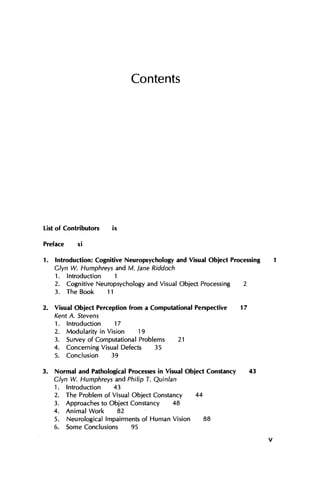









![decomposition of vision into modules reflects that which nature chose? The
still more sceptical might further suggest that it is misguided to imagine any
modular decomposition of vision, that vision can be understood only by
embracing its complexity and interactions as a whole. I would remind them
that we have already developed computer systems the complexity of which
defy understanding except in terms of levels of abstraction (ignoring the
hardware when thinking of the functionality, and vice versa) and only very
locally (considering only a very narrow aspect of the system under the
simplifying assumption that there are no important dependencies on global
states of the system that are not already reflected by local parameters). Of
course, we return to the fact that computer systems are artefacts that are
intentionally made with a high degree of strict modularity—we cannot
make complicated systems otherwise.
Marr (1982, p. 102), however, suggests that nature has also adopted the
principle o f modular design, primarily because if the components of a
system are not made as independent of one another as the individual tasks
allow, a small change to one component will have undesired consequences
elsewhere. A system that is not modujar would be difficult to improve or
extend; evolution presumably favours a functionally modular design.
Functional modularity does not mean strict segregation of function at the
neural level, however. Actual segregation or isolation of processes, in fact,
has its disadvantages, primarily poor economy of design and the problem
of communicating functionally useful information among processes. If two
problems are interrelated (such that the solution to one partly constrains
the solution to the other), it would be disadvantageous to isolate them.
Moreover, just as evolution favours functional modularity, it probably is
limited in how literally the modularity can be extended. That is, it would
seem improbable that evolution would extend the capabilities of a visual
system by implementing the new perceptual ability with neural structures
that are strictly isolated from the neural mechanisms that preceded it.
More likely would be either the duplication or subdivision of existing
cortical structures in order to perform some new, ecologically advantage-
ous, computation on existing internal information structures (see, for
example, Livingstone and Hubei, 1984, where they suggest that new
functional architecture to support colour vision was introduced into the
centre of the h]/percolumns found in striate cortex). As a consequence, the
new functional architecture would not only be intimately tied with the
earlier architecture, it would probably incorporate facilitatory interactions
between related processes in an ad hoc and case-by-case manner. I would
doubt that evolution adheres to strict design standards for adding new
functional capabilities; it is probably governed primarily by the particular
problems at hand.
For example, consider the problem of combining the 3-D information
20 STEVENS](https://image.slidesharecdn.com/26230805-250606151936-7a816fff/85/Visual-Object-Processing-A-Cognitive-Neuropsychological-Approach-Glyn-W-Humphreys-41-320.jpg)
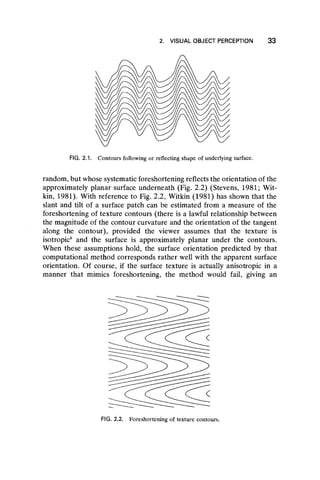




![This ebook is for the use of anyone anywhere in the United States
and most other parts of the world at no cost and with almost no
restrictions whatsoever. You may copy it, give it away or re-use it
under the terms of the Project Gutenberg License included with this
ebook or online at www.gutenberg.org. If you are not located in the
United States, you will have to check the laws of the country where
you are located before using this eBook.
Title: False Evidence
Author: E. Phillips Oppenheim
Illustrator: Maurice Grieffenhagen
Release date: October 24, 2017 [eBook #55798]
Most recently updated: October 23, 2024
Language: English
Credits: Produced by Al Haines
*** START OF THE PROJECT GUTENBERG EBOOK FALSE EVIDENCE
***](https://image.slidesharecdn.com/26230805-250606151936-7a816fff/85/Visual-Object-Processing-A-Cognitive-Neuropsychological-Approach-Glyn-W-Humphreys-60-320.jpg)