
http://communicationknowledgecenter.wordpress.com
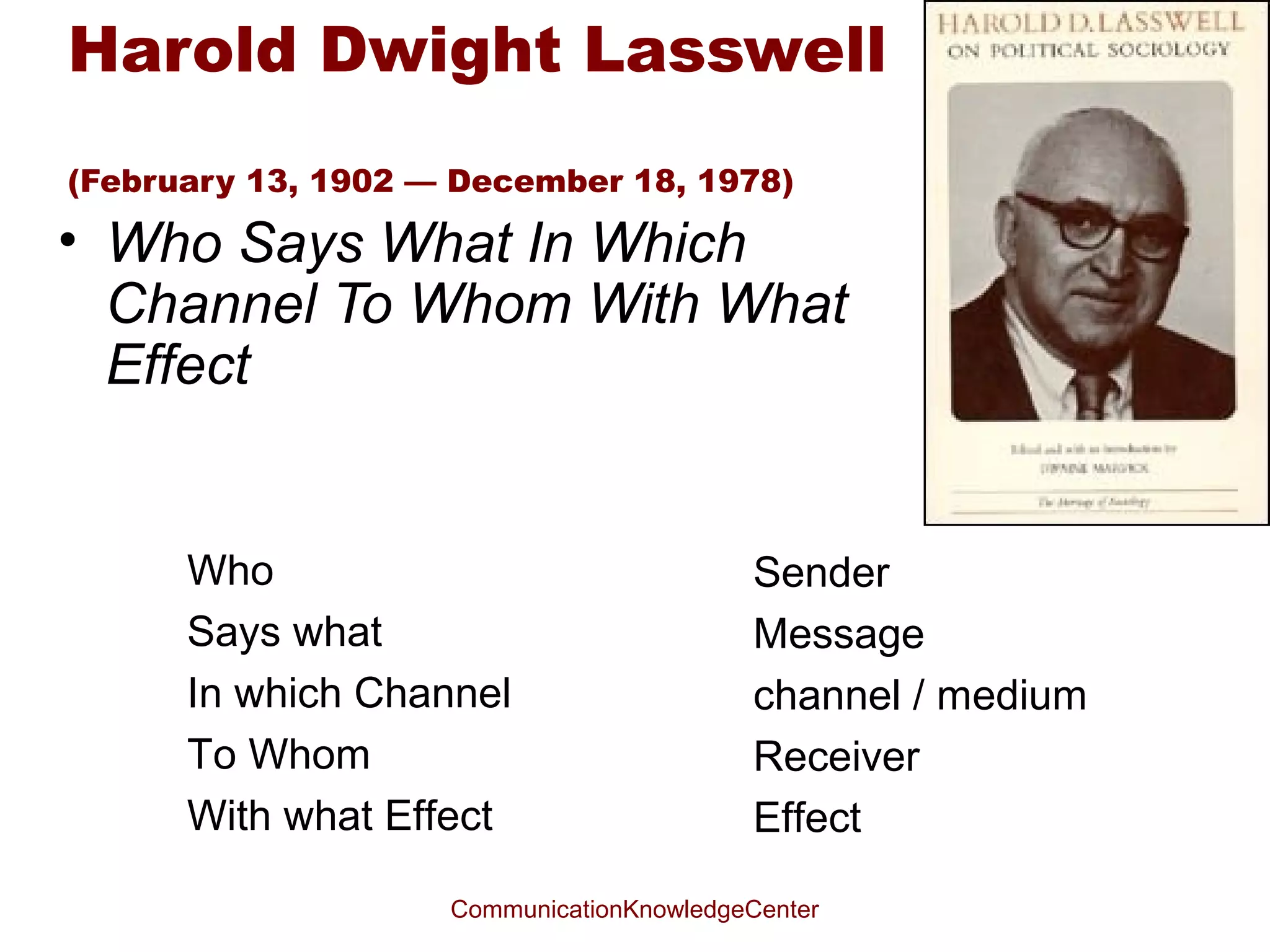
Harold Dwight Lasswell
(February 13, 1902 — December 18, 1978)

• Who Says What In Which
  Channel To Whom With What
  Effect


      Who                                 Sender
      Says what                           Message
      In which Channel                    channel / medium
      To Whom                             Receiver
      With what Effect                    Effect

                    CommunicationKnowledgeCenter
Some questions an organizational
communication expert has to
answer:
• the organizational problem,
• who actually influences this problem
• which individuals should be influenced in
  what they know, feel and do,
• which media they use,
• which places they visit,
• to which people and brands they are
  open,
• for what message they may be sensitive.
               CommunicationKnowledgeCenter
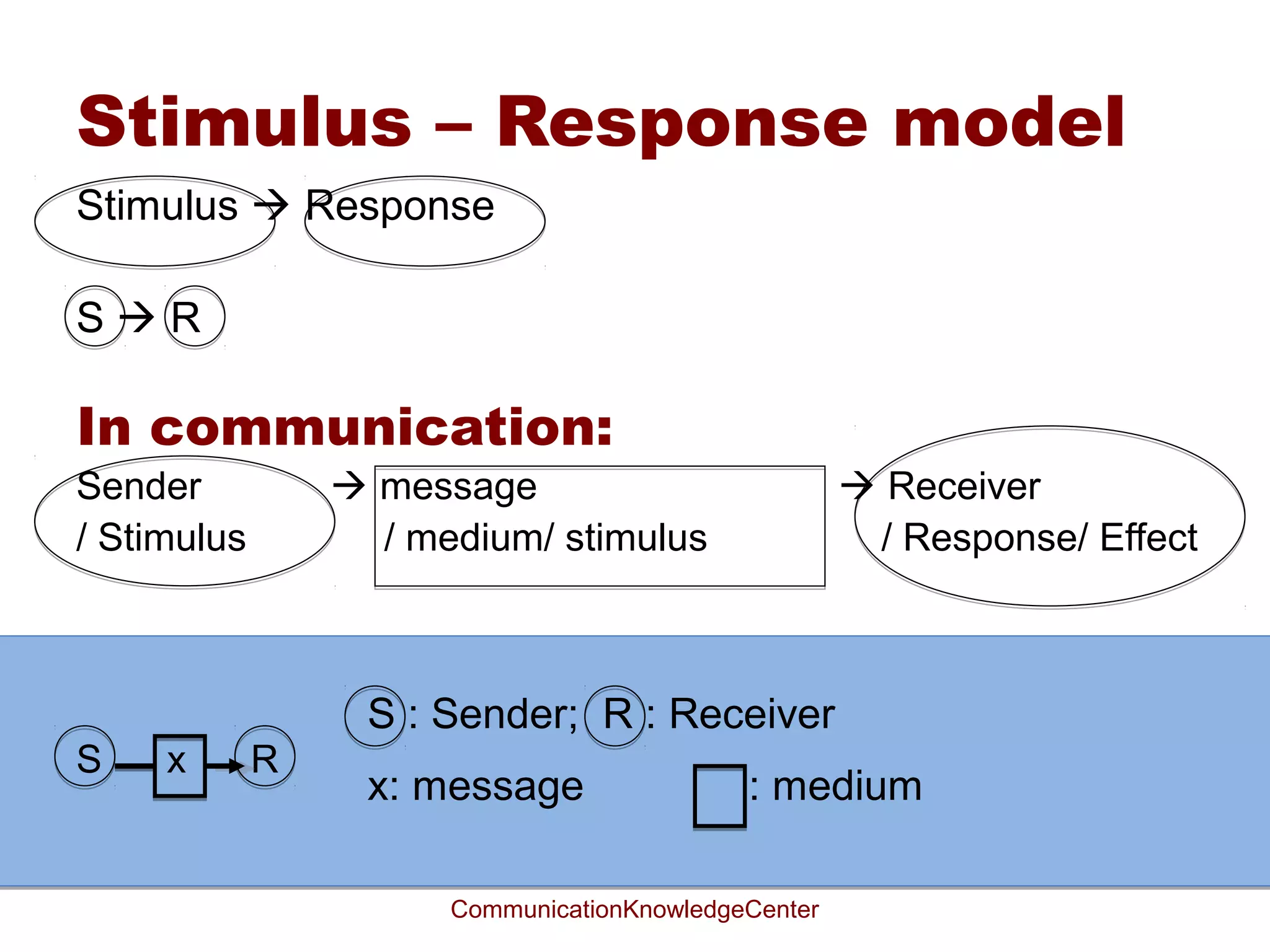
Stimulus – Response model
Stimulus  Response

SR

In communication:
Sender            message                             Receiver
/ Stimulus         / medium/ stimulus                  / Response/ Effect


                  S : Sender; R : Receiver
S    x       R
                  x: message                 : medium

                       CommunicationKnowledgeCenter
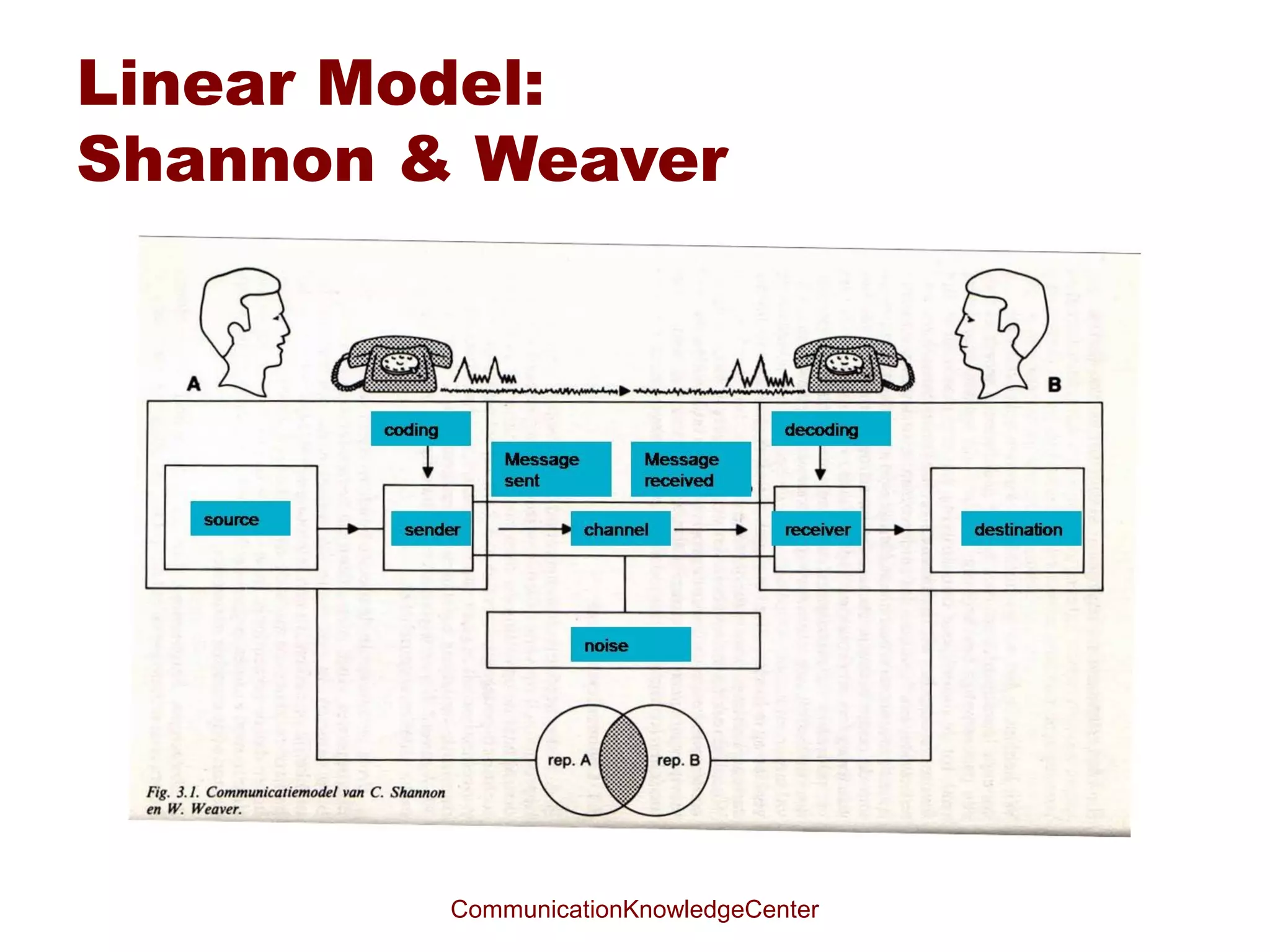
Shannon & Weaver
http://www.shkaminski.com/Classes/Handouts/Communication
%20Models.htm#TheShannonWeaverMathematicalModel1949


                     CommunicationKnowledgeCenter
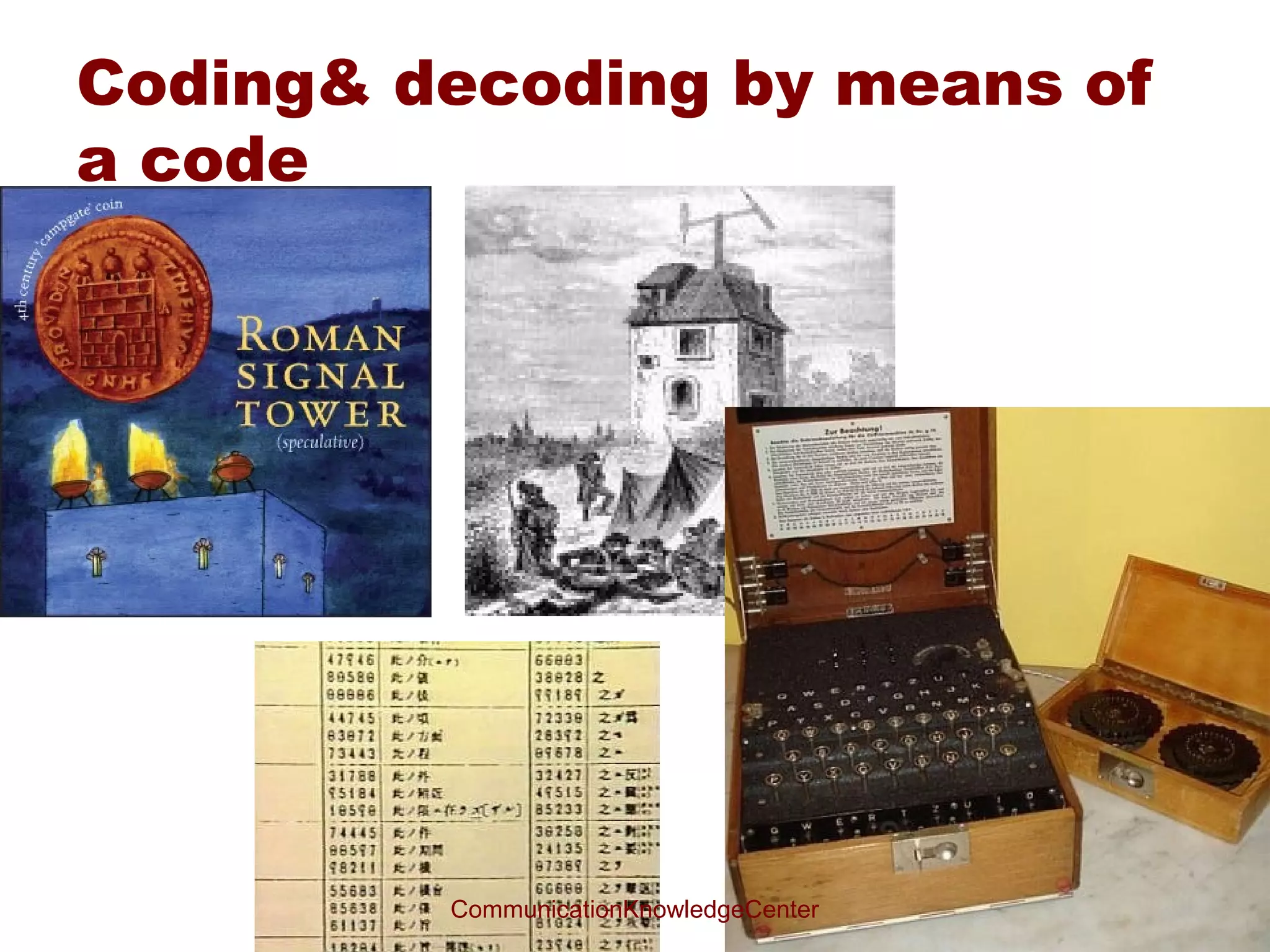
Coding& decoding by means of
a code


         CommunicationKnowledgeCenter
An ancient telegraph : fire and
    water
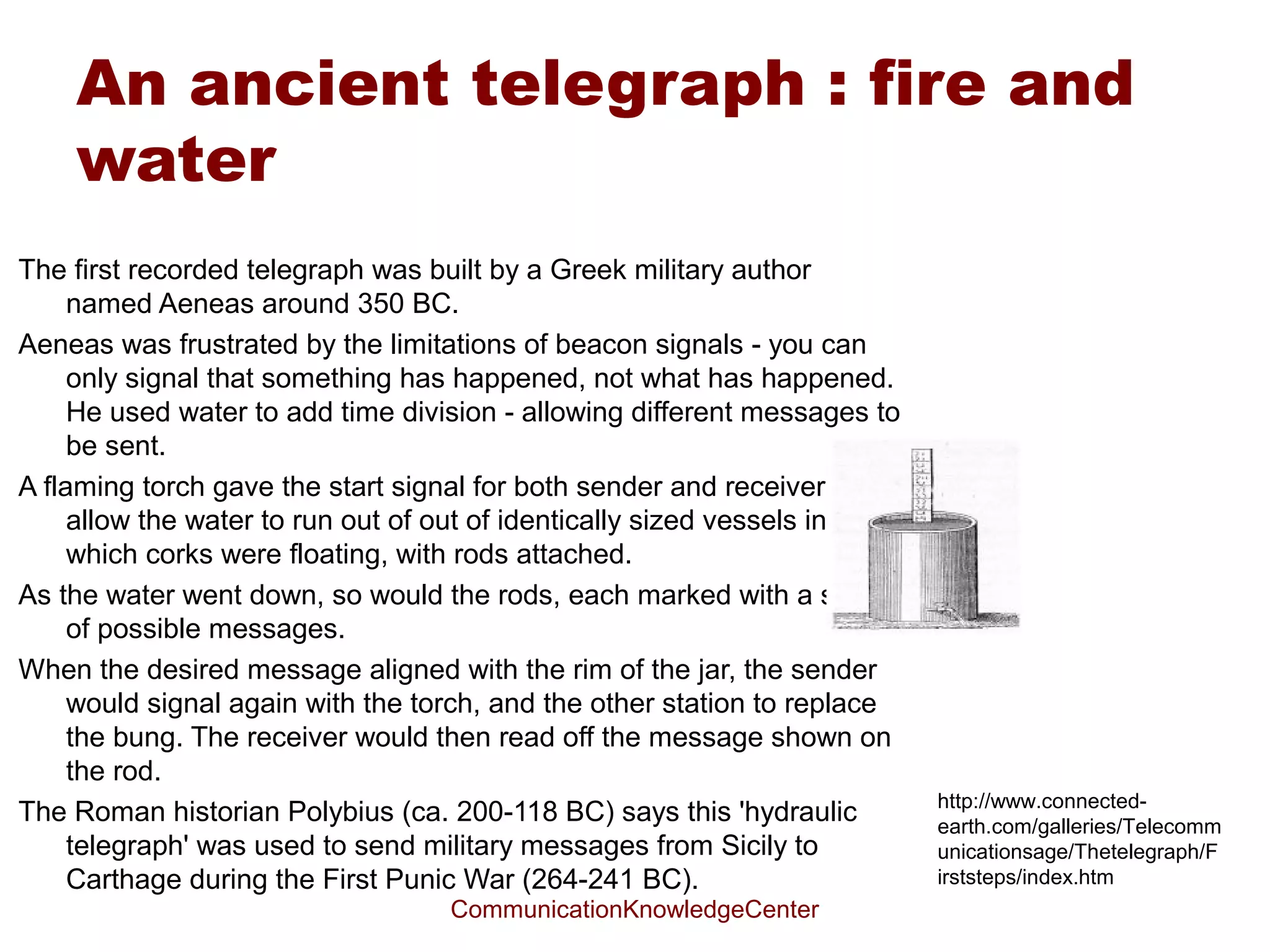
The first recorded telegraph was built by a Greek military author
     named Aeneas around 350 BC.
Aeneas was frustrated by the limitations of beacon signals - you can
     only signal that something has happened, not what has happened.
     He used water to add time division - allowing different messages to
     be sent.
A flaming torch gave the start signal for both sender and receiver to
     allow the water to run out of out of identically sized vessels in
     which corks were floating, with rods attached.
As the water went down, so would the rods, each marked with a series
     of possible messages.
When the desired message aligned with the rim of the jar, the sender
     would signal again with the torch, and the other station to replace
     the bung. The receiver would then read off the message shown on
     the rod.
                                                                           http://www.connected-
The Roman historian Polybius (ca. 200-118 BC) says this 'hydraulic         earth.com/galleries/Telecomm
     telegraph' was used to send military messages from Sicily to          unicationsage/Thetelegraph/F
     Carthage during the First Punic War (264-241 BC).                     irststeps/index.htm
                                   CommunicationKnowledgeCenter
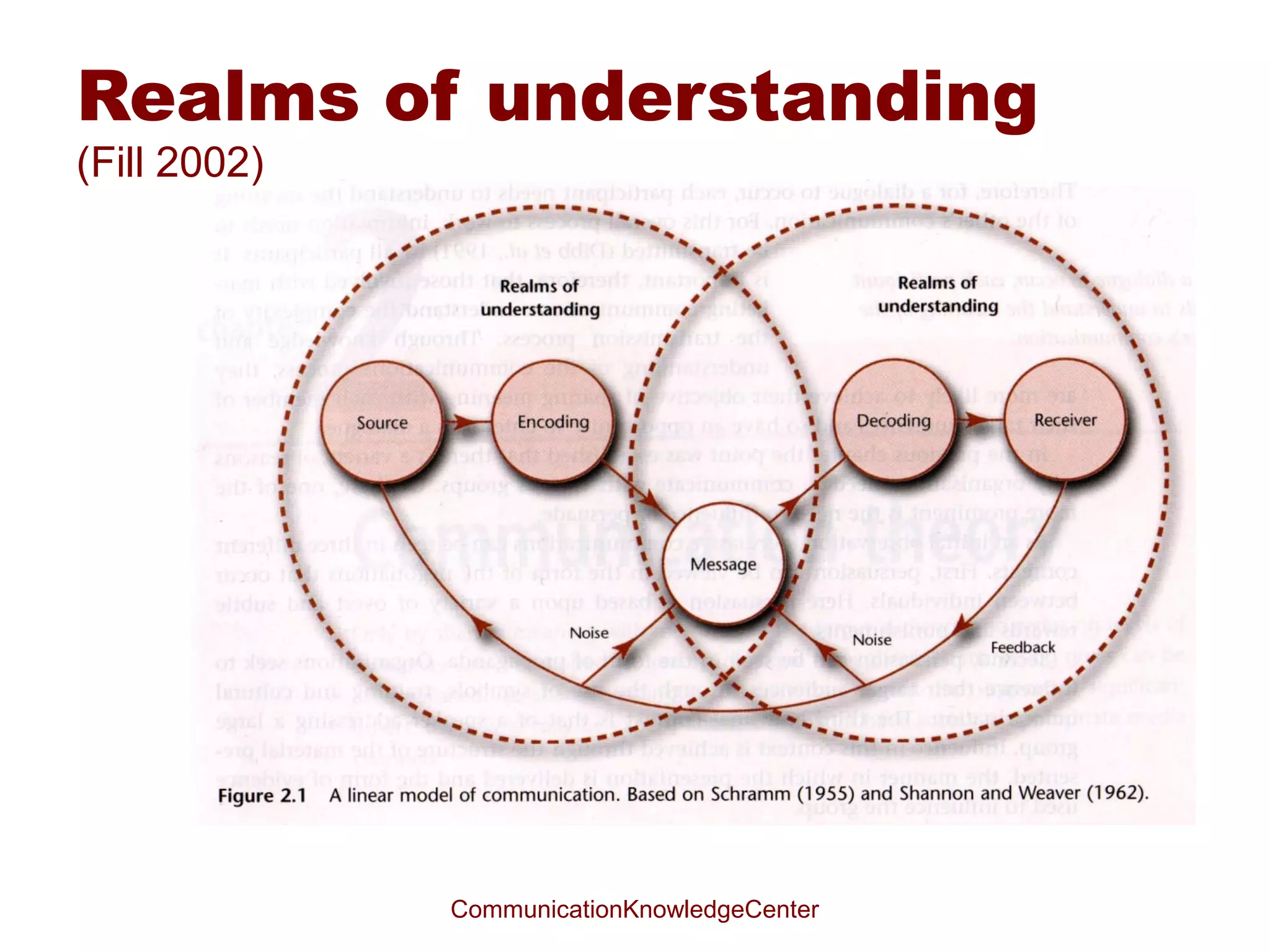
Realms of understanding
(Fill 2002)


              CommunicationKnowledgeCenter
Masculine versus feminine view
Masculine                                   Feminine
•   Hunting.                                •   Gathering.
•   Communication is sending.               •   Communication is making common.
•   Expanding the realm of influence.       •   Maintaining norms and values.
•   The more we send, the better we         •   Quality of communication counts, not
    communicate.                                quantity.
•   The bigger the communication budget,    •   The communication budget should be
    the better.                                 big enough to guarantee good
•   The sender is the dominant party.           communication.
•   You are the target and I shoot my       •   People are equal participants in a
    knowledge on it.                            process.
•   I know something and I teach you.       •   We all possess information, let's tell
•   As a result we both know what I know.       each other about it and conclude what
                                                we can do with it.
•   Stimulus evokes response.
                                            •   As a result we all know more than
•   Linear vision.                              before we met.
•   Action of expanding the amount of       •   People create their own reality.
    people who agree with me.
                                            •   Circular vision.
•   Action targeted on a goal; stops when
                                            •   Process of group formation.
    goal is reached.
•                                           •   Process, aimed at continuity.
    Communicate to.
                                            •
Environment
      Environment


        Employees
        Employees


          Manage
          Manage
           -ment
            -ment


CommunicationKnowledgeCenter
Similarities between dance
and communication: (Clampitt 2005 p14)
• Communication is used for Multiple Purposes (such as:
  to entertain, inform, persuade, incite and seduce).
• Communication Involves the Coordination of Meanings
• Communication Involves Co-Orientation
• Communication Is Rule-Governed
• Communicators Develop a Repertoire of Skills That May
  Pass From the Level of Consciousness
• Communication Can Be Viewed as a Patterned Activity


                  CommunicationKnowledgeCenter
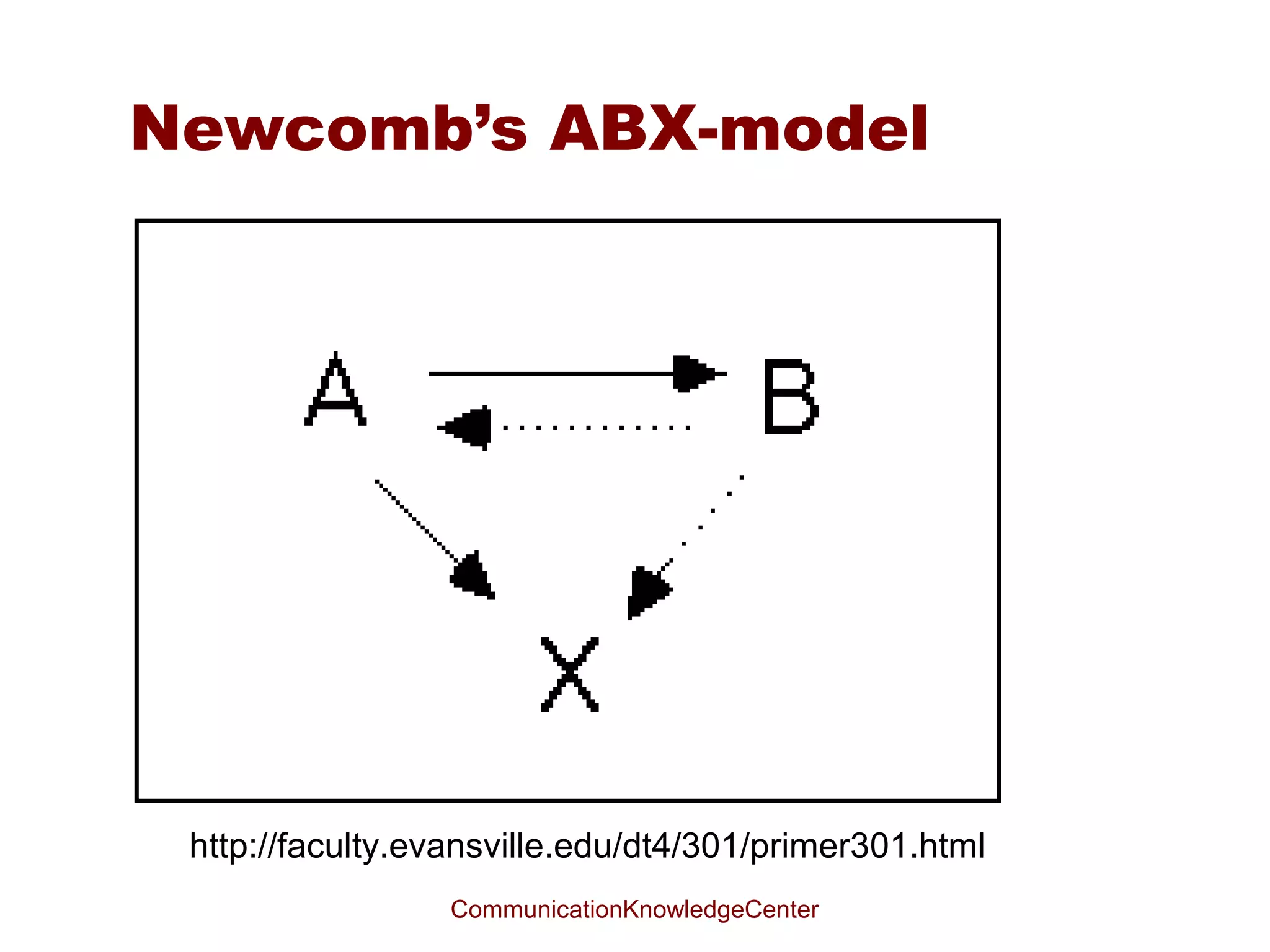
Newcomb’s ABX-model


 http://faculty.evansville.edu/dt4/301/primer301.html
                  CommunicationKnowledgeCenter
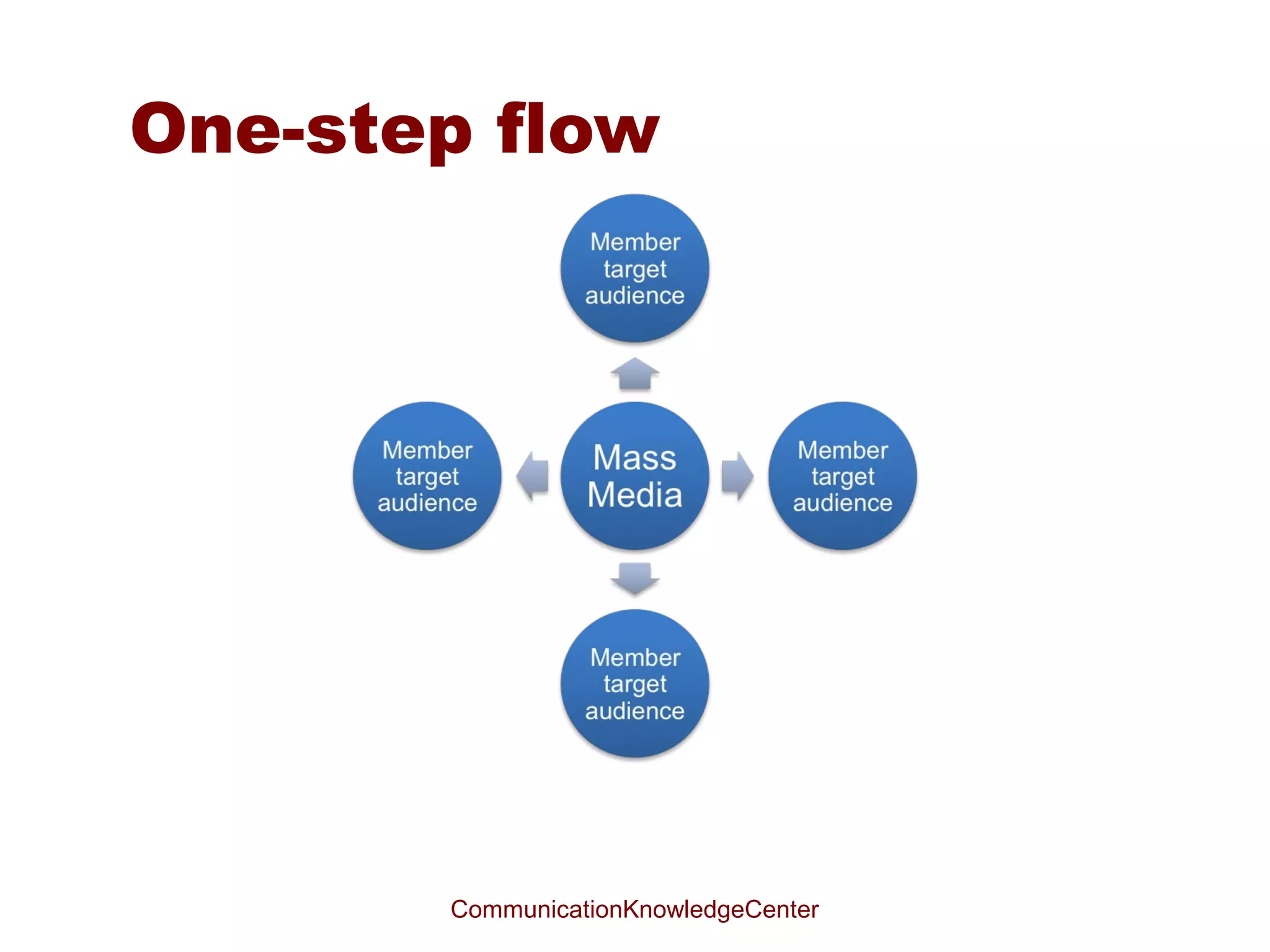
One-step flow


       CommunicationKnowledgeCenter
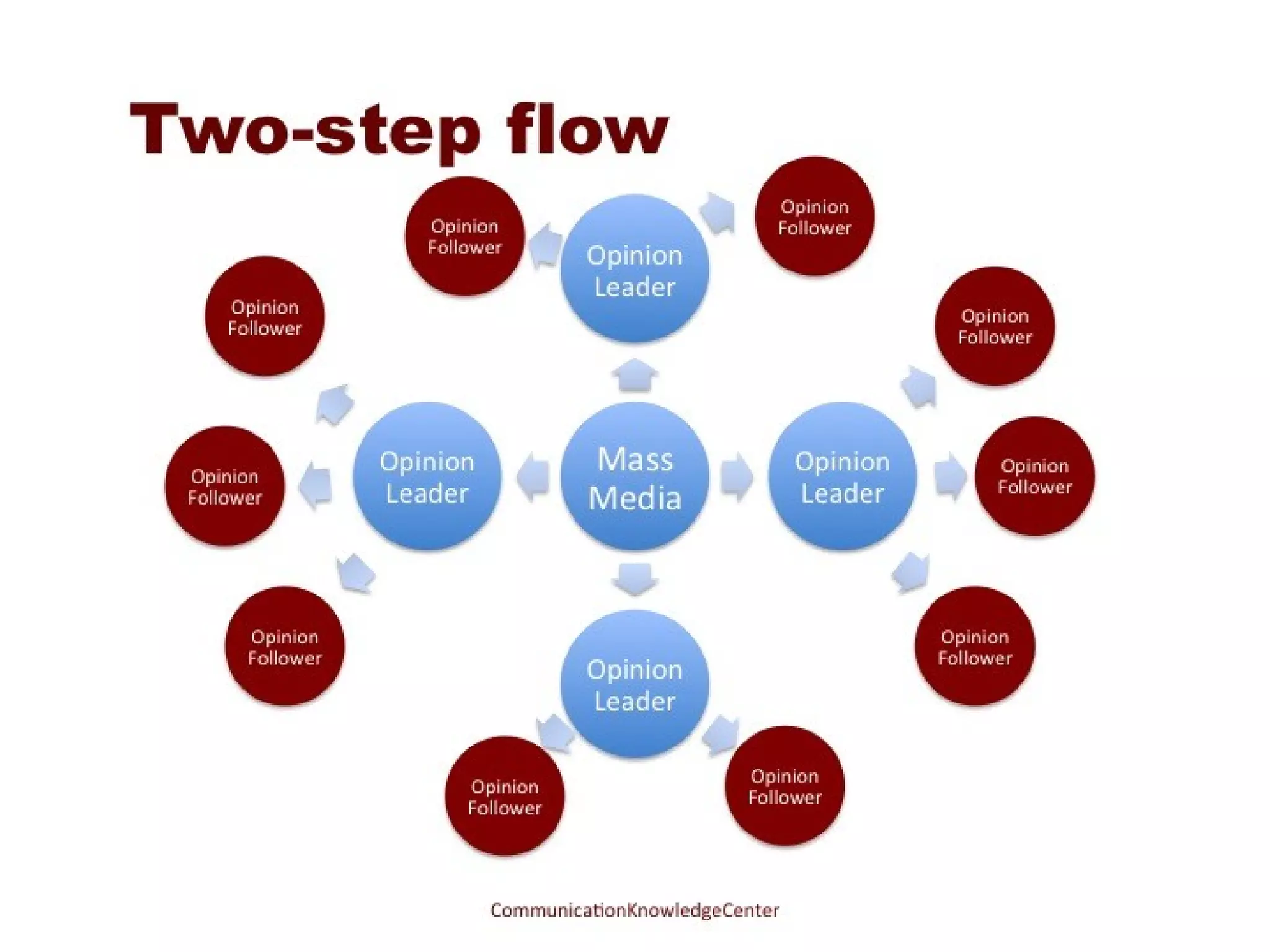
CommunicationKnowledgeCenter
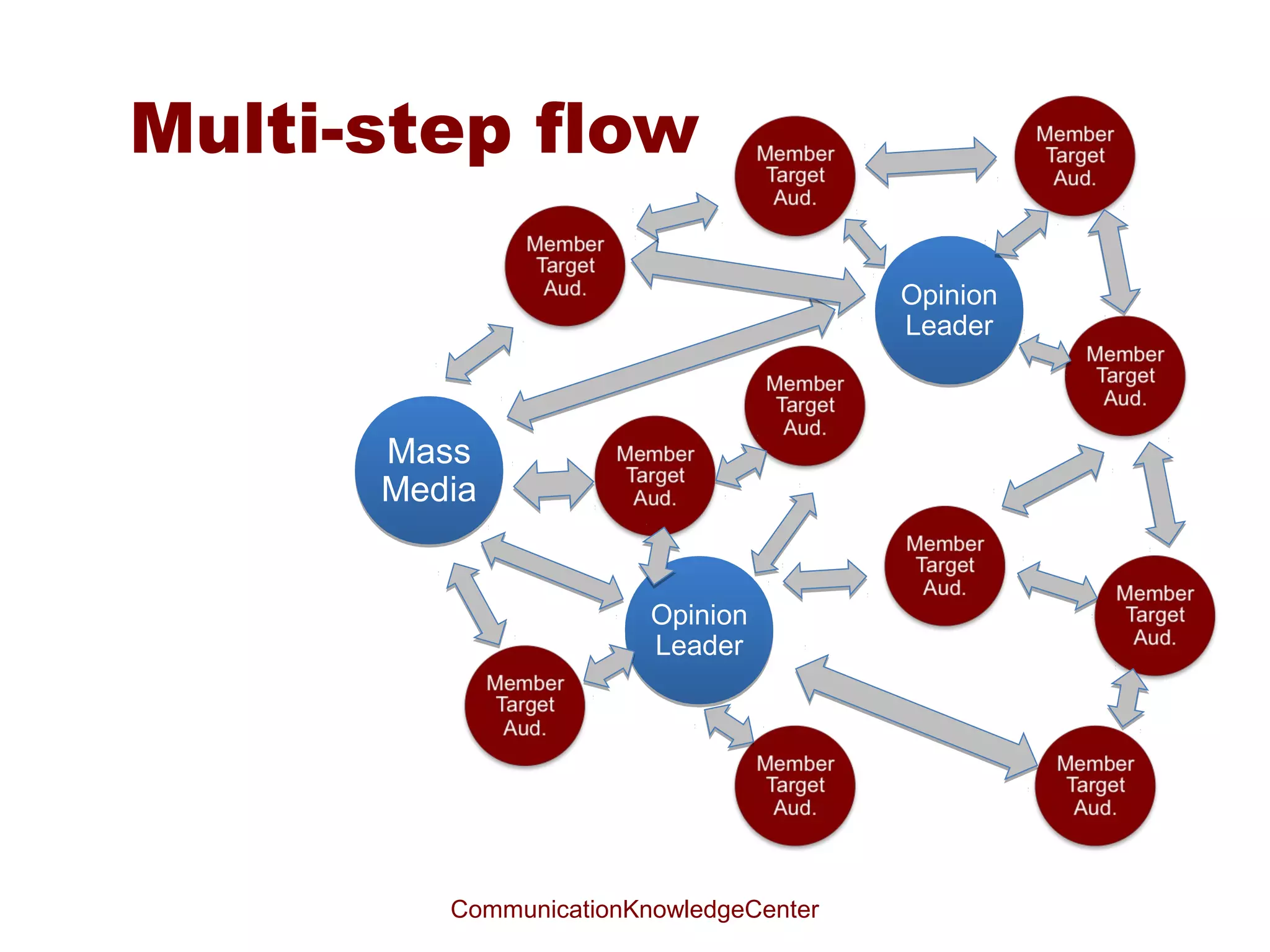
Multi-step flow

                                        Opinion
                                        Leader


      Mass
      Media


                        Opinion
                        Leader


         CommunicationKnowledgeCenter
Communicate
to / with
• The word ‘communication’ has been
  derived from the Latin word ‘communis’
  which means ‘to make common’.
• This can be understood as:
   – Communicate to: I know, I tell you, and    : sending
     then we both know.
   – Communicate with: We know things,          : ABX
     tell each other about it, together we
     create a common understanding.


                 CommunicationKnowledgeCenter
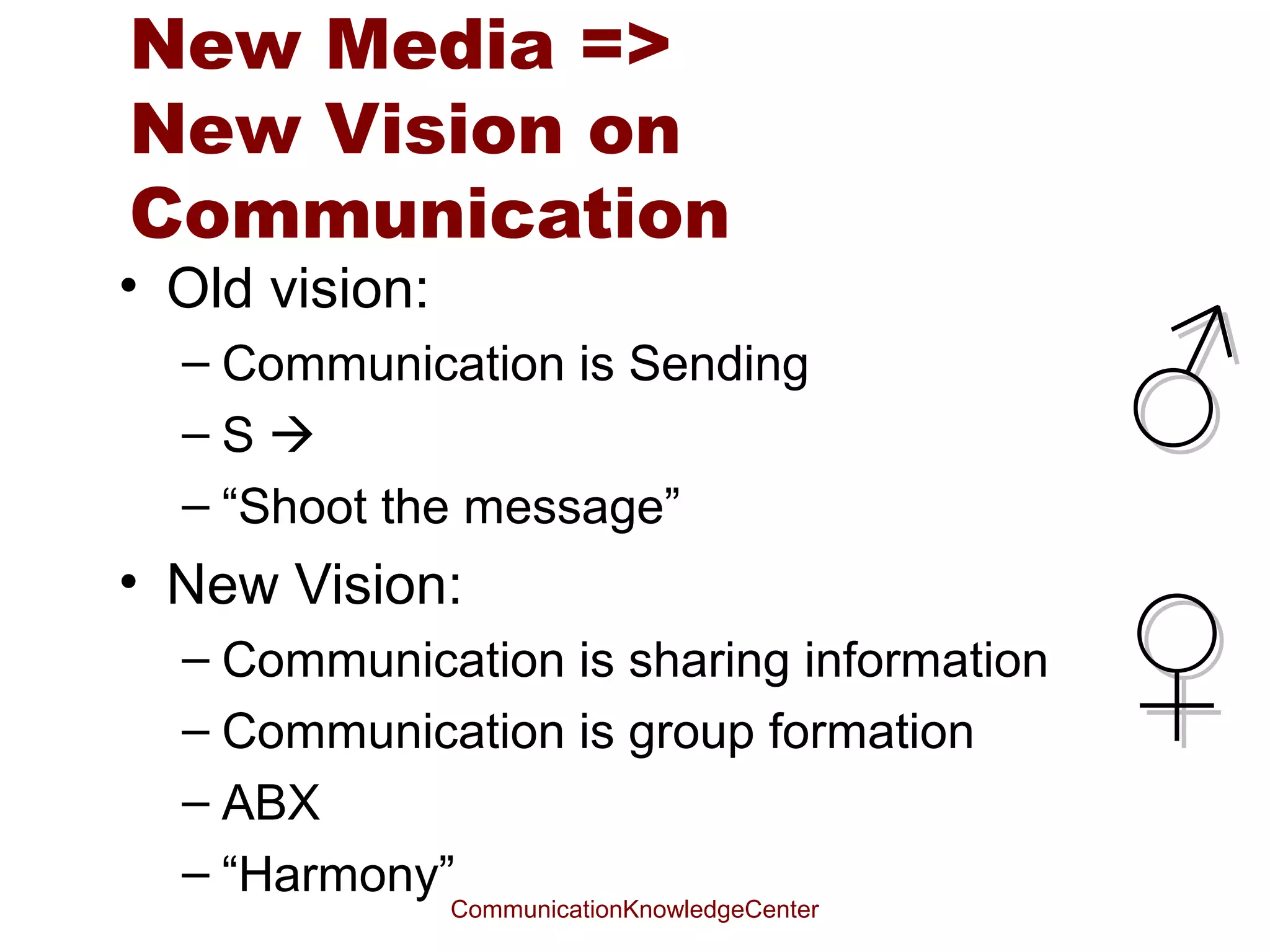
New Media =>
New Vision on
Communication
• Old vision:
  – Communication is Sending
  –S                                          ♂
  – “Shoot the message”
• New Vision:
  – Communication is sharing information
  – Communication is group formation
                                               ♀
  – ABX
  – “Harmony”
                CommunicationKnowledgeCenter
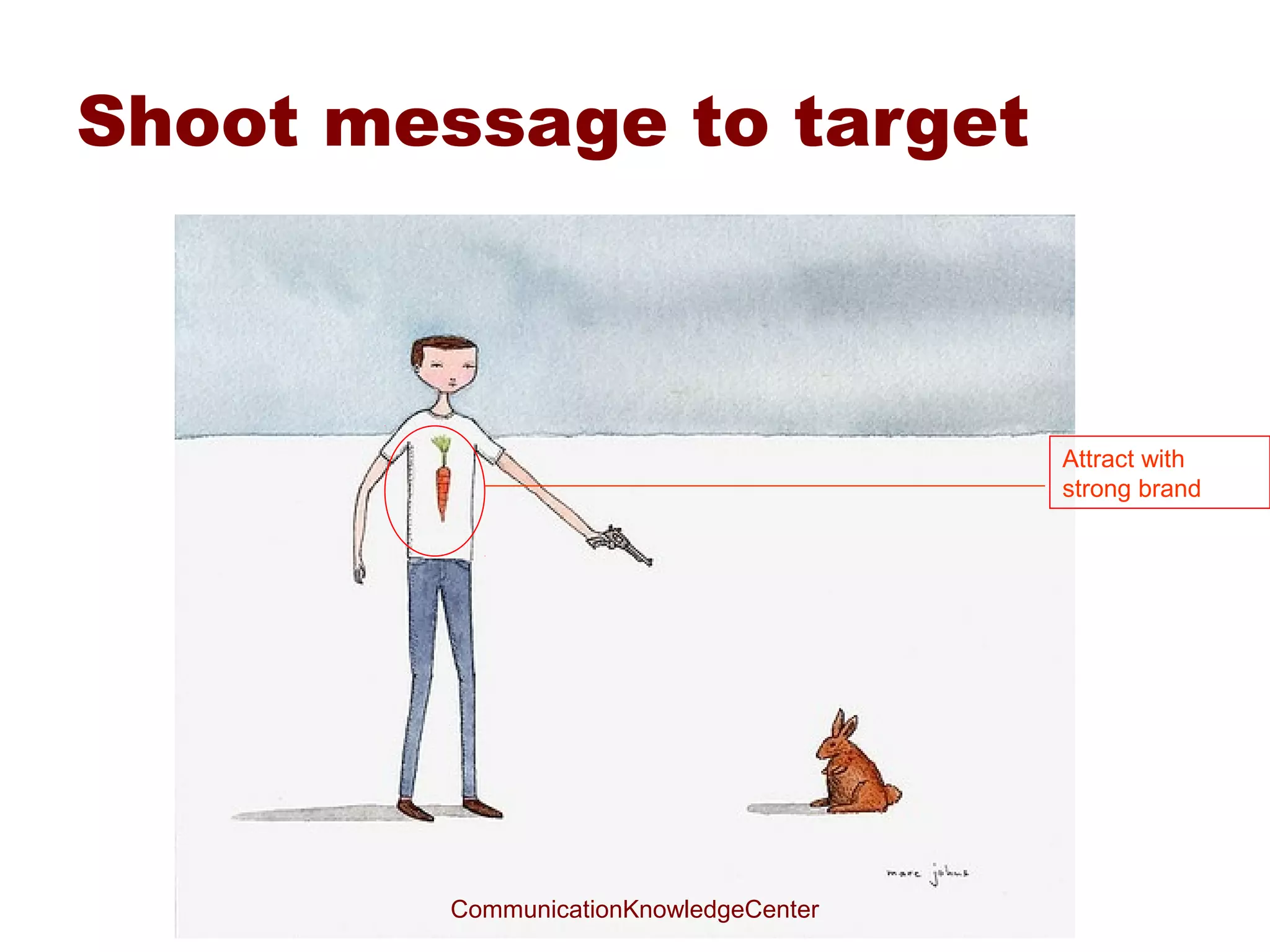
Shoot message to target


                                        Attract with
                                        strong brand


         CommunicationKnowledgeCenter
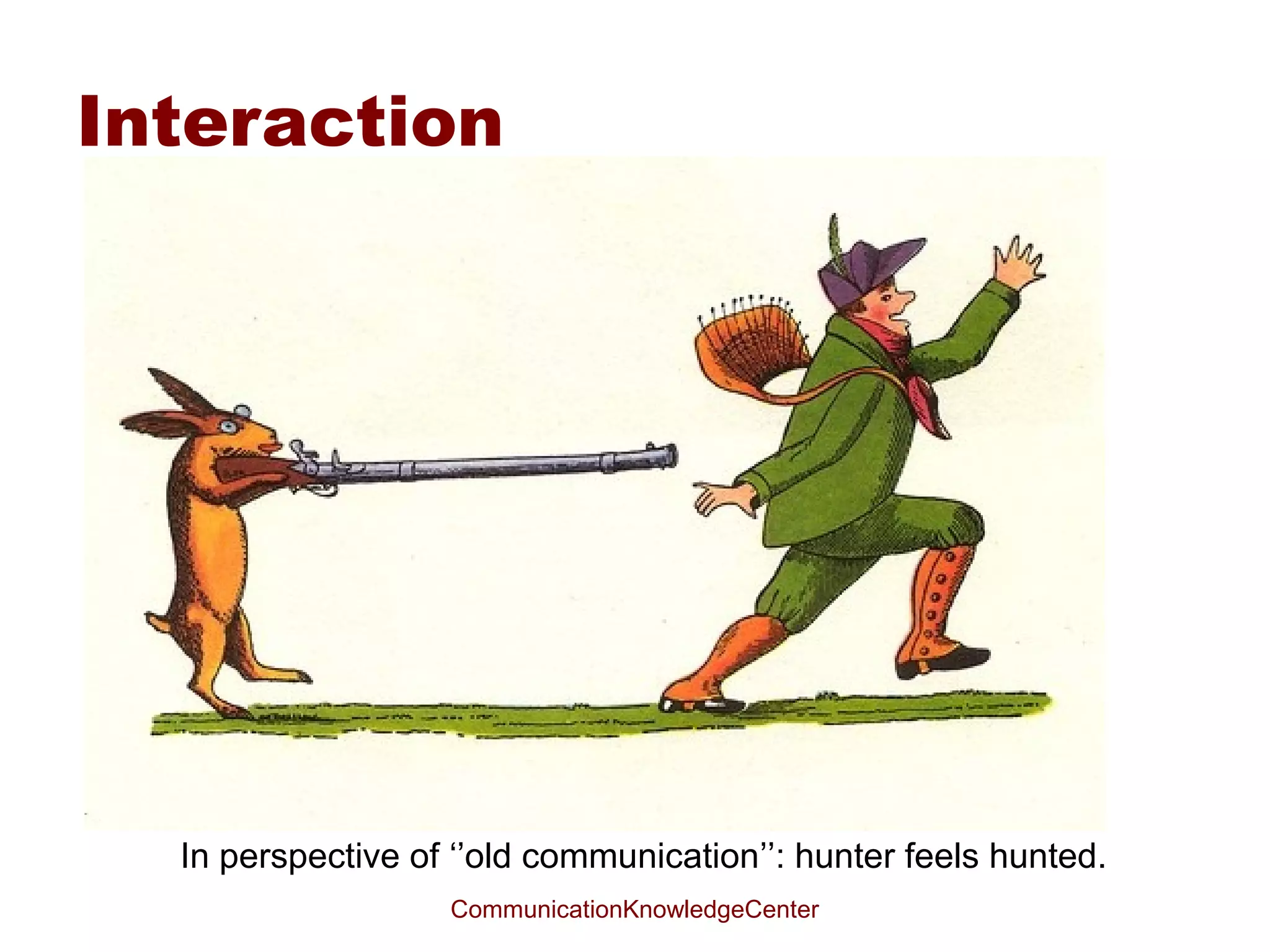
Interaction


  In perspective of ‘’old communication’’: hunter feels hunted.
                   CommunicationKnowledgeCenter
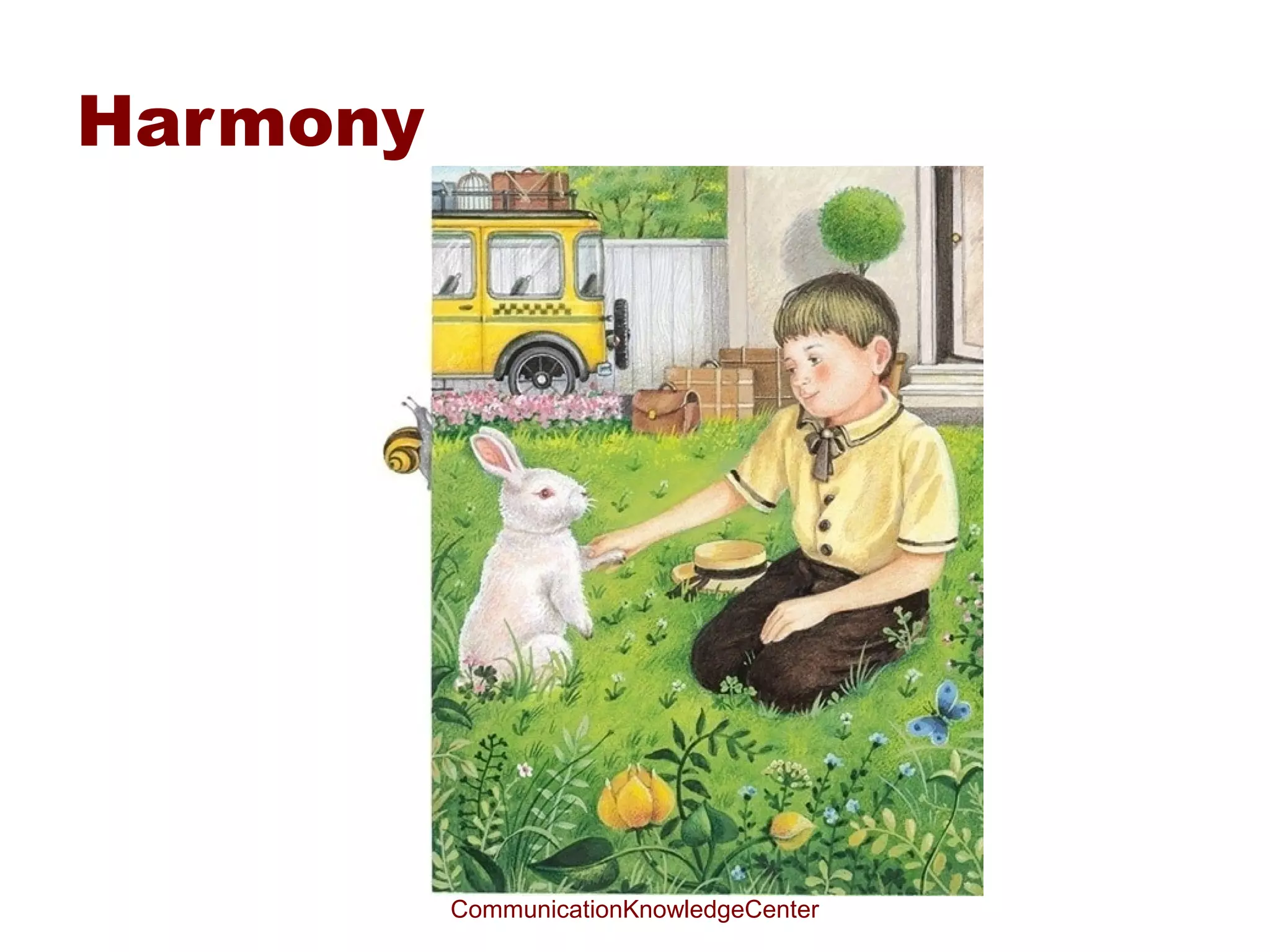
Harmony


          CommunicationKnowledgeCenter
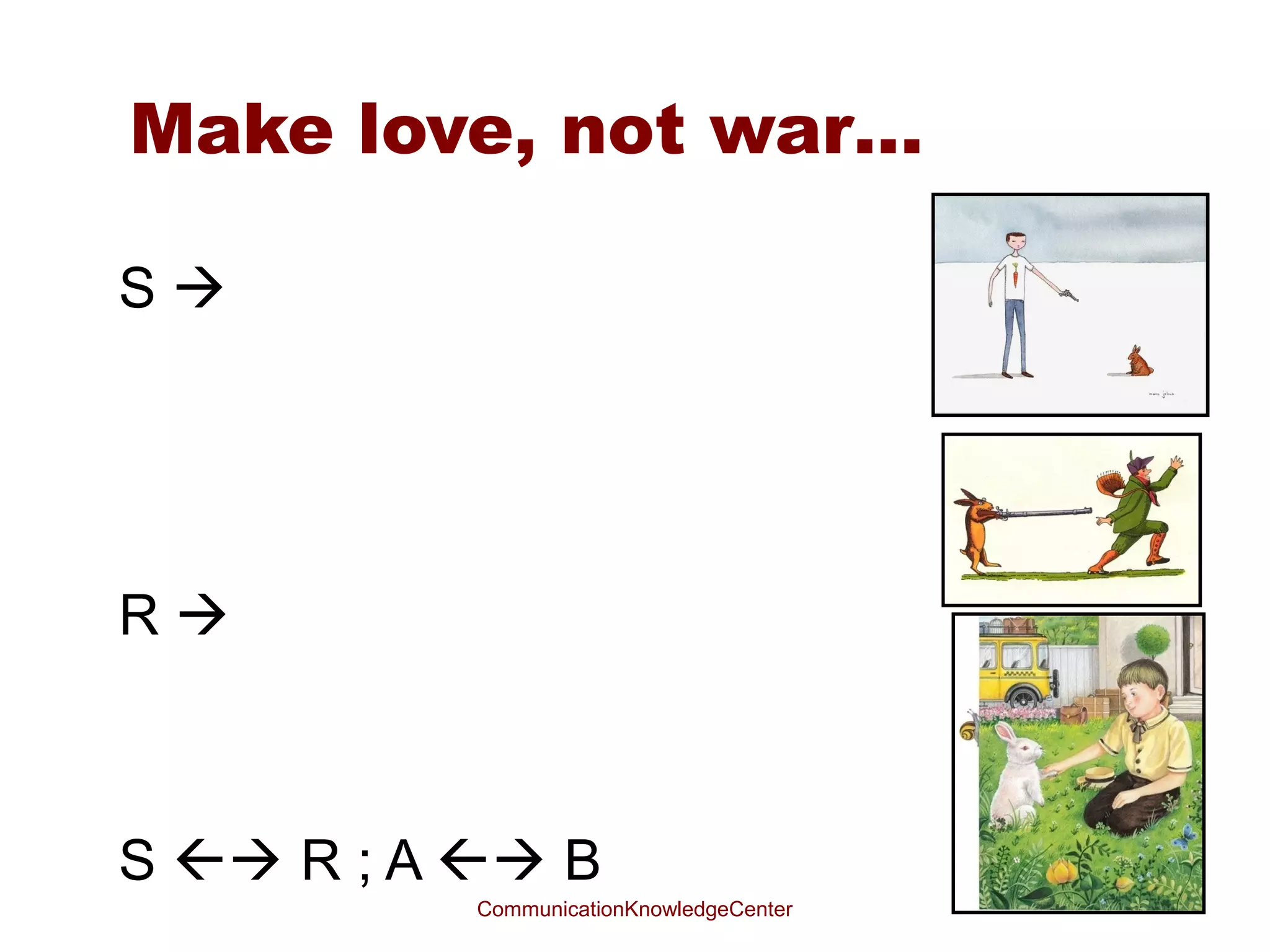
Make love, not war…

S


R


S  R ; A  B
           CommunicationKnowledgeCenter
Make love, not war…


        CommunicationKnowledgeCenter
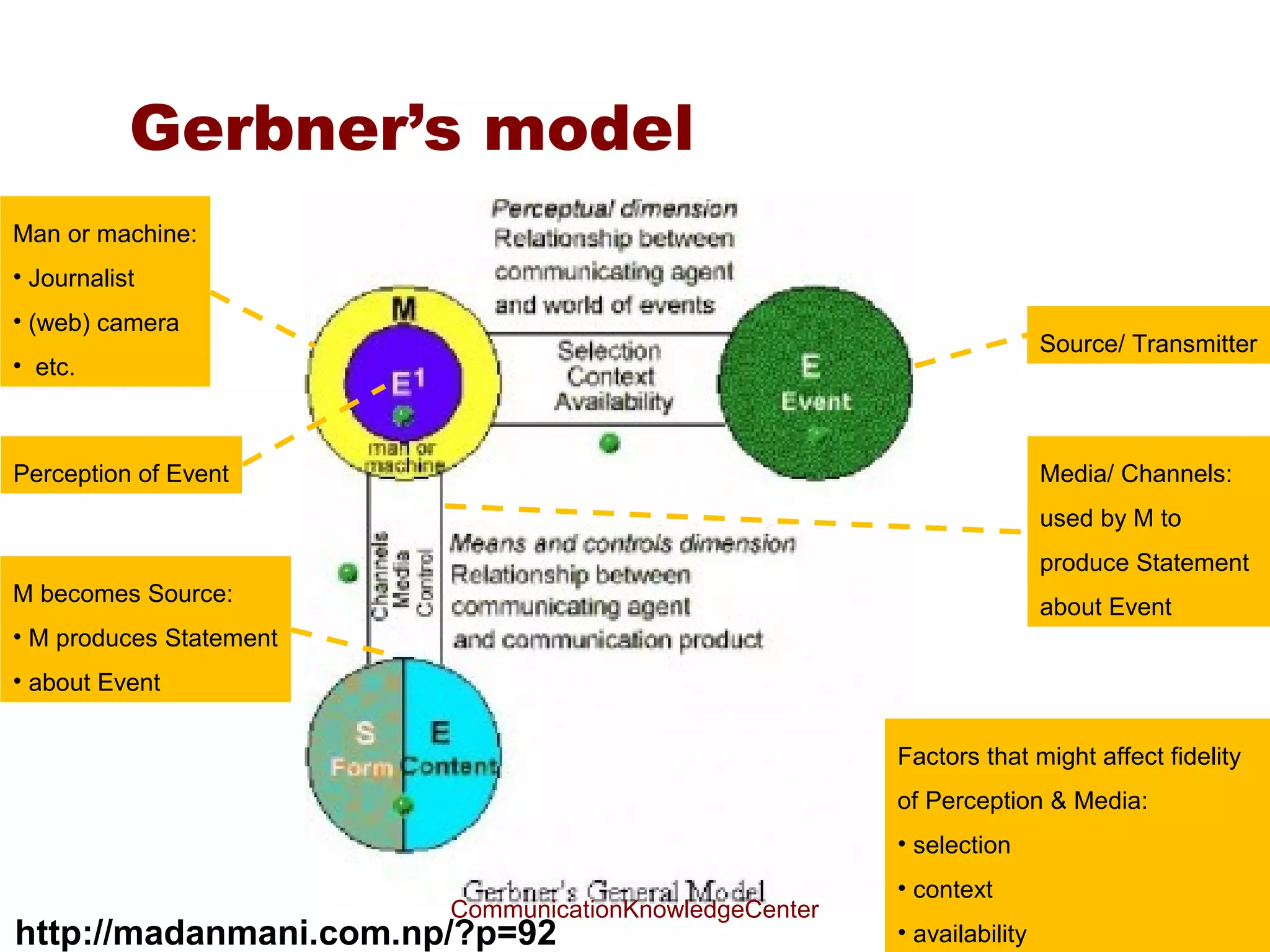
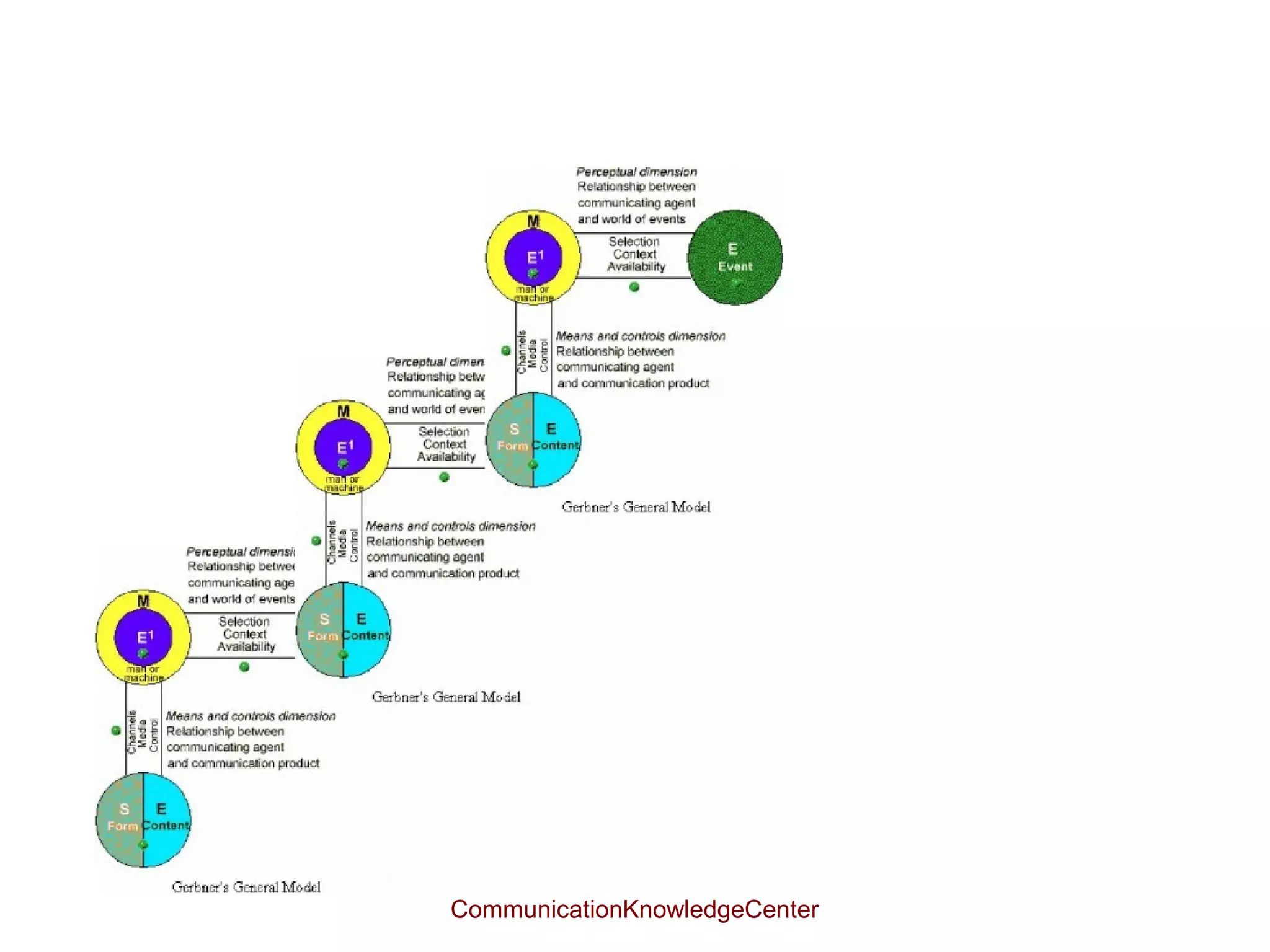
Gerbner’s model
Man or machine:
• Journalist
• (web) camera
                                                                         Source/ Transmitter
• etc.


Perception of Event                                                      Media/ Channels:
                                                                         used by M to
                                                                         produce Statement
M becomes Source:
                                                                         about Event
• M produces Statement
• about Event


                                                        Factors that might affect fidelity
                                                        of Perception & Media:
                                                        • selection
                                                        • context
                         CommunicationKnowledgeCenter
http://madanmani.com.np/?p=92                           • availability
CommunicationKnowledgeCenter
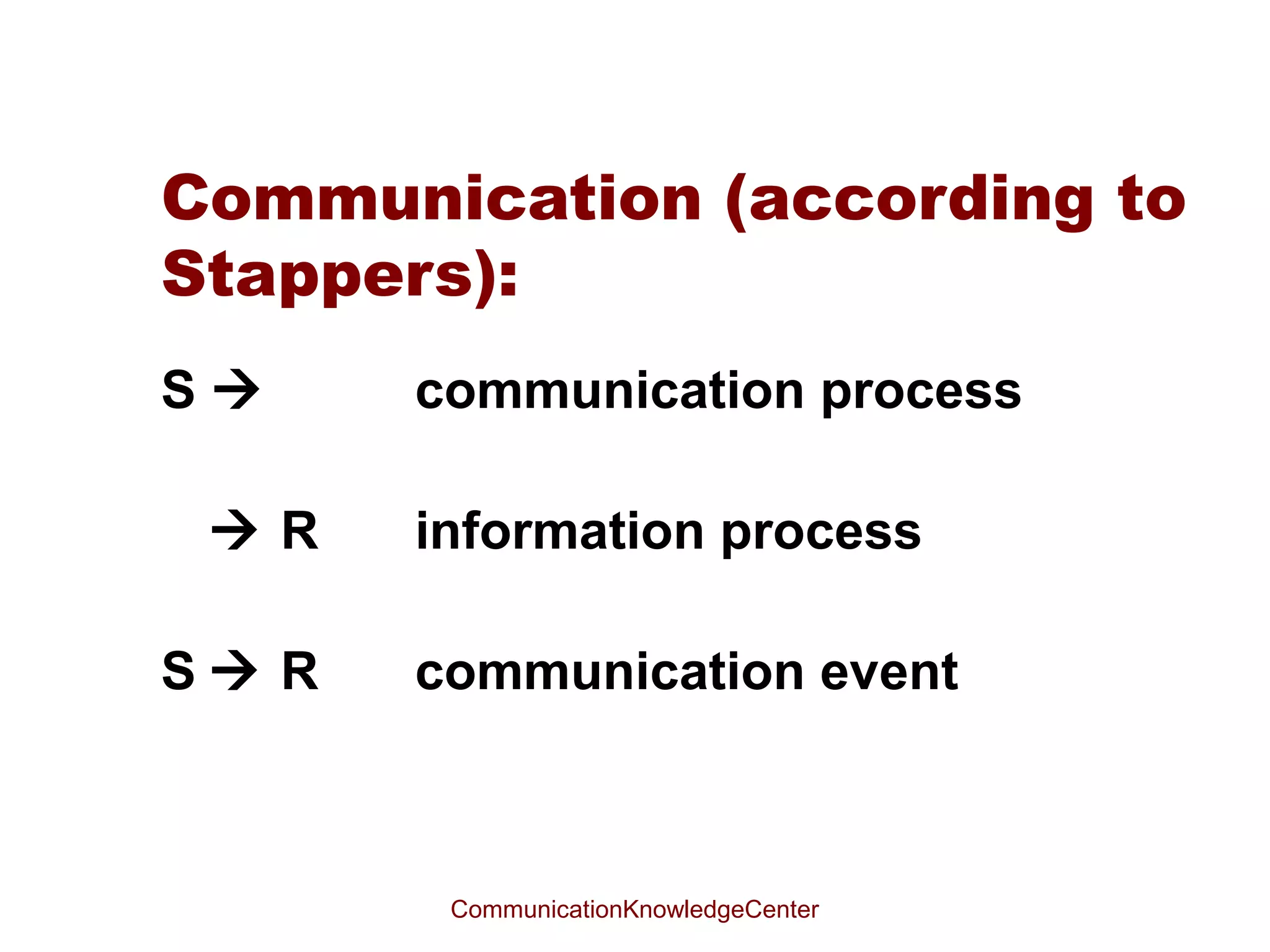
Communication (according to
Stappers):
S     communication process

 R    information process

S R   communication event


        CommunicationKnowledgeCenter
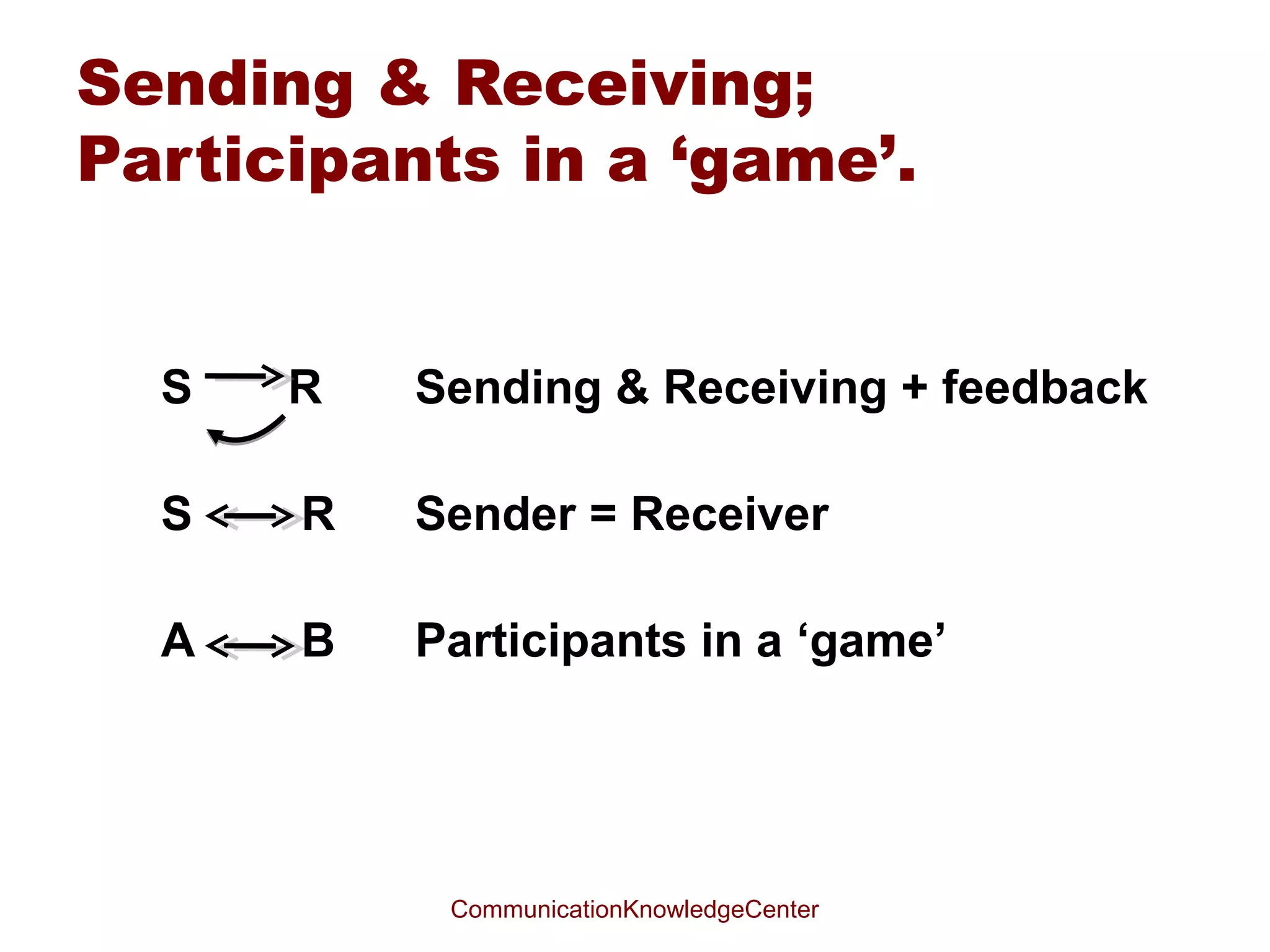
Sending & Receiving;
Participants in a ‘game’.


  S   R   Sending & Receiving + feedback

  S   R   Sender = Receiver

  A   B   Participants in a ‘game’


           CommunicationKnowledgeCenter
CommunicationKnowledgeCenter

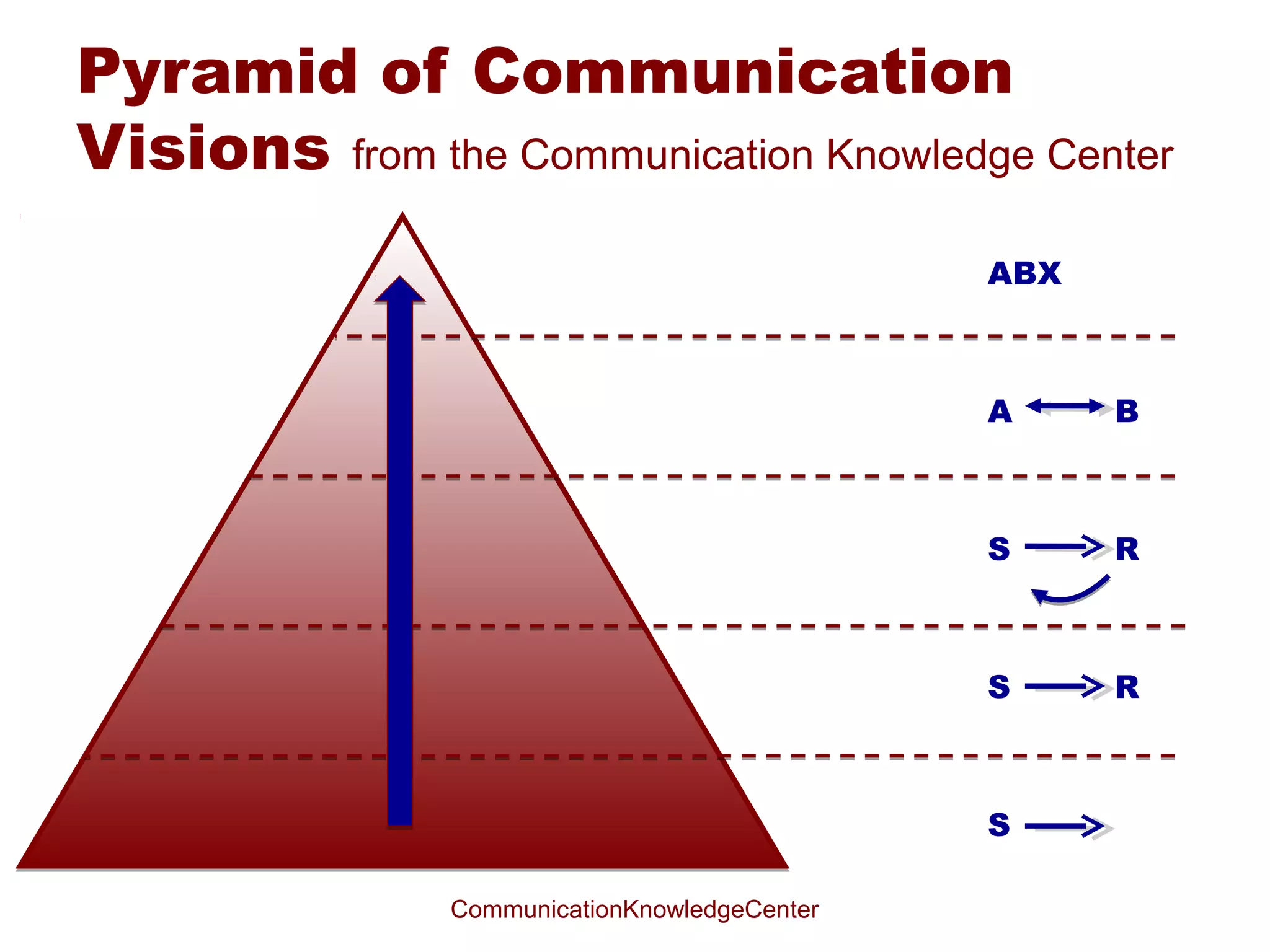
Visions on communication com kc

  • 1.
  • 2.
    Harold Dwight Lasswell (February13, 1902 — December 18, 1978) • Who Says What In Which Channel To Whom With What Effect Who Sender Says what Message In which Channel channel / medium To Whom Receiver With what Effect Effect CommunicationKnowledgeCenter
  • 3.
    Some questions anorganizational communication expert has to answer: • the organizational problem, • who actually influences this problem • which individuals should be influenced in what they know, feel and do, • which media they use, • which places they visit, • to which people and brands they are open, • for what message they may be sensitive. CommunicationKnowledgeCenter
  • 4.
    Stimulus – Responsemodel Stimulus  Response SR In communication: Sender  message  Receiver / Stimulus / medium/ stimulus / Response/ Effect S : Sender; R : Receiver S x R x: message : medium CommunicationKnowledgeCenter
  • 5.
  • 6.
    Coding& decoding bymeans of a code CommunicationKnowledgeCenter
  • 7.
    An ancient telegraph: fire and water The first recorded telegraph was built by a Greek military author named Aeneas around 350 BC. Aeneas was frustrated by the limitations of beacon signals - you can only signal that something has happened, not what has happened. He used water to add time division - allowing different messages to be sent. A flaming torch gave the start signal for both sender and receiver to allow the water to run out of out of identically sized vessels in which corks were floating, with rods attached. As the water went down, so would the rods, each marked with a series of possible messages. When the desired message aligned with the rim of the jar, the sender would signal again with the torch, and the other station to replace the bung. The receiver would then read off the message shown on the rod. http://www.connected- The Roman historian Polybius (ca. 200-118 BC) says this 'hydraulic earth.com/galleries/Telecomm telegraph' was used to send military messages from Sicily to unicationsage/Thetelegraph/F Carthage during the First Punic War (264-241 BC). irststeps/index.htm CommunicationKnowledgeCenter
  • 8.
    Realms of understanding (Fill2002) CommunicationKnowledgeCenter
  • 9.
    Masculine versus feminineview Masculine Feminine • Hunting. • Gathering. • Communication is sending. • Communication is making common. • Expanding the realm of influence. • Maintaining norms and values. • The more we send, the better we • Quality of communication counts, not communicate. quantity. • The bigger the communication budget, • The communication budget should be the better. big enough to guarantee good • The sender is the dominant party. communication. • You are the target and I shoot my • People are equal participants in a knowledge on it. process. • I know something and I teach you. • We all possess information, let's tell • As a result we both know what I know. each other about it and conclude what we can do with it. • Stimulus evokes response. • As a result we all know more than • Linear vision. before we met. • Action of expanding the amount of • People create their own reality. people who agree with me. • Circular vision. • Action targeted on a goal; stops when • Process of group formation. goal is reached. • • Process, aimed at continuity. Communicate to. •
  • 10.
    Environment Environment Employees Employees Manage Manage -ment -ment CommunicationKnowledgeCenter
  • 11.
    Similarities between dance andcommunication: (Clampitt 2005 p14) • Communication is used for Multiple Purposes (such as: to entertain, inform, persuade, incite and seduce). • Communication Involves the Coordination of Meanings • Communication Involves Co-Orientation • Communication Is Rule-Governed • Communicators Develop a Repertoire of Skills That May Pass From the Level of Consciousness • Communication Can Be Viewed as a Patterned Activity CommunicationKnowledgeCenter
  • 12.
  • 13.
    One-step flow CommunicationKnowledgeCenter
  • 14.
  • 15.
    Multi-step flow Opinion Leader Mass Media Opinion Leader CommunicationKnowledgeCenter
  • 16.
    Communicate to / with •The word ‘communication’ has been derived from the Latin word ‘communis’ which means ‘to make common’. • This can be understood as: – Communicate to: I know, I tell you, and : sending then we both know. – Communicate with: We know things, : ABX tell each other about it, together we create a common understanding. CommunicationKnowledgeCenter
  • 17.
    New Media => NewVision on Communication • Old vision: – Communication is Sending –S ♂ – “Shoot the message” • New Vision: – Communication is sharing information – Communication is group formation ♀ – ABX – “Harmony” CommunicationKnowledgeCenter
  • 18.
    Shoot message totarget Attract with strong brand CommunicationKnowledgeCenter
  • 19.
    Interaction Inperspective of ‘’old communication’’: hunter feels hunted. CommunicationKnowledgeCenter
  • 20.
    Harmony CommunicationKnowledgeCenter
  • 21.
    Make love, notwar… S R S  R ; A  B CommunicationKnowledgeCenter
  • 22.
    Make love, notwar… CommunicationKnowledgeCenter
  • 23.
    Gerbner’s model Man ormachine: • Journalist • (web) camera Source/ Transmitter • etc. Perception of Event Media/ Channels: used by M to produce Statement M becomes Source: about Event • M produces Statement • about Event Factors that might affect fidelity of Perception & Media: • selection • context CommunicationKnowledgeCenter http://madanmani.com.np/?p=92 • availability
  • 24.
  • 25.
    Communication (according to Stappers): S communication process R information process S R communication event CommunicationKnowledgeCenter
  • 26.
    Sending & Receiving; Participantsin a ‘game’. S R Sending & Receiving + feedback S R Sender = Receiver A B Participants in a ‘game’ CommunicationKnowledgeCenter
  • 27.

Editor's Notes

  • #3 xxxxxxxxxxxxxxx 01/09/13 xxxxxxxxxxxxx
  • #7 xxxxxxxxxxxxxxx 01/09/13 xxxxxxxxxxxxx
  • #13 xxxxxxxxxxxxxxx 01/09/13 xxxxxxxxxxxxx
  • #17 xxxxxxxxxxxxxxx 01/09/13 xxxxxxxxxxxxx
  • #18 xxxxxxxxxxxxxxx 01/09/13 xxxxxxxxxxxxx
  • #24 xxxxxxxxxxxxxxx 01/09/13 xxxxxxxxxxxxx
  • #25 xxxxxxxxxxxxxxx 01/09/13 xxxxxxxxxxxxx