1
Visionary Leadership
Leadership Series 2010
December 15, 2010
betti@leadershipQB.com
The Concept of Leadership
• Managers are people who do things right, while leaders are people who do
the right thing.
• 'Leadership is all about courage to dream big.‘
• Leadership is a complex process by which a person influences others to
accomplish a mission, task, or objective and directs the organization in a
way that makes it more cohesive and coherent
• Leadership makes people want to achieve high goals and objectives, while,
on the other hand, bosses tell people to accomplish a task or objective.
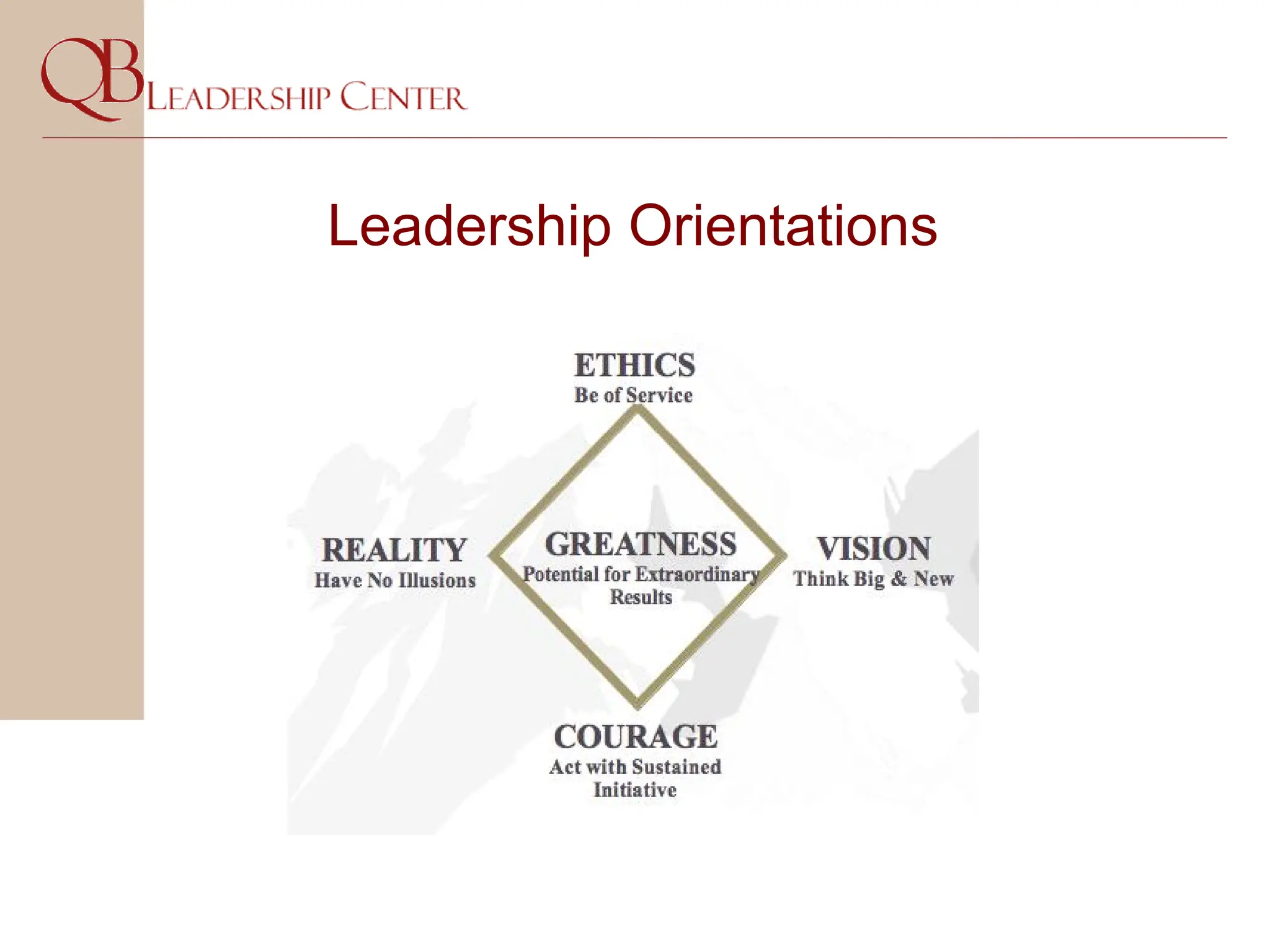
Leadership Orientations
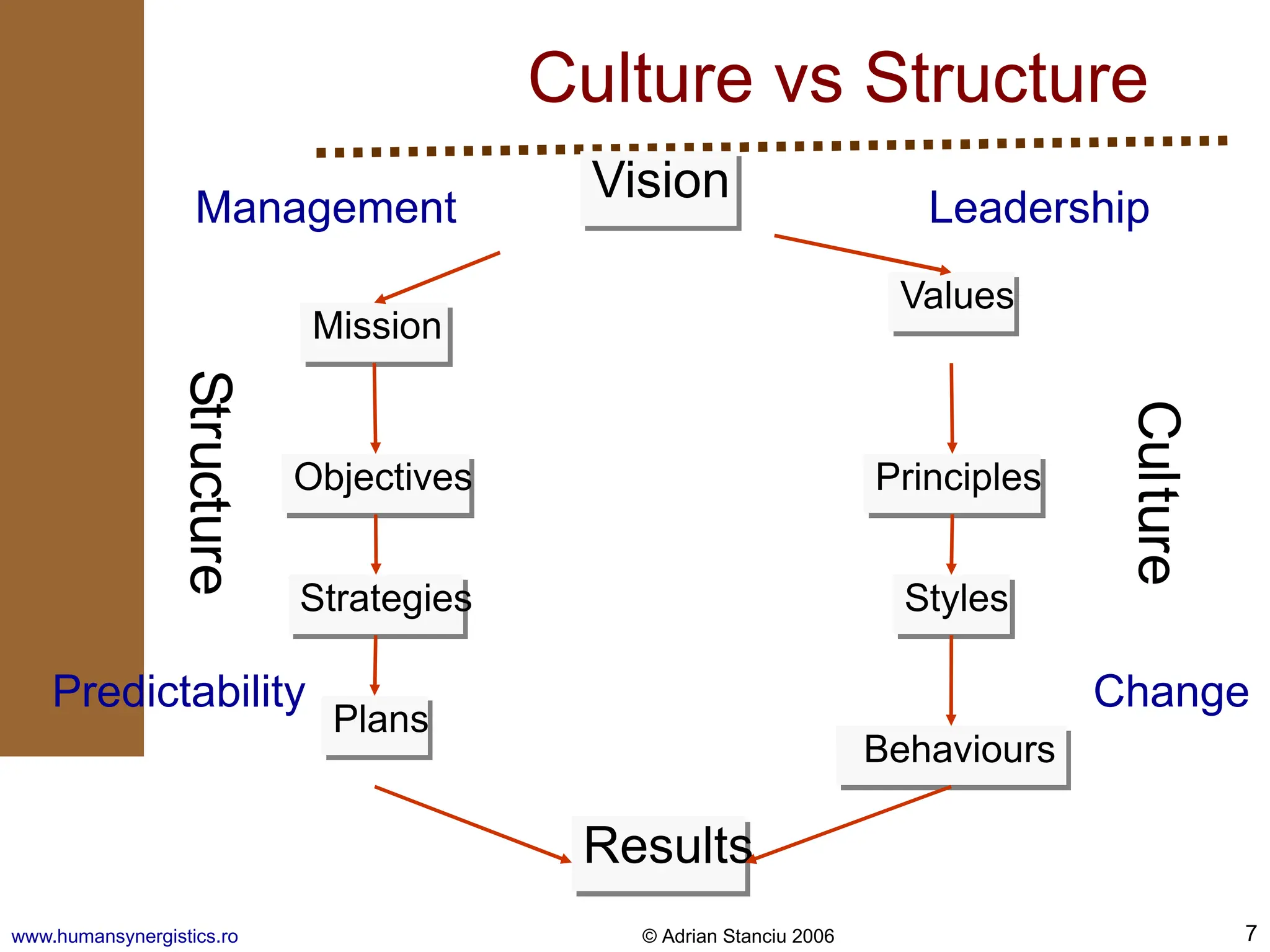
www.humansynergistics.ro 7
Vision
Results
Values
Styles
Strategies
Principles
Objectives
Mission
Plans
Behaviours
Structure
Culture
Predictability Change
Management Leadership
© Adrian Stanciu 2006
Culture vs Structure
Leadership Secrets
DECISIVENESS IS KEY
The most distinguished trait that defines a good
leader is the willingness to make decisions that are
needed of the hour no matter how difficult they
may be.
And the most significant component of such decision-
making is self-confidence.
Leadership Secrets
• RELATE AND RULE
Good leadership is the ability to
recognize all the factors that would
make the leader succeed in
motivating the group.
• TAKE RESPONSIBILITY
A leader is only as good as his team.
Leadership involves two steps:
helping subordinates take advantage
of their talents, and then fine tuning
their performance. Good leaders
always take responsibility for both the
success and failure of their teams
Visionary Leadership
Visionary leaders are the builders of a new dawn, working with imagination, insight, and boldness.
They present a challenge that calls forth the best in people and brings them together around a shared
sense of purpose.
Their eyes are on the horizon, not just on the near at hand. They are social innovators and change
agents, seeing the big picture and thinking strategically.
Visionary leaders help awaken and direct the inner strength of the people. they are interested in
pulling people up; they invigorate and stir a greater possibility.
Visionary perseveres, usually through a wide variety of challenges, uncertainties, personal short-
comings, and setbacks, taking her place among fellow visionaries who sow vision seeds of
individual and collective potential.
Ten Qualities Shared by Visionary Business Leaders
• They execute with confidence
• They're self-created
• They aren't worried about being liked
• They're innovators
• They're delegators
• They create learning opportunities
• They have high expectations
• They recognize natural talent
• They believe in actions, not words
• They're well balanced
Source : www.allbusiness.com
The Power of Imagination
Akio Morita
• In 1946, just following Japan's defeat in World War II, Morita began the effort that would
secure the reputation of his country as a marketplace leader.
• When Morita first opened shop in the 1950s the phrase “Made in Japan” was
synonymous with cheap imitations and inferior quality. Yet he was able to envision a
day when his company, Sony, would be a brand that consumers would identify
with the highest of quality. He devoted all of his efforts to realizing that vision.
• Partnering with Masaru Ibuka who brought engineering expertise and a product
orientation, the two brought to market one success after another: the first AM
transistor radio, the first pocket-sized transistor radio, the first all transistor television,
the first home use VCR and on and on.
• Before he died in 1999 Sony was an acknowledged world leader in the consumer
electronics and entertainment industries. He had personally played a leading role in
transforming Japan's economy from post-WWII shambles to a superior player in the
global marketplace.
Source : Seth-Kahan
Make Social Responsibility a Modus Operandi
Anita Roddick
By dedicating her business to the pursuit of social and environmental change, Anita
Roddick garnered the support of a massive consumer base and raised the bar of
employee engagement to new heights.
She changed the multi-billion dollar global cosmetics business through her company, The
Body Shop. In 1976 Roddick opened a shop in East Sussex with a handful of
homemade products. Today there are “over 1,700 stores serving over 84 million
customers in 49 different markets in 24 different languages and across 12 time zones.”
Roddick is not using social action as a marketing ploy. She says, “This is not about one
penny being spent in so-called cause-related marketing which is disingenuous. This is
about having a passion to shout out and be persuasive about what you do."
Instead of relying on traditional advertising, Roddick pursued marketing through in-store
brochures and interviews with the press. The stories focused on the unique nature of
her products and the social activism that was at the heart of her business philosophy.
When the company went public in 1984 its stocks doubled after one day and continued
to rise all through the decade. The store built a reputation not just by adopting global
causes, such as saving the rainforest and banning animal testing, but by encouraging
their staff to become active locally. The result has been a tremendously loyal customer
base that extends beyond traditional consumer interests.
Source : Seth-Kahan
Managers focus on control, leaders on goals,
visionary leaders on change.
"Visionary leaders realize it's better to fight tough
battles for worthy causes - than lead popular
movements doomed to eventual failure." - Allan
Wallace
visionary leadership skill organization.pdf

visionary leadership skill organization.pdf

  • 1.
    1 Visionary Leadership Leadership Series2010 December 15, 2010 betti@leadershipQB.com
  • 2.
    The Concept ofLeadership • Managers are people who do things right, while leaders are people who do the right thing. • 'Leadership is all about courage to dream big.‘ • Leadership is a complex process by which a person influences others to accomplish a mission, task, or objective and directs the organization in a way that makes it more cohesive and coherent • Leadership makes people want to achieve high goals and objectives, while, on the other hand, bosses tell people to accomplish a task or objective.
  • 3.
  • 4.
  • 5.
    Leadership Secrets DECISIVENESS ISKEY The most distinguished trait that defines a good leader is the willingness to make decisions that are needed of the hour no matter how difficult they may be. And the most significant component of such decision- making is self-confidence.
  • 6.
    Leadership Secrets • RELATEAND RULE Good leadership is the ability to recognize all the factors that would make the leader succeed in motivating the group. • TAKE RESPONSIBILITY A leader is only as good as his team. Leadership involves two steps: helping subordinates take advantage of their talents, and then fine tuning their performance. Good leaders always take responsibility for both the success and failure of their teams
  • 7.
    Visionary Leadership Visionary leadersare the builders of a new dawn, working with imagination, insight, and boldness. They present a challenge that calls forth the best in people and brings them together around a shared sense of purpose. Their eyes are on the horizon, not just on the near at hand. They are social innovators and change agents, seeing the big picture and thinking strategically. Visionary leaders help awaken and direct the inner strength of the people. they are interested in pulling people up; they invigorate and stir a greater possibility. Visionary perseveres, usually through a wide variety of challenges, uncertainties, personal short- comings, and setbacks, taking her place among fellow visionaries who sow vision seeds of individual and collective potential.
  • 8.
    Ten Qualities Sharedby Visionary Business Leaders • They execute with confidence • They're self-created • They aren't worried about being liked • They're innovators • They're delegators • They create learning opportunities • They have high expectations • They recognize natural talent • They believe in actions, not words • They're well balanced Source : www.allbusiness.com
  • 9.
    The Power ofImagination Akio Morita • In 1946, just following Japan's defeat in World War II, Morita began the effort that would secure the reputation of his country as a marketplace leader. • When Morita first opened shop in the 1950s the phrase “Made in Japan” was synonymous with cheap imitations and inferior quality. Yet he was able to envision a day when his company, Sony, would be a brand that consumers would identify with the highest of quality. He devoted all of his efforts to realizing that vision. • Partnering with Masaru Ibuka who brought engineering expertise and a product orientation, the two brought to market one success after another: the first AM transistor radio, the first pocket-sized transistor radio, the first all transistor television, the first home use VCR and on and on. • Before he died in 1999 Sony was an acknowledged world leader in the consumer electronics and entertainment industries. He had personally played a leading role in transforming Japan's economy from post-WWII shambles to a superior player in the global marketplace. Source : Seth-Kahan
  • 10.
    Make Social Responsibilitya Modus Operandi Anita Roddick By dedicating her business to the pursuit of social and environmental change, Anita Roddick garnered the support of a massive consumer base and raised the bar of employee engagement to new heights. She changed the multi-billion dollar global cosmetics business through her company, The Body Shop. In 1976 Roddick opened a shop in East Sussex with a handful of homemade products. Today there are “over 1,700 stores serving over 84 million customers in 49 different markets in 24 different languages and across 12 time zones.” Roddick is not using social action as a marketing ploy. She says, “This is not about one penny being spent in so-called cause-related marketing which is disingenuous. This is about having a passion to shout out and be persuasive about what you do." Instead of relying on traditional advertising, Roddick pursued marketing through in-store brochures and interviews with the press. The stories focused on the unique nature of her products and the social activism that was at the heart of her business philosophy. When the company went public in 1984 its stocks doubled after one day and continued to rise all through the decade. The store built a reputation not just by adopting global causes, such as saving the rainforest and banning animal testing, but by encouraging their staff to become active locally. The result has been a tremendously loyal customer base that extends beyond traditional consumer interests. Source : Seth-Kahan
  • 11.
    Managers focus oncontrol, leaders on goals, visionary leaders on change. "Visionary leaders realize it's better to fight tough battles for worthy causes - than lead popular movements doomed to eventual failure." - Allan Wallace