Regulation
Lesson 7
‘The Golden Age’ 1970-1985
• 1983 US arcade and home video games industry is
worth $11.8 billion (more than US film and music
together)
• 1985 crash due to rival consoles and lack of
quality control
• By 1985 the industry was only worth $100 million
….. 30 years on
• Tighter regulation
• Internet speeds, 4G and Wi-Fi provide greater
accessibility
Copycats
• Clone Minecraft games
• Castleminer.com
• Battleminer-3DS
• At the time Microsoft purchased Mojang there
was a huge surge of clones trying to cash in on
audiences desires
• Is that why Notch sold to Microsoft?
Regulation
Who are these institutions and what are
their roles?
• BBFC
• Video Standards Council
• PEGI
• ERSB
Regulation
• Originally Minecraft was given a PEGI 7
• Later Minecraft Stones was higher – why?
• ESRB has a different criteria – why?
• Minecraft Realms hosted on a specialised server by
Mojang – who has the ownership of intellectual
content?
• Disclaimers – the company state that they own
everything created by blocks within the virtual worlds –
accreditations not guaranteed – how has this been met
by the gamers?
Ratings
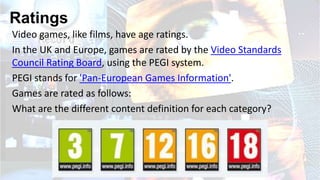
Video games, like films, have age ratings.
In the UK and Europe, games are rated by the Video Standards
Council Rating Board, using the PEGI system.
PEGI stands for 'Pan-European Games Information'.
Games are rated as follows:
What are the different content definition for each category?
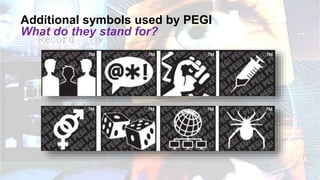
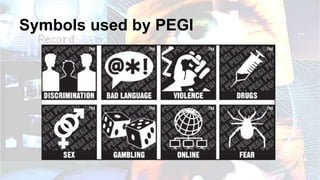
Additional symbols used by PEGI
What do they stand for?
Regulation - Age rating
• The British Board of Film
Classification (BBFC) 1970s – 2012. The BBFC
still classify all games featuring strong
pornographic (R18-level)
• In July 2012, the Video Standards Council -
VSC Rating Board became the sole UK
statutory video games regulator for the UK.
The VSC Rating Board has been a PEGI
Administrator since 2003 and subsequently
uses the PEGI criteria to classify video games.
• April 2003 PEGI set up
PEGI protects children
The PEGI website says this:
While most games (49%) are suitable for players of all ages there are many that are only
suitable for older children and young teenagers. There are also some games (4%) that
are made for adults only (over the age of 18).
The rating on a game confirms that it is suitable for players over a certain age.
Accordingly, a PEGI 7 game is only suitable for those aged seven and above and an
PEGI 18 game is only suitable for adults aged eighteen and above. The PEGI rating
considers the age suitability of a game, not the level of difficulty.
PEGI is used and recognised throughout Europe and has the enthusiastic support of the
European Commission. It is considered to be a model of European harmonisation in
the field of the protection of children.
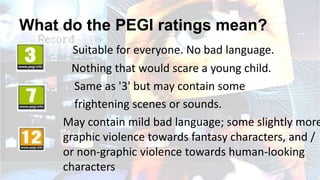
What do the PEGI ratings mean?
Suitable for everyone. No bad language.
Nothing that would scare a young child.
Same as '3' but may contain some
frightening scenes or sounds.
May contain mild bad language; some slightly more
graphic violence towards fantasy characters, and /
or non-graphic violence towards human-looking
characters
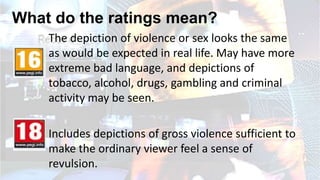
What do the ratings mean?
The depiction of violence or sex looks the same
as would be expected in real life. May have more
extreme bad language, and depictions of
tobacco, alcohol, drugs, gambling and criminal
activity may be seen.
Includes depictions of gross violence sufficient to
make the ordinary viewer feel a sense of
revulsion.
Symbols used by PEGI
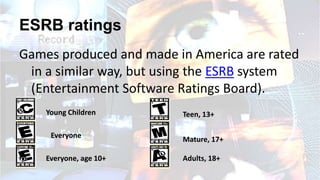
ESRB ratings
Games produced and made in America are rated
in a similar way, but using the ESRB system
(Entertainment Software Ratings Board).
Young Children
Everyone
Everyone, age 10+
Teen, 13+
Mature, 17+
Adults, 18+
The Effects Model
The ratings system is to protect players from seeing violence, until
they are old enough to deal with it. It is partly based on the Effects
Model, or Effects Theory.
This theory says that people, particularly vulnerable people (like
children and teenagers) may be over-influenced by the violence they
see on screen. They may start to behave in a violent way in real life.
What research has been carried out and what were the
findings? https://www.youtube.com/watch?v=GI1fNjdeOvY
The Byron Review 2007
The copy-cat theory
Video games have often been blamed for
crimes. Some criminals are thought to copy or
re-enact the violence they see in video games.
Watch some of these videos on the possible
links between violent video games and crime.
What do you think?
• Should violent games be banned altogether?
• Are PEGI ratings are a form of censorship?
• Should people be able to choose for themselves what games they
want to play?
• Do ratings protect people?
• Are ratings pointless because no one takes any notice of them?
• Can games be enjoyable without violence?
Look at these statements. Which ones support the effects model
(people copy violence)? Which ones don't support the effects
model?
1. Hardly any gamers commit violent crimes.
2. Violent games 'desensitise' gamers to violence - they begin to get used to violence and
see it as normal.
3. Only boys become violent; girls don't - so it is because of their gender not because of
the games.
4. Gamers who spend all their leisure time fighting in games can begin to see the world as
hostile and threatening and over-react to problems.
5. Games can be a good release, a 'safe' place to be angry, stopping people from taking
out their anger in the real world.
6. Gamers know the difference between game-worlds and the real world.
7. People who like violence will find it somewhere else if they can't find it in games.
8. You can't stop it - if people like violent games, there will always be a company ready to
make them.
Explain these terms
• institution
• indie
• blockbuster game
• TripleA
• mainstream
• niche market
• PEGI ratings
• The Effects Model
• Copycat crimes

Video games minecraft lesson 7 08 03 18

  • 1.
  • 2.
    ‘The Golden Age’1970-1985 • 1983 US arcade and home video games industry is worth $11.8 billion (more than US film and music together) • 1985 crash due to rival consoles and lack of quality control • By 1985 the industry was only worth $100 million
  • 3.
    ….. 30 yearson • Tighter regulation • Internet speeds, 4G and Wi-Fi provide greater accessibility
  • 4.
    Copycats • Clone Minecraftgames • Castleminer.com • Battleminer-3DS • At the time Microsoft purchased Mojang there was a huge surge of clones trying to cash in on audiences desires • Is that why Notch sold to Microsoft?
  • 5.
    Regulation Who are theseinstitutions and what are their roles? • BBFC • Video Standards Council • PEGI • ERSB
  • 6.
    Regulation • Originally Minecraftwas given a PEGI 7 • Later Minecraft Stones was higher – why? • ESRB has a different criteria – why? • Minecraft Realms hosted on a specialised server by Mojang – who has the ownership of intellectual content? • Disclaimers – the company state that they own everything created by blocks within the virtual worlds – accreditations not guaranteed – how has this been met by the gamers?
  • 7.
    Ratings Video games, likefilms, have age ratings. In the UK and Europe, games are rated by the Video Standards Council Rating Board, using the PEGI system. PEGI stands for 'Pan-European Games Information'. Games are rated as follows: What are the different content definition for each category?
  • 8.
    Additional symbols usedby PEGI What do they stand for?
  • 9.
    Regulation - Agerating • The British Board of Film Classification (BBFC) 1970s – 2012. The BBFC still classify all games featuring strong pornographic (R18-level) • In July 2012, the Video Standards Council - VSC Rating Board became the sole UK statutory video games regulator for the UK. The VSC Rating Board has been a PEGI Administrator since 2003 and subsequently uses the PEGI criteria to classify video games. • April 2003 PEGI set up
  • 10.
    PEGI protects children ThePEGI website says this: While most games (49%) are suitable for players of all ages there are many that are only suitable for older children and young teenagers. There are also some games (4%) that are made for adults only (over the age of 18). The rating on a game confirms that it is suitable for players over a certain age. Accordingly, a PEGI 7 game is only suitable for those aged seven and above and an PEGI 18 game is only suitable for adults aged eighteen and above. The PEGI rating considers the age suitability of a game, not the level of difficulty. PEGI is used and recognised throughout Europe and has the enthusiastic support of the European Commission. It is considered to be a model of European harmonisation in the field of the protection of children.
  • 11.
    What do thePEGI ratings mean? Suitable for everyone. No bad language. Nothing that would scare a young child. Same as '3' but may contain some frightening scenes or sounds. May contain mild bad language; some slightly more graphic violence towards fantasy characters, and / or non-graphic violence towards human-looking characters
  • 12.
    What do theratings mean? The depiction of violence or sex looks the same as would be expected in real life. May have more extreme bad language, and depictions of tobacco, alcohol, drugs, gambling and criminal activity may be seen. Includes depictions of gross violence sufficient to make the ordinary viewer feel a sense of revulsion.
  • 13.
  • 14.
    ESRB ratings Games producedand made in America are rated in a similar way, but using the ESRB system (Entertainment Software Ratings Board). Young Children Everyone Everyone, age 10+ Teen, 13+ Mature, 17+ Adults, 18+
  • 15.
    The Effects Model Theratings system is to protect players from seeing violence, until they are old enough to deal with it. It is partly based on the Effects Model, or Effects Theory. This theory says that people, particularly vulnerable people (like children and teenagers) may be over-influenced by the violence they see on screen. They may start to behave in a violent way in real life. What research has been carried out and what were the findings? https://www.youtube.com/watch?v=GI1fNjdeOvY The Byron Review 2007
  • 16.
    The copy-cat theory Videogames have often been blamed for crimes. Some criminals are thought to copy or re-enact the violence they see in video games. Watch some of these videos on the possible links between violent video games and crime.
  • 17.
    What do youthink? • Should violent games be banned altogether? • Are PEGI ratings are a form of censorship? • Should people be able to choose for themselves what games they want to play? • Do ratings protect people? • Are ratings pointless because no one takes any notice of them? • Can games be enjoyable without violence?
  • 18.
    Look at thesestatements. Which ones support the effects model (people copy violence)? Which ones don't support the effects model? 1. Hardly any gamers commit violent crimes. 2. Violent games 'desensitise' gamers to violence - they begin to get used to violence and see it as normal. 3. Only boys become violent; girls don't - so it is because of their gender not because of the games. 4. Gamers who spend all their leisure time fighting in games can begin to see the world as hostile and threatening and over-react to problems. 5. Games can be a good release, a 'safe' place to be angry, stopping people from taking out their anger in the real world. 6. Gamers know the difference between game-worlds and the real world. 7. People who like violence will find it somewhere else if they can't find it in games. 8. You can't stop it - if people like violent games, there will always be a company ready to make them.
  • 19.
    Explain these terms •institution • indie • blockbuster game • TripleA • mainstream • niche market • PEGI ratings • The Effects Model • Copycat crimes

Editor's Notes

  • #17 A good wikipedia page. Also covers representation issues: https://en.wikipedia.org/wiki/Video_game_controversy