Contemporary Media Regulation
Critical Perspectives In Media - Section B
Self-Regulated – Proactive Regulation
• PEGI is a European system for classifying the content of video games.
• PEGI is used in 30 countries in most of Europe.
• PEGI is supported by major console manufacturers Sony, Microsoft and
Nintendo, as well as publishers and developers of interactive games.
• PEGI introduced an age rating/descriptor system, used to ensure that
video games are clearly labelled stating the content they contain. It provides
guidance to consumers (particularly parents) to help them decide whether or
not to buy a particular video game for their children.
• PEGI are proactive – classifying every video game prior to its general public
release. However, PEGI also process complaints from consumers who do not
agree with PEGI’s regulation.
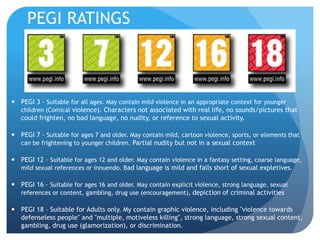
 PEGI 3 – Suitable for all ages. May contain mild violence in an appropriate context for younger
children (Comical violence). Characters not associated with real life, no sounds/pictures that
could frighten, no bad language, no nudity, or reference to sexual activity.
 PEGI 7 – Suitable for ages 7 and older. May contain mild, cartoon violence, sports, or elements that
can be frightening to younger children. Partial nudity but not in a sexual context
 PEGI 12 – Suitable for ages 12 and older. May contain violence in a fantasy setting, coarse language,
mild sexual references or innuendo. Bad language is mild and falls short of sexual expletives.
 PEGI 16 – Suitable for ages 16 and older. May contain explicit violence, strong language, sexual
references or content, gambling, drug use (encouragement), depiction of criminal activities
 PEGI 18 – Suitable for Adults only. My contain graphic violence, including "violence towards
defenseless people" and "multiple, motiveless killing", strong language, strong sexual content,
gambling, drug use (glamorization), or discrimination.
PEGI RATINGS
How Effective is PEGI?
 Watch the video below, and begin thinking about whether
or not PEGI do a good job in protecting the vulnerable
members of our society.
http://www.youtube.com/watch?v=QMEnPFZxDR4
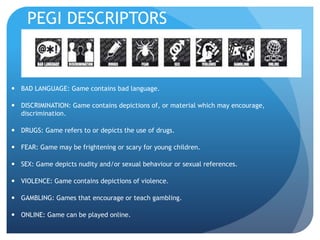
 BAD LANGUAGE: Game contains bad language.
 DISCRIMINATION: Game contains depictions of, or material which may encourage,
discrimination.
 DRUGS: Game refers to or depicts the use of drugs.
 FEAR: Game may be frightening or scary for young children.
 SEX: Game depicts nudity and/or sexual behaviour or sexual references.
 VIOLENCE: Game contains depictions of violence.
 GAMBLING: Games that encourage or teach gambling.
 ONLINE: Game can be played online.
PEGI DESCRIPTORS
Contemporary Media REGULATION
Critical Perspectives In Media - Section B
CASE STUDIES
Released: November 2003 – October 2008
 Manhunt & Manhunt 2 are a stealth-based psychological horror video games developed and
published by Rockstar Games.
 Manhunt follows a supposedly executed death row inmate who is forced to participate in a series
of snuff films. Manhunt 2 follows a mental escapee suffering from amnesia, as he tries to uncover
his identity. He is accompanied by a sociopathic assassin, who guides him on his journey.
 The high level of graphic violence in Manhunt drew controversy all over the world when it was
linked to the murder of 14 year old Stefan Pakeerah from Leicestershire. In 2004 he was brutally
murdered by his friend Warren LeBlanc who was said to be obsessed with the game. The way in
which LeBlanc committed the murder was very similar to how the game was set out.
 The game was removed by many UK sellers yet Rockstar games stated "we are naturally very
surprised and disappointed that any retailer would choose to pull any game. We reject any
suggestion or association between the tragic events and the sale of Manhunt”.
 Controversy followed upon the release of Manhunt 2 a few years later. On June 19, 2007, less than
a month prior to the game's worldwide release, Manhunt 2 was refused classification by the BBFC.
 In light of the BBFC decisions, Rockstar Games decided to censor the game by 1) Adding a blurring
effect over executions (screen turns red and flashes black and white) - 2) Removing
two decapitations - 3) A pliers executions was changed from ripping off the enemy's testicles and
tearing open his throat to beating the enemy over the head - 4) Some innocent characters from
levels were removed – 5) The rating system of speed and severity of execution types was removed.
 The BBFC were excused of making their decision based on media pressure, particularly from
the Daily Mail, which had run a campaign to have the first game banned.
 On December 10, 2007, the Video Appeals Committee overruled the BBFC by four votes to three
and the game was ultimately released on PS2, PSP and Wii on October 31, 2008 with an 18 cert, a
year after the US release.
Released: March 2011
 We Dare is an adult-oriented party video game developed by Ubisoft, for the Wii and PS3 systems.
 It is marketed as a "sexy, quirky, party game” involving kissing and striptease. However, some
reviewers have noted that the game is in fact a relatively tame party game compilation with only
very mild sexual connotations.
 PEGI were criticized by rating the game 12, implying that the game was suitable for children
(despite being marketed to adults). Ubisoft were ordered by PEGI to remove its "misleading" We
Dare advertisement from the internet as it caused great confusion with the classification.
 PEGI stated: "It was correct to give the game a 12 rating. "The content of the game and the
interaction that the game itself implies do not warrant a higher rating. Marketing may have
implied something else, but PEGI does not rate advertising, it rates game content”.
 PEGI advised Ubisoft to add a 'Parental Discretion Advised' sticker to the game in order to ensure
that parents are informed of the potential sensitive nature of the game content.
Released: September 2013
 PEGI were made to defend how they went about informing gamers about the adult rating of Grand
Theft Auto 5. The rating system deemed GTA 5 inappropriate for anyone younger than the age of
18, citing bad language and violence (and most likely a bevy of other adult-only material).
 PEGI controversially stated that the impetus to keep children away from mature video games lies
with parents and guardians. “Parents who take a sincere interest in what their kids are playing will
have found out about PEGI ratings. We cannot force them to do that,”.
 Controversy arose in regards to the mission called ‘By the Book’. The synopsis of a mission where
you must ‘extract’ information from Mr K using a range of torturing instruments. If Mr K’s heart
rate drops due to the pain you have to stop then give him an adrenaline shot to wake him up.
 Complaints were made to PEGI about the extremities of the mission as it is very explicit and
bearing in mind Mr K is actually innocent as he was just unfortunate to be in the vicinity of the
person the wanted.
Released: November 2009
 COD: Modern Warfare 2 is a first-person shooter video game surrounded in controversy since its
release mainly due to its violent depiction of a terrorist attack on a Russian airport.
 An optional level early in the game entitled "No Russian" has the player assume control of a deep-
cover CIA agent joining a group of Russian ultranationalist terrorists enacting an airport massacre.
Although the player is technically allied with the terrorists, they are not forced to kill any of the
civilians themselves to fulfil the mission's objectives, yet the player also cannot kill the terrorists
themselves which would result in failure of the mission. The player is warned prior to starting the
single player campaign of the mission's "disturbing content", and can choose to skip the mission at
no penalty.
 The game was discussed briefly in the House of Commons and received significant criticism from
UK religious leaders who discussed whether violent video games were dangerous to society.
 The first game in the series to receive an 18 rating from the BBFC (& later an 18 from PEGI)

Pegi

  • 1.
    Contemporary Media Regulation CriticalPerspectives In Media - Section B
  • 2.
  • 3.
    • PEGI isa European system for classifying the content of video games. • PEGI is used in 30 countries in most of Europe. • PEGI is supported by major console manufacturers Sony, Microsoft and Nintendo, as well as publishers and developers of interactive games. • PEGI introduced an age rating/descriptor system, used to ensure that video games are clearly labelled stating the content they contain. It provides guidance to consumers (particularly parents) to help them decide whether or not to buy a particular video game for their children. • PEGI are proactive – classifying every video game prior to its general public release. However, PEGI also process complaints from consumers who do not agree with PEGI’s regulation.
  • 4.
     PEGI 3– Suitable for all ages. May contain mild violence in an appropriate context for younger children (Comical violence). Characters not associated with real life, no sounds/pictures that could frighten, no bad language, no nudity, or reference to sexual activity.  PEGI 7 – Suitable for ages 7 and older. May contain mild, cartoon violence, sports, or elements that can be frightening to younger children. Partial nudity but not in a sexual context  PEGI 12 – Suitable for ages 12 and older. May contain violence in a fantasy setting, coarse language, mild sexual references or innuendo. Bad language is mild and falls short of sexual expletives.  PEGI 16 – Suitable for ages 16 and older. May contain explicit violence, strong language, sexual references or content, gambling, drug use (encouragement), depiction of criminal activities  PEGI 18 – Suitable for Adults only. My contain graphic violence, including "violence towards defenseless people" and "multiple, motiveless killing", strong language, strong sexual content, gambling, drug use (glamorization), or discrimination. PEGI RATINGS
  • 5.
    How Effective isPEGI?  Watch the video below, and begin thinking about whether or not PEGI do a good job in protecting the vulnerable members of our society. http://www.youtube.com/watch?v=QMEnPFZxDR4
  • 6.
     BAD LANGUAGE:Game contains bad language.  DISCRIMINATION: Game contains depictions of, or material which may encourage, discrimination.  DRUGS: Game refers to or depicts the use of drugs.  FEAR: Game may be frightening or scary for young children.  SEX: Game depicts nudity and/or sexual behaviour or sexual references.  VIOLENCE: Game contains depictions of violence.  GAMBLING: Games that encourage or teach gambling.  ONLINE: Game can be played online. PEGI DESCRIPTORS
  • 7.
    Contemporary Media REGULATION CriticalPerspectives In Media - Section B CASE STUDIES
  • 8.
    Released: November 2003– October 2008
  • 9.
     Manhunt &Manhunt 2 are a stealth-based psychological horror video games developed and published by Rockstar Games.  Manhunt follows a supposedly executed death row inmate who is forced to participate in a series of snuff films. Manhunt 2 follows a mental escapee suffering from amnesia, as he tries to uncover his identity. He is accompanied by a sociopathic assassin, who guides him on his journey.  The high level of graphic violence in Manhunt drew controversy all over the world when it was linked to the murder of 14 year old Stefan Pakeerah from Leicestershire. In 2004 he was brutally murdered by his friend Warren LeBlanc who was said to be obsessed with the game. The way in which LeBlanc committed the murder was very similar to how the game was set out.  The game was removed by many UK sellers yet Rockstar games stated "we are naturally very surprised and disappointed that any retailer would choose to pull any game. We reject any suggestion or association between the tragic events and the sale of Manhunt”.
  • 10.
     Controversy followedupon the release of Manhunt 2 a few years later. On June 19, 2007, less than a month prior to the game's worldwide release, Manhunt 2 was refused classification by the BBFC.  In light of the BBFC decisions, Rockstar Games decided to censor the game by 1) Adding a blurring effect over executions (screen turns red and flashes black and white) - 2) Removing two decapitations - 3) A pliers executions was changed from ripping off the enemy's testicles and tearing open his throat to beating the enemy over the head - 4) Some innocent characters from levels were removed – 5) The rating system of speed and severity of execution types was removed.  The BBFC were excused of making their decision based on media pressure, particularly from the Daily Mail, which had run a campaign to have the first game banned.  On December 10, 2007, the Video Appeals Committee overruled the BBFC by four votes to three and the game was ultimately released on PS2, PSP and Wii on October 31, 2008 with an 18 cert, a year after the US release.
  • 11.
  • 12.
     We Dareis an adult-oriented party video game developed by Ubisoft, for the Wii and PS3 systems.  It is marketed as a "sexy, quirky, party game” involving kissing and striptease. However, some reviewers have noted that the game is in fact a relatively tame party game compilation with only very mild sexual connotations.  PEGI were criticized by rating the game 12, implying that the game was suitable for children (despite being marketed to adults). Ubisoft were ordered by PEGI to remove its "misleading" We Dare advertisement from the internet as it caused great confusion with the classification.  PEGI stated: "It was correct to give the game a 12 rating. "The content of the game and the interaction that the game itself implies do not warrant a higher rating. Marketing may have implied something else, but PEGI does not rate advertising, it rates game content”.  PEGI advised Ubisoft to add a 'Parental Discretion Advised' sticker to the game in order to ensure that parents are informed of the potential sensitive nature of the game content.
  • 13.
  • 14.
     PEGI weremade to defend how they went about informing gamers about the adult rating of Grand Theft Auto 5. The rating system deemed GTA 5 inappropriate for anyone younger than the age of 18, citing bad language and violence (and most likely a bevy of other adult-only material).  PEGI controversially stated that the impetus to keep children away from mature video games lies with parents and guardians. “Parents who take a sincere interest in what their kids are playing will have found out about PEGI ratings. We cannot force them to do that,”.  Controversy arose in regards to the mission called ‘By the Book’. The synopsis of a mission where you must ‘extract’ information from Mr K using a range of torturing instruments. If Mr K’s heart rate drops due to the pain you have to stop then give him an adrenaline shot to wake him up.  Complaints were made to PEGI about the extremities of the mission as it is very explicit and bearing in mind Mr K is actually innocent as he was just unfortunate to be in the vicinity of the person the wanted.
  • 15.
  • 16.
     COD: ModernWarfare 2 is a first-person shooter video game surrounded in controversy since its release mainly due to its violent depiction of a terrorist attack on a Russian airport.  An optional level early in the game entitled "No Russian" has the player assume control of a deep- cover CIA agent joining a group of Russian ultranationalist terrorists enacting an airport massacre. Although the player is technically allied with the terrorists, they are not forced to kill any of the civilians themselves to fulfil the mission's objectives, yet the player also cannot kill the terrorists themselves which would result in failure of the mission. The player is warned prior to starting the single player campaign of the mission's "disturbing content", and can choose to skip the mission at no penalty.  The game was discussed briefly in the House of Commons and received significant criticism from UK religious leaders who discussed whether violent video games were dangerous to society.  The first game in the series to receive an 18 rating from the BBFC (& later an 18 from PEGI)