Video Games and Operant ConditioningThe Virtual Skinner Box
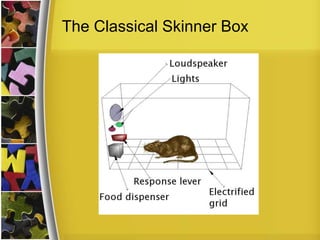
What is a Skinner Boxa box used in experiments in animal learning, esp. in operant conditioning, equipped with a mechanism that automatically gives the animal food or other reward or permits escape, as by opening a doorB.F. Skinner—20th Century Behavioral PsychologistRadical behaviorismOperant conditioningPositive reinforcementReward schedules
The Classical Skinner Box
Quick Psychology LessonRadical Behaviorists (like Skinner) believe that ALL animal functions are attributable to external/internal physical stimuli.  Psychoanalysis is a fraud because you can explain actions without having to “guess” at the deep inner workings of the subconscious mindBasically operant conditioning (OC) says that the frequency of a behavior will increase if it is rewarded, and that it will decrease if it is punished
Schedule of RewardContinuous – behavior is rewarded every time it is displayed Every time Sniffy presses the bar he gets a treatExtinction – behavior is never rewardedIntermittent – only some instances of behavior are rewardedRatio schedule (such as 3:1 behavior: reward) is most common
Timing is Everything in Behavioral ConditioningReward needs to be linked closely in time/association to the behavior being trainedReward strain – if reward schedule changes to rapidly, performance begins to go extinctLearned apathy/learned helplessnessResistance to extinction – some intermittent and variable reward schedules allow greater increases in variables and make behavior more resistant to extinction
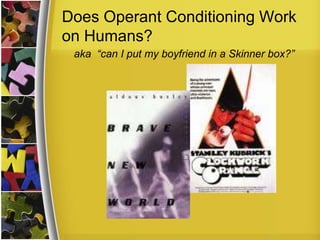
Does Operant Conditioning Work on Humans?	aka  “can I put my boyfriend in a Skinner box?”
Operant Conditioning and Human LearningFIVE MAIN OBSTACLES TO LEARNINGPeople have a fear of failure. The task is not broken down into small enough steps. There is a lack of directions. There is also a lack of clarity in the directions. Positive reinforcement is lacking.
Operant Conditioning and Human LearningAny age-appropriate skill can be taught using five principles to remedy the problems:Give the learner immediate feedback. Break down the task into small steps. Repeat the directions as many times as possible. Work from the most simple to the most complex tasks. Give positive reinforcement.
The Modern Skinner Box?
Video Games and Operant ConditioningMost  MMORPGs use variable/intermittent schedules of reward/reinforcement More work, less pay-outMost casual immersive environments use a fixed interval reinforcement The truly addictive games (think EVER-CRACK and WoW) use a random interval reinforcement scheduleYou have to keep playing because you never know when that extra skill point is coming or how many points you’ll get for that battle
Why are games so addictive?Ever wondered HOW that “guy you know” manages to log 30+ hours a week in WoW?Daily questsTraining and complex questsSide games/hobbies/etcEverything about the game is designed to keep you coming backNo pause button; you log-out, you get left behind
What’s Next?Researchers at USC’s Institute for Creative Technology are developing virtual reality diagnostic tools for assessing and treating a variety of DSM-IV disorders, including Alzheimer’s and PTSDThere are also VR tools to help patients learn to manage pain and to teach doctors how to talk to patients (really, can bedside manner be taught?)
VR DiagnosticsThese VR diagnostics vary—virtual patients for training purposes, VR environments for aversion therapy in phobia treatment, 3D puzzles for depth perception and visuospacial memoryImmersing a patient in a controlled VR environment and training certain social response is really the ultimate Skinner boxhttp://www.youtube.com/watch?v=YyN67vqoxl0http://www.vidoemo.com/yvideo.php?i=NzZLUjNpcWuRpdEcwS0E&operant-conditioning=
Some really neat resourceshttp://www.nickyee.com/eqt/skinner.htmlThis article actually analyzes EverQuest in terms of Maslow’s Hierarchy of Needs and how that overlaps on the operant conditioning to create interconnected community Skinner Box networkshttp://onlyagame.typepad.com/only_a_game/2008/01/freedom-to-fail.htmlUnrelated article that talks about fail/continue games

Video Games And Operant Conditioning

  • 1.
    Video Games andOperant ConditioningThe Virtual Skinner Box
  • 2.
    What is aSkinner Boxa box used in experiments in animal learning, esp. in operant conditioning, equipped with a mechanism that automatically gives the animal food or other reward or permits escape, as by opening a doorB.F. Skinner—20th Century Behavioral PsychologistRadical behaviorismOperant conditioningPositive reinforcementReward schedules
  • 3.
  • 4.
    Quick Psychology LessonRadicalBehaviorists (like Skinner) believe that ALL animal functions are attributable to external/internal physical stimuli. Psychoanalysis is a fraud because you can explain actions without having to “guess” at the deep inner workings of the subconscious mindBasically operant conditioning (OC) says that the frequency of a behavior will increase if it is rewarded, and that it will decrease if it is punished
  • 5.
    Schedule of RewardContinuous– behavior is rewarded every time it is displayed Every time Sniffy presses the bar he gets a treatExtinction – behavior is never rewardedIntermittent – only some instances of behavior are rewardedRatio schedule (such as 3:1 behavior: reward) is most common
  • 6.
    Timing is Everythingin Behavioral ConditioningReward needs to be linked closely in time/association to the behavior being trainedReward strain – if reward schedule changes to rapidly, performance begins to go extinctLearned apathy/learned helplessnessResistance to extinction – some intermittent and variable reward schedules allow greater increases in variables and make behavior more resistant to extinction
  • 7.
    Does Operant ConditioningWork on Humans? aka “can I put my boyfriend in a Skinner box?”
  • 8.
    Operant Conditioning andHuman LearningFIVE MAIN OBSTACLES TO LEARNINGPeople have a fear of failure. The task is not broken down into small enough steps. There is a lack of directions. There is also a lack of clarity in the directions. Positive reinforcement is lacking.
  • 9.
    Operant Conditioning andHuman LearningAny age-appropriate skill can be taught using five principles to remedy the problems:Give the learner immediate feedback. Break down the task into small steps. Repeat the directions as many times as possible. Work from the most simple to the most complex tasks. Give positive reinforcement.
  • 10.
  • 11.
    Video Games andOperant ConditioningMost MMORPGs use variable/intermittent schedules of reward/reinforcement More work, less pay-outMost casual immersive environments use a fixed interval reinforcement The truly addictive games (think EVER-CRACK and WoW) use a random interval reinforcement scheduleYou have to keep playing because you never know when that extra skill point is coming or how many points you’ll get for that battle
  • 12.
    Why are gamesso addictive?Ever wondered HOW that “guy you know” manages to log 30+ hours a week in WoW?Daily questsTraining and complex questsSide games/hobbies/etcEverything about the game is designed to keep you coming backNo pause button; you log-out, you get left behind
  • 13.
    What’s Next?Researchers atUSC’s Institute for Creative Technology are developing virtual reality diagnostic tools for assessing and treating a variety of DSM-IV disorders, including Alzheimer’s and PTSDThere are also VR tools to help patients learn to manage pain and to teach doctors how to talk to patients (really, can bedside manner be taught?)
  • 14.
    VR DiagnosticsThese VRdiagnostics vary—virtual patients for training purposes, VR environments for aversion therapy in phobia treatment, 3D puzzles for depth perception and visuospacial memoryImmersing a patient in a controlled VR environment and training certain social response is really the ultimate Skinner boxhttp://www.youtube.com/watch?v=YyN67vqoxl0http://www.vidoemo.com/yvideo.php?i=NzZLUjNpcWuRpdEcwS0E&operant-conditioning=
  • 15.
    Some really neatresourceshttp://www.nickyee.com/eqt/skinner.htmlThis article actually analyzes EverQuest in terms of Maslow’s Hierarchy of Needs and how that overlaps on the operant conditioning to create interconnected community Skinner Box networkshttp://onlyagame.typepad.com/only_a_game/2008/01/freedom-to-fail.htmlUnrelated article that talks about fail/continue games