The Science Behind Motivation_ Skinner’s Operant Conditioning Explained.pdf
1.
The Science BehindMotivation: Skinner’s
Operant Conditioning Explained
Skinner’s Theory of Operant Conditioning: Reinventing
Learning Through Behavior
In the ever-evolving landscape of corporate training and educational
psychology, one foundational theory continues to shape how learning
is delivered, reinforced, and retained — B.F. Skinner’s Theory of
Operant Conditioning. This behaviorist theory, which emphasizes
the role of reinforcement and punishment in shaping behavior, offers
2.
powerful insights formodern learning platforms, especially those
leveraging microlearning, gamification, and AI-driven
personalization — like MaxLearn.
Understanding how operant conditioning works and applying its
principles effectively can significantly enhance learner engagement,
retention, and performance.
What Is Operant Conditioning?
Developed by American psychologist B.F. Skinner, operant
conditioning is a method of learning that occurs through rewards
and punishments for behavior. Unlike classical conditioning,
which links involuntary responses to stimuli (think Pavlov’s dogs),
operant conditioning is about voluntary behaviors and the
consequences that follow them.
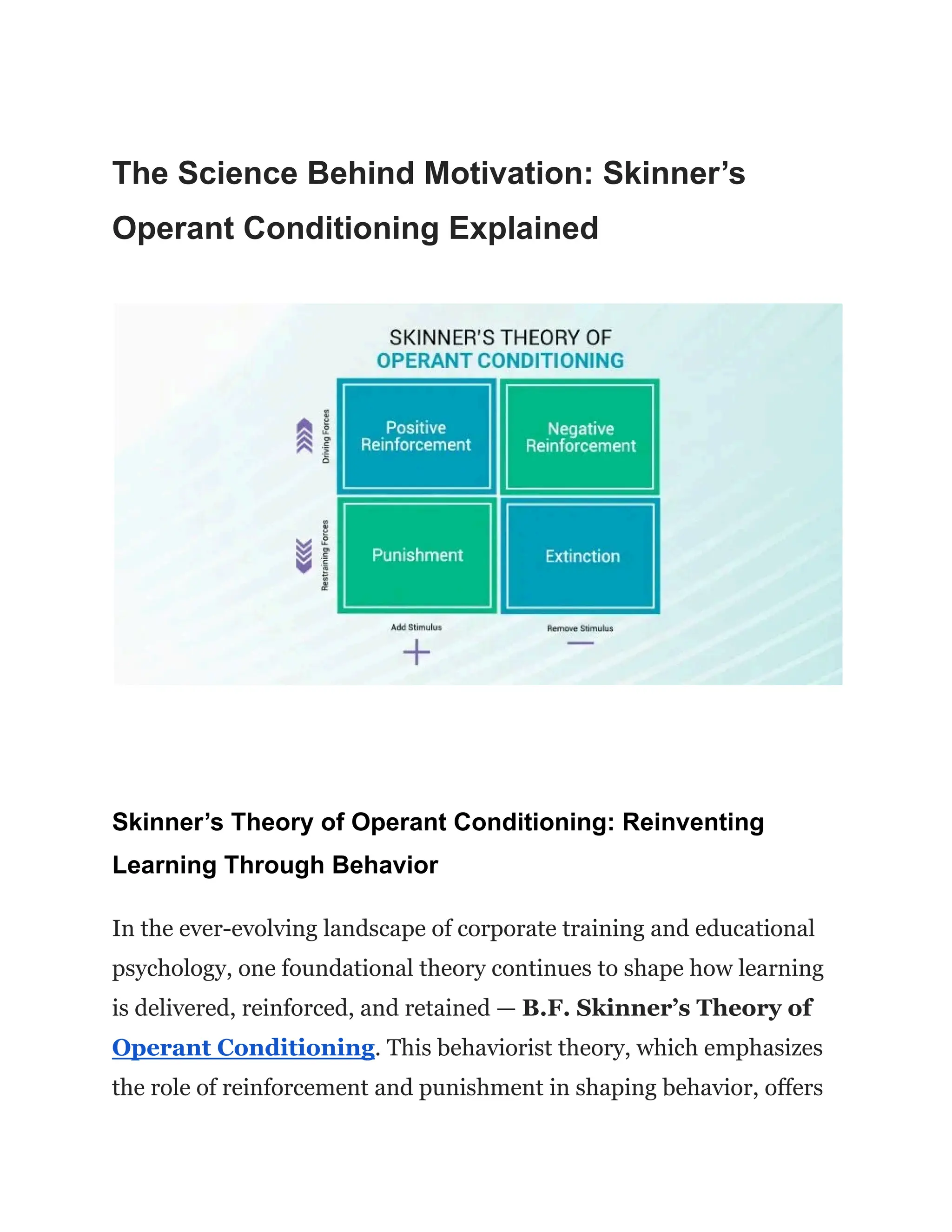
Skinner categorized reinforcement into four primary types:
● Positive Reinforcement: Adding a rewarding stimulus to
increase the likelihood of a behavior.
● Negative Reinforcement: Removing an unpleasant
stimulus to encourage a behavior.
3.
● Positive Punishment:Adding an unpleasant stimulus to
decrease a behavior.
● Negative Punishment: Removing a desired stimulus to
reduce a behavior.
In essence, operant conditioning is about shaping behavior through
consistent feedback — something that’s at the heart of every effective
learning experience.
Relevance of Operant Conditioning in Today’s
Learning Landscape
Modern learners, especially in the workplace, are time-poor,
goal-driven, and motivated by immediate results. They expect
learning experiences that are engaging, personalized, and
rewarding. Operant conditioning provides a behavioral framework
that supports these expectations by reinforcing desired learning
behaviors and discouraging ineffective ones.
Let’s explore how MaxLearn integrates operant conditioning
principles into its AI-powered, gamified microlearning
platform.
4.
Microlearning and Reinforcement:A Perfect Pair
One of the cornerstones of operant conditioning is timely
reinforcement. MaxLearn’s microlearning platform delivers content
in short, focused bursts, enabling learners to engage in
manageable learning episodes. This format not only reduces cognitive
overload but also allows for immediate feedback and
reinforcement, a core tenet of Skinner’s theory.
After completing a short module or quiz, learners receive instant
feedback — either a reward for correct behavior (positive
reinforcement) or an encouragement to try again (mild negative
reinforcement), reinforcing the behavior of continuous learning and
persistence.
Gamification: Turning Reinforcement Into Motivation
Gamification is an ideal application of Skinner’s operant conditioning
in digital learning. Points, badges, levels, leaderboards — these aren’t
just fun extras; they’re deliberate reinforcers designed to
motivate behavior change.
On MaxLearn, every interaction is an opportunity for reinforcement:
5.
● Completing amodule may unlock a badge (positive
reinforcement).
● Consistently logging in might place a learner on a
leaderboard (social reinforcement).
● Missing a deadline could lead to a drop in rank or level
(negative punishment).
These mechanics create a behavioral loop where learners are
continuously encouraged to engage, improve, and progress.
Personalization Through AI: Tailoring Reinforcement
to Individual Behavior
One of the limitations of traditional operant conditioning is that it
assumes uniform responses to reinforcement. In real life, learners are
diverse and respond differently to various stimuli. This is where AI
and adaptive learning systems like MaxLearn excel.
MaxLearn uses AI to analyze learner behavior and personalize
reinforcement:
● If a learner responds well to positive feedback, the system
increases such reinforcement.
6.
● If anothershows improvement through gamified
challenges, the platform adjusts the content flow to
emphasize competitive tasks.
● For those struggling, targeted nudges and reminders act as
negative reinforcers to encourage re-engagement without
punitive effects.
By adapting to the learner’s behavior, MaxLearn ensures that
reinforcement remains relevant, effective, and motivational —
just as Skinner envisioned.
Shaping Desired Behaviors Over Time
Another important concept in operant conditioning is shaping —
gradually reinforcing successive approximations of the desired
behavior. This is especially useful in skills training, where the goal is to
develop complex competencies step by step.
In MaxLearn, shaping is embedded through:
● Progressive content sequencing that reinforces
foundational knowledge before introducing advanced
concepts.
7.
● Milestone achievementsthat reward learners as they
reach specific goals.
● Feedback loops that highlight incremental progress,
encouraging learners to keep going.
This structured approach to shaping behavior builds confidence,
competence, and consistency, leading to better long-term
performance.
Reinforcement Schedules: Timing Matters
Skinner also emphasized that the schedule of reinforcement
affects the strength and persistence of learning. MaxLearn
incorporates both continuous reinforcement (e.g., instant
feedback after each quiz) and variable reinforcement (e.g., random
rewards or surprises) to keep learners engaged.
● Continuous schedules are useful during the initial
learning stages.
● Variable schedules create long-term engagement by
keeping the brain anticipating rewards — a concept borrowed
from gaming and behavioral economics.
8.
By mixing thesestrategies, MaxLearn keeps motivation high without
making the experience predictable or boring.
Real-World Applications of Operant Conditioning in
Corporate Training
Here’s how operant conditioning works in real-life training scenarios
using MaxLearn:
● Compliance Training: Employees earn digital rewards for
completing modules on time (positive reinforcement). Those
who delay receive follow-up prompts (negative
reinforcement).
● Sales Training: High performers gain access to bonus
content or exclusive levels (positive reinforcement),
encouraging others to emulate their behavior.
● Risk-Focused Training: Mistakes in simulations trigger
corrective feedback without penalty (mild positive
punishment), creating a safe space to learn from errors.
These strategies align learner behavior with organizational goals —
driving better results through a scientific, structured approach to
behavior change.
9.
Conclusion: From Theoryto Practice
Skinner’s Theory of Operant Conditioning isn’t just an academic
concept — it’s a practical, time-tested framework for designing
effective learning experiences. By integrating this theory with
modern learning technologies, MaxLearn empowers
organizations to influence learner behavior in meaningful ways.
Through microlearning, gamification, adaptive learning, and
AI-driven reinforcement, MaxLearn transforms the classroom of
Skinner’s era into a dynamic, data-informed ecosystem — where every
click, quiz, and badge is a step toward behavior change and
performance improvement.
In today’s competitive and fast-paced learning environment,
understanding and applying operant conditioning is more than smart
— it’s essential.
Ready to experience behaviorally-informed learning?
Explore how MaxLearn’s microlearning platform applies Skinner’s
principles to deliver personalized, gamified, and results-driven
training at maxlearn.