VEE-MAP: USAGE TO IMPROVE
FACILITATOR’S COMPETENCE FOR
CONDUCTING PARTICIPATORY
MEDIATION IN CONFLICT RESOLUTION
CONTEXT
• Participatory mediation is important for
peaceful settlement of disputes and conflicts.
• Necessity for collaboration, partnerships and
cooperation in mediation efforts.
• Effective mediation depends on:
i. Choosing the right mediator in relation to
expertise
ii. Impartiality
iii. Credibility
iv. Sensitivity to the process and conflict
parties(their knowledge and actions)
v. Tools for mediation
• Participatory involvement of many
stakeholders is pertinent
• Sound planning is key to success and involves
such tasks as:
i. Conflict analysis
ii. Knowledge and action mapping of
stakeholders
iii. Contingency planning
• The deliverable/end product is
implementable peace agreement(IPA) and
sustainable implementation process(SIP)
• The fundamentals for effective mediation as
identified by the United Nations(UN) is in
two working sessions.
• The entire mediation cycle occurs within
parameters from preparation to
initiation(knowledge/thinking side) to
implementation of outcomes(doing side)
• The purpose of this poster presentation is to
expose the audience to a direct experience of
a methodology referred to as Vee-mapping
Approach(VMA)
• Emphasis is how to tackle complex challenges
of mediation and participatory conflict
resolution.
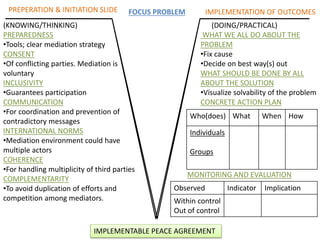
• A Vee map is a tool (diagramatic
representation) to help parties to understand
the structure as well as meaning of the
conflict.
• Parties are able to see clearly, the crucial
connections between variables of the conflict.
• Using this approach, parties will be able to
explain how possible solution to the problem
is connected to an underlying
philosophy/theory(way of thinking) as well as
their actions.
• VMA shows how all elements of people’s
thinking and doing interact to cause conflict.
• VMA is immediately engaging and helps
conflicting parties to grasp the wholeness of
things.
• VMA therefore lessens/reduces interpersonal
and intergroup friction, thereby accelerating
the process of conflict resolution and
management
PREPERATION & INITIATION SLIDE IMPLEMENTATION OF OUTCOMESFOCUS PROBLEM
(KNOWING/THINKING)
PREPAREDNESS
•Tools; clear mediation strategy
CONSENT
•Of conflicting parties. Mediation is
voluntary
INCLUSIVITY
•Guarantees participation
COMMUNICATION
•For coordination and prevention of
contradictory messages
INTERNATIONAL NORMS
•Mediation environment could have
multiple actors
COHERENCE
•For handling multiplicity of third parties
COMPLEMENTARITY
•To avoid duplication of efforts and
competition among mediators.
(DOING/PRACTICAL)
WHAT WE ALL DO ABOUT THE
PROBLEM
•Fix cause
•Decide on best way(s) out
WHAT SHOULD BE DONE BY ALL
ABOUT THE SOLUTION
•Visualize solvability of the problem
CONCRETE ACTION PLAN
Who(does) What When How
Individuals
Groups
MONITORING AND EVALUATION
Observed Indicator Implication
Within control
Out of control
IMPLEMENTABLE PEACE AGREEMENT

Vee map

  • 1.
    VEE-MAP: USAGE TOIMPROVE FACILITATOR’S COMPETENCE FOR CONDUCTING PARTICIPATORY MEDIATION IN CONFLICT RESOLUTION
  • 2.
    CONTEXT • Participatory mediationis important for peaceful settlement of disputes and conflicts. • Necessity for collaboration, partnerships and cooperation in mediation efforts.
  • 3.
    • Effective mediationdepends on: i. Choosing the right mediator in relation to expertise ii. Impartiality iii. Credibility iv. Sensitivity to the process and conflict parties(their knowledge and actions) v. Tools for mediation • Participatory involvement of many stakeholders is pertinent
  • 4.
    • Sound planningis key to success and involves such tasks as: i. Conflict analysis ii. Knowledge and action mapping of stakeholders iii. Contingency planning • The deliverable/end product is implementable peace agreement(IPA) and sustainable implementation process(SIP) • The fundamentals for effective mediation as identified by the United Nations(UN) is in two working sessions.
  • 5.
    • The entiremediation cycle occurs within parameters from preparation to initiation(knowledge/thinking side) to implementation of outcomes(doing side) • The purpose of this poster presentation is to expose the audience to a direct experience of a methodology referred to as Vee-mapping Approach(VMA) • Emphasis is how to tackle complex challenges of mediation and participatory conflict resolution.
  • 6.
    • A Veemap is a tool (diagramatic representation) to help parties to understand the structure as well as meaning of the conflict. • Parties are able to see clearly, the crucial connections between variables of the conflict. • Using this approach, parties will be able to explain how possible solution to the problem is connected to an underlying philosophy/theory(way of thinking) as well as their actions.
  • 7.
    • VMA showshow all elements of people’s thinking and doing interact to cause conflict. • VMA is immediately engaging and helps conflicting parties to grasp the wholeness of things. • VMA therefore lessens/reduces interpersonal and intergroup friction, thereby accelerating the process of conflict resolution and management
  • 8.
    PREPERATION & INITIATIONSLIDE IMPLEMENTATION OF OUTCOMESFOCUS PROBLEM (KNOWING/THINKING) PREPAREDNESS •Tools; clear mediation strategy CONSENT •Of conflicting parties. Mediation is voluntary INCLUSIVITY •Guarantees participation COMMUNICATION •For coordination and prevention of contradictory messages INTERNATIONAL NORMS •Mediation environment could have multiple actors COHERENCE •For handling multiplicity of third parties COMPLEMENTARITY •To avoid duplication of efforts and competition among mediators. (DOING/PRACTICAL) WHAT WE ALL DO ABOUT THE PROBLEM •Fix cause •Decide on best way(s) out WHAT SHOULD BE DONE BY ALL ABOUT THE SOLUTION •Visualize solvability of the problem CONCRETE ACTION PLAN Who(does) What When How Individuals Groups MONITORING AND EVALUATION Observed Indicator Implication Within control Out of control IMPLEMENTABLE PEACE AGREEMENT