Drugs used to treat cardiac
arrhythmias
Definition: a variation in either the site or
rate of cardiac impulse formation, and/or a
variation in the sequence of cardiac impulse
propagation.
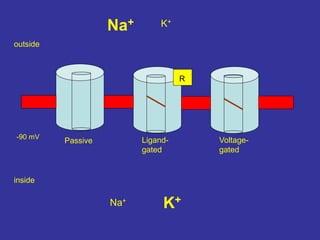
Passive Ligand-
gated
Voltage-
gated
R
Na+ K+
Na+
K+
-90 mV
inside
outside
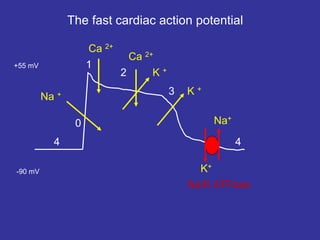
Na +
Ca 2+
Ca 2+
K +
K +
4
0
1
2
3
4
K+
Na+
Na/K ATPase
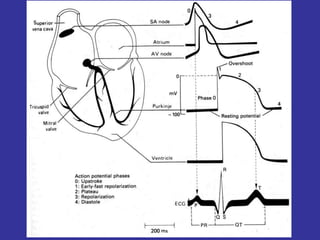
The fast cardiac action potential
-90 mV
+55 mV
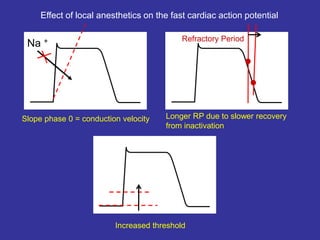
Na + Refractory Period
Effect of local anesthetics on the fast cardiac action potential
Slope phase 0 = conduction velocity Longer RP due to slower recovery
from inactivation
Increased threshold
4
0
1
2
3
4
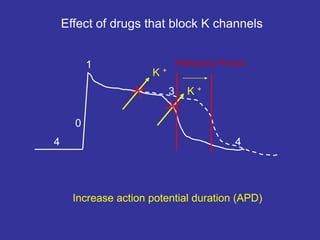
K +
K +
Refractory Period
Effect of drugs that block K channels
Increase action potential duration (APD)
4
0
2
3
4
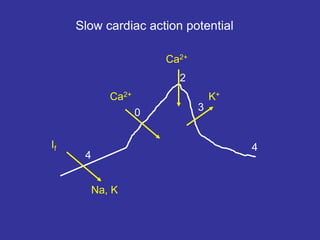
Ca2+
Ca2+
K+
If
Na, K
Slow cardiac action potential
4
0
2
3
4
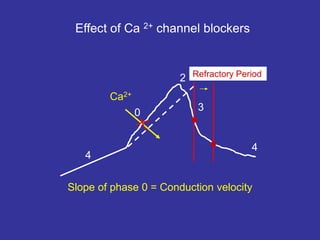
Ca2+
Slope of phase 0 = Conduction velocity
Effect of Ca 2+ channel blockers
Refractory Period
4
0
2
3
4
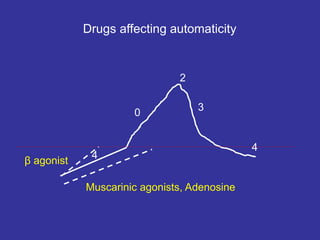
β agonist
Muscarinic agonists, Adenosine
Drugs affecting automaticity
Causes of Arrhythmia
1. Automoticity
-ectopic pacemakers
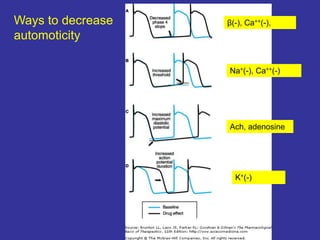
Ways to decrease
automoticity
β(-), Ca++(-),
Na+(-), Ca++(-)
Ach, adenosine
K+(-)
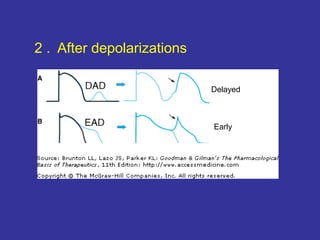
2 . After depolarizations
Early
Delayed
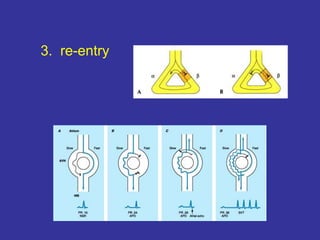
3. re-entry
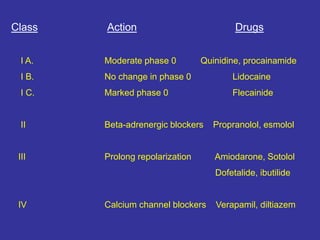
Class Action Drugs
I A. Moderate phase 0 Quinidine, procainamide
I B. No change in phase 0 Lidocaine
I C. Marked phase 0 Flecainide
II Beta-adrenergic blockers Propranolol, esmolol
III Prolong repolarization Amiodarone, Sotolol
Dofetalide, ibutilide
IV Calcium channel blockers Verapamil, diltiazem
Class 1: Local anesthetics
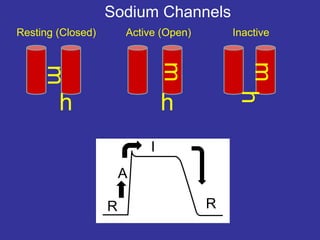
m
m
m
h h
h
Resting (Closed) Active (Open) Inactive
Sodium Channels
R R
A
I
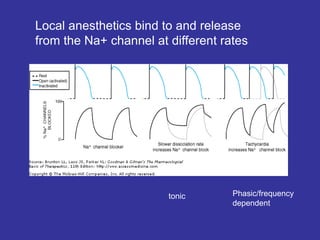
Local anesthetics bind to and release
from the Na+ channel at different rates
Phasic/frequency
dependent
tonic
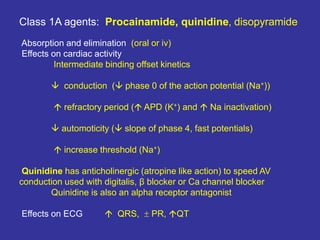
Class 1A agents: Procainamide, quinidine, disopyramide
Absorption and elimination (oral or iv)
Effects on cardiac activity
Intermediate binding offset kinetics
 conduction ( phase 0 of the action potential (Na+))
 refractory period ( APD (K+) and  Na inactivation)
 automoticity ( slope of phase 4, fast potentials)
 increase threshold (Na+)
Quinidine has anticholinergic (atropine like action) to speed AV
conduction used with digitalis, β blocker or Ca channel blocker
Quinidine is also an alpha receptor antagonist
Effects on ECG  QRS,  PR, QT
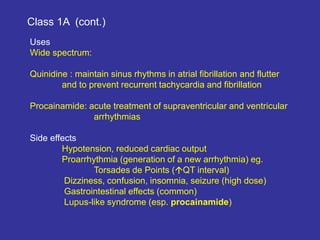
Uses
Wide spectrum:
Quinidine : maintain sinus rhythms in atrial fibrillation and flutter
and to prevent recurrent tachycardia and fibrillation
Procainamide: acute treatment of supraventricular and ventricular
arrhythmias
Side effects
Hypotension, reduced cardiac output
Proarrhythmia (generation of a new arrhythmia) eg.
Torsades de Points (QT interval)
Dizziness, confusion, insomnia, seizure (high dose)
Gastrointestinal effects (common)
Lupus-like syndrome (esp. procainamide)
Class 1A (cont.)
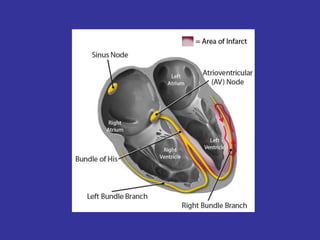
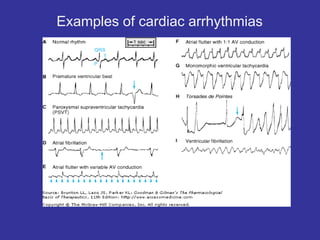
Examples of cardiac arrhythmias
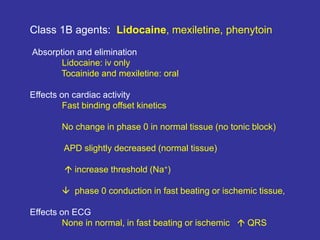
Class 1B agents: Lidocaine, mexiletine, phenytoin
Absorption and elimination
Lidocaine: iv only
Tocainide and mexiletine: oral
Effects on cardiac activity
Fast binding offset kinetics
No change in phase 0 in normal tissue (no tonic block)
APD slightly decreased (normal tissue)
 increase threshold (Na+)
 phase 0 conduction in fast beating or ischemic tissue,
Effects on ECG
None in normal, in fast beating or ischemic  QRS
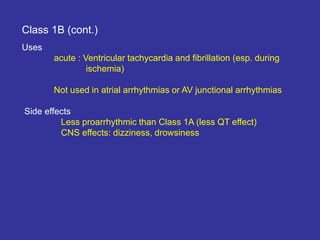
Uses
acute : Ventricular tachycardia and fibrillation (esp. during
ischemia)
Not used in atrial arrhythmias or AV junctional arrhythmias
Side effects
Less proarrhythmic than Class 1A (less QT effect)
CNS effects: dizziness, drowsiness
Class 1B (cont.)
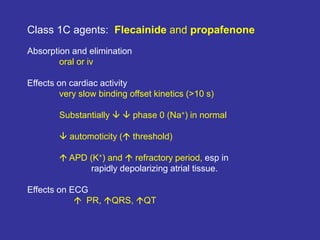
Class 1C agents: Flecainide and propafenone
Absorption and elimination
oral or iv
Effects on cardiac activity
very slow binding offset kinetics (>10 s)
Substantially   phase 0 (Na+) in normal
 automoticity ( threshold)
 APD (K+) and  refractory period, esp in
rapidly depolarizing atrial tissue.
Effects on ECG
 PR, QRS, QT
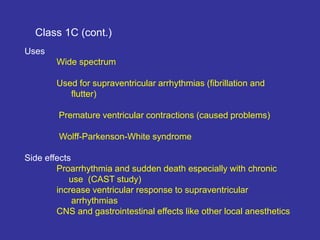
Uses
Wide spectrum
Used for supraventricular arrhythmias (fibrillation and
flutter)
Premature ventricular contractions (caused problems)
Wolff-Parkenson-White syndrome
Side effects
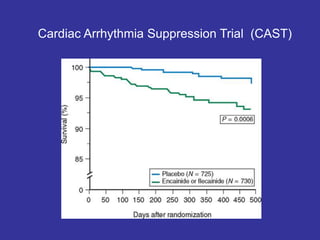
Proarrhythmia and sudden death especially with chronic
use (CAST study)
increase ventricular response to supraventricular
arrhythmias
CNS and gastrointestinal effects like other local anesthetics
Class 1C (cont.)
Cardiac Arrhythmia Suppression Trial (CAST)
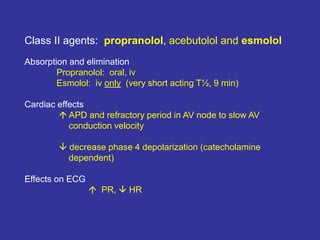
Class II agents: propranolol, acebutolol and esmolol
Absorption and elimination
Propranolol: oral, iv
Esmolol: iv only (very short acting T½, 9 min)
Cardiac effects
 APD and refractory period in AV node to slow AV
conduction velocity
 decrease phase 4 depolarization (catecholamine
dependent)
Effects on ECG
 PR,  HR
Class II (cont.)
Uses
treating sinus and catecholamine dependent tachy
arrhythmias
converting reentrant arrhythmias in AV
protecting the ventricles from high atrial rates (slow AV
conduction)
Side effects
bronchospasm
hypotension
don’t use in partial AV block or ventricular failure
Class III agents: amiodarone, sotalol, ibutilide, dofetilide
Amiodarone
Absorption and elimination
oral or iv (T 1/2 about 3 months)
Cardiac effects
 increase refractory period and  APD (K+)
 phase 0 and conduction (Na+)
 threshold
 phase 4 (β block and Ca++ block)
 speed of AV conduction
Effects on ECG
 PR, QRS,  QT,  HR
Amiodarone (cont.)
Uses
Very wide spectrum: effective for most arrhythmias
Side effects: many serious that increase with time
Pulmonary fibrosis
Hepatic injury
Increase LDL cholesterol
Thyroid disease
Photosensitivity
May need to reduce the dose of digoxin and class 1 antiarrhythmics
Class III (cont.)
Sotolol
Absorption oral
Cardiac effects
 APD and refractory period in atrial and ventricular tissue
Slow phase 4 (β blocker)
Slow AV conduction
ECG effects  QT,  HR
Uses
Wide spectrum: supraventricular and ventricular tachycardia
Side effects
Proarrhythmia, fatigue, insomnia
Class III (cont.)
Ibutilide
Absorption
rapid iv infusion
Cardiac effects
pure Ikr channel blocker
also activates inward Na+ current
net result in  APD
ECG effects QT
Uses
conversion of atrial fibrillation and flutter
Side effects
Torsades de pointes
Class III (cont.)
Dofetilide
Absorption oral
Cardiac effects
pure Ikr channel blocker
 APD and refractory period
ECG effects  QT
Uses
maintain sinus rhythm in pts with atrial fibrillation
Side effects
restricted use
Torsades de pointes
Class III (cont.)
Class IV agents: verapamil and diltiazem
Administration
verapamil: oral or i.v.
diltiazem: oral
Cardiac effects
slow conduction through AV (Ca++)
 refractory period in AV node
 slope of phase 4 in SA to slow HR
Effects on ECG
 PR,  HR (depending of blood pressure
response and baroreflex)
Class IV (cont.)
Uses
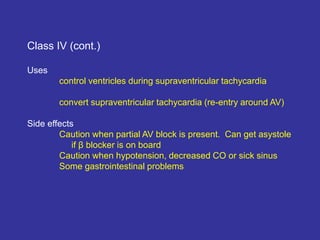
control ventricles during supraventricular tachycardia
convert supraventricular tachycardia (re-entry around AV)
Side effects
Caution when partial AV block is present. Can get asystole
if β blocker is on board
Caution when hypotension, decreased CO or sick sinus
Some gastrointestinal problems
Additional antiarrhythmic agents
Adenosine
Adminsitration
rapid i.v. bolus, very short T1/2 (seconds)
Mechanism
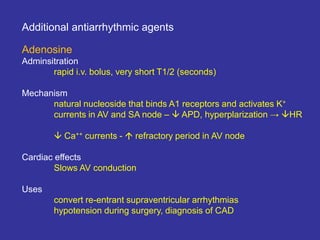
natural nucleoside that binds A1 receptors and activates K+
currents in AV and SA node –  APD, hyperplarization → HR
 Ca++ currents -  refractory period in AV node
Cardiac effects
Slows AV conduction
Uses
convert re-entrant supraventricular arrhythmias
hypotension during surgery, diagnosis of CAD
Digioxin (cardiac glycosides)
Mechanism
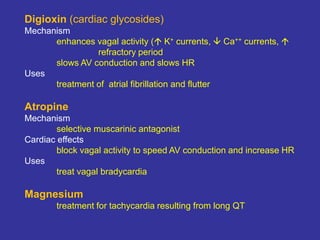
enhances vagal activity ( K+ currents,  Ca++ currents, 
refractory period
slows AV conduction and slows HR
Uses
treatment of atrial fibrillation and flutter
Atropine
Mechanism
selective muscarinic antagonist
Cardiac effects
block vagal activity to speed AV conduction and increase HR
Uses
treat vagal bradycardia
Magnesium
treatment for tachycardia resulting from long QT
DC Cardioversion (electric shock)
Treatment of choice for unstable, life-threatening
cardiac arrhyghmias.
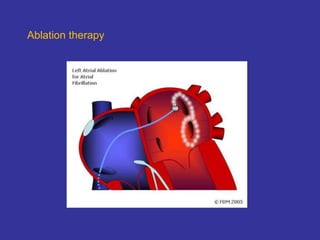
Ablation therapy
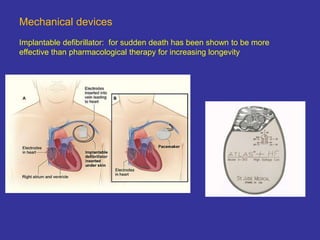
Mechanical devices
Implantable defibrillator: for sudden death has been shown to be more
effective than pharmacological therapy for increasing longevity