LET'S TALK ABOUT
VARIOUS BANKING
INSTRUMENTS
Banks offer various types of
instruments through which the
financial transactions can take place.
In our daytime day life, one might
have encountered use of deposit slip,
withdrawal slip or even checks but
there are other types of instruments
which banks do use for transactions
and among them, some are open
Before going into details of the
banking instruments, one should think
about two types instruments.
One is negotiable bank instruments
and the other one is nonnegotiable
bank instruments.
Negotiable instruments are those
instruments which can be transferred
 Non-negotiable instruments are those
instruments which aren't transferable from
one person to the other and hence, they are
specific in nature.
 This s the main difference between
negotiable and non-negotiable instruments
where one can be transferred and the other
one doesn't give permission to be
transferred.
 When we talk about negotiable instruments
 Those instruments are checks, bank draft,
bill of exchange and promissory notes.
 They are characterized by the fact that, they
are uninhibitedly transferable, unconditional,
in writing and payable on demand.
 On the other hand, the characteristics of
non-negotiable instruments are that it can
be transferred. For example, government
bonds are a perfect example of non-
negotiable bonds.
They can only be redeemed by the owner
and others cannot redeem it at any cost.
In our daily life, we use one instrument
more than the other. For example,
someone will love to deal with checks but
he or she may not be comfortable while
dealing with cash.
As such, it gives a convenient of not
having to carry a lot of money. And since
Moreover, promissory notes or
demand drafts also play a key part in
banking instruments.
For example, a demand draft
guarantees to pay that exact amount
to the person/organization whose
name is written in the demand draft.
Thus it is the bank instruments which
This kind of instrument plays a
pivotal part in the economy.
It is these instruments through
which transactions can actually
take place.
Hence, these instruments are the
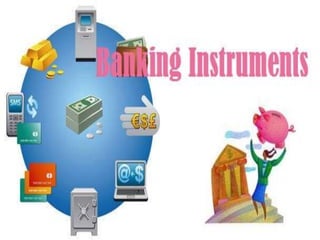
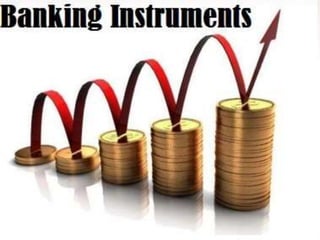
Various Types of Banking Instruments

Various Types of Banking Instruments

  • 1.
    LET'S TALK ABOUT VARIOUSBANKING INSTRUMENTS
  • 2.
    Banks offer varioustypes of instruments through which the financial transactions can take place. In our daytime day life, one might have encountered use of deposit slip, withdrawal slip or even checks but there are other types of instruments which banks do use for transactions and among them, some are open
  • 4.
    Before going intodetails of the banking instruments, one should think about two types instruments. One is negotiable bank instruments and the other one is nonnegotiable bank instruments. Negotiable instruments are those instruments which can be transferred
  • 5.
     Non-negotiable instrumentsare those instruments which aren't transferable from one person to the other and hence, they are specific in nature.  This s the main difference between negotiable and non-negotiable instruments where one can be transferred and the other one doesn't give permission to be transferred.  When we talk about negotiable instruments
  • 7.
     Those instrumentsare checks, bank draft, bill of exchange and promissory notes.  They are characterized by the fact that, they are uninhibitedly transferable, unconditional, in writing and payable on demand.  On the other hand, the characteristics of non-negotiable instruments are that it can be transferred. For example, government bonds are a perfect example of non- negotiable bonds.
  • 9.
    They can onlybe redeemed by the owner and others cannot redeem it at any cost. In our daily life, we use one instrument more than the other. For example, someone will love to deal with checks but he or she may not be comfortable while dealing with cash. As such, it gives a convenient of not having to carry a lot of money. And since
  • 10.
    Moreover, promissory notesor demand drafts also play a key part in banking instruments. For example, a demand draft guarantees to pay that exact amount to the person/organization whose name is written in the demand draft. Thus it is the bank instruments which
  • 12.
    This kind ofinstrument plays a pivotal part in the economy. It is these instruments through which transactions can actually take place. Hence, these instruments are the