Callable Bond and
Vaulation
Dmitry Popov
FinPricing
http://www.finpricing.com
Callable Bond
Summary
◆ Callable Bond Definition
◆ The Advantages of Callable Bonds
◆ Callable Bond Payoffs
◆ Valuation Model Selection Criteria
◆ LGM Model
◆ LGM Assumption
◆ LGM calibration
◆ Valuation Implementation
◆ A real world example
Callable Bond
Callable Bond Definition
◆ A callable bond is a bond in which the issuer has the right to call the
bond at specified times (callable dates) from the investor for a specified
price (call price).
◆ At each callable date prior to the bond maturity, the issuer may recall
the bond from its investor by returning the investor’s money.
◆ The underlying bond can be a fixed rate bond or a floating rate bond.
◆ A callable bond can therefore be considered a vanilla underlying bond
with an embedded Bermudan style option.
◆ Callable bonds protect issuers. Therefore, a callable bond normally pays
the investor a higher coupon than a non-callable bond.
Callable bond
Advantages of Callable Bond
◆ Although a callable bond is a higher cost to the issuer and an
uncertainty to the investor comparing to a regular bond, it is actually
quite attractive to both issuers and investors.
◆ For issuers, callable bonds allow them to reduce interest costs at a
future date should rate decrease.
◆ For investors, callable bonds allow them to earn a higher interest rate of
return until the bonds are called off.
◆ If interest rates have declined since the issuer first issues the bond, the
issuer is like to call its current bond and reissues it at a lower coupon.
Callable Bond
Callable Bond Payoffs
◆ At the bond maturity T, the payoff of a callable bond is given by
𝑉𝑐 𝑡 =
𝐹 + 𝐶 𝑖𝑓 𝑛𝑜𝑡 𝑐𝑎𝑙𝑙𝑒𝑑
min(𝑃𝑐, 𝐹 + 𝐶) 𝑖𝑓 𝑐𝑎𝑙𝑙𝑒𝑑
where F – the principal or face value; C – the coupon; 𝑃𝑐 – the call price; min (x, y) –
the minimum of x and y
◆ The payoff of the callable bond at any call date 𝑇𝑖 can be expressed as
𝑉𝑐 𝑇𝑖 =
𝑉 𝑇 𝑖
𝑖𝑓 𝑛𝑜𝑡 𝑐𝑎𝑙𝑙𝑒𝑑
min 𝑃𝑐, 𝑉 𝑇 𝑖
𝑖𝑓 𝑐𝑎𝑙𝑙𝑒𝑑
where 𝑉 𝑇 𝑖
– continuation value at 𝑇𝑖
Callable Bond
Model Selection Criteria
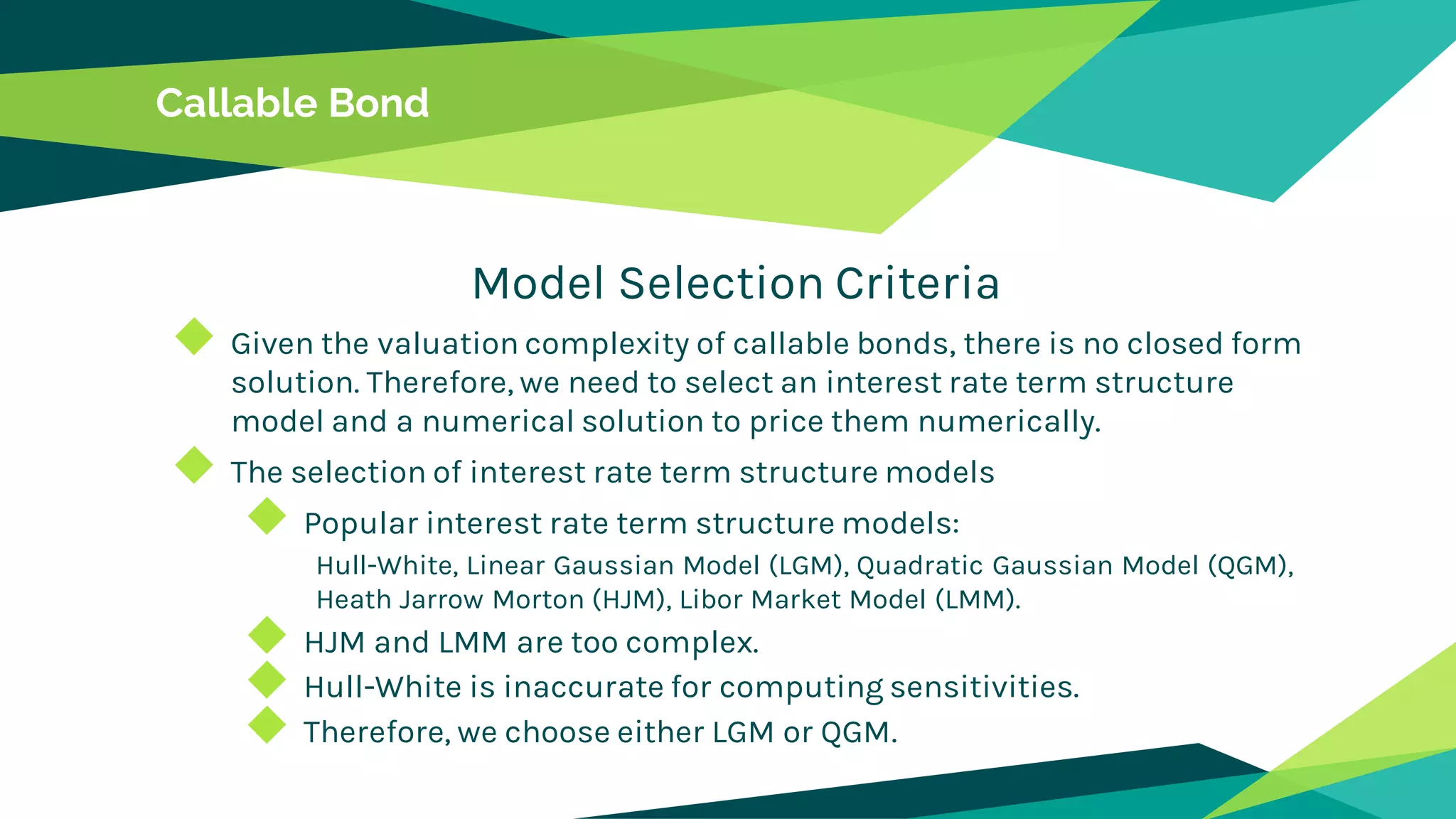
◆ Given the valuation complexity of callable bonds, there is no closed form
solution. Therefore, we need to select an interest rate term structure
model and a numerical solution to price them numerically.
◆ The selection of interest rate term structure models
◆ Popular interest rate term structure models:
Hull-White, Linear Gaussian Model (LGM), Quadratic Gaussian Model (QGM),
Heath Jarrow Morton (HJM), Libor Market Model (LMM).
◆ HJM and LMM are too complex.
◆ Hull-White is inaccurate for computing sensitivities.
◆ Therefore, we choose either LGM or QGM.
Callable Bond
Model Selection Criteria (Cont)
◆ The selection of numeric approaches
◆ After selecting a term structure model, we need to choose a numerical
approach to approximate the underlying stochastic process of the model.
◆ Commonly used numeric approaches are tree, partial differential equation
(PDE), lattice and Monte Carlo simulation.
◆ Tree and Monte Carlo are notorious for inaccuracy on sensitivity calculation.
◆ Therefore, we choose either PDE or lattice.
◆ Our decision is to use LGM plus lattice.
Callable Bond
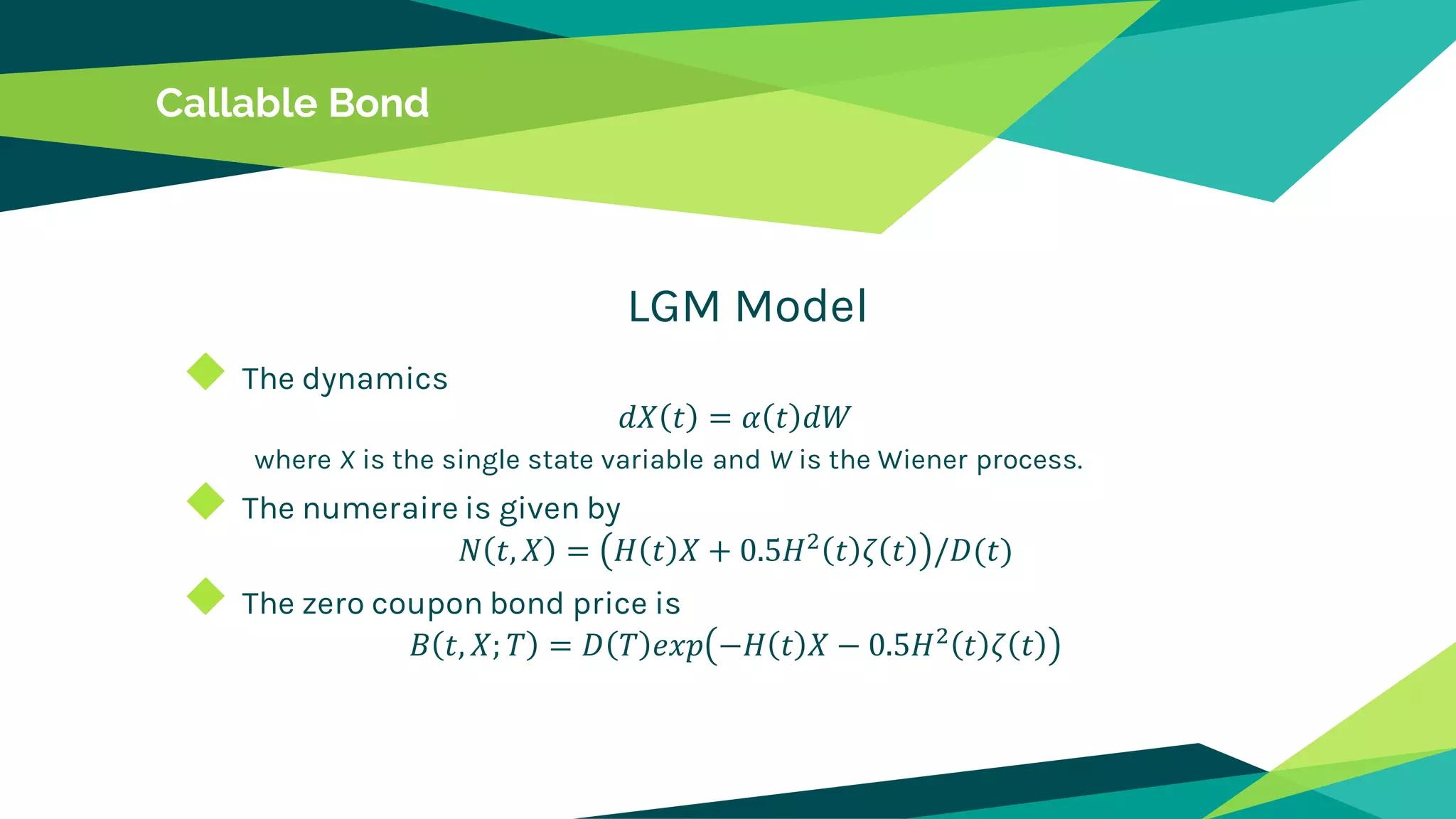
LGM Model
◆ The dynamics
𝑑𝑋 𝑡 = 𝛼 𝑡 𝑑𝑊
where X is the single state variable and W is the Wiener process.
◆ The numeraire is given by
𝑁 𝑡, 𝑋 = 𝐻 𝑡 𝑋 + 0.5𝐻2
𝑡 𝜁 𝑡 /𝐷(𝑡)
◆ The zero coupon bond price is
𝐵 𝑡, 𝑋; 𝑇 = 𝐷 𝑇 𝑒𝑥𝑝 −𝐻 𝑡 𝑋 − 0.5𝐻2
𝑡 𝜁 𝑡
Callable Bond
LGM Assumption
◆ The LGM model is mathematically equivalent to the Hull-White model
but offers
◆ Significant improvement of stability and accuracy for calibration.
◆ Significant improvement of stability and accuracy for sensitivity calculation.
◆ The state variable is normally distributed under the appropriate
measure.
◆ The LGM model has only one stochastic driver (one-factor), thus
changes in rates are perfected correlated.
Callable Bond
LGM calibration
◆ Match today’s curve
At time t=0, X(0)=0 and H(0)=0. Thus Z(0,0;T)=D(T). In other words, the
LGM automatically fits today’s discount curve.
◆ Select a group of market swaptions.
◆ Solve parameters by minimizing the relative error between the market
swaption prices and the LGM model swaption prices.
Callable Bond
Valuation Implementation
◆ Calibrate the LGM model.
◆ Create the lattice based on the LGM: the grid range should cover at least
3 standard deviations.
◆ Calculate the payoff of the callable bond at each final note.
◆ Conduct backward induction process iteratively rolling back from final
dates until reaching the valuation date.
◆ Compare exercise values with intrinsic values at each exercise date.
◆ The value at the valuation date is the price of the callable bond.
Callabe Bond
A real world example
Bond specification Callable schedule
Buy Sell Buy Call Price Notification Date
Calendar NYC 100 1/26/2015
Coupon Type Fixed 100 7/25/2018
Currency USD
First Coupon Date 7/30/2013
Interest Accrual
Date
1/30/2013
Issue Date 1/30/2013
Last Coupon Date 1/30/2018
Maturity Date 7/30/2018
Settlement Lag 1
Face Value 100
Pay Receive Receive
Day Count dc30360
Payment Frequency 6
Coupon 0.015
Thanks!

Valuing Callable Bond

  • 1.
    Callable Bond and Vaulation DmitryPopov FinPricing http://www.finpricing.com
  • 2.
    Callable Bond Summary ◆ CallableBond Definition ◆ The Advantages of Callable Bonds ◆ Callable Bond Payoffs ◆ Valuation Model Selection Criteria ◆ LGM Model ◆ LGM Assumption ◆ LGM calibration ◆ Valuation Implementation ◆ A real world example
  • 3.
    Callable Bond Callable BondDefinition ◆ A callable bond is a bond in which the issuer has the right to call the bond at specified times (callable dates) from the investor for a specified price (call price). ◆ At each callable date prior to the bond maturity, the issuer may recall the bond from its investor by returning the investor’s money. ◆ The underlying bond can be a fixed rate bond or a floating rate bond. ◆ A callable bond can therefore be considered a vanilla underlying bond with an embedded Bermudan style option. ◆ Callable bonds protect issuers. Therefore, a callable bond normally pays the investor a higher coupon than a non-callable bond.
  • 4.
    Callable bond Advantages ofCallable Bond ◆ Although a callable bond is a higher cost to the issuer and an uncertainty to the investor comparing to a regular bond, it is actually quite attractive to both issuers and investors. ◆ For issuers, callable bonds allow them to reduce interest costs at a future date should rate decrease. ◆ For investors, callable bonds allow them to earn a higher interest rate of return until the bonds are called off. ◆ If interest rates have declined since the issuer first issues the bond, the issuer is like to call its current bond and reissues it at a lower coupon.
  • 5.
    Callable Bond Callable BondPayoffs ◆ At the bond maturity T, the payoff of a callable bond is given by 𝑉𝑐 𝑡 = 𝐹 + 𝐶 𝑖𝑓 𝑛𝑜𝑡 𝑐𝑎𝑙𝑙𝑒𝑑 min(𝑃𝑐, 𝐹 + 𝐶) 𝑖𝑓 𝑐𝑎𝑙𝑙𝑒𝑑 where F – the principal or face value; C – the coupon; 𝑃𝑐 – the call price; min (x, y) – the minimum of x and y ◆ The payoff of the callable bond at any call date 𝑇𝑖 can be expressed as 𝑉𝑐 𝑇𝑖 = 𝑉 𝑇 𝑖 𝑖𝑓 𝑛𝑜𝑡 𝑐𝑎𝑙𝑙𝑒𝑑 min 𝑃𝑐, 𝑉 𝑇 𝑖 𝑖𝑓 𝑐𝑎𝑙𝑙𝑒𝑑 where 𝑉 𝑇 𝑖 – continuation value at 𝑇𝑖
  • 6.
    Callable Bond Model SelectionCriteria ◆ Given the valuation complexity of callable bonds, there is no closed form solution. Therefore, we need to select an interest rate term structure model and a numerical solution to price them numerically. ◆ The selection of interest rate term structure models ◆ Popular interest rate term structure models: Hull-White, Linear Gaussian Model (LGM), Quadratic Gaussian Model (QGM), Heath Jarrow Morton (HJM), Libor Market Model (LMM). ◆ HJM and LMM are too complex. ◆ Hull-White is inaccurate for computing sensitivities. ◆ Therefore, we choose either LGM or QGM.
  • 7.
    Callable Bond Model SelectionCriteria (Cont) ◆ The selection of numeric approaches ◆ After selecting a term structure model, we need to choose a numerical approach to approximate the underlying stochastic process of the model. ◆ Commonly used numeric approaches are tree, partial differential equation (PDE), lattice and Monte Carlo simulation. ◆ Tree and Monte Carlo are notorious for inaccuracy on sensitivity calculation. ◆ Therefore, we choose either PDE or lattice. ◆ Our decision is to use LGM plus lattice.
  • 8.
    Callable Bond LGM Model ◆The dynamics 𝑑𝑋 𝑡 = 𝛼 𝑡 𝑑𝑊 where X is the single state variable and W is the Wiener process. ◆ The numeraire is given by 𝑁 𝑡, 𝑋 = 𝐻 𝑡 𝑋 + 0.5𝐻2 𝑡 𝜁 𝑡 /𝐷(𝑡) ◆ The zero coupon bond price is 𝐵 𝑡, 𝑋; 𝑇 = 𝐷 𝑇 𝑒𝑥𝑝 −𝐻 𝑡 𝑋 − 0.5𝐻2 𝑡 𝜁 𝑡
  • 9.
    Callable Bond LGM Assumption ◆The LGM model is mathematically equivalent to the Hull-White model but offers ◆ Significant improvement of stability and accuracy for calibration. ◆ Significant improvement of stability and accuracy for sensitivity calculation. ◆ The state variable is normally distributed under the appropriate measure. ◆ The LGM model has only one stochastic driver (one-factor), thus changes in rates are perfected correlated.
  • 10.
    Callable Bond LGM calibration ◆Match today’s curve At time t=0, X(0)=0 and H(0)=0. Thus Z(0,0;T)=D(T). In other words, the LGM automatically fits today’s discount curve. ◆ Select a group of market swaptions. ◆ Solve parameters by minimizing the relative error between the market swaption prices and the LGM model swaption prices.
  • 11.
    Callable Bond Valuation Implementation ◆Calibrate the LGM model. ◆ Create the lattice based on the LGM: the grid range should cover at least 3 standard deviations. ◆ Calculate the payoff of the callable bond at each final note. ◆ Conduct backward induction process iteratively rolling back from final dates until reaching the valuation date. ◆ Compare exercise values with intrinsic values at each exercise date. ◆ The value at the valuation date is the price of the callable bond.
  • 12.
    Callabe Bond A realworld example Bond specification Callable schedule Buy Sell Buy Call Price Notification Date Calendar NYC 100 1/26/2015 Coupon Type Fixed 100 7/25/2018 Currency USD First Coupon Date 7/30/2013 Interest Accrual Date 1/30/2013 Issue Date 1/30/2013 Last Coupon Date 1/30/2018 Maturity Date 7/30/2018 Settlement Lag 1 Face Value 100 Pay Receive Receive Day Count dc30360 Payment Frequency 6 Coupon 0.015
  • 13.