S§
Validation and Hypothesis based
Product Management
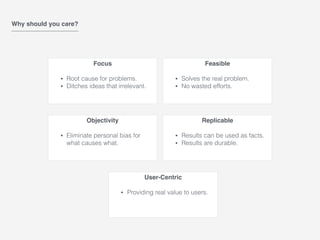
Focus
• Root cause for problems.
• Ditches ideas that irrelevant.
Why should you care?
Feasible
• Solves the real problem.
• No wasted efforts.
Objectivity
• Eliminate personal bias for
what causes what.
Replicable
• Results can be used as facts.
• Results are durable.
User-Centric
• Providing real value to users.
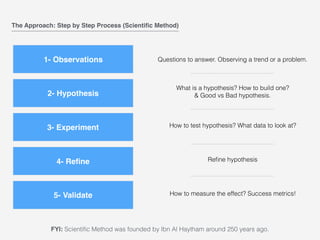
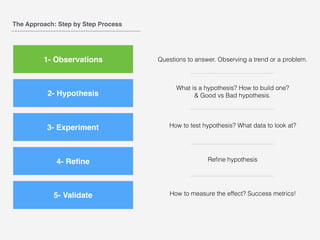
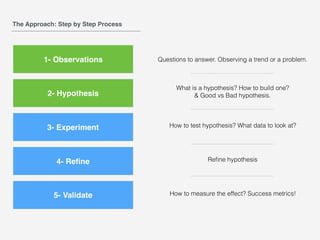
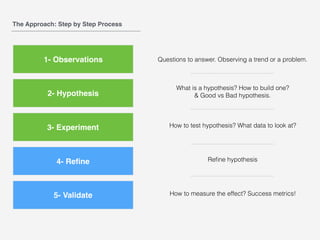
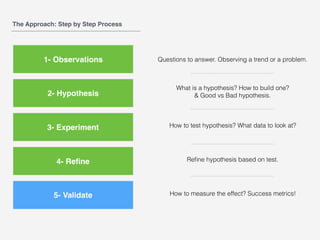
The Approach: Step by Step Process (Scientific Method)
1- Observations
2- Hypothesis
3- Experiment
4- Refine
5- Validate
Questions to answer. Observing a trend or a problem.
What is a hypothesis? How to build one?
& Good vs Bad hypothesis.
How to test hypothesis? What data to look at?
Refine hypothesis
How to measure the effect? Success metrics!
FYI: Scientific Method was founded by Ibn Al Haytham around 250 years ago.
Observations
Observing a trend or a problem.
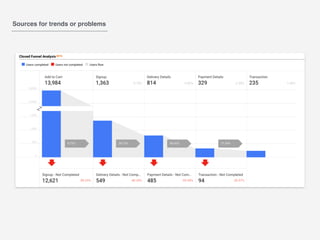
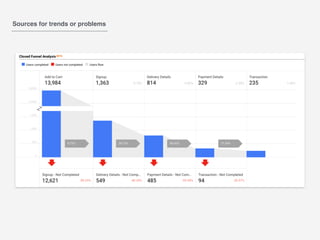
Sources for trends or problems
Customer Service
SalesOnline Discussions
Product Vision
Sources for trends or problems
Impact Based Prioritization
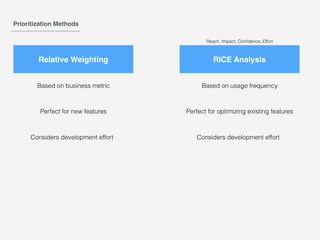
Prioritization Methods
Relative Weighting RICE Analysis
Based on business metric Based on usage frequency
Perfect for new features Perfect for optimizing existing features
Considers development effort Considers development effort
Reach, Impact, Confidence, Effort
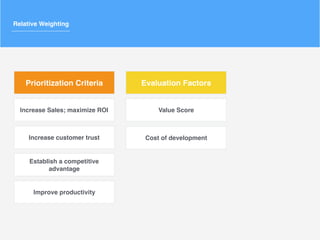
Relative Weighting
Prioritization Criteria Evaluation Factors
Increase Sales; maximize ROI
Increase customer trust
Establish a competitive
advantage
Improve productivity
Cost of development
Value Score
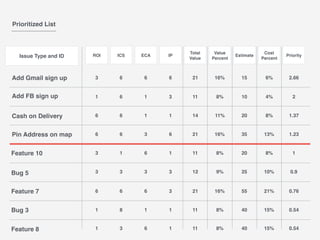
Prioritized List
Issue Type and ID ROI ICS ECA IP
Total
Value
Value
Percent
Estimate
Cost
Percent
Priority
Add FB sign up
Feature 10
Cash on Delivery
Bug 3
Feature 7
1 6 1 3
3 1 6 1
6 6 1 1
1 8 1 1
6 6 6 3
11
11
14
11
21
10
20
20
40
55
Add Gmail sign up 3 6 6 6 21 15
Pin Address on map 6 6 3 6 21 35
Bug 5 3 3 3 3 12 25
Feature 8 1 3 6 1 11 40
8%
8%
11%
8%
16%
16%
16%
9%
8%
4%
8%
8%
15%
21%
6%
13%
10%
15%
2
1
1.37
0.54
0.76
2.66
1.23
0.9
0.54
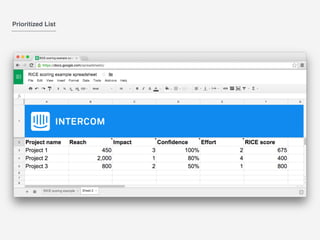
RICE Analysis
Prioritized List
1- Observations
2- Hypothesis
3- Experiment
4- Refine
5- Validate
The Approach: Step by Step Process
Questions to answer. Observing a trend or a problem.
What is a hypothesis? How to build one?
& Good vs Bad hypothesis.
How to test hypothesis? What data to look at?
Refine hypothesis
How to measure the effect? Success metrics!
Hypothesis
What is a hypothesis? How to build it?
& Good vs Bad one.
What is a hypothesis?
"If _____[I do this] _____, then _____[this]_____ will happen."
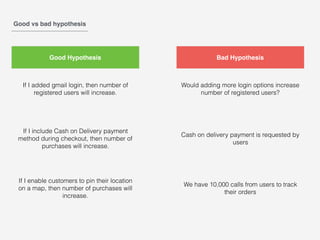
If I added gmail login, then number of registered users will increase.
If I include Cash on Delivery payment method during checkout, then number of purchases will increase.
If I enable customers to pin their location on a map, then number of purchases will increase.
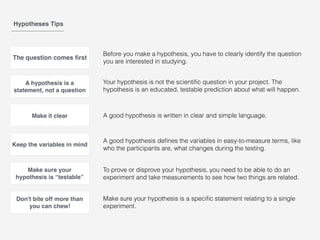
Hypotheses Tips
Before you make a hypothesis, you have to clearly identify the question
you are interested in studying.
The question comes first
A hypothesis is a
statement, not a question
Your hypothesis is not the scientific question in your project. The
hypothesis is an educated, testable prediction about what will happen.
Make it clear A good hypothesis is written in clear and simple language.
Keep the variables in mind
A good hypothesis defines the variables in easy-to-measure terms, like
who the participants are, what changes during the testing.
Make sure your
hypothesis is “testable”
Don't bite off more than
you can chew!
To prove or disprove your hypothesis, you need to be able to do an
experiment and take measurements to see how two things are related.
Make sure your hypothesis is a specific statement relating to a single
experiment.
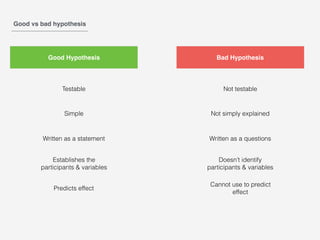
Good vs bad hypothesis
Good Hypothesis Bad Hypothesis
Testable
Simple
Written as a statement
Establishes the
participants & variables
Predicts effect
Not testable
Not simply explained
Written as a questions
Doesn’t identify
participants & variables
Cannot use to predict
effect
Good vs bad hypothesis
Good Hypothesis Bad Hypothesis
If I added gmail login, then number of
registered users will increase.
If I include Cash on Delivery payment
method during checkout, then number of
purchases will increase.
If I enable customers to pin their location
on a map, then number of purchases will
increase.
Would adding more login options increase
number of registered users?
Cash on delivery payment is requested by
users
We have 10,000 calls from users to track
their orders
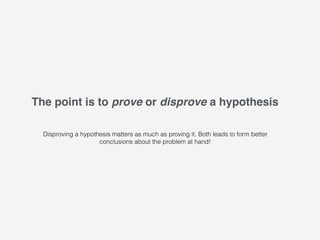
The point is to prove or disprove a hypothesis
Disproving a hypothesis matters as much as proving it. Both leads to form better
conclusions about the problem at hand!
Sources for trends or problems
1- Observations
2- Hypothesis
3- Experiment
4- Refine
5- Validate
The Approach: Step by Step Process
Questions to answer. Observing a trend or a problem.
What is a hypothesis? How to build one?
& Good vs Bad hypothesis.
How to test hypothesis? What data to look at?
Refine hypothesis
How to measure the effect? Success metrics!
Experiment
How to test hypothesis? What data to look at?
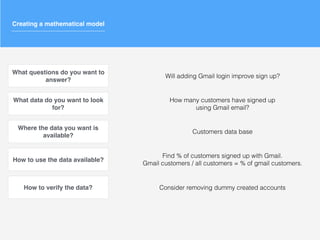
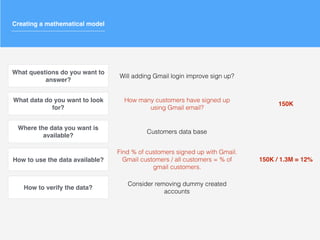
Creating a mathematical model
What questions do you want to
answer?
What data do you want to look
for?
Where the data you want is
available?
How to use the data available?
How to verify the data?
Will adding Gmail login improve sign up?
How many customers have signed up
using Gmail email?
Customers data base
Find % of customers signed up with Gmail.
Gmail customers / all customers = % of gmail customers.
Consider removing dummy created accounts
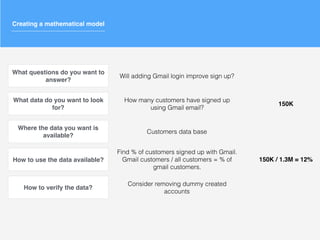
Creating a mathematical model
What questions do you want to
answer?
What data do you want to look
for?
Where the data you want is
available?
How to use the data available?
How to verify the data?
Will adding Gmail login improve sign up?
How many customers have signed up
using Gmail email?
Customers data base
Find % of customers signed up with Gmail.
Gmail customers / all customers = % of
gmail customers.
Consider removing dummy created
accounts
150K
150K / 1.3M = 12%
1- Observations
2- Hypothesis
3- Experiment
4- Refine
5- Validate
The Approach: Step by Step Process
Questions to answer. Observing a trend or a problem.
What is a hypothesis? How to build one?
& Good vs Bad hypothesis.
How to test hypothesis? What data to look at?
Refine hypothesis
How to measure the effect? Success metrics!
Refine
Refine mathematical model, removing bias!
Will adding Gmail login improve sign up?
How many customers have signed up
using Gmail email?
Find % of customers signed up with Gmail.
Gmail customers / all customers = % of
gmail customers.
Consider removing dummy created
accounts
150K
150K / 1.3M = 12%
What questions do you want to
answer?
What data do you want to look
for?
Where the data you want is
available?
How to use the data available?
How to verify the data?
Creating a mathematical model
Customers data base
We live in a dynamic world, so always consider things
in a timely manner!
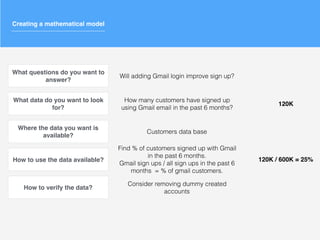
Creating a mathematical model
What questions do you want to
answer?
What data do you want to look
for?
Where the data you want is
available?
How to use the data available?
How to verify the data?
Will adding Gmail login improve sign up?
How many customers have signed up
using Gmail email in the past 6 months?
Customers data base
Find % of customers signed up with Gmail
in the past 6 months.
Gmail sign ups / all sign ups in the past 6
months = % of gmail customers.
Consider removing dummy created
accounts
120K
120K / 600K = 25%
1- Observations
2- Hypothesis
3- Experiment
4- Refine
5- Validate
The Approach: Step by Step Process
Questions to answer. Observing a trend or a problem.
What is a hypothesis? How to build one?
& Good vs Bad hypothesis.
How to test hypothesis? What data to look at?
Refine hypothesis based on test.
How to measure the effect? Success metrics!
Validate
How to measure the effect? Success metrics!
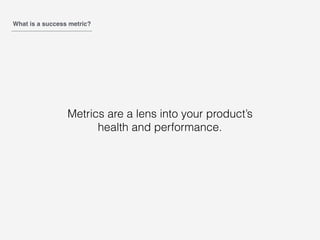
What is a success metric?
Metrics are a lens into your product’s
health and performance.
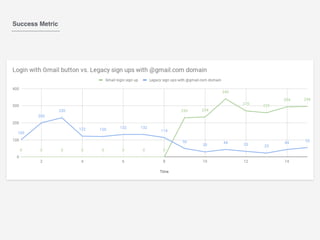
Success Metric
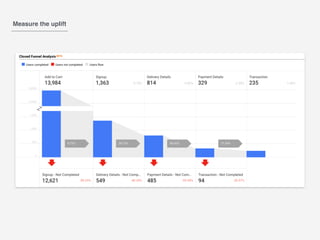
Measure the uplift
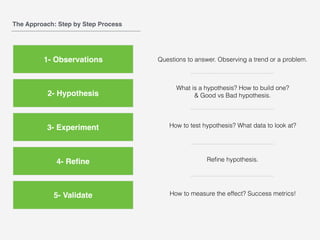
1- Observations
2- Hypothesis
3- Experiment
4- Refine
5- Validate
The Approach: Step by Step Process
Questions to answer. Observing a trend or a problem.
What is a hypothesis? How to build one?
& Good vs Bad hypothesis.
How to test hypothesis? What data to look at?
Refine hypothesis.
How to measure the effect? Success metrics!
Thank you
Abdallah Al-Khalidi
Linkedin: abzkhaldi | Twitter: @abzkhaldi
Email: abdallah.khalidi@gmail.com

Validation and hypothesis based product management by Abdallah Al-Khalidi

  • 1.
    S§ Validation and Hypothesisbased Product Management
  • 2.
    Focus • Root causefor problems. • Ditches ideas that irrelevant. Why should you care? Feasible • Solves the real problem. • No wasted efforts. Objectivity • Eliminate personal bias for what causes what. Replicable • Results can be used as facts. • Results are durable. User-Centric • Providing real value to users.
  • 3.
    The Approach: Stepby Step Process (Scientific Method) 1- Observations 2- Hypothesis 3- Experiment 4- Refine 5- Validate Questions to answer. Observing a trend or a problem. What is a hypothesis? How to build one? & Good vs Bad hypothesis. How to test hypothesis? What data to look at? Refine hypothesis How to measure the effect? Success metrics! FYI: Scientific Method was founded by Ibn Al Haytham around 250 years ago.
  • 4.
  • 5.
    Sources for trendsor problems Customer Service SalesOnline Discussions Product Vision
  • 6.
    Sources for trendsor problems
  • 7.
  • 8.
    Prioritization Methods Relative WeightingRICE Analysis Based on business metric Based on usage frequency Perfect for new features Perfect for optimizing existing features Considers development effort Considers development effort Reach, Impact, Confidence, Effort
  • 9.
    Relative Weighting Prioritization CriteriaEvaluation Factors Increase Sales; maximize ROI Increase customer trust Establish a competitive advantage Improve productivity Cost of development Value Score
  • 10.
    Prioritized List Issue Typeand ID ROI ICS ECA IP Total Value Value Percent Estimate Cost Percent Priority Add FB sign up Feature 10 Cash on Delivery Bug 3 Feature 7 1 6 1 3 3 1 6 1 6 6 1 1 1 8 1 1 6 6 6 3 11 11 14 11 21 10 20 20 40 55 Add Gmail sign up 3 6 6 6 21 15 Pin Address on map 6 6 3 6 21 35 Bug 5 3 3 3 3 12 25 Feature 8 1 3 6 1 11 40 8% 8% 11% 8% 16% 16% 16% 9% 8% 4% 8% 8% 15% 21% 6% 13% 10% 15% 2 1 1.37 0.54 0.76 2.66 1.23 0.9 0.54
  • 11.
  • 12.
  • 13.
    1- Observations 2- Hypothesis 3-Experiment 4- Refine 5- Validate The Approach: Step by Step Process Questions to answer. Observing a trend or a problem. What is a hypothesis? How to build one? & Good vs Bad hypothesis. How to test hypothesis? What data to look at? Refine hypothesis How to measure the effect? Success metrics!
  • 14.
    Hypothesis What is ahypothesis? How to build it? & Good vs Bad one.
  • 15.
    What is ahypothesis? "If _____[I do this] _____, then _____[this]_____ will happen." If I added gmail login, then number of registered users will increase. If I include Cash on Delivery payment method during checkout, then number of purchases will increase. If I enable customers to pin their location on a map, then number of purchases will increase.
  • 16.
    Hypotheses Tips Before youmake a hypothesis, you have to clearly identify the question you are interested in studying. The question comes first A hypothesis is a statement, not a question Your hypothesis is not the scientific question in your project. The hypothesis is an educated, testable prediction about what will happen. Make it clear A good hypothesis is written in clear and simple language. Keep the variables in mind A good hypothesis defines the variables in easy-to-measure terms, like who the participants are, what changes during the testing. Make sure your hypothesis is “testable” Don't bite off more than you can chew! To prove or disprove your hypothesis, you need to be able to do an experiment and take measurements to see how two things are related. Make sure your hypothesis is a specific statement relating to a single experiment.
  • 17.
    Good vs badhypothesis Good Hypothesis Bad Hypothesis Testable Simple Written as a statement Establishes the participants & variables Predicts effect Not testable Not simply explained Written as a questions Doesn’t identify participants & variables Cannot use to predict effect
  • 18.
    Good vs badhypothesis Good Hypothesis Bad Hypothesis If I added gmail login, then number of registered users will increase. If I include Cash on Delivery payment method during checkout, then number of purchases will increase. If I enable customers to pin their location on a map, then number of purchases will increase. Would adding more login options increase number of registered users? Cash on delivery payment is requested by users We have 10,000 calls from users to track their orders
  • 19.
    The point isto prove or disprove a hypothesis Disproving a hypothesis matters as much as proving it. Both leads to form better conclusions about the problem at hand!
  • 20.
    Sources for trendsor problems
  • 21.
    1- Observations 2- Hypothesis 3-Experiment 4- Refine 5- Validate The Approach: Step by Step Process Questions to answer. Observing a trend or a problem. What is a hypothesis? How to build one? & Good vs Bad hypothesis. How to test hypothesis? What data to look at? Refine hypothesis How to measure the effect? Success metrics!
  • 22.
    Experiment How to testhypothesis? What data to look at?
  • 23.
    Creating a mathematicalmodel What questions do you want to answer? What data do you want to look for? Where the data you want is available? How to use the data available? How to verify the data? Will adding Gmail login improve sign up? How many customers have signed up using Gmail email? Customers data base Find % of customers signed up with Gmail. Gmail customers / all customers = % of gmail customers. Consider removing dummy created accounts
  • 24.
    Creating a mathematicalmodel What questions do you want to answer? What data do you want to look for? Where the data you want is available? How to use the data available? How to verify the data? Will adding Gmail login improve sign up? How many customers have signed up using Gmail email? Customers data base Find % of customers signed up with Gmail. Gmail customers / all customers = % of gmail customers. Consider removing dummy created accounts 150K 150K / 1.3M = 12%
  • 25.
    1- Observations 2- Hypothesis 3-Experiment 4- Refine 5- Validate The Approach: Step by Step Process Questions to answer. Observing a trend or a problem. What is a hypothesis? How to build one? & Good vs Bad hypothesis. How to test hypothesis? What data to look at? Refine hypothesis How to measure the effect? Success metrics!
  • 26.
  • 27.
    Will adding Gmaillogin improve sign up? How many customers have signed up using Gmail email? Find % of customers signed up with Gmail. Gmail customers / all customers = % of gmail customers. Consider removing dummy created accounts 150K 150K / 1.3M = 12% What questions do you want to answer? What data do you want to look for? Where the data you want is available? How to use the data available? How to verify the data? Creating a mathematical model Customers data base
  • 28.
    We live ina dynamic world, so always consider things in a timely manner!
  • 29.
    Creating a mathematicalmodel What questions do you want to answer? What data do you want to look for? Where the data you want is available? How to use the data available? How to verify the data? Will adding Gmail login improve sign up? How many customers have signed up using Gmail email in the past 6 months? Customers data base Find % of customers signed up with Gmail in the past 6 months. Gmail sign ups / all sign ups in the past 6 months = % of gmail customers. Consider removing dummy created accounts 120K 120K / 600K = 25%
  • 30.
    1- Observations 2- Hypothesis 3-Experiment 4- Refine 5- Validate The Approach: Step by Step Process Questions to answer. Observing a trend or a problem. What is a hypothesis? How to build one? & Good vs Bad hypothesis. How to test hypothesis? What data to look at? Refine hypothesis based on test. How to measure the effect? Success metrics!
  • 31.
    Validate How to measurethe effect? Success metrics!
  • 32.
    What is asuccess metric? Metrics are a lens into your product’s health and performance.
  • 33.
  • 34.
  • 35.
    1- Observations 2- Hypothesis 3-Experiment 4- Refine 5- Validate The Approach: Step by Step Process Questions to answer. Observing a trend or a problem. What is a hypothesis? How to build one? & Good vs Bad hypothesis. How to test hypothesis? What data to look at? Refine hypothesis. How to measure the effect? Success metrics!
  • 36.
    Thank you Abdallah Al-Khalidi Linkedin:abzkhaldi | Twitter: @abzkhaldi Email: abdallah.khalidi@gmail.com