11th Airborne
Division SSI
13th Airborne
Division SSI
17th Airborne
Division SSI
SWCS
SSI
US Army
Airborne Command
SSI
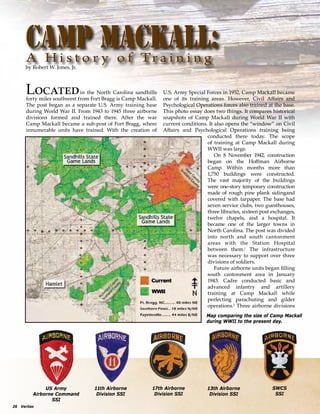
Map comparing the size of Camp Mackall
during WWII to the present day.
Camp Mackall:A H i s t o r y o f Tr a i n i n g
LOCATEDin the North Carolina sandhills
forty miles southwest from Fort Bragg is Camp Mackall.
The post began as a separate U.S. Army training base
during World War II. From 1943 to 1945 three airborne
divisions formed and trained there. After the war
Camp Mackall became a sub-post of Fort Bragg, where
innumerable units have trained. With the creation of
U.S. Army Special Forces in 1952, Camp Mackall became
one of its training areas. However, Civil Affairs and
Psychological Operations forces also trained at the base.
This photo essay does two things. It compares historical
snapshots of Camp Mackall during World War II with
current conditions. It also opens the “window” on Civil
Affairs and Psychological Operations training being
conducted there today. The scope
of training at Camp Mackall during
WWII was large.
On 8 November 1942, construction
began on the Hoffman Airborne
Camp. Within months more than
1,750 buildings were constructed.
The vast majority of the buildings
were one-story temporary construction
made of rough pine plank sidingand
covered with tarpaper. The base had
seven service clubs, two guesthouses,
three libraries, sixteen post exchanges,
twelve chapels, and a hospital. It
became one of the larger towns in
North Carolina. The post was divided
into north and south cantonment
areas with the Station Hospital
between them.1
The infrastructure
was necessary to support over three
divisions of soldiers.
Future airborne units began filling
south cantonment area in January
1943. Cadre conducted basic and
advanced infantry and artillery
training at Camp Mackall while
perfecting parachuting and gilder
operations.2
Three airborne divisions
by Robert W. Jones, Jr.
26 Veritas
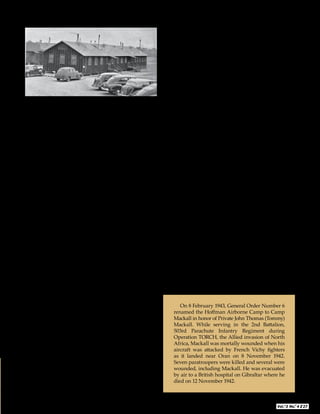
On 8 February 1943, General Order Number 6
renamed the Hoffman Airborne Camp to Camp
Mackall in honor of Private John Thomas (Tommy)
Mackall. While serving in the 2nd Battalion,
503rd Parachute Infantry Regiment during
Operation TORCH, the Allied invasion of North
Africa, Mackall was mortally wounded when his
aircraft was attacked by French Vichy fighters
as it landed near Oran on 8 November 1942.
Seven paratroopers were killed and several were
wounded, including Mackall. He was evacuated
by air to a British hospital on Gibraltar where he
died on 12 November 1942.
A tarpaper “theater of operations” building found
throughout WWII training bases, such as Camp
Mackall.
(the 11th, 13th and 17th Airborne Divisions) were
formed and trained at Camp Mackall during
World War II. The 82nd and 101st Airborne Divisions,
while not formed at Camp Mackall, trained there before
leaving for the European Theater. During the war a variety
of units trained and conducted operational tests at Camp
Mackall. After the war, Camp Mackall was used as an
airborne maneuver area by XVIII Airborne Corps units.
In the 1950s, Camp Mackall was a training site for the
newly created Special Forces. However, it fell into
disrepair until the 1980s. In the post Vietnam period
the U.S. Army John F. Kennedy Special Warfare Center
and School (USAJFKSWCS) built the Rowe Training
Facility for Special Forces training.3
Other USAJFKSWCS
courses also began using Camp Mackall as a training site.
A lesser-known part of Camp Mackall history is the Civil
Affairs and PSYOP training conducted by the members
of 3rd Battalion, 1st Special Warfare Training Group (Air-
borne). The training site for CA and PSYOP went through
a series of evolutions since 1999. The first permanent
CA/PSYOP training site was built by 18C Special Forces
engineer sergeant students as a practicum during the
“Q-course” (each building was constructed by a different
class). CA and PSYOP cadre began using these temporary
facilities as a command post and training area in late 1999
until a permanent compound could be constructed.
The present training site was constructed in stages from
2004 to 2007 to support capstone-training exercises for the
Civil Affairs and Psychological Operations officer and non-
commissioned officer courses.4
The CA/PSYOP training
area has three individual sites. The largest is Forward
Operation Base (FOB) Freedom, built to replicate a typical
FOB anywhere in the world. The second is Freedom
Village, a collection of buildings currently made to resemble
a town in the Middle East. A contracted civilian population
of role players enhances training. The third training site
is the Soldiers Urban Reaction Facility (SURF). Here, role
players challenge the students with a series of situational
dilemmas.5
These scenarios serve as the culminating
exercise for CA and PSYOP officer and NCO training.
After classroom training at Fort Bragg the CA and PSYOP
students undergo a 10-day, three-phase culmination
exercise. Named “Operation CERTAIN TRUST,” the
exercise is focused on preparing the soldiers for
operational assignments. Supported from Forward
Operating Base (FOB) Freedom, the 214 hours of training
in Operation CERTAIN TRUST is divided into 3 phases.
The operation begins with a 36-hour Situational
Training Exercise (STX) to introduce physical and mental
stress (Phase I). Next, in Phase II, they go to the Soldiers
UrbanReactionFacility(SURF)tosolveaseriesofproblem
based scenarios. The CA and PSYOP soldiers have separate
challenges. The scenarios allow the cadre to evaluate
individual and collective performance in a controlled,
but realistic operational environment. Each student team
responds to four different scenarios. Contracted male
and female Middle Eastern and African nationals serve
as role players, adding more realism to the scenarios.
Contracted “Enhancement Coaches,” all with
operational military experience, accompany student
teams to provide feedback on tactics, techniques, and
procedures employed to solve the problem. Each dilemma
is evaluated by an Enhancement Coach who, combined
with coaching and mentoring, conducts an after action
review for the teams. After successfully completing
Phase II the soldiers move into a Field Training Exercise
at Freedom Village and in the North Carolina counties
surrounding Camp Mackall (Hoke, Lee, Montgomery,
Moore, Richmond, Robeson, and Scotland).6
While
Freedom Village is the focus of the exercise the counties
provide an opportunity to assess real world public
facilities. Though very involved in training at Camp
Mackall few soldiers know anything about its history.
Most soldiers are unaware of the historic connection
of the base to WWII. The FOB Freedom operations
center tent sits where the former WWII Station Hospital
was located. Freedom Village occupies the original
hospital steam plant. The SURF was built where the
hospital supply area was once located.
This photo essay is just a “snapshot” of ongoing
training at Camp Mackall. The historical snapshots of the
post connect yesterday to today. This photo essay has a
secondarymotive,topromptveteranstofurnishvignettes,
photographs, and documents that pertain to Camp
Mackall. The current contracted history project for
2008 is a history of Camp Mackall, WWII to the present.
Vol. 3 No. 4 27
OPERATION CERTAIN THRUST
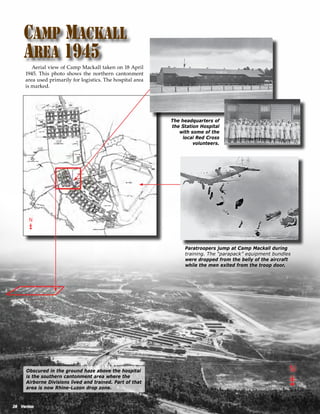
The headquarters of
the Station Hospital
with some of the
local Red Cross
volunteers.
Paratroopers jump at Camp Mackall during
training. The “parapack” equipment bundles
were dropped from the belly of the aircraft
while the men exited from the troop door.
CAMP MACKALL
AREA 1945
Aerial view of Camp Mackall taken on 18 April
1945. This photo shows the northern cantonment
area used primarily for logistics. The hospital area
is marked.
/
N
/
N
Obscured in the ground haze above the hospital
is the southern cantonment area where the
Airborne Divisions lived and trained. Part of that
area is now Rhine-Luzon drop zone.
28 Veritas28 Veritas
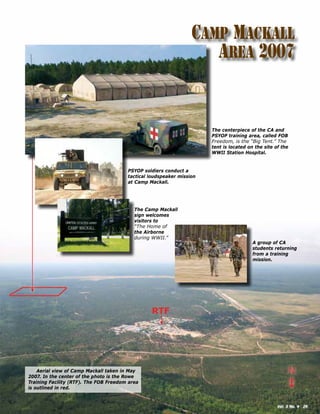
A group of CA
students returning
from a training
mission.
CAMP MACKALL
AREA 2007
The centerpiece of the CA and
PSYOP training area, called FOB
Freedom, is the “Big Tent.” The
tent is located on the site of the
WWII Station Hospital.
PSYOP soldiers conduct a
tactical loudspeaker mission
at Camp Mackall.
The Camp Mackall
sign welcomes
visitors to
“The Home of
the Airborne
during WWII.”
Aerial view of Camp Mackall taken in May
2007. In the center of the photo is the Rowe
Training Facility (RTF). The FOB Freedom area
is outlined in red.
/
N
RTF
Vol. 3 No. 4 29Vol. 3 No. 4 29
OPERATION CERTAIN TRUST
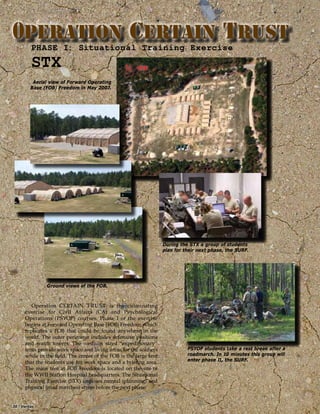
PHASE I: Situational Training Exercise
STX
/
N
Aerial view of Forward Operating
Base (FOB) Freedom in May 2007.
During the STX a group of students
plan for their next phase, the SURF.
Ground views of the FOB.
PSYOP students take a rest break after a
roadmarch. In 10 minutes this group will
enter phase II, the SURF.
Operation CERTAIN TRUST is the culminating
exercise for Civil Affairs (CA) and Psychological
Operations (PSYOP) courses. Phase I of the exercise
begins at Forward Operating Base (FOB) Freedom, which
replicates a FOB that could be found anywhere in the
world. The outer perimeter includes defensive positions
and watch towers. The medium sized “expeditionary”
tents provide work space and living areas for the soldiers
while in the field. The center of the FOB is the large tent
that the students use for work space and a briefing area.
The main tent at FOB Freedom is located on the site of
the WWII Station Hospital headquarters. The Situational
Training Exercise (STX) imposes mental (planning) and
physical (road marches) stress before the next phase.
30 Veritas
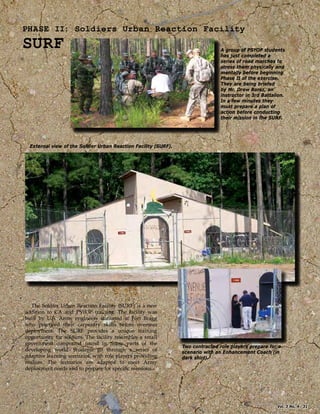
PHASE II: Soldiers Urban Reaction Facility
SURF A group of PSYOP students
has just completed a
series of road marches to
stress them physically and
mentally before beginning
Phase II of the exercise.
They are being briefed
by Mr. Drew Borsz, an
instructor in 3rd Battalion.
In a few minutes they
must prepare a plan of
action before conducting
their mission in the SURF.
External view of the Soldier Urban Reaction Facility (SURF).
Two contracted role players prepare for a
scenario with an Enhancement Coach (in
dark shirt).
The Soldier Urban Reaction Facility (SURF) is a new
addition to CA and PSYOP training. The facility was
built by U.S. Army engineers stationed at Fort Bragg
who practiced their carpentry skills before overseas
deployment. The SURF provides a unique training
opportunity for soldiers. The facility resembles a small
government compound found in many parts of the
developing world. Students go through a series of
adaptive learning scenarios, with role players providing
realism. The scenarios are adapted to meet Army
deployment needs and to prepare for specific missions.
Vol. 3 No. 4 31
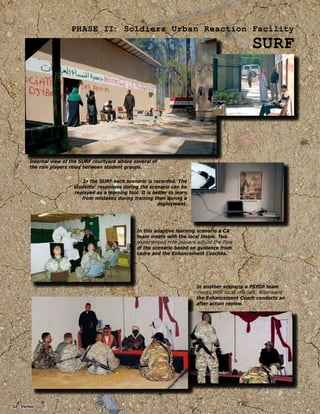
PHASE II: Soldiers Urban Reaction Facility
SURF
Internal view of the SURF courtyard where several of
the role players relax between student groups.
In this adaptive learning scenario a CA
team meets with the local Imam. Two
experienced role players adjust the flow
of the scenario based on guidance from
cadre and the Enhancement Coaches.
In another scenario a PSYOP team
meets with local officials. Afterward
the Enhancement Coach conducts an
after action review.
In the SURF each scenario is recorded. The
students’ responses during the scenario can be
replayed as a learning tool. It is better to learn
from mistakes during training than during a
deployment.
32 Veritas
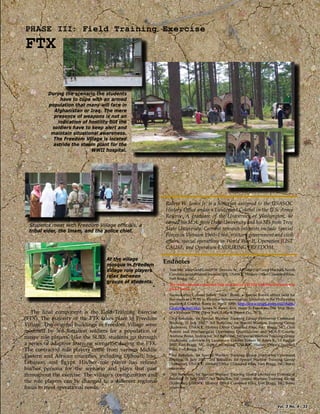
PHASE III: Field Training Exercise
FTX
At the village
mosque in Freedom
Village role players
relax between
groups of students.
During the scenario the students
have to cope with an armed
population that many will face in
Afghanistan or Iraq. The mere
presence of weapons is not an
indication of hostility but the
soldiers have to keep alert and
maintain situational awareness.
The Freedom Village is located
astride the steam plant for the
WWII hospital.
Students meet with Freedom Village officials, a
tribal elder, the Imam, and the police chief.
The final component is the Field Training Exercise
(FTX). The majority of the FTX takes place in Freedom
Village. The original buildings in Freedom Village were
modified by 3rd Battalion soldiers for a population of
native role players. Like the SURF, students go through
a series of adaptive learning scenarios during the FTX.
The contracted role players come from various Middle
Eastern and African countries, including Djibouti, Iraq,
Lebanon, and Egypt. His/her role player has refined
his/her persona for the scenario and plays that part
throughout the exercise. The village’s configuration and
the role players can be changed to a different regional
focus to meet operational needs.
Endnotes
1 Tom McCallum and Lowell W. Stevens, Sr., A History of Camp Mackall, North
Carolina (unpublished manuscript), USASOC History Office Classified Files,
Fort Bragg, NC.
2 The reader should remember that over half of a WWII Airborne Division was
glider borne.
3 Named after Colonel James “Nick” Rowe, a Special Forces officer held for
five years as a POW in Vietnam before escaping. Terrorists in the Philippines
murdered Colonel Rowe in April 1989; http://www.bragg.army.mil/18abn/
CampMackall.htm; James N. Rowe, Five Years To Freedom: The True Story
of a Vietnam POW (New York: Little & Brown Co., 1971).
4 “3rd Battalion, 1st Special Warfare Training Group (Airborne) Command
Briefing, 31 July 2007,” 3rd Battalion, 1st Special Warfare Training Group
(Airborne), USASOC History Office Classified Files, Fort Bragg, NC; Civil
Affairs and Psychological Operations Qualification and MOS-T Course;
Andrew Borsz, Instructor, 3rd Battalion, 1st Special Warfare Training Group
(Airborne), interview by Lieutenant Colonel Robert W. Jones Jr., 13 August
2007, Fort Bragg, NC, digital recording, USASOC History Office Classified
Files, Fort Bragg, NC.
5 “3rd Battalion, 1st Special Warfare Training Group (Airborne) Command
Briefing, 31 July 2007,” 3rd Battalion, 1st Special Warfare Training Group
(Airborne), USASOC History Office Classified Files, Fort Bragg, NC; Borsz
interview.
6 “3rd Battalion, 1st Special Warfare Training Group (Airborne) Command
Briefing, 31 July 2007,” 3rd Battalion, 1st Special Warfare Training Group
(Airborne), USASOC History Office Classified Files, Fort Bragg, NC; Borsz
interview.
Robert W. Jones Jr. is a historian assigned to the USASOC
History Office and is a Lieutenant Colonel in the U.S. Army
Reserve. A graduate of the University of Washington, he
earned his M.A. from Duke University and his MS from Troy
State University. Current research interests include Special
Forces in Vietnam 1960–1966, military government and civil
affairs, special operations in World War II, Operation JUST
CAUSE, and Operation ENDURING FREEDOM.
Vol. 3 No. 4 33

V3n4 camp mackall

  • 1.
    11th Airborne Division SSI 13thAirborne Division SSI 17th Airborne Division SSI SWCS SSI US Army Airborne Command SSI Map comparing the size of Camp Mackall during WWII to the present day. Camp Mackall:A H i s t o r y o f Tr a i n i n g LOCATEDin the North Carolina sandhills forty miles southwest from Fort Bragg is Camp Mackall. The post began as a separate U.S. Army training base during World War II. From 1943 to 1945 three airborne divisions formed and trained there. After the war Camp Mackall became a sub-post of Fort Bragg, where innumerable units have trained. With the creation of U.S. Army Special Forces in 1952, Camp Mackall became one of its training areas. However, Civil Affairs and Psychological Operations forces also trained at the base. This photo essay does two things. It compares historical snapshots of Camp Mackall during World War II with current conditions. It also opens the “window” on Civil Affairs and Psychological Operations training being conducted there today. The scope of training at Camp Mackall during WWII was large. On 8 November 1942, construction began on the Hoffman Airborne Camp. Within months more than 1,750 buildings were constructed. The vast majority of the buildings were one-story temporary construction made of rough pine plank sidingand covered with tarpaper. The base had seven service clubs, two guesthouses, three libraries, sixteen post exchanges, twelve chapels, and a hospital. It became one of the larger towns in North Carolina. The post was divided into north and south cantonment areas with the Station Hospital between them.1 The infrastructure was necessary to support over three divisions of soldiers. Future airborne units began filling south cantonment area in January 1943. Cadre conducted basic and advanced infantry and artillery training at Camp Mackall while perfecting parachuting and gilder operations.2 Three airborne divisions by Robert W. Jones, Jr. 26 Veritas
  • 2.
    On 8 February1943, General Order Number 6 renamed the Hoffman Airborne Camp to Camp Mackall in honor of Private John Thomas (Tommy) Mackall. While serving in the 2nd Battalion, 503rd Parachute Infantry Regiment during Operation TORCH, the Allied invasion of North Africa, Mackall was mortally wounded when his aircraft was attacked by French Vichy fighters as it landed near Oran on 8 November 1942. Seven paratroopers were killed and several were wounded, including Mackall. He was evacuated by air to a British hospital on Gibraltar where he died on 12 November 1942. A tarpaper “theater of operations” building found throughout WWII training bases, such as Camp Mackall. (the 11th, 13th and 17th Airborne Divisions) were formed and trained at Camp Mackall during World War II. The 82nd and 101st Airborne Divisions, while not formed at Camp Mackall, trained there before leaving for the European Theater. During the war a variety of units trained and conducted operational tests at Camp Mackall. After the war, Camp Mackall was used as an airborne maneuver area by XVIII Airborne Corps units. In the 1950s, Camp Mackall was a training site for the newly created Special Forces. However, it fell into disrepair until the 1980s. In the post Vietnam period the U.S. Army John F. Kennedy Special Warfare Center and School (USAJFKSWCS) built the Rowe Training Facility for Special Forces training.3 Other USAJFKSWCS courses also began using Camp Mackall as a training site. A lesser-known part of Camp Mackall history is the Civil Affairs and PSYOP training conducted by the members of 3rd Battalion, 1st Special Warfare Training Group (Air- borne). The training site for CA and PSYOP went through a series of evolutions since 1999. The first permanent CA/PSYOP training site was built by 18C Special Forces engineer sergeant students as a practicum during the “Q-course” (each building was constructed by a different class). CA and PSYOP cadre began using these temporary facilities as a command post and training area in late 1999 until a permanent compound could be constructed. The present training site was constructed in stages from 2004 to 2007 to support capstone-training exercises for the Civil Affairs and Psychological Operations officer and non- commissioned officer courses.4 The CA/PSYOP training area has three individual sites. The largest is Forward Operation Base (FOB) Freedom, built to replicate a typical FOB anywhere in the world. The second is Freedom Village, a collection of buildings currently made to resemble a town in the Middle East. A contracted civilian population of role players enhances training. The third training site is the Soldiers Urban Reaction Facility (SURF). Here, role players challenge the students with a series of situational dilemmas.5 These scenarios serve as the culminating exercise for CA and PSYOP officer and NCO training. After classroom training at Fort Bragg the CA and PSYOP students undergo a 10-day, three-phase culmination exercise. Named “Operation CERTAIN TRUST,” the exercise is focused on preparing the soldiers for operational assignments. Supported from Forward Operating Base (FOB) Freedom, the 214 hours of training in Operation CERTAIN TRUST is divided into 3 phases. The operation begins with a 36-hour Situational Training Exercise (STX) to introduce physical and mental stress (Phase I). Next, in Phase II, they go to the Soldiers UrbanReactionFacility(SURF)tosolveaseriesofproblem based scenarios. The CA and PSYOP soldiers have separate challenges. The scenarios allow the cadre to evaluate individual and collective performance in a controlled, but realistic operational environment. Each student team responds to four different scenarios. Contracted male and female Middle Eastern and African nationals serve as role players, adding more realism to the scenarios. Contracted “Enhancement Coaches,” all with operational military experience, accompany student teams to provide feedback on tactics, techniques, and procedures employed to solve the problem. Each dilemma is evaluated by an Enhancement Coach who, combined with coaching and mentoring, conducts an after action review for the teams. After successfully completing Phase II the soldiers move into a Field Training Exercise at Freedom Village and in the North Carolina counties surrounding Camp Mackall (Hoke, Lee, Montgomery, Moore, Richmond, Robeson, and Scotland).6 While Freedom Village is the focus of the exercise the counties provide an opportunity to assess real world public facilities. Though very involved in training at Camp Mackall few soldiers know anything about its history. Most soldiers are unaware of the historic connection of the base to WWII. The FOB Freedom operations center tent sits where the former WWII Station Hospital was located. Freedom Village occupies the original hospital steam plant. The SURF was built where the hospital supply area was once located. This photo essay is just a “snapshot” of ongoing training at Camp Mackall. The historical snapshots of the post connect yesterday to today. This photo essay has a secondarymotive,topromptveteranstofurnishvignettes, photographs, and documents that pertain to Camp Mackall. The current contracted history project for 2008 is a history of Camp Mackall, WWII to the present. Vol. 3 No. 4 27
  • 3.
    OPERATION CERTAIN THRUST Theheadquarters of the Station Hospital with some of the local Red Cross volunteers. Paratroopers jump at Camp Mackall during training. The “parapack” equipment bundles were dropped from the belly of the aircraft while the men exited from the troop door. CAMP MACKALL AREA 1945 Aerial view of Camp Mackall taken on 18 April 1945. This photo shows the northern cantonment area used primarily for logistics. The hospital area is marked. / N / N Obscured in the ground haze above the hospital is the southern cantonment area where the Airborne Divisions lived and trained. Part of that area is now Rhine-Luzon drop zone. 28 Veritas28 Veritas
  • 4.
    A group ofCA students returning from a training mission. CAMP MACKALL AREA 2007 The centerpiece of the CA and PSYOP training area, called FOB Freedom, is the “Big Tent.” The tent is located on the site of the WWII Station Hospital. PSYOP soldiers conduct a tactical loudspeaker mission at Camp Mackall. The Camp Mackall sign welcomes visitors to “The Home of the Airborne during WWII.” Aerial view of Camp Mackall taken in May 2007. In the center of the photo is the Rowe Training Facility (RTF). The FOB Freedom area is outlined in red. / N RTF Vol. 3 No. 4 29Vol. 3 No. 4 29
  • 5.
    OPERATION CERTAIN TRUST PHASEI: Situational Training Exercise STX / N Aerial view of Forward Operating Base (FOB) Freedom in May 2007. During the STX a group of students plan for their next phase, the SURF. Ground views of the FOB. PSYOP students take a rest break after a roadmarch. In 10 minutes this group will enter phase II, the SURF. Operation CERTAIN TRUST is the culminating exercise for Civil Affairs (CA) and Psychological Operations (PSYOP) courses. Phase I of the exercise begins at Forward Operating Base (FOB) Freedom, which replicates a FOB that could be found anywhere in the world. The outer perimeter includes defensive positions and watch towers. The medium sized “expeditionary” tents provide work space and living areas for the soldiers while in the field. The center of the FOB is the large tent that the students use for work space and a briefing area. The main tent at FOB Freedom is located on the site of the WWII Station Hospital headquarters. The Situational Training Exercise (STX) imposes mental (planning) and physical (road marches) stress before the next phase. 30 Veritas
  • 6.
    PHASE II: SoldiersUrban Reaction Facility SURF A group of PSYOP students has just completed a series of road marches to stress them physically and mentally before beginning Phase II of the exercise. They are being briefed by Mr. Drew Borsz, an instructor in 3rd Battalion. In a few minutes they must prepare a plan of action before conducting their mission in the SURF. External view of the Soldier Urban Reaction Facility (SURF). Two contracted role players prepare for a scenario with an Enhancement Coach (in dark shirt). The Soldier Urban Reaction Facility (SURF) is a new addition to CA and PSYOP training. The facility was built by U.S. Army engineers stationed at Fort Bragg who practiced their carpentry skills before overseas deployment. The SURF provides a unique training opportunity for soldiers. The facility resembles a small government compound found in many parts of the developing world. Students go through a series of adaptive learning scenarios, with role players providing realism. The scenarios are adapted to meet Army deployment needs and to prepare for specific missions. Vol. 3 No. 4 31
  • 7.
    PHASE II: SoldiersUrban Reaction Facility SURF Internal view of the SURF courtyard where several of the role players relax between student groups. In this adaptive learning scenario a CA team meets with the local Imam. Two experienced role players adjust the flow of the scenario based on guidance from cadre and the Enhancement Coaches. In another scenario a PSYOP team meets with local officials. Afterward the Enhancement Coach conducts an after action review. In the SURF each scenario is recorded. The students’ responses during the scenario can be replayed as a learning tool. It is better to learn from mistakes during training than during a deployment. 32 Veritas
  • 8.
    PHASE III: FieldTraining Exercise FTX At the village mosque in Freedom Village role players relax between groups of students. During the scenario the students have to cope with an armed population that many will face in Afghanistan or Iraq. The mere presence of weapons is not an indication of hostility but the soldiers have to keep alert and maintain situational awareness. The Freedom Village is located astride the steam plant for the WWII hospital. Students meet with Freedom Village officials, a tribal elder, the Imam, and the police chief. The final component is the Field Training Exercise (FTX). The majority of the FTX takes place in Freedom Village. The original buildings in Freedom Village were modified by 3rd Battalion soldiers for a population of native role players. Like the SURF, students go through a series of adaptive learning scenarios during the FTX. The contracted role players come from various Middle Eastern and African countries, including Djibouti, Iraq, Lebanon, and Egypt. His/her role player has refined his/her persona for the scenario and plays that part throughout the exercise. The village’s configuration and the role players can be changed to a different regional focus to meet operational needs. Endnotes 1 Tom McCallum and Lowell W. Stevens, Sr., A History of Camp Mackall, North Carolina (unpublished manuscript), USASOC History Office Classified Files, Fort Bragg, NC. 2 The reader should remember that over half of a WWII Airborne Division was glider borne. 3 Named after Colonel James “Nick” Rowe, a Special Forces officer held for five years as a POW in Vietnam before escaping. Terrorists in the Philippines murdered Colonel Rowe in April 1989; http://www.bragg.army.mil/18abn/ CampMackall.htm; James N. Rowe, Five Years To Freedom: The True Story of a Vietnam POW (New York: Little & Brown Co., 1971). 4 “3rd Battalion, 1st Special Warfare Training Group (Airborne) Command Briefing, 31 July 2007,” 3rd Battalion, 1st Special Warfare Training Group (Airborne), USASOC History Office Classified Files, Fort Bragg, NC; Civil Affairs and Psychological Operations Qualification and MOS-T Course; Andrew Borsz, Instructor, 3rd Battalion, 1st Special Warfare Training Group (Airborne), interview by Lieutenant Colonel Robert W. Jones Jr., 13 August 2007, Fort Bragg, NC, digital recording, USASOC History Office Classified Files, Fort Bragg, NC. 5 “3rd Battalion, 1st Special Warfare Training Group (Airborne) Command Briefing, 31 July 2007,” 3rd Battalion, 1st Special Warfare Training Group (Airborne), USASOC History Office Classified Files, Fort Bragg, NC; Borsz interview. 6 “3rd Battalion, 1st Special Warfare Training Group (Airborne) Command Briefing, 31 July 2007,” 3rd Battalion, 1st Special Warfare Training Group (Airborne), USASOC History Office Classified Files, Fort Bragg, NC; Borsz interview. Robert W. Jones Jr. is a historian assigned to the USASOC History Office and is a Lieutenant Colonel in the U.S. Army Reserve. A graduate of the University of Washington, he earned his M.A. from Duke University and his MS from Troy State University. Current research interests include Special Forces in Vietnam 1960–1966, military government and civil affairs, special operations in World War II, Operation JUST CAUSE, and Operation ENDURING FREEDOM. Vol. 3 No. 4 33