Uxors
Stars partially obscured
by debris clouds
Amanda Bacon and Connor McElravy
Characteristics of Uxors: Mass
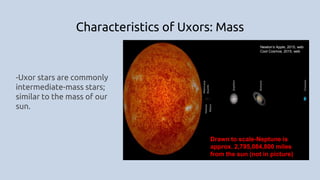
Drawn to scale-Neptune is
approx. 2,795,084,800 miles
from the sun (not in picture)
Newton’s Apple, 2015, web
Cool Cosmos, 2015, web
-Uxor stars are commonly
intermediate-mass stars;
similar to the mass of our
sun.
Characteristics of Uxors: Formation
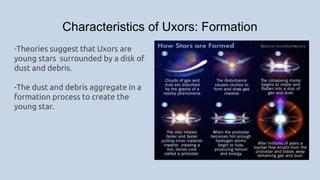
-Theories suggest that Uxors are
young stars surrounded by a disk of
dust and debris.
-The dust and debris aggregate in a
formation process to create the
young star.
Characteristics of Uxors: Disks
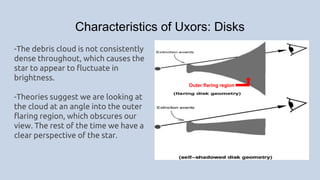
-The debris cloud is not consistently
dense throughout, which causes the
star to appear to fluctuate in
brightness.
-Theories suggest we are looking at
the cloud at an angle into the outer
flaring region, which obscures our
view. The rest of the time we have a
clear perspective of the star.
Outer flaring region
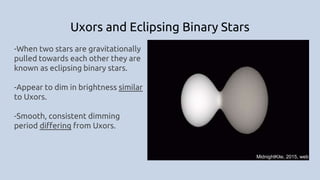
Uxors and Eclipsing Binary Stars
-When two stars are gravitationally
pulled towards each other they are
known as eclipsing binary stars.
-Appear to dim in brightness similar
to Uxors.
-Smooth, consistent dimming
period differing from Uxors.
MidnightKite, 2015, web
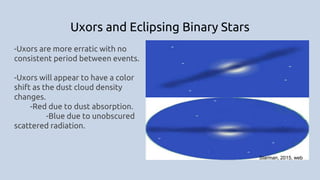
Uxors and Eclipsing Binary Stars
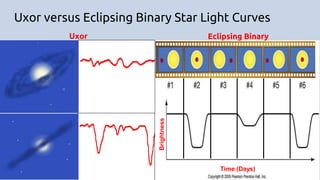
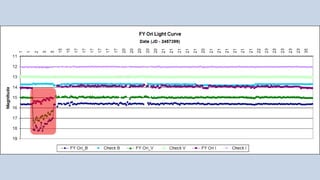
-Uxors are more erratic with no
consistent period between events.
-Uxors will appear to have a color
shift as the dust cloud density
changes.
-Red due to dust absorption.
-Blue due to unobscured
scattered radiation.
Starman, 2015, web
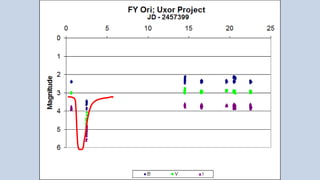
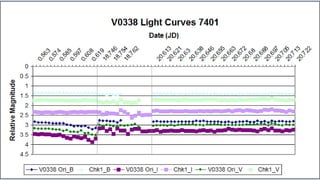
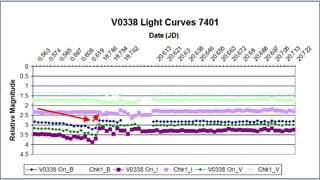
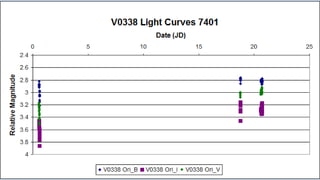
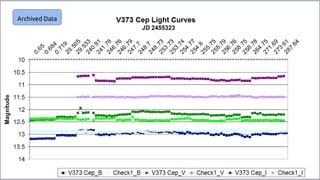
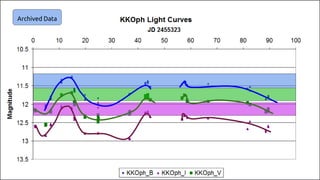
Uxor versus Eclipsing Binary Star Light Curves
Eclipsing Binary
Time (Days)
Uxor
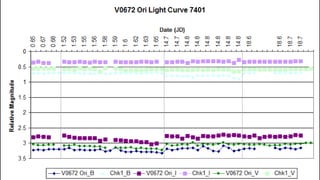
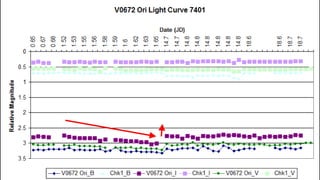
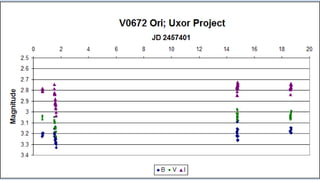
Archived Data
Archived Data
Archived Data
Archived Data
Archived Data
Archived Data
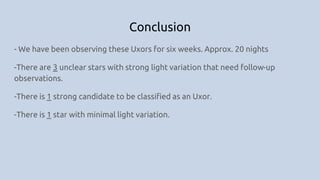
Conclusion
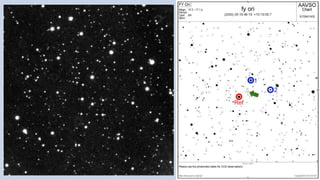
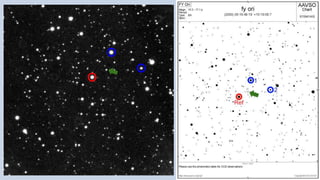
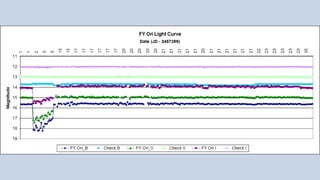
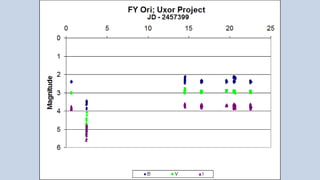
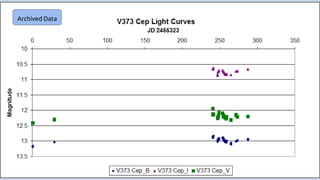
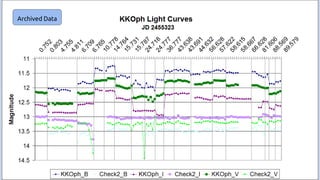
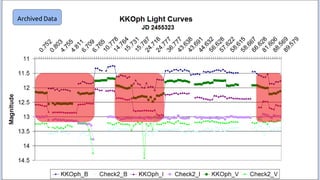
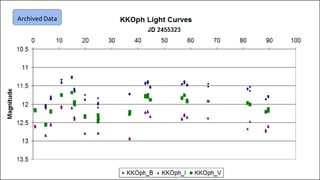
- We have been observing these Uxors for six weeks. Approx. 20 nights
-There are 3 unclear stars with strong light variation that need follow-up
observations.
-There is 1 strong candidate to be classified as an Uxor.
-There is 1 star with minimal light variation.

Uxor Presentation

  • 1.
    Uxors Stars partially obscured bydebris clouds Amanda Bacon and Connor McElravy
  • 2.
    Characteristics of Uxors:Mass Drawn to scale-Neptune is approx. 2,795,084,800 miles from the sun (not in picture) Newton’s Apple, 2015, web Cool Cosmos, 2015, web -Uxor stars are commonly intermediate-mass stars; similar to the mass of our sun.
  • 3.
    Characteristics of Uxors:Formation -Theories suggest that Uxors are young stars surrounded by a disk of dust and debris. -The dust and debris aggregate in a formation process to create the young star.
  • 4.
    Characteristics of Uxors:Disks -The debris cloud is not consistently dense throughout, which causes the star to appear to fluctuate in brightness. -Theories suggest we are looking at the cloud at an angle into the outer flaring region, which obscures our view. The rest of the time we have a clear perspective of the star. Outer flaring region
  • 5.
    Uxors and EclipsingBinary Stars -When two stars are gravitationally pulled towards each other they are known as eclipsing binary stars. -Appear to dim in brightness similar to Uxors. -Smooth, consistent dimming period differing from Uxors. MidnightKite, 2015, web
  • 6.
    Uxors and EclipsingBinary Stars -Uxors are more erratic with no consistent period between events. -Uxors will appear to have a color shift as the dust cloud density changes. -Red due to dust absorption. -Blue due to unobscured scattered radiation. Starman, 2015, web
  • 7.
    Uxor versus EclipsingBinary Star Light Curves Eclipsing Binary Time (Days) Uxor
  • 21.
  • 22.
  • 23.
  • 24.
  • 25.
  • 26.
  • 27.
    Conclusion - We havebeen observing these Uxors for six weeks. Approx. 20 nights -There are 3 unclear stars with strong light variation that need follow-up observations. -There is 1 strong candidate to be classified as an Uxor. -There is 1 star with minimal light variation.

Editor's Notes

  • #3 Newton’s Apple, 2015, web
  • #4 Garcia, Carla and Ubando, L. Gemmalyn, 2012, web http://abyss.uoregon.edu/~js/ast122/lectures/lec13.html-star formation process
  • #5 C.P. Dullemond, M.E. van den Ancker, B. Acke, R. van Boekel, 2003, submitted
  • #6 http://www.midnightkite.com/index.aspx?URL=Binary, 2015, web http://astro.unl.edu/naap/ebs/animations/ebs.html---Input information for eclipsing binary stars
  • #7 C.P. Dullemond, M.E. van den Ancker, B. Acke, R. van Boekel, 2003, submitted http://www.starman.co.uk/variables/Young%20Stellar%20Objects/uxors.html, 2015, web (images)
  • #8 Brau, Jim, 2015, web