URINARY TRACT
INFECTION
By – Dr A. C. GUPTA
PROFESSOR, KPS INSTITUTE
MEDICINE
Introduction
• Urinary tract infections are among the most common entities
encountered in medical practice
• Coliform bacteria are responsible for most uncomplicated urinary
tract infections, with Escherichia coli being the most common.
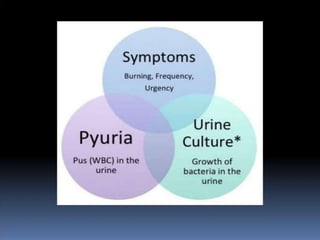
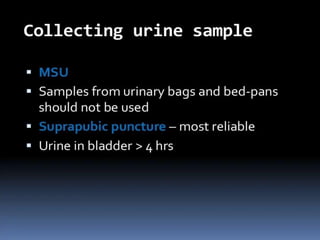
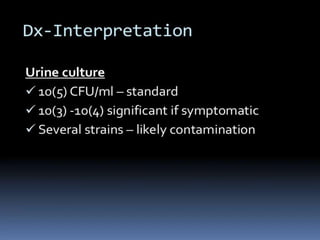
• A urine culture is recommended for patients with suspected
urinary tract infection. Previously, a colony count greater than
105/mL was considered the criterion for urinary tract infection,
though up to 50% of women with symptomatic infections may have
lower counts. In addition, the presence of pyuria correlates poorly
with the diagnosis of urinary tract infection, and thus urinalysis
alone is not adequate for diagnosis.
• With respect to treatment, tissue infections (pyelonephritis,
prostatitis) require therapy for 1-2 weeks, while mucosal infections
(cystitis) require only1-3 days of therapy.
DEFINITIONS
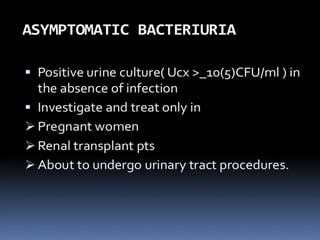
• UTI may be asymptomatic (subclinical infection) or
symptomatic (disease).
• Thus, the term urinary tract infection encompasses a
variety of clinical entities, including asymptomatic
bacteriuria (ASB), cystitis, prostatitis, and pyelonephritis
• ASB occurs in the absence of symptoms attributable to the
bacteria in the urinary tract and usually does not require
treatment
• the term urinary tract infection denotes symptomatic
disease;
• cystitis,symptomatic infection of the bladder;
• pyelonephritis, symptomatic infection of the kidneys.
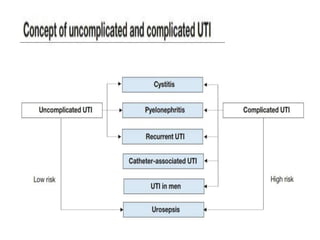
• Recurrent urinary tract infectionis not
necessarily complicated; individual episodes
can be uncomplicated and treated as such.
• Catheter-associated bacteriuria can be either
symptomatic (CAUTI) or asymptomatic.
PATHOPHYSIOLOGY-
• Urine is an excellent culture media for
bacteria.
• Urothelium of susceptible person may have
more receptor to which virulent strains of
E.Coli become adherent.
• In women ,the ascent of organisms into the
bladder is easier than in men
RISK FACTOR FOR UTI
• Bladder outflow obstruction- Benign prostatic enlargement
Urethral stricture
Prostate cancer
• ANATOMICAL ABNORMALITIES-VESICO-URETERIC REFLUX
• LOSS OF HOST DEFENCE - Diabetes mellitus,
Atrophic urethritis
vaginitis
• FOREIGN BODIES- Urethral catheter
Suprapubic catheter
Urolithiasis
Ureteric stent
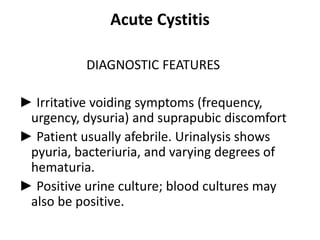
Acute Cystitis
DIAGNOSTIC FEATURES
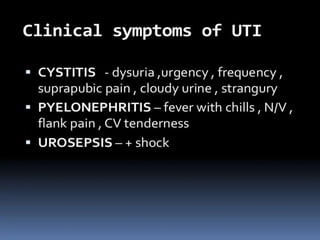
► Irritative voiding symptoms (frequency,
urgency, dysuria) and suprapubic discomfort
► Patient usually afebrile. Urinalysis shows
pyuria, bacteriuria, and varying degrees of
hematuria.
► Positive urine culture; blood cultures may
also be positive.
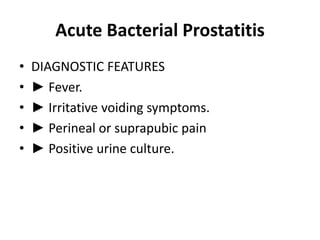
Acute Bacterial Prostatitis
• DIAGNOSTIC FEATURES
• ► Fever.
• ► Irritative voiding symptoms.
• ► Perineal or suprapubic pain
• ► Positive urine culture.
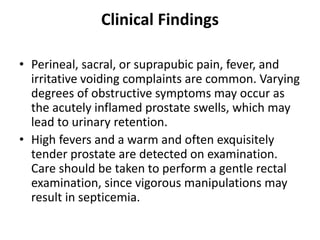
Clinical Findings
• Perineal, sacral, or suprapubic pain, fever, and
irritative voiding complaints are common. Varying
degrees of obstructive symptoms may occur as
the acutely inflamed prostate swells, which may
lead to urinary retention.
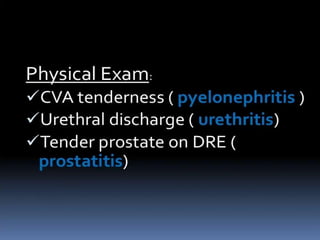
• High fevers and a warm and often exquisitely
tender prostate are detected on examination.
Care should be taken to perform a gentle rectal
examination, since vigorous manipulations may
result in septicemia.
. Acute Pyelonephritis
• Acute pyelonephritis is an infectious
inflammatory disease involving the kidney
parenchyma and renal pelvis. Gram negative
bacteria are the most common causative
agents including E coli, Proteus, Klebsiella
• The infection usually ascends from the lower
urinary tract—with the exception of S aureus,
which usually is spread by a hematogenous
route
Clinical Findings
• Symptoms include fever, flank pain, shaking
chills, and irritative voiding symptoms
(urgency, frequency, dysuria).
• Associated nausea and vomiting and diarrhea
are common.
• Signs include fever and tachycardia.
•
. Laboratory Findings
• Complete blood cell count shows leukocytosis
and a left shift.
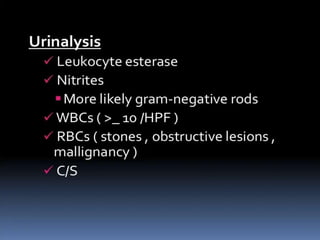
• Urinalysis shows pyuria, bacteriuria, and
varying degrees of hematuria.
• White cell casts may be seen.
• Urine culture demonstrates growth of the
offending organism, and blood culture may
also be positive.
UTI ppt
UTI ppt
UTI ppt
UTI ppt
UTI ppt
UTI ppt
UTI ppt
UTI ppt

UTI ppt

  • 1.
    URINARY TRACT INFECTION By –Dr A. C. GUPTA PROFESSOR, KPS INSTITUTE MEDICINE
  • 2.
    Introduction • Urinary tractinfections are among the most common entities encountered in medical practice • Coliform bacteria are responsible for most uncomplicated urinary tract infections, with Escherichia coli being the most common. • A urine culture is recommended for patients with suspected urinary tract infection. Previously, a colony count greater than 105/mL was considered the criterion for urinary tract infection, though up to 50% of women with symptomatic infections may have lower counts. In addition, the presence of pyuria correlates poorly with the diagnosis of urinary tract infection, and thus urinalysis alone is not adequate for diagnosis. • With respect to treatment, tissue infections (pyelonephritis, prostatitis) require therapy for 1-2 weeks, while mucosal infections (cystitis) require only1-3 days of therapy.
  • 3.
    DEFINITIONS • UTI maybe asymptomatic (subclinical infection) or symptomatic (disease). • Thus, the term urinary tract infection encompasses a variety of clinical entities, including asymptomatic bacteriuria (ASB), cystitis, prostatitis, and pyelonephritis • ASB occurs in the absence of symptoms attributable to the bacteria in the urinary tract and usually does not require treatment • the term urinary tract infection denotes symptomatic disease; • cystitis,symptomatic infection of the bladder; • pyelonephritis, symptomatic infection of the kidneys.
  • 4.
    • Recurrent urinarytract infectionis not necessarily complicated; individual episodes can be uncomplicated and treated as such. • Catheter-associated bacteriuria can be either symptomatic (CAUTI) or asymptomatic.
  • 5.
    PATHOPHYSIOLOGY- • Urine isan excellent culture media for bacteria. • Urothelium of susceptible person may have more receptor to which virulent strains of E.Coli become adherent. • In women ,the ascent of organisms into the bladder is easier than in men
  • 6.
    RISK FACTOR FORUTI • Bladder outflow obstruction- Benign prostatic enlargement Urethral stricture Prostate cancer • ANATOMICAL ABNORMALITIES-VESICO-URETERIC REFLUX • LOSS OF HOST DEFENCE - Diabetes mellitus, Atrophic urethritis vaginitis • FOREIGN BODIES- Urethral catheter Suprapubic catheter Urolithiasis Ureteric stent
  • 22.
    Acute Cystitis DIAGNOSTIC FEATURES ►Irritative voiding symptoms (frequency, urgency, dysuria) and suprapubic discomfort ► Patient usually afebrile. Urinalysis shows pyuria, bacteriuria, and varying degrees of hematuria. ► Positive urine culture; blood cultures may also be positive.
  • 23.
    Acute Bacterial Prostatitis •DIAGNOSTIC FEATURES • ► Fever. • ► Irritative voiding symptoms. • ► Perineal or suprapubic pain • ► Positive urine culture.
  • 24.
    Clinical Findings • Perineal,sacral, or suprapubic pain, fever, and irritative voiding complaints are common. Varying degrees of obstructive symptoms may occur as the acutely inflamed prostate swells, which may lead to urinary retention. • High fevers and a warm and often exquisitely tender prostate are detected on examination. Care should be taken to perform a gentle rectal examination, since vigorous manipulations may result in septicemia.
  • 25.
    . Acute Pyelonephritis •Acute pyelonephritis is an infectious inflammatory disease involving the kidney parenchyma and renal pelvis. Gram negative bacteria are the most common causative agents including E coli, Proteus, Klebsiella • The infection usually ascends from the lower urinary tract—with the exception of S aureus, which usually is spread by a hematogenous route
  • 26.
    Clinical Findings • Symptomsinclude fever, flank pain, shaking chills, and irritative voiding symptoms (urgency, frequency, dysuria). • Associated nausea and vomiting and diarrhea are common. • Signs include fever and tachycardia. •
  • 27.
    . Laboratory Findings •Complete blood cell count shows leukocytosis and a left shift. • Urinalysis shows pyuria, bacteriuria, and varying degrees of hematuria. • White cell casts may be seen. • Urine culture demonstrates growth of the offending organism, and blood culture may also be positive.