Medical management of fibroids
 Fibroid growth is hormone dependent
 Medical treatments mainly involve hormonal
Manipulations
AIM : to control Menorrhagia , Improve
Haemoglobin before surgery
 Iron Therapy for anaemia
 Drugs used to control Menorrhagia :-
Anti fibrinolytic agents
GnRH therapy
Danazol
Clomiphene Citrate
Mirena IUCD
NSAIDs
The objectives of medical
treatment are-
 To improve menorrhagia and to correct anemia before
surgery .
 To minimize the size and vascularity of the tumor in
order to facilitate surgery .
 In selected cases of infertility to facilitate
hysteroscopic or laparoscopic surgery .
 As an alternative to surgery in perimenopausal women
or woman with high-risk factors for surgery .
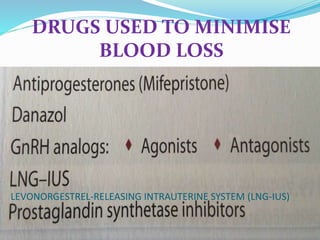
DRUGS USED TO MINIMISE
BLOOD LOSS
LEVONORGESTREL-RELEASING INTRAUTERINE SYSTEM (LNG-IUS)
ANTIPROGESTERONE
 Mifepristone (RU486) is very effective to reduce
fibroid size and also menorrhagia. It may produce
amenorrhea. A daily dose of 25-30 mg is
recommended for 3 months . Long term therapy is
avoided as it causes Endometrial hyperplasia.
Asoprisnil is used with success,it is a selective
progesterone receptor modulator & it does not
cause endometrial hyperplasia.
DANAZOL
It administered daily in divided doses
ranging from 200-400 mg for 3 months
minimizes blood loss or even produce
amenorrhea by its antigonadotropin &
androgen agonist actions.
GnRH AGONISTS
 Drugs commonly used are- goserelin ,
luporelin , buserelin or nafarelin .
Mechanism of action is sustained pituitary
down regulation and suppression of ovarian
function. Optimal duration of therapy is 3
months.
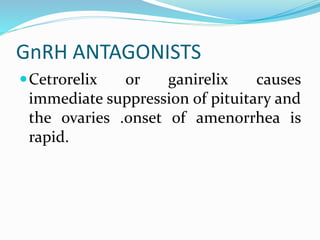
GnRH ANTAGONISTS
Cetrorelix or ganirelix causes
immediate suppression of pituitary and
the ovaries .onset of amenorrhea is
rapid.
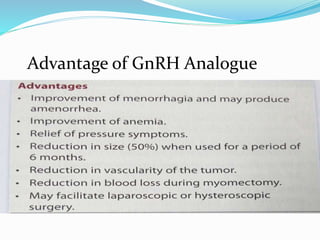
Advantage of GnRH Analogue
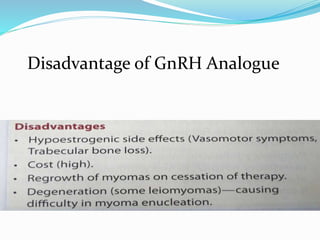
Disadvantage of GnRH Analogue
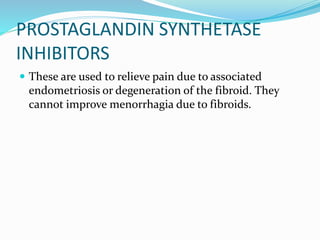
PROSTAGLANDIN SYNTHETASE
INHIBITORS
 These are used to relieve pain due to associated
endometriosis or degeneration of the fibroid. They
cannot improve menorrhagia due to fibroids.
LEVONORGESTREL-RELEASING
INTRAUTERINE SYSTEM (LNG-IUS)
 It reduces blood loss and uterine size. However, this is
not recommended when the uterine size is >12 weeks
or there is distortion of uterine cavity.
Benefits of medical t/t
Pfannenstiel’s incision can be given during total
hystrectomy
Vaginal hystrectomy can be done
Hysteroscopic guided resection can be done
Demerits of medical t/t
Expensive
Regrowth after stopping therapy
Difficulty in establishing the surgical plane
between fibroid and surrounding tissue due to
thinning of capsule
Menopausal signs and symptoms
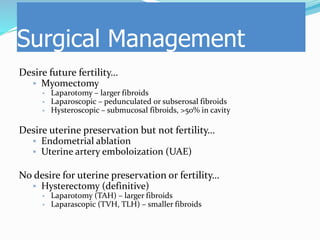
Desire future fertility…
 Myomectomy
 Laparotomy – larger fibroids
 Laparoscopic – pedunculated or subserosal fibroids
 Hysteroscopic – submucosal fibroids, >50% in cavity
Desire uterine preservation but not fertility…
 Endometrial ablation
 Uterine artery emboloization (UAE)
No desire for uterine preservation or fertility…
 Hysterectomy (definitive)
 Laparotomy (TAH) – larger fibroids
 Laparascopic (TVH, TLH) – smaller fibroids
Surgical Management
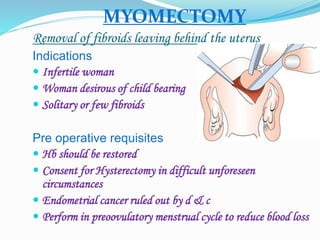
MYOMECTOMY
Removal of fibroids leaving behind the uterus
Indications
 Infertile woman
 Woman desirous of child bearing
 Solitary or few fibroids
Pre operative requisites
 Hb should be restored
 Consent for Hysterectomy in difficult unforeseen
circumstances
 Endometrial cancer ruled out by d & c
 Perform in preoovulatory menstrual cycle to reduce blood loss
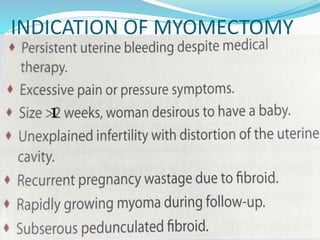
INDICATION OF MYOMECTOMY
1
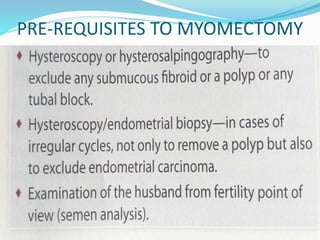
PRE-REQUISITES TO MYOMECTOMY
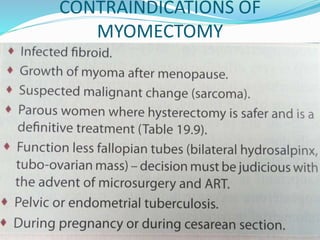
CONTRAINDICATIONS OF
MYOMECTOMY
Technique
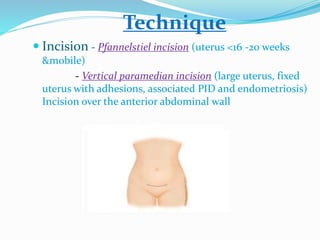
 Incision - Pfannelstiel incision (uterus <16 -20 weeks
&mobile)
- Vertical paramedian incision (large uterus, fixed
uterus with adhesions, associated PID and endometriosis)
Incision over the anterior abdominal wall
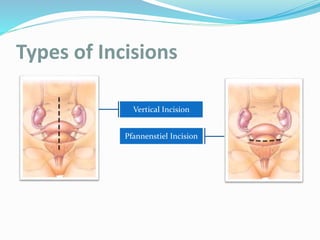
Types of Incisions
Vertical Incision
Pfannenstiel Incision
Hemorrhage
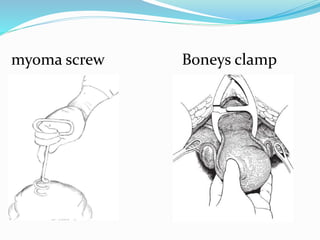
Controlled by Bonney’s myomectomy clamp
Ovarian vessels occluded by sponge forceps
Rubber tourniquet when myomectomy clamp
cannot be applied
 Capsule incised and fibroid enucleated with help
of myomectomy screw
 Following enucleation haemostasis secured ,
cavity obliterated by several catgut sutures
myoma screw Boneys clamp
COMPLICATIONS
Primary , Secondary and Reactionary
Haemorrhage
Trauma to bladder , ureter , bowel
Infection
Adhesions
Recurrence of fibroid
Persistence of menorrhagia
Types of Myomectomy
Abdominal
Laproscopic
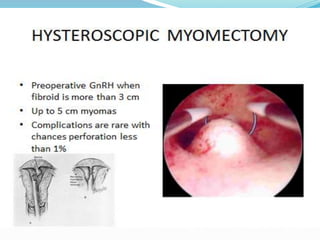
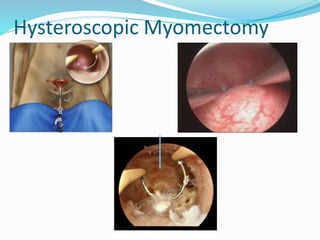
Hysteroscopic
- Removes fibroid through cervix without making
incision
- Submucous fibroid excised by cautery , laser or
resectoscope
 Vaginal (sub mucous fibroid)
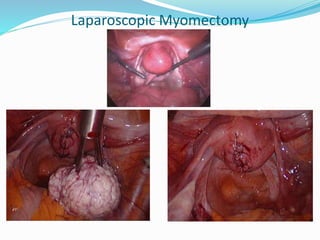
Laproscopic Myomectomy
Done in
Pedunculated fibroid
Sub serous fibroid < 10 cm
< 4 in number
 Use of unipolar or bipolar cautery or laser
 Fibroma is retrieved through posterior colpotomy
, mini laprotomy , morcellation
Disadvantages
 More bleeding
 Post operative adhesions
 Scar rupture
 Not safe in infertile woman
Laparoscopic Myomectomy
Hysteroscopic Myomectomy
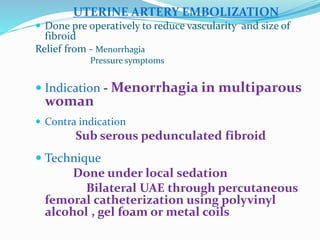
UTERINE ARTERY EMBOLIZATION
 Done pre operatively to reduce vascularity and size of
fibroid
Relief from - Menorrhagia
Pressure symptoms
 Indication - Menorrhagia in multiparous
woman
 Contra indication
Sub serous pedunculated fibroid
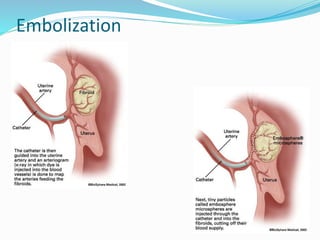
 Technique
Done under local sedation
Bilateral UAE through percutaneous
femoral catheterization using polyvinyl
alcohol , gel foam or metal coils
Embolization
Complications
 Fever
 Infection
 Vaginal discharge and bleeding
 Ischaemic pain
 Pulmonary embolism
 Ovarian failure
 Premature menopause
Advantages
 No major surgery
 No intra operative bleeding
 Short hospital stay
HYSTERECTOMY
 Removal of uterus
Indications
 Age >40 years
 Multiparous
 Malignancy
 Uncontrolled haemorrhage during myomectomy
Types
 Abdominal
 Vaginal
 Laproscopic
Abdominal Hysterectomy
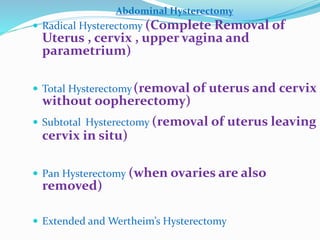
 Radical Hysterectomy (Complete Removal of
Uterus , cervix , upper vagina and
parametrium)
 Total Hysterectomy(removal of uterus and cervix
without oopherectomy)
 Subtotal Hysterectomy (removal of uterus leaving
cervix in situ)
 Pan Hysterectomy (when ovaries are also
removed)
 Extended and Wertheim’s Hysterectomy
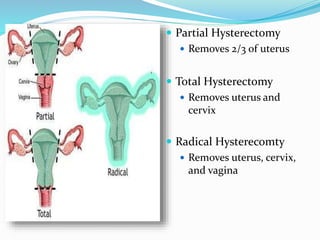
 Partial Hysterectomy
 Removes 2/3 of uterus
 Total Hysterectomy
 Removes uterus and
cervix
 Radical Hysterecomty
 Removes uterus, cervix,
and vagina
Vaginal Hysterectomy
Done in
 <14 weeks
 Uterus mobile
 No previous surgery
 Uterus size if more than 12 weeks provided uterus is not fixed
by adhesions ,adnexal inflammatory mass or endometriosis by
performing -
 Bi section of uterus removing each half separately
 Myomectomy and enucleation of fibroid first
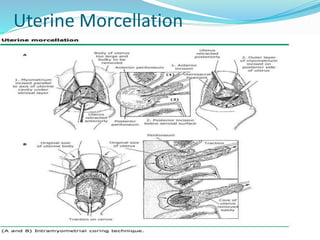
 Morcellation
Complications
 Primary secondary and reactionary haemorrhage
 Trauma to bladder ureter and bowel
 Sepsis
 Anesthetic complications
 Paralytic ileus and intestinal obstruction
 Thrombosis and pulmonary embolism
 Burst abdomen and scar hernia
 Post operative infections
 Abdominal adhesions
SEQUELAE OF HYSTERECTOMY
 Dyspareunia and ovarian adhesions to vaginal wall
 Chronic pelvic pain
 residual ovarian syndrome and atrophy
 Vault prolapse
 Ovarian cancer in 1% if ovaries are left behind
 Prolapse of fallopian tube
0THER MODALITIES
Laparoscopic assisted vaginal hysterectomy
Laparoscopic myolysis
• MRI guided percutaneous laser ablation
MRI guided focussed ultra sound (FUS)
surgery
Uterine Morcellation

Uterinefibroids ashish

  • 3.
    Medical management offibroids  Fibroid growth is hormone dependent  Medical treatments mainly involve hormonal Manipulations AIM : to control Menorrhagia , Improve Haemoglobin before surgery  Iron Therapy for anaemia  Drugs used to control Menorrhagia :- Anti fibrinolytic agents GnRH therapy Danazol Clomiphene Citrate Mirena IUCD NSAIDs
  • 4.
    The objectives ofmedical treatment are-  To improve menorrhagia and to correct anemia before surgery .  To minimize the size and vascularity of the tumor in order to facilitate surgery .  In selected cases of infertility to facilitate hysteroscopic or laparoscopic surgery .  As an alternative to surgery in perimenopausal women or woman with high-risk factors for surgery .
  • 5.
    DRUGS USED TOMINIMISE BLOOD LOSS LEVONORGESTREL-RELEASING INTRAUTERINE SYSTEM (LNG-IUS)
  • 6.
    ANTIPROGESTERONE  Mifepristone (RU486)is very effective to reduce fibroid size and also menorrhagia. It may produce amenorrhea. A daily dose of 25-30 mg is recommended for 3 months . Long term therapy is avoided as it causes Endometrial hyperplasia. Asoprisnil is used with success,it is a selective progesterone receptor modulator & it does not cause endometrial hyperplasia.
  • 7.
    DANAZOL It administered dailyin divided doses ranging from 200-400 mg for 3 months minimizes blood loss or even produce amenorrhea by its antigonadotropin & androgen agonist actions.
  • 8.
    GnRH AGONISTS  Drugscommonly used are- goserelin , luporelin , buserelin or nafarelin . Mechanism of action is sustained pituitary down regulation and suppression of ovarian function. Optimal duration of therapy is 3 months.
  • 9.
    GnRH ANTAGONISTS Cetrorelix organirelix causes immediate suppression of pituitary and the ovaries .onset of amenorrhea is rapid.
  • 10.
  • 11.
  • 12.
    PROSTAGLANDIN SYNTHETASE INHIBITORS  Theseare used to relieve pain due to associated endometriosis or degeneration of the fibroid. They cannot improve menorrhagia due to fibroids.
  • 13.
    LEVONORGESTREL-RELEASING INTRAUTERINE SYSTEM (LNG-IUS) It reduces blood loss and uterine size. However, this is not recommended when the uterine size is >12 weeks or there is distortion of uterine cavity.
  • 14.
    Benefits of medicalt/t Pfannenstiel’s incision can be given during total hystrectomy Vaginal hystrectomy can be done Hysteroscopic guided resection can be done
  • 15.
    Demerits of medicalt/t Expensive Regrowth after stopping therapy Difficulty in establishing the surgical plane between fibroid and surrounding tissue due to thinning of capsule Menopausal signs and symptoms
  • 16.
    Desire future fertility… Myomectomy  Laparotomy – larger fibroids  Laparoscopic – pedunculated or subserosal fibroids  Hysteroscopic – submucosal fibroids, >50% in cavity Desire uterine preservation but not fertility…  Endometrial ablation  Uterine artery emboloization (UAE) No desire for uterine preservation or fertility…  Hysterectomy (definitive)  Laparotomy (TAH) – larger fibroids  Laparascopic (TVH, TLH) – smaller fibroids Surgical Management
  • 17.
    MYOMECTOMY Removal of fibroidsleaving behind the uterus Indications  Infertile woman  Woman desirous of child bearing  Solitary or few fibroids Pre operative requisites  Hb should be restored  Consent for Hysterectomy in difficult unforeseen circumstances  Endometrial cancer ruled out by d & c  Perform in preoovulatory menstrual cycle to reduce blood loss
  • 18.
  • 19.
  • 20.
  • 21.
    Technique  Incision -Pfannelstiel incision (uterus <16 -20 weeks &mobile) - Vertical paramedian incision (large uterus, fixed uterus with adhesions, associated PID and endometriosis) Incision over the anterior abdominal wall
  • 22.
    Types of Incisions VerticalIncision Pfannenstiel Incision
  • 23.
    Hemorrhage Controlled by Bonney’smyomectomy clamp Ovarian vessels occluded by sponge forceps Rubber tourniquet when myomectomy clamp cannot be applied  Capsule incised and fibroid enucleated with help of myomectomy screw  Following enucleation haemostasis secured , cavity obliterated by several catgut sutures
  • 24.
  • 25.
    COMPLICATIONS Primary , Secondaryand Reactionary Haemorrhage Trauma to bladder , ureter , bowel Infection Adhesions Recurrence of fibroid Persistence of menorrhagia
  • 26.
    Types of Myomectomy Abdominal Laproscopic Hysteroscopic -Removes fibroid through cervix without making incision - Submucous fibroid excised by cautery , laser or resectoscope  Vaginal (sub mucous fibroid)
  • 27.
    Laproscopic Myomectomy Done in Pedunculatedfibroid Sub serous fibroid < 10 cm < 4 in number  Use of unipolar or bipolar cautery or laser  Fibroma is retrieved through posterior colpotomy , mini laprotomy , morcellation Disadvantages  More bleeding  Post operative adhesions  Scar rupture  Not safe in infertile woman
  • 28.
  • 30.
  • 31.
    UTERINE ARTERY EMBOLIZATION Done pre operatively to reduce vascularity and size of fibroid Relief from - Menorrhagia Pressure symptoms  Indication - Menorrhagia in multiparous woman  Contra indication Sub serous pedunculated fibroid  Technique Done under local sedation Bilateral UAE through percutaneous femoral catheterization using polyvinyl alcohol , gel foam or metal coils
  • 32.
  • 33.
    Complications  Fever  Infection Vaginal discharge and bleeding  Ischaemic pain  Pulmonary embolism  Ovarian failure  Premature menopause Advantages  No major surgery  No intra operative bleeding  Short hospital stay
  • 34.
    HYSTERECTOMY  Removal ofuterus Indications  Age >40 years  Multiparous  Malignancy  Uncontrolled haemorrhage during myomectomy Types  Abdominal  Vaginal  Laproscopic
  • 35.
    Abdominal Hysterectomy  RadicalHysterectomy (Complete Removal of Uterus , cervix , upper vagina and parametrium)  Total Hysterectomy(removal of uterus and cervix without oopherectomy)  Subtotal Hysterectomy (removal of uterus leaving cervix in situ)  Pan Hysterectomy (when ovaries are also removed)  Extended and Wertheim’s Hysterectomy
  • 36.
     Partial Hysterectomy Removes 2/3 of uterus  Total Hysterectomy  Removes uterus and cervix  Radical Hysterecomty  Removes uterus, cervix, and vagina
  • 37.
    Vaginal Hysterectomy Done in <14 weeks  Uterus mobile  No previous surgery  Uterus size if more than 12 weeks provided uterus is not fixed by adhesions ,adnexal inflammatory mass or endometriosis by performing -  Bi section of uterus removing each half separately  Myomectomy and enucleation of fibroid first  Morcellation
  • 38.
    Complications  Primary secondaryand reactionary haemorrhage  Trauma to bladder ureter and bowel  Sepsis  Anesthetic complications  Paralytic ileus and intestinal obstruction  Thrombosis and pulmonary embolism  Burst abdomen and scar hernia  Post operative infections  Abdominal adhesions
  • 39.
    SEQUELAE OF HYSTERECTOMY Dyspareunia and ovarian adhesions to vaginal wall  Chronic pelvic pain  residual ovarian syndrome and atrophy  Vault prolapse  Ovarian cancer in 1% if ovaries are left behind  Prolapse of fallopian tube
  • 40.
    0THER MODALITIES Laparoscopic assistedvaginal hysterectomy Laparoscopic myolysis • MRI guided percutaneous laser ablation MRI guided focussed ultra sound (FUS) surgery
  • 43.