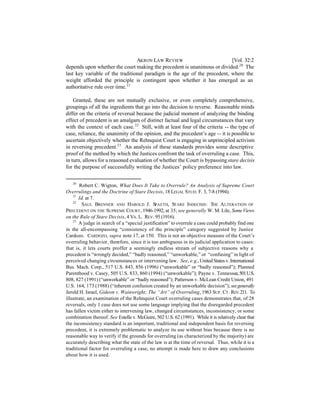
This document discusses how the U.S. Supreme Court's conceptions of stare decisis, or adherence to precedent, influence social change. It argues that some claim the Rehnquist Court used an unprincipled theory of stare decisis to achieve partisan objectives. However, the author concludes that while the Court's jurisprudence shifted rightward, its behavior in reversing precedents is normal and does not undermine the rule of law. The reversals occurred during times of natural instability and membership change on the Court.
![AKRON LAW REVIEW [Vol. 32:2
It concludes that Justice Marshall is only partially correct. While the ideological
direction of its jurisprudence has shifted to the right, the Court’s behavior in reversing
itself is normal and does not endanger the Court’s legitimacy or its faithful adherence to
law. A fair assessment of the Rehnquist Court’s precedent cases indicates that they are
reversals which were decided in times of natural court instability and rapid membership
change. As a result, the Rehnquist Court’s behavior is not that unusual because it is
merely re-examining precedent in periods of constitutional “flux” and legal policy
change. 5
A. Traditional Stare Decisis Analysis
The conception of stare decisis fits within a framework of traditional legal analysis
that the Court regularly employs in evaluating the viability of precedent. Contrary to the
notion that the Rehnquist Court has created an “artificial distinction” to test the legal
validity of extant precedent,6 the criteria by which it decides to depart from precedent
has a firm legal basis and enjoys wide acceptance in courts. Even so, although
empirical studies have explored stare decisis from an attitudinal or legal perspective, 7
none have examined in any detail what type of legal criteria the Rehnquist Court actually
uses to depart from binding precedent. Investigating the legal factors that the Court
applies to its overruling and overturned cases is important since it may be the first step
in understanding whether the Rehnquist Court has adopted a “radical” theory of stare
decisis. 8 Once such legal factors are ascertained, it is then possible to analyze their
application in cases and determine whether the Rehnquist Court is making social policy
through its precedent-shattering cases and, in the process, compromising the rule of
law with its judicial politics.
A typical discussion of stare decisis and its impact on precedent often begins with
posing the question of whether there is a “special justification”9 for overruling past law.
While this term defies simple definition, it is clear that the Court tries to adopt a
principled approach in its stare decisis decision-making where “society [can] presume
that bedrock principles are founded in law rather than in the proclivities of
5
William O. Douglas, Stare Decisis, 49 COLUM. L. REV. 735, 736-37 (1949).
6
Jeffrey A. Segal and Harold J. Spaeth, The Influence of Stare Decisis on the Votes of the
United States Supreme Court Justices, 40 A M. J. POL. SCI. 971, 972 (1996).
7
See, e.g., Saul Brenner and Marc Stier, Retesting Segal and Spaeth’s Stare Decisis
Model, 40 A M. J. POL. SCI. 1036 (1996); Richard A. Brisbin, Jr., Slaying the Dragon: Segal,
Spaeth and the Function of Law in Supreme Court Decision Making, 40 A M. J. POL. SCI.
1004 (1996).
8
Payne v. Tennessee, 501 U.S. 808, 845 (1991).
9
See, e.g., United States v. International Business Machines Corp., 517 U.S. 843, 856
(1996); Welch v. Texas Dep’t. of Highways and Pub. Transp., 483 U.S. 468, 479 (1987);
Arizona v. Rumsey, 467 U.S. 203, 212 (1984).](https://image.slidesharecdn.com/usscandsocialchange-120331173726-phpapp01/85/Ussc-and-social-change-2-320.jpg)
![1999] REVERSALS OF PRECEDENT AND J UDICIAL POLICY-MAKING
individuals.”10 Using this rhetoric allows the Supreme Court to preserve the popular
conception that it i a legitimate and neutral arbiter of public law. Justice Antonia
s
Scalia’s comments in Hubbard v. U.S.11 illustrate this point. Scalia, who has said that
stare decisis is merely an “administrative convenience,”12 cautioned in Hubbard against
calling the underlying decision “wrongly decided.”13 More justification in reversing
precedent is needed, he said, because a judge “who ignores [stare decisis] must give
reasons, and reasons that go beyond mere demonstration that the overruled opinion was
wrong.”14 To do otherwise would completely nullify the doctrine’s effect.15
Where to draw the judicial line between whimsical and principled behavior is less
than clear if one acknowledges the inherent tendency of judges to manipulate the
doctrine politically. Nevertheless, an examination of the Court’s precedent cases
indicates that there are at least five traditional legal criteria that the Court looks to
whenever it tries to justify a departure from precedent.16 Ironically, the preeminent
legal realist, Justice Benjamin Cardozo, best expressed these traditional legal standards.
In his classic The Nature of the Judicial Process Cardozo reminds us that “adherence to
precedent should be the rule and not the exception.”17 But, while remaining true to the
values of stare decisis boasts several advantages (including stability, predictability, and
uniformity of law),18 Cardozo accepts the reality that judges are not irrevocably
committed to what has gone on before. Rather, when faced with a decision to depart
from stare decisis, he states that judges should give more or less weight to precedent
according to several factors, including: First, whether the court is deciding a
constitutional or statutory case; second, whether the underlying decision is inconsistent
with justice or the social welfare; and third, whether the precedent has produced a
substantial reliance interest that prevents the court from overruling it.19 Supplementing
the Cardozo formulation are two other legal criteria which are integral components of
the judicial decision to overrule. The fourth factor is whether the underlying court
spoke with one voice in pronouncing the rule of law; that is, the force of precedent
10
Vasquez v. Hillery, 474 U.S. 254, 265 (1986).
11
514 U.S. 695 (1995).
12
Payne, 501 U.S. at 834 (Scalia, J., concurring).
13
Hubbard, 514 U.S. at 716 (Scalia, J., concurring).
14
Id.
15
Id.
16
The Supreme Court uses these terms. Patterson v. McLean Credit Union, 491 U.S. 164,
173 (1989) (describing overruling factors as “traditional”); Planned Parenthood v. Casey, 505
U.S. 833, 861 (1992) (describing overruling factors as customary). Scholars employ them as
well. Padden, supra note 2, at 1694.
17
BENJAMIN N. CARDOZO, THE NATURE OF THE JUDICIAL PROCESS 149 (1921).
18
See generally Edward D. Re, Stare Decisis, Address at the Seminar for Federal
Appellate Judges Sponsored by the Federal Judicial Center 2-3 (May 13, 1975) (transcript
available in The University of Akron Law School Library).
19
CARDOZO, supra note 17, at 150, 152-60.](https://image.slidesharecdn.com/usscandsocialchange-120331173726-phpapp01/85/Ussc-and-social-change-3-320.jpg)
![1999] REVERSALS OF PRECEDENT AND J UDICIAL POLICY-MAKING
1. The Type of Case Before the Supreme Court
Justice Louis Brandeis once explained in Burnet v. Coronado Oil and Gas Co.24 that
the Supreme Court ought to have more freedom to reverse itself in cases relating to
judicial construction of the meaning of the U.S. Constitution (i.e. “constitutional
cases”). The reason, said Brandeis, is simple. With constitutional cases, it is nearly
impossible for the popularly-elected branch to correct bad or poorly-reasoned
decisions.25 In cases where the Court is asked to interpret a statute (i.e. statutory
cases), Brandeis observed that the Court should exhibit more hesitation in upsetting
prior law.26 This is because the Congress, and not the Court, enjoys more latitude to
fix erroneous decisions which, implicitly, gives the Court more opportunity to develop a
consistent body of stable law.27
While a few commentators are skeptical about the validity of this distinction,28
Appendix A, which lists the overruling decisions of the Rehnquist Court, suggests that
the Court regularly applies it in its decision-making. Table 1 (Tables begin on page
249), in particular, indicates that twenty-two of the twenty-eight overruling cases
(78.5%) decided since the 1986 Term are constitutional cases.29 Only six, or 21.5%,
are statutory. Of the constitutional cases, 42.9% concern issues of criminal
law/procedure, whereas the balance deal with primary claims involving interpretations
of the commerce clause (14.5%), the Tenth or Eleventh Amendments (14.5%), habeas
corpus and federalism (9.5%), the First Amendment (9.5%), affirmative action (4.8%),
and abortion (4.8%).30 Notably, these areas have been the focus of conservative
24
285 U.S. 393, 407 (1932) (Brandeis, J., dissenting).
25
Id.
26
Id. at 406.
27
Christopher P. Banks, The Supreme Court and Precedent: An Analysis of Natural
Courts and Reversal Trends, 75 JUDICATURE, 262, 264 (1992).
28
Earl M. Maltz, The Nature of Precedent, 66 N.C. L. REV. 367 (1987-88).
29
Since constitutional, common law, statutory construction, or judicial administration-
supervisory issues may be present in one case, reasonable minds differ as to what is a
constitutional or statutory case. A constitutional case is defined here as one primarily
relating to the adjudication of a dispositive constitutional issue, including those raising
judicial supervisory (but not common law) concerns. See, e.g., Coleman v. Thompson, 501
U.S. 722 (1991) (deciding issues of comity/federalism in habeas corpus context). A statutory
case primarily concerns statutory construction. See, e.g., Exxon Corp. v. Central Gulf Lines,
Inc., 500 U.S. 603 (1991).
30
Particular issues are identified by recording the majority number of subject matter
headnotes in West’s Reporter in an overruling case. Where headnotes are unclear, a case is
classified in accordance with the most salient issue(s) decided by the Court. Criminal law
cases are: Griffith v. Kentucky, 479 U.S. 314 (1987); Alabama v. Smith, 490 U.S. 794 (1989);
Collins v. Youngblood, 497 U.S. 37 (1990); Estelle v. McGuire, 502 U.S. 62 (1991); Arizona v.
Fulminante, 499 U.S. 279 (1991); California v. Acevedo, 500 U.S. 565 (1991); Payne v.](https://image.slidesharecdn.com/usscandsocialchange-120331173726-phpapp01/85/Ussc-and-social-change-5-320.jpg)
![1999] REVERSALS OF PRECEDENT AND J UDICIAL POLICY-MAKING
In contemporary times the reliance interest linked with precedent has assumed more
substantive meaning and, on occasion, enjoys broad application in the judicial politics of
the Rehnquist Court. As Justices O’Connor, Kennedy, and Souter explained for a
divided Court in the abortion case of Planned Parenthood of Southeastern Pennsylvania
v. Casey, 36 the Court refused to overrule the “central holding” of Roe v. Wade37
because to do so would wrongly deny that,
for two decades of economic and social developments, people have organized intimate
relationships and made choices that define their views of themselves and their places
in society, in reliance on the availability of abortion in the event that contraception
should fail. The ability of women to participate equally in the economic and social life
of the Nation has been facilitated by their ability to control their reproductive lives.38
Recognition of the reliance interest, moreover, has surfaced in other politically-
charged decisions that have little to do with the preservation of contract or property
rights.39 As these cases and others40 aptly demonstrate, the question of reliance--which
“counts the cost of a rule’s repudiation as it would fall on those who have relied
reasonably on the rule’s continued application”41 --increasingly is a point of departure
for knowing if fixed legal principles in the Rehnquist Court change or remain constant.
While reliance interests are a high priority in stare decisis jurisprudence, the opposite
is true for those implicating procedural or evidentiary rules, particularly in constitutional
cases.42 For every case that is given more weight due to a reliance interest, there are an
equal number of opinions having less force because they pertain to some element of the
mechanics underlying the judic ial process. Contracts and property cases have a higher
stare decisis priority because they preserve an expectation that courts will extend
protection to interests that become more valuable as time elapses. While procedural or
evidentiary issues insure governmental neutrality in litigation, they simply do not create
the sort of vested commercial interests that become more significant in the future.
Hence they are given less weight in the decisional processes of courts.
Analysis of the overturned decisions in the Rehnquist Court reveals that reliance
36
505 U.S. 833 (1992).
37
410 U.S. 113 (1973).
38
Casey, 505 U.S. at 856.
39
See Payne v. Tennessee, 501 U.S. 808 (1991) (deciding on the admissibility of evidence
in capital sentencing proceeding); Hubbard v. U.S., 514 U.S. 695 (1995) (addressing the
fraud/federal false statement statute); Adarand Constructors, Inc. v. Pena, 515 U.S. 200 (1995)
(addressing affirmative action).
40
E.g., Quill Corp. v. Heitkamp, 504 U.S. 298 (1992); see also U.S. v. Lopez, 515 U.S. 549,
584 (1995) (Thomas, J., concurring).
41
Casey, 505 U.S. at 856.
42
E.g., U.S. v Gaudin, 515 U.S. 506 (1993).](https://image.slidesharecdn.com/usscandsocialchange-120331173726-phpapp01/85/Ussc-and-social-change-7-320.jpg)
![AKRON LAW REVIEW [Vol. 32:2
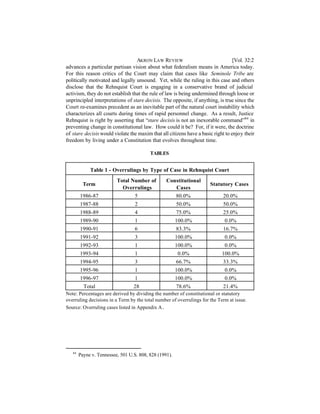
considerations are in fact given special weight. Table 2 illustrates that the Court tends
to follow precedent more often in reliance interest cases and, conversely, rejects it in
those raising procedural or evidentiary subject matter. The difference in treatment is
quite marked. Of the total percentage of cases relating to either reliance or non-reliance
interests (47.1%), only two property or contract cases, or 5.9%, were overturned.
Conversely, fourteen cases involving a procedural or evidentiary issue, or 41.2%, were
upset by the Supreme Court. On balance, this persuasively indicates that the Supreme
Court applies the conventional logic of presuming that property or contract precedents
merit compelling force, whereas non-reliance interests have less precedential value.
B. Unanimity or Dissension from the Court Creating the Precedent
Former Chief Justice Charles Evan Hughes once said that, “a dissent in a court of
last resort is an appeal to the brooding spirit of the law, to the intelligence of a future
day when a later decision may possibly correct the error into which the dissenting judge
believes the court has been betrayed.”43 The brooding spirit of dissension substantially
undercuts judicial devotion to a legal rule over time. Without unanimity, adherence to
the rule of law is difficult because “[t]he first essential of a lasting precedent is that the
court or the majority that promulgates it be fully committed to its principle.”44
That courts analyze extant precedent in light of the solidarity of the court issuing the
underlying rule of law is intuitive. The more dissension in a case cannot help but signal
to prospective litigants and courts that a disfavored precedent is on weak footing and
ripe for an aggressive challenge in court. Table 3, a summary of the percentage of
unanimity or dissension in overturned cases by the Rehnquist Court, partially belies this
traditional logic, however. Of the total number of overturned cases, twelve, or 36.4%,
were decided by a bare majority (i.e. a 5-4 vote). In addition, in cases featuring three
dissents or more, the Court reversed them nearly one-half (48.5%) the time. These
findings show that opinions resulting from closely-divided Courts are indeed more
vulnerable to subsequent attack. Nevertheless, Table 3 also discloses that unanimity is
not a guarantee that precedent is sacrosanct. Of the thirty-four toppled decisions,
eleven precedents, or 33.3%, were unanimous. While unanimity or dissension is still a
conventional part of the Court’s approach to stare decisis, the expectation that
unanimity strengthens the force of precedent and dissension weakens it is not,
therefore, completely met.
C. The Age of the Precedent
The final legal factor affecting the laws’ stability is the age of the precedent under
review. Courts are more apt to re-examine extant principles if they are less seasoned or
43
A YITAH & SUMMERS, FORM AND SUBSTANCE IN A NGLO-A MERICAN LAW , 130 (quoting
Chief Justice Hughes).
44
Robert H. Jackson, Decisional Law and Stare Decisis, 30 A.B.A. J. 334, 335 (1944).](https://image.slidesharecdn.com/usscandsocialchange-120331173726-phpapp01/85/Ussc-and-social-change-8-320.jpg)
![1999] REVERSALS OF PRECEDENT AND J UDICIAL POLICY-MAKING
not well-established over time. Thus, in their study of 154 Supreme Court precedents,
Brenner and Spaeth report that 50.0% are less than twenty-one years old at the time of
overturning; whereas, only 6.4% of the overturned decisions are older than ninety
years.45 They also observe that the average and median age of the precedents
overturned in the Rehnquist Court (up to 1992) is 38.8 and 23.0 years, respectively.
Half of the overruled cases they studied lasted less than twenty-one years, and only
10% predate 1900.46 Their major findings therefore support the conventional wisdom
that recent principles of law are more at risk than older principles. It seems fair to say,
then, that a legal principle of recent origin is more susceptible to having the Rehnquist
Court give that principle a second look and, under the right circumstances, reverse it.
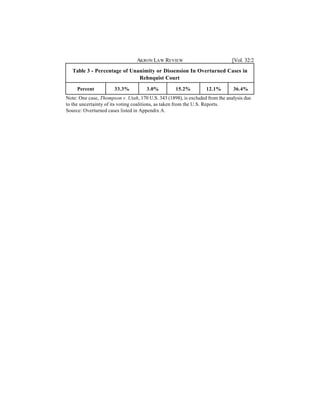
Table 4 identifies, in ten-year increments, the precise age of the precedent reversed
by the Rehnquist Court since 1986. It discloses that the preponderance of overturned
cases are relatively young in age. For example, 29.4% were only on the books less than
ten years, and 17.7% were upset after having an age between eleven and twenty years.
23.5% had an age of twenty-one to thirty years. The most striking finding, though, is
that the age of nearly half (47.1%) of the overturned cases is less than twenty years;
almost three-quarters (70.6%) of the overturned cases have an age of thirty years or
less; and, over two-thirds (76.5%) are forty years or less. While 14.7% of the
overturned rulings are more than ninety-one years old, only 8.8% are over 100 years
old. Though the percentages slightly differ, these findings are generally consistent with
Brenner and Spaeths’ major conclusions. It is relatively certain, therefore, that the
Rehnquist Court will reverse younger, less seasoned law while, at the same time,
hesitate in overturning older cases.
In summary, a review of the pertinent elements reveals that the traditional stare
decisis paradigm has a pervasive influence on the Supreme Court’s precedent
jurisprudence. These findings also diminish the claim that the legal criteria for overruling
a case in Payne are novel. Clearly, if only the asserted legal grounds for overruling the
decision are considered, Marshall’s criticism of Rehnquist is unsubstantiated since the
judicial standard outlined in Payne--that precedent has less force if it involves a
procedural or evidentiary issue or if it is a 5-4 decision--fall squarely in the normal
category of reliance and unanimity or dissension. Although Rehnquist also stated in
Payne that cases have less weight if they are passed over “spirited dissents,”47 it is fair
to associate that element with the unanimity or dissension factor.48 In the end, Marshall
45
BRENNER & SPAETH, supra note 22, at 29.
46
Id.
47
Payne v. Tennessee, 501 U.S. 808, 829-30 (1991).
48
Nominations of William H. Rehnquist, of Arizona, and Lewis F. Powell, Jr., of Virginia,
to be Associate Justices of the Supreme Court of the United States, 1971: Before the
Committee on the Judiciary, 92nd Cong. 19, 55, 76, 138 (1987); Nomination of William H.
Rehnquist to be Chief Justice of the Supreme Court of the United States, 1986: Before the
Committee on the Judiciary, 99th Cong. 133, 271 (1987) [hereinafter, Nomination of](https://image.slidesharecdn.com/usscandsocialchange-120331173726-phpapp01/85/Ussc-and-social-change-9-320.jpg)
![AKRON LAW REVIEW [Vol. 32:2
incorrectly accused the Chief Justice of inventing legal standards of precedent which
are non-traditionally based. However, the substance of Justice Marshall’s political
criticism of the Court is validated when the Rehnquist Court’s propensity to engage in
conservative judicial activism in its precedent cases is considered.
D. Precedent and the Judicial Activism of the U.S. Supreme Court
In exploring why the Supreme Court reverses precedent, it is instructive to know
whether the Justices themselves believe non-political forces explain judicial behavior. In
1986, for example, Chairman Strom Thurmond (R-S.C.) asked then-Associate Justice
Rehnquist at his confirmation hearings whether he knew why the Supreme Court tends
to overrule its own decisions.49 The answer, said Rehnquist, is found with the large
number of constitutional cases on the Court’s docket. Since less weight is normally
given to constitutional cases, Rehnquist thought that the Court would review more
cases and accordingly reverse more precedents.50 With these comments Rehnquist
unwittingly raised the issue that the Court’s caseload has an association with the
number of cases the Court overturns.
Political scientists have investigated the hypothesis that there is a correlation between
larger caseloads and the Court’s reversal rate. In their study of state supreme courts’
reversals, Stephanie Lindquist and Kevin Pybas tested Sidney Ulmer’s hypothesis that
there is a statistical correlation between a court’s docket and the rate of reversals.51
Notably, they confirm Rehnquist’s suspicion that a relationship exists by reporting that
the volume of a court’s docket is positively associated with an increased rate of
reversals. There are two explanations for the existence of this relationship. First, the
pressures of a higher caseload create more judicial mistakes in drafting opinions, which
in turn compels courts to correct the errors by reversing imprecise rulings. Second,
the sheer size of a docket gives a court more chances to overturn cases, especially if
the docket continues to grow.52
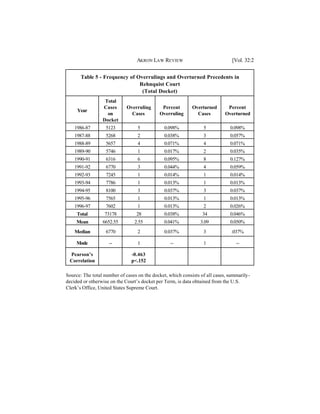
Tables 5 and 6 lend mixed support to these hypotheses, however. Table 5, which
pertains to the Supreme Court’s total docket, and Table 6, which considers only the
amount of full written opinions issued by the Court, at best show that a moderate
association exists. The Pearson correlation coefficient in Table 5 implies, for example,
that having more cases on the total docket will not result in more cases reversed (-.46,
p<.152). Table 6, however, presents a slightly different picture since the coefficient in
this case is positive (.48) instead of negative; yet, it is still insignificant at p<.129. As a
Rehnquist 1986].
49
Nomination of Rehnquist 1986, supra note 48, at 132-33.
50
Id.
51
Stephanie A. Lindquist and Kevin Pybas, Address at the Annual Meeting of the
Midwest Political Science Association (April 1997) (transcript on file with author).
52
Id.](https://image.slidesharecdn.com/usscandsocialchange-120331173726-phpapp01/85/Ussc-and-social-change-10-320.jpg)
![1999] REVERSALS OF PRECEDENT AND J UDICIAL POLICY-MAKING
result, perhaps the most important finding of the correlation analysis is that it appears to
show that how the Court’s docket is defined makes a considerable difference in proving
whether caseload impacts the reversal rate. If so, then whether there is a negative or
positive correlation, and ultimately whether the Court’s caseload results in more
reversals as a statistical issue, appears to be affected by one’s conception of what is the
best measure of the Court’s docket.53 At bottom, however, the findings here make
clear that there is little evidence that a larger caseload makes the Court reverse itself
more often.
Tables 5 and 6 also imply that the Rehnquist Court is not an activist Court in terms
of the sheer frequency of overruling and overruled cases. Although Table 5 reports a
mean of 2.55 reversals per Term, the mean percentage of reversals is still infinitesimal
(the mean is less than one-half percent, at .041) if the total docket is considered. Table
6, on the other hand, suggests that reversals constitute a more substantial (but still
small) part of the Court’s work, with a mean percentage rate of 2.02% per Term. In
any event, both Tables acknowledge that overrulings are a rare event in terms of the
total number of cases on the docket and in relation to how many full, written opinions
the Court produces. Also, the amount of law being reversed is not, in the aggregate,
impressive. In terms of the Court’s total docket, the mean rate of overturned cases is
slightly less than one-half percent (.046%). Likewise, the mean percentage for
overturned cases is 3.09% if the full written opinion docket is only taken into account.
While these findings shed some light on what is influencing the reversal patterns of
the Rehnquist Court, there is a more fundamental reason why the precedent is
reexamined. A number of observers of the judicial process argue that the law’s stability
is greatly affected by who is sitting on the Court at a determinate time in political
history.54 As the Court’s membership changes through the presidential appointment
process, so too does the ideological scope and content of constitutional law. Justice
William O. Douglas perhaps said it best when he noted that the Supreme Court
inevitably enters into periods of constitutional “flux,” or times when newly-appointed
Justices are given the opportunity to re-evaluate the decisions of their predecessors.55
In times of flux, there is a rapid turnover of Justices, and precedents are likely to fall as
new majorities coalesce on the bench and write their own policy preferences into law as
a natural part of their judicial function.56 In this sense, the rule of law is transformed
into a principle of political convenience, where the “friends” of stare decisis are only
53
The full opinion docket, which consists of signed and per curiam opinions, may be the
best choice in stare decisis research because reversals of prior law usually need to be based
upon a written rationale in order to preserve the Court’s legitimacy as a neutral arbiter of the
law.
54
Israel, supra note 23, at 219; Charles J. Cooper, Stare Decisis: Precedent and Principle
in Constitutional Adjudication, 73 CORNELL L. REV. 401, 402-3 (1987).
55
Douglas, supra note 5, at 736-37
56
Id.](https://image.slidesharecdn.com/usscandsocialchange-120331173726-phpapp01/85/Ussc-and-social-change-11-320.jpg)
![AKRON LAW REVIEW [Vol. 32:2
“determined by the needs of the moment.”57
Since 1986, when William Rehnquist became Chief Justice, there have been six
natural courts,58 twenty-eight reversals, and thirty-four overturned decisions in the
Supreme Court. While the most number of reversals (7) transpired in the second
natural court period, the bulk of reversals (22), or 78.6% of the total overruling
decisions, occurred in the first four natural courts. During this period, which spanned
almost seven years (1986 to 1993), twenty-seven precedents fell, or 79.4% of the total
number (34). Moreover, the first natural court emerged with the departure of Chief
Justice Warren Burger and President Ronald Reagan’s appointment of William
Rehnquist as his successor. Over the seven year period of the first four natural courts,
four new members, Justices Scalia, Anthony Kennedy, David Souter, and Clarence
Thomas, were appointed by politically conservative presidents. Notably, the new
conservative appointments replaced three Justices, namely Brennan, M arshall, and
Byron White, put on the bench by liberal presidents.59
As Table 7 suggests, when the new conservative bloc of judicial appointments
coalesced into a majority in a relatively short period of time (approximately seven
years), the Rehnquist Court re-examined precedent and, at times, significantly altered
legal and public policy. The overruling decisions during the first four natural court
periods demonstrate the “interpretative instability” and fluidity of constitutional law, one
dimension of the Courts’ judicial activism. As political scientist Bradley Canon explains,
interpretative stability is one of six dimensions of judicial activism and it “measures the
degree to which a Supreme Court decision either retains or abandons precedent or
existing judicial doctrine.”60 Moreover, he notes, “[t]he most visible and dramatic
instance of interpretative instability comes when the Court explicitly overrules one of its
own earlier decisions.”61
Through its reversals of precedent the Rehnquist Court has been politically
successful in narrowing the scope of civil rights of those who come into contact with
the criminal justice system.62 In Thornburgh v. Abbott, 63 for example, the Court
increased the power of prison authorities to inspect incoming mail sent to prisoners.
57
Cooper, supra note 54, at 402.
58
“Natural courts” represent a time when the Court’s membership is stable. A new
natural court is created when membership changes and a justice either begins or ends service
on the bench. O’Brien, supra note 31, at 981.
59
Justice Lewis Powell (part of the first natural court), a Nixon appointee, also left Court
service. THE SUPREME COURT OF THE UNITED STATES 22-23 (1997).
60
Bradley C. Canon, Defining the Dimensions of Judicial Activism, 66 JUDICATURE 237,
241 (1983).
61
Id.
62
O’Brien, supra note 31, at 996-98.
63
490 U.S. 401 (1989).](https://image.slidesharecdn.com/usscandsocialchange-120331173726-phpapp01/85/Ussc-and-social-change-12-320.jpg)
![1999] REVERSALS OF PRECEDENT AND J UDICIAL POLICY-MAKING
With a trio of important cases, the Rehnquist Court also altered prior doctrine and
extended the application of the harmless error rule to involuntary confessions in Arizona
v. Fulminante;64 broadened the right of the police to search closed containers in
automobiles without a warrant in California v. Acevedo;65 and, in Payne v.
Tennessee, 66 condoned the admission of victim impact statements in a capital
sentencing. In still other criminal procedure cases, the Court made it easier to insulate
judges from having their criminal sentencing determinations upset on appeal in Alabama
v. Smith67 and Collins v. Youngblood. 68 Finally, in two significant habeas
corpus/federalism cases, Coleman v. Thompson69 and Keeney v. Tamayo-Reyes, 70 the
Rehnquist Court continued to limit the ability of convicted felons to seek collateral relief
in federal court on the basis of alleged violations of constitutional rights. Significantly,
these last two rulings are influential in light of other Rehnquist Court decisions limiting
the right of habeas corpus and the Chief Justices’ own effort (as the titular head of the
federal judiciary) to restrict the right in federal courts.71
That the Rehnquist Court has sought to curtail rights of criminal defendants is not
surprising to those familiar with his judicial philosophy. During his 1986 confirmation
hearings, Rehnquist testified that the constitutional rights of the accused must be
balanced against the right of society to “apprehend the guilty and exonerate the
innocent.”72 In his view, “[the] endless expansion of constitutional rights for
defendants by judicial construction is not a welcomed thing.”73 While the Supreme
Court’s movement to the right of the political spectrum is aligned with Rehnquist’s
attitude on criminal justice, the Supreme Court under his leadership has also made an
impact on other areas of constitutional law jurisprudence.
In fact, if all six natural courts are considered, the Court’s precedent-altering
behavior reveals that its conservative judicial politics has been incorporated into the
dynamic area of Eleventh Amendment jurisprudence. With Welch v. Texas Department
of Highways and Transportation, 74 and later in Seminole Tribe of Florida v. Florida, 75
the Justices fortified the principle that the Eleventh Amendment is a restriction on the
64
499 U.S. 279 (1991).
65
500 U.S. 565 (1991).
66
501 U.S. 808 (1991).
67
490 U.S. 794 (1989).
68
497 U.S. 37 (1990).
69
501 U.S. 722 (1991).
70
504 U.S. 1 (1992).
71
See Felker v. Turpin, 518 U.S. 651 (1996); see also William H. Rehnquist, 1996 Year-End
Report on the Federal Judiciary <http://www.uscourts.govcj96.htm>.
72
Nomination of Rehnquist 1986, supra note 48, at 211.
73
Id. at 211-12.
74
483 U.S. 468 (1987).
75
517 U.S. 44 (1996).](https://image.slidesharecdn.com/usscandsocialchange-120331173726-phpapp01/85/Ussc-and-social-change-13-320.jpg)
![1999] REVERSALS OF PRECEDENT AND J UDICIAL POLICY-MAKING
treatment are less than twelve years old and, in eight of the thirty-four overturned
decisions (23.5%), Justice William Brennan, one of the Court’s most liberal members,
wrote the opinion for the Court.80 These results lend force to the argument that the
Rehnquist Court has shifted constitutional doctrine through an ongoing process of
reversing cases and distinguishing precedent.81 The ultimate issue, though, is not
whether the Rehnquist Court has been successful in achieving conservative change;
there is little question that it has, at least to a certain degree. More important is the
question of whether the Court’s re-examination and alteration of precedent is
necessarily harmful to the rule of law or the American polity, a claim that implicates the
Court’s institutional legitimacy.
E. Conclusion
In Seminole Tribe of Florida v. Florida, 82 a 5-4 decision, Chief Justice William
Rehnquist held that Pennsylvania v. Union Gas Company83 had lost its value as an
enduring principle of law and must be overruled. Union Gas, Rehnquist argued, was
wrongly decided because a plurality endorsed it while a majority rejected it; and, as a
result, lower federal courts were confused as to its meaning and application in
subsequent cases. Worse still, it was at odds with other lines of more established, and
correctly decided, federalism jurisprudence. Accordingly, over the spirited dissents of
Justices David Souter and John P Stevens, the Court ruled that the Eleventh
aul
Amendment prevents Congress from authorizing lawsuits by Indian tribes against the
states to enforce federal legislation pursuant to the Indian Commerce Clause.
Seminole Tribe well illustrates that the Rehnquist Court is willing to disregard
precedent that is flawed in several traditional respects. Not only was Union Gas only
seven years old as a controlling legal principle, it also was created through a divided
Court and deemed to be inconsistent with prevailing law. Moreover, it was a
constitutional case and, at least implicitly, did not command any sort of reliance interest
that would make the Court hesitate in overruling it. Instead of manipulating the law
through a novel theory of stare decisis created by a result-oriented Rehnquist Court, the
overruling of precedent in Seminole Tribe indicates that the Supreme Court applied all
five of the conventional factors normally associated with the re-examination of
constitutional law principles.
Consequently, Seminole Tribe is a significant Eleventh Amendment case that
80
Parden v. Terminal Railway, 377 U.S. 184 (1964); Fay v. Noia, 372 U. S. 391(1963); South
Carolina v. Gathers, 490 U.S. 805 (1989); Grady v. Corbin, 495 U.S. 508 (1990); Metro Broad.,
Inc. v. F.C.C., 497 U.S. 547 (1990); Pennsylvania v. Union Gas Co., 491 U.S. 1 (1989); Aguilar v.
Felton, 473 U.S. 402 (1985); School Dist. of Grand Rapids v. Ball, 473 U.S. 373 (1985).
81
O’Brien, supra note 31.
82
517 U.S. 44 (1996).
83
491 U.S. 1 (1989).](https://image.slidesharecdn.com/usscandsocialchange-120331173726-phpapp01/85/Ussc-and-social-change-15-320.jpg)
![1999] REVERSALS OF PRECEDENT AND J UDICIAL POLICY-MAKING
Table 2 - Percentage of Overturned Cases With Reliance Interest in
Rehnquist Court
Property/
Total Procedural/ Excluded
Term Contract Perc. Perc. Perc.
Cases Evidentiary Cases
Cases
1986-87 5 0 0.0% 0 0.0% 5 100.0%
1987-88 3 0 0.0% 0 0.0% 3 100.0%
1988-89 4 1 25.0% 1 25.0% 2 50.0%
1989-90 2 0 0.0% 2 100.0% 0 0.0%
1990-91 8 1 12.5% 6 75.0% 1 12.5%
1991-92 4 0 0.0% 2 50.0% 2 50.0%
1992-93 1 0 0.0% 0 0.0% 1 100.0%
1993-94 1 0 0.0% 1 100.0% 0 0.0%
1994-95 3 0 0.0% 2 66.7% 1 33.3%
1995-96 1 0 0.0% 0 0.0% 1 0.0%
1996-97 2 0 0.0% 0 0.0% 2 100.0%
Total 34 2 5.9% 14 41.2% 18 52.9%
Note: “Excluded” cases did not involve either property/contract or procedural/evidentiary
interests.
Source: Overturned cases listed in Appendix A.
Table 3 - Percentage of Unanimity or Dissension In Overturned Cases in
Rehnquist Court
One Two Three Four
Term Unanimous
Dissent Dissents Dissents Dissents
1986-87 (N=5) 1 0 1 1 2
1987-88 (N=3) 2 0 1 0 0
1988-89 (N=4) 2 0 2 0 0
1989-90 (N=1) 0 0 0 0 1
1990-91 (N=8) 3 1 1 1 2
1991-92 (N=4) 0 0 0 2 2
1992-93 (N=1) 0 0 0 0 1
1993-94 (N=1) 1 0 0 0 0
1994-95 (N=3) 2 0 0 0 1
1995-96 (N=1) 0 0 0 0 1
1996-97 (N=2) 0 0 0 0 2
Total (N=33) 11 1 5 4 12](https://image.slidesharecdn.com/usscandsocialchange-120331173726-phpapp01/85/Ussc-and-social-change-17-320.jpg)
![1999] REVERSALS OF PRECEDENT AND J UDICIAL POLICY-MAKING
Table 4 - Age of Overturned Cases in Rehnquist Court
Term 0-10 11-20 21-30 31-40 41-50 51-60 61-70 71-80 81-90 91-100 Over 100
1986-1987
1 3 1
(N=5)
1987-1988
1 1 1
(N=3)
1988-1989
2 1 1
(N=4)
1989-1990
1 1
(N=2)
1990-1991
4 1 2 1
(N=8)
1991-1992
2 2
(N=4)
1992-1993
1
(N=1)
1993-1994
1
(N=1)
1994-1995
1 1 1
(N=3)
1995-1996
1
(N=1)
1996-1997
1 1
(N=2)
Total
10 6 8 2 1 1 1 0 0 2 3
(N=34)
Percent 29.4% 17.7% 23.5% 5.9% 2.9% 2.9% 2.9% 0.0% 0.0% 5.9% 8.8%
Source: Overturned cases listed in Appendix A.](https://image.slidesharecdn.com/usscandsocialchange-120331173726-phpapp01/85/Ussc-and-social-change-19-320.jpg)
![1999] REVERSALS OF PRECEDENT AND J UDICIAL POLICY-MAKING
Table 6 - Frequency of Overrulings and Overturned Precedents in
Rehnquist Court
(Full Written Opinions’ Docket)
Total
Number
Overruling Percent Overturned Percent
Year of Full
Cases Overruling Cases Overturned
Written
Opinions
1986-87 174 5 2.874% 5 2.874%
1987-88 160 2 1.250% 3 1.875%
1988-89 168 4 2.381% 4 2.381%
1989-90 146 1 0.685% 2 1.370%
1990-91 125 6 4.800% 8 6.400%
1991-92 123 3 2.439% 4 3.252%
1992-93 115 1 0.870% 1 0.870%
1993-94 99 1 1.010% 1 1.010%
1994-95 94 3 3.191% 3 3.191%
1995-96 90 1 1.111% 1 1.111%
1996-97 90 1 1.111% 2 2.222%
Total 1384 28 2.023% 34 2.457%
Mean 125.82 2.55 1.975% 3.09 2.414%
Median 123 2 1.25% 3 2.22%
Mode 90 0 1.11% 1 --
Pearson’s
0.487
Correla-
P<.129
tion
Source: The total number of full written opinions, which consists of only those cases
disposed of by signed or per curiam opinions on the Court’s docket per Term, is data
obtained from the U.S. Clerk’s Office, United States Supreme Court.](https://image.slidesharecdn.com/usscandsocialchange-120331173726-phpapp01/85/Ussc-and-social-change-21-320.jpg)
![1999] REVERSALS OF PRECEDENT AND J UDICIAL POLICY-MAKING
Table 8 - Rehnquist Court’s Treatment of “Endangered Precedents”
Endangered Precedent Subsequent Treatment
1. Metro Broad. v. F.C.C. Overruled (in part) by:
497 U.S. 547 (1990). Adarand Constructors v. Pena, 515 U.S. 200
(1995).
2. Grady v. Corbin Overruled (in part) by:
495 U.S. 508 (1990). United States v. Dixon, 509 U.S. 688 (1993).
3. Mills v. Maryland None
486 U.S. 367 (1988).
4. United States v. Paradise None
480 U.S. 149 (1987).
5. Ford v. Wainwright Distinguished in:
477 U.S. 399 (1986). Herrera v. Collins, 506 U.S. 390 (1993).
Stanford v. Kentucky, 492 U.S. 361 (1989).
H.J. Inc. v. Northwestern Bell Tel. Co.492 U.S.
229 (1989).
6. Thornburgh v. American College Overruled (in part) by:
of Obstetricians & Gynecologists, Planned Parenthood v. Casey, 505 U.S. 833
476 U.S. 747 (1986). (1992).
7. Aguilar v. Felton Overruled (in part) by:
473 U.S. 402 (1985) Agostini v. Felton, 1997 U.S. Lexis 4000 (1997)
8. Rutan v. Republican Party None
497 U.S. 62 (1990)
9. Peel v. Attorney Registration & None
Disciplinary Comm.
496 U.S. 91 (1990)
10. Zinermon v. Burch None
494 U.S. 113 (1990)
11. James v. Illinois None
493 U.S. 307 (1990)
12. Rankin v. McPherson None
483 U.S. 378 (1987)
13. Rock v. Arkansas None
483 U.S. 44 (1987)
14. Gray v. Mississippi Distinguished and Limited in:
481 U.S. 648 (1987) Ross v. Oklahoma, 487 U.S. 81 (1988)
15. Maine v. Moulton Distinguished in:
474 U.S. 159 (1985) McCoy v. Court of Appeals, 486 U.S. 429
(1988)
16. Garcia v. San Antonio Transit Distinguished in:
Auth. N.Y. v. U.S., 112 S.Ct. 2408 (1992)
469 U.S. 528 (1985)
17. Pulliam v. Allen None
466 U.S. 522 (1984)](https://image.slidesharecdn.com/usscandsocialchange-120331173726-phpapp01/85/Ussc-and-social-change-23-320.jpg)