Using
for Science Communication
Bailey DeBarmore, MHS RD
PhD Student, Epidemiology
@BaileyDeBarmore
Updated February 27, 2019
Notes
Go to github.com/baileydebarmore/sci-comm.git for
links and articles mentioned in this presentation
and to download my Getting Started on Twitter guide
Science
Communication
and then we expect journalists to
explain it to everyone else.”
- Christie Wilcox
“Social Media for Scientists” series, 2011 in Scientific American
“Scientists pass the buck when it comes to
communicating science. We write papers
Don’t pass the buck
Health professionals have an opportunity and a
responsibility to adopt and harness
these new [social media] formats
as they engage a global
audience.
- Esther K Choo et al.
Choo et al. Twitter as a tool for communication and knowledge exchange in academic medicine: A guide for
skeptics and novices. Medical Teacher. 2015. www.bit.ly/2MNgHwE
Lay Media Presence
Journalists use online search functions
to find experts
Lay Media Presence
Twitter posts rank high
in search results
Gain recognition as an expert
1. Advance your public image
2. Provide credible information to the public
3. Improve perception of scientists by the
public
“If scientists could communicate…in a familiar tone
with a less specialized vocabulary, would a wide range
of people understand them better?
Would their work be better understood by the general public,
policy-makers, funders, and even in some cases, other
scientists?”
– Alan Alda
Twitter for Science Education. www.blogs.plos.org/scied 2013
“Putting your head in the ground and ignoring
[social media] adds to the ivory tower attitude
that people have towards scientists.”
Twitter
Lingo
Hashtags
Word or phrase prefixed with #
• Denote topic:
• #CausalInference
• Identify community:
• #EpiTwitter #Rstats #StatsTwitter #AcademicTwitter #PhDChat
• Group with a conference:
• #AHA18 #EpiLifestyle19
Hashtags
are searchable
Retweet
• Repost a message from another user and share with your own
followers
Original tweet
Retweet with comment
Tips for
Science Communication
Constructing a Great
Science Tweet
Credit: dribbble.com/MakiMiller
Sharing science on twitter
Ideally include 3 things
 “So what?” punchline
 Link
 Visual
Great example
Hook
+
Punchline
+
Link
+
Visual
Great example
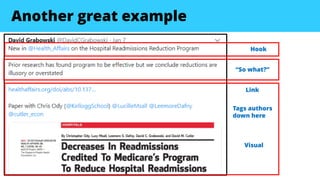
Another great example
Tags authors
down here
Link
Visual
Hook
“So what?”
And another great example
Using visuals
• Screenshot the formatted paper or PubMed
Abstract
• Use compelling figure from the paper
• Find related free stock photo
• Rawpixel.com
• Pexels.com
• Unsplash.com
• Retweet journal tweet that includes image
Writing Effective Science
Tweets
Is your audience hearing what
you want to say?
Overall approach
• Write like you’re having a conversation.
Then engage in the discussion that follows.
– Ellie Murray @EpiEllie
• Stay away from acronyms and unique science terms. Instead,
include concepts and ideas everyone knows and build on their
understanding from there.
– Val Klavans @astroguitarist
Write like you’re having a conversation
Ever have someone read a draft of
your writing and then ask for
clarification?
Write like you’re having a conversation
• Use active voice, contractions, and short sentences
• Replace complex language with simple vocabulary
• Engage the reader with questions and use “you”
Tips adapted from Henneke Duistermaat (@HennekeD)
www.enchantingmarketing.com/conversational-writing/
Writerly and science-y
Previously called atypical myocardial infarction,
myocardial infarctions presenting without classic
chest pain are more common in certain patient
groups, including those with more comorbidities.
These myocardial infarctions without classic pain
are associated with delayed hospital arrival time,
delayed coronary revascularization, and poorer
outcomes following the event.
Casual and approachable
Do you know someone who’s had a heart
attack?
We often think of someone having chest pain
but you might have different symptoms or no
symptoms at all.
I study these different heart attack
presentations to see if they are more common
in certain groups.
Engage your audience with a question
or statement that connects people
with the science
Imagine if you couldn’t afford your medications.
New study shows concerns over medication costs
negatively affect BP med adherence and BP control,
especially in low income areas.
Tips for finding the point
• Ask yourself
• What did I take away from this article?
• Why am I sharing this post?
• What questions do I still have?
You’ve probably read through several articles.
Why did you stop on this one?
Did you think of another discussion you had?
Tips for getting to the point
• Think about a friend asking, “What was the study about?”
• Answer in 1-2 sentences
• Too many ideas and details confuse the reader
• Start with your first thoughts
• Drill down to the main point
Improving readability
• Not enough characters?
• Use multi-thread tool instead of “txt
msg”-style abbreviations
• Shy away from using ALL CAPS or
too many #hashtags
• Avoid replacing words with emojis
multi-thread tool
Other tips
• Tag authors and journal if on Twitter, but at the end of your tweet
• Use white space
• Shorten links with bit.ly
or other services
Using
for Science Communication
Bailey DeBarmore, MHS RD
PhD Student, Epidemiology
github.com/baileydebarmore/sci-comm.git

Using Twitter for Science Communication

  • 1.
    Using for Science Communication BaileyDeBarmore, MHS RD PhD Student, Epidemiology @BaileyDeBarmore Updated February 27, 2019
  • 2.
    Notes Go to github.com/baileydebarmore/sci-comm.gitfor links and articles mentioned in this presentation and to download my Getting Started on Twitter guide
  • 3.
  • 4.
    and then weexpect journalists to explain it to everyone else.” - Christie Wilcox “Social Media for Scientists” series, 2011 in Scientific American “Scientists pass the buck when it comes to communicating science. We write papers
  • 5.
    Don’t pass thebuck Health professionals have an opportunity and a responsibility to adopt and harness these new [social media] formats as they engage a global audience. - Esther K Choo et al. Choo et al. Twitter as a tool for communication and knowledge exchange in academic medicine: A guide for skeptics and novices. Medical Teacher. 2015. www.bit.ly/2MNgHwE
  • 6.
    Lay Media Presence Journalistsuse online search functions to find experts
  • 7.
    Lay Media Presence Twitterposts rank high in search results
  • 8.
    Gain recognition asan expert 1. Advance your public image 2. Provide credible information to the public 3. Improve perception of scientists by the public
  • 9.
    “If scientists couldcommunicate…in a familiar tone with a less specialized vocabulary, would a wide range of people understand them better? Would their work be better understood by the general public, policy-makers, funders, and even in some cases, other scientists?” – Alan Alda
  • 10.
    Twitter for ScienceEducation. www.blogs.plos.org/scied 2013 “Putting your head in the ground and ignoring [social media] adds to the ivory tower attitude that people have towards scientists.”
  • 11.
  • 12.
    Hashtags Word or phraseprefixed with # • Denote topic: • #CausalInference • Identify community: • #EpiTwitter #Rstats #StatsTwitter #AcademicTwitter #PhDChat • Group with a conference: • #AHA18 #EpiLifestyle19
  • 13.
  • 14.
    Retweet • Repost amessage from another user and share with your own followers Original tweet Retweet with comment
  • 15.
  • 16.
    Constructing a Great ScienceTweet Credit: dribbble.com/MakiMiller
  • 17.
    Sharing science ontwitter Ideally include 3 things  “So what?” punchline  Link  Visual
  • 18.
  • 19.
  • 20.
    Another great example Tagsauthors down here Link Visual Hook “So what?”
  • 21.
  • 22.
    Using visuals • Screenshotthe formatted paper or PubMed Abstract • Use compelling figure from the paper • Find related free stock photo • Rawpixel.com • Pexels.com • Unsplash.com • Retweet journal tweet that includes image
  • 23.
    Writing Effective Science Tweets Isyour audience hearing what you want to say?
  • 24.
    Overall approach • Writelike you’re having a conversation. Then engage in the discussion that follows. – Ellie Murray @EpiEllie • Stay away from acronyms and unique science terms. Instead, include concepts and ideas everyone knows and build on their understanding from there. – Val Klavans @astroguitarist
  • 25.
    Write like you’rehaving a conversation Ever have someone read a draft of your writing and then ask for clarification?
  • 26.
    Write like you’rehaving a conversation • Use active voice, contractions, and short sentences • Replace complex language with simple vocabulary • Engage the reader with questions and use “you” Tips adapted from Henneke Duistermaat (@HennekeD) www.enchantingmarketing.com/conversational-writing/
  • 27.
    Writerly and science-y Previouslycalled atypical myocardial infarction, myocardial infarctions presenting without classic chest pain are more common in certain patient groups, including those with more comorbidities. These myocardial infarctions without classic pain are associated with delayed hospital arrival time, delayed coronary revascularization, and poorer outcomes following the event.
  • 28.
    Casual and approachable Doyou know someone who’s had a heart attack? We often think of someone having chest pain but you might have different symptoms or no symptoms at all. I study these different heart attack presentations to see if they are more common in certain groups.
  • 29.
    Engage your audiencewith a question or statement that connects people with the science Imagine if you couldn’t afford your medications. New study shows concerns over medication costs negatively affect BP med adherence and BP control, especially in low income areas.
  • 30.
    Tips for findingthe point • Ask yourself • What did I take away from this article? • Why am I sharing this post? • What questions do I still have? You’ve probably read through several articles. Why did you stop on this one? Did you think of another discussion you had?
  • 31.
    Tips for gettingto the point • Think about a friend asking, “What was the study about?” • Answer in 1-2 sentences • Too many ideas and details confuse the reader • Start with your first thoughts • Drill down to the main point
  • 32.
    Improving readability • Notenough characters? • Use multi-thread tool instead of “txt msg”-style abbreviations • Shy away from using ALL CAPS or too many #hashtags • Avoid replacing words with emojis multi-thread tool
  • 33.
    Other tips • Tagauthors and journal if on Twitter, but at the end of your tweet • Use white space • Shorten links with bit.ly or other services
  • 34.
    Using for Science Communication BaileyDeBarmore, MHS RD PhD Student, Epidemiology github.com/baileydebarmore/sci-comm.git