Found Objects in Art: Where to Find “Stuff”
If you are interested in making assemblage art or
found object art, you may be wondering where to find
things to use.
The truth is, we have stuff all around us, just waiting to
be made into art. Here are some suggestions of
where to find things.
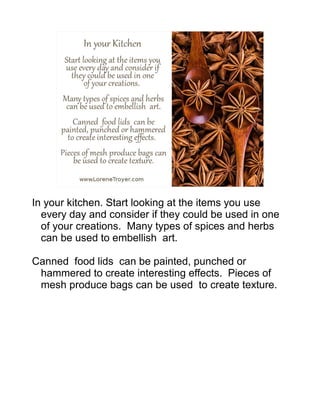
In your kitchen. Start looking at the items you use
every day and consider if they could be used in one
of your creations. Many types of spices and herbs
can be used to embellish art.
Canned food lids can be painted, punched or
hammered to create interesting effects. Pieces of
mesh produce bags can be used to create texture.
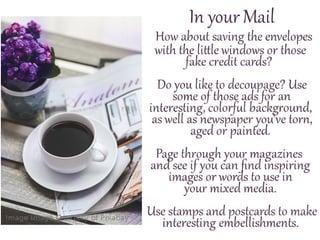
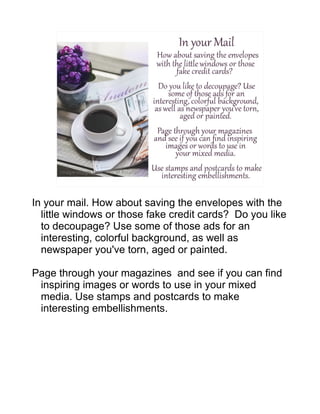
In your mail. How about saving the envelopes with the
little windows or those fake credit cards? Do you like
to decoupage? Use some of those ads for an
interesting, colorful background, as well as
newspaper you've torn, aged or painted.
Page through your magazines and see if you can find
inspiring images or words to use in your mixed
media. Use stamps and postcards to make
interesting embellishments.
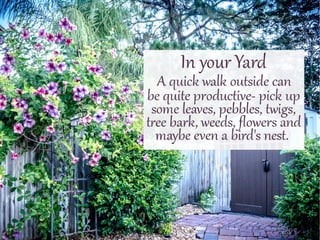
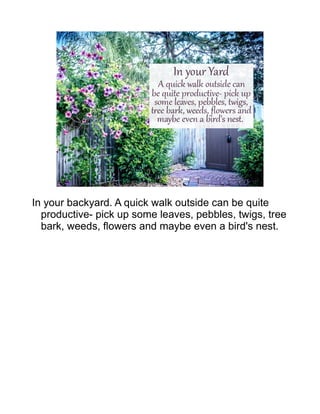
In your backyard. A quick walk outside can be quite
productive- pick up some leaves, pebbles, twigs, tree
bark, weeds, flowers and maybe even a bird's nest.
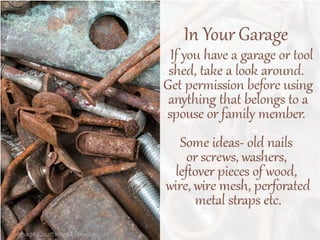
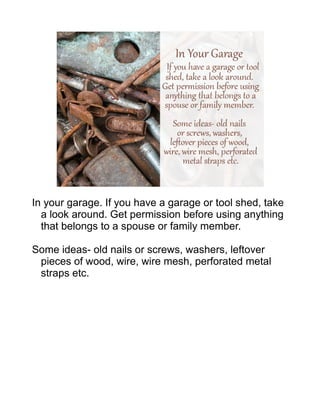
In your garage. If you have a garage or tool shed, take
a look around. Get permission before using anything
that belongs to a spouse or family member.
Some ideas- old nails or screws, washers, leftover
pieces of wood, wire, wire mesh, perforated metal
straps etc.
In your clothes closet. Are there any clothes you want
to get rid of? Before you take them to a second hand
store or throw them in the trash, take another look.
I like to save the buttons, the pockets, any
embellishments, belts or tags and sometimes, the
material itself, especially if it has an interesting
texture or design
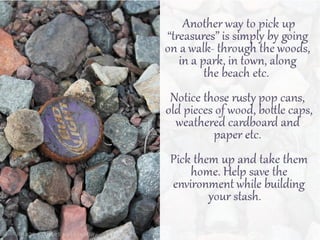
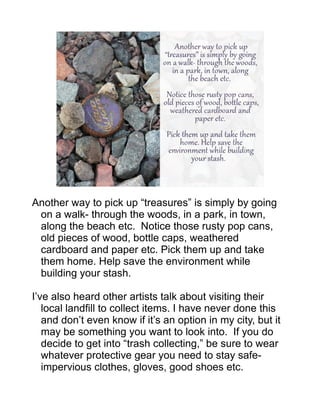
Another way to pick up “treasures” is simply by going
on a walk- through the woods, in a park, in town,
along the beach etc. Notice those rusty pop cans,
old pieces of wood, bottle caps, weathered
cardboard and paper etc. Pick them up and take
them home. Help save the environment while
building your stash.
I’ve also heard other artists talk about visiting their
local landfill to collect items. I have never done this
and don’t even know if it’s an option in my city, but it
may be something you want to look into. If you do
decide to get into “trash collecting,” be sure to wear
whatever protective gear you need to stay safe-
impervious clothes, gloves, good shoes etc.
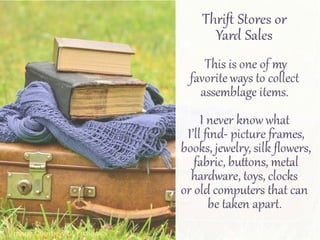
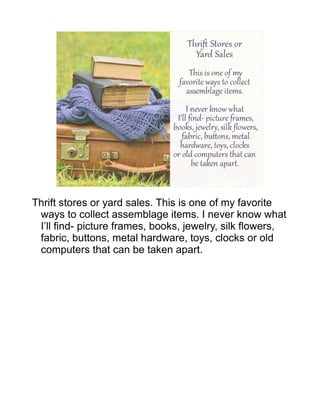
Thrift stores or yard sales. This is one of my favorite
ways to collect assemblage items. I never know what
I’ll find- picture frames, books, jewelry, silk flowers,
fabric, buttons, metal hardware, toys, clocks or old
computers that can be taken apart.
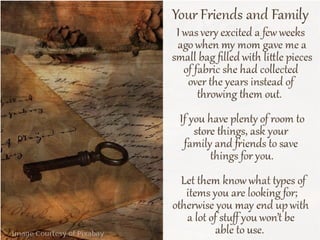
Your friends and family. I was very excited a few weeks
ago when my mom gave me a small bag filled with
little pieces of fabric she had collected over the years
instead of throwing them out.
If you have plenty of room to store things, ask your
family and friends to save things for you. Let them
know what types of items you are looking for;
otherwise you may end up with a lot of stuff you
won’t be able to use.
As you can see, there is no shortage of ways to collect
items to use in your mixed media/found object art.
Treasures are all around you. The problem then
becomes, “Where will I put all this “stuff?!!”
For more tips on creating mixed media, go to
www.LoreneTroyer.com

Using Found Objects in Art: Where to Find "Stuff"

  • 12.
    Found Objects inArt: Where to Find “Stuff”
  • 13.
    If you areinterested in making assemblage art or found object art, you may be wondering where to find things to use. The truth is, we have stuff all around us, just waiting to be made into art. Here are some suggestions of where to find things.
  • 14.
    In your kitchen.Start looking at the items you use every day and consider if they could be used in one of your creations. Many types of spices and herbs can be used to embellish art. Canned food lids can be painted, punched or hammered to create interesting effects. Pieces of mesh produce bags can be used to create texture.
  • 15.
    In your mail.How about saving the envelopes with the little windows or those fake credit cards? Do you like to decoupage? Use some of those ads for an interesting, colorful background, as well as newspaper you've torn, aged or painted. Page through your magazines and see if you can find inspiring images or words to use in your mixed media. Use stamps and postcards to make interesting embellishments.
  • 16.
    In your backyard.A quick walk outside can be quite productive- pick up some leaves, pebbles, twigs, tree bark, weeds, flowers and maybe even a bird's nest.
  • 17.
    In your garage.If you have a garage or tool shed, take a look around. Get permission before using anything that belongs to a spouse or family member. Some ideas- old nails or screws, washers, leftover pieces of wood, wire, wire mesh, perforated metal straps etc.
  • 18.
    In your clothescloset. Are there any clothes you want to get rid of? Before you take them to a second hand store or throw them in the trash, take another look. I like to save the buttons, the pockets, any embellishments, belts or tags and sometimes, the material itself, especially if it has an interesting texture or design
  • 19.
    Another way topick up “treasures” is simply by going on a walk- through the woods, in a park, in town, along the beach etc. Notice those rusty pop cans, old pieces of wood, bottle caps, weathered cardboard and paper etc. Pick them up and take them home. Help save the environment while building your stash. I’ve also heard other artists talk about visiting their local landfill to collect items. I have never done this and don’t even know if it’s an option in my city, but it may be something you want to look into. If you do decide to get into “trash collecting,” be sure to wear whatever protective gear you need to stay safe- impervious clothes, gloves, good shoes etc.
  • 20.
    Thrift stores oryard sales. This is one of my favorite ways to collect assemblage items. I never know what I’ll find- picture frames, books, jewelry, silk flowers, fabric, buttons, metal hardware, toys, clocks or old computers that can be taken apart.
  • 21.
    Your friends andfamily. I was very excited a few weeks ago when my mom gave me a small bag filled with little pieces of fabric she had collected over the years instead of throwing them out. If you have plenty of room to store things, ask your family and friends to save things for you. Let them know what types of items you are looking for; otherwise you may end up with a lot of stuff you won’t be able to use.
  • 22.
    As you cansee, there is no shortage of ways to collect items to use in your mixed media/found object art. Treasures are all around you. The problem then becomes, “Where will I put all this “stuff?!!” For more tips on creating mixed media, go to www.LoreneTroyer.com