Read Anytime Anywhere Easy Ebook Downloads at ebookmeta.com
Using Focus Groups Theory Methodology Practice
Ivana Acocella
https://ebookmeta.com/product/using-focus-groups-theory-
methodology-practice-ivana-acocella/
OR CLICK HERE
DOWLOAD EBOOK
Visit and Get More Ebook Downloads Instantly at https://ebookmeta.com
Recommended digital products (PDF, EPUB, MOBI) that
you can download immediately if you are interested.
Subjectivism and Interpretative Methodology in Theory and
Practice 1st Edition Fu Lai Tony Yu
https://ebookmeta.com/product/subjectivism-and-interpretative-
methodology-in-theory-and-practice-1st-edition-fu-lai-tony-yu/
ebookmeta.com
Bayesian Optimization: Theory and Practice Using Python
1st Edition Peng Liu
https://ebookmeta.com/product/bayesian-optimization-theory-and-
practice-using-python-1st-edition-peng-liu/
ebookmeta.com
Writing Using Sources for Academic Purposes Theory
Research and Practice Rosemary Wette
https://ebookmeta.com/product/writing-using-sources-for-academic-
purposes-theory-research-and-practice-rosemary-wette/
ebookmeta.com
A Man's Word 1 : An Isekai Fantasy (Princess or Three in
Distress Book 1) 1st Edition Marcus Sloss
https://ebookmeta.com/product/a-mans-word-1-an-isekai-fantasy-
princess-or-three-in-distress-book-1-1st-edition-marcus-sloss/
ebookmeta.com
The Reading Makeover 1st Edition Danny Brassell
https://ebookmeta.com/product/the-reading-makeover-1st-edition-danny-
brassell/
ebookmeta.com
Insurance Era Risk Governance and the Privatization of
Security in Postwar America 1st Edition Caley Horan
https://ebookmeta.com/product/insurance-era-risk-governance-and-the-
privatization-of-security-in-postwar-america-1st-edition-caley-horan/
ebookmeta.com
Genetic Transparency Ethical and Social Implications of
Next Generation Human Genomics and Genetic Medicine 1st
Edition Malte Dreyer
https://ebookmeta.com/product/genetic-transparency-ethical-and-social-
implications-of-next-generation-human-genomics-and-genetic-
medicine-1st-edition-malte-dreyer/
ebookmeta.com
Healthy Living Grade 10 STEM Road Map for High School 1st
Edition Carla C. Johnson
https://ebookmeta.com/product/healthy-living-grade-10-stem-road-map-
for-high-school-1st-edition-carla-c-johnson/
ebookmeta.com
Project Management for Engineering and Construction: A
Life-Cycle Approach Fourth Edition Garold Oberlender
https://ebookmeta.com/product/project-management-for-engineering-and-
construction-a-life-cycle-approach-fourth-edition-garold-oberlender/
ebookmeta.com
Selected Essays on George Gascoigne 1st Edition Gillian
Austen Ed
https://ebookmeta.com/product/selected-essays-on-george-gascoigne-1st-
edition-gillian-austen-ed/
ebookmeta.com
Using Focus Groups
Using Focus Groups
Theory, Methodology, Practice
Ivana Acocella
Silvia Cataldi
Los Angeles
London
New Delhi
Singapore
Washington DC
Melbourne
SAGE Publications Ltd
1 Oliver’s Yard
55 City Road
London EC1Y 1SP
SAGE Publications Inc.
2455 Teller Road
Thousand Oaks, California 91320
SAGE Publications India Pvt Ltd
B 1/I 1 Mohan Cooperative Industrial Area
Mathura Road
New Delhi 110 044
SAGE Publications Asia-Pacific Pte Ltd
3 Church Street
#10-04 Samsung Hub
Singapore 049483
© Ivana Acocella and Silvia Cataldi 2021
First published 2021
Apart from any fair dealing for the purposes of research or private
study, or criticism or review, as permitted under the Copyright,
Designs and Patents Act, 1988, this publication may be reproduced,
stored or transmitted in any form, or by any means, only with the
prior permission in writing of the publishers, or in the case of
reprographic reproduction, in accordance with the terms of licences
issued by the Copyright Licensing Agency. Enquiries concerning
reproduction outside those terms should be sent to the publishers.
Library of Congress Control Number: 2020932301
British Library Cataloguing in Publication data
A catalogue record for this book is available from the British Library
ISBN 978-1-5264-4560-5
ISBN 978-1-5264-4561-2 (pbk)
Editor: Natalie Aguilera
Assistant editor: Eve Williams
Production editor: Katherine Haw
Copyeditor: Solveig Gardner Servian
Proofreader: Rebecca Storr
Indexer: Silvia Benvenuto
Marketing manager: Susheel Gokarakonda
Cover design: Francis Kenney
Typeset by: C&M Digitals (P) Ltd, Chennai, India
Printed in the UK
At SAGE we take sustainability seriously. Most of our products are printed in the UK using
responsibly sourced papers and boards. When we print overseas we ensure sustainable
papers are used as measured by the PREPS grading system. We undertake an annual audit
to monitor our sustainability.
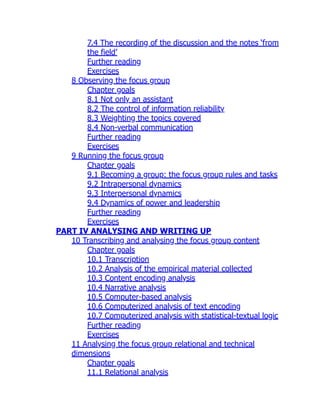
Contents
About the authors
PART I WHAT IS A FOCUS GROUP?
1 Outlining the focus group
Chapter goals
1.1 The main features of the technique
1.2 The group and interaction as sources of
information
1.3 The advantages and disadvantages of interaction
1.4 When to choose the focus group: comparison with
related techniques
1.5 Online focus groups
Further reading
Exercises
2 Dealing with ethical challenges
Chapter goals
2.1 General ethical principles
2.2 Choosing and recruiting participants
2.3 Interaction
2.4 Choosing sensitive or delicate topics
2.5 Incentives
2.6 Data transmission, data storing and data analysis
2.7 Ethics in online focus groups
Further reading
Exercises
PART II PLANNING AND DESIGNING
3 Designing a focus group research
Chapter goals
3.1 The characteristics of a focus group research
design
3.2 The four functions of focus groups
3.3 The exploratory-descriptive function
3.4 The analytical-in-depth function
3.5 The experimental function
3.6 The evaluative function
Further reading
Exercises
4 Mixing the focus group with other techniques
Chapter goals
4.1 Combination with other techniques
4.2 Triangulation
4.3 The ex-ante role in the orientation phase
4.4 The ex-post role in the analytical-interpretative
phase
4.5 Mixing qualitative methods
Further reading
Exercises
5 Choosing and recruiting the focus group participants
Chapter goals
5.1 A ‘collectivity’ built ad hoc
5.2 The participants’ characteristics
5.3 Group size and number of focus groups
5.4 Recruiting the participants
5.5 Fix the appointment: logistics and context
Further reading
Exercises
6 Designing focus group tools
Chapter goals
6.1 The discussion outline
6.2 Probing techniques
Further reading
Exercises
PART III CONDUCTING
7 Moderating the focus group
Chapter goals
7.1 The moderation styles of discussion
7.2 The function of the moderator
7.3 Conducting an online focus group
7.4 The recording of the discussion and the notes ‘from
the field’
Further reading
Exercises
8 Observing the focus group
Chapter goals
8.1 Not only an assistant
8.2 The control of information reliability
8.3 Weighting the topics covered
8.4 Non-verbal communication
Further reading
Exercises
9 Running the focus group
Chapter goals
9.1 Becoming a group: the focus group rules and tasks
9.2 Intrapersonal dynamics
9.3 Interpersonal dynamics
9.4 Dynamics of power and leadership
Further reading
Exercises
PART IV ANALYSING AND WRITING UP
10 Transcribing and analysing the focus group content
Chapter goals
10.1 Transcription
10.2 Analysis of the empirical material collected
10.3 Content encoding analysis
10.4 Narrative analysis
10.5 Computer-based analysis
10.6 Computerized analysis of text encoding
10.7 Computerized analysis with statistical-textual logic
Further reading
Exercises
11 Analysing the focus group relational and technical
dimensions
Chapter goals
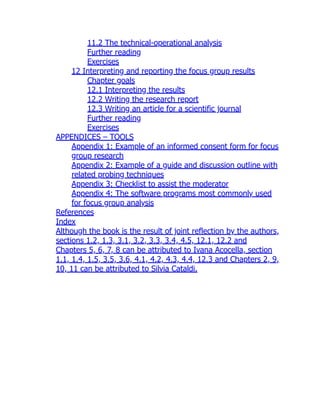
11.1 Relational analysis
11.2 The technical-operational analysis
Further reading
Exercises
12 Interpreting and reporting the focus group results
Chapter goals
12.1 Interpreting the results
12.2 Writing the research report
12.3 Writing an article for a scientific journal
Further reading
Exercises
APPENDICES – TOOLS
Appendix 1: Example of an informed consent form for focus
group research
Appendix 2: Example of a guide and discussion outline with
related probing techniques
Appendix 3: Checklist to assist the moderator
Appendix 4: The software programs most commonly used
for focus group analysis
References
Index
Although the book is the result of joint reflection by the authors,
sections 1.2, 1.3, 3.1, 3.2, 3.3, 3.4, 4.5, 12.1, 12.2 and
Chapters 5, 6, 7, 8 can be attributed to Ivana Acocella, section
1.1, 1.4, 1.5, 3.5, 3.6, 4.1, 4.2, 4.3, 4.4, 12.3 and Chapters 2, 9,
10, 11 can be attributed to Silvia Cataldi.
About the authors
Ivana Acocella
is a Lecturer of Sociology at the University of Florence (Italy).
Since 2002, she has taught Methodology and Research Methods
for the Social Sciences. She currently teaches Sociology of
Migration and Qualitative Research. Her research focuses on
epistemological and methodological assessment of qualitative
research approaches.
Silvia Cataldi
is a Lecturer of Sociology at the Sapienza University of Rome
(Italy). Since her PhD, she has taught Social Sciences Research
Methodology and Sociology. Her research focuses on
methodological aspects of social research, public sociology and
social action regimes. She is partner of many European projects
and she is a board member of RN20 Qualitative Methodology of
the European Sociological Association.
Part I What Is A Focus Group?
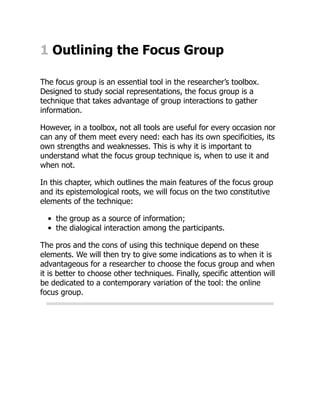
1 Outlining the Focus Group
The focus group is an essential tool in the researcher’s toolbox.
Designed to study social representations, the focus group is a
technique that takes advantage of group interactions to gather
information.
However, in a toolbox, not all tools are useful for every occasion nor
can any of them meet every need: each has its own specificities, its
own strengths and weaknesses. This is why it is important to
understand what the focus group technique is, when to use it and
when not.
In this chapter, which outlines the main features of the focus group
and its epistemological roots, we will focus on the two constitutive
elements of the technique:
the group as a source of information;
the dialogical interaction among the participants.
The pros and the cons of using this technique depend on these
elements. We will then try to give some indications as to when it is
advantageous for a researcher to choose the focus group and when
it is better to choose other techniques. Finally, specific attention will
be dedicated to a contemporary variation of the tool: the online
focus group.
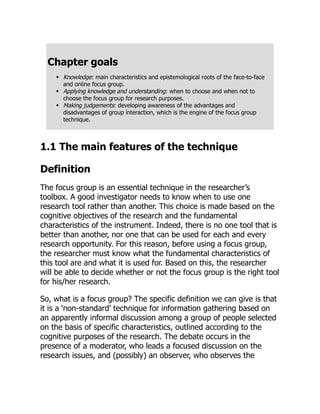
Chapter goals
Knowledge: main characteristics and epistemological roots of the face-to-face
and online focus group.
Applying knowledge and understanding: when to choose and when not to
choose the focus group for research purposes.
Making judgements: developing awareness of the advantages and
disadvantages of group interaction, which is the engine of the focus group
technique.
1.1 The main features of the technique
Definition
The focus group is an essential technique in the researcher’s
toolbox. A good investigator needs to know when to use one
research tool rather than another. This choice is made based on the
cognitive objectives of the research and the fundamental
characteristics of the instrument. Indeed, there is no one tool that is
better than another, nor one that can be used for each and every
research opportunity. For this reason, before using a focus group,
the researcher must know what the fundamental characteristics of
this tool are and what it is used for. Based on this, the researcher
will be able to decide whether or not the focus group is the right tool
for his/her research.
So, what is a focus group? The specific definition we can give is that
it is a ‘non-standard’ technique for information gathering based on
an apparently informal discussion among a group of people selected
on the basis of specific characteristics, outlined according to the
cognitive purposes of the research. The debate occurs in the
presence of a moderator, who leads a focused discussion on the
research issues, and (possibly) an observer, who observes the
interactions and integrates the verbal information arising from the
conversation.
Let us analyse this definition point by point.
Research technique
First of all, we define the focus group as a ‘technique’. The term
technique in the scientific field indicates a tool that the investigator
uses for research purposes. The term technique can be distinguished
from ‘method’ because a method is a set of procedures, rules and
principles that allow the researcher to know/explain reality. A
technique therefore derives from reflections on the method as it
represents its applicative result.
The second important thing is that it is a ‘research technique’. When
we use this expression, we intend to anchor it in the field of
scientific investigation. This means that, while not excluding more
applicative fields, in this text we will mainly deal with the focus
group as an application of ‘scientific research’, understood as a
systematic investigation undertaken to discover facts or relationships
and reach conclusions using scientific method.
This does not mean that the technique is only of use to intellectuals
or academics. It rather means that we place the focus group within
the ‘research cycle’. Scientific research has some characteristic
phases: identification and definition of the investigation problem,
formulation of research questions or hypotheses, collection and
analysis of information, and communication of results. The focus
group is therefore a useful tool for the ‘information gathering’ phase
of a research project. Learning to use a focus group consciously and
appropriately can therefore constitute a resource for scholars of all
ages: it can be useful both for junior researchers and for qualified
and senior researchers. Furthermore, the focus group is a useful tool
for many disciplines. It therefore has an interdisciplinary value.
Indeed, over the last decades the focus group has been gaining
more and more attention in a variety of disciplines: marketing,
political science, evaluation research, business and administration,
medicine, health, education and social research.
A ‘non-standard’ technique and qualitative
approach
Another specific feature of the focus group is that it is a research
technique that uses ‘non-standard’ gathering procedures. This
means that: from the moderator’s point of view, in the information
collection tools and discussion outline, the questions do not follow
either a predetermined order or an a priori precisely established
text; from the point of view of those taking part in the discussion, no
classification scheme is provided for possible alternative answers. In
other words, the technique develops within the qualitative approach
of social research.
Concepts and Theories
Within the debate between qualitative and quantitative research, Alberto Marradi
(1997) suggested using ‘standard’ and ‘non-standard’ to qualify the families of
approaches used in the social sciences: ‘standard’ is the classical one referring to
the families of the experimental method, characterized by variable manipulation,
and the data matrix method, relating to associations among variables; ‘non-
standard’ stands for specific research activities and related conceptual and
operational tools based on non-standardized information collection procedures.
We will look into the kind of distinct information that the researcher
can obtain when using the focus group later on (see section 1.2).
Here, suffice it to say that, developing in the context of a qualitative
approach, the focus group is a technique based on non-standardized
data collection procedures. Furthermore, it is based on a mainly
bottom-up research path. This means that the researcher collects
the empirical material and then examines it to establish which
interpretation is suggested by the set of most relevant information.
Connected to this, some scholars also emphasize the ‘emic’ aspect of
the focus group (among others, Stewart and Shamdasani, 1990: 13;
Cyr, 2019: 10) deriving from the close connection that links the data
produced to the social context of origin. Indeed, the use of non-
standardized information collection procedures allows the researcher
to enhance the ‘insiders’ point of view’, in order to understand and
explain a phenomenon starting from its conceptual, analytical and
linguistic categories. In this way, it is possible to highlight the gap
between the researcher’s and the insiders’ ‘frames of reference’ and
reach a ‘thick description’ (Geertz, 1975: 27) of the phenomenon,
starting from the perspectives and the categorization processes of
the people who are directly involved in that phenomenon, because it
is part of their daily life. Taking up the famous distinction of Klaus
Krippendorff (2004), these scholars highlight some aspects that
characterize the technique, including the proximity of the social
situation described by the group debate to the participants’ life-
world, as well as the low degree of structuring given to the
discussion outline and the moderate role played by the researcher in
directing the collective debate.
Moreover, in order to maximize the advantages of the technique, the
non-standard and qualitative connotation of this tool should pertain
to both the collection of information, as well as to the entire logic
that guides its use. However, it should be emphasized that the focus
group can be combined with other qualitative or quantitative tools in
the context of a mixed-method research design, as well as
quantitative tools based on standard logics which can be used during
the information analysis.
Incidentally, we prefer to talk about ‘information’ rather than ‘data’,
since the term data etymologically refers to something that is given,
that already exists in nature and simply needs to be collected by the
researcher. In contrast, scientific research data are always influenced
by the specific information collection procedure of each technique.
In the case of the focus group, the data are the texts produced by
the verbal and non-verbal interactions between the moderator and
the participants.
An informal discussion in appearance only
One other point is that the interaction among the group members
brings the focus group discussion closer to everyday communication:
people can express themselves in a similar way to any
communication with peers or other analogous exchange of opinions
relating to everyday life.
For this reason, some authors point out that the focus group has a
phenomenological basis (Calder, 1977; Beck et al., 1986; Frey and
Fontana, 1993; Vaughn et al., 1996; Palmer et al., 2010). In detail,
they stress the naturalness and informality of the information
collection context, which is characterized by little conditioning by the
researcher and takes place in an atmosphere of dialogical
interaction.
However, we must not be deceived by this closeness to the world of
everyday life. The debate in a focus group only apparently looks like
a natural discussion, since the interaction among the participants:
takes place in a place identified by the research group;
is based on pre-established cognitive purposes;
takes place among people chosen with specific criteria.
Indeed, the meeting is the first element of artificiality: the people
participating in a focus group are not observed in their natural
environment but are called to interact in a place and at a time
proposed by the research group. Second, their co-presence is not
spontaneous, they are carefully selected, recruited. Third, the
discussion itself will not be free, but will be conducted by a
researcher, and above all it will be focused on some specific theme
or aspects of it, established ex ante by the research group. This
focus aspect is so important that the term ‘focus’ becomes part of
the name of this technique, stressing that the discussion is
concentrated on a few specific topics.
In other words, the technique requires planning as part of a
research design and a series of procedures aimed at maximizing the
usefulness of the results in relation to the pre-established objectives.
For this reason, the focus group cannot be naively considered a
natural context of interaction.
The focus group actors
Finally, the focus group actors are fundamental. First of all, there is
the moderator. He/she is the person who supports and relaunches
the discussion, following an outline planned on the basis of cognitive
purposes and adapted to the people with whom he/she is interacting
in that moment. The moderator may or may not be the researcher
or a member of the research group. However, he/she should be
specialized in group dynamics management, and fully aware of the
choices made by the research group. In other words, it is
fundamental that the moderator has internalized the cognitive issues
of the research and has participated in project meetings from the
beginning.
Another important figure is the observer. Indeed, to maximize the
effectiveness of the focus group, we recommend that, alongside the
moderator, an observer also attends the discussion session. The
observer is the person who detects non-verbal behaviours and
information on the type of interaction that is established among the
participants in order to integrate and strengthen the analysis of the
verbal information. Since interactions are an integral part of the
information production process in a focus group, it is important to
have the presence of this second person, who not only acts as an
assistant to the moderator but also focuses on observing the
interactions among the participants. Indeed, this activity requires
continuous attention, which the moderator – engaged in other tasks
– cannot guarantee.
Finally, the key players in the focus group are the participants. They
are chosen based on criteria established by the researcher because
they are deemed useful for the research purposes. They are also
required to interact in the group, and are asked not only to respond
to the stimuli proposed by the moderator, but above all to
problematize and discuss the topic of investigation through
comparison and an exchange of ideas with the others present. This
is why a small group of people is considered most suitable to meet
the cognitive objectives set.
Summing up
In conclusion, we can state that the focus group is a research
technique having the following distinctive properties:
the presence of a moderator;
the (recommended) presence of an observer;
the presence of a small group of people deemed suitable to
provide information on the research topic;
the focus of the discussion on a specific topic or on particular
aspects of a theme decided on the basis of the interests of the
research group;
non-standardized information collection procedures;
a discussion that is not spontaneous.
These six distinctive properties ensure that the focus group can be
considered a useful research tool for studying collective
representations and opinions. However, we should bear in mind that
the engine of the technique is group interaction, as it is the source
of information. The next section is dedicated to this important
aspect.
1.2 The group and interaction as sources of
information
The information produced by the focus group has some specificities
deriving from two features of this technique:
the particular group formed for the focus group;
the dialogic interaction that is established among the
participants.
The process of cognitive identification with a
‘social group’
The discussion group constitutes the main source of information for
the focus group. The discussion is formed by emphasizing some of
the social categories with which the members identify. In such a
way, a common group of belonging or reference emerges, bringing
to light those shared elements distinguishing the participants.
Indeed, the choice of the same social category of
belonging/identification makes it possible to spread the perception
among the participants that they have not been invited as ‘individual
persons’, but as ‘representative members of a social group’ evaluated
by the researcher as the most suitable to discuss the research issue.
According to the composition of the group, therefore, each focus
group can solicit the collection of an individual’s opinions as a
representative member of a social category, for example as a ‘child’,
‘mother’, ‘student’, ‘worker’ and so on. This favours the presence of
experience common to the research topic, as well as the emergence
of points of view and ways of categorizing the phenomena that are
similar or at least comparable.
Concepts and Theories
Adapting the theory of Henri Tajfel (1974) to a focus group discussion, it is
cognitive identification with a common social category that spreads a sense of
belonging to the same social/reference group. Therefore, the sense of
identification is not based on real physical and interactive belonging to a group in
everyday life, but on ‘self-categorization’ and a form of ‘external recognition’ with
reference to a given social category (Tajfel, 1974; Turner, 1982).
The research group chooses which social category of
belonging/identification to bring out during the group discussion.
This choice is made on the basis of the research objectives, thus
evaluating which is the most suitable perspective to exploit in order
to problematize and discuss the research issue.
Indeed, in our opinion, during a focus group we are interested in
bringing out those cognitive processes influenced by feelings of
belonging to ‘social groups of reference/identification’ which – even
if they are sometimes taken for granted – contribute to the
formation of the individual’s social identity and condition his/her way
of categorizing reality and of acting (therefore, they provide models
of interpretation and action orientation). In other words, those
cognitive processes are at the basis of the reproduction, which may
be unconscious, of the symbolic forms of the socially shared
knowledge disseminated in particular social groups.
Concepts and Theories
Referring to the theory of social identity developed by Henri Tajfel and John C.
Turner in the 1970s, social attitudes can be considered the product of the
response to cognitive processes of social categorization. In other words, they are
the result of shared cognitive organizations based on the common perception of
social collocations. According to this theory, through the process of identification
with particular social categories, an individual adopts attitudes and behaviours
associated with them. Thus, these social categories become an integral part of
the definition of an individual’s social identity and influence his/her way of
thinking and acting.
Therefore, the focus group can be an effective technique to draw out
socially influenced cognitive systems if it values this cognitive
categorization/identification process for the formation of the
discussion group. These cognitive systems sometimes crystallize and
sometimes remain fluid, but in any event influence the social
representations of individuals on the reality that surrounds them.
Thus it is possible during the group discussion to thematize and
discuss the particular object of study, starting from the chosen social
category of identification/belonging, in order to render these
cognitive processes evident. By proceeding in this way, the
technique can favour the emergence of inter-subjective or – better
still – inter-group representations, which reproduce the images
spread and the beliefs shared among the social group that the
participants of the meeting have been called to represent
(Cunningham-Burley et al., 2001: 196; Marková et al., 2007: 19–24;
Cyr, 2019: 10–20).
This potential of the technique increases if ‘experts’ on the topic are
invited to the group discussion. They should not be ‘specialists’, but
people having familiarity with the phenomenon studied, since it is
part of their everyday lives (Stewart and Shamdasani, 1990: 53;
Carey and Asbury, 2012: 41). In this way, the focus group will allow
the researcher to explore inter-subjective representations and the
socially shared knowledge relating to aspects of people’s daily lives.
Comparison between groups formed from different cognitive
processes of categorization/identification can make use of the
technique even more interesting. Indeed, inter-subjective
representations and shared beliefs are not the same for all groups –
even though they may reach a certain degree of agreement in each
of these (Terry and Hogg, 1996; Cooper et al., 2001) – because they
derive from the experience that a group makes of a specific social
phenomenon. In this way, comparison between different groups will
allow the emergence of a plurality of representations and
perspectives on the phenomenon starting from the social category of
identification/belonging chosen each time.
Expert advice
As an example, we can consider the different representations that social workers,
third-sector operators or volunteers may develop on the topic of immigration.
They may come into contact with immigrants daily, but for different reasons and
with specific methods of intervention/relationships. This can influence the
production of different social representations on specific topics. For example,
they can even provide different meanings for the term ‘foreign’ or the expression
‘social integration’.
Ultimately, the choice of how to form the various focus group
sessions will allow the discussion group to be used for a dual
purpose:
the group as a ‘means’ to bring out a social category with which
the individual participants can identify and to engender a feeling
they have not been invited to participate in the discussion
meeting as single persons but as members of a specific social
group;
the group as a ‘unit of analysis’, because it is representative of
the social group that the researcher wants to investigate in a
discussion (i.e. starting from the particular social category
requested) in order to bring out the collective representations
connected to it.
Interaction as an integral part of information
The interaction between the various actors involved (among the
participants, between the moderator and the participants) plays a
fundamental role in the information production and detection process of
a focus group (Puchta and Potter, 2004: 9–20).
Only rarely has the methodological literature explored the peculiar role
that dialogue among the social actors plays in the collective formation
of the statements and negotiation of meanings during a focus group.
However, focus groups explicitly use group interaction as part of the
technique (Kitzinger, 1994a).
As detailed above, since focus groups involve people who share the
same social category of identification/belonging, it allows the researcher
to examine different forms of socially shared knowledge. Hence, a focus
group is not only a local activity at that particular time, but an
interactive situated activity whose aim is to bring out social
representations and discursive sense-making processes, thus involving
socio-cultural aspects of dialogue (Albrecht et al., 1993: 58–9;
Liamputtong, 2011: 16–18; Halkier, 2017: 394–8). However, the notion
of social representation itself cannot be conceived of as a set of
homogeneous, static and decontextualized ‘ideas’ that a person (or a
group of subjects) has on a given topic. Indeed, social representations
arise from social interaction between individuals and groups, circulate
through communication, and, therefore, are embedded in dialogical
activities (Cunningham-Burley et al., 2001: 198).
Concepts and Theories
Serge Moscovici (1961, 2000) defines social representations as a series of concepts,
statements and explanations which arise in everyday life, through interpersonal
communications. They are forms of socially elaborated and participated knowledge
that contribute to the construction of social reality. Therefore, they designate a form
of social thought. The term ‘social’ also refers to the interactive and dialogic nature of
the formation of social representations.
Therefore, if socially shared knowledge has a dialogical nature, it
implies that its contents have a dynamic structure and show
progression and change. At the same time, if socially shared knowledge
has a dialogical nature, it is – due to its same nature – characterized by
regularities and recurrences, as well as by tensions, contradictions,
vagueness and ambiguities; indeed, since social representations are
‘thoughts in movement’ elaborated through public debate, different
points of view may emerge during the transformation of abstract
information into concrete meanings. For this reason, human dialogue
can under no circumstances be reduced to sheer transmission of
information.
Based on these premises, since the focus group may be regarded as
socially situated interaction, this technique appears to be a particularly
suitable means of exploring the dynamics of the contents and forms of
social representations through the study of communicative processes
(Frisina, 2018: 190). In this way, interactions among the participants
may be considered both a means of generating data and a focus of
analysis (Kitzinger, 1995: 299).
By considering a focus group as a situated communication activity that
relies on historically and culturally shared social knowledge, this
technique can allow the researcher to identify the hegemonic
representations related to the social beliefs, knowledge and ideologies
circulating in societies. In this way, it provides information on the
relatively stabilized forms of socially shared knowledge. Usually, this
refers to knowledge about the social reality that the individual has
assimilated into the environment and that makes daily life relatively
orderly, habitual and systematic. In the ‘natural attitude’, this
knowledge is taken for granted, while providing a supply of
‘information-at-hand’ that serves to direct action in everyday life.
Concepts and Theories
According to Alfred Schütz (1962, 1975), a ‘natural attitude’ (natürliche Aufstellung)
prevails in any form of social relationship. Based on this attitude, it is taken for
granted that both the promoter and the interlocutor attribute the same meaning to
an action, and that, therefore, there is perfect interchangeability between the
subjective points of view. This happens because, in the social world, experiences of
consciousness of the ‘other’ are grasped through the mediation of already codified
models of meaning or ‘typification’ of experiences, compressing their uniqueness. The
typifications are sets of interpretative schemes that the individual has assimilated
from the environment, thus providing ‘the stock of knowledge-at-hand’ which serves
to orient in daily actions. In this way, the action develops because there exist pre-
established interpretations and expectations of the behaviour of the other. Starting
from this pre-established cultural code, the individual is able to move easily in
different social situations. Hence, typification is a socially influenced cognitive process
at the basis of ‘naive’ action (therefore of the ‘natural attitude’), which – even
implicitly – limits experiences, pre-constituting them as ‘typical’.
At the same time, through the study of communicative processes,
during focus groups the researcher may also learn the dialogic and
interactive process that underlies the formation of shared social
knowledge. Indeed, in a focus group, even if participants share a great
deal of social knowledge, the dialogue is always characterized by an
open and heterogeneous interplay of multiple meanings and voices in
continuous tension (Smithson, 2000: 109; Liamputtong, 2011: 16–18;
Hennink, 2014: 26–7; Halkier, 2017: 406–7). By paying attention not
only to ‘what’ a participant says, but also to ‘how’ he/she says it when
discussing with others, study of the interaction allows the researcher to
explore the dynamic structures of the group debate and which themes
under discussion show progression and change.
In this way, the focus group may also favour the emergence of diverse
voices, as well as of the multiple meanings that people attribute to
social representations since, as detailed above, social representations
are not crystallized knowledge but ‘thoughts in movement’. Therefore,
by foregrounding diversities and heterogeneities in the shared social
knowledge, the dialogical perspective allows us to investigate the
change in social representations, as well as the direct or subtle
challenges to the social order and to the different forms of conditioning
(Kitzinger, 2004). For this reason, during a focus group, in the same
way as it is possible to observe the manner in which the social
representations are taken for granted or reproduced, it is also possible
to investigate the acts of resistance (pushing towards change) in
relation to certain social norms (Frisina, 2018: 204).
There is no doubt that, through dialogical thinking and communication,
the focus group allows the researcher to examine language, thinking
and knowledge in action. In this way, it is possible to discover the
dynamic and heterogeneous characteristics of socially shared
knowledge and the way in which this knowledge is in continuity or
discontinuity with the past, as well as the different forms of interactive
communication. For this reason, we are convinced that this technique
offers significant opportunities to explore the power of dialogue
dynamics.
Summing up
In conclusion, if the researcher develops a process of cognitive
identification with a ‘social group’ among the participants and he/she
enhances a dialogic interaction during the debate, a focus group
enables the exploration of:
stabilized forms of socially shared knowledge;
tensions and different meanings inside the same shared
knowledge;
reinterpretations of the symbolic forms of social knowledge.
1.3 The advantages and disadvantages of
interaction
To promote dialogical interaction during the focus group, the moderator
should conduct the debate in such a way as to solicit a ‘group
discussion’ rather than a ‘group interview’ (Kitzinger, 1995: 299; Parker
and Tritter, 2006: 25–6; Barbour, 2007: 20; Flick, 2019: 318). Indeed,
the term ‘interview’ evokes not only the detection of individual opinions,
but also a procedure based on an interviewer asking a question and an
interviewee producing an answer (Corrao, 2000: 16). In contrast, in
focus groups, the moderator launches a discussion topic and he/she
should wait for an answer, which is generated by the dynamics
established among the participants. Only in this way will it be possible
to enhance the interactive nature of the discussion that is the focus
group’s hallmark.
However, the interaction is twofold: sometimes it can enhance the
information assets of the focus group; at other times it can reduce the
effectiveness of the technique. Below, we will analyse when interaction
is an added value and when some cognitive or communication problems
may arise due to the group dynamics (see Table 1.1).
Interaction as an added value
If the interaction among the participants proceeds in a serene
atmosphere and the discussion is conducted in a way that is not too
direct or structured by the moderator, an information amplification
effect can be produced. Indeed, the synergy of the group can favour
the expression of varied information and a plurality of positions,
activating the memory of forgotten details and aspects not previously
considered (Hennink, 2014: 30–1). With its memory solicitation and
idea-confrontation processes, the ‘reticular’ interaction plays a
fundamental role during this phase.
Moreover, group discussions often develop through the association of
ideas, since each participant can link to the others’ interventions to add
information, provide his/her point of view, ask for clarifications, report
any strengths or weaknesses and so on. This triggers a process of chain
responses in which one ‘intervention draws on the other’ soliciting the
formulation of many opinions, with a consequent enrichment of the
knowledge of the phenomenon under investigation. For these reasons,
when referring to the advantages of group interaction, several scholars
use terms such as ‘synergism’, ‘snowballing’, ‘stimulation’ (Stewart and
Shamdasani, 1990). For the same reasons, other authors consider the
focus group a technique particularly suited to obtaining new ideas,
additional knowledge and unexpected opinions, thus stimulating the
researchers’ interpretative imagination (Morgan, 1997: 27; Puchta and
Potter, 2004: 118–20; Marková et al., 2007: 87).
In a focus group discussion, interaction also allows participants to form
their own point of view by comparing themselves with others, enabling
them to better define their position and gain greater awareness of their
ideas (Hennink, 2014: 30–1). This happens because the group synergy
encourages the participants to publicly discuss the motivations that led
them to reflect in a certain way or to adopt a certain behaviour in
everyday life (Barbour, 2007: 150). Thus, comparison with others allows
a participant to discover the vital ‘background’ that underlies his/her
own actions and to focus attention on aspects that are often taken for
granted and on which, therefore, he/she had not reflected before. At
the same time, the focus group can help participants clarify, reinforce or
modify an opinion that had remained uncertain until then. For this
reason, when referring to the focus group, David E. Morrison defines it
as ‘a consciousness-raising exercise’ (1998: xiv). For the same reason,
other scholars suggest that the focus group is a particularly suitable
technique for studying the ordinary processes of idea and socially
shared knowledge formulation (Marková et al., 2007).
In addition to facilitating the collection of a large amount of
information, the interaction can clarify the content of the discussion.
Indeed, interaction with other participants allows the individual
members of the group to explicate their conceptual, linguistic and
argumentative schemes, according to a sharing and comparing
procedure that leads to the definition of subjective meanings and the
creation of new common areas of mutual understanding (Frey and
Fontana, 1993; Vaughn et al., 1996; Smithson, 2000: 111). In the same
way, the ‘reticular’ interaction allows the identification of similarities and
differences among the various opinions, as well as the strengths and
weaknesses of the various positions (Cardano, 2003: 155). In this way,
the comparison between the participants and the group synergy can
favour the development of arguments and inter-subjective
representations deriving from the continuous feedback, collective
reasoning and negotiation of all the persons involved in the debate
(Marková et al., 2007: 46–7; Carey and Asbury, 2012: 28).
Cognitive and communicative problems
However, it should be remembered that interaction is not always an
advantage. During the process of attributing meaning to a question or
to a response provided to/by a participant, a cognitive problem that
may occur concerns polysemy or ‘semantic dispersion’. Indeed, since
the link between concepts and terms is not rigid, the linguistic code is
not fully shared, making communication imperfect (Marradi, 2007: 30–
40). In focus group discussions, this problem can multiply according to
the number and variety of participants (Marková et al., 2007: 18–19,
25). These considerations support the hypothesis that during the focus
group it is appropriate to invite people who share a common or
analogous experience with regard to the research topic. This can favour
the emergence of similar ways of categorizing the phenomenon.
A second problem relates to the dynamics that are produced among the
members of a group when they are asked to share a series of pieces of
individually owned information to perform a common task. Indeed,
some psychologists have found that as the number of group
components increases, the quality of individual performance decreases
(Latané et al., 1979; Williams et al., 1981; Kerr and Park, 2001: 112–
16). This is attributed primarily to problems of coordination, which end
up slowing the free production of ideas (Kravitz and Martin, 1986;
Forsyth, 2014: 208–9). This mechanism can also occur in a focus group
discussion, since, even if it solicits the formulation of ideas, the reticular
interaction does not always give everyone the opportunity to express
themselves. While listening to others, memories and reasoning are
prompted very quickly. However, since it is not necessarily possible to
intervene at any given time, not everyone can always express what
they are thinking and, maybe, when a participant takes the floor,
he/she does not remember all the thoughts that the discussion had
solicited in him/her. In the same way, it can also happen that, in the
discussion, a person is continually interrupted by other participants who
want to make their own contributions to what was stated, making
him/her lose the thread of his/her reasoning.
In addition, the speed of interaction during the discussion can reduce
adequate information retrieval. Indeed, as already pointed out, in the
discussions of a focus group, interaction often proceeds through
association of ideas. Despite this favouring the emergence of a
multitude of ideas and opinions, however, continuous changes of topic
can occur. Furthermore, some relevant themes that may have emerged
can be abandoned quickly, while others can be expanded on even if
they are only marginal with respect to the research issues (Acocella,
2012: 1131–3). Therefore, there is no guarantee that the focus group
discussion always permits a complete and adequate analysis of the
research issues, especially if many topics are considered. These
considerations support the hypothesis that the focus group discussion
should focus on a few aspects considered relevant to the research, to
allow all participants to reflect and express their opinions on each topic
in an appropriate way in the short time available (an hour and a half on
average).
Finally, in group discussions, even if the dialogic interaction is the main
source for the collective construction of the statements and the
negotiation of meanings, some group dynamics can occur which risk
reducing the effectiveness of the technique. Indeed, interacting and
discussing in a collective debate is not easy and the way of relating with
others changes from person to person, depending on the characteristics
of the single participants and the interactive context. Indeed, dynamics
of conformism and attitudes of acquiescence can arise, as well as
subjugation or extreme conflict. The fear of being judged or of exposing
himself/herself too much can, therefore, lead an individual to conform
(at least publicly) to the most widespread opinions in the group, since
they are considered more standard and shared by society. At the same
time, stereotyped ideas can emerge, due to the pressure and
conditioning exercised by social conventions. Furthermore, dynamics of
power can arise relating to the presence of people who exercise
particular influence, due to their status or social position or just
because they are ‘perceived’ as more expert, competent and capable of
dealing with the research topic (Liamputtong, 2011: 80–2; Carey and
Asbury, 2012: 28; Hennink, 2014: 30–3). At other times in group
discussions, individual participants may interact less, out of shyness,
while others tend to intervene too much because they are less inhibited
by public speaking or because they know more about the discussed
topic (Cyr, 2019: 79–80).
For this reason, the choice to invite people who share common or at
least comparable experiences can partly defuse these dynamics or
reduce their negative effects. Indeed, this reduces the degree of
uncertainty that can derive from living a new ‘experience’ like that of
participating in a focus group. Furthermore, it may favour the formation
of a comfortable environment and the perception of being among
‘equals’, as well as increasing the possibility of discussing the research
topic from similar perspectives.
These dynamics are part of everyday life. Therefore, they cannot be
considered ‘right’ or ‘wrong’ a priori. This is because adoption of the
technique is useful not only to gather opinions on the research topic,
but also to explore the dynamic and interactive processes that underlie
the formation of inter-subjective and social representations and
different forms of socially shared knowledge. Sometimes, these
dynamics are the product of ineffective focus group planning or
unproductive discussion management. Other times, in contrast, they
arise spontaneously during the debate, because, even if the research
group has adequately planned the focus group session, it is not possible
to predict in advance what the participants will be like and how they will
react in the common discussion. Over the course of the book, we will
return to these dynamics and how to moderate them when they
compromise the success of the focus group. Here, suffice it to
anticipate that both the moderator and the observer play a fundamental
role in recognizing these dynamics and evaluating when, during the
group discussion, they can be considered inappropriate because they
compromise the free circulation of ideas and the establishment of a
comfortable environment for all participants. In this case, it will be up
to the moderator to intervene to mitigate them and reduce the
cognitive and communicative risks connected to them.
Table 1.1
1.4 When to choose the focus group: comparison
with related techniques
The focus group and other group techniques
As a fashionable research technique, the focus group ‘is often adopted
without any prior consideration of whether it really is the most suitable
technique for achieving the cognitive goals of the research’ (Acocella,
2012: 1126). In reality, the researcher may have other similar tools in
his/her toolbox. He/she should therefore be familiar with the
characteristics of each of them, in order to understand which is more
functional for the purposes of that particular research project.
First of all, there are other techniques that use a group as a source of
information. The most important are:
the nominal group technique (NGT);
the Delphi method;
brainstorming.
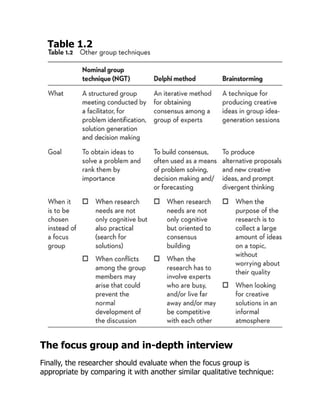
The specificities of a focus group and the kind of information it is able
to collect allow the researcher to distinguish this technique from others
using a group as a source of information.
The focus group and NGT
The main difference between the focus group and NGT relates to the
form interaction between participants takes (see Table 1.2). While
interaction is very much encouraged in the focus group and can be
considered the real engine of the technique, in NGT free interaction is
avoided and, in any event, very much structured (Stewart and
Shamdasani, 1990: 22; Dean, 2004: 389). Indeed, in NGT, even when
the participants are in the same place, in the first phase they are asked
not to interact and instead to answer open questions or a questionnaire
privately; in the second phase, they are asked to discuss the ideas
collected. However, in this second phase, the facilitator tries to maintain
the anonymity of the idea collected individually in the first phase and
participants cannot freely intervene in response to the solicitations of
others, because only rounds of circular intervention are planned
(therefore not reticular interactions like the focus group). A feature of
the technique is the ‘nominality’ of the group, so much so that there are
also versions of NGT in which the participants are not co-present, and
the interaction is completely mediated by the facilitator.
Given these specificities of the technique, the choice of NGT over focus
group is to be preferred in some specific cases: first, when the research
is closer to the world of work, business or political decisions, rather
than purely cognitive purposes, and the researcher wants to get
problem-solving ideas and rank them by importance, emphasizing the
participants’ individual contributions more than the interaction among
them (Barbour, 2007: 171); and second, the NGT technique is to be
preferred when conflicts might arise among group members that
prevent the normal development of the discussion, since it allows
greater control over interaction (Corrao, 2000: 20; Acocella, 2008: 13).
The focus group and the Delphi method
The kind of interaction established among participants also
distinguishes the focus group from another group technique: the Delphi
method (see Table 1.2). Like NGT, in this case the group is again
‘nominal’, since its members are generally located in different spaces
(Stewart and Shamdasani, 1990: 23). Indeed, normally, the technique
does not require the co-presence of the participants but is carried out
remotely (usually via email). It proceeds in different rounds in which,
first, the moderator obtains a series of answers to one or more
questions from each person separately, and second, he/she summarizes
the individual contributions and sends them back to all the group
members, asking for subsequent answers/reflections in the light of the
expressed positions (Barbour, 2007: 46–7). Each round provides an
opportunity for the participants to respond and to ask for an answer to
their questions. Over multiple rounds, the process can lead to
consensus or near-consensus (Linstone and Turoff, 2002: 4–7; Shariff,
2015: 246). A feature of the technique is the maintenance of
anonymity, so a participant does not know who the other members of
the group are and only interacts with the facilitator.
As in the case of NGT, this technique serves research needs closer to
the world of work, business or political decisions, rather than purely
cognitive issues. Indeed, the Delphi method is used to build consensus
around some solutions, so that they become shared. Indeed, over
multiple rounds, the process should gradually lead to a convergence of
opinions and, in the last step, the collected answers are converted into
closed questions in order to narrow down the topic and reach a
majority agreement.
Furthermore, the choice of the Delphi method is to be preferred to the
focus group when dealing with real experts, such as scientists or
technicians (Acocella, 2008: 13). Such experts may either be too busy
to participate in a face-to-face session that requires a meeting in a
specific place and time, or they may live far apart from each other, and,
above all, they may be in competition with one another. For this reason,
interaction mediated by a facilitator and at a distance can be the best
solution.
The focus group and brainstorming
The focus group also differs from a third technique that uses the group
as a source of information: brainstorming (Sullivan, 2009: 53). Like the
focus group, brainstorming was designed to promote creativity and
serendipity. However, unlike the focus group, this technique involves a
group of individuals who are asked to produce, sometimes even without
the presence of a moderator, new ideas on a topic, without worrying
about their quality. In this case, therefore, the interaction, although
reticular, is aimed more at the rapid association of ideas rather than
exploring opinions. Indeed, this technique is based on the principle that
the greater the quantity of ideas produced, the higher the probability
that some are good (Stewart and Shamdasani, 1990: 24–7; Corrao,
2000: 23).
These differences are due to the fact that, while use of the focus group
is aimed at gaining knowledge of a given phenomenon, brainstorming is
usually limited to the elaboration of new ideas or the suggestion of
possible solutions to a given problem (Bezzi and Baldini, 2006; Acocella,
2008: 13). This is why brainstorming should be preferred when looking
for creative solutions in an informal atmosphere (see Table 1.2).
Table 1.2
The focus group and in-depth interview
Finally, the researcher should evaluate when the focus group is
appropriate by comparing it with another similar qualitative technique:
the individual interview with a low degree of structuring, or in-depth
interview.
Both techniques have something in common: they belong to the family
of interrogation techniques (which can be individual or group); they
develop in coherence with an emic and qualitative approach to research
(epistemological roots); they use non-standardized information
collection procedures; they have a high degree of freedom as to the
respondents’ answers (open answers, wide and aimed at
problematization).
Precisely due to these similarities, the information collected in a focus
group is often considered identical to the data collected in an individual
interview (Johnston et al., 1995: 57; Smithson, 2000: 105). In reality,
the techniques are different. Therefore, there is no absolute superiority
of one over the other, or one which gives better information than the
other (Kaplowitz and Hoehn, 2001). There are divergences both in the
objective of the two techniques and in the type of interaction context
that is created through the two instruments.
Regarding the objectives, the first thing is that, while interviews excel
at eliciting ‘private’ accounts, focus groups give researchers access to
the interactive and dialogic narratives that participants produce in group
situations (Frisina, 2018: 190). So, the in-depth interview should be
preferred when a researcher aims to detect individual attitudes and
motivations, personal experiences or life stories (Hennink, 2014: 28–9).
Moreover, the individual interview is functional to the study of
extraordinary and unique circumstances, especially those involving
sensitive or personal topics (Robson and Foster, 1989; Stokes and
Bergin, 2006). In all these cases, the focus group should not be chosen.
Regarding interaction, in a very elementary way it can be stated that,
while in the focus group the interaction is in a group, in the individual
interview the interaction takes place between two actors alone: the
interviewer and the interviewee. Even if the literature tends to
underestimate the relational dimension of the individual interview,
today many scholars agree on the centrality of the relational dimension
and, therefore, they are aware that information resulting from the
interrogation techniques can neither be reified nor objectified (Gobo
and Mauceri, 2014; Cataldi, 2018). Indeed, the human relations
established during the interrogation process contribute to the
production of information. Precisely for this reason, we cannot say that
interaction does not count. Rather, we can state that the dynamics of
interaction represent the condition and the product for both the in-
depth interview and a focus group. In both techniques, the relational
dimension is unavoidable and constitutive of the information
development processes (Cataldi, 2018: 309).
However, there are some differences. First of all, dialogic interaction
among participants is the hallmark of focus groups, in order to examine
the development, maintenance and changes in socially shared
knowledge (Marková et al., 2007: 46–7; Carey and Asbury, 2012: 28).
Indeed, as detailed above, the collective interaction among people who
share the same social category of identification/belonging is both a
form of information generation as well as a focus of analysis (Kitzinger,
1995: 299). This is why ‘the added value of focus groups is that they
are able to observe the interactional context in which they are
produced’ (Frisina, 2018: 190).
In contrast, in an in-depth interview, the interaction between the
interviewer and the interviewee is the main source of information. This
interaction is based on a ‘pact of trust’ (Bichi, 2002), in which the
interviewer places himself/herself in a position of ‘active listening’ and
an ‘empathic role’ aimed to problematize biographical attitudes and
experiences, while the interviewee provides his/her definitions of
situations, tells his/her own daily practices and explains the reasons for
his/her choices and actions. Ultimately, the purpose of the interaction is
to explore personal opinions, biographical events and the subjection-
subjectivities processes that occur during a person’s life, in order to
bring out an individual perspective on a particular phenomenon or
biographical identity profile (Acocella, 2013; Hennink, 2014: 28–9;
Caillaud and Flick, 2017: 164–8).
For a summary of the main differences between the focus group and in-
depth interview, see Tables 1.3 and 1.4.
Another Random Scribd Document
with Unrelated Content
of death fizzing there within a few yards of them. But there was one
man on deck who saw what to do.
Acting-mate Lucas, on duty near one of the guns, promptly ran
forward and with iron nerve picked up the shell, dropping it instantly
over the ship’s side. The burning fuse sputtered out in the water, and
the shell sank harmlessly to the bottom.
Captain Hall, his commander, brought the plucky deed under the
notice of Admiral Napier, who, in writing to the Admiralty about the
young sailor’s bravery, trusted that “their Lordships would mark their
sense of it by promoting him.” This recommendation was acted
upon, Lucas being at once raised to the rank of lieutenant. When
later on the Victoria Cross was instituted the young officer’s name
figured duly in the Gazette.
Two other sailors who gained the V.C. for similar actions were
Captain William Peel, the dashing leader of the Naval Brigade, and
Chief Gunner Israel Harding of H.M.S. Alexandra, also a Crimean
veteran.
Whole pages might be written about Captain Peel’s exploits. All
the time the naval men were engaged with the troops round
Sebastopol he was ever to the fore, leading forlorn hopes and
fighting shoulder to shoulder with his soldier comrades whenever
opportunity offered. At Inkerman, at the fierce attack on the
Sandbag Battery, he was in the thick of it, and again at the Redan
assault.
Peel loved danger for danger’s sake. There was no risk that
daunted him. At the attack on the impregnable Shah Nujeef, at
Lucknow, in the Indian Mutiny, two years later, he led his gun
detachment right up to the loopholed walls, which were crowded
with rebel sharpshooters. He behaved, said Sir Colin Campbell, “very
much as if he had been laying the Shannon alongside an enemy’s
frigate.”
It was Peel who first demonstrated the practicability of fighting
with big guns in the skirmishing line. “It is a truth, and not a jest,”
he once wrote home, “that in battle we are with the skirmishers.”
The way in which the sailors handled their great ship’s cannon, 8-
inch guns, 24-pounders, and the like, was marvellous. A military
officer, in a letter that was written at the front, gives an interesting
reminiscence of the Naval Brigade. “Sometimes in these early days
of October 1854,” he says, “whilst our soldiery were lying upon the
ground, weary, languid, and silent, there used to be heard a strange
uproar of men coming nearer and nearer. Soon the comers would
prove to be Peel of the Diamond with a number of his sailors, all
busy in dragging up to the front one of the ship’s heavy guns.”
In a future chapter we shall meet again this intrepid son of Sir
Robert Peel, the great statesman, winning glory and renown under
Campbell and Havelock. For the present I must confine myself to his
career in the Crimea.
The most notable of the three acts, the dates of which are
inscribed on his Cross, was performed in October 1854, at the
Diamond Battery which some of the Naval Brigade were holding. The
battery needing fresh ammunition, this had to be brought in by
volunteers, for the horses of the waggons refused to approach the
earthworks owing to the heavy Russian fire.
Case by case it was carried in and stacked in its place, and right
into the midst of it all, like a bolt from the blue, dropped a shell. Peel
jumped for it like a flash. One heave of his shoulders and away went
the “whistle-neck” to burst in impotent fury several yards off—
outside the battery’s parapet.
The second date on his Cross notes the affair at the Sandbag
Battery, where he joined the Grenadier officers and helped to save
the colours from capture. On the third occasion when his bravery
was commended for recognition he headed a ladder-party in that
assault on the Redan in which Graham and Perie won such
distinction.
In this attack the gallant captain was badly wounded in the head
and arm, a misfortune which was the means of gaining the V.C. for
another brave young sailor. From the beginning of the war
Midshipman Edward St. John Daniels had attached himself to
Captain Peel, acting as the latter’s aide-de-camp at Inkerman.
During the battle he was a conspicuous figure, as, mounted on a
pony, he accompanied his leader about the field.
In the Redan assault he was still by Peel’s side, and caught him as
he fell on the glacis. Then, heedless of the danger to which he was
exposed, he coolly set to work to bandage the wounded man, tying
a tourniquet on his arm, which is said to have saved Peel’s life. This
done, he got his chief to a place of safety.
Daniels did another plucky action some months earlier, when he
volunteered to bring in ammunition from a waggon that had broken
down outside his battery. The fact that the waggon became
immediately the target for a murderous fire from the Russian guns
weighed little with him. He brought in the cartridges and powder
without receiving a scratch, and the battery cheered to a man as the
plucky little chap scrambled over the parapet with his last armful.
Along with Peel and Daniels must be named that popular idol
William Nathan Wrighte Hewett, known to his messmates as “Bully
Hewett.” He was nearly as picturesque a character as his
commander.
At Sebastopol, the day following Balaclava fight, Hewett (he was
acting-mate at the time), fought a great long-range Lancaster gun
that had been hauled up from his ship, H.M.S. Beagle. The gun drew
a determined attack on its flank from a very large force of Russians,
and orders were sent to Hewett by a military officer to spike the gun
and abandon his battery. The odds were too overwhelming.
In emphatic language the young sailor declared that he’d take no
orders from anyone but his own captain, and was going to stick to
his gun.
The other “Beagles” were quite of his opinion. In quick time they
knocked down a portion of the parapet that prevented the huge
Lancaster bearing on the flank and slewed the piece round. Then,
loading and firing with sailorly smartness, they poured such a hot
fire into the advancing horde of Russians that the latter beat a
retreat.
They used the big gun with great advantage at Inkerman, but the
young mate’s splendid defence of his battery was enough by itself to
win him a well-deserved V.C. Hewett died eighteen years ago, a
Vice-Admiral and a K.C.B.
A page or two back I mentioned Israel Harding, chief gunner, as a
third naval hero of the live shell. It was many years after the
Crimean War that his opportunity came, but his exploit may well be
noted down here.
Harding was a gunner on board H.M.S. Alexandra, when, in July
1882, Sir Beauchamp Seymour (afterwards Lord Alcester) with his
fleet bombarded Alexandria. On the first day of the action (the
11th), a big 10-inch shell from an Egyptian battery struck the
ironclad and lodged on the main deck. The alarm was raised, and at
the cry “Live shell above the hatchway!” Harding rushed up the
companion. There was luckily a tub of water handy, and having
wetted the fizzing fuse he dumped the shell into the tub just in the
nick of time.
As in Lucas’s case, promotion quickly followed with the gunner,
while the V.C. was soon after conferred upon him. The shell, it may
be of interest to note, is now among the treasures of her Majesty
the Queen.
So many naval heroes call for attention that I must hurry on to
speak of Lucas’s comrades in the Baltic who also won the coveted
decoration.
There was Captain of the Mast George Ingouville, serving in the
Arrogant. On the 13th of July 1855, the second cutter of his vessel
got into difficulties while the fleet was bombarding the town of
Viborg. A shell having exploded her magazine, she became half
swamped and began to drift quickly to shore. Observing this,
Ingouville dived off into the sea and swam after the runaway. He
was handicapped with a wounded arm, but being a strong swimmer
he reached the cutter just as it neared a battery. With the painter
over his shoulder he struck out again for the Arrogant, and towed
his prize safely under her lee.
At about the same time a gallant lieutenant of Marines—now
Lieut.-Col. George Dare Dowell, R.M.A.—did much the same thing.
When a rocket-boat of the Arrogant was disabled he lowered the
quarter-boat of his ship the Ruby, and with three volunteers rowed
to the other’s aid. Dowell not only succeeded in saving some of the
Arrogant men, but on a second journey recaptured the boat.
It was a lieutenant of the Arrogant, however, who eclipsed both
these deeds, brave as they were. The exploit of John Bythesea and
his ship’s stoker, William Johnstone, on the Island of Wardo, reads
more like fiction than sober fact. This is the story of it.
Early in August of 1854 Lieutenant Bythesea learned from a
reliable source that some highly important despatches from the Tsar,
intended for the General in charge of the island, were expected to
arrive with a mail then due. At once he conceived the daring idea of
intercepting the despatch-carrier and securing his valuable
documents. His superior officers thought the project a mad one
when he first broached it, but Bythesea would not be gainsaid. The
thing was worth trying, and he and Johnstone (who had volunteered
his services) were the men to carry it through with success. In the
end he had his way, though when the two plucky fellows quitted the
ship on their hazardous errand their shipmates bade them good-bye
with little expectation of ever seeing them again.
The lieutenant and the stoker had disguised themselves very
effectively in Russian clothes, and managed to get to land safely.
Here they learned from their informant, a Swedish farmer, that the
mail had not yet arrived, but was expected at any hour. When
darkness fell, therefore, the two Englishmen found a good hiding-
place down by the shore, and commenced their vigil.
This was the evening of the 9th of August. It was not until the
12th that the long-awaited mail came to land. For three whole days
and nights they had not ventured from their concealment, save once
or twice when the vigilance of Russian patrols had forced them to
take to a small boat and anchor about half a mile off the coast.
On the morning of the 12th, Johnstone, who spoke Swedish
fluently, learned from the friendly farmer that the mail had arrived,
and was to be sent to the fort that night. Great caution was to be
observed, the farmer added, as it was known to the Russians that
someone from the British fleet had landed. At dark, therefore, the
two took up their position at a convenient spot and awaited the
coming of the mail-bags. In due course they heard the grating of a
boat’s keel on the beach. A few Russian words of command were
given, and then sounded the tramp of feet on the road that led up to
the military station.
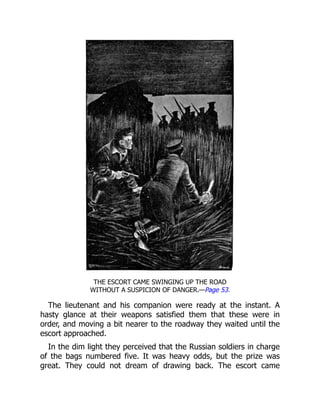
THE ESCORT CAME SWINGING UP THE ROAD
WITHOUT A SUSPICION OF DANGER.—Page 53.
The lieutenant and his companion were ready at the instant. A
hasty glance at their weapons satisfied them that these were in
order, and moving a bit nearer to the roadway they waited until the
escort approached.
In the dim light they perceived that the Russian soldiers in charge
of the bags numbered five. It was heavy odds, but the prize was
great. They could not dream of drawing back. The escort came
swinging up the road without a suspicion of danger, and just as they
passed the spot where a clump of bushes provided secure shelter
out leapt the two Englishmen with cutlass and revolver.
The cold steel did the work effectively; a pistol shot would have
raised the alarm. Three of the soldiers were cut down in the surprise
attack, while the remaining two yielded themselves prisoners to
these redoubtable assailants. As quickly as possible prisoners and
mail-bags were hurried to the water’s edge, where a boat lay in
readiness for them.
In half an hour’s time the despatches were being examined in the
captain’s cabin on board the Arrogant, their contents proving to be
of the utmost importance. Bythesea had captured the details of
certain extensive operations planned against the Baltic fleet of the
Allies and the army in the South. Such a service was worthy of the
highest honour, and both the lieutenant and Stoker Johnstone
received the Cross for Valour for that desperate night’s work.
Down in the South, in the Sea of Azov, which the map shows us to
lie just north of the Black Sea, our Bluejackets were doing splendid
service in the latter months of 1855. The towns of Genitchesk and
Taganrog were shelled with great loss to the Russians, but as they
moved their stores farther inland the occasion arose for individual
expeditions which aimed at destroying these. The story of the fleet’s
operations in this quarter, therefore, resolves itself into a relation of
the several attempts, successful and otherwise, to harass the enemy
in this way.
That the task of setting fire to the store buildings was attended
with tremendous risk was proved over and over again. One or two
daring spirits, including a French captain, were caught and shot by
Cossack patrols. But there are always men to be found ready—nay,
anxious—to undertake enterprises of so desperate a nature.
Wellington had the renowned scout, Major Colquhoun Grant
(whose adventures in the Peninsula teem with romance), doing
wonderful “intelligence” work for him; and to come to more recent
times, we may call to mind Lord Kitchener’s daring journey through
the Soudan in 1884, disguised as an Arab, for the purpose of
learning what were the intentions of the various tribes with regard to
Egypt.
In the Crimea such men as Lieutenants Day, Buckley, Burgoyne,
and Commerell acted as the eyes and ears of their commanders, and
volunteered for those little jobs that so infuriated the Russians when
the red glow in the midnight sky showed them where stacks of
forage and other stores blazed merrily.
Day’s V.C. was awarded him for a most valuable piece of work. His
ship was stationed off Genitchesk (frequently spelt Genitchi), in the
north-eastern corner of the Crimea, and it was deemed necessary to
reconnoitre the enemy’s lines to ascertain the full strength of the
Russians. For this dangerous service the young lieutenant
volunteered.
Accordingly, one night he was landed alone on the Tongue, or
Spit, of Arabat, at the spot he had chosen whence to start.
Cossacks, singly or in small companies, policed the marshy wastes,
but Day wriggled his way between their posts and eventually got
close to the Russian gunboats. The dead silence that prevailed
misled him as to the numbers thereon, and convinced that the
vessels were deserted he returned to report the facts to his captain.
The next day circumstances induced him to suppose that he had
been mistaken. He decided to make a second journey without loss of
time, and one night very soon afterwards saw him again on the Spit.
Day soon discovered that large reinforcements had arrived on the
mainland, and at once made haste to return to his ship.
The long detours he was now obliged to make, to avoid contact
with the Cossack sentries, led him through quagmires and over
sandy stretches that severely tried his endurance. When he reached
the shore at last, well-nigh exhausted, nearly ten hours had elapsed
since his start, and it is not surprising that, having heard shots fired,
his comrades had given him up for lost. He got back after a most
providential escape, however, and made his report. But for his
discoveries an attempt would certainly have been made to seize the
Russian boats, in which case the result must have been disastrous.
Lieutenants Buckley and Burgoyne distinguished themselves by
landing near Genitchesk at night and firing some immense supplies
of stones. With the seaman, Robarts, who accompanied them, they
were nearly cut off by Cossacks on their return, and only a fierce
fight enabled them to escape. All three won the V.C. for this daring
piece of work.
Lieutenant Commerell (afterwards Admiral Sir J. E. Commerell,
G.C.B.) performed a like action later on the same year, which gained
the V.C. for him and one of his two companions, Quartermaster
Rickard.
Their objective was the Crimean shore of the Putrid Sea, on the
western side of the Spit of Arabat. They accomplished their task
successfully, setting fire to 400 tons of Russian corn and forage, but
were chased by Cossacks for a long distance. In the helter-skelter
rush back for the boat, about three miles away, the third man of the
party, Able-Seaman George Milestone, fell exhausted in a swamp,
and but for Commerell’s and Rickard’s herculean exertions must have
fallen a victim to the enemy.
Making what is popularly known as a “bandy-chair”, by clasping
each other’s wrists, the two officers managed to carry their
companion a considerable distance. A party of Cossacks at this
juncture had nearly succeeded in cutting them off, but the sailors in
the boat now opened fire, while Commerell, dropping his burden for
a moment, brought down the leading horseman by a bullet from his
revolver. This fortunately checked the Cossacks, who were only some
sixty yards away, and by dint of half carrying, half dragging
Milestone, the plucky lieutenant and quartermaster eventually got
him to the boat, and were soon out of reach of their pursuers.
The foregoing deeds of derring-do worthily uphold the finest
traditions of the Royal Navy. How more largely still was the “First
Line” to write its name in the annals of the Victoria Cross will be
seen in the succeeding pages.
CHAPTER VII.
PERSIA.—HOW THE SQUARE WAS BROKEN.
Among our little wars of the last century that with Persia must not
be passed over here, inasmuch as it was the means of three
distinguished British officers winning the V.C. These were Captain
John Wood, of the Bombay Native Infantry, and Lieutenants A. T.
Moore and J. G. Malcolmson, of the Bombay Light Cavalry.
The war originated in the persistent ill-treatment of British
residents at Teheran, and in the insults offered to our Minister at the
Persian Court, Mr. Murray. No apologies being forthcoming,
diplomatic relations were broken off early in 1856. In November of
the same year, after fruitless attempts had been made to patch up
the quarrel, Persia revealed the reason for her hostility by violating
her treaty and capturing Herat, and war was declared.
Herat from time immemorial had been subject to Afghanistan, and
as, from its position on the high road from India to Persia, it formed
the key of Afghanistan, it was long coveted by the Shah. He laid
violent hands upon it in 1838, but the British Government made him
withdraw. This second insolent defiance of our warnings could not
be borne with equanimity; a force comprising two British and three
native regiments was despatched from India to read the Persian
monarch a lesson. Sir James Outram commanded the expedition.
The capture of Bushire was the first success scored by the British
troops, and it was in the attack on this coast town in the Persian
Gulf that Captain Wood gained his Cross.
At the head of a grenadier company Wood made a rush for the
fort. Persian soldiers were in force behind the parapet, and a hot
rifle-fire was poured into the advancing infantry, but under the
inspiration of their leader they held bravely on. The captain was the
first to mount the wall, where his tall figure instantly became a
target for the enemy. A score of rifles were levelled at him, and
some six or seven bullets found their mark in his body.
Badly wounded as he was, Wood jumped down into the midst of
the enemy, killing their leader and striking terror into the hearts of
the rest. This desperate charge, completed by his men, who had
quickly swarmed up the parapet after him, carried the day. The fort
was surrendered with little more opposition.
The feat of arms, however, which led to Lieutenants Moore and
Malcolmson being decorated, was of even greater brilliancy. To
Moore belongs the almost unique distinction of having broken a
square.
It was at Khoosh-ab that his act of heroism took place. Near this
village, some way inland behind Bushire, the Persians were massed
about eight thousand strong. Outram’s little army had made a
successful advance into the interior and routed the Persian troops
with considerable loss on their side, and was now making its way
back to the coast. Surprise attacks at night had been frequent, but
this was the first attempt to make a determined stand against our
troops.
It was by a singular irony of fate that in this war we should have
had to fight against soldiers trained in the art of war by British
officers. But so it was. After Sir John Malcolm’s mission to Persia in
1810, the Shah set to work to remodel his army among other
institutions, and British officers were borrowed for the purpose of
bringing it to a state of efficiency. The soldiers who gave battle to
our troops at Khoosh-ab, therefore, on February 8th, 1857, were not
raw levies. But, for all that, when it came to a pitched battle the
Persians showed great pusillanimity. At the charges of the Bengal
Cavalry their horsemen scattered like chaff before the wind.
Most of the infantry, too, fled when Forbes’ turbaned sowars of
the 3rd Bengals and Poonah Horse rode down upon them, as panic-
stricken as the cavalry. But there was one regiment that, to its
honour, stood firm. In proper square formation they awaited the
onset of the charge, the front rank kneeling with fixed bayonets, and
those behind firing in volleys.
With his colonel by his side, Lieutenant Moore led his troop of the
Bengals when the order was given to charge, but Forbes having
been hit the young officer found himself alone. He had doubtless
read of Arnold Winkelried’s brave deed at Sempach, when “in arms
the Austrian phalanx stood,” but whether this was in his mind or not
he resolved on a bold course. He would “break the square.”
As he neared the front rank of gleaming steel, above which,
through the curls of smoke, appeared the dark bearded faces of the
Persians, Moore pulled his charger’s head straight, drove in his
spurs, and leapt sheer on to the raised bayonets. The splendid
animal fell dead within the square, pinning its rider beneath its body;
but the lieutenant was up and on his feet in an instant, while
through the gap he had made the sowars charged after him.
In his fall Moore had the misfortune to break his sword, and he
was now called on to defend himself with but a few inches of steel
and a revolver. Seeing his predicament, the Persians closed round
him, eager to avenge their defeat on the man who had broken their
square. Against these odds he must inevitably have gone under had
not help been suddenly forthcoming.
Luckily for him, his brother-officer, Lieutenant Malcolmson, saw his
danger. Spurring his horse, he dashed through the throng of
Persians to his comrade’s aid, laying a man low with each sweep of
his long sword. Then, bidding Moore grip a stirrup, he clove a way
free for both of them out of the press. What is certainly a
remarkable fact is that neither of the two received so much as a
scratch.
Malcolmson’s plucky rescue was noted for recognition when the
proper time came, and in due course he and Moore received their
V.C.’s together. The former died a few years ago, but Moore is still
with us, a Major-General and a C.B.
CHAPTER VIII.
INDIA.—THE GALLANT NINE AT DELHI.
The early part of the year 1857 saw the outburst of the Indian
Mutiny which was to startle the world by its unparalleled horrors and
shake to its foundations our rule in India. Never before was a mere
handful of white men called upon to face such a fearful ordeal as fell
to the lot of the 38,000 soldiers who were sprinkled all over the
North-West Provinces, and the record of that splendid struggle for
mastery is one that thrills every Englishman’s heart with pride.
There are pages in it that one would willingly blot out, for from
the outset some terrible blunders were committed. Inaction,
smothered in “the regulations, Section XVII.,” allowed mutiny to rear
its head unchecked and gain strength, until the time had almost
passed when it could be stamped out. But if there were cowards and
worse among the old-school British officers of that day, there were
not wanting those who knew how to cope with the peril. We are glad
to forget Hewitt and those who erred with him in the memory of
Lawrence, Nicholson, Edwardes, Chamberlain, and the many other
heroes who came to the front.
In every great crisis such as that which shook India in 1857 the
occasion has always found the man. The Sepoy revolt was the
means of bringing into prominence hundreds of men unsuspected of
either genius or heroism, and of giving them a high niche in the
temple of fame. Young subalterns suddenly thrust into positions of
command, with the lives of women and children in their hands,
displayed extraordinary courage and resource, and the annals of the
Victoria Cross bear witness to the magnificent spirit of devotion
which animated every breast.
One hundred and eighty-two Crosses were awarded for acts of
valour performed in the Mutiny, the list of recipients including
officers of the highest, and privates of the humblest, rank; doctors
and civilians; men and beardless boys. In the following pages I shall
describe some of the deeds which won the decoration and which
stand out from the rest as especially notable, beginning with the
historic episode of “the Gallant Nine” at Delhi.
The Indian Mutiny was not in its inception the revolution that
some historians have averred it to be. It was a military mutiny
arising from more or less real grievances of the sepoys, to which the
affair of the “greased” cartridges served as the last straw. Moreover,
it was confined to one Presidency, that of Bengal, and it is incorrect
to say that the conspiracy was widespread and that a large number
of native princes and rajahs were at the bottom of it.
As a matter of fact only two dynastic rulers—the execrable Nana
Sahib and the Ranee of Jhansi—lent it their support. The majority of
the native princes, among them being the powerful Maharajah of
Pattiala, sided with the British from the first, and it was their fidelity,
with their well-trained troops, which enabled us to keep the flag
flying through that awful time.
“There were sepoys on both sides of the entrenchments at
Lucknow,” says Dr. Fitchett in his Tale of the Great Mutiny. “Counting
camp followers, native servants, etc., there were two black faces to
every white face under the British flag which fluttered so proudly
over the historic ridge at Delhi. The ‘protected’ Sikh chiefs kept
British authority from temporary collapse betwixt the Jumna and the
Sutlej. They formed what Sir Richard Temple calls ‘a political
breakwater,’ on which the fury of rebellious Hindustan broke in vain.”
Had the Mutiny indeed been a national uprising, what chances would
the 38,000 white soldiers have had against the millions of natives
who comprised India’s population?
It is important to bear all this in mind while following the course of
events which marked the progress of revolt. We shall not then get
such a distorted picture of the whole as is too frequently presented
to us.
The Mutiny was a military one, as I have said. It began
prematurely in an outbreak at Barrackpore, on March 29, 1857. Here
a drunken fanatical sepoy, named Mungul Pandy, shot two British
officers and set light to the “human powder magazine,” which was all
too ready to explode. On the 10th of May following came the
tragedy of Meerut, where the 3rd Bengal Light Cavalry, the 11th and
20th Regiments of Native Infantry rose and massacred every
European not in the British lines, and this despite the presence there
of a strong troop of horse artillery and a regiment of rifles, 1000
strong!
After the carnage at Meerut the mutinous sowars poured out
unchecked along the high road to Delhi, to spread the news of their
success and claim in the old, enfeebled pantaloon Mogul king in that
city a political head to their revolt. Delhi received them open-armed.
There were no British troops there, by special treaty, only a few
Englishmen in charge of the great magazine and its stores.
It is quite clear that the 31st of May (a Sunday) was the day fixed
for the sepoy regiments in Bengal to rise simultaneously. Unforeseen
events had precipitated the catastrophe by a few weeks. In Delhi,
which was a nest of treason and intrigue, arrangements had been
perfected for the outbreak there, one of the first objects to be
attained being the seizure of its arsenal. Hither, then, the mutineers
turned at once after their triumphant entry.
The magazine of Delhi was a huge building standing about six
hundred yards from the main-guard of the Cashmere Gate. Within its
four walls were guns, shells, powder, rifles, and stores of cartridges
in vast quantities, from which the mutineers had relied upon arming
themselves. And to defend this priceless storehouse there was but a
little band of nine Englishmen, for the score or so of sepoys under
their command could not be depended on.
The Nine comprised Lieutenant George Willoughby, Captains
Forrest and Raynor, Sergeants Stuart and Edwards, and four
Conductors, Buckley, Shaw, Scully, and Crowe. Willoughby was in
charge, a quiet-mannered, slow-speaking man, but possessed of
that moral courage which is perhaps the highest of human
attributes. When the shouting horde from Meerut swarmed in and
began to massacre every white person they met, he called his
assistants inside the courtyard and locked the great gates. At all
costs the magazine must be saved from falling into the hands of the
mutineers.
There was not a man of the eight but shared his leader’s
determination. With set, grim faces they went about their work,
preparing for the attack which must come sooner or later. There
were ten guns to be placed in position, several gates to be bolted
and barred, and, last of all, the mine to be laid beneath the
magazine. Help would surely come—come along that very road
down which the sowars of the 3rd Bengal Cavalry had galloped with
bloodstained swords and tunics. But if it did not, the Nine knew their
duty and would not flinch from doing it.
With all possible speed the front entrance and other important
vulnerable points were covered with howitzers, loaded with grape-
shot. Arms had been served out to all, including the native
employees, but the latter only waited the opportunity to escape. In
the meantime Conductor Buckley saw to the laying of the mine,
connecting it with a long thin line of powder that ran out to the
centre of the courtyard under a little lemon tree.
Conductor Scully begged for the honour of firing the train when
the fatal moment came, and obtained his desire. A signal (the raising
of a cap) was then arranged to be given, at which he was to apply
his port-fire to the fuse.
All being at last in readiness, the Nine stood at their several posts
waiting for the enemy to make the first move. They had not to wait
long. Within half an hour came an urgent messenger from the Palace
bearing a written summons to Willoughby to surrender the
magazine. The Head of the Nine tore up the paper and gave his
answer.
Soon after appeared a body of sepoys, men of the Palace Guard
and of the revolted Meerut regiments, with a rabble of city people.
“Open the gates!” they cried. “In the name of the King of Delhi,
open the gates!”
Getting the same curt refusal that had greeted the previous
summons, some went off for scaling-ladders, and as they heard
these being fixed against the outer wall the Nine knew the moment
for action had come. The sepoy employees of the Arsenal were in
full flight now, but Willoughby let them go. He had no shot to spare
for them. So over the walls they scrambled, like rats deserting a
sinking ship, to join their compatriots without.
As the last man of them disappeared the rush of the mutineers
began. Swarming up the ladders they lined the walls, whence they
fired upon the brave group of defenders, while the more intrepid
among them leapt boldly down into the yard. The rifles of the Nine
rang out sharply; then at the word “Fire!” the big guns poured their
charges of grape into the huddled mass of rebels.
By this time a gate had been burst open, and here the 24-pounder
was booming its grim defiance. The sepoys hung back in check for
some minutes before the rain of shot. Behind them, however, was a
rapidly increasing crowd, filling the air with the cry of faith—“Deen!
Deen!” and calling on their brothers in the front to kill, and kill
quickly. At this, though the ground was littered with dead, the
rushes became more daring and the yard began to fill with dusky
forms, driving the Englishmen farther back.
The end was very near now. The sepoys were dangerously close
to the guns, and Willoughby realised that in a few moments he
would have to give the fatal signal. One last quick glance up the
white streak of road showed him no sign of approaching aid. They
were helpless—doomed!
Willoughby threw a last charge into the gun he himself worked.
“One more round, men,” he said, “and then—we’ve done.”
The big pieces thundered again in the face of the dark crowd by
the broken gate, and at the groups along the wall. Then, dropping
his fuse, Scully ran swiftly to the lemon tree where the post of
honour was his.
It had been arranged that Buckley should give the signal at a word
from Willoughby, but the brave conductor was bowled over with a
ball in his elbow. It fell to Willoughby himself, therefore, to make the
sign. He raised his cap from his head, as if in salute, and the same
moment Scully bent down with his port-fire over the powder train.
There was a flash of flame across the yard to the door of the big
store building, a brief instant of suspense, and then, with a
deafening roar which shook Delhi from end to end, the great
magazine blew up.
A dense column of smoke and débris shot high up into the sky,
which was lit with crimson glory by the leaping flames. The smoke
hung there for hours, like a black pall over the city, a sign for all who
could read that the Huzoors, the Masters, had given their first
answer of defiance to Mutiny.
In that tremendous explosion close on a thousand mutineers
perished, crushed by the falling walls and masonry. Of the devoted
Nine five were never seen again, among them being Conductor
Scully. The four survivors, Willoughby, Buckley, Forrest, and Raynor,
smoke-blackened and unrecognisable, escaped into the country
outside the walls, and set off for Meerut, the nearest British
cantonment.
Forrest and Buckley, both badly wounded, arrived safely there with
Raynor, to tell the story of their deed; but Willoughby, who had
separated from them, was less fortunate. His companions learned of
their brave leader’s fate some time after, when a native brought
news of how some five British officers had been waylaid and cut to
pieces near Koomhera. Willoughby formed one of the doomed party.
It was a sad ending to a fine career, and throughout India and
England the keenest regret was felt that he had not lived to receive
the V.C. with which, in due course, each of his three comrades was
decorated.
CHAPTER IX.
INDIA.—WITH SABRE AND GUN AGAINST
SEPOY.
The siege of Delhi, which was begun a month after the rebellion
had broken out, ranks with the most historic sieges of modern times.
In its course it yielded many notable Crosses.
Defended by high bastions and walls of solid masonry, the city
proved a hard nut to crack, and Generals Barnard and Wilson, who
conducted the operations with an army of British, Afghan, Sikh, and
Ghurka troops, spent several months before reducing the stronghold.
Even then its capture was only made possible by the arrival of a
siege train under Brigadier-General John Nicholson.
To Nicholson belongs a great share of the credit for the fall of
Delhi. By a series of remarkable forced marches he brought a strong
force of artillery and British and Sikh soldiers from the Punjab to the
Ridge at Delhi, which added greatly to the strength of the army
there encamped. And by his impetuosity in council he compelled the
wavering General Wilson to decide on the final assault in September.
Before I come to this point, however, I have to tell of some gallant
deeds that were performed in the fighting round Delhi. While the
army lay on the Ridge preparing for its leap upon the rebel city, a
number of engagements with the enemy took place. These were
mostly of a very desperate character, and the individual deeds of
some who distinguished themselves therein were fittingly rewarded
with the Cross for Valour.
In one of the sorties made by the sepoys at Delhi in July of that
year, 1857, Lieutenant Hills and Major Tombs, of the Bengal Horse
Artillery, had a fierce encounter with the rebels, which gained the
V.C. for each of them.
With a cavalry picket and two guns, Hills was on outpost duty on
the trunk road, near a piece of high ground called the Mound, when
a large body of sepoy sowars from the city charged upon him. The
picket, taken by surprise, took to flight and left the guns
undefended, but Hills remained at his post. To save his guns and
give the gunners a chance of opening fire was the plucky
lieutenant’s first thought, so clapping spurs to his horse he bore
down alone on the enemy.
In narrating the incident himself he says: “I thought that by
charging them I might make a commotion, and give the guns time
to load, so in I went at the front rank, cut down the first fellow,
slashed the next across the face as hard as I could, when two
sowars charged me. Both their horses crashed into mine at the same
moment, and, of course, both horse and myself were sent flying. We
went down at such a pace that I escaped the cuts made at me, one
of them giving my jacket an awful slice just below the left arm—it
only, however, cut the jacket.
“Well, I lay quite snug until all had passed over me, and then got
up and looked about for my sword. I found it full ten yards off. I had
hardly got hold of it when these fellows returned, two on horseback.
The first I wounded, and dropped him from his horse. The second
charged me with his lance. I put it aside, and caught him an awful
gash on the head and face. I thought I had killed him. Apparently he
must have clung to his horse, for he disappeared. The wounded man
then came up, but got his skull split. Then came on the third man—a
young, active fellow.
“I found myself getting very weak from want of breath, the fall
from my horse having pumped me considerably, and my cloak,
somehow or other, had got tightly fixed round my throat, and was
actually choking me. I went, however, at the fellow and cut him on
the shoulder, but some ‘kupra’ (cloth) on it apparently turned the
blow. He managed to seize the hilt of my sword and twisted it out of
my hand, and then we had a hand-to-hand fight, I punching his
head with my fists, and he trying to cut me, but I was too close to
him.”
At this critical moment Hills slipped on the wet ground and fell. He
lay at the sowar’s mercy, and nothing could have saved him from
death had not Major Tombs come within sight of the scene. The
major was some thirty yards away, and had only his revolver and
sword with him. There was no time to be lost, so resting the former
weapon on his arm he took a quick steady aim and fired. The shot
caught the sepoy in the breast, and as his uplifted arm fell limply to
his side he tumbled dead to the ground.
Thanking Heaven that his aim had been true, Major Tombs
hastened to assist Hills to his feet and help him back to camp. But as
they stood together a rebel sowar rode by with the lieutenant’s pistol
in his hand. In a moment Hills, who had regained his sword, dashed
after the man, who proved no mean adversary.
They went at it cut and slash for some time; then a smashing
blow from the sowar’s tulwar broke down the lieutenant’s guard and
cut him on the head. Tombs now received the sepoy’s attack, but
the major was among the best swordsmen in the army, and closing
with his opponent he speedily ran him through.
Both the officers had had their fill of fighting for the day, and
fortunately, perhaps, for them, no more rebels appeared to molest
them on their return to the camp. The lieutenant, I may note in
passing, is now the well-known Lieut.-General Sir J. Hills-Johnes,
G.C.B.; his fellow-hero of the fight died some years ago, a Major-
General and a K.C.B.
Another veteran of the Indian Mutiny still alive, who also won his
V.C. at Delhi, is Colonel Thomas Cadell. A lieutenant in the Bengal
European Fusiliers at the time, Cadell figured in a hot affray between
a picket and an overwhelmingly large body of rebels. In the face of a
very severe fire he gallantly went to the aid of a wounded bugler of
his own regiment and brought him safely in. On the same day,
hearing that another wounded man had been left behind, he made a
dash into the open, accompanied by three men of his regiment, and
succeeded in making a second rescue.
The heroes of Delhi are so many that it is difficult to choose
among them. Place must be found, however, for brief mention of the
dashing exploit of Colour-Sergeant Stephen Garvin of the 60th Rifles.
The Rifles, by the way, now the King’s Royal Rifle Corps, have the
goodly number of thirteen V.C.’s to their credit.
In June 1857 the British army on the Ridge was greatly harassed
by rebel sharpshooters who took up their position in a building
known as the “Sammy House.” It was essential that this hornet’s
nest should be destroyed, and volunteers were called for. For this
service Colour-Sergeant Garvin promptly stepped forward and, with
a small party of daring spirits, set out on what looked to most like a
forlorn hope.
What the rebels thought of this impudent attempt to oust them
from their stronghold we cannot tell, for but one or two of them
escaped to the city with their lives. Such an onslaught as they
received at the “Sammy House,” when Garvin and his valiant dozen
rushed the place, quite surpassed anything in their experience. The
colour-sergeant is described as hewing and hacking like a paladin of
romance, and for his bravery and the example he set to his followers
he well deserved the Cross that later adorned his breast.
At Bulandshahr, a little to the south of Delhi, in September of the
same year, there was a gallant action fought by a body of the Bengal
Horse Artillery, which resulted in no fewer than seven V.C.’s being
awarded; but there is, I think, no more heroic act recorded in the
annals of this famous corps than that of brave Gunner Connolly at
Jhelum, two months previously.
While working his gun early in the action he was wounded in the
left thigh, but he said nothing about his wound, mounting his horse
in the team when the battery limbered up to another position. After
some hours’ hot work at this new post, Connolly was again hit, and
so badly that his superior officer ordered him to the rear.
“I gave instructions for his removal out of action,” says Lieutenant
Cookes in his report, “but this brave man, hearing the order,
staggered to his feet and said, ‘No, sir, I’ll not go there whilst I can
work here,’ and shortly afterwards he again resumed his post as a
spongeman.”
Throughout the fighting that day Connolly stuck to his gun,
though his wounds caused him great suffering and loss of blood, and
it was not until a third bullet had ploughed its way through his leg
that he gave up. Then he was carried from the field unconscious.
That was the stuff that our gunners in India were made of, and we
may give Connolly and his fellows our unstinted admiration. For
sheer pluck and devotion to duty they had no peers.
A highly distinguished artilleryman, who won his Cross in a
different way, was a young lieutenant named Frederick Sleigh
Roberts, now known to fame as Field-Marshal Earl Roberts, K.G. The
scene of his valour was Khudaganj, near Fatehgarh, in the Agra
district, and the date the 2nd of January 1858.
Some five thousand rebels under the Nawab of Farukhabad being
in force in the neighbourhood, Sir Colin Campbell pushed on with his
troops to disperse the enemy. Lieutenant Roberts was attached to
Sir Hope Grant’s staff, and with his leader came into contact with the
rebels at the village of Khudaganj. Here a sharp engagement took
place, which resulted in the Nawab’s army being completely routed.
At the end of the fight, while the mounted men were following up
the fugitives, the young lieutenant saw a sowar of the Punjab
Cavalry (a loyal native regiment) in danger of being worsted by a
sepoy armed with fixed bayonet. Wheeling his horse in their
direction, he quickly thrust himself between the two and, with a
terrific sweep of his sword across the other’s face, laid the sepoy
low. A minute or two later he caught sight of a couple of rebels
making off with a standard. Roberts determined that this should be
captured, so setting spurs to his horse he galloped after them.
He overtook the pair just as they were about to seek refuge in a
village close by, and engaged them both at once. The one who
clutched the standard he cut down, wrenching the trophy out of the
other’s hands, but the second sepoy, ere he could turn, placed his
musket close to the young officer’s body and pulled the trigger.
Fortunately for him, the musket missed fire (it was in the days of the
old percussion caps), whereupon the sepoy made off, leaving
Roberts to return in triumph.
In other engagements like those at Bulandshahr and Khudaganj
many young cavalry officers who came to high honour in later years
distinguished themselves by personal bravery. Prominent among
these were Captain Dighton Probyn and Lieutenant John Watson,
both of the Punjab Cavalry. Their exploits are well worth narrating.
At the battle of Agra Probyn at the head of his squadron charged a
body of rebel infantry, and in the mêlée became separated from his
men. Beset as he was by a crowd of sepoys, he cut his way through
them and engaged in a series of single combats of an Homeric kind.
In one instance he rode down upon a cluster of sepoys, singled out
the standard-bearer, killed him on the spot, and dashed off again
with the colours. His gallantry on this and other occasions was, as
Sir Hope Grant said in his despatch, so marked that he was promptly
awarded the V.C.
Lieutenant Watson had a similar heroic encounter with a rebel on
November 14th, 1857, when just outside Lucknow he and his troop
of Punjabis came into contact with a force of rebel cavalry which far
outnumbered them.
As they approached the Ressaldar in command of the rebels rode
out in advance of his men with half a dozen followers. He is
described as having been “a fine specimen of the Hindustani
Mussulman,” a stalwart, black-bearded, fierce-looking man. Here was
a foeman worthy of one’s steel. With all the daring that had already
made him beloved by his sowars and feared by the enemy, Watson
accepted the challenge thus offered, and rode out to give the other
combat.
He had got within a yard or so of his opponent when the
Ressaldar fired his pistol point blank at him, but luckily the shot
failed to take effect. It can only be supposed that the bullet had
fallen out in the process of loading, for the two were too close
together for the rebel leader to have missed his mark. Without
hesitating, the lieutenant charged and dismounted the other, who
drew his tulwar and called his followers to his aid.
Watson now found himself engaged with seven opponents, and
against their onslaught he had to defend himself like a lion. It is not
recorded that he slew the Ressaldar, though it is to be hoped that he
did so, but he succeeded in keeping them all at bay until his own
sowars came to the rescue with some of Probyn’s Horse who had
witnessed the combat. And when the rebels were put to flight the
brave lieutenant’s wounds bore evidence of the fierce nature of the
combat. A hideous slash on the head, a cut on the left arm, another
on the right arm that disabled that limb for some time afterwards,
and a sabre cut on the leg which came near to permanently laming
him, were the chief hurts he had received, while a bullet hole in his
coat showed how nearly a shot had found him.
There were many tight corners that the young cavalry leader
found himself in before the Mutiny came to an end, and despatches
recorded his name more than once for distinguished services, but if
you were to ask General Sir John Watson (he is a G.C.B. now, like
his brother-officer, Sir Dighton Probyn) to-day, I doubt if he could
remember another fight that was so desperate as that hand-to-hand
combat with the mighty Ressaldar.
And if it should ever come to fade from his memory he has only to
look at a little bronze Maltese cross which hangs among his other
medals on his breast, to remind himself of a time when it was touch-
and-go with death.
CHAPTER X.
INDIA.—THE BLOWING UP OF THE CASHMERE
GATE.
The final assault of Delhi, the leap of a little army of five thousand
British and native soldiers upon a strongly fortified city held by fifty
thousand rebels, forms one of the most exciting chapters in the
history of the Indian Mutiny, and the blowing up of the Cashmere
Gate one of its most heroic incidents. Once more did the gallant
“sappers and miners,” whom we last saw doing noble work in the
trenches at Sebastopol, here show themselves ready to face any
peril at duty’s call.
The decision to make the attack was come to at that historic
council on September 6th, 1857, to which Nicholson went fully
prepared to propose that General Wilson should be superseded did
he hesitate longer. On the following day the engineers under Baird-
Smith and his able lieutenants set to work to construct the trenching
batteries, and by the 13th enough had been done to warrant the
assault.
We have a very vivid picture drawn for us by several writers of
how, on the night of the 13th, four Engineer subalterns stole out of
the camp on the Ridge and crept cautiously up to the walls of the
enemy’s bastions to see what condition they were in. Greathed,
Home, Medley, and Lang were the names of the four; one of them,
Lieutenant Home, was to earn undying fame the next day at the
Cashmere Gate.
Armed with swords and revolvers, the party—divided into two
sections—slipped into the great ditch, sixteen feet deep, and made
for the top of the breach. But quiet as they were, the sepoy sentries
on the wall above had heard them. Men were heard running from
point to point. “They conversed in a low tone,” writes Medley, who
was with Lang under the Cashmere Bastion, “and presently we
heard the ring of their steel ramrods as they loaded.”
Huddled into the darkest corner of the ditch, the two officers
waited anxiously for the sepoys to go away, when another attempt
might be made; but the alarmed sentries held their ground. The
engineers, however, had seen that the breach was a good one, “the
slope being easy of ascent and no guns on the flank,” so the four of
them jumped up and made a bolt for home. Directly they were
discovered a volley rattled out from behind them, and the whizzing
of balls about their ears quickened their steps over the rough
ground. Luckily not one was hit.
There was one other man engaged in reconnoitring work that
same night of whom little mention is made in accounts of the siege.
This was Bugler William Sutton, of the 60th Rifles, a very brave
fellow, as had been proved some weeks previously during a sortie
from Delhi. On this occasion he dashed out from cover and threw
himself upon the sepoy bugler who was about to sound the
“advance” for the rebels. The call never rang out, for Bugler Sutton’s
aim was quick and true, and the rebels, in some disorder, were
driven back.
Volunteering for the dangerous service on which the four
engineers above-named had undertaken, Sutton ventured forth
alone to spy out the breach at which his regiment was to be hurled
next morning, and succeeded in obtaining some very valuable
information for his superiors. The 60th Rifles gained no fewer than
eight Victoria Crosses during the Mutiny, and one of them fell to
Bugler Sutton, who was elected unanimously for the honour by his
comrades.
But it is of the Cashmere Gate and what was done there that this
chapter is mainly to tell. According to the plans of the council, four
columns were to make the attack simultaneously at four different
points in the walls. The one under Nicholson was to carry the breach
near the Cashmere Bastion, while another column, under Colonel


Using Focus Groups Theory Methodology Practice Ivana Acocella

  • 1.
    Read Anytime AnywhereEasy Ebook Downloads at ebookmeta.com Using Focus Groups Theory Methodology Practice Ivana Acocella https://ebookmeta.com/product/using-focus-groups-theory- methodology-practice-ivana-acocella/ OR CLICK HERE DOWLOAD EBOOK Visit and Get More Ebook Downloads Instantly at https://ebookmeta.com
  • 2.
    Recommended digital products(PDF, EPUB, MOBI) that you can download immediately if you are interested. Subjectivism and Interpretative Methodology in Theory and Practice 1st Edition Fu Lai Tony Yu https://ebookmeta.com/product/subjectivism-and-interpretative- methodology-in-theory-and-practice-1st-edition-fu-lai-tony-yu/ ebookmeta.com Bayesian Optimization: Theory and Practice Using Python 1st Edition Peng Liu https://ebookmeta.com/product/bayesian-optimization-theory-and- practice-using-python-1st-edition-peng-liu/ ebookmeta.com Writing Using Sources for Academic Purposes Theory Research and Practice Rosemary Wette https://ebookmeta.com/product/writing-using-sources-for-academic- purposes-theory-research-and-practice-rosemary-wette/ ebookmeta.com A Man's Word 1 : An Isekai Fantasy (Princess or Three in Distress Book 1) 1st Edition Marcus Sloss https://ebookmeta.com/product/a-mans-word-1-an-isekai-fantasy- princess-or-three-in-distress-book-1-1st-edition-marcus-sloss/ ebookmeta.com
  • 3.
    The Reading Makeover1st Edition Danny Brassell https://ebookmeta.com/product/the-reading-makeover-1st-edition-danny- brassell/ ebookmeta.com Insurance Era Risk Governance and the Privatization of Security in Postwar America 1st Edition Caley Horan https://ebookmeta.com/product/insurance-era-risk-governance-and-the- privatization-of-security-in-postwar-america-1st-edition-caley-horan/ ebookmeta.com Genetic Transparency Ethical and Social Implications of Next Generation Human Genomics and Genetic Medicine 1st Edition Malte Dreyer https://ebookmeta.com/product/genetic-transparency-ethical-and-social- implications-of-next-generation-human-genomics-and-genetic- medicine-1st-edition-malte-dreyer/ ebookmeta.com Healthy Living Grade 10 STEM Road Map for High School 1st Edition Carla C. Johnson https://ebookmeta.com/product/healthy-living-grade-10-stem-road-map- for-high-school-1st-edition-carla-c-johnson/ ebookmeta.com Project Management for Engineering and Construction: A Life-Cycle Approach Fourth Edition Garold Oberlender https://ebookmeta.com/product/project-management-for-engineering-and- construction-a-life-cycle-approach-fourth-edition-garold-oberlender/ ebookmeta.com
  • 4.
    Selected Essays onGeorge Gascoigne 1st Edition Gillian Austen Ed https://ebookmeta.com/product/selected-essays-on-george-gascoigne-1st- edition-gillian-austen-ed/ ebookmeta.com
  • 6.
  • 8.
    Using Focus Groups Theory,Methodology, Practice Ivana Acocella Silvia Cataldi Los Angeles London New Delhi Singapore Washington DC Melbourne
  • 9.
    SAGE Publications Ltd 1Oliver’s Yard 55 City Road London EC1Y 1SP SAGE Publications Inc. 2455 Teller Road Thousand Oaks, California 91320 SAGE Publications India Pvt Ltd B 1/I 1 Mohan Cooperative Industrial Area Mathura Road New Delhi 110 044 SAGE Publications Asia-Pacific Pte Ltd 3 Church Street #10-04 Samsung Hub Singapore 049483 © Ivana Acocella and Silvia Cataldi 2021 First published 2021 Apart from any fair dealing for the purposes of research or private study, or criticism or review, as permitted under the Copyright, Designs and Patents Act, 1988, this publication may be reproduced, stored or transmitted in any form, or by any means, only with the prior permission in writing of the publishers, or in the case of reprographic reproduction, in accordance with the terms of licences issued by the Copyright Licensing Agency. Enquiries concerning reproduction outside those terms should be sent to the publishers.
  • 10.
    Library of CongressControl Number: 2020932301 British Library Cataloguing in Publication data A catalogue record for this book is available from the British Library ISBN 978-1-5264-4560-5 ISBN 978-1-5264-4561-2 (pbk) Editor: Natalie Aguilera Assistant editor: Eve Williams Production editor: Katherine Haw Copyeditor: Solveig Gardner Servian Proofreader: Rebecca Storr Indexer: Silvia Benvenuto Marketing manager: Susheel Gokarakonda Cover design: Francis Kenney Typeset by: C&M Digitals (P) Ltd, Chennai, India Printed in the UK At SAGE we take sustainability seriously. Most of our products are printed in the UK using responsibly sourced papers and boards. When we print overseas we ensure sustainable papers are used as measured by the PREPS grading system. We undertake an annual audit to monitor our sustainability.
  • 11.
    Contents About the authors PARTI WHAT IS A FOCUS GROUP? 1 Outlining the focus group Chapter goals 1.1 The main features of the technique 1.2 The group and interaction as sources of information 1.3 The advantages and disadvantages of interaction 1.4 When to choose the focus group: comparison with related techniques 1.5 Online focus groups Further reading Exercises 2 Dealing with ethical challenges Chapter goals 2.1 General ethical principles 2.2 Choosing and recruiting participants 2.3 Interaction 2.4 Choosing sensitive or delicate topics 2.5 Incentives 2.6 Data transmission, data storing and data analysis 2.7 Ethics in online focus groups Further reading Exercises PART II PLANNING AND DESIGNING 3 Designing a focus group research Chapter goals 3.1 The characteristics of a focus group research design 3.2 The four functions of focus groups 3.3 The exploratory-descriptive function 3.4 The analytical-in-depth function
  • 12.
    3.5 The experimentalfunction 3.6 The evaluative function Further reading Exercises 4 Mixing the focus group with other techniques Chapter goals 4.1 Combination with other techniques 4.2 Triangulation 4.3 The ex-ante role in the orientation phase 4.4 The ex-post role in the analytical-interpretative phase 4.5 Mixing qualitative methods Further reading Exercises 5 Choosing and recruiting the focus group participants Chapter goals 5.1 A ‘collectivity’ built ad hoc 5.2 The participants’ characteristics 5.3 Group size and number of focus groups 5.4 Recruiting the participants 5.5 Fix the appointment: logistics and context Further reading Exercises 6 Designing focus group tools Chapter goals 6.1 The discussion outline 6.2 Probing techniques Further reading Exercises PART III CONDUCTING 7 Moderating the focus group Chapter goals 7.1 The moderation styles of discussion 7.2 The function of the moderator 7.3 Conducting an online focus group
  • 13.
    7.4 The recordingof the discussion and the notes ‘from the field’ Further reading Exercises 8 Observing the focus group Chapter goals 8.1 Not only an assistant 8.2 The control of information reliability 8.3 Weighting the topics covered 8.4 Non-verbal communication Further reading Exercises 9 Running the focus group Chapter goals 9.1 Becoming a group: the focus group rules and tasks 9.2 Intrapersonal dynamics 9.3 Interpersonal dynamics 9.4 Dynamics of power and leadership Further reading Exercises PART IV ANALYSING AND WRITING UP 10 Transcribing and analysing the focus group content Chapter goals 10.1 Transcription 10.2 Analysis of the empirical material collected 10.3 Content encoding analysis 10.4 Narrative analysis 10.5 Computer-based analysis 10.6 Computerized analysis of text encoding 10.7 Computerized analysis with statistical-textual logic Further reading Exercises 11 Analysing the focus group relational and technical dimensions Chapter goals 11.1 Relational analysis
  • 14.
    11.2 The technical-operationalanalysis Further reading Exercises 12 Interpreting and reporting the focus group results Chapter goals 12.1 Interpreting the results 12.2 Writing the research report 12.3 Writing an article for a scientific journal Further reading Exercises APPENDICES – TOOLS Appendix 1: Example of an informed consent form for focus group research Appendix 2: Example of a guide and discussion outline with related probing techniques Appendix 3: Checklist to assist the moderator Appendix 4: The software programs most commonly used for focus group analysis References Index Although the book is the result of joint reflection by the authors, sections 1.2, 1.3, 3.1, 3.2, 3.3, 3.4, 4.5, 12.1, 12.2 and Chapters 5, 6, 7, 8 can be attributed to Ivana Acocella, section 1.1, 1.4, 1.5, 3.5, 3.6, 4.1, 4.2, 4.3, 4.4, 12.3 and Chapters 2, 9, 10, 11 can be attributed to Silvia Cataldi.
  • 15.
    About the authors IvanaAcocella is a Lecturer of Sociology at the University of Florence (Italy). Since 2002, she has taught Methodology and Research Methods for the Social Sciences. She currently teaches Sociology of Migration and Qualitative Research. Her research focuses on epistemological and methodological assessment of qualitative research approaches. Silvia Cataldi is a Lecturer of Sociology at the Sapienza University of Rome (Italy). Since her PhD, she has taught Social Sciences Research Methodology and Sociology. Her research focuses on methodological aspects of social research, public sociology and social action regimes. She is partner of many European projects and she is a board member of RN20 Qualitative Methodology of the European Sociological Association.
  • 16.
    Part I WhatIs A Focus Group?
  • 17.
    1 Outlining theFocus Group The focus group is an essential tool in the researcher’s toolbox. Designed to study social representations, the focus group is a technique that takes advantage of group interactions to gather information. However, in a toolbox, not all tools are useful for every occasion nor can any of them meet every need: each has its own specificities, its own strengths and weaknesses. This is why it is important to understand what the focus group technique is, when to use it and when not. In this chapter, which outlines the main features of the focus group and its epistemological roots, we will focus on the two constitutive elements of the technique: the group as a source of information; the dialogical interaction among the participants. The pros and the cons of using this technique depend on these elements. We will then try to give some indications as to when it is advantageous for a researcher to choose the focus group and when it is better to choose other techniques. Finally, specific attention will be dedicated to a contemporary variation of the tool: the online focus group.
  • 18.
    Chapter goals Knowledge: maincharacteristics and epistemological roots of the face-to-face and online focus group. Applying knowledge and understanding: when to choose and when not to choose the focus group for research purposes. Making judgements: developing awareness of the advantages and disadvantages of group interaction, which is the engine of the focus group technique. 1.1 The main features of the technique Definition The focus group is an essential technique in the researcher’s toolbox. A good investigator needs to know when to use one research tool rather than another. This choice is made based on the cognitive objectives of the research and the fundamental characteristics of the instrument. Indeed, there is no one tool that is better than another, nor one that can be used for each and every research opportunity. For this reason, before using a focus group, the researcher must know what the fundamental characteristics of this tool are and what it is used for. Based on this, the researcher will be able to decide whether or not the focus group is the right tool for his/her research. So, what is a focus group? The specific definition we can give is that it is a ‘non-standard’ technique for information gathering based on an apparently informal discussion among a group of people selected on the basis of specific characteristics, outlined according to the cognitive purposes of the research. The debate occurs in the presence of a moderator, who leads a focused discussion on the research issues, and (possibly) an observer, who observes the
  • 19.
    interactions and integratesthe verbal information arising from the conversation. Let us analyse this definition point by point. Research technique First of all, we define the focus group as a ‘technique’. The term technique in the scientific field indicates a tool that the investigator uses for research purposes. The term technique can be distinguished from ‘method’ because a method is a set of procedures, rules and principles that allow the researcher to know/explain reality. A technique therefore derives from reflections on the method as it represents its applicative result. The second important thing is that it is a ‘research technique’. When we use this expression, we intend to anchor it in the field of scientific investigation. This means that, while not excluding more applicative fields, in this text we will mainly deal with the focus group as an application of ‘scientific research’, understood as a systematic investigation undertaken to discover facts or relationships and reach conclusions using scientific method. This does not mean that the technique is only of use to intellectuals or academics. It rather means that we place the focus group within the ‘research cycle’. Scientific research has some characteristic phases: identification and definition of the investigation problem, formulation of research questions or hypotheses, collection and analysis of information, and communication of results. The focus group is therefore a useful tool for the ‘information gathering’ phase of a research project. Learning to use a focus group consciously and appropriately can therefore constitute a resource for scholars of all ages: it can be useful both for junior researchers and for qualified and senior researchers. Furthermore, the focus group is a useful tool for many disciplines. It therefore has an interdisciplinary value. Indeed, over the last decades the focus group has been gaining
  • 20.
    more and moreattention in a variety of disciplines: marketing, political science, evaluation research, business and administration, medicine, health, education and social research. A ‘non-standard’ technique and qualitative approach Another specific feature of the focus group is that it is a research technique that uses ‘non-standard’ gathering procedures. This means that: from the moderator’s point of view, in the information collection tools and discussion outline, the questions do not follow either a predetermined order or an a priori precisely established text; from the point of view of those taking part in the discussion, no classification scheme is provided for possible alternative answers. In other words, the technique develops within the qualitative approach of social research. Concepts and Theories Within the debate between qualitative and quantitative research, Alberto Marradi (1997) suggested using ‘standard’ and ‘non-standard’ to qualify the families of approaches used in the social sciences: ‘standard’ is the classical one referring to the families of the experimental method, characterized by variable manipulation, and the data matrix method, relating to associations among variables; ‘non- standard’ stands for specific research activities and related conceptual and operational tools based on non-standardized information collection procedures. We will look into the kind of distinct information that the researcher can obtain when using the focus group later on (see section 1.2). Here, suffice it to say that, developing in the context of a qualitative approach, the focus group is a technique based on non-standardized data collection procedures. Furthermore, it is based on a mainly bottom-up research path. This means that the researcher collects the empirical material and then examines it to establish which interpretation is suggested by the set of most relevant information.
  • 21.
    Connected to this,some scholars also emphasize the ‘emic’ aspect of the focus group (among others, Stewart and Shamdasani, 1990: 13; Cyr, 2019: 10) deriving from the close connection that links the data produced to the social context of origin. Indeed, the use of non- standardized information collection procedures allows the researcher to enhance the ‘insiders’ point of view’, in order to understand and explain a phenomenon starting from its conceptual, analytical and linguistic categories. In this way, it is possible to highlight the gap between the researcher’s and the insiders’ ‘frames of reference’ and reach a ‘thick description’ (Geertz, 1975: 27) of the phenomenon, starting from the perspectives and the categorization processes of the people who are directly involved in that phenomenon, because it is part of their daily life. Taking up the famous distinction of Klaus Krippendorff (2004), these scholars highlight some aspects that characterize the technique, including the proximity of the social situation described by the group debate to the participants’ life- world, as well as the low degree of structuring given to the discussion outline and the moderate role played by the researcher in directing the collective debate. Moreover, in order to maximize the advantages of the technique, the non-standard and qualitative connotation of this tool should pertain to both the collection of information, as well as to the entire logic that guides its use. However, it should be emphasized that the focus group can be combined with other qualitative or quantitative tools in the context of a mixed-method research design, as well as quantitative tools based on standard logics which can be used during the information analysis. Incidentally, we prefer to talk about ‘information’ rather than ‘data’, since the term data etymologically refers to something that is given, that already exists in nature and simply needs to be collected by the researcher. In contrast, scientific research data are always influenced by the specific information collection procedure of each technique. In the case of the focus group, the data are the texts produced by
  • 22.
    the verbal andnon-verbal interactions between the moderator and the participants. An informal discussion in appearance only One other point is that the interaction among the group members brings the focus group discussion closer to everyday communication: people can express themselves in a similar way to any communication with peers or other analogous exchange of opinions relating to everyday life. For this reason, some authors point out that the focus group has a phenomenological basis (Calder, 1977; Beck et al., 1986; Frey and Fontana, 1993; Vaughn et al., 1996; Palmer et al., 2010). In detail, they stress the naturalness and informality of the information collection context, which is characterized by little conditioning by the researcher and takes place in an atmosphere of dialogical interaction. However, we must not be deceived by this closeness to the world of everyday life. The debate in a focus group only apparently looks like a natural discussion, since the interaction among the participants: takes place in a place identified by the research group; is based on pre-established cognitive purposes; takes place among people chosen with specific criteria. Indeed, the meeting is the first element of artificiality: the people participating in a focus group are not observed in their natural environment but are called to interact in a place and at a time proposed by the research group. Second, their co-presence is not spontaneous, they are carefully selected, recruited. Third, the discussion itself will not be free, but will be conducted by a researcher, and above all it will be focused on some specific theme or aspects of it, established ex ante by the research group. This focus aspect is so important that the term ‘focus’ becomes part of
  • 23.
    the name ofthis technique, stressing that the discussion is concentrated on a few specific topics. In other words, the technique requires planning as part of a research design and a series of procedures aimed at maximizing the usefulness of the results in relation to the pre-established objectives. For this reason, the focus group cannot be naively considered a natural context of interaction. The focus group actors Finally, the focus group actors are fundamental. First of all, there is the moderator. He/she is the person who supports and relaunches the discussion, following an outline planned on the basis of cognitive purposes and adapted to the people with whom he/she is interacting in that moment. The moderator may or may not be the researcher or a member of the research group. However, he/she should be specialized in group dynamics management, and fully aware of the choices made by the research group. In other words, it is fundamental that the moderator has internalized the cognitive issues of the research and has participated in project meetings from the beginning. Another important figure is the observer. Indeed, to maximize the effectiveness of the focus group, we recommend that, alongside the moderator, an observer also attends the discussion session. The observer is the person who detects non-verbal behaviours and information on the type of interaction that is established among the participants in order to integrate and strengthen the analysis of the verbal information. Since interactions are an integral part of the information production process in a focus group, it is important to have the presence of this second person, who not only acts as an assistant to the moderator but also focuses on observing the interactions among the participants. Indeed, this activity requires continuous attention, which the moderator – engaged in other tasks – cannot guarantee.
  • 24.
    Finally, the keyplayers in the focus group are the participants. They are chosen based on criteria established by the researcher because they are deemed useful for the research purposes. They are also required to interact in the group, and are asked not only to respond to the stimuli proposed by the moderator, but above all to problematize and discuss the topic of investigation through comparison and an exchange of ideas with the others present. This is why a small group of people is considered most suitable to meet the cognitive objectives set. Summing up In conclusion, we can state that the focus group is a research technique having the following distinctive properties: the presence of a moderator; the (recommended) presence of an observer; the presence of a small group of people deemed suitable to provide information on the research topic; the focus of the discussion on a specific topic or on particular aspects of a theme decided on the basis of the interests of the research group; non-standardized information collection procedures; a discussion that is not spontaneous. These six distinctive properties ensure that the focus group can be considered a useful research tool for studying collective representations and opinions. However, we should bear in mind that the engine of the technique is group interaction, as it is the source of information. The next section is dedicated to this important aspect. 1.2 The group and interaction as sources of information
  • 25.
    The information producedby the focus group has some specificities deriving from two features of this technique: the particular group formed for the focus group; the dialogic interaction that is established among the participants. The process of cognitive identification with a ‘social group’ The discussion group constitutes the main source of information for the focus group. The discussion is formed by emphasizing some of the social categories with which the members identify. In such a way, a common group of belonging or reference emerges, bringing to light those shared elements distinguishing the participants. Indeed, the choice of the same social category of belonging/identification makes it possible to spread the perception among the participants that they have not been invited as ‘individual persons’, but as ‘representative members of a social group’ evaluated by the researcher as the most suitable to discuss the research issue. According to the composition of the group, therefore, each focus group can solicit the collection of an individual’s opinions as a representative member of a social category, for example as a ‘child’, ‘mother’, ‘student’, ‘worker’ and so on. This favours the presence of experience common to the research topic, as well as the emergence of points of view and ways of categorizing the phenomena that are similar or at least comparable. Concepts and Theories Adapting the theory of Henri Tajfel (1974) to a focus group discussion, it is cognitive identification with a common social category that spreads a sense of belonging to the same social/reference group. Therefore, the sense of identification is not based on real physical and interactive belonging to a group in everyday life, but on ‘self-categorization’ and a form of ‘external recognition’ with reference to a given social category (Tajfel, 1974; Turner, 1982).
  • 26.
    The research groupchooses which social category of belonging/identification to bring out during the group discussion. This choice is made on the basis of the research objectives, thus evaluating which is the most suitable perspective to exploit in order to problematize and discuss the research issue. Indeed, in our opinion, during a focus group we are interested in bringing out those cognitive processes influenced by feelings of belonging to ‘social groups of reference/identification’ which – even if they are sometimes taken for granted – contribute to the formation of the individual’s social identity and condition his/her way of categorizing reality and of acting (therefore, they provide models of interpretation and action orientation). In other words, those cognitive processes are at the basis of the reproduction, which may be unconscious, of the symbolic forms of the socially shared knowledge disseminated in particular social groups. Concepts and Theories Referring to the theory of social identity developed by Henri Tajfel and John C. Turner in the 1970s, social attitudes can be considered the product of the response to cognitive processes of social categorization. In other words, they are the result of shared cognitive organizations based on the common perception of social collocations. According to this theory, through the process of identification with particular social categories, an individual adopts attitudes and behaviours associated with them. Thus, these social categories become an integral part of the definition of an individual’s social identity and influence his/her way of thinking and acting. Therefore, the focus group can be an effective technique to draw out socially influenced cognitive systems if it values this cognitive categorization/identification process for the formation of the discussion group. These cognitive systems sometimes crystallize and sometimes remain fluid, but in any event influence the social representations of individuals on the reality that surrounds them. Thus it is possible during the group discussion to thematize and discuss the particular object of study, starting from the chosen social category of identification/belonging, in order to render these
  • 27.
    cognitive processes evident.By proceeding in this way, the technique can favour the emergence of inter-subjective or – better still – inter-group representations, which reproduce the images spread and the beliefs shared among the social group that the participants of the meeting have been called to represent (Cunningham-Burley et al., 2001: 196; Marková et al., 2007: 19–24; Cyr, 2019: 10–20). This potential of the technique increases if ‘experts’ on the topic are invited to the group discussion. They should not be ‘specialists’, but people having familiarity with the phenomenon studied, since it is part of their everyday lives (Stewart and Shamdasani, 1990: 53; Carey and Asbury, 2012: 41). In this way, the focus group will allow the researcher to explore inter-subjective representations and the socially shared knowledge relating to aspects of people’s daily lives. Comparison between groups formed from different cognitive processes of categorization/identification can make use of the technique even more interesting. Indeed, inter-subjective representations and shared beliefs are not the same for all groups – even though they may reach a certain degree of agreement in each of these (Terry and Hogg, 1996; Cooper et al., 2001) – because they derive from the experience that a group makes of a specific social phenomenon. In this way, comparison between different groups will allow the emergence of a plurality of representations and perspectives on the phenomenon starting from the social category of identification/belonging chosen each time. Expert advice As an example, we can consider the different representations that social workers, third-sector operators or volunteers may develop on the topic of immigration. They may come into contact with immigrants daily, but for different reasons and with specific methods of intervention/relationships. This can influence the production of different social representations on specific topics. For example, they can even provide different meanings for the term ‘foreign’ or the expression ‘social integration’.
  • 28.
    Ultimately, the choiceof how to form the various focus group sessions will allow the discussion group to be used for a dual purpose: the group as a ‘means’ to bring out a social category with which the individual participants can identify and to engender a feeling they have not been invited to participate in the discussion meeting as single persons but as members of a specific social group; the group as a ‘unit of analysis’, because it is representative of the social group that the researcher wants to investigate in a discussion (i.e. starting from the particular social category requested) in order to bring out the collective representations connected to it.
  • 29.
    Interaction as anintegral part of information The interaction between the various actors involved (among the participants, between the moderator and the participants) plays a fundamental role in the information production and detection process of a focus group (Puchta and Potter, 2004: 9–20). Only rarely has the methodological literature explored the peculiar role that dialogue among the social actors plays in the collective formation of the statements and negotiation of meanings during a focus group. However, focus groups explicitly use group interaction as part of the technique (Kitzinger, 1994a). As detailed above, since focus groups involve people who share the same social category of identification/belonging, it allows the researcher to examine different forms of socially shared knowledge. Hence, a focus group is not only a local activity at that particular time, but an interactive situated activity whose aim is to bring out social representations and discursive sense-making processes, thus involving socio-cultural aspects of dialogue (Albrecht et al., 1993: 58–9; Liamputtong, 2011: 16–18; Halkier, 2017: 394–8). However, the notion of social representation itself cannot be conceived of as a set of homogeneous, static and decontextualized ‘ideas’ that a person (or a group of subjects) has on a given topic. Indeed, social representations arise from social interaction between individuals and groups, circulate through communication, and, therefore, are embedded in dialogical activities (Cunningham-Burley et al., 2001: 198). Concepts and Theories Serge Moscovici (1961, 2000) defines social representations as a series of concepts, statements and explanations which arise in everyday life, through interpersonal communications. They are forms of socially elaborated and participated knowledge that contribute to the construction of social reality. Therefore, they designate a form of social thought. The term ‘social’ also refers to the interactive and dialogic nature of the formation of social representations.
  • 30.
    Therefore, if sociallyshared knowledge has a dialogical nature, it implies that its contents have a dynamic structure and show progression and change. At the same time, if socially shared knowledge has a dialogical nature, it is – due to its same nature – characterized by regularities and recurrences, as well as by tensions, contradictions, vagueness and ambiguities; indeed, since social representations are ‘thoughts in movement’ elaborated through public debate, different points of view may emerge during the transformation of abstract information into concrete meanings. For this reason, human dialogue can under no circumstances be reduced to sheer transmission of information. Based on these premises, since the focus group may be regarded as socially situated interaction, this technique appears to be a particularly suitable means of exploring the dynamics of the contents and forms of social representations through the study of communicative processes (Frisina, 2018: 190). In this way, interactions among the participants may be considered both a means of generating data and a focus of analysis (Kitzinger, 1995: 299). By considering a focus group as a situated communication activity that relies on historically and culturally shared social knowledge, this technique can allow the researcher to identify the hegemonic representations related to the social beliefs, knowledge and ideologies circulating in societies. In this way, it provides information on the relatively stabilized forms of socially shared knowledge. Usually, this refers to knowledge about the social reality that the individual has assimilated into the environment and that makes daily life relatively orderly, habitual and systematic. In the ‘natural attitude’, this knowledge is taken for granted, while providing a supply of ‘information-at-hand’ that serves to direct action in everyday life. Concepts and Theories According to Alfred Schütz (1962, 1975), a ‘natural attitude’ (natürliche Aufstellung) prevails in any form of social relationship. Based on this attitude, it is taken for granted that both the promoter and the interlocutor attribute the same meaning to an action, and that, therefore, there is perfect interchangeability between the subjective points of view. This happens because, in the social world, experiences of
  • 31.
    consciousness of the‘other’ are grasped through the mediation of already codified models of meaning or ‘typification’ of experiences, compressing their uniqueness. The typifications are sets of interpretative schemes that the individual has assimilated from the environment, thus providing ‘the stock of knowledge-at-hand’ which serves to orient in daily actions. In this way, the action develops because there exist pre- established interpretations and expectations of the behaviour of the other. Starting from this pre-established cultural code, the individual is able to move easily in different social situations. Hence, typification is a socially influenced cognitive process at the basis of ‘naive’ action (therefore of the ‘natural attitude’), which – even implicitly – limits experiences, pre-constituting them as ‘typical’. At the same time, through the study of communicative processes, during focus groups the researcher may also learn the dialogic and interactive process that underlies the formation of shared social knowledge. Indeed, in a focus group, even if participants share a great deal of social knowledge, the dialogue is always characterized by an open and heterogeneous interplay of multiple meanings and voices in continuous tension (Smithson, 2000: 109; Liamputtong, 2011: 16–18; Hennink, 2014: 26–7; Halkier, 2017: 406–7). By paying attention not only to ‘what’ a participant says, but also to ‘how’ he/she says it when discussing with others, study of the interaction allows the researcher to explore the dynamic structures of the group debate and which themes under discussion show progression and change. In this way, the focus group may also favour the emergence of diverse voices, as well as of the multiple meanings that people attribute to social representations since, as detailed above, social representations are not crystallized knowledge but ‘thoughts in movement’. Therefore, by foregrounding diversities and heterogeneities in the shared social knowledge, the dialogical perspective allows us to investigate the change in social representations, as well as the direct or subtle challenges to the social order and to the different forms of conditioning (Kitzinger, 2004). For this reason, during a focus group, in the same way as it is possible to observe the manner in which the social representations are taken for granted or reproduced, it is also possible to investigate the acts of resistance (pushing towards change) in relation to certain social norms (Frisina, 2018: 204). There is no doubt that, through dialogical thinking and communication, the focus group allows the researcher to examine language, thinking
  • 32.
    and knowledge inaction. In this way, it is possible to discover the dynamic and heterogeneous characteristics of socially shared knowledge and the way in which this knowledge is in continuity or discontinuity with the past, as well as the different forms of interactive communication. For this reason, we are convinced that this technique offers significant opportunities to explore the power of dialogue dynamics. Summing up In conclusion, if the researcher develops a process of cognitive identification with a ‘social group’ among the participants and he/she enhances a dialogic interaction during the debate, a focus group enables the exploration of: stabilized forms of socially shared knowledge; tensions and different meanings inside the same shared knowledge; reinterpretations of the symbolic forms of social knowledge. 1.3 The advantages and disadvantages of interaction To promote dialogical interaction during the focus group, the moderator should conduct the debate in such a way as to solicit a ‘group discussion’ rather than a ‘group interview’ (Kitzinger, 1995: 299; Parker and Tritter, 2006: 25–6; Barbour, 2007: 20; Flick, 2019: 318). Indeed, the term ‘interview’ evokes not only the detection of individual opinions, but also a procedure based on an interviewer asking a question and an interviewee producing an answer (Corrao, 2000: 16). In contrast, in focus groups, the moderator launches a discussion topic and he/she should wait for an answer, which is generated by the dynamics established among the participants. Only in this way will it be possible to enhance the interactive nature of the discussion that is the focus group’s hallmark.
  • 33.
    However, the interactionis twofold: sometimes it can enhance the information assets of the focus group; at other times it can reduce the effectiveness of the technique. Below, we will analyse when interaction is an added value and when some cognitive or communication problems may arise due to the group dynamics (see Table 1.1). Interaction as an added value If the interaction among the participants proceeds in a serene atmosphere and the discussion is conducted in a way that is not too direct or structured by the moderator, an information amplification effect can be produced. Indeed, the synergy of the group can favour the expression of varied information and a plurality of positions, activating the memory of forgotten details and aspects not previously considered (Hennink, 2014: 30–1). With its memory solicitation and idea-confrontation processes, the ‘reticular’ interaction plays a fundamental role during this phase. Moreover, group discussions often develop through the association of ideas, since each participant can link to the others’ interventions to add information, provide his/her point of view, ask for clarifications, report any strengths or weaknesses and so on. This triggers a process of chain responses in which one ‘intervention draws on the other’ soliciting the formulation of many opinions, with a consequent enrichment of the knowledge of the phenomenon under investigation. For these reasons, when referring to the advantages of group interaction, several scholars use terms such as ‘synergism’, ‘snowballing’, ‘stimulation’ (Stewart and Shamdasani, 1990). For the same reasons, other authors consider the focus group a technique particularly suited to obtaining new ideas, additional knowledge and unexpected opinions, thus stimulating the researchers’ interpretative imagination (Morgan, 1997: 27; Puchta and Potter, 2004: 118–20; Marková et al., 2007: 87). In a focus group discussion, interaction also allows participants to form their own point of view by comparing themselves with others, enabling them to better define their position and gain greater awareness of their ideas (Hennink, 2014: 30–1). This happens because the group synergy
  • 34.
    encourages the participantsto publicly discuss the motivations that led them to reflect in a certain way or to adopt a certain behaviour in everyday life (Barbour, 2007: 150). Thus, comparison with others allows a participant to discover the vital ‘background’ that underlies his/her own actions and to focus attention on aspects that are often taken for granted and on which, therefore, he/she had not reflected before. At the same time, the focus group can help participants clarify, reinforce or modify an opinion that had remained uncertain until then. For this reason, when referring to the focus group, David E. Morrison defines it as ‘a consciousness-raising exercise’ (1998: xiv). For the same reason, other scholars suggest that the focus group is a particularly suitable technique for studying the ordinary processes of idea and socially shared knowledge formulation (Marková et al., 2007). In addition to facilitating the collection of a large amount of information, the interaction can clarify the content of the discussion. Indeed, interaction with other participants allows the individual members of the group to explicate their conceptual, linguistic and argumentative schemes, according to a sharing and comparing procedure that leads to the definition of subjective meanings and the creation of new common areas of mutual understanding (Frey and Fontana, 1993; Vaughn et al., 1996; Smithson, 2000: 111). In the same way, the ‘reticular’ interaction allows the identification of similarities and differences among the various opinions, as well as the strengths and weaknesses of the various positions (Cardano, 2003: 155). In this way, the comparison between the participants and the group synergy can favour the development of arguments and inter-subjective representations deriving from the continuous feedback, collective reasoning and negotiation of all the persons involved in the debate (Marková et al., 2007: 46–7; Carey and Asbury, 2012: 28). Cognitive and communicative problems However, it should be remembered that interaction is not always an advantage. During the process of attributing meaning to a question or to a response provided to/by a participant, a cognitive problem that may occur concerns polysemy or ‘semantic dispersion’. Indeed, since
  • 35.
    the link betweenconcepts and terms is not rigid, the linguistic code is not fully shared, making communication imperfect (Marradi, 2007: 30– 40). In focus group discussions, this problem can multiply according to the number and variety of participants (Marková et al., 2007: 18–19, 25). These considerations support the hypothesis that during the focus group it is appropriate to invite people who share a common or analogous experience with regard to the research topic. This can favour the emergence of similar ways of categorizing the phenomenon. A second problem relates to the dynamics that are produced among the members of a group when they are asked to share a series of pieces of individually owned information to perform a common task. Indeed, some psychologists have found that as the number of group components increases, the quality of individual performance decreases (Latané et al., 1979; Williams et al., 1981; Kerr and Park, 2001: 112– 16). This is attributed primarily to problems of coordination, which end up slowing the free production of ideas (Kravitz and Martin, 1986; Forsyth, 2014: 208–9). This mechanism can also occur in a focus group discussion, since, even if it solicits the formulation of ideas, the reticular interaction does not always give everyone the opportunity to express themselves. While listening to others, memories and reasoning are prompted very quickly. However, since it is not necessarily possible to intervene at any given time, not everyone can always express what they are thinking and, maybe, when a participant takes the floor, he/she does not remember all the thoughts that the discussion had solicited in him/her. In the same way, it can also happen that, in the discussion, a person is continually interrupted by other participants who want to make their own contributions to what was stated, making him/her lose the thread of his/her reasoning. In addition, the speed of interaction during the discussion can reduce adequate information retrieval. Indeed, as already pointed out, in the discussions of a focus group, interaction often proceeds through association of ideas. Despite this favouring the emergence of a multitude of ideas and opinions, however, continuous changes of topic can occur. Furthermore, some relevant themes that may have emerged can be abandoned quickly, while others can be expanded on even if
  • 36.
    they are onlymarginal with respect to the research issues (Acocella, 2012: 1131–3). Therefore, there is no guarantee that the focus group discussion always permits a complete and adequate analysis of the research issues, especially if many topics are considered. These considerations support the hypothesis that the focus group discussion should focus on a few aspects considered relevant to the research, to allow all participants to reflect and express their opinions on each topic in an appropriate way in the short time available (an hour and a half on average). Finally, in group discussions, even if the dialogic interaction is the main source for the collective construction of the statements and the negotiation of meanings, some group dynamics can occur which risk reducing the effectiveness of the technique. Indeed, interacting and discussing in a collective debate is not easy and the way of relating with others changes from person to person, depending on the characteristics of the single participants and the interactive context. Indeed, dynamics of conformism and attitudes of acquiescence can arise, as well as subjugation or extreme conflict. The fear of being judged or of exposing himself/herself too much can, therefore, lead an individual to conform (at least publicly) to the most widespread opinions in the group, since they are considered more standard and shared by society. At the same time, stereotyped ideas can emerge, due to the pressure and conditioning exercised by social conventions. Furthermore, dynamics of power can arise relating to the presence of people who exercise particular influence, due to their status or social position or just because they are ‘perceived’ as more expert, competent and capable of dealing with the research topic (Liamputtong, 2011: 80–2; Carey and Asbury, 2012: 28; Hennink, 2014: 30–3). At other times in group discussions, individual participants may interact less, out of shyness, while others tend to intervene too much because they are less inhibited by public speaking or because they know more about the discussed topic (Cyr, 2019: 79–80). For this reason, the choice to invite people who share common or at least comparable experiences can partly defuse these dynamics or reduce their negative effects. Indeed, this reduces the degree of
  • 37.
    uncertainty that canderive from living a new ‘experience’ like that of participating in a focus group. Furthermore, it may favour the formation of a comfortable environment and the perception of being among ‘equals’, as well as increasing the possibility of discussing the research topic from similar perspectives. These dynamics are part of everyday life. Therefore, they cannot be considered ‘right’ or ‘wrong’ a priori. This is because adoption of the technique is useful not only to gather opinions on the research topic, but also to explore the dynamic and interactive processes that underlie the formation of inter-subjective and social representations and different forms of socially shared knowledge. Sometimes, these dynamics are the product of ineffective focus group planning or unproductive discussion management. Other times, in contrast, they arise spontaneously during the debate, because, even if the research group has adequately planned the focus group session, it is not possible to predict in advance what the participants will be like and how they will react in the common discussion. Over the course of the book, we will return to these dynamics and how to moderate them when they compromise the success of the focus group. Here, suffice it to anticipate that both the moderator and the observer play a fundamental role in recognizing these dynamics and evaluating when, during the group discussion, they can be considered inappropriate because they compromise the free circulation of ideas and the establishment of a comfortable environment for all participants. In this case, it will be up to the moderator to intervene to mitigate them and reduce the cognitive and communicative risks connected to them.
  • 38.
    Table 1.1 1.4 Whento choose the focus group: comparison with related techniques The focus group and other group techniques
  • 39.
    As a fashionableresearch technique, the focus group ‘is often adopted without any prior consideration of whether it really is the most suitable technique for achieving the cognitive goals of the research’ (Acocella, 2012: 1126). In reality, the researcher may have other similar tools in his/her toolbox. He/she should therefore be familiar with the characteristics of each of them, in order to understand which is more functional for the purposes of that particular research project. First of all, there are other techniques that use a group as a source of information. The most important are: the nominal group technique (NGT); the Delphi method; brainstorming. The specificities of a focus group and the kind of information it is able to collect allow the researcher to distinguish this technique from others using a group as a source of information. The focus group and NGT The main difference between the focus group and NGT relates to the form interaction between participants takes (see Table 1.2). While interaction is very much encouraged in the focus group and can be considered the real engine of the technique, in NGT free interaction is avoided and, in any event, very much structured (Stewart and Shamdasani, 1990: 22; Dean, 2004: 389). Indeed, in NGT, even when the participants are in the same place, in the first phase they are asked not to interact and instead to answer open questions or a questionnaire privately; in the second phase, they are asked to discuss the ideas collected. However, in this second phase, the facilitator tries to maintain the anonymity of the idea collected individually in the first phase and participants cannot freely intervene in response to the solicitations of others, because only rounds of circular intervention are planned (therefore not reticular interactions like the focus group). A feature of the technique is the ‘nominality’ of the group, so much so that there are
  • 40.
    also versions ofNGT in which the participants are not co-present, and the interaction is completely mediated by the facilitator. Given these specificities of the technique, the choice of NGT over focus group is to be preferred in some specific cases: first, when the research is closer to the world of work, business or political decisions, rather than purely cognitive purposes, and the researcher wants to get problem-solving ideas and rank them by importance, emphasizing the participants’ individual contributions more than the interaction among them (Barbour, 2007: 171); and second, the NGT technique is to be preferred when conflicts might arise among group members that prevent the normal development of the discussion, since it allows greater control over interaction (Corrao, 2000: 20; Acocella, 2008: 13). The focus group and the Delphi method The kind of interaction established among participants also distinguishes the focus group from another group technique: the Delphi method (see Table 1.2). Like NGT, in this case the group is again ‘nominal’, since its members are generally located in different spaces (Stewart and Shamdasani, 1990: 23). Indeed, normally, the technique does not require the co-presence of the participants but is carried out remotely (usually via email). It proceeds in different rounds in which, first, the moderator obtains a series of answers to one or more questions from each person separately, and second, he/she summarizes the individual contributions and sends them back to all the group members, asking for subsequent answers/reflections in the light of the expressed positions (Barbour, 2007: 46–7). Each round provides an opportunity for the participants to respond and to ask for an answer to their questions. Over multiple rounds, the process can lead to consensus or near-consensus (Linstone and Turoff, 2002: 4–7; Shariff, 2015: 246). A feature of the technique is the maintenance of anonymity, so a participant does not know who the other members of the group are and only interacts with the facilitator. As in the case of NGT, this technique serves research needs closer to the world of work, business or political decisions, rather than purely
  • 41.
    cognitive issues. Indeed,the Delphi method is used to build consensus around some solutions, so that they become shared. Indeed, over multiple rounds, the process should gradually lead to a convergence of opinions and, in the last step, the collected answers are converted into closed questions in order to narrow down the topic and reach a majority agreement. Furthermore, the choice of the Delphi method is to be preferred to the focus group when dealing with real experts, such as scientists or technicians (Acocella, 2008: 13). Such experts may either be too busy to participate in a face-to-face session that requires a meeting in a specific place and time, or they may live far apart from each other, and, above all, they may be in competition with one another. For this reason, interaction mediated by a facilitator and at a distance can be the best solution. The focus group and brainstorming The focus group also differs from a third technique that uses the group as a source of information: brainstorming (Sullivan, 2009: 53). Like the focus group, brainstorming was designed to promote creativity and serendipity. However, unlike the focus group, this technique involves a group of individuals who are asked to produce, sometimes even without the presence of a moderator, new ideas on a topic, without worrying about their quality. In this case, therefore, the interaction, although reticular, is aimed more at the rapid association of ideas rather than exploring opinions. Indeed, this technique is based on the principle that the greater the quantity of ideas produced, the higher the probability that some are good (Stewart and Shamdasani, 1990: 24–7; Corrao, 2000: 23). These differences are due to the fact that, while use of the focus group is aimed at gaining knowledge of a given phenomenon, brainstorming is usually limited to the elaboration of new ideas or the suggestion of possible solutions to a given problem (Bezzi and Baldini, 2006; Acocella, 2008: 13). This is why brainstorming should be preferred when looking for creative solutions in an informal atmosphere (see Table 1.2).
  • 42.
    Table 1.2 The focusgroup and in-depth interview Finally, the researcher should evaluate when the focus group is appropriate by comparing it with another similar qualitative technique:
  • 43.
    the individual interviewwith a low degree of structuring, or in-depth interview. Both techniques have something in common: they belong to the family of interrogation techniques (which can be individual or group); they develop in coherence with an emic and qualitative approach to research (epistemological roots); they use non-standardized information collection procedures; they have a high degree of freedom as to the respondents’ answers (open answers, wide and aimed at problematization). Precisely due to these similarities, the information collected in a focus group is often considered identical to the data collected in an individual interview (Johnston et al., 1995: 57; Smithson, 2000: 105). In reality, the techniques are different. Therefore, there is no absolute superiority of one over the other, or one which gives better information than the other (Kaplowitz and Hoehn, 2001). There are divergences both in the objective of the two techniques and in the type of interaction context that is created through the two instruments. Regarding the objectives, the first thing is that, while interviews excel at eliciting ‘private’ accounts, focus groups give researchers access to the interactive and dialogic narratives that participants produce in group situations (Frisina, 2018: 190). So, the in-depth interview should be preferred when a researcher aims to detect individual attitudes and motivations, personal experiences or life stories (Hennink, 2014: 28–9). Moreover, the individual interview is functional to the study of extraordinary and unique circumstances, especially those involving sensitive or personal topics (Robson and Foster, 1989; Stokes and Bergin, 2006). In all these cases, the focus group should not be chosen. Regarding interaction, in a very elementary way it can be stated that, while in the focus group the interaction is in a group, in the individual interview the interaction takes place between two actors alone: the interviewer and the interviewee. Even if the literature tends to underestimate the relational dimension of the individual interview, today many scholars agree on the centrality of the relational dimension and, therefore, they are aware that information resulting from the
  • 44.
    interrogation techniques canneither be reified nor objectified (Gobo and Mauceri, 2014; Cataldi, 2018). Indeed, the human relations established during the interrogation process contribute to the production of information. Precisely for this reason, we cannot say that interaction does not count. Rather, we can state that the dynamics of interaction represent the condition and the product for both the in- depth interview and a focus group. In both techniques, the relational dimension is unavoidable and constitutive of the information development processes (Cataldi, 2018: 309). However, there are some differences. First of all, dialogic interaction among participants is the hallmark of focus groups, in order to examine the development, maintenance and changes in socially shared knowledge (Marková et al., 2007: 46–7; Carey and Asbury, 2012: 28). Indeed, as detailed above, the collective interaction among people who share the same social category of identification/belonging is both a form of information generation as well as a focus of analysis (Kitzinger, 1995: 299). This is why ‘the added value of focus groups is that they are able to observe the interactional context in which they are produced’ (Frisina, 2018: 190). In contrast, in an in-depth interview, the interaction between the interviewer and the interviewee is the main source of information. This interaction is based on a ‘pact of trust’ (Bichi, 2002), in which the interviewer places himself/herself in a position of ‘active listening’ and an ‘empathic role’ aimed to problematize biographical attitudes and experiences, while the interviewee provides his/her definitions of situations, tells his/her own daily practices and explains the reasons for his/her choices and actions. Ultimately, the purpose of the interaction is to explore personal opinions, biographical events and the subjection- subjectivities processes that occur during a person’s life, in order to bring out an individual perspective on a particular phenomenon or biographical identity profile (Acocella, 2013; Hennink, 2014: 28–9; Caillaud and Flick, 2017: 164–8). For a summary of the main differences between the focus group and in- depth interview, see Tables 1.3 and 1.4.
  • 45.
    Another Random ScribdDocument with Unrelated Content
  • 46.
    of death fizzingthere within a few yards of them. But there was one man on deck who saw what to do. Acting-mate Lucas, on duty near one of the guns, promptly ran forward and with iron nerve picked up the shell, dropping it instantly over the ship’s side. The burning fuse sputtered out in the water, and the shell sank harmlessly to the bottom. Captain Hall, his commander, brought the plucky deed under the notice of Admiral Napier, who, in writing to the Admiralty about the young sailor’s bravery, trusted that “their Lordships would mark their sense of it by promoting him.” This recommendation was acted upon, Lucas being at once raised to the rank of lieutenant. When later on the Victoria Cross was instituted the young officer’s name figured duly in the Gazette. Two other sailors who gained the V.C. for similar actions were Captain William Peel, the dashing leader of the Naval Brigade, and Chief Gunner Israel Harding of H.M.S. Alexandra, also a Crimean veteran. Whole pages might be written about Captain Peel’s exploits. All the time the naval men were engaged with the troops round Sebastopol he was ever to the fore, leading forlorn hopes and fighting shoulder to shoulder with his soldier comrades whenever opportunity offered. At Inkerman, at the fierce attack on the Sandbag Battery, he was in the thick of it, and again at the Redan assault. Peel loved danger for danger’s sake. There was no risk that daunted him. At the attack on the impregnable Shah Nujeef, at Lucknow, in the Indian Mutiny, two years later, he led his gun detachment right up to the loopholed walls, which were crowded with rebel sharpshooters. He behaved, said Sir Colin Campbell, “very much as if he had been laying the Shannon alongside an enemy’s frigate.” It was Peel who first demonstrated the practicability of fighting with big guns in the skirmishing line. “It is a truth, and not a jest,”
  • 47.
    he once wrotehome, “that in battle we are with the skirmishers.” The way in which the sailors handled their great ship’s cannon, 8- inch guns, 24-pounders, and the like, was marvellous. A military officer, in a letter that was written at the front, gives an interesting reminiscence of the Naval Brigade. “Sometimes in these early days of October 1854,” he says, “whilst our soldiery were lying upon the ground, weary, languid, and silent, there used to be heard a strange uproar of men coming nearer and nearer. Soon the comers would prove to be Peel of the Diamond with a number of his sailors, all busy in dragging up to the front one of the ship’s heavy guns.” In a future chapter we shall meet again this intrepid son of Sir Robert Peel, the great statesman, winning glory and renown under Campbell and Havelock. For the present I must confine myself to his career in the Crimea. The most notable of the three acts, the dates of which are inscribed on his Cross, was performed in October 1854, at the Diamond Battery which some of the Naval Brigade were holding. The battery needing fresh ammunition, this had to be brought in by volunteers, for the horses of the waggons refused to approach the earthworks owing to the heavy Russian fire. Case by case it was carried in and stacked in its place, and right into the midst of it all, like a bolt from the blue, dropped a shell. Peel jumped for it like a flash. One heave of his shoulders and away went the “whistle-neck” to burst in impotent fury several yards off— outside the battery’s parapet. The second date on his Cross notes the affair at the Sandbag Battery, where he joined the Grenadier officers and helped to save the colours from capture. On the third occasion when his bravery was commended for recognition he headed a ladder-party in that assault on the Redan in which Graham and Perie won such distinction. In this attack the gallant captain was badly wounded in the head and arm, a misfortune which was the means of gaining the V.C. for
  • 48.
    another brave youngsailor. From the beginning of the war Midshipman Edward St. John Daniels had attached himself to Captain Peel, acting as the latter’s aide-de-camp at Inkerman. During the battle he was a conspicuous figure, as, mounted on a pony, he accompanied his leader about the field. In the Redan assault he was still by Peel’s side, and caught him as he fell on the glacis. Then, heedless of the danger to which he was exposed, he coolly set to work to bandage the wounded man, tying a tourniquet on his arm, which is said to have saved Peel’s life. This done, he got his chief to a place of safety. Daniels did another plucky action some months earlier, when he volunteered to bring in ammunition from a waggon that had broken down outside his battery. The fact that the waggon became immediately the target for a murderous fire from the Russian guns weighed little with him. He brought in the cartridges and powder without receiving a scratch, and the battery cheered to a man as the plucky little chap scrambled over the parapet with his last armful. Along with Peel and Daniels must be named that popular idol William Nathan Wrighte Hewett, known to his messmates as “Bully Hewett.” He was nearly as picturesque a character as his commander. At Sebastopol, the day following Balaclava fight, Hewett (he was acting-mate at the time), fought a great long-range Lancaster gun that had been hauled up from his ship, H.M.S. Beagle. The gun drew a determined attack on its flank from a very large force of Russians, and orders were sent to Hewett by a military officer to spike the gun and abandon his battery. The odds were too overwhelming. In emphatic language the young sailor declared that he’d take no orders from anyone but his own captain, and was going to stick to his gun. The other “Beagles” were quite of his opinion. In quick time they knocked down a portion of the parapet that prevented the huge Lancaster bearing on the flank and slewed the piece round. Then,
  • 49.
    loading and firingwith sailorly smartness, they poured such a hot fire into the advancing horde of Russians that the latter beat a retreat. They used the big gun with great advantage at Inkerman, but the young mate’s splendid defence of his battery was enough by itself to win him a well-deserved V.C. Hewett died eighteen years ago, a Vice-Admiral and a K.C.B. A page or two back I mentioned Israel Harding, chief gunner, as a third naval hero of the live shell. It was many years after the Crimean War that his opportunity came, but his exploit may well be noted down here. Harding was a gunner on board H.M.S. Alexandra, when, in July 1882, Sir Beauchamp Seymour (afterwards Lord Alcester) with his fleet bombarded Alexandria. On the first day of the action (the 11th), a big 10-inch shell from an Egyptian battery struck the ironclad and lodged on the main deck. The alarm was raised, and at the cry “Live shell above the hatchway!” Harding rushed up the companion. There was luckily a tub of water handy, and having wetted the fizzing fuse he dumped the shell into the tub just in the nick of time. As in Lucas’s case, promotion quickly followed with the gunner, while the V.C. was soon after conferred upon him. The shell, it may be of interest to note, is now among the treasures of her Majesty the Queen. So many naval heroes call for attention that I must hurry on to speak of Lucas’s comrades in the Baltic who also won the coveted decoration. There was Captain of the Mast George Ingouville, serving in the Arrogant. On the 13th of July 1855, the second cutter of his vessel got into difficulties while the fleet was bombarding the town of Viborg. A shell having exploded her magazine, she became half swamped and began to drift quickly to shore. Observing this, Ingouville dived off into the sea and swam after the runaway. He
  • 50.
    was handicapped witha wounded arm, but being a strong swimmer he reached the cutter just as it neared a battery. With the painter over his shoulder he struck out again for the Arrogant, and towed his prize safely under her lee. At about the same time a gallant lieutenant of Marines—now Lieut.-Col. George Dare Dowell, R.M.A.—did much the same thing. When a rocket-boat of the Arrogant was disabled he lowered the quarter-boat of his ship the Ruby, and with three volunteers rowed to the other’s aid. Dowell not only succeeded in saving some of the Arrogant men, but on a second journey recaptured the boat. It was a lieutenant of the Arrogant, however, who eclipsed both these deeds, brave as they were. The exploit of John Bythesea and his ship’s stoker, William Johnstone, on the Island of Wardo, reads more like fiction than sober fact. This is the story of it. Early in August of 1854 Lieutenant Bythesea learned from a reliable source that some highly important despatches from the Tsar, intended for the General in charge of the island, were expected to arrive with a mail then due. At once he conceived the daring idea of intercepting the despatch-carrier and securing his valuable documents. His superior officers thought the project a mad one when he first broached it, but Bythesea would not be gainsaid. The thing was worth trying, and he and Johnstone (who had volunteered his services) were the men to carry it through with success. In the end he had his way, though when the two plucky fellows quitted the ship on their hazardous errand their shipmates bade them good-bye with little expectation of ever seeing them again. The lieutenant and the stoker had disguised themselves very effectively in Russian clothes, and managed to get to land safely. Here they learned from their informant, a Swedish farmer, that the mail had not yet arrived, but was expected at any hour. When darkness fell, therefore, the two Englishmen found a good hiding- place down by the shore, and commenced their vigil.
  • 51.
    This was theevening of the 9th of August. It was not until the 12th that the long-awaited mail came to land. For three whole days and nights they had not ventured from their concealment, save once or twice when the vigilance of Russian patrols had forced them to take to a small boat and anchor about half a mile off the coast. On the morning of the 12th, Johnstone, who spoke Swedish fluently, learned from the friendly farmer that the mail had arrived, and was to be sent to the fort that night. Great caution was to be observed, the farmer added, as it was known to the Russians that someone from the British fleet had landed. At dark, therefore, the two took up their position at a convenient spot and awaited the coming of the mail-bags. In due course they heard the grating of a boat’s keel on the beach. A few Russian words of command were given, and then sounded the tramp of feet on the road that led up to the military station.
  • 52.
    THE ESCORT CAMESWINGING UP THE ROAD WITHOUT A SUSPICION OF DANGER.—Page 53. The lieutenant and his companion were ready at the instant. A hasty glance at their weapons satisfied them that these were in order, and moving a bit nearer to the roadway they waited until the escort approached. In the dim light they perceived that the Russian soldiers in charge of the bags numbered five. It was heavy odds, but the prize was great. They could not dream of drawing back. The escort came
  • 53.
    swinging up theroad without a suspicion of danger, and just as they passed the spot where a clump of bushes provided secure shelter out leapt the two Englishmen with cutlass and revolver. The cold steel did the work effectively; a pistol shot would have raised the alarm. Three of the soldiers were cut down in the surprise attack, while the remaining two yielded themselves prisoners to these redoubtable assailants. As quickly as possible prisoners and mail-bags were hurried to the water’s edge, where a boat lay in readiness for them. In half an hour’s time the despatches were being examined in the captain’s cabin on board the Arrogant, their contents proving to be of the utmost importance. Bythesea had captured the details of certain extensive operations planned against the Baltic fleet of the Allies and the army in the South. Such a service was worthy of the highest honour, and both the lieutenant and Stoker Johnstone received the Cross for Valour for that desperate night’s work. Down in the South, in the Sea of Azov, which the map shows us to lie just north of the Black Sea, our Bluejackets were doing splendid service in the latter months of 1855. The towns of Genitchesk and Taganrog were shelled with great loss to the Russians, but as they moved their stores farther inland the occasion arose for individual expeditions which aimed at destroying these. The story of the fleet’s operations in this quarter, therefore, resolves itself into a relation of the several attempts, successful and otherwise, to harass the enemy in this way. That the task of setting fire to the store buildings was attended with tremendous risk was proved over and over again. One or two daring spirits, including a French captain, were caught and shot by Cossack patrols. But there are always men to be found ready—nay, anxious—to undertake enterprises of so desperate a nature. Wellington had the renowned scout, Major Colquhoun Grant (whose adventures in the Peninsula teem with romance), doing
  • 54.
    wonderful “intelligence” workfor him; and to come to more recent times, we may call to mind Lord Kitchener’s daring journey through the Soudan in 1884, disguised as an Arab, for the purpose of learning what were the intentions of the various tribes with regard to Egypt. In the Crimea such men as Lieutenants Day, Buckley, Burgoyne, and Commerell acted as the eyes and ears of their commanders, and volunteered for those little jobs that so infuriated the Russians when the red glow in the midnight sky showed them where stacks of forage and other stores blazed merrily. Day’s V.C. was awarded him for a most valuable piece of work. His ship was stationed off Genitchesk (frequently spelt Genitchi), in the north-eastern corner of the Crimea, and it was deemed necessary to reconnoitre the enemy’s lines to ascertain the full strength of the Russians. For this dangerous service the young lieutenant volunteered. Accordingly, one night he was landed alone on the Tongue, or Spit, of Arabat, at the spot he had chosen whence to start. Cossacks, singly or in small companies, policed the marshy wastes, but Day wriggled his way between their posts and eventually got close to the Russian gunboats. The dead silence that prevailed misled him as to the numbers thereon, and convinced that the vessels were deserted he returned to report the facts to his captain. The next day circumstances induced him to suppose that he had been mistaken. He decided to make a second journey without loss of time, and one night very soon afterwards saw him again on the Spit. Day soon discovered that large reinforcements had arrived on the mainland, and at once made haste to return to his ship. The long detours he was now obliged to make, to avoid contact with the Cossack sentries, led him through quagmires and over sandy stretches that severely tried his endurance. When he reached the shore at last, well-nigh exhausted, nearly ten hours had elapsed since his start, and it is not surprising that, having heard shots fired,
  • 55.
    his comrades hadgiven him up for lost. He got back after a most providential escape, however, and made his report. But for his discoveries an attempt would certainly have been made to seize the Russian boats, in which case the result must have been disastrous. Lieutenants Buckley and Burgoyne distinguished themselves by landing near Genitchesk at night and firing some immense supplies of stones. With the seaman, Robarts, who accompanied them, they were nearly cut off by Cossacks on their return, and only a fierce fight enabled them to escape. All three won the V.C. for this daring piece of work. Lieutenant Commerell (afterwards Admiral Sir J. E. Commerell, G.C.B.) performed a like action later on the same year, which gained the V.C. for him and one of his two companions, Quartermaster Rickard. Their objective was the Crimean shore of the Putrid Sea, on the western side of the Spit of Arabat. They accomplished their task successfully, setting fire to 400 tons of Russian corn and forage, but were chased by Cossacks for a long distance. In the helter-skelter rush back for the boat, about three miles away, the third man of the party, Able-Seaman George Milestone, fell exhausted in a swamp, and but for Commerell’s and Rickard’s herculean exertions must have fallen a victim to the enemy. Making what is popularly known as a “bandy-chair”, by clasping each other’s wrists, the two officers managed to carry their companion a considerable distance. A party of Cossacks at this juncture had nearly succeeded in cutting them off, but the sailors in the boat now opened fire, while Commerell, dropping his burden for a moment, brought down the leading horseman by a bullet from his revolver. This fortunately checked the Cossacks, who were only some sixty yards away, and by dint of half carrying, half dragging Milestone, the plucky lieutenant and quartermaster eventually got him to the boat, and were soon out of reach of their pursuers.
  • 56.
    The foregoing deedsof derring-do worthily uphold the finest traditions of the Royal Navy. How more largely still was the “First Line” to write its name in the annals of the Victoria Cross will be seen in the succeeding pages.
  • 57.
    CHAPTER VII. PERSIA.—HOW THESQUARE WAS BROKEN. Among our little wars of the last century that with Persia must not be passed over here, inasmuch as it was the means of three distinguished British officers winning the V.C. These were Captain John Wood, of the Bombay Native Infantry, and Lieutenants A. T. Moore and J. G. Malcolmson, of the Bombay Light Cavalry. The war originated in the persistent ill-treatment of British residents at Teheran, and in the insults offered to our Minister at the Persian Court, Mr. Murray. No apologies being forthcoming, diplomatic relations were broken off early in 1856. In November of the same year, after fruitless attempts had been made to patch up the quarrel, Persia revealed the reason for her hostility by violating her treaty and capturing Herat, and war was declared. Herat from time immemorial had been subject to Afghanistan, and as, from its position on the high road from India to Persia, it formed the key of Afghanistan, it was long coveted by the Shah. He laid violent hands upon it in 1838, but the British Government made him withdraw. This second insolent defiance of our warnings could not be borne with equanimity; a force comprising two British and three native regiments was despatched from India to read the Persian monarch a lesson. Sir James Outram commanded the expedition. The capture of Bushire was the first success scored by the British troops, and it was in the attack on this coast town in the Persian Gulf that Captain Wood gained his Cross. At the head of a grenadier company Wood made a rush for the fort. Persian soldiers were in force behind the parapet, and a hot rifle-fire was poured into the advancing infantry, but under the inspiration of their leader they held bravely on. The captain was the
  • 58.
    first to mountthe wall, where his tall figure instantly became a target for the enemy. A score of rifles were levelled at him, and some six or seven bullets found their mark in his body. Badly wounded as he was, Wood jumped down into the midst of the enemy, killing their leader and striking terror into the hearts of the rest. This desperate charge, completed by his men, who had quickly swarmed up the parapet after him, carried the day. The fort was surrendered with little more opposition. The feat of arms, however, which led to Lieutenants Moore and Malcolmson being decorated, was of even greater brilliancy. To Moore belongs the almost unique distinction of having broken a square. It was at Khoosh-ab that his act of heroism took place. Near this village, some way inland behind Bushire, the Persians were massed about eight thousand strong. Outram’s little army had made a successful advance into the interior and routed the Persian troops with considerable loss on their side, and was now making its way back to the coast. Surprise attacks at night had been frequent, but this was the first attempt to make a determined stand against our troops. It was by a singular irony of fate that in this war we should have had to fight against soldiers trained in the art of war by British officers. But so it was. After Sir John Malcolm’s mission to Persia in 1810, the Shah set to work to remodel his army among other institutions, and British officers were borrowed for the purpose of bringing it to a state of efficiency. The soldiers who gave battle to our troops at Khoosh-ab, therefore, on February 8th, 1857, were not raw levies. But, for all that, when it came to a pitched battle the Persians showed great pusillanimity. At the charges of the Bengal Cavalry their horsemen scattered like chaff before the wind. Most of the infantry, too, fled when Forbes’ turbaned sowars of the 3rd Bengals and Poonah Horse rode down upon them, as panic- stricken as the cavalry. But there was one regiment that, to its
  • 59.
    honour, stood firm.In proper square formation they awaited the onset of the charge, the front rank kneeling with fixed bayonets, and those behind firing in volleys. With his colonel by his side, Lieutenant Moore led his troop of the Bengals when the order was given to charge, but Forbes having been hit the young officer found himself alone. He had doubtless read of Arnold Winkelried’s brave deed at Sempach, when “in arms the Austrian phalanx stood,” but whether this was in his mind or not he resolved on a bold course. He would “break the square.” As he neared the front rank of gleaming steel, above which, through the curls of smoke, appeared the dark bearded faces of the Persians, Moore pulled his charger’s head straight, drove in his spurs, and leapt sheer on to the raised bayonets. The splendid animal fell dead within the square, pinning its rider beneath its body; but the lieutenant was up and on his feet in an instant, while through the gap he had made the sowars charged after him. In his fall Moore had the misfortune to break his sword, and he was now called on to defend himself with but a few inches of steel and a revolver. Seeing his predicament, the Persians closed round him, eager to avenge their defeat on the man who had broken their square. Against these odds he must inevitably have gone under had not help been suddenly forthcoming. Luckily for him, his brother-officer, Lieutenant Malcolmson, saw his danger. Spurring his horse, he dashed through the throng of Persians to his comrade’s aid, laying a man low with each sweep of his long sword. Then, bidding Moore grip a stirrup, he clove a way free for both of them out of the press. What is certainly a remarkable fact is that neither of the two received so much as a scratch. Malcolmson’s plucky rescue was noted for recognition when the proper time came, and in due course he and Moore received their V.C.’s together. The former died a few years ago, but Moore is still with us, a Major-General and a C.B.
  • 61.
    CHAPTER VIII. INDIA.—THE GALLANTNINE AT DELHI. The early part of the year 1857 saw the outburst of the Indian Mutiny which was to startle the world by its unparalleled horrors and shake to its foundations our rule in India. Never before was a mere handful of white men called upon to face such a fearful ordeal as fell to the lot of the 38,000 soldiers who were sprinkled all over the North-West Provinces, and the record of that splendid struggle for mastery is one that thrills every Englishman’s heart with pride. There are pages in it that one would willingly blot out, for from the outset some terrible blunders were committed. Inaction, smothered in “the regulations, Section XVII.,” allowed mutiny to rear its head unchecked and gain strength, until the time had almost passed when it could be stamped out. But if there were cowards and worse among the old-school British officers of that day, there were not wanting those who knew how to cope with the peril. We are glad to forget Hewitt and those who erred with him in the memory of Lawrence, Nicholson, Edwardes, Chamberlain, and the many other heroes who came to the front. In every great crisis such as that which shook India in 1857 the occasion has always found the man. The Sepoy revolt was the means of bringing into prominence hundreds of men unsuspected of either genius or heroism, and of giving them a high niche in the temple of fame. Young subalterns suddenly thrust into positions of command, with the lives of women and children in their hands, displayed extraordinary courage and resource, and the annals of the Victoria Cross bear witness to the magnificent spirit of devotion which animated every breast.
  • 62.
    One hundred andeighty-two Crosses were awarded for acts of valour performed in the Mutiny, the list of recipients including officers of the highest, and privates of the humblest, rank; doctors and civilians; men and beardless boys. In the following pages I shall describe some of the deeds which won the decoration and which stand out from the rest as especially notable, beginning with the historic episode of “the Gallant Nine” at Delhi. The Indian Mutiny was not in its inception the revolution that some historians have averred it to be. It was a military mutiny arising from more or less real grievances of the sepoys, to which the affair of the “greased” cartridges served as the last straw. Moreover, it was confined to one Presidency, that of Bengal, and it is incorrect to say that the conspiracy was widespread and that a large number of native princes and rajahs were at the bottom of it. As a matter of fact only two dynastic rulers—the execrable Nana Sahib and the Ranee of Jhansi—lent it their support. The majority of the native princes, among them being the powerful Maharajah of Pattiala, sided with the British from the first, and it was their fidelity, with their well-trained troops, which enabled us to keep the flag flying through that awful time. “There were sepoys on both sides of the entrenchments at Lucknow,” says Dr. Fitchett in his Tale of the Great Mutiny. “Counting camp followers, native servants, etc., there were two black faces to every white face under the British flag which fluttered so proudly over the historic ridge at Delhi. The ‘protected’ Sikh chiefs kept British authority from temporary collapse betwixt the Jumna and the Sutlej. They formed what Sir Richard Temple calls ‘a political breakwater,’ on which the fury of rebellious Hindustan broke in vain.” Had the Mutiny indeed been a national uprising, what chances would the 38,000 white soldiers have had against the millions of natives who comprised India’s population?
  • 63.
    It is importantto bear all this in mind while following the course of events which marked the progress of revolt. We shall not then get such a distorted picture of the whole as is too frequently presented to us. The Mutiny was a military one, as I have said. It began prematurely in an outbreak at Barrackpore, on March 29, 1857. Here a drunken fanatical sepoy, named Mungul Pandy, shot two British officers and set light to the “human powder magazine,” which was all too ready to explode. On the 10th of May following came the tragedy of Meerut, where the 3rd Bengal Light Cavalry, the 11th and 20th Regiments of Native Infantry rose and massacred every European not in the British lines, and this despite the presence there of a strong troop of horse artillery and a regiment of rifles, 1000 strong! After the carnage at Meerut the mutinous sowars poured out unchecked along the high road to Delhi, to spread the news of their success and claim in the old, enfeebled pantaloon Mogul king in that city a political head to their revolt. Delhi received them open-armed. There were no British troops there, by special treaty, only a few Englishmen in charge of the great magazine and its stores. It is quite clear that the 31st of May (a Sunday) was the day fixed for the sepoy regiments in Bengal to rise simultaneously. Unforeseen events had precipitated the catastrophe by a few weeks. In Delhi, which was a nest of treason and intrigue, arrangements had been perfected for the outbreak there, one of the first objects to be attained being the seizure of its arsenal. Hither, then, the mutineers turned at once after their triumphant entry. The magazine of Delhi was a huge building standing about six hundred yards from the main-guard of the Cashmere Gate. Within its four walls were guns, shells, powder, rifles, and stores of cartridges in vast quantities, from which the mutineers had relied upon arming themselves. And to defend this priceless storehouse there was but a little band of nine Englishmen, for the score or so of sepoys under their command could not be depended on.
  • 64.
    The Nine comprisedLieutenant George Willoughby, Captains Forrest and Raynor, Sergeants Stuart and Edwards, and four Conductors, Buckley, Shaw, Scully, and Crowe. Willoughby was in charge, a quiet-mannered, slow-speaking man, but possessed of that moral courage which is perhaps the highest of human attributes. When the shouting horde from Meerut swarmed in and began to massacre every white person they met, he called his assistants inside the courtyard and locked the great gates. At all costs the magazine must be saved from falling into the hands of the mutineers. There was not a man of the eight but shared his leader’s determination. With set, grim faces they went about their work, preparing for the attack which must come sooner or later. There were ten guns to be placed in position, several gates to be bolted and barred, and, last of all, the mine to be laid beneath the magazine. Help would surely come—come along that very road down which the sowars of the 3rd Bengal Cavalry had galloped with bloodstained swords and tunics. But if it did not, the Nine knew their duty and would not flinch from doing it. With all possible speed the front entrance and other important vulnerable points were covered with howitzers, loaded with grape- shot. Arms had been served out to all, including the native employees, but the latter only waited the opportunity to escape. In the meantime Conductor Buckley saw to the laying of the mine, connecting it with a long thin line of powder that ran out to the centre of the courtyard under a little lemon tree. Conductor Scully begged for the honour of firing the train when the fatal moment came, and obtained his desire. A signal (the raising of a cap) was then arranged to be given, at which he was to apply his port-fire to the fuse. All being at last in readiness, the Nine stood at their several posts waiting for the enemy to make the first move. They had not to wait long. Within half an hour came an urgent messenger from the Palace bearing a written summons to Willoughby to surrender the
  • 65.
    magazine. The Headof the Nine tore up the paper and gave his answer. Soon after appeared a body of sepoys, men of the Palace Guard and of the revolted Meerut regiments, with a rabble of city people. “Open the gates!” they cried. “In the name of the King of Delhi, open the gates!” Getting the same curt refusal that had greeted the previous summons, some went off for scaling-ladders, and as they heard these being fixed against the outer wall the Nine knew the moment for action had come. The sepoy employees of the Arsenal were in full flight now, but Willoughby let them go. He had no shot to spare for them. So over the walls they scrambled, like rats deserting a sinking ship, to join their compatriots without. As the last man of them disappeared the rush of the mutineers began. Swarming up the ladders they lined the walls, whence they fired upon the brave group of defenders, while the more intrepid among them leapt boldly down into the yard. The rifles of the Nine rang out sharply; then at the word “Fire!” the big guns poured their charges of grape into the huddled mass of rebels. By this time a gate had been burst open, and here the 24-pounder was booming its grim defiance. The sepoys hung back in check for some minutes before the rain of shot. Behind them, however, was a rapidly increasing crowd, filling the air with the cry of faith—“Deen! Deen!” and calling on their brothers in the front to kill, and kill quickly. At this, though the ground was littered with dead, the rushes became more daring and the yard began to fill with dusky forms, driving the Englishmen farther back. The end was very near now. The sepoys were dangerously close to the guns, and Willoughby realised that in a few moments he would have to give the fatal signal. One last quick glance up the white streak of road showed him no sign of approaching aid. They were helpless—doomed! Willoughby threw a last charge into the gun he himself worked.
  • 66.
    “One more round,men,” he said, “and then—we’ve done.” The big pieces thundered again in the face of the dark crowd by the broken gate, and at the groups along the wall. Then, dropping his fuse, Scully ran swiftly to the lemon tree where the post of honour was his. It had been arranged that Buckley should give the signal at a word from Willoughby, but the brave conductor was bowled over with a ball in his elbow. It fell to Willoughby himself, therefore, to make the sign. He raised his cap from his head, as if in salute, and the same moment Scully bent down with his port-fire over the powder train. There was a flash of flame across the yard to the door of the big store building, a brief instant of suspense, and then, with a deafening roar which shook Delhi from end to end, the great magazine blew up. A dense column of smoke and débris shot high up into the sky, which was lit with crimson glory by the leaping flames. The smoke hung there for hours, like a black pall over the city, a sign for all who could read that the Huzoors, the Masters, had given their first answer of defiance to Mutiny. In that tremendous explosion close on a thousand mutineers perished, crushed by the falling walls and masonry. Of the devoted Nine five were never seen again, among them being Conductor Scully. The four survivors, Willoughby, Buckley, Forrest, and Raynor, smoke-blackened and unrecognisable, escaped into the country outside the walls, and set off for Meerut, the nearest British cantonment. Forrest and Buckley, both badly wounded, arrived safely there with Raynor, to tell the story of their deed; but Willoughby, who had separated from them, was less fortunate. His companions learned of their brave leader’s fate some time after, when a native brought news of how some five British officers had been waylaid and cut to pieces near Koomhera. Willoughby formed one of the doomed party.
  • 67.
    It was asad ending to a fine career, and throughout India and England the keenest regret was felt that he had not lived to receive the V.C. with which, in due course, each of his three comrades was decorated.
  • 68.
    CHAPTER IX. INDIA.—WITH SABREAND GUN AGAINST SEPOY. The siege of Delhi, which was begun a month after the rebellion had broken out, ranks with the most historic sieges of modern times. In its course it yielded many notable Crosses. Defended by high bastions and walls of solid masonry, the city proved a hard nut to crack, and Generals Barnard and Wilson, who conducted the operations with an army of British, Afghan, Sikh, and Ghurka troops, spent several months before reducing the stronghold. Even then its capture was only made possible by the arrival of a siege train under Brigadier-General John Nicholson. To Nicholson belongs a great share of the credit for the fall of Delhi. By a series of remarkable forced marches he brought a strong force of artillery and British and Sikh soldiers from the Punjab to the Ridge at Delhi, which added greatly to the strength of the army there encamped. And by his impetuosity in council he compelled the wavering General Wilson to decide on the final assault in September. Before I come to this point, however, I have to tell of some gallant deeds that were performed in the fighting round Delhi. While the army lay on the Ridge preparing for its leap upon the rebel city, a number of engagements with the enemy took place. These were mostly of a very desperate character, and the individual deeds of some who distinguished themselves therein were fittingly rewarded with the Cross for Valour. In one of the sorties made by the sepoys at Delhi in July of that year, 1857, Lieutenant Hills and Major Tombs, of the Bengal Horse
  • 69.
    Artillery, had afierce encounter with the rebels, which gained the V.C. for each of them. With a cavalry picket and two guns, Hills was on outpost duty on the trunk road, near a piece of high ground called the Mound, when a large body of sepoy sowars from the city charged upon him. The picket, taken by surprise, took to flight and left the guns undefended, but Hills remained at his post. To save his guns and give the gunners a chance of opening fire was the plucky lieutenant’s first thought, so clapping spurs to his horse he bore down alone on the enemy. In narrating the incident himself he says: “I thought that by charging them I might make a commotion, and give the guns time to load, so in I went at the front rank, cut down the first fellow, slashed the next across the face as hard as I could, when two sowars charged me. Both their horses crashed into mine at the same moment, and, of course, both horse and myself were sent flying. We went down at such a pace that I escaped the cuts made at me, one of them giving my jacket an awful slice just below the left arm—it only, however, cut the jacket. “Well, I lay quite snug until all had passed over me, and then got up and looked about for my sword. I found it full ten yards off. I had hardly got hold of it when these fellows returned, two on horseback. The first I wounded, and dropped him from his horse. The second charged me with his lance. I put it aside, and caught him an awful gash on the head and face. I thought I had killed him. Apparently he must have clung to his horse, for he disappeared. The wounded man then came up, but got his skull split. Then came on the third man—a young, active fellow. “I found myself getting very weak from want of breath, the fall from my horse having pumped me considerably, and my cloak, somehow or other, had got tightly fixed round my throat, and was actually choking me. I went, however, at the fellow and cut him on the shoulder, but some ‘kupra’ (cloth) on it apparently turned the blow. He managed to seize the hilt of my sword and twisted it out of
  • 70.
    my hand, andthen we had a hand-to-hand fight, I punching his head with my fists, and he trying to cut me, but I was too close to him.” At this critical moment Hills slipped on the wet ground and fell. He lay at the sowar’s mercy, and nothing could have saved him from death had not Major Tombs come within sight of the scene. The major was some thirty yards away, and had only his revolver and sword with him. There was no time to be lost, so resting the former weapon on his arm he took a quick steady aim and fired. The shot caught the sepoy in the breast, and as his uplifted arm fell limply to his side he tumbled dead to the ground. Thanking Heaven that his aim had been true, Major Tombs hastened to assist Hills to his feet and help him back to camp. But as they stood together a rebel sowar rode by with the lieutenant’s pistol in his hand. In a moment Hills, who had regained his sword, dashed after the man, who proved no mean adversary. They went at it cut and slash for some time; then a smashing blow from the sowar’s tulwar broke down the lieutenant’s guard and cut him on the head. Tombs now received the sepoy’s attack, but the major was among the best swordsmen in the army, and closing with his opponent he speedily ran him through. Both the officers had had their fill of fighting for the day, and fortunately, perhaps, for them, no more rebels appeared to molest them on their return to the camp. The lieutenant, I may note in passing, is now the well-known Lieut.-General Sir J. Hills-Johnes, G.C.B.; his fellow-hero of the fight died some years ago, a Major- General and a K.C.B. Another veteran of the Indian Mutiny still alive, who also won his V.C. at Delhi, is Colonel Thomas Cadell. A lieutenant in the Bengal European Fusiliers at the time, Cadell figured in a hot affray between a picket and an overwhelmingly large body of rebels. In the face of a very severe fire he gallantly went to the aid of a wounded bugler of his own regiment and brought him safely in. On the same day,
  • 71.
    hearing that anotherwounded man had been left behind, he made a dash into the open, accompanied by three men of his regiment, and succeeded in making a second rescue. The heroes of Delhi are so many that it is difficult to choose among them. Place must be found, however, for brief mention of the dashing exploit of Colour-Sergeant Stephen Garvin of the 60th Rifles. The Rifles, by the way, now the King’s Royal Rifle Corps, have the goodly number of thirteen V.C.’s to their credit. In June 1857 the British army on the Ridge was greatly harassed by rebel sharpshooters who took up their position in a building known as the “Sammy House.” It was essential that this hornet’s nest should be destroyed, and volunteers were called for. For this service Colour-Sergeant Garvin promptly stepped forward and, with a small party of daring spirits, set out on what looked to most like a forlorn hope. What the rebels thought of this impudent attempt to oust them from their stronghold we cannot tell, for but one or two of them escaped to the city with their lives. Such an onslaught as they received at the “Sammy House,” when Garvin and his valiant dozen rushed the place, quite surpassed anything in their experience. The colour-sergeant is described as hewing and hacking like a paladin of romance, and for his bravery and the example he set to his followers he well deserved the Cross that later adorned his breast. At Bulandshahr, a little to the south of Delhi, in September of the same year, there was a gallant action fought by a body of the Bengal Horse Artillery, which resulted in no fewer than seven V.C.’s being awarded; but there is, I think, no more heroic act recorded in the annals of this famous corps than that of brave Gunner Connolly at Jhelum, two months previously. While working his gun early in the action he was wounded in the left thigh, but he said nothing about his wound, mounting his horse in the team when the battery limbered up to another position. After
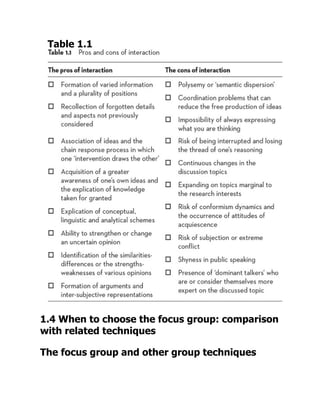
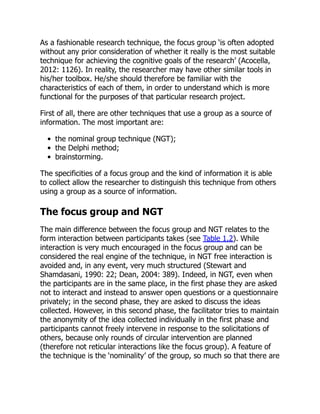
  • 72.
    some hours’ hotwork at this new post, Connolly was again hit, and so badly that his superior officer ordered him to the rear. “I gave instructions for his removal out of action,” says Lieutenant Cookes in his report, “but this brave man, hearing the order, staggered to his feet and said, ‘No, sir, I’ll not go there whilst I can work here,’ and shortly afterwards he again resumed his post as a spongeman.” Throughout the fighting that day Connolly stuck to his gun, though his wounds caused him great suffering and loss of blood, and it was not until a third bullet had ploughed its way through his leg that he gave up. Then he was carried from the field unconscious. That was the stuff that our gunners in India were made of, and we may give Connolly and his fellows our unstinted admiration. For sheer pluck and devotion to duty they had no peers. A highly distinguished artilleryman, who won his Cross in a different way, was a young lieutenant named Frederick Sleigh Roberts, now known to fame as Field-Marshal Earl Roberts, K.G. The scene of his valour was Khudaganj, near Fatehgarh, in the Agra district, and the date the 2nd of January 1858. Some five thousand rebels under the Nawab of Farukhabad being in force in the neighbourhood, Sir Colin Campbell pushed on with his troops to disperse the enemy. Lieutenant Roberts was attached to Sir Hope Grant’s staff, and with his leader came into contact with the rebels at the village of Khudaganj. Here a sharp engagement took place, which resulted in the Nawab’s army being completely routed. At the end of the fight, while the mounted men were following up the fugitives, the young lieutenant saw a sowar of the Punjab Cavalry (a loyal native regiment) in danger of being worsted by a sepoy armed with fixed bayonet. Wheeling his horse in their direction, he quickly thrust himself between the two and, with a terrific sweep of his sword across the other’s face, laid the sepoy low. A minute or two later he caught sight of a couple of rebels
  • 73.
    making off witha standard. Roberts determined that this should be captured, so setting spurs to his horse he galloped after them. He overtook the pair just as they were about to seek refuge in a village close by, and engaged them both at once. The one who clutched the standard he cut down, wrenching the trophy out of the other’s hands, but the second sepoy, ere he could turn, placed his musket close to the young officer’s body and pulled the trigger. Fortunately for him, the musket missed fire (it was in the days of the old percussion caps), whereupon the sepoy made off, leaving Roberts to return in triumph. In other engagements like those at Bulandshahr and Khudaganj many young cavalry officers who came to high honour in later years distinguished themselves by personal bravery. Prominent among these were Captain Dighton Probyn and Lieutenant John Watson, both of the Punjab Cavalry. Their exploits are well worth narrating. At the battle of Agra Probyn at the head of his squadron charged a body of rebel infantry, and in the mêlée became separated from his men. Beset as he was by a crowd of sepoys, he cut his way through them and engaged in a series of single combats of an Homeric kind. In one instance he rode down upon a cluster of sepoys, singled out the standard-bearer, killed him on the spot, and dashed off again with the colours. His gallantry on this and other occasions was, as Sir Hope Grant said in his despatch, so marked that he was promptly awarded the V.C. Lieutenant Watson had a similar heroic encounter with a rebel on November 14th, 1857, when just outside Lucknow he and his troop of Punjabis came into contact with a force of rebel cavalry which far outnumbered them. As they approached the Ressaldar in command of the rebels rode out in advance of his men with half a dozen followers. He is described as having been “a fine specimen of the Hindustani Mussulman,” a stalwart, black-bearded, fierce-looking man. Here was a foeman worthy of one’s steel. With all the daring that had already
  • 74.
    made him belovedby his sowars and feared by the enemy, Watson accepted the challenge thus offered, and rode out to give the other combat. He had got within a yard or so of his opponent when the Ressaldar fired his pistol point blank at him, but luckily the shot failed to take effect. It can only be supposed that the bullet had fallen out in the process of loading, for the two were too close together for the rebel leader to have missed his mark. Without hesitating, the lieutenant charged and dismounted the other, who drew his tulwar and called his followers to his aid. Watson now found himself engaged with seven opponents, and against their onslaught he had to defend himself like a lion. It is not recorded that he slew the Ressaldar, though it is to be hoped that he did so, but he succeeded in keeping them all at bay until his own sowars came to the rescue with some of Probyn’s Horse who had witnessed the combat. And when the rebels were put to flight the brave lieutenant’s wounds bore evidence of the fierce nature of the combat. A hideous slash on the head, a cut on the left arm, another on the right arm that disabled that limb for some time afterwards, and a sabre cut on the leg which came near to permanently laming him, were the chief hurts he had received, while a bullet hole in his coat showed how nearly a shot had found him. There were many tight corners that the young cavalry leader found himself in before the Mutiny came to an end, and despatches recorded his name more than once for distinguished services, but if you were to ask General Sir John Watson (he is a G.C.B. now, like his brother-officer, Sir Dighton Probyn) to-day, I doubt if he could remember another fight that was so desperate as that hand-to-hand combat with the mighty Ressaldar. And if it should ever come to fade from his memory he has only to look at a little bronze Maltese cross which hangs among his other medals on his breast, to remind himself of a time when it was touch- and-go with death.
  • 76.
    CHAPTER X. INDIA.—THE BLOWINGUP OF THE CASHMERE GATE. The final assault of Delhi, the leap of a little army of five thousand British and native soldiers upon a strongly fortified city held by fifty thousand rebels, forms one of the most exciting chapters in the history of the Indian Mutiny, and the blowing up of the Cashmere Gate one of its most heroic incidents. Once more did the gallant “sappers and miners,” whom we last saw doing noble work in the trenches at Sebastopol, here show themselves ready to face any peril at duty’s call. The decision to make the attack was come to at that historic council on September 6th, 1857, to which Nicholson went fully prepared to propose that General Wilson should be superseded did he hesitate longer. On the following day the engineers under Baird- Smith and his able lieutenants set to work to construct the trenching batteries, and by the 13th enough had been done to warrant the assault. We have a very vivid picture drawn for us by several writers of how, on the night of the 13th, four Engineer subalterns stole out of the camp on the Ridge and crept cautiously up to the walls of the enemy’s bastions to see what condition they were in. Greathed, Home, Medley, and Lang were the names of the four; one of them, Lieutenant Home, was to earn undying fame the next day at the Cashmere Gate. Armed with swords and revolvers, the party—divided into two sections—slipped into the great ditch, sixteen feet deep, and made for the top of the breach. But quiet as they were, the sepoy sentries on the wall above had heard them. Men were heard running from
  • 77.
    point to point.“They conversed in a low tone,” writes Medley, who was with Lang under the Cashmere Bastion, “and presently we heard the ring of their steel ramrods as they loaded.” Huddled into the darkest corner of the ditch, the two officers waited anxiously for the sepoys to go away, when another attempt might be made; but the alarmed sentries held their ground. The engineers, however, had seen that the breach was a good one, “the slope being easy of ascent and no guns on the flank,” so the four of them jumped up and made a bolt for home. Directly they were discovered a volley rattled out from behind them, and the whizzing of balls about their ears quickened their steps over the rough ground. Luckily not one was hit. There was one other man engaged in reconnoitring work that same night of whom little mention is made in accounts of the siege. This was Bugler William Sutton, of the 60th Rifles, a very brave fellow, as had been proved some weeks previously during a sortie from Delhi. On this occasion he dashed out from cover and threw himself upon the sepoy bugler who was about to sound the “advance” for the rebels. The call never rang out, for Bugler Sutton’s aim was quick and true, and the rebels, in some disorder, were driven back. Volunteering for the dangerous service on which the four engineers above-named had undertaken, Sutton ventured forth alone to spy out the breach at which his regiment was to be hurled next morning, and succeeded in obtaining some very valuable information for his superiors. The 60th Rifles gained no fewer than eight Victoria Crosses during the Mutiny, and one of them fell to Bugler Sutton, who was elected unanimously for the honour by his comrades. But it is of the Cashmere Gate and what was done there that this chapter is mainly to tell. According to the plans of the council, four columns were to make the attack simultaneously at four different points in the walls. The one under Nicholson was to carry the breach near the Cashmere Bastion, while another column, under Colonel