Using Digital Tools to Unlock HR’s 
True Potential
Talent Has Gone Digital, But Not HR 
The Human Resource (HR) function is at 
the center of sweeping changes. Digital 
technologies are radically impacting 
the manner in which employees and 
prospects connect and communicate 
with organizations. Barring a few 
exceptions, however, HR functions 
in most organizations continue to 
stay rooted in traditional modes of 
engagement. 
Mobile devices now 
account for over a billion 
job searches. 
Job Seekers are Rapidly 
Graduating to Mobile and 
Social Platforms 
Job seekers are increasingly using digital 
channels and devices to search for jobs. 
In a survey of over 900 job seekers in 
America, 52% mentioned that they use 
Facebook, 38% use LinkedIn and 34% 
use Twitter to find jobs1. Additionally, 
mobile devices account for over a 
billion job searches per month2. An 
organization’s presence across digital 
channels now has a strong impact on job 
seeker preferences. For instance, 40% 
of job seekers abandon a non-mobile 
friendly job application process3. 
2 
But HR is Still Lagging in 
the Use of Digital 
The use of digital in HR is lagging on many 
fronts. 75% of leaders in HR and talent 
management believe their companies are 
behind the curve in the use of internal and 
external social networking technologies7. 
Only 26 of Fortune 500 companies offer a 
mobile optimized job application process8. 
And only 26% of talent acquisition leaders 
feel that their organization uses workforce 
analytics well during the hiring process9. 
We decided to explore the current state 
of digitization in HR in more detail, to 
understand the use of digital in key HR 
processes. In Spring 2013, Capgemini 
Consulting conducted its annual survey 
of 130 HR executives – the Global HR 
Barometer survey. The survey revealed 
that the overall digital maturity level of HR 
processes is low. Only few organizations 
have established best-in-class digital 
processes to interact with current and 
potential employees. 
75% of leaders in HR 
and talent management 
believe their companies 
are behind the curve 
in the use of internal 
and external social 
networking technologies. 
Only 6% of organizations 
use social recruiting as 
a way to interact with 
potential candidates and 
strengthen the employer 
brand. 
Employees are Using 
Digital to Record Workplace 
Impressions 
Digital is changing the way employees 
interact with employers. Increasingly, 
employees are using social platforms 
such as Twitter and Glassdoor to 
express opinions on workplace issues. 
Glassdoor, for instance, has more than 
3 million pieces of content contributed 
by employees, on more than 200,000 
companies across 190 countries4. 
Given their reach, these platforms can 
significantly impact employer branding. 
For instance, employees at HMV publicly 
tweeted their angst on being fired through 
the company’s official Twitter account, 
which had a following of over 70,0005. 
The first tweet went viral with over 1,300 
retweets in 30 minutes. The incident was 
a major public relations disaster for the 
company6.
3 
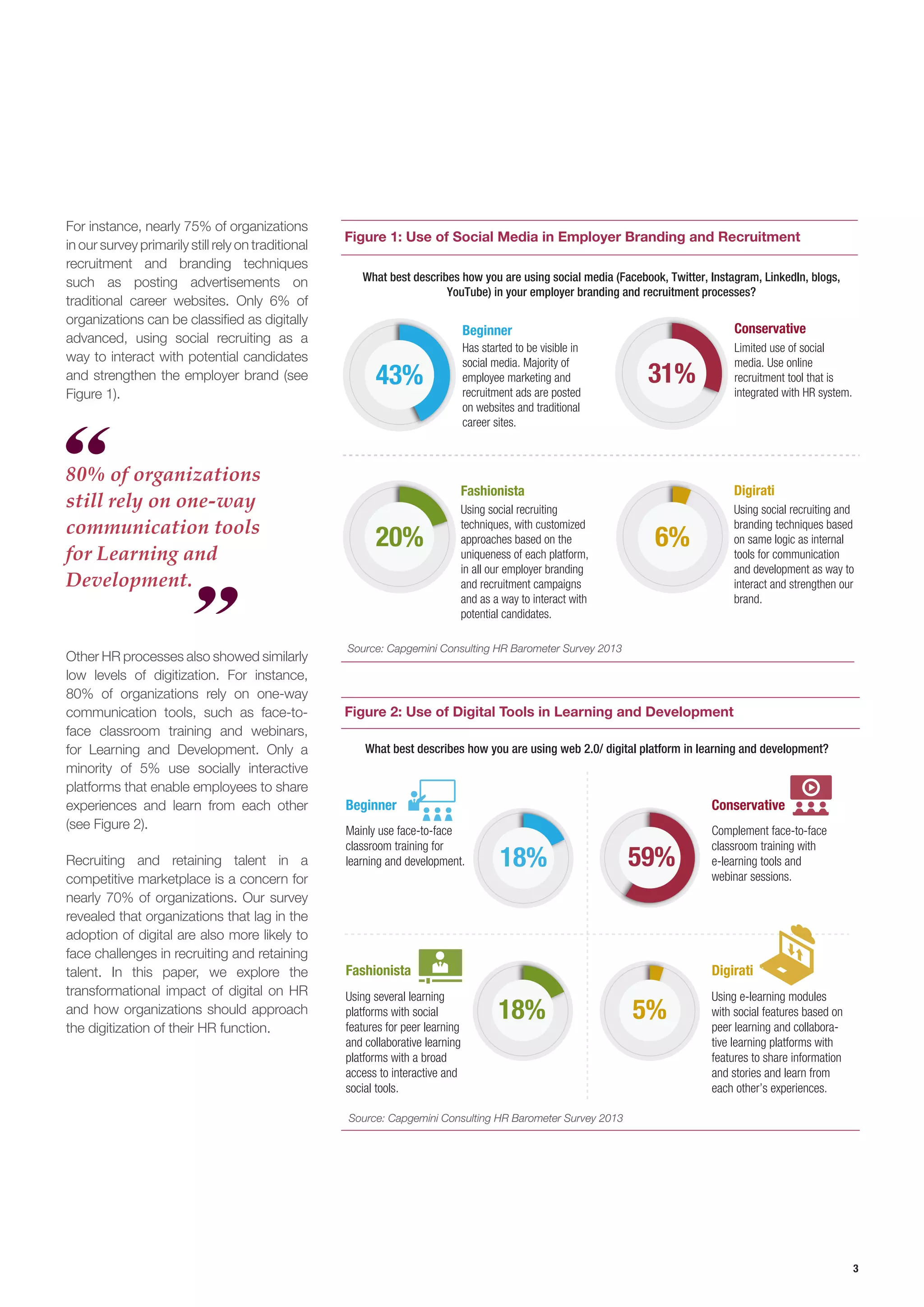
For instance, nearly 75% of organizations 
in our survey primarily still rely on traditional 
recruitment and branding techniques 
such as posting advertisements on 
traditional career websites. Only 6% of 
organizations can be classified as digitally 
advanced, using social recruiting as a 
way to interact with potential candidates 
and strengthen the employer brand (see 
Figure 1). 
80% of organizations 
still rely on one-way 
communication tools 
for Learning and 
Development. 
Figure 1: Use of Social Media in Employer Branding and Recruitment 
What best describes how you are using social media (Facebook, Twitter, Instagram, LinkedIn, blogs, 
YouTube) in your employer branding and recruitment processes? 
Beginner 
Fashionista 
Source: Capgemini Consulting HR Barometer Survey 2013 
31% 
Figure 2: Use of Digital Tools in Learning and Development 
What best describes how you are using web 2.0/ digital platform in learning and development? 
Beginner 
Fashionista 
18% 
Source: Capgemini Consulting HR Barometer Survey 2013 
Other HR processes also showed similarly 
low levels of digitization. For instance, 
80% of organizations rely on one-way 
communication tools, such as face-to-face 
classroom training and webinars, 
for Learning and Development. Only a 
minority of 5% use socially interactive 
platforms that enable employees to share 
experiences and learn from each other 
(see Figure 2). 
Recruiting and retaining talent in a 
competitive marketplace is a concern for 
nearly 70% of organizations. Our survey 
revealed that organizations that lag in the 
adoption of digital are also more likely to 
face challenges in recruiting and retaining 
talent. In this paper, we explore the 
transformational impact of digital on HR 
and how organizations should approach 
the digitization of their HR function. 
Limited use of social 
media. Use online 
recruitment tool that is 
integrated with HR system. 
Has started to be visible in 
social media. Majority of 
employee marketing and 
recruitment ads are posted 
on websites and traditional 
career sites. 
Using social recruiting and 
branding techniques based 
on same logic as internal 
tools for communication 
and development as way to 
interact and strengthen our 
brand. 
Using social recruiting 
techniques, with customized 
approaches based on the 
uniqueness of each platform, 
in all our employer branding 
and recruitment campaigns 
and as a way to interact with 
potential candidates. 
Conservative 
Digirati 
43% 
20% 6% 
Complement face-to-face 
classroom training with 
e-learning tools and 
webinar sessions. 
Mainly use face-to-face 
classroom training for 
learning and development. 
Using e-learning modules 
with social features based on 
peer learning and collabora-tive 
learning platforms with 
features to share information 
and stories and learn from 
each other’s experiences. 
Using several learning 
platforms with social 
features for peer learning 
and collaborative learning 
platforms with a broad 
access to interactive and 
social tools. 
Conservative 
Digirati 
59% 
18% 5%
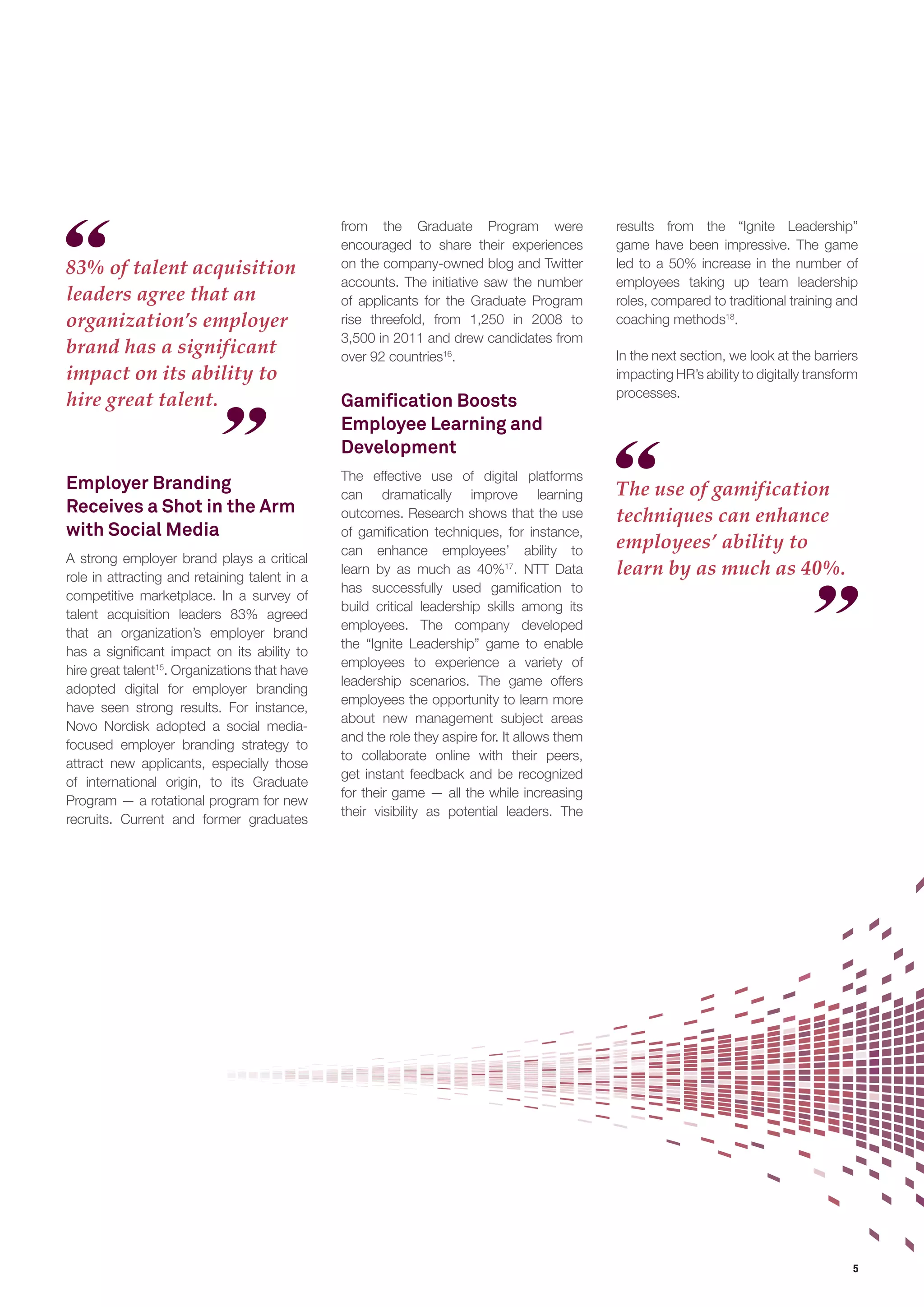
Digital Offers Innovative Ways 
to Attract, Retain and Engage Talent 
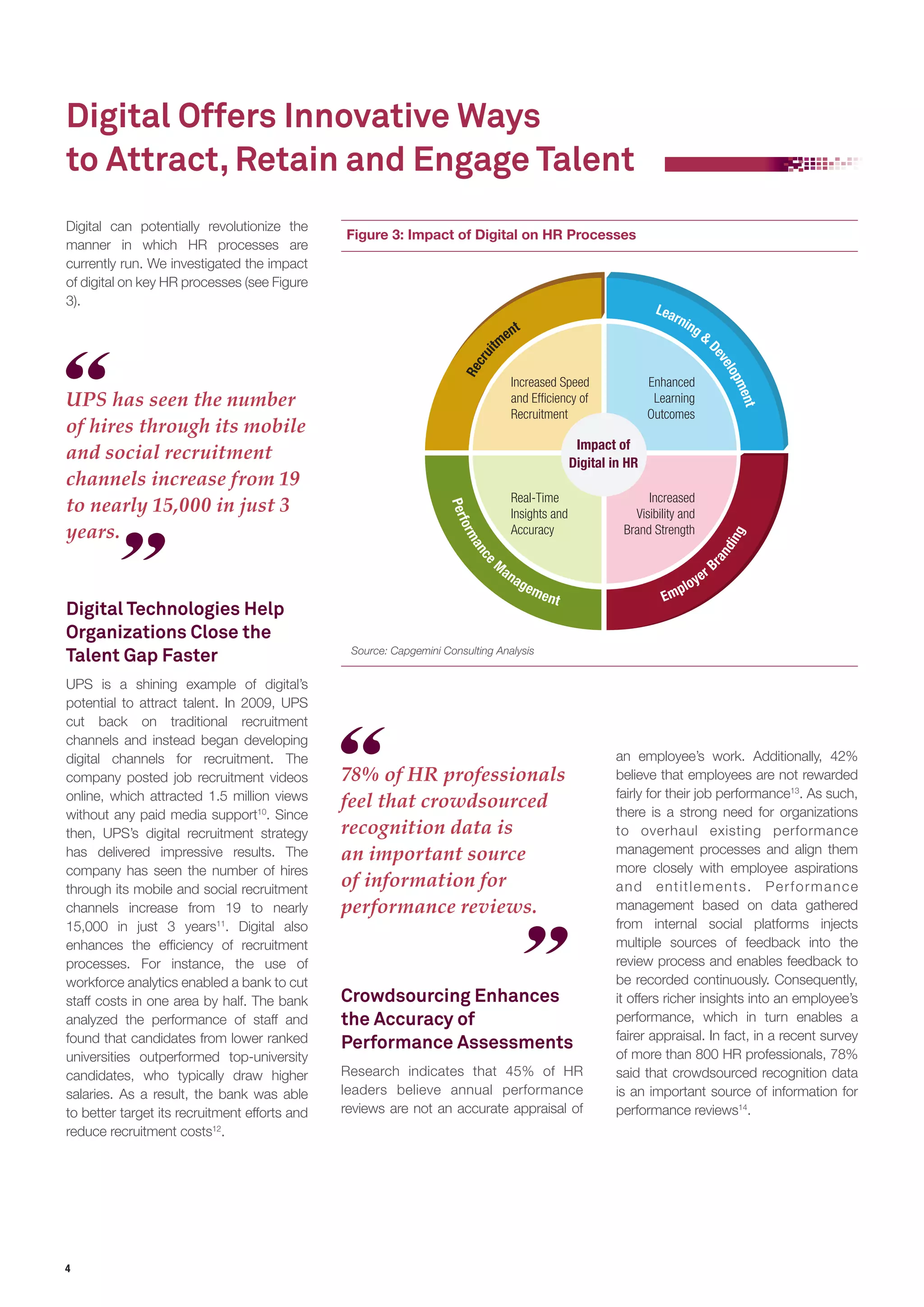
Digital can potentially revolutionize the 
manner in which HR processes are 
currently run. We investigated the impact 
of digital on key HR processes (see Figure 
3). 
UPS has seen the number 
of hires through its mobile 
and social recruitment 
channels increase from 19 
to nearly 15,000 in just 3 
years. 
4 
Recruitment Learning & Development 
Increased Speed 
and Efficiency of 
Recruitment 
Real-Time 
Insights and 
Accuracy 
78% of HR professionals 
feel that crowdsourced 
recognition data is 
an important source 
of information for 
performance reviews. 
Digital Technologies Help 
Organizations Close the 
Talent Gap Faster 
UPS is a shining example of digital’s 
potential to attract talent. In 2009, UPS 
cut back on traditional recruitment 
channels and instead began developing 
digital channels for recruitment. The 
company posted job recruitment videos 
online, which attracted 1.5 million views 
without any paid media support10. Since 
then, UPS’s digital recruitment strategy 
has delivered impressive results. The 
company has seen the number of hires 
through its mobile and social recruitment 
channels increase from 19 to nearly 
15,000 in just 3 years11. Digital also 
enhances the efficiency of recruitment 
processes. For instance, the use of 
workforce analytics enabled a bank to cut 
staff costs in one area by half. The bank 
analyzed the performance of staff and 
found that candidates from lower ranked 
universities outperformed top-university 
candidates, who typically draw higher 
salaries. As a result, the bank was able 
to better target its recruitment efforts and 
reduce recruitment costs12. 
Figure 3: Impact of Digital on HR Processes 
Impact of 
Digital in HR 
Crowdsourcing Enhances 
the Accuracy of 
Performance Assessments 
Research indicates that 45% of HR 
leaders believe annual performance 
reviews are not an accurate appraisal of 
an employee’s work. Additionally, 42% 
believe that employees are not rewarded 
fairly for their job performance13. As such, 
there is a strong need for organizations 
to overhaul existing performance 
management processes and align them 
more closely with employee aspirations 
and entitlements. Performance 
management based on data gathered 
from internal social platforms injects 
multiple sources of feedback into the 
review process and enables feedback to 
be recorded continuously. Consequently, 
it offers richer insights into an employee’s 
performance, which in turn enables a 
fairer appraisal. In fact, in a recent survey 
of more than 800 HR professionals, 78% 
said that crowdsourced recognition data 
is an important source of information for 
performance reviews14. 
Source: Capgemini Consulting Analysis 
Enhanced 
Learning 
Outcomes 
Increased 
Visibility and 
Brand Strength 
Performance Management Employer Branding
5 
83% of talent acquisition 
leaders agree that an 
organization’s employer 
brand has a significant 
impact on its ability to 
hire great talent. 
The use of gamification 
techniques can enhance 
employees’ ability to 
learn by as much as 40%. 
Employer Branding 
Receives a Shot in the Arm 
with Social Media 
A strong employer brand plays a critical 
role in attracting and retaining talent in a 
competitive marketplace. In a survey of 
talent acquisition leaders 83% agreed 
that an organization’s employer brand 
has a significant impact on its ability to 
hire great talent15. Organizations that have 
adopted digital for employer branding 
have seen strong results. For instance, 
Novo Nordisk adopted a social media-focused 
employer branding strategy to 
attract new applicants, especially those 
of international origin, to its Graduate 
Program — a rotational program for new 
recruits. Current and former graduates 
from the Graduate Program were 
encouraged to share their experiences 
on the company-owned blog and Twitter 
accounts. The initiative saw the number 
of applicants for the Graduate Program 
rise threefold, from 1,250 in 2008 to 
3,500 in 2011 and drew candidates from 
over 92 countries16. 
Gamification Boosts 
Employee Learning and 
Development 
The effective use of digital platforms 
can dramatically improve learning 
outcomes. Research shows that the use 
of gamification techniques, for instance, 
can enhance employees’ ability to 
learn by as much as 40%17. NTT Data 
has successfully used gamification to 
build critical leadership skills among its 
employees. The company developed 
the “Ignite Leadership” game to enable 
employees to experience a variety of 
leadership scenarios. The game offers 
employees the opportunity to learn more 
about new management subject areas 
and the role they aspire for. It allows them 
to collaborate online with their peers, 
get instant feedback and be recognized 
for their game — all the while increasing 
their visibility as potential leaders. The 
results from the “Ignite Leadership” 
game have been impressive. The game 
led to a 50% increase in the number of 
employees taking up team leadership 
roles, compared to traditional training and 
coaching methods18. 
In the next section, we look at the barriers 
impacting HR’s ability to digitally transform 
processes.
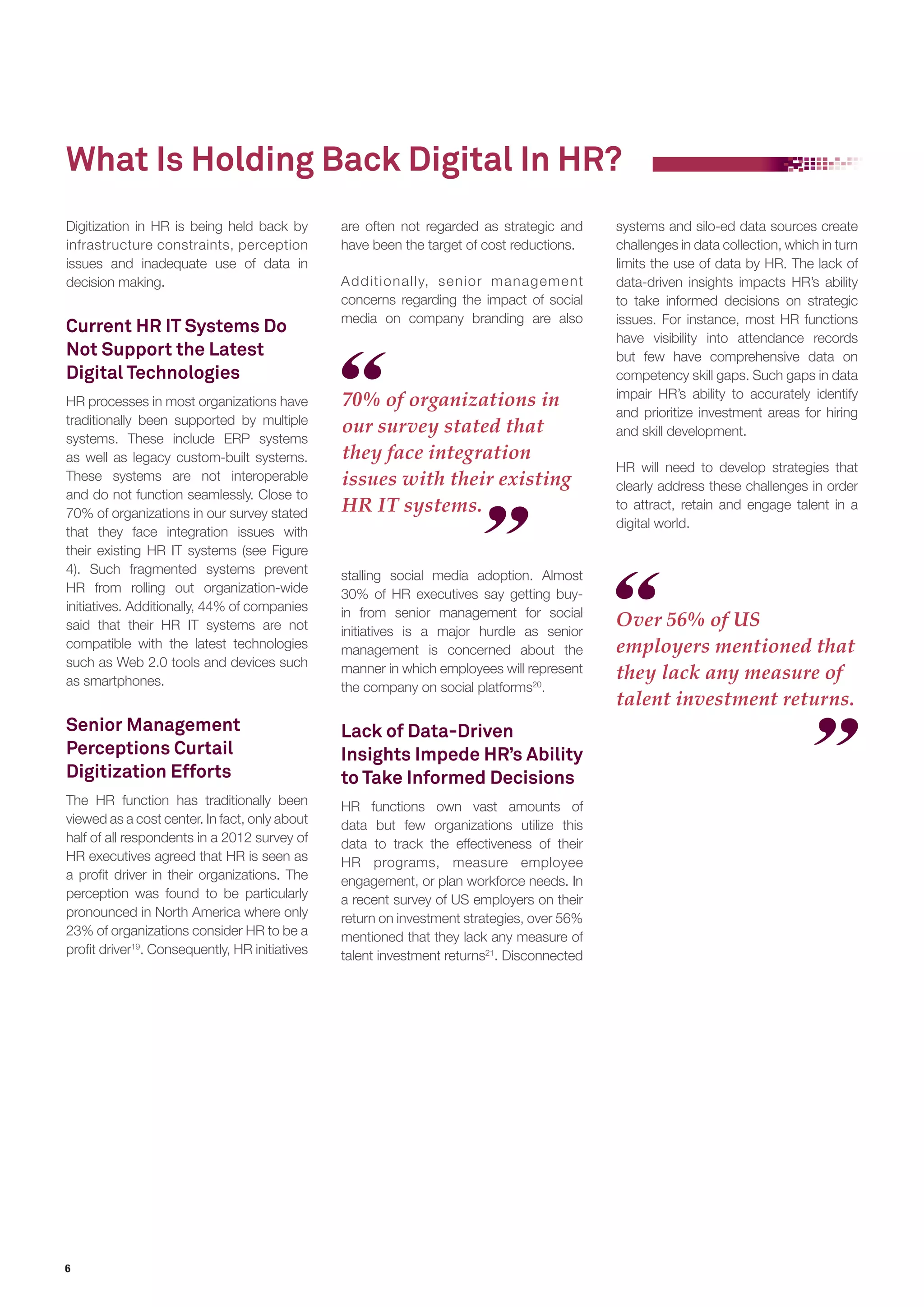
What Is Holding Back Digital In HR? 
6 
stalling social media adoption. Almost 
30% of HR executives say getting buy-in 
from senior management for social 
initiatives is a major hurdle as senior 
management is concerned about the 
manner in which employees will represent 
the company on social platforms20. 
Lack of Data-Driven 
Insights Impede HR’s Ability 
to Take Informed Decisions 
HR functions own vast amounts of 
data but few organizations utilize this 
data to track the effectiveness of their 
HR programs, measure employee 
engagement, or plan workforce needs. In 
a recent survey of US employers on their 
return on investment strategies, over 56% 
mentioned that they lack any measure of 
talent investment returns21. Disconnected 
Digitization in HR is being held back by 
infrastructure constraints, perception 
issues and inadequate use of data in 
decision making. 
Current HR IT Systems Do 
Not Support the Latest 
Digital Technologies 
HR processes in most organizations have 
traditionally been supported by multiple 
systems. These include ERP systems 
as well as legacy custom-built systems. 
These systems are not interoperable 
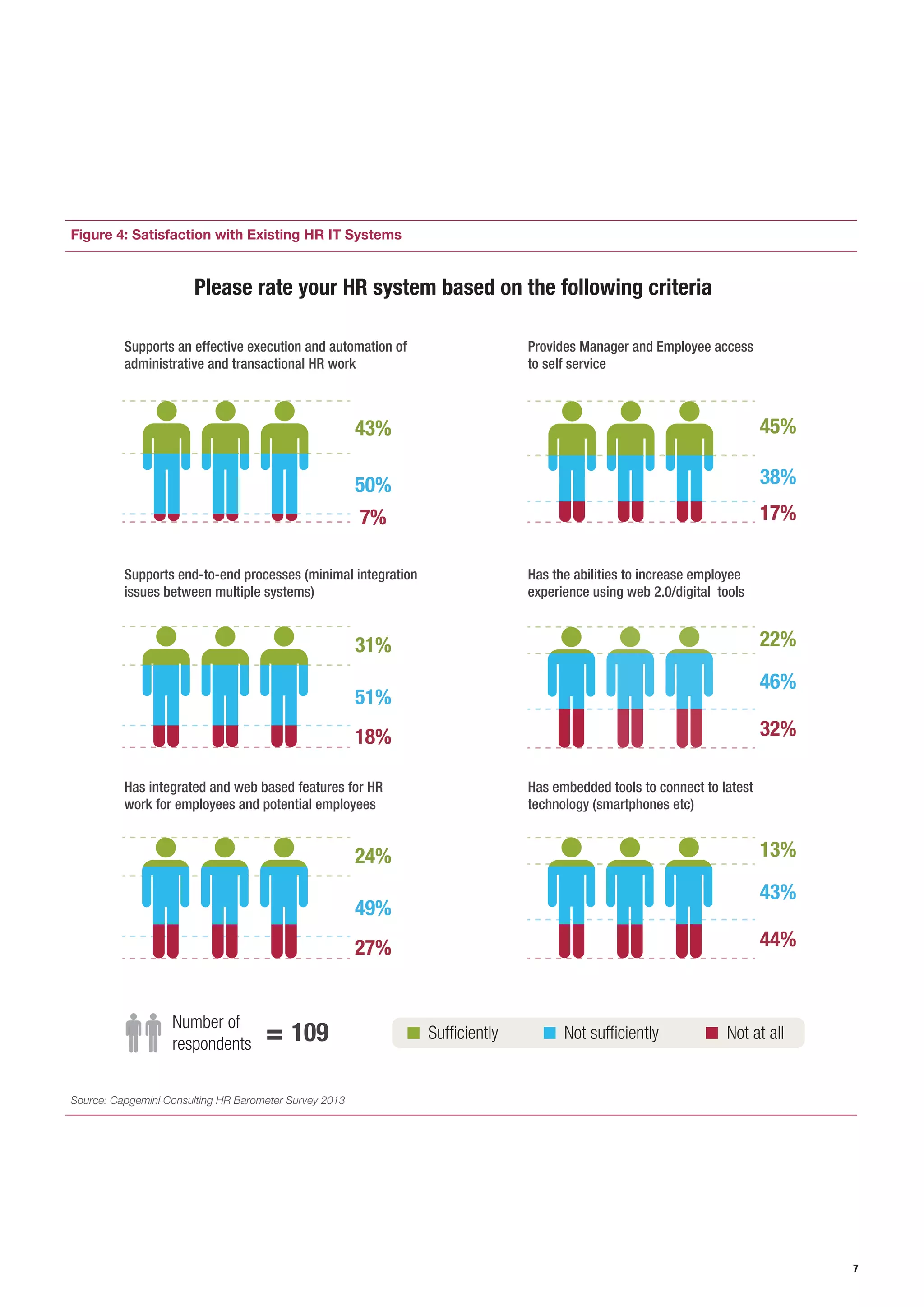
and do not function seamlessly. Close to 
70% of organizations in our survey stated 
that they face integration issues with 
their existing HR IT systems (see Figure 
4). Such fragmented systems prevent 
HR from rolling out organization-wide 
initiatives. Additionally, 44% of companies 
said that their HR IT systems are not 
compatible with the latest technologies 
such as Web 2.0 tools and devices such 
as smartphones. 
Senior Management 
Perceptions Curtail 
Digitization Efforts 
The HR function has traditionally been 
viewed as a cost center. In fact, only about 
half of all respondents in a 2012 survey of 
HR executives agreed that HR is seen as 
a profit driver in their organizations. The 
perception was found to be particularly 
pronounced in North America where only 
23% of organizations consider HR to be a 
profit driver19. Consequently, HR initiatives 
70% of organizations in 
our survey stated that 
they face integration 
issues with their existing 
HR IT systems. 
Over 56% of US 
employers mentioned that 
they lack any measure of 
talent investment returns. 
are often not regarded as strategic and 
have been the target of cost reductions. 
Additionally, senior management 
concerns regarding the impact of social 
media on company branding are also 
systems and silo-ed data sources create 
challenges in data collection, which in turn 
limits the use of data by HR. The lack of 
data-driven insights impacts HR’s ability 
to take informed decisions on strategic 
issues. For instance, most HR functions 
have visibility into attendance records 
but few have comprehensive data on 
competency skill gaps. Such gaps in data 
impair HR’s ability to accurately identify 
and prioritize investment areas for hiring 
and skill development. 
HR will need to develop strategies that 
clearly address these challenges in order 
to attract, retain and engage talent in a 
digital world.
7 
Figure 4: Satisfaction with Existing HR IT Systems 
Please rate your HR system based on the following criteria 
43% 
50% 
7% 
31% 
51% 
18% 
24% 
49% 
27% 
Number of 
respondents 
Sufficiently Not sufficiently Not at all 
Supports an effective execution and automation of 
administrative and transactional HR work 
Provides Manager and Employee access 
to self service 
Supports end-to-end processes (minimal integration 
issues between multiple systems) 
Has the abilities to increase employee 
experience using web 2.0/digital tools 
Has integrated and web based features for HR 
work for employees and potential employees 
Has embedded tools to connect to latest 
technology (smartphones etc) 
45% 
38% 
17% 
22% 
46% 
32% 
13% 
43% 
44% 
= 109 
Source: Capgemini Consulting HR Barometer Survey 2013
The Road Ahead 
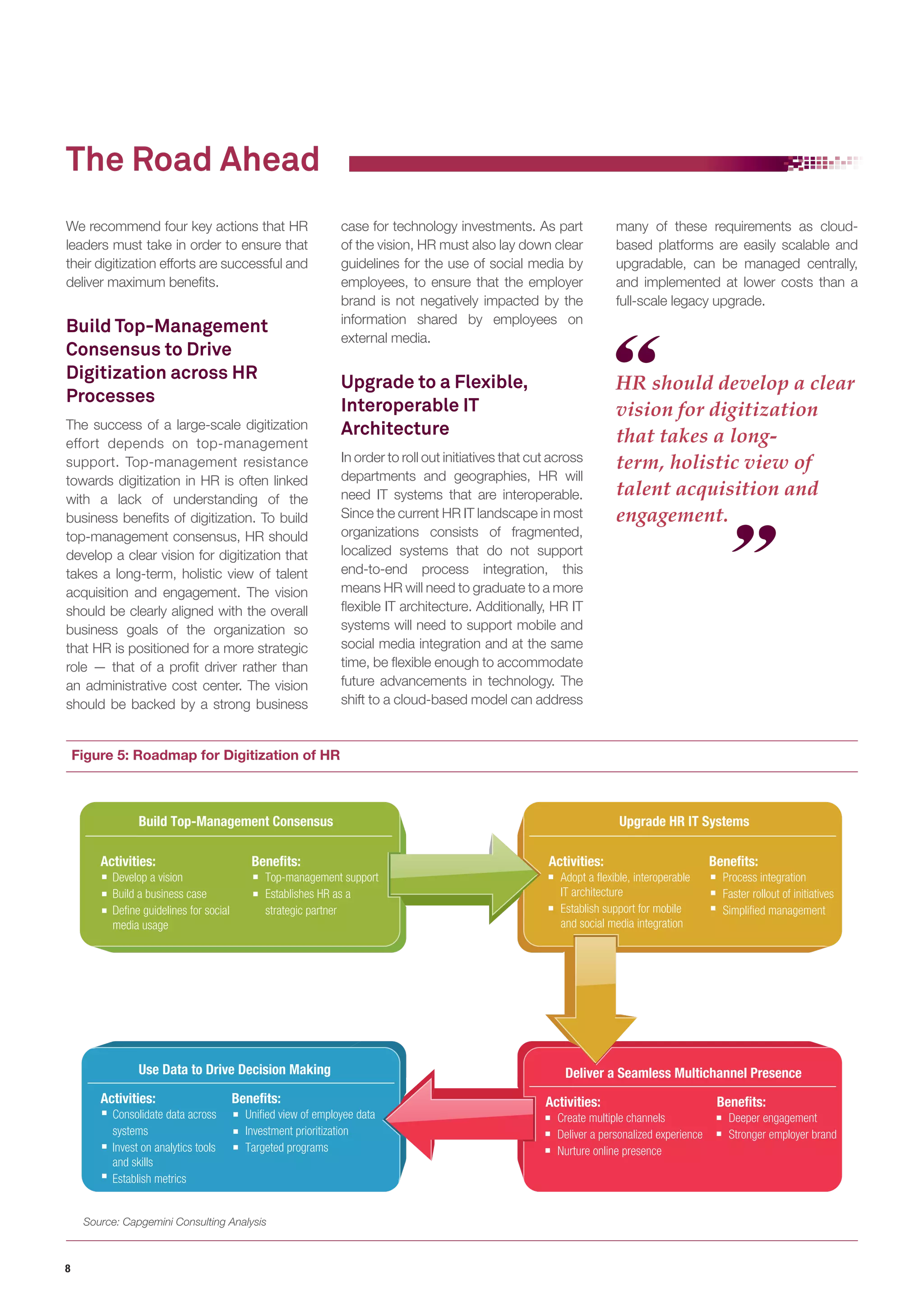
We recommend four key actions that HR 
leaders must take in order to ensure that 
their digitization efforts are successful and 
deliver maximum benefits. 
Build Top-Management 
Consensus to Drive 
Digitization across HR 
Processes 
The success of a large-scale digitization 
effort depends on top-management 
support. Top-management resistance 
towards digitization in HR is often linked 
with a lack of understanding of the 
business benefits of digitization. To build 
top-management consensus, HR should 
develop a clear vision for digitization that 
takes a long-term, holistic view of talent 
acquisition and engagement. The vision 
should be clearly aligned with the overall 
business goals of the organization so 
that HR is positioned for a more strategic 
role — that of a profit driver rather than 
an administrative cost center. The vision 
should be backed by a strong business 
8 
case for technology investments. As part 
of the vision, HR must also lay down clear 
guidelines for the use of social media by 
employees, to ensure that the employer 
brand is not negatively impacted by the 
information shared by employees on 
external media. 
Upgrade to a Flexible, 
Interoperable IT 
Architecture 
In order to roll out initiatives that cut across 
departments and geographies, HR will 
need IT systems that are interoperable. 
Since the current HR IT landscape in most 
organizations consists of fragmented, 
localized systems that do not support 
end-to-end process integration, this 
means HR will need to graduate to a more 
flexible IT architecture. Additionally, HR IT 
systems will need to support mobile and 
social media integration and at the same 
time, be flexible enough to accommodate 
future advancements in technology. The 
shift to a cloud-based model can address 
many of these requirements as cloud-based 
platforms are easily scalable and 
upgradable, can be managed centrally, 
and implemented at lower costs than a 
full-scale legacy upgrade. 
HR should develop a clear 
vision for digitization 
that takes a long-term, 
holistic view of 
talent acquisition and 
engagement. 
Figure 5: Roadmap for Digitization of HR 
Build Top-Management Consensus 
Activities: 
Develop a vision 
Build a business case 
Define guidelines for social 
media usage 
Benefits: 
Top-management support 
Establishes HR as a 
strategic partner 
Upgrade HR IT Systems 
Activities: 
Adopt a flexible, interoperable 
IT architecture 
Establish support for mobile 
and social media integration 
Benefits: 
Process integration 
Faster rollout of initiatives 
Simplified management 
Use Data to Drive Decision Making Deliver a Seamless Multichannel Presence 
Activities: 
Consolidate data across 
systems 
Invest on analytics tools 
and skills 
Establish metrics 
Benefits: 
Unified view of employee data 
Investment prioritization 
Targeted programs 
Activities: 
Create multiple channels 
Deliver a personalized experience 
Nurture online presence 
Benefits: 
Deeper engagement 
Stronger employer brand 
Source: Capgemini Consulting Analysis
9 
Deliver a Seamless 
Multichannel Experience 
HR should use social and mobile 
platforms to build stronger relationships 
with employees as well as prospects. For 
the user, the experience of interacting with 
HR should be seamless across channels. 
Mobile websites and applications should 
be designed such that they are easy to 
use and simplify the applicant’s access 
to information. HR should also aim to 
personalize the experience based on 
the user’s profile. Building a digital HR 
strategy will need to be an ongoing 
process for organizations. HR will need to 
continuously monitor digital channels to 
ensure that it is listening and responding 
to the needs of its target audience. In a 
competitive marketplace, it is steps like 
these that will differentiate an organization 
and enable it to attract and retain the best 
talent. 
A shift to a data-driven 
approach to decision 
making is a crucial 
element of digitization of 
HR. 
Use Data to Drive Decision 
Making 
A shift to a data-driven approach to 
decision making is a crucial element of 
digitization that HR needs to address. 
Data should be used across all HR 
processes — including recruitment, 
learning and development, and 
performance management. As a first 
step, HR should develop a unified view of 
all employee data. To do so, HR will need 
to consolidate data that currently resides in 
multiple systems spread across business 
units and geographies into a centralized 
repository. The next step should be to 
invest in analytics tools and skill sets so 
that the data can be utilized effectively. 
Finally, HR should establish metrics and 
KPIs that will enable it to determine the 
effectiveness of its initiatives. These steps 
will enable HR to prioritize its investments 
and develop targeted programs. 
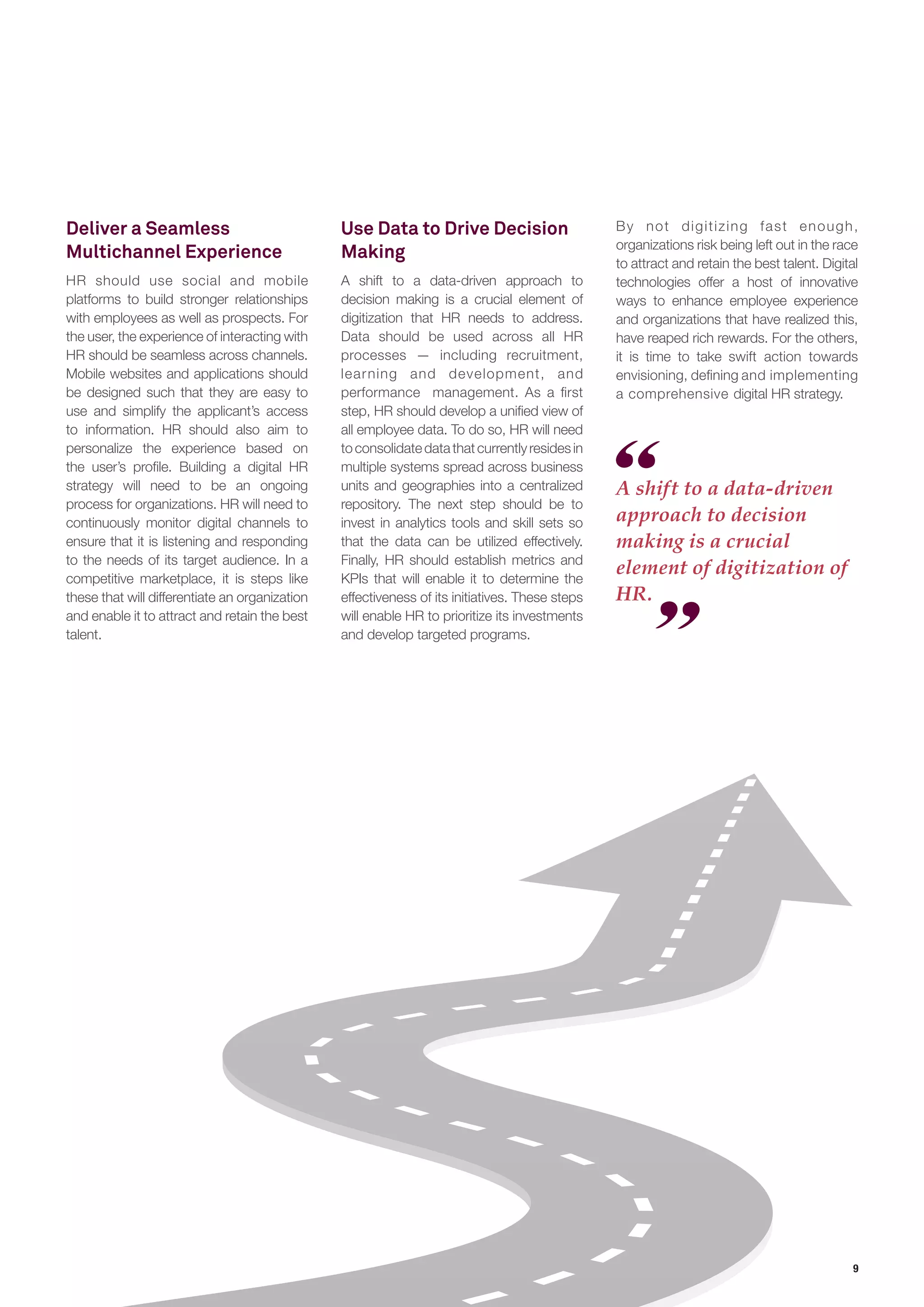
By not digitizing fast enough, 
organizations risk being left out in the race 
to attract and retain the best talent. Digital 
technologies offer a host of innovative 
ways to enhance employee experience 
and organizations that have realized this, 
have reaped rich rewards. For the others, 
it is time to take swift action towards 
envisioning, defining and implementing 
a comprehensive digital HR strategy.
References 
1 Jobvite, “2012 Social Job Seeker Survey”, September 2012 
2 Talent HQ, “20 Mobile Recruiting Insights #mrec13”, September 2013 
3 Talent HQ, “45 Mobile Recruiting Tips and Trends From #mrec”, September 2013 
4 TechCrunch, “With 40% Of Traffic From Outside The U.S., Glassdoor Raises $20M Series D To Expand Internationally”, 
October 2012 
5 LinkedIn, “Inside HMV’s Twitter Disaster: What went wrong (and how to keep your company safe)”, February 2013 
6 Two Four Seven, “HMV tweets their own sacking”, January 2013 
7 Forbes, “2013: The Year of Social HR”, January 2013 
8 Talent HQ, “20 Mobile Recruiting Insights #mrec13”, September 2013 
9 LinkedIn Talent blog, “Three Days, Three Key Themes: My Review of Talent Connect 2012”, October 2012 
10 Slideshare, “Making the Quantum Leap: UPS Social Media Recruitment ROI 2012”, January 2012 
11 Slideshare, “UPS Jobs Mobile Case Study at MREC 2013”, September 2013 
12 LinkedIn, “People Management: Data And Analytics Will Change It Forever”, November 2013 
13 Globoforce, “2012 SHRM/Globoforce Employee Recognition Report”, 2012 
14 Globoforce, “2012 SHRM/Globoforce Employee Recognition Report”, 2012 
15 Slideshare, “State of Employer Brand”, October 2012 
16 Mind Jumpers, “How to use Social Media for Employer Branding and Recruitment”, July 2012 
17 Business Insider, “‘Gamification’ Techniques Increase Your Employees’ Ability To Learn By 40%”, September 2013 
18 Forbes, “Gamification In Leadership Development: How Companies Use Gaming To Build Their Leader Pipeline”, September 
2013 
19 Oxford Economics, “The Digital Transformation of People Management”, March 2012 
20 Oxford Economics, “The Digital Transformation of People Management”, March 2012 
21 Recruiter.com, “Survey: Most Employers Lack RTI Figures on Talent”, March 2013
Authors 
Barbara Spitzer 
Senior Vice President, North America 
barbara.spitzer@capgemini.com 
Carin Soderstrom 
Managing Consultant, Sweden 
carin.soderstrom@capgemini.com 
Anna Karin Vernet 
Director, Sweden/Finland 
annakarin.vernet@capgemini.com 
Roopa Nambiar 
Manager, Digital Transformation 
Research Institute 
roopa.nambiar@capgemini.com 
The authors would also like to acknowledge the contributions of Jerome Buvat, Subrahmanyam KVJ and Ashish Bisht from the 
Digital Transformation Research Institute and Anna Eriksson and Liselotte Fors from Capgemini Consulting Sweden. 
For more information contact: 
North America 
Barbara Spitzer 
barbara.spitzer@capgemini.com 
Argentina 
Alejandro Roberto Giuliodori 
Alejandro-Roberto.Giuliodori@ 
capgemini.com 
Austria 
Ingrid Berndt 
Ingrid.berndt@capgemini.com 
Australia 
Sheila Mistry 
sheila.mistry@capgemini.com 
France 
Stephan Paolini 
stephan.paolini@capgemini.com 
Belgium 
Peter Speleers 
peter.speleers@capgemini.com 
China 
Julien Bourdiniere 
julien.bourdiniere@capgemini.com 
Germany/ Switzerland 
Imke Keicher 
imke.keicher@capgemini.com 
Norway 
Laars Fossli 
lars.fossli@capgemini.com 
Portugal 
Jorge Martins 
jorge.martins@capgemini.com 
Capgemini Consulting is the global strategy and transformation 
consulting organization of the Capgemini Group, specializing 
in advising and supporting enterprises in significant 
transformation, from innovative strategy to execution and with 
an unstinting focus on results. With the new digital economy 
creating significant disruptions and opportunities, our global 
team of over 3,600 talented individuals work with leading 
companies and governments to master Digital Transformation, 
drawing on our understanding of the digital economy and 
our leadership in business transformation and organizational 
change. 
Find out more at: 
http://www.capgemini-consulting.com/ 
Rightshore® is a trademark belonging to Capgemini 
Digital Transformation 
Research Institute 
dtri.in@capgemini.com 
Spain 
Carlos Garcia Santos 
carlos.garcia.s@capgemini.com 
Sweden/Finland 
Anna Karin Vernet 
annakarin.vernet@capgemini.com 
The Netherlands 
Jan Brouwer 
jan.brouwer@capgemini.com 
United Kingdom 
Anne Gauton 
Anne.gauton@capgemini.com 
About Capgemini and the 
Collaborative Business Experience 
With more than 130,000 people in 44 countries, Capgemini 
is one of the world’s foremost providers of consulting, 
technology and outsourcing services. The Group reported 2012 
global revenues of EUR 10.3 billion. Together with its clients, 
Capgemini creates and delivers business and technology 
solutions that fit their needs and drive the results they want. A 
deeply multicultural organization, Capgemini has developed its 
own way of working, the Collaborative Business ExperienceTM, 
and draws on Rightshore®, its worldwide delivery model. 
Learn more about us at www.uk.capgemini.com 
Capgemini Consulting is the strategy and transformation consulting brand of Capgemini Group. The information contained in this document is proprietary. 
© 2013 Capgemini. All rights reserved.

Using digital tools to unlock hr's true potential

  • 1.
    Using Digital Toolsto Unlock HR’s True Potential
  • 2.
    Talent Has GoneDigital, But Not HR The Human Resource (HR) function is at the center of sweeping changes. Digital technologies are radically impacting the manner in which employees and prospects connect and communicate with organizations. Barring a few exceptions, however, HR functions in most organizations continue to stay rooted in traditional modes of engagement. Mobile devices now account for over a billion job searches. Job Seekers are Rapidly Graduating to Mobile and Social Platforms Job seekers are increasingly using digital channels and devices to search for jobs. In a survey of over 900 job seekers in America, 52% mentioned that they use Facebook, 38% use LinkedIn and 34% use Twitter to find jobs1. Additionally, mobile devices account for over a billion job searches per month2. An organization’s presence across digital channels now has a strong impact on job seeker preferences. For instance, 40% of job seekers abandon a non-mobile friendly job application process3. 2 But HR is Still Lagging in the Use of Digital The use of digital in HR is lagging on many fronts. 75% of leaders in HR and talent management believe their companies are behind the curve in the use of internal and external social networking technologies7. Only 26 of Fortune 500 companies offer a mobile optimized job application process8. And only 26% of talent acquisition leaders feel that their organization uses workforce analytics well during the hiring process9. We decided to explore the current state of digitization in HR in more detail, to understand the use of digital in key HR processes. In Spring 2013, Capgemini Consulting conducted its annual survey of 130 HR executives – the Global HR Barometer survey. The survey revealed that the overall digital maturity level of HR processes is low. Only few organizations have established best-in-class digital processes to interact with current and potential employees. 75% of leaders in HR and talent management believe their companies are behind the curve in the use of internal and external social networking technologies. Only 6% of organizations use social recruiting as a way to interact with potential candidates and strengthen the employer brand. Employees are Using Digital to Record Workplace Impressions Digital is changing the way employees interact with employers. Increasingly, employees are using social platforms such as Twitter and Glassdoor to express opinions on workplace issues. Glassdoor, for instance, has more than 3 million pieces of content contributed by employees, on more than 200,000 companies across 190 countries4. Given their reach, these platforms can significantly impact employer branding. For instance, employees at HMV publicly tweeted their angst on being fired through the company’s official Twitter account, which had a following of over 70,0005. The first tweet went viral with over 1,300 retweets in 30 minutes. The incident was a major public relations disaster for the company6.
  • 3.
    3 For instance,nearly 75% of organizations in our survey primarily still rely on traditional recruitment and branding techniques such as posting advertisements on traditional career websites. Only 6% of organizations can be classified as digitally advanced, using social recruiting as a way to interact with potential candidates and strengthen the employer brand (see Figure 1). 80% of organizations still rely on one-way communication tools for Learning and Development. Figure 1: Use of Social Media in Employer Branding and Recruitment What best describes how you are using social media (Facebook, Twitter, Instagram, LinkedIn, blogs, YouTube) in your employer branding and recruitment processes? Beginner Fashionista Source: Capgemini Consulting HR Barometer Survey 2013 31% Figure 2: Use of Digital Tools in Learning and Development What best describes how you are using web 2.0/ digital platform in learning and development? Beginner Fashionista 18% Source: Capgemini Consulting HR Barometer Survey 2013 Other HR processes also showed similarly low levels of digitization. For instance, 80% of organizations rely on one-way communication tools, such as face-to-face classroom training and webinars, for Learning and Development. Only a minority of 5% use socially interactive platforms that enable employees to share experiences and learn from each other (see Figure 2). Recruiting and retaining talent in a competitive marketplace is a concern for nearly 70% of organizations. Our survey revealed that organizations that lag in the adoption of digital are also more likely to face challenges in recruiting and retaining talent. In this paper, we explore the transformational impact of digital on HR and how organizations should approach the digitization of their HR function. Limited use of social media. Use online recruitment tool that is integrated with HR system. Has started to be visible in social media. Majority of employee marketing and recruitment ads are posted on websites and traditional career sites. Using social recruiting and branding techniques based on same logic as internal tools for communication and development as way to interact and strengthen our brand. Using social recruiting techniques, with customized approaches based on the uniqueness of each platform, in all our employer branding and recruitment campaigns and as a way to interact with potential candidates. Conservative Digirati 43% 20% 6% Complement face-to-face classroom training with e-learning tools and webinar sessions. Mainly use face-to-face classroom training for learning and development. Using e-learning modules with social features based on peer learning and collabora-tive learning platforms with features to share information and stories and learn from each other’s experiences. Using several learning platforms with social features for peer learning and collaborative learning platforms with a broad access to interactive and social tools. Conservative Digirati 59% 18% 5%
  • 4.
    Digital Offers InnovativeWays to Attract, Retain and Engage Talent Digital can potentially revolutionize the manner in which HR processes are currently run. We investigated the impact of digital on key HR processes (see Figure 3). UPS has seen the number of hires through its mobile and social recruitment channels increase from 19 to nearly 15,000 in just 3 years. 4 Recruitment Learning & Development Increased Speed and Efficiency of Recruitment Real-Time Insights and Accuracy 78% of HR professionals feel that crowdsourced recognition data is an important source of information for performance reviews. Digital Technologies Help Organizations Close the Talent Gap Faster UPS is a shining example of digital’s potential to attract talent. In 2009, UPS cut back on traditional recruitment channels and instead began developing digital channels for recruitment. The company posted job recruitment videos online, which attracted 1.5 million views without any paid media support10. Since then, UPS’s digital recruitment strategy has delivered impressive results. The company has seen the number of hires through its mobile and social recruitment channels increase from 19 to nearly 15,000 in just 3 years11. Digital also enhances the efficiency of recruitment processes. For instance, the use of workforce analytics enabled a bank to cut staff costs in one area by half. The bank analyzed the performance of staff and found that candidates from lower ranked universities outperformed top-university candidates, who typically draw higher salaries. As a result, the bank was able to better target its recruitment efforts and reduce recruitment costs12. Figure 3: Impact of Digital on HR Processes Impact of Digital in HR Crowdsourcing Enhances the Accuracy of Performance Assessments Research indicates that 45% of HR leaders believe annual performance reviews are not an accurate appraisal of an employee’s work. Additionally, 42% believe that employees are not rewarded fairly for their job performance13. As such, there is a strong need for organizations to overhaul existing performance management processes and align them more closely with employee aspirations and entitlements. Performance management based on data gathered from internal social platforms injects multiple sources of feedback into the review process and enables feedback to be recorded continuously. Consequently, it offers richer insights into an employee’s performance, which in turn enables a fairer appraisal. In fact, in a recent survey of more than 800 HR professionals, 78% said that crowdsourced recognition data is an important source of information for performance reviews14. Source: Capgemini Consulting Analysis Enhanced Learning Outcomes Increased Visibility and Brand Strength Performance Management Employer Branding
  • 5.
    5 83% oftalent acquisition leaders agree that an organization’s employer brand has a significant impact on its ability to hire great talent. The use of gamification techniques can enhance employees’ ability to learn by as much as 40%. Employer Branding Receives a Shot in the Arm with Social Media A strong employer brand plays a critical role in attracting and retaining talent in a competitive marketplace. In a survey of talent acquisition leaders 83% agreed that an organization’s employer brand has a significant impact on its ability to hire great talent15. Organizations that have adopted digital for employer branding have seen strong results. For instance, Novo Nordisk adopted a social media-focused employer branding strategy to attract new applicants, especially those of international origin, to its Graduate Program — a rotational program for new recruits. Current and former graduates from the Graduate Program were encouraged to share their experiences on the company-owned blog and Twitter accounts. The initiative saw the number of applicants for the Graduate Program rise threefold, from 1,250 in 2008 to 3,500 in 2011 and drew candidates from over 92 countries16. Gamification Boosts Employee Learning and Development The effective use of digital platforms can dramatically improve learning outcomes. Research shows that the use of gamification techniques, for instance, can enhance employees’ ability to learn by as much as 40%17. NTT Data has successfully used gamification to build critical leadership skills among its employees. The company developed the “Ignite Leadership” game to enable employees to experience a variety of leadership scenarios. The game offers employees the opportunity to learn more about new management subject areas and the role they aspire for. It allows them to collaborate online with their peers, get instant feedback and be recognized for their game — all the while increasing their visibility as potential leaders. The results from the “Ignite Leadership” game have been impressive. The game led to a 50% increase in the number of employees taking up team leadership roles, compared to traditional training and coaching methods18. In the next section, we look at the barriers impacting HR’s ability to digitally transform processes.
  • 6.
    What Is HoldingBack Digital In HR? 6 stalling social media adoption. Almost 30% of HR executives say getting buy-in from senior management for social initiatives is a major hurdle as senior management is concerned about the manner in which employees will represent the company on social platforms20. Lack of Data-Driven Insights Impede HR’s Ability to Take Informed Decisions HR functions own vast amounts of data but few organizations utilize this data to track the effectiveness of their HR programs, measure employee engagement, or plan workforce needs. In a recent survey of US employers on their return on investment strategies, over 56% mentioned that they lack any measure of talent investment returns21. Disconnected Digitization in HR is being held back by infrastructure constraints, perception issues and inadequate use of data in decision making. Current HR IT Systems Do Not Support the Latest Digital Technologies HR processes in most organizations have traditionally been supported by multiple systems. These include ERP systems as well as legacy custom-built systems. These systems are not interoperable and do not function seamlessly. Close to 70% of organizations in our survey stated that they face integration issues with their existing HR IT systems (see Figure 4). Such fragmented systems prevent HR from rolling out organization-wide initiatives. Additionally, 44% of companies said that their HR IT systems are not compatible with the latest technologies such as Web 2.0 tools and devices such as smartphones. Senior Management Perceptions Curtail Digitization Efforts The HR function has traditionally been viewed as a cost center. In fact, only about half of all respondents in a 2012 survey of HR executives agreed that HR is seen as a profit driver in their organizations. The perception was found to be particularly pronounced in North America where only 23% of organizations consider HR to be a profit driver19. Consequently, HR initiatives 70% of organizations in our survey stated that they face integration issues with their existing HR IT systems. Over 56% of US employers mentioned that they lack any measure of talent investment returns. are often not regarded as strategic and have been the target of cost reductions. Additionally, senior management concerns regarding the impact of social media on company branding are also systems and silo-ed data sources create challenges in data collection, which in turn limits the use of data by HR. The lack of data-driven insights impacts HR’s ability to take informed decisions on strategic issues. For instance, most HR functions have visibility into attendance records but few have comprehensive data on competency skill gaps. Such gaps in data impair HR’s ability to accurately identify and prioritize investment areas for hiring and skill development. HR will need to develop strategies that clearly address these challenges in order to attract, retain and engage talent in a digital world.
  • 7.
    7 Figure 4:Satisfaction with Existing HR IT Systems Please rate your HR system based on the following criteria 43% 50% 7% 31% 51% 18% 24% 49% 27% Number of respondents Sufficiently Not sufficiently Not at all Supports an effective execution and automation of administrative and transactional HR work Provides Manager and Employee access to self service Supports end-to-end processes (minimal integration issues between multiple systems) Has the abilities to increase employee experience using web 2.0/digital tools Has integrated and web based features for HR work for employees and potential employees Has embedded tools to connect to latest technology (smartphones etc) 45% 38% 17% 22% 46% 32% 13% 43% 44% = 109 Source: Capgemini Consulting HR Barometer Survey 2013
  • 8.
    The Road Ahead We recommend four key actions that HR leaders must take in order to ensure that their digitization efforts are successful and deliver maximum benefits. Build Top-Management Consensus to Drive Digitization across HR Processes The success of a large-scale digitization effort depends on top-management support. Top-management resistance towards digitization in HR is often linked with a lack of understanding of the business benefits of digitization. To build top-management consensus, HR should develop a clear vision for digitization that takes a long-term, holistic view of talent acquisition and engagement. The vision should be clearly aligned with the overall business goals of the organization so that HR is positioned for a more strategic role — that of a profit driver rather than an administrative cost center. The vision should be backed by a strong business 8 case for technology investments. As part of the vision, HR must also lay down clear guidelines for the use of social media by employees, to ensure that the employer brand is not negatively impacted by the information shared by employees on external media. Upgrade to a Flexible, Interoperable IT Architecture In order to roll out initiatives that cut across departments and geographies, HR will need IT systems that are interoperable. Since the current HR IT landscape in most organizations consists of fragmented, localized systems that do not support end-to-end process integration, this means HR will need to graduate to a more flexible IT architecture. Additionally, HR IT systems will need to support mobile and social media integration and at the same time, be flexible enough to accommodate future advancements in technology. The shift to a cloud-based model can address many of these requirements as cloud-based platforms are easily scalable and upgradable, can be managed centrally, and implemented at lower costs than a full-scale legacy upgrade. HR should develop a clear vision for digitization that takes a long-term, holistic view of talent acquisition and engagement. Figure 5: Roadmap for Digitization of HR Build Top-Management Consensus Activities: Develop a vision Build a business case Define guidelines for social media usage Benefits: Top-management support Establishes HR as a strategic partner Upgrade HR IT Systems Activities: Adopt a flexible, interoperable IT architecture Establish support for mobile and social media integration Benefits: Process integration Faster rollout of initiatives Simplified management Use Data to Drive Decision Making Deliver a Seamless Multichannel Presence Activities: Consolidate data across systems Invest on analytics tools and skills Establish metrics Benefits: Unified view of employee data Investment prioritization Targeted programs Activities: Create multiple channels Deliver a personalized experience Nurture online presence Benefits: Deeper engagement Stronger employer brand Source: Capgemini Consulting Analysis
  • 9.
    9 Deliver aSeamless Multichannel Experience HR should use social and mobile platforms to build stronger relationships with employees as well as prospects. For the user, the experience of interacting with HR should be seamless across channels. Mobile websites and applications should be designed such that they are easy to use and simplify the applicant’s access to information. HR should also aim to personalize the experience based on the user’s profile. Building a digital HR strategy will need to be an ongoing process for organizations. HR will need to continuously monitor digital channels to ensure that it is listening and responding to the needs of its target audience. In a competitive marketplace, it is steps like these that will differentiate an organization and enable it to attract and retain the best talent. A shift to a data-driven approach to decision making is a crucial element of digitization of HR. Use Data to Drive Decision Making A shift to a data-driven approach to decision making is a crucial element of digitization that HR needs to address. Data should be used across all HR processes — including recruitment, learning and development, and performance management. As a first step, HR should develop a unified view of all employee data. To do so, HR will need to consolidate data that currently resides in multiple systems spread across business units and geographies into a centralized repository. The next step should be to invest in analytics tools and skill sets so that the data can be utilized effectively. Finally, HR should establish metrics and KPIs that will enable it to determine the effectiveness of its initiatives. These steps will enable HR to prioritize its investments and develop targeted programs. By not digitizing fast enough, organizations risk being left out in the race to attract and retain the best talent. Digital technologies offer a host of innovative ways to enhance employee experience and organizations that have realized this, have reaped rich rewards. For the others, it is time to take swift action towards envisioning, defining and implementing a comprehensive digital HR strategy.
  • 10.
    References 1 Jobvite,“2012 Social Job Seeker Survey”, September 2012 2 Talent HQ, “20 Mobile Recruiting Insights #mrec13”, September 2013 3 Talent HQ, “45 Mobile Recruiting Tips and Trends From #mrec”, September 2013 4 TechCrunch, “With 40% Of Traffic From Outside The U.S., Glassdoor Raises $20M Series D To Expand Internationally”, October 2012 5 LinkedIn, “Inside HMV’s Twitter Disaster: What went wrong (and how to keep your company safe)”, February 2013 6 Two Four Seven, “HMV tweets their own sacking”, January 2013 7 Forbes, “2013: The Year of Social HR”, January 2013 8 Talent HQ, “20 Mobile Recruiting Insights #mrec13”, September 2013 9 LinkedIn Talent blog, “Three Days, Three Key Themes: My Review of Talent Connect 2012”, October 2012 10 Slideshare, “Making the Quantum Leap: UPS Social Media Recruitment ROI 2012”, January 2012 11 Slideshare, “UPS Jobs Mobile Case Study at MREC 2013”, September 2013 12 LinkedIn, “People Management: Data And Analytics Will Change It Forever”, November 2013 13 Globoforce, “2012 SHRM/Globoforce Employee Recognition Report”, 2012 14 Globoforce, “2012 SHRM/Globoforce Employee Recognition Report”, 2012 15 Slideshare, “State of Employer Brand”, October 2012 16 Mind Jumpers, “How to use Social Media for Employer Branding and Recruitment”, July 2012 17 Business Insider, “‘Gamification’ Techniques Increase Your Employees’ Ability To Learn By 40%”, September 2013 18 Forbes, “Gamification In Leadership Development: How Companies Use Gaming To Build Their Leader Pipeline”, September 2013 19 Oxford Economics, “The Digital Transformation of People Management”, March 2012 20 Oxford Economics, “The Digital Transformation of People Management”, March 2012 21 Recruiter.com, “Survey: Most Employers Lack RTI Figures on Talent”, March 2013
  • 11.
    Authors Barbara Spitzer Senior Vice President, North America barbara.spitzer@capgemini.com Carin Soderstrom Managing Consultant, Sweden carin.soderstrom@capgemini.com Anna Karin Vernet Director, Sweden/Finland annakarin.vernet@capgemini.com Roopa Nambiar Manager, Digital Transformation Research Institute roopa.nambiar@capgemini.com The authors would also like to acknowledge the contributions of Jerome Buvat, Subrahmanyam KVJ and Ashish Bisht from the Digital Transformation Research Institute and Anna Eriksson and Liselotte Fors from Capgemini Consulting Sweden. For more information contact: North America Barbara Spitzer barbara.spitzer@capgemini.com Argentina Alejandro Roberto Giuliodori Alejandro-Roberto.Giuliodori@ capgemini.com Austria Ingrid Berndt Ingrid.berndt@capgemini.com Australia Sheila Mistry sheila.mistry@capgemini.com France Stephan Paolini stephan.paolini@capgemini.com Belgium Peter Speleers peter.speleers@capgemini.com China Julien Bourdiniere julien.bourdiniere@capgemini.com Germany/ Switzerland Imke Keicher imke.keicher@capgemini.com Norway Laars Fossli lars.fossli@capgemini.com Portugal Jorge Martins jorge.martins@capgemini.com Capgemini Consulting is the global strategy and transformation consulting organization of the Capgemini Group, specializing in advising and supporting enterprises in significant transformation, from innovative strategy to execution and with an unstinting focus on results. With the new digital economy creating significant disruptions and opportunities, our global team of over 3,600 talented individuals work with leading companies and governments to master Digital Transformation, drawing on our understanding of the digital economy and our leadership in business transformation and organizational change. Find out more at: http://www.capgemini-consulting.com/ Rightshore® is a trademark belonging to Capgemini Digital Transformation Research Institute dtri.in@capgemini.com Spain Carlos Garcia Santos carlos.garcia.s@capgemini.com Sweden/Finland Anna Karin Vernet annakarin.vernet@capgemini.com The Netherlands Jan Brouwer jan.brouwer@capgemini.com United Kingdom Anne Gauton Anne.gauton@capgemini.com About Capgemini and the Collaborative Business Experience With more than 130,000 people in 44 countries, Capgemini is one of the world’s foremost providers of consulting, technology and outsourcing services. The Group reported 2012 global revenues of EUR 10.3 billion. Together with its clients, Capgemini creates and delivers business and technology solutions that fit their needs and drive the results they want. A deeply multicultural organization, Capgemini has developed its own way of working, the Collaborative Business ExperienceTM, and draws on Rightshore®, its worldwide delivery model. Learn more about us at www.uk.capgemini.com Capgemini Consulting is the strategy and transformation consulting brand of Capgemini Group. The information contained in this document is proprietary. © 2013 Capgemini. All rights reserved.