User Acceptance Testing A Stepbystep Guide 1st
Edition Brian Hambling download
https://ebookbell.com/product/user-acceptance-testing-a-
stepbystep-guide-1st-edition-brian-hambling-5308406
Explore and download more ebooks at ebookbell.com
Here are some recommended products that we believe you will be
interested in. You can click the link to download.
Software Development Activity Cycles Collaborative Development
Continuous Testing And User Acceptance 1st Edition Robert F Rose
https://ebookbell.com/product/software-development-activity-cycles-
collaborative-development-continuous-testing-and-user-acceptance-1st-
edition-robert-f-rose-44173492
Testing And Use Of Environmentally Acceptable Lubricants Insik Rhee
https://ebookbell.com/product/testing-and-use-of-environmentally-
acceptable-lubricants-insik-rhee-4689128
User Acceptance Of Mobile Notifications 1st Edition Tilo Westermann
Auth
https://ebookbell.com/product/user-acceptance-of-mobile-
notifications-1st-edition-tilo-westermann-auth-5886902
Enhanced Trustworthiness And End User Acceptance Of Conditionally
Automated Vehicles In The Transition Period 1st Ed Daniel Watzenig
https://ebookbell.com/product/enhanced-trustworthiness-and-end-user-
acceptance-of-conditionally-automated-vehicles-in-the-transition-
period-1st-ed-daniel-watzenig-22496244
Acceptance And Usage Of Technology Through The Digital User Experience
Nedra Bahriammari
https://ebookbell.com/product/acceptance-and-usage-of-technology-
through-the-digital-user-experience-nedra-bahriammari-48677602
The Politics Of Common Sense How Social Movements Use Public Discourse
To Change Politics And Win Acceptance 1st Edition Deva R Woodly
https://ebookbell.com/product/the-politics-of-common-sense-how-social-
movements-use-public-discourse-to-change-politics-and-win-
acceptance-1st-edition-deva-r-woodly-5035360
Microsoft Word Maths 2nd Edition User
https://ebookbell.com/product/microsoft-word-maths-2nd-edition-
user-23554586
Fiitjee Aits 2021 Jee 2021 User
https://ebookbell.com/product/fiitjee-aits-2021-jee-2021-user-32987406
Powerpoint Presentation User
https://ebookbell.com/product/powerpoint-presentation-user-38179388
USER ACCEPTANCE TESTING
BCS, THE CHARTERED INSTITUTE FOR IT
BCS, The Chartered Institute for IT champions the global IT profession and the interests
of individuals engaged in that profession for the benefit of all. We promote wider social
and economic progress through the advancement of information technology science and
practice. We bring together industry, academics, practitioners and government to share
knowledge, promote new thinking, inform the design of new curricula, shape public policy
and inform the public.
Our vision is to be a world-class organisation for IT.Our 70,000 strong membership includes
practitioners,businesses,academics and students in the UK and internationally.We deliver
a range of professional development tools for practitioners and employees. A leading IT
qualification body, we offer a range of widely recognised qualifications.
Further Information
BCS, The Chartered Institute for IT,
First Floor, Block D,
North Star House, North Star Avenue,
Swindon, SN2 1FA, United Kingdom.
T +44 (0) 1793 417 424
F +44 (0) 1793 417 444
www.bcs.org/contact
USER ACCEPTANCE TESTING
A STEP-BY-STEP GUIDE
Brian Hambling, Pauline van Goethem
© BCS Learning & Development Ltd 2013
All rights reserved.Apart from any fair dealing for the purposes of research or private study,or criticism or review,
as permitted by the Copyright Designs and Patents Act 1988,no part of this publication may be reproduced,stored
or transmitted in any form or by any means, except with the prior permission in writing of the publisher, or in the
case of reprographic reproduction, in accordance with the terms of the licences issued by the Copyright Licensing
Agency. Enquiries for permission to reproduce material outside those terms should be directed to the publisher.
All trade marks, registered names etc. acknowledged in this publication are the property of their respective
owners. BCS and the BCS logo are the registered trade marks of the British Computer Society, charity number
292786 (BCS).
Published by BCS Learning and Development Ltd, a wholly owned subsidiary of BCS, The Chartered Institute for
IT, First Floor, Block D, North Star House, North Star Avenue, Swindon, SN2 1FA, UK.
www.bcs.org
Paperback ISBN: 978-1-78017-167-8
PDF ISBN: 978-1-78017-168-5
ePUB ISBN: 978-1-78017-169-2
Kindle ISBN: 978-1-78017-170-8
British Cataloguing in Publication Data.
A CIP catalogue record for this book is available at the British Library.
Disclaimer:
The views expressed in this book are of the author(s) and do not necessarily reflect the views of the Institute or
BCS Learning and Development Ltd except where explicitly stated as such. Although every care has been taken
by the authors and BCS Learning and Development Ltd in the preparation of the publication, no warranty is given
by the authors or BCS Learning and Development Ltd as publisher as to the accuracy or completeness of the infor-
mation contained within it and neither the authors nor BCS Learning and Development Ltd shall be responsible
or liable for any loss or damage whatsoever arising by virtue of such information or any instructions or advice
contained within this publication or by any of the aforementioned.
Typeset by Lapiz Digital Services, Chennai, India.
Printed at CPI Antony Rowe Ltd, Chippenham, UK.
iv
CONTENTS
List of figures and tables viii
Authorsx
INTRODUCTION1
What this book is about 2
The role of UAT 5
The costs and benefits of UAT 5
The value of UAT – the reasons we need to do it 6
Stakeholders – who this book is for 10
How to get the best from this book 11
Checklists12
Case studies 13
1. THE IMPORTANCE OF UAT 15
What is UAT? 15
Why test ISs? 17
Business vulnerability 19
The UAT process 21
From UAT to service delivery 24
UAT and contracts 26
Stakeholders in UAT 29
Chapter summary 31
2. BUSINESS REQUIREMENTS 34
Business requirements 34
Business intent and user expectations 38
Acceptance criteria 39
The requirement types 40
Prioritising business requirements 42
The relationship between business requirements and UAT 43
The relationship between development and UAT 45
Scope of UAT 46
Building a test basis for UAT 48
Chapter summary 54
3. TESTING BASICS FOR UAT 56
What is testing? 56
Test types 58
Testing processes 62
Test-case design techniques 68
v
CONTENTS
Testing approaches for UAT 70
Reviews72
Chapter summary 73
4. THE UAT TEAM 75
Stakeholders and the UAT team 75
Key roles in a UAT team 77
Creating a successful team 80
Training the team 82
UAT training content 84
The team life cycle 86
Dealing with team conflict 88
The working environment and working patterns 89
Basic disciplines 90
Chapter summary 91
5. UAT AS TRANSITION 93
The IS life cycle as a series of transitions 93
Planning for transitions 95
UAT as a transitional phase 96
UAT as an event and UAT as a process 96
Chapter summary 98
6. PREPARING FOR UAT – PLANNING 99
Deciding what we want to achieve 100
Acceptance criteria 101
UAT objectives 103
Entry criteria 103
Defining the testing we will need 105
Creating a test basis for UAT 107
Setting up the test management controls 119
Chapter summary 120
7. TEST DESIGN FOR UAT 122
The hierarchy of test design 122
Identifying test conditions 124
Designing test cases 128
Designing test scripts 133
Data creation 138
Chapter summary 142
8. IMPLEMENTING THE TESTS 144
The testing schedule 144
Implementing the test schedule 150
Identifying progress 155
The status report 156
The post-testing summary 156
Chapter summary 158
9. EVALUATING THE SYSTEM 159
How do we decide whether or not to accept a system? 159
When the testing has to stop 161
vi
CONTENTS
The risk of release 162
Measuring the risk of release 163
Defining and evaluating emergency-release criteria 163
Decision process for evaluating UAT results 165
Test summary report conclusions 168
The final release decision 169
Chapter summary 169
10. LIFE AFTER UAT 171
Post-UAT reporting 171
End-user training 175
Preparing a roll-out strategy 175
Implementation176
Post-implementation defect corrections 176
Measuring business benefits 176
The end of UAT? 177
Chapter summary 177
APPENDIX A UAT Checklists 178
Initiating the UAT project checklist (sponsor) 178
Planning the UAT project checklist (UAT team leader) 180
UAT test design checklist 182
UAT test execution checklist 183
UAT release decision checklist 184
Post-UAT actions checklist 184
APPENDIX B ANSWERS AND COMMENTS 186
Chapter 1 186
Chapter 2 188
Chapter 3 190
Chapter 4 191
Chapter 5 193
Chapter 6 194
Chapter 7 196
Chapter 8 198
Chapter 9 200
APPENDIX C UAT TRAINING 202
The training process 202
The training consultant role 203
References210
Index211
vii
LIST OF FIGURES AND TABLES
Figure 0.1 An information system 3
Figure 0.2 Life cycle of an IS 4
Figure 1.1	
End-to-end testing of a transaction in an online retail
system17
Figure 1.2 The process of UAT 22
Figure 1.3 The transition to live use 25
Figure 2.1 A sequential development life cycle 45
Figure 2.2 An iterative development life cycle 46
Figure 3.1 Functional testing 59
Figure 3.2 Business process end-to-end testing 61
Figure 5.1 The IS life cycle 94
Figure 5.2 A map of transitions 94
Figure 5.3 Preparation for transitions 95
Figure 5.4 UAT as transition 97
Figure 6.1 The cost and value of a system 106
Figure 7.1 The test design hierarchy 123
Figure 8.1 The life cycle of a test 146
Figure 8.2 Example of an incident report 154
Figure 8.3 Example status report contents 157
Figure 9.1 Process for deciding go/no go for release 160
Figure 9.2 UAT completion report format 167
Figure 10.1 UAT completion report outline 173
Figure 10.2 Post-UAT analysis report 174
Figure C.1 The training process 204
Table 2.1 Business requirements 35
Table 2.2 The requirements document 36
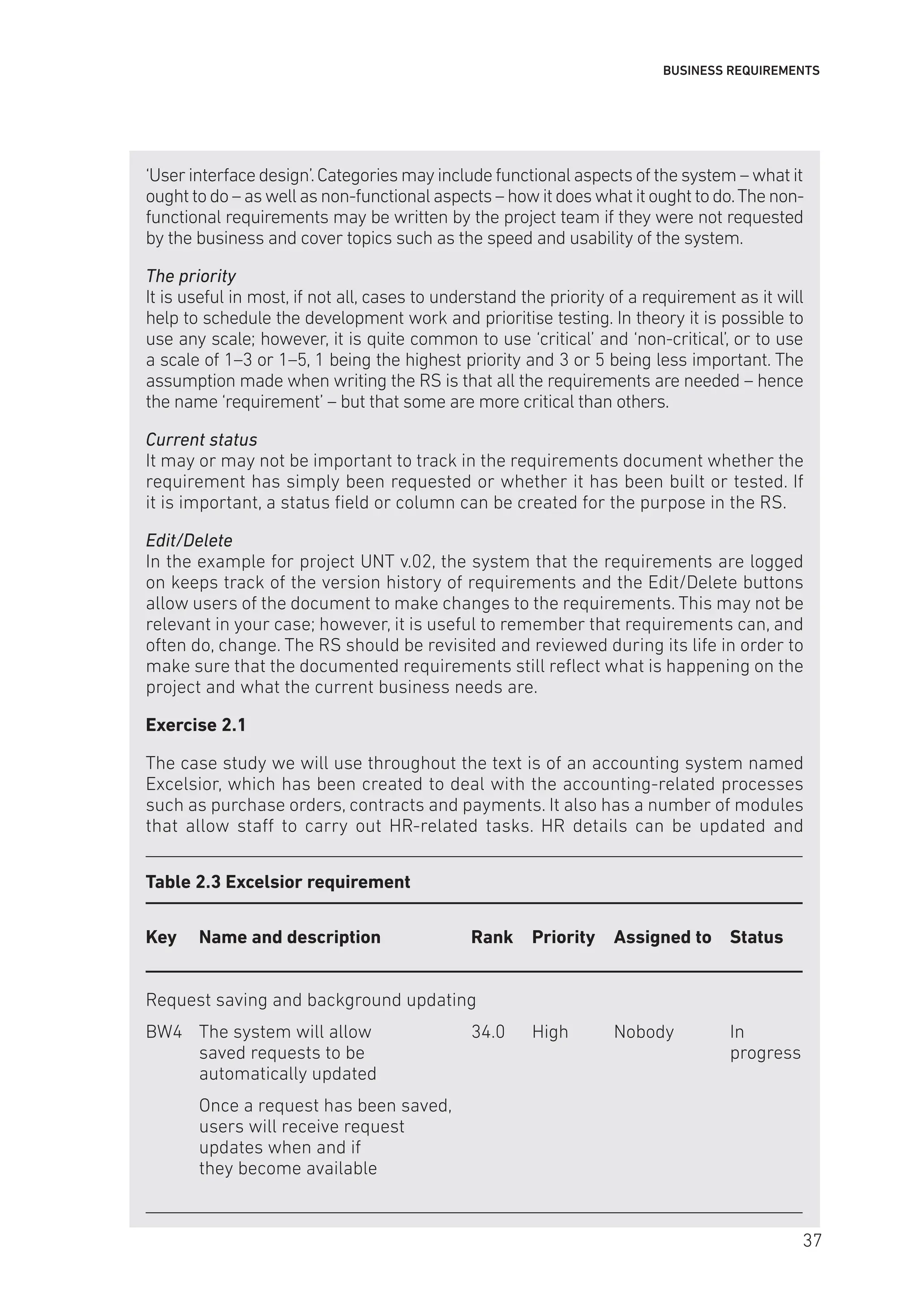
Table 2.3 Excelsior requirement 37
Table 2.4 Use case 53
Table 3.1 Test conditions table 63
Table 3.2 Test cases 64
Table 3.3 Test script 65
Table 6.1 Absence requirements 109
Table 6.2 ATM use cases 112
Table 6.3 Expenses use cases 115
Table 7.1 Login requirements 124
Table 7.2 Test condition matrix 126
Table 7.3 Login use case 129
Table 7.4 Simple login test script 134
viii
LIST OF FIGURES AND TABLES
Table 7.5 A contract data input sheet 141
Table 8.1 Example of a test schedule 149
Table 8.2 Example of a test log 152
ix
AUTHORS
Pauline van Goethem is a freelance UAT and IT training consultant. She has 17 years’
experience of change management, testing and training, helping to deliver IT and change
management projects in industries as diverse as financial services, energy and utilities
and TV and social media. She is a certified tester and Scrum Master and has been
employed as a project manager, business analyst, UA tester, UAT manager, end user
trainer and UAT trainer. She started her own implementation support company in 2006,
specialising in offering training and UAT consultancy and services. Pauline is a member
of the International Software Testing Qualification Board (ISTQB) Glossary review team.
Brian Hambling has spent nearly 40 years in the IT industry in a wide variety of
development, testing and quality management and project management roles. His first
task as a software professional was to acceptance test flight software on behalf of the
RAF and he has maintained a strong interest in the achievement of software quality
throughout his career. He has been an active member of the testing community through
the BCS Special Interest Group in Software Testing, at BCS Professional Certification
(formerly ISEB) as Chair of the Software Testing Examination Board, and at the ISTQB
as a contributor to examination processes and as an examiner.
x
INTRODUCTION
This is a book about user acceptance testing (UAT) in its many forms and the uses
to which it is put. It draws together many strands of material about testing, project
management, quality management, team behaviour and other relevant pieces of the
complete UAT experience and weaves them into a strong and reliable lifeline for the
novice UA tester or stakeholder.
The book has been written to meet the needs of three disparate groups of people.
The first of these groups is those who are directly involved in the UAT exercise. For
this group we aim to provide a practical and fairly complete guide to the testing of
information systems that contain software. As the subtitle indicates, we have adopted
a step-by-step approach to enable them to acquire the necessary terminology (jargon)
and basic principles as they learn about the practical challenges of UAT and how to
deal with them. Within this group we include not only those asked to do the testing
(usually end-users of the system) but also those who will have commissioned the
system and the testing (sponsors) and those who will be expected to deliver the
expected benefits (business managers). The book addresses this group as a whole,
but also identifies the specific challenges and provides a practical guide for each of
the subgroups within it.
The second group is the professional testers or developers who have been asked to
support UAT, or who may simply wish to better understand why UAT is both important
and challenging. For this group we explain what kind of support may be needed and
why, and we explain where UAT fits within the overall context of structured testing and
development life cycles.
The third group is made up of those professionals for whom UAT is an essential ‘tool of
the trade’; project managers, quality managers and test managers for example. For this
group we seek to place UAT within the overall disciplines of testing, quality management
and project management.
Above all the book is intended to explain and explore the significance of an exercise
that is commonly neglected in books about testing and often overlooked in books about
project management and quality management, yet which is a bridge between these
disciplines and, in some respects, is an essential practical expression of each of them.
1
USER ACCEPTANCE TESTING
WHAT THIS BOOK IS ABOUT
Information systems (ISs)
Generally speaking we acquire software to enable us to achieve something of value to
us, such as playing a game, making our first million on the stock exchange, or making
our business run more efficiently. In some cases software can achieve its purpose
without human involvement (except to press a button), but in most cases software
interacts with people in a way that achieves a desired result. For example an air
traffic control system might provide information to air traffic controllers about where
aircraft are, where they are going, how fast and so on. The air traffic controller makes
decisions about where each aircraft should go to ensure they are all safely separated
and the system relays this information to the pilots of the aircraft. So the purpose of the
overall system is to keep aircraft safe and to do that it needs suitably trained people,
the air traffic control software, some hardware and some organisation (for example
to provide communications between air traffic controllers and pilots). Although this is
quite a complex example, it has all the characteristics of an IS. What it most importantly
demonstrates is that software is not something that operates in isolation. What users
are interested in is not just whether the software does what it should do but whether
the system as a whole achieves its purpose and whether they, as users, will be able to
operate the system effectively (and without undue stress).
Characteristics of a system
A system is a collection of interdependent components that interact according to a
plan to achieve a specific goal.
The key thing to remember about a system is that ‘the whole is greater than the
sum of the parts’. So a team focused on a goal can achieve much more than the
team members could achieve individually if they were not a team.
Interdependence means that every part is vital.
Systems only behave like systems when they have a clear purpose.
Characteristics of an IS
An IS is a system comprising humans, computers, organisation, processes and a
single purpose – the business intent.
It is the business intent that makes this collection a system. The components are
interdependent, so neither the computers nor the humans can achieve the business
intent on their own. Organisation and processes manage the interactions.
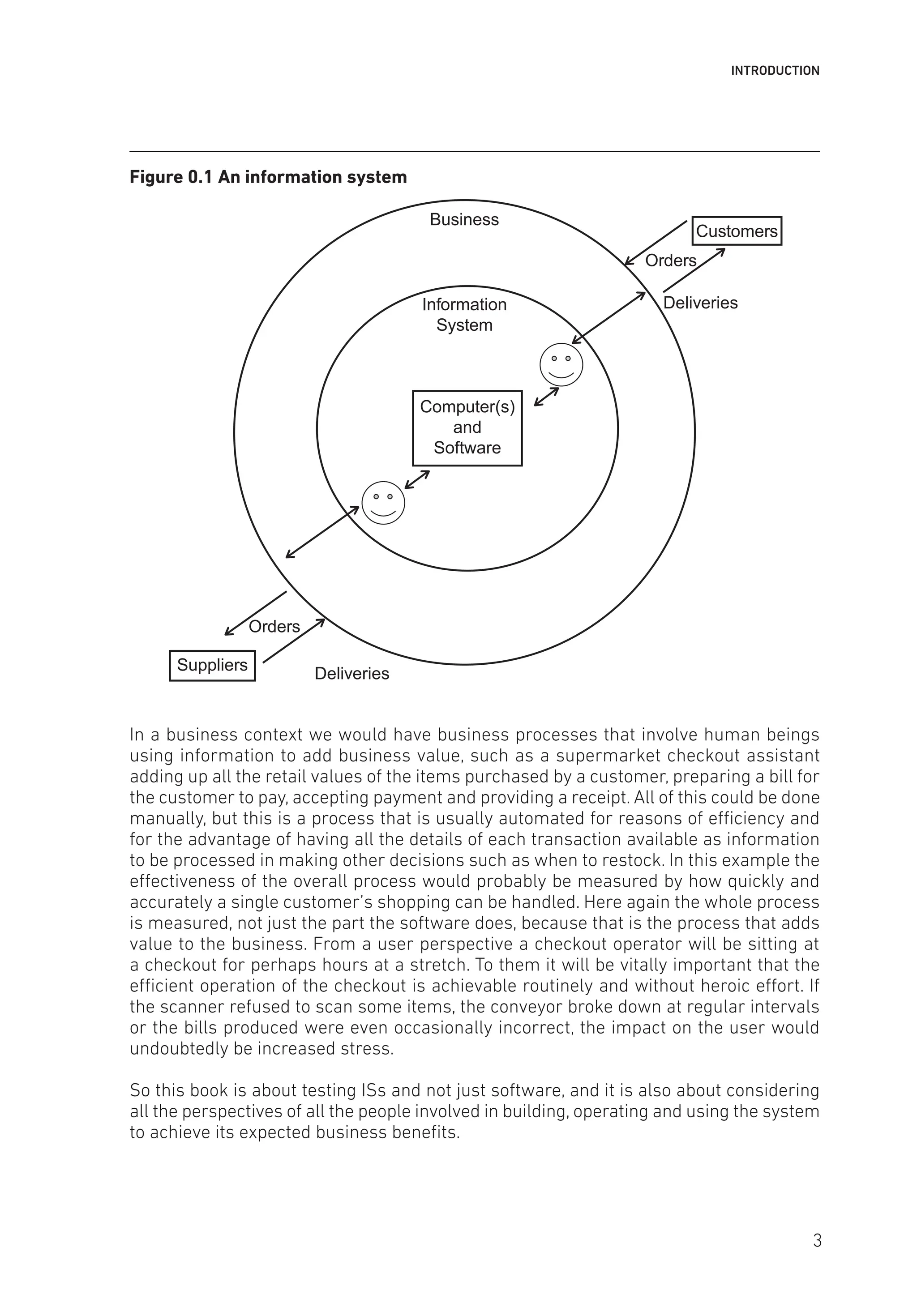
When we build or test an IS we must consider all the components, and the
interactions, and the common business intent. Figure 0.1 provides a schematic view
of an IS for a business.
2
INTRODUCTION
Figure 0.1 An information system
Customers
Business
Orders
Information
System
Deliveries
Suppliers
Orders
Deliveries
Computer(s)
and
Software
In a business context we would have business processes that involve human beings
using information to add business value, such as a supermarket checkout assistant
adding up all the retail values of the items purchased by a customer, preparing a bill for
the customer to pay, accepting payment and providing a receipt. All of this could be done
manually, but this is a process that is usually automated for reasons of efficiency and
for the advantage of having all the details of each transaction available as information
to be processed in making other decisions such as when to restock. In this example the
effectiveness of the overall process would probably be measured by how quickly and
accurately a single customer’s shopping can be handled. Here again the whole process
is measured, not just the part the software does, because that is the process that adds
value to the business. From a user perspective a checkout operator will be sitting at
a checkout for perhaps hours at a stretch. To them it will be vitally important that the
efficient operation of the checkout is achievable routinely and without heroic effort. If
the scanner refused to scan some items, the conveyor broke down at regular intervals
or the bills produced were even occasionally incorrect, the impact on the user would
undoubtedly be increased stress.
So this book is about testing ISs and not just software, and it is also about considering
all the perspectives of all the people involved in building, operating and using the system
to achieve its expected business benefits.
3
USER ACCEPTANCE TESTING
Testing ISs
When we set up a UAT exercise we are testing a system and not just a piece of software,
which means we are really interested in knowing whether the overall IS works. If the
system does not work as we expect, there could be a number of reasons, and among
these is the possibility that the software does not do what it should. But the software
could be working perfectly and some other aspect of the system could be at fault.
To make this as clear as possible we need to take a brief look at how ISs are created –
not in detail but as a high-level view of what happens to an IS from the first idea through
to the realisation. This high-level perspective is usually called a life cycle.
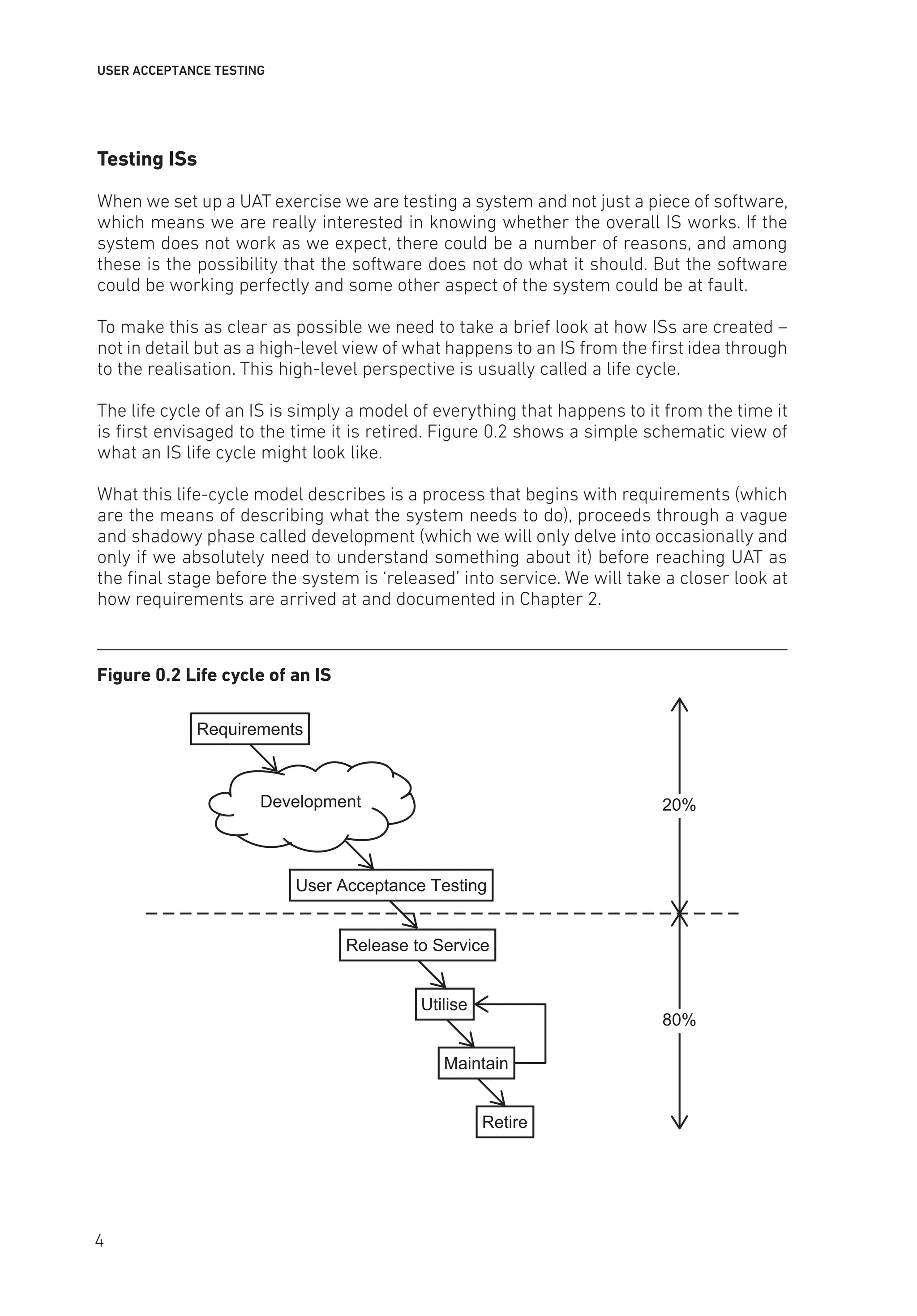
The life cycle of an IS is simply a model of everything that happens to it from the time it
is first envisaged to the time it is retired. Figure 0.2 shows a simple schematic view of
what an IS life cycle might look like.
What this life-cycle model describes is a process that begins with requirements (which
are the means of describing what the system needs to do), proceeds through a vague
and shadowy phase called development (which we will only delve into occasionally and
only if we absolutely need to understand something about it) before reaching UAT as
the final stage before the system is ‘released’ into service. We will take a closer look at
how requirements are arrived at and documented in Chapter 2.
Figure 0.2 Life cycle of an IS
20%
80%
Requirements
User Acceptance Testing
Release to Service
Utilise
Maintain
Retire
Development
4
INTRODUCTION
One key feature of this life cycle is the balance of time, effort and money spent on it. The
part of the life cycle that usually gets most of the attention is the initial development,
even though that accounts for only about 20 per cent of the total spend. Most of a
system’s life is spent in being used, maintained, modified and repaired. The better the
system is at the end of development, the lower that large chunk of life-cycle cost is likely
to be – and the ‘gatekeeper’ between development and the rest of the life cycle is UAT.
Effective UAT can avoid excessive maintenance costs (for example repairing defects),
reduce the cost of modifications (for example to improve the system’s usability) and
prolong the life of the system, so giving a better return on the original investment in
development.
UAT is the final frontier between initial development and the rest of the system’s life,
a frontier beyond which could be a world in which your new IT system makes your life
easier, anticipates your needs, saves you time and always turns out great results – or a
world where using your IT system is a nightmare in which nothing functions, the system
seems determined to prevent you completing your work and the outputs are never what
you wanted.
Anyone accustomed to using IT systems knows that these two ‘parallel universes’
are actually very close together and that predicting which of those worlds you will be
transported to when your system is declared operational is not easy. That is the role of
UAT – to provide a glimpse of the future (just) in time to avert a disaster if that is what
you foresee and to give the users the best possible start with using the system.
THE ROLE OF UAT
UAT is a test of an IS from the perspective of the users and other stakeholders for whom
it has been built or acquired. UAT is not just a test of the software, nor of the functionality,
performance, reliability and security, nor of the usability of the system. That does not
mean UAT is not concerned with any or all of those areas, but that its primary concern
and absolute focus is on whether or not the system can deliver the expected business
benefits when operated by its designated users. All of the specialist areas mentioned
will have, or certainly should have, been tested during development. None of those tests,
however, answers the question ‘Is the system fit for purpose?’ UAT answers that question
unequivocally by testing it against the reason it was built or acquired, using the eventual
end-users as testers and, as far as possible, utilising the user documentation prepared
to support their use of the system. This will entail not just exercising the system in
some random or even structured way; it will entail using the system to enable business
processes that deliver value using realistic (or actual) scenarios, data and operations. UAT
is the nearest we get to ‘the real thing’ without actually taking the risk of releasing the
system into service, and it is the exercise that will enable us to make a rational judgement
about whether to take the risk of releasing it into service.
THE COSTS AND BENEFITS OF UAT
UAT is an expensive exercise. As well as the hard costs of actually doing the testing,
we have to factor in the additional time that development resources are tied up before
roll-out of the system allows them to be released to other projects.
5
USER ACCEPTANCE TESTING
The largest components of the direct cost of UAT are:
y
y The cost of diverting end-user staff from their normal work to plan and carry
out UAT. As well as salary costs there is the loss of whatever revenue the staff
would have generated or the delay in realising that revenue.
y
y The cost of training or familiarisation for the UAT team (and subsequently for
all end-users).
y
y The cost of test environments for UAT.
A UAT exercise with a team of six staff that takes two weeks to complete might have
direct costs of around £6,000–£10,000 for salaries alone.
What do we have to offset this cost?
THE VALUE OF UAT – THE REASONS WE NEED TO DO IT
In case you are not convinced of the need to go to the time and expense of a UAT exercise,
we will take a brief look at the world of ISs and what can go wrong with them.
Reason 1: risk management – avoiding expensive failures
HIGH-PROFILE IT FAILURES
US trading systems, unable to cope with the number of transactions, fail causing
panic among sellers.
On Friday 17 October 1987, after a number of Securities and Exchange Commission
(SEC) investigations of insider trading and the London stock market closing due to
severe weather conditions, it looked like a sustained period of growth was going
to come to a sudden halt for the US stock market. On Black Monday the crash
started in Far Eastern markets and, after a weekend of worrying about their shares,
investors sold stock in a mass exodus of the market, generating a flood of sell
orders and crashing trading systems. As a result more than 20 per cent was wiped
off the value of the US stock market in a single day.
A new computer system means 500,000 UK passports cannot be issued on time.
In the summer of 1999 the UK Passport Agency brought in a new Siemens computer
system without sufficiently testing it or sufficiently training staff on how to use it.
At the same time an unusually high demand for passports was driven by a change
in the law, which meant that children under the age of 16 required their own
passport when travelling abroad. As a result the Home Office had to pay millions in
compensation for missed holidays and staff overtime.
A memory leak in the London Ambulance Service’s new emergency dispatch system
leaves 46 people dead.
Before 1992, office staff decided what ambulances should be dispatched where
and it seemed that there were efficiencies that could be achieved by using a
6
INTRODUCTION
computerised system. Just a few hours after it was deployed problems began to
arise with the new system. The root cause of the main breakdown of the system
was a memory leak in a small portion of code. The system retained memory about
incident information on the file server even after it was no longer needed. As with
any memory leak, after enough time, the memory filled up and caused the system
to fail. The next day, the Ambulance Service switched back to a part-manual system,
and shut down the computer system completely when it stopped working altogether
eight days later. In those nine days the lives of up to 46 people might have been
saved had an ambulance been able to get to them in time.
Microsoft rushes to release a flawed games console to stay ahead of the competition.
The Xbox 360 games console was released by Microsoft in November of 2005,
just ahead of Nintendo’s PlayStation. It quickly became clear that the Xbox was
subject to a number of technical problems and failures; a series of glowing red
lights flashing on the face of the console, later nicknamed the ‘Red Ring of Death’,
being the most well known. It was not until 5 July 2007 that Microsoft published an
open letter recognising the console’s problems, as well as announcing a three-year
warranty for every Xbox 360 console that experienced the general hardware failure.
The design issues were alleged to be the end results of management decisions and
inadequate testing resources prior to the console’s release.
Not all ISs end in high-profile failure; many are highly successful and trouble free over
a long life, but it is nevertheless true that the statistical likelihood of failure for an IS is
relatively high.
In 1995 The Standish Group published a report based on research into a large number
of failures in software systems. It was called the CHAOS report (The Standish Group has
never revealed what the acronym stands for, only conceding that a few select people
in the organisation know) and it contained some frightening statistics, for example that
only 16.2 per cent of IS projects were completed on time and on budget. Worse still,
completion often required significant watering down of the original specification for
these systems.
The statistics relate to system failures and these are not necessarily related to UAT,
but the CHAOS report analysed their statistical evidence and identified key factors
that contributed to failure. These factors point to problems in some aspects of system
development that UAT can throw some light on, such as lack of user involvement and
poorly defined requirements.
The original CHAOS report was published quite a long time ago, but The Standish Group
has repeated its research and published updated results over a number of years. The
results have gradually been improving with the introduction of agile project models
and a greater awareness of the issues that cause projects to fail. The 2011 edition of
the CHAOS report found that 37 per cent of all projects succeeded and Jim Johnson,
Chairman of The Standish Group, stated, ‘This year’s results represent the highest
success rate in the history of the CHAOS research. We clearly are entering a new
understanding of why projects succeed or fail.’ Although the results show a significant
improvement on the original 1995 figures, it is a sobering thought that, even with these
7
USER ACCEPTANCE TESTING
unprecedented results, 63 per cent of projects in the study did not succeed. Although
other researchers have criticised The Standish Group for providing little or no context
to its figures, for instance by not distinguishing between projects where going over
the deadline means failure and those where an reasonable overrun can be easily
tolerated, nevertheless the CHAOS report presents a very useful list of the key factors
that contribute to project failures, the knowledge and application of which can benefit
any project. We shall explore some of these factors and how we can learn from them
in Chapter 1.
Avoiding high-profile disasters or even low-profile mishaps is not solely about
performing effective UAT of course. By the time we get to UAT the seeds of failure have
not only been sown, they may well have already germinated; but well-planned UAT may
still be able to highlight the potential for disaster before it actually happens. This is an
important reason, but not the only one, for doing UAT.
Reason 2: confidence building – achieving expected business benefits
If we have acquired some expensive software or some software designed to do
something really important for our business, we need to be sure before we accept it
that we have minimised the risk of it not doing the job we acquired it for. This is not just
a repetition of disaster avoidance, but a form of ‘good housekeeping’ that ensures we
have addressed all the things that could go wrong when we start to use the system.
Many of these may be only small things, but they can add up to a problem in service, and
some of these smaller issues may not have been addressed by the testing done during
development, which was designed to ensure the system meets its specification rather
than ensuring that the users will be able to use it effectively. In Chapter 3 we will show
how risk-based testing can be used to minimise the risk.
We will also need to be sure that the people who use the software will get the expected
productivity or other benefits and that the business will get the efficiency or other
improvements we intended. To do this we need to put the system to use in a realistic
environment and work through some examples of situations in which it is expected to
add value, such as streamlining processes or reducing the cost of production. This kind
of testing will be based on an understanding of how the system will be used to gain
business benefits and setting up a realistic ‘trial’ to see that it is capable of delivering
those benefits. We explain in Chapter 6 how we can set up this kind of test.
Reason 3: assessment – getting the business processes right
As well as making sure that the system will not only do what it is supposed to do but will
also be usable by our staff, we need to give the end-users an opportunity to exercise the
system in whatever way they have agreed to work to make it effective. Users will need
to check system behaviour as part of the overall business processes, using it in the way
that has been agreed. We will not only treat the system as an IS and test its behaviour
when the intended business transactions are passed through it, but we will also test that
end-users can operate the system in the way that is needed to make those processes
work effectively.
One further benefit of UAT is that the act of determining a system’s fitness for purpose
necessarily involves comparing the system’s behaviour with user expectations. If the
8
INTRODUCTION
comparison is done systematically and formally, then the primary ‘result’ of UAT may
be to accept or not to accept the system. A valuable secondary result, though, is that
the comparison will have generated a detailed understanding of how well the system
matches expectations. This comparison can be made the basis of an assessment of
the system’s current capability and value to the business, which in turn can be used
to underpin a strategy for future development or enhancement. It enables us to know
exactly what the strengths and weaknesses of the system are and to assess value for
money and potential for improving business value from the investment in development.
Reason 4: preparation – assessing readiness for service
Finally we want to be sure that the software is fit to release into the business and that the
business is ready to make use of it, so we will need to assess readiness. After we have
completed the testing based on risks, benefits and usability, we may have discovered
some problems that need to be resolved, some defects that need to be corrected or some
other aspect that needs to be addressed (such as training). The combination of these
things will have an impact on when a system will be completely ready for the users to
take on. This aspect of readiness is about how robust the system is in operation, how
closely it fits expectations, how many ‘workarounds’ have been found necessary and a
host of other factors that may affect whether or not the system is ready to deliver value
to the business. This is usually a matter of discussion and negotiation, and results in a
decision to release the software. Chapter 9 will explore the mechanisms we can put in
place to make that decision as objective as possible. If we consider this aspect of UAT well
in advance (as we should), we can define a set of acceptance criteria that will be used to
come to a decision about release and so avoid the conflicts that can arise at this stage.
One important thing to say in this context is that UAT is distinct from training,
familiarisation and all other aspects of roll-out. It has its own set of objectives that
would be seriously jeopardised if UAT was carried out by unprepared, untrained end-
users who were unfamiliar with the system. Having said that, however, the experience of
UAT will be a learning exercise that is second to none and the experience gained during
UAT can be captured and utilised in training, familiarising and preparing the end-user
population for using the system effectively – including dealing with any issues raised by
UAT for which ‘workarounds’ have been defined.
THE ENIGMA OF SOFTWARE
It is always difficult to pin down the cost of software, but it is true that the case
usually made for acquiring software – that it saves staff costs – has been shown
to be invalid in most cases. Software is expensive to acquire and operate over its
complete life cycle from inception to disposal.
A second key characteristic of software is its inflexibility. We imagine software to be
very elastic, so that we can change it at will, but this is far from the truth. While it is
very easy to change a line of code (in the sense that code can be updated at almost
no cost because it is electronic and lives on a machine that can alter its contents
instantly), it is very difficult to change the behaviour of a software application in a
way that has no negative consequences and meets all our expectations. Software
9
USER ACCEPTANCE TESTING
is actually very inflexible as a tool for achieving a business purpose. Once installed
the cost and impact of modification can be, and often is, very high.
Thirdly, software is not visible. It has no moving parts and so has nothing that we
can see operating. When it stops working it does not ‘break’ in the way that physical
systems do. The computers usually keep operating and doing something; they
just stop doing what we want them to. This can be very frustrating especially if
we find that the software is not malfunctioning at all, but just responding to some
unexpected input.
These three characteristics make software a difficult medium to work with and a
difficult business tool to operate unless it is working exactly as we expect it to.
The enigmatic nature of software as a medium makes the risk associated with
deploying ISs containing software significant and UAT is the best mechanism we have
for managing that risk for the user community. We have already stated that the main
reason why UAT is a worthwhile exercise is that it can help to avoid some of the costs of
dealing with failures and of modifying the software after its acceptance. The potential
costs of failure can be judged from the case study examples, but the cost of failure is
invariably higher than expected in a business context because of the ramifications of
failure in the tightly knit relationship between business processes and ISs.
There is also one other major benefit from UAT.The skills and newly acquired experience,
combined with the invaluable experience that stakeholders bring with them to UAT, have
enormous potential value in preparing for and achieving a painless roll-out. Beyond that,
the insights gained by those spending time in testing a system can be harnessed to
enhance future business process development, training and support. There is potentially
a massive benefit to be reaped from the experience of UAT for the individuals concerned
and for the business as a whole.
STAKEHOLDERS – WHO THIS BOOK IS FOR
This book is aimed at the groups of people who together comprise the principal
stakeholders of UAT:
y
y sponsors (typically owners or senior managers who have decided to acquire
software of some kind to enhance their business);
y
y business managers, who will be responsible for ensuring the IS delivers the
expected business benefits;
y
y end-users, who will be most interested in the way they are able to interact with
the system to achieve their tasks;
y
y professional developers and testers, who will be concerned with providing the
most effective support for UAT;
y
y managers of processes, practices and standards, who will take an interest in
making UAT a cost-effective process using best practice.
10
INTRODUCTION
In each of these groups there may be some who have no experience of testing at all and
for whom an assignment to a UAT team is a daunting prospect.
If you are in this category then this book is for you, and it speaks to you very directly:
y
y by using non-technical language wherever possible;
y
y by assuming no prior knowledge of testing at all;
y
y by identifying what you need to do in a step-by-step fashion;
y
y by providing case studies, examples and exercises for you to practise at least
some of the tasks.
If you are a sponsor and are in the process of acquiring a new IS, the book will identify
the role of UAT in ensuring you get the system you are expecting, but it will also help
you to understand how UAT fits into your overall planning and what benefits it brings in
terms of training and supporting the inevitable change to working practices that new
ISs invariably bring.
If you are a business manager who will be responsible for the effective operation of
the system in achieving business benefits, the book will explain how those benefits are
defined and measured and how you can ensure UAT is shaped to provide you with the
information you need to prepare for the system’s release into service in your part of
the business.
If you are an end-user tasked with testing an IS, the book will provide you with all the
tools and techniques you will need to be an effective UA tester.
If you are in the group of ‘interested professionals’ who may need to support UAT, you
will find in this book a clear exposition of how and where the world of UAT interfaces
with the work of professional developers and testers and how best to manage that
interface and support the UAT activity.
Finally, if your role involves managing and enhancing practice of some kind as a test
manager,quality manager or project manager,you will find the book useful as a manual of
key techniques, methods and tools. Quality managers wanting to improve UAT practices,
for example, will find here a comprehensive review of UAT from which best practice can
be distilled and then customised to fit your organisational culture, size and budget.
HOW TO GET THE BEST FROM THIS BOOK
The two main premises of this book are:
1. We can and must make UAT effective to reduce the risk and cost of
underperforming ISs.
2. The benefits of UAT outweigh the costs.
To explain why and how these results can be achieved the book has been structured as
described below.
11
USER ACCEPTANCE TESTING
The first three chapters provide all the background and justification for a step-by-step
approach to UAT:
y
y Chapter 1 – The Importance of UAT;
y
y Chapter 2 – Business Requirements;
y
y Chapter 3 – Testing Basics for UAT.
The next two chapters are dedicated to the practical issues of creating, shaping, training
and deploying an effective UAT team:
y
y Chapter 4 – The UAT Team;
y
y Chapter 5 – UAT as Transition.
The remaining chapters explain the step-by-step approach in practical detail:
y
y Chapter 6 – Preparing for UAT – Planning;
y
y Chapter 7 – Test Design for UAT;
y
y Chapter 8 – Implementing the Tests;
y
y Chapter 9 – Evaluating the System;
y
y Chapter 10 – Life after UAT.
We sincerely hope that all readers of the book will find it interesting and rewarding
enough to want to read it from cover to cover. However, the first encounter with any
book of this kind needs some kind of plan to extract the maximum value in the minimum
time to provide a starting point from which a more detailed exploration of the content
can begin. The initial route through the book naturally depends on your starting point.
All readers are strongly advised to read Chapters 1–3 as general background and as
preparation for the practical approach later in the book.
Those responsible for managing a UAT team should read Chapters 4 and 5, and all those
selected to take part in UAT will gain an understanding of the skills needed and the style
of operation for a UAT team by reading these two chapters.
All readers are encouraged to read Chapters 6–10 although some chapters will be more
relevant to some groups than to others. Within these chapters all of the stakeholders are
considered and information of particular importance to one group or another is labelled
appropriately to guide your initial reading.
CHECKLISTS
Whatever approach you take to reading the book you will be guided through all the key
steps in UAT through Chapters 6 – 10. Your reading should help you to understand what
the key steps are and why they are ordered as they are.
12
INTRODUCTION
To help you in applying what you learn from the book, you will find a set of checklists
for all the major steps in UAT at Appendix A. The purpose of the checklists is to present
the key steps in a logical order, uncluttered by explanation, but also indicate where you
can find supporting material in the book. We hope you will find these useful when you
come to apply the step-by-step approach to your projects.
CASE STUDIES
Throughout the book we will make use of case studies, examples and exercises. The
case studies are used to provide documented real-life examples of the things we
are talking about; the examples will give you practical guidance on how to use the
techniques, methods and approaches we present; the exercises will provide you with
opportunities to try out some of the techniques.
In addition to these in-text components we end each chapter with a few multiple-choice
questions that you can use as a check that you have understood the key ideas in the
chapter and we also provide you with questions that you might like to think about. These
raise some of the issues and challenges that you might face as a user acceptance (UA)
tester and give you an opportunity to think about them before you have to deal with
any real challenges in a project context. We have provided answers to all the exercises
in Appendix B so you can check your answers against ours. The more open-ended
questions at the end of the chapters have no correct answer, but we have included
some of our own thoughts on these questions that you can read if you want to. We make
no claims about these being the best responses to the questions, but they are the ones
that we have developed from our experience.
Finally, before we progress on to Chapter 1 and take the first step in introducing the
UAT process, we are going to introduce you to a small imaginary company called HMF
that is acquiring an IS. We will use the HMF case study mainly to wrap around the
more significant examples we provide, especially in Chapters 6–9, to provide continuity
of ideas and hopefully to help you see how information is built up at each step of the
approach for use in later stages.
CASE STUDY – HMF AND THE EXCELSIOR SYSTEM
HMF is a web-based insurance company offering low-cost insurance solutions for
a broad range of domestic and commercial risks. HMF has rapidly developed its
product range by acquiring smaller specialised insurance providers and integrating
their specialised products into its own platform.
HMF has recently conducted a rationalisation programme to ensure that staff
numbers and skills are optimal for the integrated product range and to harmonise
processes across the business. The rationalisation exercise revealed that
accounting and human resource (HR) practices had become fragmented after
multiple acquisitions and integrations, and a decision was taken to develop an IS
to support common accounting practices across the business and, as a secondary
objective, to enhance HR process integration. At the heart of the IS a new software
package, known as Excelsior, was specified to run on existing HMF servers.
13
USER ACCEPTANCE TESTING
The Excelsior accounting system was commissioned as a custom-built accounting
solution based on a collection of standard accounting modules configured in an
architecture that supports full integration of all the modules’ services and also
enables selected HR applications to be incorporated. The development will be
incremental to allow basic functions to become well established before adding
further complexity and the first incremental delivery is now ready for UAT. At the
current stage of development the accounting functions available will be:
y
y general accounting;
y
y purchase orders;
y
y contracts;
y
y payments.
In addition the following HR services will be available:
y
y absence (to book days off, sickness and other absence and manage
requests for absence for a team);
y
y expenses (to enable submission of expenses forms and receipts for
payment and to approve expenses related to a team);
y
y changing contact and bank details and updating personal details held by HR;
y
y internal purchase orders (request purchases and approve purchases
related to a team, marking a purchase order as fulfilled);
y
y training (request training, take online training, record training attendance);
y
y administration (support and managerial functionality);
y
y jobs (search for, list or apply for vacancies, approve applications related to
a team).
Each module has a unique title related to Excelsior, for example Excelsior – Training.
Every service is listed on the main menu on the Excelsior home page but access is
restricted for some modules. Users are granted access to services based on their
role-based login profile. Where access is denied, a link appears that allows users to
request access from the appropriate person.
We hope you find HMF and Excelsior, and all the case studies, examples, exercises and
the questions at the chapter ends, helpful in bringing the ideas to life and enabling you
to gain some insight into what is happening during a real UAT exercise.
14
1 THE IMPORTANCE OF UAT
The introduction presented some general concepts that help to get a better understand-
ing of UAT and introduced examples of high-profile project failures that, if not caused
by UAT, were certainly not prevented by it. Chapter 1 provides an overview of UAT, its
purpose and its relationship to an implementation project and the people who take part
in it. You will find out why UAT is different from other types of testing and yet often uses
the same processes – one of which is the fundamental test process. Finally you will
discover what the different types of UAT are, who the stakeholders of UAT are and what
each role has to offer to and to gain from the UAT process.
Topics covered in this chapter
y
y What is UAT?
y
y Why test information systems?
y
y Business vulnerability
y
y The UAT process
y
y From UAT to service delivery
y
y UAT and contracts
y
y Stakeholders in UAT
WHAT IS UAT?
UAT stands for user acceptance testing and is commonly used to refer to the end-user
software testing carried out prior to a new information system (IS) being introduced to
an organisation. The primary objective of UAT is to ensure the new system does what it
set out to do and meets the requirements the business has of it. Here is a definition of
the term UAT taken from the ISTQB Glossary of Testing Terms:
Formal testing with respect to user needs, requirements, and business processes,
conducted to determine whether or not a system satisfies the acceptance criteria
and to enable the user, customers or other authorized entity to determine whether
or not to accept the system.
15
USER ACCEPTANCE TESTING
THE INTERNATIONAL SOFTWARE TESTING QUALIFICATIONS BOARD (ISTQB)
ISTQB provides certification at Foundation, Advanced and Expert levels for software
testers. The certificates are supported by a glossary available free from www.istqb.
org/downloads/glossary.html. We will use the ISTQB Glossary throughout this
book because it is widely used in the testing community and in tester certification
programmes.
You may also find the following related books, which also use the ISTQB Glossary,
helpful if you want to increase your knowledge of testing: Software Testing: an ISTQB-
ISEB Foundation Guide by Brian Hambling (Ed), Peter Morgan, Angelina Samaroo,
Geoff Thompson and Peter Williams; Software Testing: An ISEB Intermediate Certificate
by Brian Hambling and Angelina Samaroo.
Three aspects of this definition are important and will drive what we do in preparing
and implementing UAT:
1. UAT requires ‘formal testing’, which means that tests should be designed
and executed in a structured way that provides objective evidence of the
acceptability or otherwise of the system.
2. The definition speaks of testing with respect to ‘user needs, requirements,
and business processes’. It does not mention any particular specification
document but it does draw attention to what users need and it goes beyond
testing software to include business processes.
3. The definition speaks of satisfying ‘acceptance criteria’, which define what is
acceptable to the users.
We will explore all three of these key ideas in the book and we will be developing our UAT
around acceptance criteria and formal testing of user needs and business processes.
Although other testing takes place before UAT is carried out, UAT is unique in that it is
the first time the completed system is tested by users against user needs. Testing during
development is based on ensuring that what is delivered matches the corresponding
technical specification,but the fit between an IS and its business users is more intimate and
it is the unique user perspective that can identify the problems of fitness for purpose in a
business context.Without it a system that has been tested by developers and professional
testers, and which has passed every test, can still fail at the first hurdle of real use.
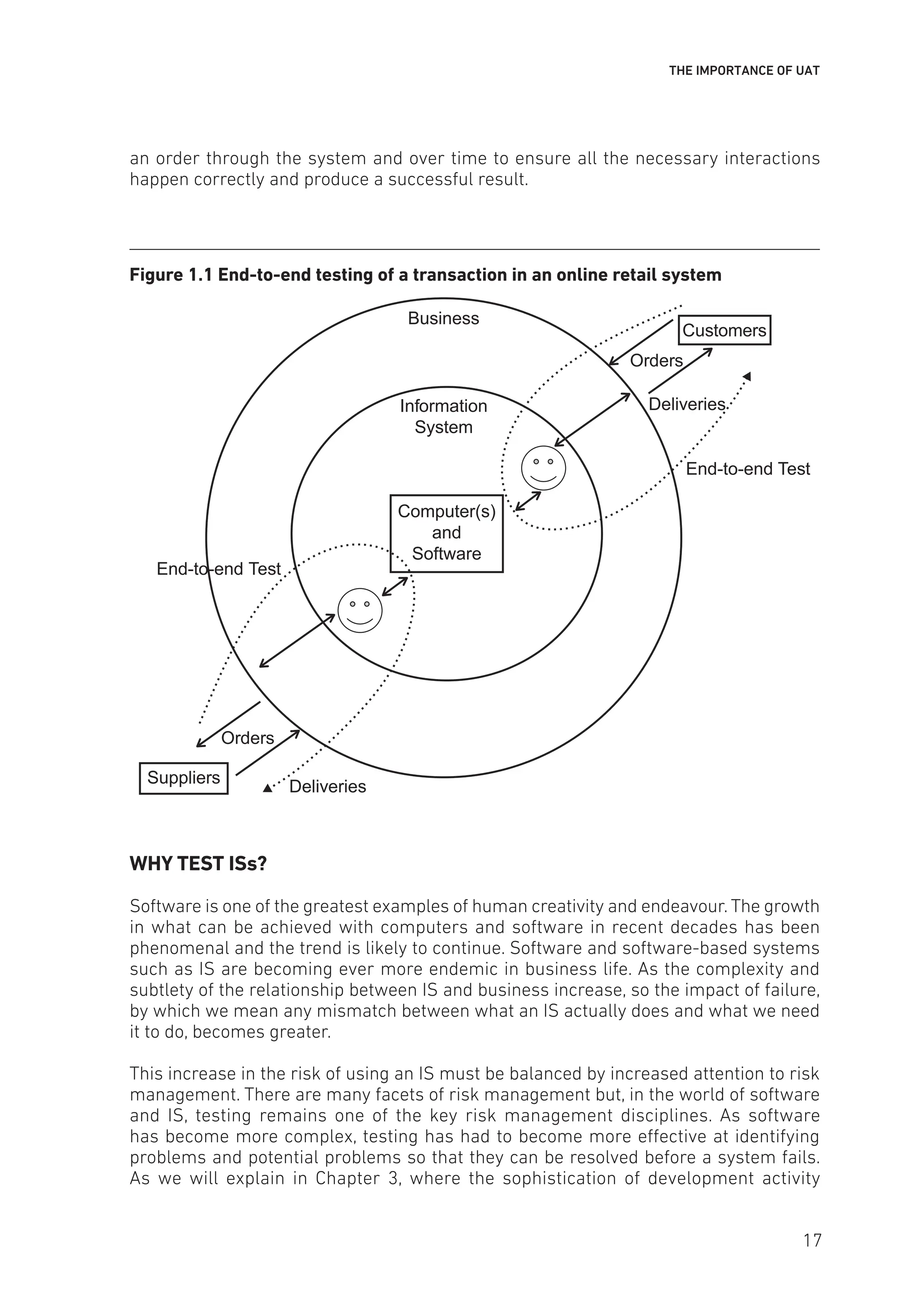
That is why UAT needs to include ‘end-to-end’ testing that exercises complete business
processes, including the computer system, rather than testing the computer system
in isolation (Figure 1.1). For example in an online retail system, a test of the ordering
process must check that an order placed by a customer is accepted and that it triggers
identifying, packaging and shipping of the correct product. But these processes must
trigger other processes to complete a transaction, for example that the order generates
and sends a correct invoice and that payment received is correctly matched with the
invoice to close the transaction. Although the scenario is simple, this is a fairly complex
set of interacting processes and there is also a time lapse between the initial order and
the payment of the invoice, so a full end-to-end test of the transaction will need to follow
16
THE IMPORTANCE OF UAT
an order through the system and over time to ensure all the necessary interactions
happen correctly and produce a successful result.
Figure 1.1 End-to-end testing of a transaction in an online retail system
Customers
Business
Orders
Information
System
Deliveries
End-to-end Test
End-to-end Test
Suppliers
Orders
Deliveries
Computer(s)
and
Software
WHY TEST ISs?
Software is one of the greatest examples of human creativity and endeavour. The growth
in what can be achieved with computers and software in recent decades has been
phenomenal and the trend is likely to continue. Software and software-based systems
such as IS are becoming ever more endemic in business life. As the complexity and
subtlety of the relationship between IS and business increase, so the impact of failure,
by which we mean any mismatch between what an IS actually does and what we need
it to do, becomes greater.
This increase in the risk of using an IS must be balanced by increased attention to risk
management. There are many facets of risk management but, in the world of software
and IS, testing remains one of the key risk management disciplines. As software
has become more complex, testing has had to become more effective at identifying
problems and potential problems so that they can be resolved before a system fails.
As we will explain in Chapter 3, where the sophistication of development activity
17
USER ACCEPTANCE TESTING
has increased, testing has also had to become more sophisticated. Why? Because
with greater complexity comes greater risk of human mistakes in design and in
implementation; because greater integration between human activity and the systems
that enable it brings more opportunities for mismatch; and because the many essential
characteristics of ISs (such as reliability, usability and security) all need to be assured
before the system can be trusted to deliver its services in a real business situation.
The increased dependence of business on IS has also made the relationship between
systems and business processes more critical to business success, and in many cases
the desired behaviour of an IS cannot be adequately described in technical specifications.
Most testing during development is based on ensuring that what is delivered matches
the corresponding technical specification, but the fit between an IS and its business
users is more intimate and more critical than the fit between craftspeople and their
tools; it is rather more like the fit of a garment that is ‘made to measure’ so that an
individual can work comfortably and effectively in it all day and every day. Whether
that kind of fit has been achieved is not something that can be determined by anyone
other than the user. That is why UAT is different from all other kinds of testing and also
why users must take part in it. It is the unique user perspective that can identify the
problems of fitness for purpose in a business context and, without it, a system that has
been tested by developers and professional testers, and which has passed every test,
can still fail at the first hurdle of real use.
REASONS WHY WE NEED TO TEST
The fact that we live in an imperfect world is, at the most basic level, why we may
have trouble creating a perfect IS and why it is important to test them.
There may be many reasons why requirements do not exist at all or are not complete
and up to date:
y
y It is often hard for the sponsor or end-users to imagine what their
requirements are going to be. Ideas about what the system should become
change over time and in the context of development.
y
y Even when the requirements are clear in the minds of the sponsor or
end-user, they may have trouble communicating the requirement. What is
written in the requirements document may therefore not reflect what was
intended.
y
y If the requirements reflect what was intended by the sponsor or end-user,
the developers may interpret requirements incorrectly because they will
bring their own assumptions to the process.
y
y Even if correctly imagined, communicated, written and interpreted,
developers may make mistakes when writing the code that creates the
functionality described in the requirements because they are human and
therefore fallible.
All of these have been cited as significant issues in studies of why systems fail.
18
THE IMPORTANCE OF UAT
BUSINESS VULNERABILITY
The relationship we have with IS in business is a unique one. In most cases the system
does not just make our lives a little easier; it actually carries on some or all of our
business processes in a way that may be difficult or even impossible to do manually
once the system is in place. The intimate relationship between businesses and the ISs
that serve them makes us particularly vulnerable when a system is first introduced or
when it is changed or updated. The term ‘business critical’ is often used for systems
that have a significant impact on the way a business operates and delivers its services.
To be clear, this is not just about avoiding high-profile failure; it is about ensuring that
each and every time we initiate a new IS or change the relationship between a business
and its IS, we take care that the new relationship will be as we expected and planned
it to be.
The UAT process is the last, and arguably the most important check, before an IS is
rolled out. ISs are becoming more and more embedded in business processes and
in delivery of business value and, as a result, they are also becoming more complex.
The combination of the complexity and business criticality of ISs leaves little margin
for error.
THE CHAOS REPORT – THE STANDISH GROUP
The Standish Group was formed in1985 by a group of IT professionals whose aim
was to collect case information on real-life IT failures in order to improve IT project
success rates. The original CHAOS report, published in 1994, examined 8,380
projects in order to determine whether they were successful and, if not, what the
causes of the failures were. The report found the following percentages of projects
were successful, unsuccessful or impaired:
y
y Successful projects completed on time, within budget, containing all the
features and functions initially specified – 16 per cent.
y
y Challenged projects completed and working, but over budget, over time and
offering fewer features and functions than initially specified – 53 per cent.
y
y Impaired projects cancelled at any point during the development cycle or
not used post-completion – 31 per cent.
The report also identified the reasons for the failures, listed from the most often
occurring to the least often occurring:
1. incomplete requirements;
2. lack of user involvement;
3. lack of resources;
4. unrealistic expectations;
5. other;
6. lack of executive support;
19
USER ACCEPTANCE TESTING
7. changing requirements and specifications;
8. lack of planning;
9. did not need it any longer;
10. lack of IT management;
11. technology illiteracy.
The 2011 edition of the CHAOS Manifesto, an annual report from The Standish
Group that examines trends in software project success, found that in a marked
improvement on the 1994 figures 37 per cent of all projects succeeded, 42 per
cent of projects were challenged and the remaining 21 per cent were considered
a failure. Notably, however, the majority of projects are still challenged or impaired
according to their findings.
Not all the reasons listed are relevant to UAT, but those that are relevant will be at
the forefront of our thinking when planning and executing UAT activities.
The massive disruption to NatWest Group customers following a routine update to
its software is an example of what can happen when systems do not perform as
expected in a business-critical environment such as banking. The introduction of a
new baggage-handling system for Heathrow Airport’s new Terminal 5 is another
recent example.
THE HEATHROW TERMINAL 5 OPENING
In March 2008 Willie Walsh, CEO of British Airways (BA), gave evidence to the House
of Commons Transport Committee about the problems with the opening of London
Heathrow Airport’s Terminal 5. In his evidence he said:
... we had compromised on the testing regime as a result of delays in completing
the building programme and the fact that we compromised on the testing
of the building did impact on the operation of T5 in the first few days after its
opening.
In the first five days of operation the cost to BA of the operational problems
was estimated at £16 million and a total of 23,205 bags were ‘misconnected’.
The extensive delays experienced by passengers, the sight of the unfinished
buildings and the problems caused by delays and unprepared staff also caused
embarrassment to BA, the British Airports Authority (BAA) and the UK government
(House of Commons Transport Committee 2008). One of our main aims in this
book is to explain why these kinds of outcomes happen and how they can be
avoided.
Meticulous planning, use of highly experienced and competent practitioners and good
project management are all essential to success, but they are not enough. We need
20
THE IMPORTANCE OF UAT
to know exactly what will happen from the point when the first real user logs on to
a system, and no amount of time and money spent on modelling, problem solving,
focus groups, contingency planning or any other discipline will tell us what we need
to know as effectively as a well-planned, well-structured and well-designed UAT. The
immediate cost of failure (£16 million in a few days in BA’s case) and the ongoing
impact on a business of even a small interruption in a key service, such as paying
bills through a bank, have a huge impact – significant enough to cause even large
companies to fail.
It is important to understand at this stage that although UAT has so far been described
as the activity that can verify the usefulness of the new IS and save a project from
going horribly wrong, UAT may not be perceived as such by others. UAT is sometimes
perceived as an expensive evil that interrupts ‘business as usual’, diverts important
staff, and costs a disproportionate amount of time and money. The number of high-
profile failures associated with releasing software systems that were not ready ensures
that most organisations make at least some attempt at an acceptance test, often by
pressing reluctant users into an activity in which they feel well outside their ‘comfort
zone’. Does this have to be the case? Can we make UAT an exercise that is independent
of the IT community that built the system yet in partnership with it to achieve the best
possible result? The premise of the book as a whole is that we can.
Before we embark on UAT we need to be sure that the cost and effort are worthwhile
and we also need to understand the activity well enough to do the best job with the
fewest resources. If we understand the activities of UAT well enough to carry them
out effectively, the parties involved in UAT should be well prepared, the testing should
prove the usefulness of the system and little testing time should be wasted or subject
to delay.
THE UAT PROCESS
The process we will describe in this book will take you through each stage of achieving
successful UAT in a step-by-step fashion. We will first explain enough background to
enable you to see how the parts of the process fit together and we will provide you
with tools and techniques that you will need to do your testing. Next we will describe
how to recruit and prepare an effective UAT team. Finally we will take you through
the stages of a UAT project, again step by step, so that you can apply all the tools
and techniques at the right time and in the right way. The basic process is shown in
Figure 1.2 and it is based around the fundamental test process as defined in the ISTQB
Glossary so that you can compare it with other testing processes you may read about
elsewhere.
21
USER ACCEPTANCE TESTING
Figure 1.2 The process of UAT
Recruit/Train
UAT Team
Requirements
Set Up/Plan
Requirements Design Process
Design Tests
System Test Environment
Implement Tests
Incidents/Roll-out
Stakeholders
Report/Evaluate
Rework/Delay Stakeholders
Decision Making
System Release
Follow Up
End-user Training
t
Roll-out
Plan
W
o
r
k
a
r
o
u
n
d
User Guid
S
u
p
p
o
r
e
s
22
THE IMPORTANCE OF UAT
The fundamental test process (FTP) has five stages.
The fundamental test process (FTP)
The ISTQB Glossary describes the FTP as comprising five test stages:
1. test planning and control;
2. test analysis and design;
3. test implementation and execution;
4. evaluating exit criteria and reporting;
5. test closure activities.
Each stage represents a number of key tasks that need to be carried out in order to
complete the formal testing as described in the ISTQB definition of UAT. The stages
also represent the order in which these tasks are carried out, although we will see
that in real life we will probably need to move between these stages, especially
when additional functionality is identified that needs to be tested or faults are
repaired that need to be retested. The FTP can be applied to any testing level or to
an overall testing project.
For our UAT process we will add an additional stage at the beginning for the unique
element of UAT of recruiting and forming a UAT team – unique because UAT is conducted
by end-users rather than test professionals; it does not simply follow on as one more
testing stage for the professional testers to do. UAT team recruitment, development and
training are explained in Chapter 4.
The second stage aligns with the FTP’s ‘test planning and control’ stage; it entails setting
up the UAT project, identifying its purpose and goals, ensuring that we have a sound
basis for testing, and planning all the remaining stages. The key input is requirements,
which can be problematic, and Chapter 2 explains how we ensure we have the right
requirements to work from. Chapter 6 explains in detail what we have to do at this stage.
The third stage aligns with the FTP’s ‘test analysis and design’ stage; it entails generating
tests from the requirements, using well-defined processes that we will explain in
Chapter 3. The output from this step will be a complete set of tests that we need to
implement to achieve our overall goal; this is explained in detail in Chapter 7.
The fourth stage aligns with the FTP’s ‘test implementation and execution’ stage. At
this point we need the system itself and any test environments needed to enable all the
tests to be successfully executed. As we test we will generate data about the status of
the system that we can report to stakeholders and we report any problems we find to
the development team for investigation and, if appropriate, correction. This is explained
in detail in Chapter 8.
Next comes a step that aligns with the FTP’s ‘evaluating exit criteria and reporting’ stage.
In our UAT process this is the point at which we gather together all the information from
all the testing to determine whether the acceptance criteria have been met and, if not,
how far short the system falls and what could be done about any problems. This vital
information enables the final acceptance decision to be taken and guides the follow-up
from UAT to system deployment. This is explained in detail in Chapter 9.
23
USER ACCEPTANCE TESTING
The final step aligns with the FTP’s ‘test closure activities’ stage and extends it to
consider the implications of what was found in UAT and what was decided about
deployment. Valuable experience and knowledge gained in UAT can now be used to
identify any ‘workaround’ solutions needed to overcome shortcomings of the system,
guide end-user training and the user documentation needed to support users, shape
the kind and level of technical support needed, and plan deployment mechanisms and
timescales. This is all explained in Chapter 10.
THE MANY FACES OF UAT
Contract acceptance testing
Testing to determine whether contractual conditions have been met, so UAT is
based on the requirements defined in the original contract for a system acquired
from a third-party supplier.
Factory/site acceptance testing
For systems requiring installation after build, there may be a factory acceptance
test to establish that the system meets requirements on completion of factory
build before installation. Installation may have its own contractual conditions and
there may be stage payments for completion of each stage, especially if installation
involves shipping overseas. In this case factory acceptance will normally be based
on requirements in the contract and site acceptance will be based on achieving the
same set of requirements in an installed location.
Alpha/beta testing
When requirements are difficult to define or deliberately open-ended, a conventional
contract acceptance may not be possible. In this case some form of ‘testing in use’
may be done. Alpha testing would be conducted at the developers’ premises and
beta testing would be at the customers’ premises. The actual testing may be based
on specific activities but more often is left to the users’ discretion. For obvious
reasons this is seldom used for custom-built systems, but may be used for releases
of commercial products to the marketplace.
Field testing
Field testing is needed for systems that are deployed when in use, such as a control
system for fire services. The system elements that are used in deployed locations
are tested in their deployed environment to ensure that they are fit for purpose and
sufficiently robust, and that communications with base facilities are effective.
FROM UAT TO SERVICE DELIVERY
The importance of testing throughout the development of an IS should not be
underestimated and, as The Standish Group has shown, there is a strong argument for
24
THE IMPORTANCE OF UAT
getting the eventual users involved as early as possible and for keeping them engaged
throughout development. Some systems are built this way, but many more are not – and
however we build a system, at some point it has to be transitioned from development
to use. It is at this transition that most problems with a system become visible (though
the root cause may have occurred much earlier). The choice is between unearthing the
problems before and during the transition or living with them after the transition. Given
that, for most systems, the transition involves some kind of handover from development
to users that involves money or some other form of exchange, we need a mechanism
for making the transition.
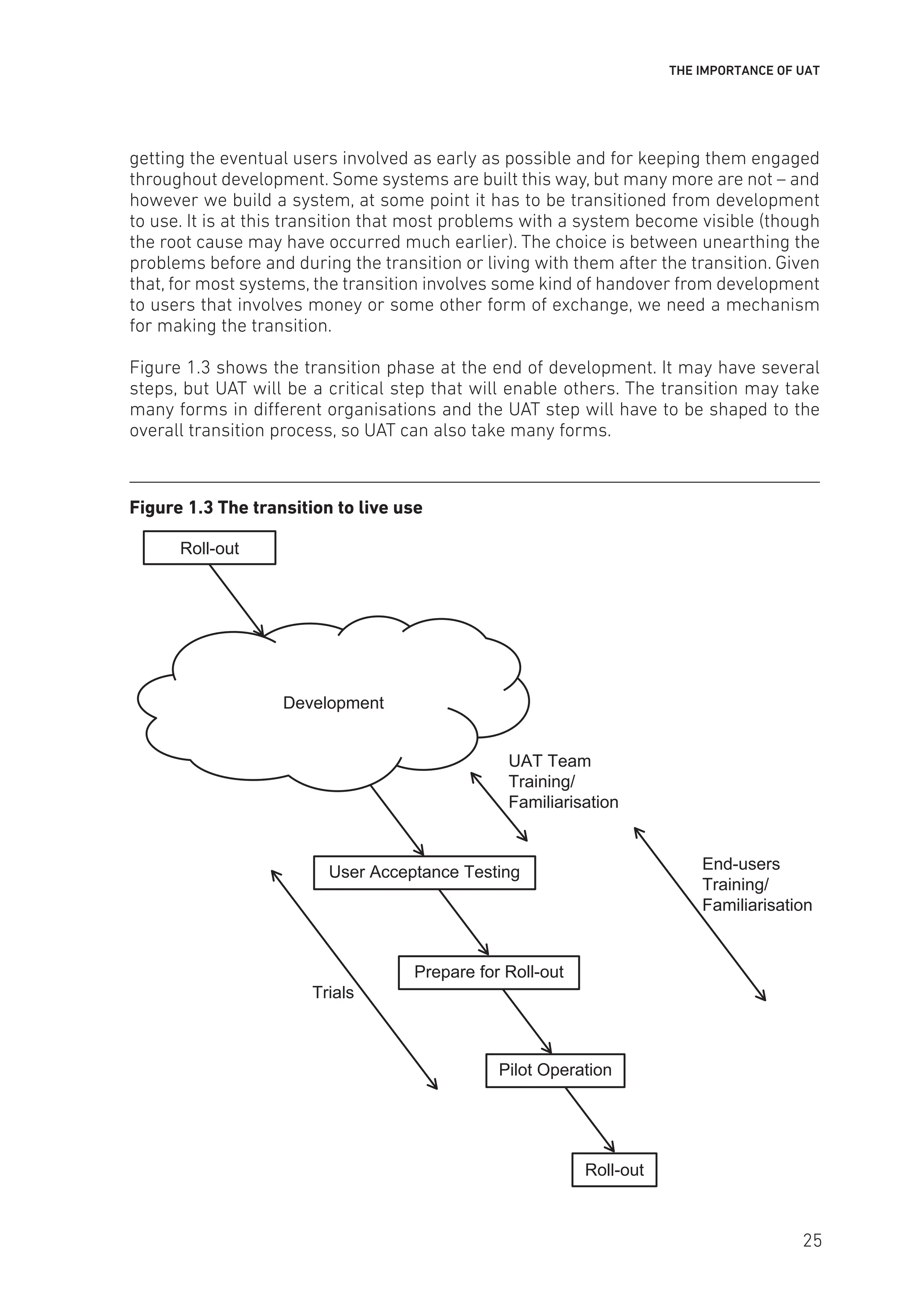
Figure 1.3 shows the transition phase at the end of development. It may have several
steps, but UAT will be a critical step that will enable others. The transition may take
many forms in different organisations and the UAT step will have to be shaped to the
overall transition process, so UAT can also take many forms.
Figure 1.3 The transition to live use
Development
UAT Team
Training/
Familiarisation
End-users
Training/
Familiarisation
Prepare for Roll-out
Trials
Pilot Operation
User Acceptance Testing
Roll-out
Roll-out
25
USER ACCEPTANCE TESTING
The tested system will then move on through other steps in transition that might involve
running a pilot project to ensure that the system is capable of meeting the business
need on a small scale before roll-out. At some point users will need training and
familiarisation with the new system. Roll-out may need to be phased to reduce the
impact on existing systems and processes. There may be many factors that can affect
the transition mechanism, some of which are outlined below. The choice of transition
mechanism will affect the nature of UAT and the way we plan it.
MANAGING THE TRANSITION TO LIVE USE
Pilot projects
A pilot project is a scaled-down implementation, usually in a controlled environment
and with specially selected staff. The aim is to demonstrate that the system is ready
for implementation and to identify any problems that might affect a full-scale roll-out.
Phased transitions
Following a successful pilot a phased roll-out can be used to gradually increase
the scale of operations. The aim in this case is to provide an opportunity to confirm
what was found in the pilot and to manage any issues that arise related to scale,
for example logistics.
Training and familiarisation
All users will need training before roll-out is complete. This may be incremental with
a phased implementation. Users will also need to become familiar with the system
following training so that they do not lose the knowledge and skills acquired during
training and so that they are reasonably proficient when the system goes into live
operation. This is a separate exercise from UAT, although UAT will certainly enhance
the system knowledge of the testers. If UAT is used for training or familiarisation,
the effect is not only to slow down the testing but also to compromise the quality
of testing because testers not trained on the system will be likely to make errors in
designing and/or executing tests.
UAT AND CONTRACTS
In the development of an IS we typically see requirements evolve throughout
development, so that the system delivered to UAT is typically rather different from that
specified in the initial requirements specification.
Where a contractual agreement exists, however, the contract is normally based on an
agreed requirements specification, and that specification will have been defined at
the beginning of the contract and, therefore, also at the beginning of the project. Even
if some allowances are made through the contractual mechanism for changes, it is
almost inevitable that the contractual requirements (on which contractual acceptance
must be based) will not completely describe the evolved business and user expectations
26
THE IMPORTANCE OF UAT
at the end of the project. UAT must therefore embed contract acceptance within a wider
UAT exercise.
We need to make a distinction between the acquisition of an IS and the development of
an IS. We speak of developing an IS when we build the system in-house using our own
resources so a contractual relationship is not necessary (although some organisations
may use an internal contract to enable one part of the business to buy services from
another). Even though the relationship between sponsor, business managers, end-users
and developers may be relatively formal, the possibility of coming to a final agreement
about what is an acceptable outcome always exists. If an IS is acquired from a third
party, or if a third party is instrumental in developing and delivering it, the scope for
flexibility in the end result is very limited.
FOUR WAYS TO ACQUIRE SOFTWARE FOR AN IS
There are at least four different ways we can acquire software:
1. Build the system in-house (with our own resources).
2. Outsource the development to a third party (who could be offshore).
3. Acquire a commercial off-the-shelf (COTS) solution configured to our
specific needs.
4. License software for our use (software as a service).
An IS may use any of these to acquire the software part of the system and this will
have an effect on how UAT is performed.
Build in-house
Within this category of systems, requirements may be documented before
development begins or they may have evolved incrementally during development.
In extreme cases, requirements may never have been documented at all or not
documented in any detail. In all these cases some work will need to be done to
match what has been captured in requirements with current user expectations.
The main advantage of building software in-house is that the key stakeholders –
developers, sponsor(s), manager(s) and end-users – should all be available for
consultation.
Outsource
A system acquired via outsourcing development will most likely have been designed
and developed in a place remote from the location where it will be used. The
requirements in this case may have been written by the acquirer, the developer or
in some form of collaborative effort, but the likelihood is that they will be similar to
the requirements we would get from an in-house development. The development
process may also be similar to that used in-house.
27
USER ACCEPTANCE TESTING
Where the similarity ends is in the availability of information and the accessibility of
key stakeholders. Sponsor, manager(s) and end-users should all be available, but
developers will be off-site, making communication about requirements, testing and
other aspects of the development activity more difficult. Essentially this acquisition
is similar to in-house development but communication channels will be potentially
less reliable, communication lines will typically be longer and information may be
harder to get and take longer to acquire.
COTS
COTS software covers a wide range of systems from simple productivity tools to
sophisticated decision support systems. COTS solutions are already defined and
built in modular form so implementation involves selecting modules, configuring
individual modules, where this is feasible, and installation. In this case there is no
access to the requirements from which the modules were built and the purchaser
(sponsor) must make any changes necessary to make the solution work by changing
business processes.
UAT for a COTS system is, in some respects, very simple because the modules
will typically be in use in other organisations and will have been in use for
some time. There should be very few, if any, issues with the way the software
functions. On the other hand, the fit with the business processes is likely to be
less than ideal and assessing how well the solution will work in the business
context and how well users will be able to adjust to its approach will be much
larger concerns. UAT in this case is much more about assessing a solution than
about testing software.
Software as a service
Software as a service (SaaS) may be used to provide services that the purchasing
organisation does not wish to develop or host on its own systems. The service is
provided under a licensing arrangement and is usually a ‘standard’ service that will
be in use in many organisations; as a result, it should be stable and reliable in use.
In some cases the service can be customised to generate changed or additional
functionality to fit a particular business need.
In the case of SaaS solutions the main focus of UAT will need to be the fit of the
solution to the organisation’s business processes.
Whenever we do business with a third party we enter into some form of contract and,
where a contract is in place, contract acceptance will be essential to enable completion
of the contract and any payment associated with that event. However, contract
acceptance does not fulfil all the objectives of UAT so we will need to ensure that UAT
includes an agreed contract acceptance. That does not mean that UAT will be limited
solely to contract acceptance; we will still need to plan to achieve all the other outcomes
that give us benefits from UAT.
28
THE IMPORTANCE OF UAT
STAKEHOLDERS IN UAT
There are many stakeholders in an implementation, drawn from the business, its staff
and its customers, the development organisation, any suppliers and potentially a host
of others. In an ideal world all these stakeholders would be identified, consulted and
informed of progress at every stage. In the real world this is hardly ever the case, but we
still need to take account of the expressed needs of at least some stakeholders.
For the purposes of UAT the most important stakeholder groups will be:
y
y the sponsor, which means the person or group that commissioned the system
(and defined the business intent);
y
y the manager(s) who will be responsible for delivering expected business
benefits from the IS implementation;
y
y the end-user(s) who will actually operate the system;
y
y developers and other technical staff who are responsible for implementation
and who will support the UAT effort.
Each of these stakeholder groups has a unique viewpoint that will influence UAT and
each group has a set of responsibilities. Each group will be expected to deliver certain
information and services and each will have information needs to enable it to carry out
its role successfully.
Sponsors
The sponsor is the person who signs the cheques. In a small company the sponsor will
typically be the owner; in a larger company a sponsor will typically be an executive at
some level who has a budget to acquire software for the organisation. In both cases the
sponsor’s interest is in getting value for money by ensuring that the acquired software
is fit for purpose, usable by the people for whom it has been acquired and meets
the acceptance criteria.
The sponsor will normally initiate the risk analysis on which test prioritisation is based
and subsequently be the person who makes the release decision. Unless the company
is very small (sole trader or partnership), the sponsor is unlikely to be the user who will
conduct the tests but may be involved in planning the UAT exercise.
The sponsor’s main concern is with achieving the expected business benefits, so their
focus of attention will be on identifying potential risks and barriers to success. Following
risk analysis the sponsor will be most interested in defining test scenarios that will
exercise the software in a realistic environment and take some measurements that
give comfort in the performance of the software and its effectiveness in driving the key
business success parameters, such as revenue, profit and cost.
Business managers
Business managers are those who will be commissioning the software and delivering
the expected benefits so they will need reassurance that the software is usable and
29
USER ACCEPTANCE TESTING
capable of achieving the claimed benefits. For this group the scope of interest is likely
to be wider than simple fitness for purpose and the tests defined will need to enable the
business processes designed around the software to be exercised by users in realistic
scenarios. The scenarios will be based on the success criteria set by the sponsor and
will ensure that users interact with the software and the business processes at a
realistic level over a realistic time frame.
An example might be to carry out a few days’ transactions, using saved data from real
processing using the existing system, to ensure that the results are better than those
achieved when the transactions were first exercised. This kind of exercise would need
the original transaction details to be saved and stored, and it would need the complete
system to be set up, with users suitably prepared, to repeat the set of transactions
with the new system and measure the results. This is an exercise that may go beyond
UAT but will necessarily include a UAT component that can be designed to achieve the
desired test coverage and measure outcomes against acceptance criteria. The overall
exercise, a form of trial or pilot, can achieve effective UAT as well as a benchmark of
business performance for the new system.
There are also other management roles that will be involved in the UAT exercise. One
of the most important of these may be a quality manager, who would be primarily
interested in the overall quality of the delivered system, or a test manager, who would
be responsible for the overall quality and effectiveness of testing and would advise and
guide the UAT team to enable them to achieve the best possible UAT with the resources
available.
End-users
End-users are those who will directly interact with the system, either inside the
organisation (staff) or outside the organisation (suppliers and customers). So a group
of end-users is not necessarily a homogeneous group with a single set of expectations;
there may be multiple viewpoints and sets of expectations to be satisfied. Since end-
users directly interact with the system it is clearly appropriate for this group to carry
out the actual testing at the user interface and a team made up of as many end-user
viewpoints as possible should be formed for that purpose. The primary role of this
team will be to assist in designing the tests and then to execute them and report on the
results. A vital secondary role, however, is to raise any issues or insights that arise as
they carry out the tests so that the user perception of the system is as fully explored
and documented as possible.
For end-users the nature of testing will be in a practical context, so test cases should
replicate realistic scenarios and use realistic data to enable the testers to operate the
software as it will be utilised to achieve the IS’s overall purpose.
End-users of software may be drawn from any specialism or none. They may have lots
of previous computer experience or none. Their common characteristic is that they will
be expected to use the new system to achieve their own business targets. Depending
on the level of previous experience with computers and especially with systems of
the kind being tested, users can be encouraged to identify scenarios that will entail
use of the software to achieve a particular business outcome. Those with significant
experience will be able to suggest scenarios of interest in testing, such as those that will
30
THE IMPORTANCE OF UAT
be particularly challenging for the system, those that will be particularly prone to errors
and those that will involve high levels of user interaction. These scenarios will ensure
that the testing is based on real business activity, while other tests can be defined to
provide adequate test coverage and ensure that all the higher risk areas of operation
are adequately exercised.
While end-users are expected to make up the body of a UAT team, it is important that
business managers and sponsors are aware that the UAT exercise should also involve
exercising their expected interaction with the system. In a well-balanced UAT team all
three roles will have some part to play directly in the UAT exercise, but even if this is not
possible the dependencies between the roles need to be well understood.
Developers and technical support staff
Although the developers’ main work should be completed by the time UAT begins and
the work of technical support will not yet have started in earnest, these two groups
can make a vital contribution to successful UAT. Developers have an important role
in helping UA testers to gain familiarisation with the built system and they will be
assessing any incident reports raised during UAT to determine what remedial work
may be required. Getting this work done promptly can have a significant impact on the
time it takes to complete UAT. Technical support staff will be responsible for managing
any test environments put in place for UAT and for keeping the system under test in a
serviceable and usable condition. Without them the whole exercise could grind to a halt
before it gets properly started.
CHAPTER SUMMARY
The main purpose of this chapter was to provide an overall view of what UAT is
about at the broadest level. It has provided a basic understanding of what UAT is
and outlined its unique role and purpose in preparation for the content covered in
the rest of the book.
The definition of UAT identified the need for formal testing and the importance of
acceptance criteria and of understanding the users’ real needs rather than relying
on a specification written at the beginning of the development project. The basic
concept of the business requirement has been introduced and this will be expanded
in Chapter 2, but we need to remember that business requirements represent the
reason a system is being constructed and this may be quite different to what was
originally captured in the requirements specification.
We have shown where UAT fits into the overall process of implementing ISs, where
UAT fits into the sequence of testing (regardless of the model the project follows), who
carries out UAT and whose needs are primarily considered during UAT. We have also
identified how UAT may be affected by the way a system has been built or acquired.
We have considered the evidence that ISs often fail at introduction or after change
and we have examined the characteristics of ISs that make them vulnerable to
potential mishaps. An analysis of the CHAOS report provides surprising and
interesting information about how closely ISs reflect the original business
31
USER ACCEPTANCE TESTING
requirements, and important conclusions can be drawn about the value of keeping
stakeholders involved throughout the development process.
The way UAT is carried out to avoid damaging failures represents UAT as a form of risk
management, and UAT also has an important role to play in building user confidence,
assessing the readiness of the system for deployment, and preparing for roll-out.
Finally we have identified the key stakeholders in UAT and their roles and we have
outlined the main areas of cost associated with UAT.
After reading Chapter 1 you should understand the purpose and the benefits of UAT,
and who is involved in UAT, and understand and justify its costs.
What have you learned?
Test your knowledge of Chapter 1 by answering the following questions. The correct
answers can be found in Appendix B.
1. In what way does UAT differ from other testing carried out during development?
A. UAT takes longer to do than other kinds of testing
B. UAT must be carried out by end-users
C. UAT evaluates the system against the requirements specification
D. UAT can be informal testing as long as it is done by users
2. Which three of the following are used as the basis of UAT?
A. Technical specifications
B. User needs
C. Requirements specification
D. Acceptance criteria
E. Business processes
F. Tests developed for system testing
G. Automated tests designed by the developers
3. Why is it vital for users to carry out UAT? Select three options.
A. Because they have more time available than developers and testers
B. Because they are not experts on the technical performance of the system
C. Because the users’ ability to use the system as a tool to achieve business
benefit is critical to success
D. Because only users will be able to recognise some situations in which the
system’s behaviour may be counterproductive
E. Because developer testing has less value than UAT
F. Because the system must be evaluated against user needs and use actual
business processes.
32
THE IMPORTANCE OF UAT
Some questions to consider (our responses are in Appendix B)
1. What questions would you ask if your organisation asked you to carry out
UAT on a new piece of software that is being introduced to support the sales
activity in your business?
2. How would you react if your boss told you that the development project for
which you will be doing UAT is running late and he wants you to do UAT in
parallel with the developers completing the development?
3. Why not just get professional testers to do UAT? After all they have experience
of formal testing and know all the techniques.
33
2 BUSINESS REQUIREMENTS
Now that we understand the context and purpose of UAT the next stage is to understand
the business requirements. This chapter explains what requirements are, how
requirements are written and how the business requirements relate to UAT. It will also
become clear why requirements may be out of sync with the real business requirements
by the time UAT takes place and how this limitation can be overcome.
Topics covered in this chapter
y
y Business requirements
y
y Business intent and user expectations
y
y Acceptance criteria
y
y The requirement types
y
y Prioritising business requirements
y
y The relationship between business requirements and UAT
y
y The relationship between development and UAT
y
y Scope of UAT
y
y Building a UA test basis
BUSINESS REQUIREMENTS
In Chapter 1 the fit between an IS and its business users was referred to as being like
the fit of a garment that is ‘made to measure’. Using the same analogy a requirement
identifies something that the customer wants to specify about the item of clothing about
to be made for them. Similarly, a business requirement is something a business wants
to specify about the IS it is about to have built or is about to acquire. In other words a
requirement is simply something that we need and in the context of an IS, a requirement
is something we need from the system. The better the desired outcomes and the detail
of what the system ought to do is understood, the better the chance of delivering what is
needed. Requirements describe what a system ought to do, what will be built and what
will be tested during UAT.
34
BUSINESS REQUIREMENTS
Having captured the needs of the organisation the project team will document them in
a requirements document using clear and simple language and using the terminology
of the user. These requirements, if too general to be of use to developers, can then
be translated into a more technical version using a structure aimed at helping the
development team to understand and build the system. The resulting document is
known as a requirements specification (RS) and the detailed needs of the business
contained in it are the requirements.
UNDERSTANDING THE SYNTAX OF REQUIREMENTS
What do requirements look like?
Requirements can be expressed in many different ways and they do not all look
the same. Requirements may be recorded in a document, in a spreadsheet or in
software designed specifically for recording requirements.
Here are some simple examples of requirements but bear in mind that any
requirements document you are given for UAT may contain much more than this
very basic information.
Example 2.1
Table 2.1 Business requirements
CR1 An administrator is able to add a new user
CR2 An administrator is able to adjust existing user details
DB1	
The system supports that 100 previous versions of a contract are
available in a version history
As long as the language and terminology used is familiar to the people who
requested it and to those who will develop it, then these are good examples of
what requirements ought to be; namely a clear description of a requirement of the
system.
However you may find that the requirements document you have been given
contains much more than just this very basic information.
Example 2.2
These requirements, related to the security of a website, were entered into a system
as opposed to written in a document. As well as a description of the requirements
this document also contains some other valuable information.
35
USER ACCEPTANCE TESTING
Table 2.2 The requirements document
Project Reference Category Description Priority Current Actions
					status
UNT v0.2 S_01 Security Users will be able 1 None Edit/
			 to change their			 Delete
			 own password
UNT v0.2 S_01.1 Security There will be an 3 None Edit/
			 option for users			 Delete
			 to change their
			 password on
			 the main menu
UNT v0.2 S_01.2 Security There will be an 3 None Edit/
			 option from the			 Delete
			 login page for
			 users to request a
			 password reset if
			 they have forgotten
			 their password
The name of the project
This field may not be needed where a requirements document relates to one project
only; however, it may be relevant to software that can record requirements related
to multiple projects.
A unique identifier of the requirement
Every requirement should have a unique identifier, which ensures that any further
project documentation that is created can refer back to which requirement an
activity or line item relates to. Because the purpose of the project is to meet the
business requirements, the unique identifier is one of the cornerstones of all the
project documentation that follows the RS. Note that there is a difference between
the unique identifiers in the two examples above.
In the second example you can see that there are two different IDs that split
the requirements into one larger overall requirement (S_01), and the detailed
requirements that belong to it (S_01.1 and S_01.2), whereas there is just one level
of ID in the first example (CR1).
The category
It probably makes sense for most RS documents to group together requirements in
categories that cover similar ground. These categories cover any related parts of the
functionality that the project is delivering and can be logically grouped together under
headings such as: ‘Creating a contract’, ‘Invoicing’, ‘Proposal maintenance’, ‘Workflow’ or
36
BUSINESS REQUIREMENTS
‘Userinterfacedesign’.Categories mayinclude functionalaspectsofthe system–whatit
oughttodo–aswellasnon-functionalaspects–howitdoeswhatitoughttodo.Thenon-
functional requirements may be written by the project team if they were not requested
by the business and cover topics such as the speed and usability of the system.
The priority
It is useful in most, if not all, cases to understand the priority of a requirement as it will
help to schedule the development work and prioritise testing. In theory it is possible to
use any scale; however, it is quite common to use ‘critical’ and ‘non-critical’, or to use
a scale of 1–3 or 1–5, 1 being the highest priority and 3 or 5 being less important. The
assumption made when writing the RS is that all the requirements are needed – hence
the name ‘requirement’ – but that some are more critical than others.
Current status
It may or may not be important to track in the requirements document whether the
requirement has simply been requested or whether it has been built or tested. If
it is important, a status field or column can be created for the purpose in the RS.
Edit/Delete
In the example for project UNT v.02, the system that the requirements are logged
on keeps track of the version history of requirements and the Edit/Delete buttons
allow users of the document to make changes to the requirements. This may not be
relevant in your case; however, it is useful to remember that requirements can, and
often do, change. The RS should be revisited and reviewed during its life in order to
make sure that the documented requirements still reflect what is happening on the
project and what the current business needs are.
Exercise 2.1
The case study we will use throughout the text is of an accounting system named
Excelsior, which has been created to deal with the accounting-related processes
such as purchase orders, contracts and payments. It also has a number of modules
that allow staff to carry out HR-related tasks. HR details can be updated and
Table 2.3 Excelsior requirement
Key Name and description Rank Priority Assigned to Status
Request saving and background updating
BW4 The system will allow 34.0 High Nobody In
saved requests to be 				 progress
automatically updated
Once a request has been saved,
users will receive request
updates when and if
they become available
37
USER ACCEPTANCE TESTING
requests can be made for other changes such as absence, training or expenses.
What information can you glean from the following business requirement?
The answer can be found in Appendix B.
Please note that if you are asked to review a requirements document or specification
and you do not understand the requirements in that document, you may need to ask
some questions of those that do.
BUSINESS INTENT AND USER EXPECTATIONS
We established that requirements are gathered and documented in a business
requirements document, a set of statements that describes all of what a user community
wants from the IS. The requirements as a whole should reflect the overall objectives and
expectations of the business. These overall objectives and expectations, although they
are often forgotten, should also be documented.
Every IS is created for a purpose: to achieve some business benefit such as improved
productivity for staff or reduced costs of operation. The purpose of the system is usually
called its ‘business intent’. Business intent is important because it identifies what the
business is expecting to be able to achieve when it has the system installed and operating.
Arising from the business intent the sponsor, managers and end-users will have a
perception about what the system should do and how it should behave. Users of systems
already in place will also have expectations based on their perception of the way they
currently work and the way they are expecting to work with the system. Expectations
may not be exactly aligned with business intent but they are an important element of
perceived success, so they should be captured as an input to UAT.
A key driver of success in IS implementation is the transparency of business intent
and user expectations so that all stakeholders, including the developers, have a
common understanding of what is required and what is expected in an IS solution.
The absence of effective transparency is a key risk factor because the parties may
be operating from different assumptions, and UAT is the final opportunity to identify
and resolve any misunderstandings that may have arisen during development. If the
business requirements match the business intent and the system meets the business
requirements, the business intent will have been achieved.
Example 2.3 – Business intent
y
y The system will enable the business to manage 250 customer accounts
simultaneously.
y
y The system will enhance throughput of widgets by 10 per cent.
y
y The system will enable the business to offer five new services.
y
y The system will enable the business to deliver customer orders within 48 hours
of order.
38
Random documents with unrelated
content Scribd suggests to you:
TUESDAY (1906) U.S. Senators played a farce entitled Who's
a Liar, by Pitchrake Tillman, to crowded houses.
WEDNESDAY
THURSDAY
FRIDAY (996) Clocks, giving good time, invented by Gebert,
Benedictine monk.
(Same year) Benedictine, giving good time, invented
by same monks.
SATURDAY
MAY
Where ignorance is bliss it is blister to be wise.
Society
Hint:
Even if you
can't get into
Who's who
in America,
you can get
into the
Telephone
Book, and it
costs lots
more.
DEPOSIT
DAYS OF
MONTH
.01 1
.02 2
.04 3
.08 4
.16 5
.32 6
.64 7
1.28 8
2.56 9
5.12 10
10.24 11
20.48 12
40.96 13
81.92 14
HOW TO GET RICH
Getting rich is a simple matter if one goes about it
right. If you will deposit one penny in the bank on the
first day of the month and double each deposit each
day thereafter, until the end of the month (30 days),
you will find yourself rich beyond the dreams of
avarice. Thus:—
163.84 15
327.68 16
655.36 17
1,310.72 18
2.621.44 19
5,242.88 20
10,485.76 21
20,971.52 22
41,943.04 23
83,886.08 24
167,772.16 25
335,544.32 26
671,088.64 27
1,342,177.28 28
2,684,354.56 29
5,368,709.12 30
$10,737,418.23 Total
The reason more people do not succeed in this Get-Rich-Quick
scheme is that they become discouraged when they get about 75
cents in bank and give it up.
SUNDAY (1867) Russia thought she was selling United States
a gold brick in Alaska.
MONDAY (1894) Gold brick proved 24 carat; Russia
heartbroken.
TUESDAY
WEDNESDAY (1796) Napoleon weds Josephine, hoping his
troubles will be little ones.
(1809) Napoleon divorces Josephine. Great trouble
being his troubles were not little ones.
THURSDAY
FRIDAY (1887) Congress passed the anti-polygamy bill.
Great anxiety at Newport.
SATURDAY
MAY
Beauty may be only skin deep, but the average
observer does not see below the skin.
A Feat in
Contortion:
To make both
ends meet on
$8 per week.
Farm Hint:
Make the sled
runners of
slippery elm.
MATERIA MEDICA
When Willie was young he cried for Mayoria.
When Willie grew older he sought Governoria.
When Willie woke up he'd lost his donoria.
Now Willie is dead: they gave him Castoria.
SUNDAY
MONDAY (1305) Dante's Inferno first noted description of
hell.
(1906) Upton Sinclair's Jungle a close second.
TUESDAY
WEDNESDAY (1540) Gomera planned Panama Canal.
(1640) The Dutch took it up—then laid it down.
THURSDAY (1879) DeLesseps tries it, but gets snarled up in the
Muck Rake.
(1906) Work progressing as rapidly as hot air will
allow.
FRIDAY
SATURDAY
MAY
There's many a slip 'twixt the stock and the tip.
Hotel Hint:
No first class
inn will permit
guests to
indulge in
such
undignified
gymnastics as
running
through the
corridors, or
jumping
board bills.
Seasonable
Advice:
Look out for
the open
work lawn
hose and
accompanying
shower baths.
FORECAST FOR JUNE
From the 1st to the last will be marked by mosquito
showers. From the 11th to the 18th weddings will
exceed divorces, followed by thunder and lightning.
From June 18th to June 30th ice-cream sodas will be
in the ascendancy. On June 21st the sun reaches the
most northerly point in the Zodiac and enters the
constellation of Cancer. Cancer is the sign for June.
Cancer is an old sign and something that ought to be
cut out.
Sidelights on Science
If all the oceans should evaporate they would leave a
deposit of 235 feet of salt. This, it is estimated, would
salt enough pretzels to supply the world for several
years.
It is claimed that if the power concealed in the sting
of a hornet could be harnessed and utilized in
commercial channels, it would lower the cost of
transportation by a good many per cent.
An interesting experiment for little boys is to go into
the dimly lit parlor where the big sister and her young
man are sitting. Do not shuffle the feet or make any
noise, and you will see a spark.
A hen will lay 200 eggs a year. A mosquito will lay
200,000,000 in one short summer. Are you gladder
that hens are not mosquitoes, or that mosquitoes are
not as big as hens?
SUNDAY (1906) Czar gives three minutes of his time in a talk
to put the Douma down and out.
Douma gives all its time to blow Czar up and out.
MONDAY
TUESDAY
WEDNESDAY
THURSDAY May 7—Cannon's boom set off by speech from Uncle
Joe—Presidential Bee taking terrible risk at Cannon's
mouth.
FRIDAY If two wrongs do not make a right—how many
franchises make a wrong?
SATURDAY
JUNE
The man who is down is looking for the other fellow
who kicked out some rungs from the ladder of
success.
Fashion
Note:
It is no longer
good form to
serenade
young ladies.
If you wish to
win their
favor, toot an
automobile
horn.
Health Hint:
For Seeing
things at
night try a
Welsh
Rarebit.
LITTLE STUDIES IN NATURAL
HISTORY
The Secretary-bird, or Loebriole.
This little creature belongs to the Knowitall class
and has no fear, often perching on the Big Stick
itself. His distinguishing characteristic is a thick oak
board where most birds wear tail-feathers. He only
sings when there is a storm coming, and then his
song has a plaintive note as he warbles Ki-yi, blame
it on me.
How to Make Credit Grow.
Select a choice bluff. Prepare this carefully, for the
size of the credit depends entirely upon the general
appearance of the bluff. When you think the bluff is
strong enough, take it to a bank. If it goes there, you
will have no further trouble. Your credit is now ready
to transplant. Should it begin to droop, give it a
check. Be careful not to use too many, for the proper
use of the credit-plant is to enable its owner to live
without money.
SUNDAY (1905) Russo-Jap peace treaty at Portsmouth, N.H.
—Japanese description of Portsmouth, A mos'
honorable plaze where they dispenz mos'
dizhonorable liquor!
MONDAY
TUESDAY (2000 B.C.) Proverbs invented by Solomon, who
gazed upon his wives and exclaimed, Variety is the
spice of life!
P. S.—Adam couldn't say this because he was
handicapped.
WEDNESDAY
THURSDAY (1258) Mad Parliament meets.
(1906) Congress mad, still in session.
FRIDAY
SATURDAY If a man tells you that he had darned hard work
getting out of bed this morning, the chances are
that the bed was a folding one.
JUNE
Woman's love is chaotic; man's idiotic.
Incendiary
Warning:
To save
money from
fire,—don't
burn it.
Etiquette
Query:
Is the game
worth the
scandal?
DECKLE-EDGE FRECKLES
Summer begins June 20. By this time your freckles
ought to have a good start.
Do you know what a freckle is, children? It is a
golden-brown splash on the northwest corner of a
young woman's nose, although her dearest friend
says it is a fright.
A freckle is the same to a druggist as a pipe line is to
Rockefeller—ready money and a lot of it.
One large deckle-edge freckle will cause a girl to buy
nine kinds of cold cream, a dozen lemons, a pint of
three-*ply acid, and a gross of poudre-de-phiz every
Saturday afternoon.
All this gives vigor to the freckle.
SUNDAY
MONDAY About a year ago the Ground 'og cast a shadow in
Packingtown.
What's the answer?
TUESDAY
WEDNESDAY (1904) It was reported that Cassie Chadwick and
'Lijah Dowie had formed a Confidence Trust,
whereupon Madam Bartrand prayed the Interstate
Commerce Commission to issue an injunction
against them under the plea of restraint of trade.
The injunction was issued, and withdrawn later
when the Supreme Court decided that confidence
was too universal to be made the basis of a
monopoly.
THURSDAY
FRIDAY
SATURDAY
JUNE
The poet associates his larks with high heaven; the
realist associates his larks with high-balls.
Pest Note:
If troubled
with
Junebugs try
sweeping the
cobwebs out
of the attic; if
troubled with
aunts close
up the house
and go to the
country.
RAISING CORN
Great care should be exercised in raising corn,
especially the variety Johnus Barleycornicus. This may
be raised with either hand. Some superstitious
agriculturists believe in the efficacy of a simple
incantation to be used in the act of raising this
variety, such as Here's how! Over the hot sands!
etc.
This kind has never been known to fail in getting to a
head. Kernels of Barleycorn originated in Kentucky.
SUNDAY
MONDAY (390 B.C.) Rome saved by the cackling of geese.
(1905) Reputations ruined by the cackling of
Alexander and Hyde.
TUESDAY
WEDNESDAY (1906) T. Roosevelt decided to write no more
magazine articles, except for the Congressional
Record.
THURSDAY
FRIDAY (1876) Alexander Graham Bell invented the
telephone.
(1877) American Humorists invented the telephone
girl.
SATURDAY
JUNE
Many a woman prefers a love of a hat to the love of
a husband.
THERMOMETER
ECONOMY:
This is the best
time to buy
thermometers.
They cost no
more than during
the winter
months and
contain more
than twice as
much mercury.
HOW TO PLANT A BEER GARDEN
Now is the time for the ruddy faced beer gardener
to lay out his beer garden. First procure a license
and a few nice rustic chairs and tables. Next
extract the seeds from a couple of seedy old suits
and get your wife to sew them. Your barber will
gladly supply you with cuttings, or, if you have the
chance, unscrew a dozen or so bulbs from some
healthy young electric light plant.
With ordinary summer weather you should soon
have a blooming fine lot of Anheuser bushes. As
soon as the buds begin to pop, pack the roots
with ice. Care should be taken to keep the plants
from drying out.
Bottle flies, while annoying, do no real injury to the
plant, and a judicious use of fly-paper will hold
them in check.
In weeding, the beer gardener should be careful to
distinguish between true widow's weeds and grass
widow's weeds. The latter not only add color and
beauty to the garden, but also give life to the
plant.
Beer was never worn so much or used so
extensively for interior decoration as it is today.
There is a ready market for it at five cents a small
bunch, and with intelligent grafting the bearing of
the plant can be increased tenfold.
SUNDAY
MONDAY (858 B.C.) Sardanapulus dies on a bier 400 feet
high. Great envy among the thirsty.
TUESDAY
WEDNESDAY
THURSDAY July 4th is a great day for those who love to tell us
that all men are created free and equal; it is also a
great day for other Fourth of Juliars.
FRIDAY
SATURDAY (1839) John D. Rockefeller born. First in the wells,
first in the pipes, first in the lamps of his
countrymen.
JULY
Never look a gift mule in the hind leg.
Carving
Note:
A chicken
neck served
to a guest is
the most
unkindest cut
of all.
HELPFUL HINT FOR JULY
The best authorities agree that it is inadvisable to
attach a pack of lighted firecrackers to the tail of the
household cat—without first making sure that the
insurance policy on the house has been placed in a
cold storage vault. A cat loves its favorite corner when
it is mentally disquieted.
SUNDAY (1906) Lucrezia Borgia rose to assert that she never
used embalmed beef at her banquets.
MONDAY
TUESDAY (1586 B.C.) Nebuchadnezzar saw the handwriting on
the wall.
(1906) John D. Rockefeller sailed for Europe.
WEDNESDAY
THURSDAY (1905) New song published by Cassie Chadwick,
I've worked every one but father.
FRIDAY
SATURDAY Boy, gun,
Joy, fun,
Gun bust.
Boy dust.
JULY
Friendship is between men a convenience; between
women, a commodity.
Advice to
Wives:
It is better to
let your
husband
bring a friend
home to
dinner than it
is to have a
friend bring
him home
after dinner.
HINTS ON DRESS
Parasols should be carried on Sun-day.
Persons attending services in poorly heated churches
are justified in making a cloak of their religion.
Eton jackets may be worn at the dinner table.
Silks with watered effects are popular with milkmen's
wives.
The smart set is devoting a good deal of attention of
late to the costuming of house dogs. Embroidered
blankets during the winter and short pants during the
hot summer weather are quite popular.
Shrinkable dress-patterns should always be sponged
before they are made up, but the custom of putting
an overcoat in soak after it has been worn awhile is
still followed by gentlemen who are financially
embarrassed.
SUNDAY
MONDAY (1896) A bas Dreyfus!
(1906) Vive le Dreyfus!
TUESDAY (1840) First Cunarder arrives in Boston. P. S.—Do
not confound with canard, which arrived with
Boston to remain always.
WEDNESDAY
THURSDAY HONOR TO WHOM, ETC.
We're all of us selfishly slow to confess
How much others aid us in winning success;
But the Fourth of July and the Oyster must see
How stupid, without any Crackers, they'd be.
FRIDAY
SATURDAY
JULY
Many a Glad Hand turns out to be The Hook.
Health Hint:
For a turned
ankle—a nicely
turned
feminine ankle
—a low shoe,
a short skirt,
and a drop-
stitch stocking
are
recommended.
SIGNS OF THE ZODIAC
(Recent Interpretations)
AQUARIUS, the waterman, indicating what many a
man becomes on the first of January.
PISCES, the fishes, indicating that by February he
begins to be just as thirsty.
ARIES, the ram, indicating that in March he begins to
meditate on the virtues of bock beer.
TAURUS, the bull, indicating that by April his
disposition is surly and it's a toss-up whether he
really remains a waterman.
GEMINI, the twins, indicating the result of the toss-
up and how he feels toward his fellowman in May.
CANCER, the crab, indicating the backward interest
with which he listens to his wife's plans for the
summer.
(Continued on next left-hand page.)
SUNDAY
MONDAY (1851) Vigilance Committee organized in San
Francisco.
(1906) Order of Muck-rakers established in
Washington.
TUESDAY
WEDNESDAY (1525 B.C.) Pharaoh's daughter finds Moses in the
Bull-rushes.
(1906 A.D.) Roosevelt finds a joker in the meat
bill.
THURSDAY INFINITUDE!
Man looks at the stars and with wonder unspeakable
He thinks on their source which he knows is
unseekable:
He asks who designed all the planets so beautiful,
But no one has ever unscrewed the unscrutable.
FRIDAY
SATURDAY
JULY
An earthquake is not what it is cracked up to be.
A Milk
Pointer:
Milkmen, too,
have their
troubles. If
they do not
water their
cows, or if
they do water
their milk,
somebody
has the law
on them.
SIGNS OF THE ZODIAC
(Continued)
LEO, the Lion, indicating the state of mind with which
in July he agrees with them.
VIRGO, the Virgin, indicating that in August he usually
hears of his daughter's engagement.
LIBRA, the scales, indicating that in September
various interested persons weight his family's summer
enjoyments and send him the bills.
SCORPIO, the scorpion, indicating the state of mind
with which he pays them in October.
SAGITTARIUS, the archer, indicating some fine
shooting on the part of his conscience toward the end
of November.
CAPRICORNUS, the goat, indicating what he feels like
as he decides that next year shall be different.
SUNDAY
MONDAY (1852) Crystal palace opened at New York.
Next week—New York people discover they cannot
live in glass houses.
TUESDAY
WEDNESDAY (1841) London Punch first issued.
Same week—Great Gloom settles over London.
THURSDAY
FRIDAY (1906) Secretary Taft visits Greenville, S.C., and
opens campaign.
Same date—Democrats of Solid South gaze at Taft
in dismay and exclaim, We are lost, we had no idea
the Republican party was so large!
SATURDAY
JULY
Matches are made in heaven—they don't need 'em
in the other place.
Report to the Secretary of War
on the Russo-Japanese War by Gen. Buzfuz, U.S.A.
Political
Note:
Politicians are
bought, not
made.
Health Hint:
Persons too
serious to
take a joke
should take a
vacation.
The war was contrary to all rules of warfare adopted
by civilized nations because:
1. It was not started by a newspaper.
2. The scene of operations was not laid near a
fashionable resort.
3. Photographers and correspondents were not
allowed to inspect the officers' wardrobes.
4. There was no San Juan Hill.
5. The officers gave no afternoon teas, dinners, or
balls.
6. The officers looked after their commands instead
of writing magazine articles.
7. The soldiers were fed real food.
8. Thousands upon thousands of soldiers were
killed.
9. The ships sunk in the naval battle were sunk in
deep water.
10. No great scandal arose from the purchase of
food, clothing, or ammunition.
11. No newspaper or magazine controversy has been
started over who won the battles.
SUNDAY
MONDAY (1886) Dumb piano invented by Virgil. Rejoicing in
Harlem.
TUESDAY
WEDNESDAY
THURSDAY (1547) Silk stockings first worn by Henry II of
France. Rainy days become popular.
FRIDAY The woman who wears a short bathing skirt is not
necessarily immodest. She may be the wife of a
popular magazine editor and cultivate exposure
because she has caught the habit.
—Supton Eclair.
SATURDAY
AUGUST
No successful business man ever spends his own
money.
Advice on
Care of Your
Rubber
Plant:
A Turkish
Bath Factory
needs
constant
attention to
make it pay.
USEFUL FARM HINTS
Take good care of the farm tools. A crow-bar, if
carefully housed when not in use, may, at a hundred
years of age be just as pry as ever.
The man who sells six onions for a nickel cannot
thrive,
For all can see that no one ought to give six scents
for five.
In delivering a chair to the repairman to bottom he
should be made to give a re-seat for it.
Feed the pigs well. A pig resembles a tree in one
respect. It is by his root that he survives.
Farmers should encourage song birds to nest about
the premises, but the lay of the hen must still bring
them the most substantial delight.
It is when the farmer sees his fine crop maturing that
he feels like singing, In this wheat by and by.
In working about a mule that kicks, it should be
remembered that his head-quarters are not his real
business end.
SUNDAY
MONDAY (1906) Boston Convention of Flies pass vote of
thanks to John B. Moran for removing screens from
hotel windows.
TUESDAY
WEDNESDAY The greatest blessing of all is that I am no longer
kept awake nights by persons who are making
modern improvements.
—Robinson Crusoe.
THURSDAY
FRIDAY (1066) William prepares to invade England with 696
ships and 60,000 men.
(1906) Alice prepares to invade England with 696
trunks and 1 man.
SATURDAY
AUGUST
A woman wears a veil for the same reason that
distance lends enchantment.
A Hint on
Luck:
A Lucky-piece
is a good
mascot; a
piece of luck
is the real
thing.
Fashion
Hint:
With peek-a-
boo waist and
short sleeves,
a woman
must wear
her heart in
her hand-bag.
HELPFUL HINTS FOR AUGUST
A cabbage leaf in the hat is an excellent means of
keeping the head cool. The experiment is more
successful if on top of the cabbage leaf you will place
about two handfuls of chipped ice, renewing it as fast
as it melts, and you might try sipping something from
a high glass decorated with mint leaves—sipping it
through a straw is favored by many eminent
practitioners at the bar.
A Bread and Milk Cow
The farmer with a Jersey cow
Can live as fine as silk
For he has got, you must allow,
His thorough-bred and milk.
SUNDAY
MONDAY (449) Robbers' Synod held at Ephesus.
(1908) Extra session of Congress held at
Washington.
TUESDAY
WEDNESDAY Do not take this day off. It is a dog day and he
may want it.
THURSDAY
FRIDAY (697) The Venetians elect their first doge.
(1906) The beef packers try their last dodge.
SATURDAY
AUGUST
A girl in a hammock is worth two in a corps de
ballet.
Health Hint:
Many are
cold, but few
are frozen.
APPROPRIATE SALUTATIONS
To the fireman: Go to blazes!
To the butcher: May you never make a miss-steak in
your endeavor to make both ends meat!
To the baker: May you always have the dough, not
too much crust, and the means to loaf whenever you
wish to!
To the spinster: May you ever be the matchless but
not the mateless woman you are now!
To the young physician: May you wait, like Patience
on a monument, till finally you shall have lots of
monuments on your patients!
To the seamstress: May life always seam sew-sew in
your hemmysphere!
To the dentist: May you always enjoy a pull and be
able to fill many an aching void and long-felt want!
To the poet: May you have many more verses than
reverses.
SUNDAY A GREAT JAG
A man may think he's a terror to drink
When he really is nothing to brag on,
For it's true, we infer, that a big chestnut burr
Gets the awfullest, all-around jag on.
MONDAY
TUESDAY
WEDNESDAY (6,99,950 B.C.) Eve appears in a peek-a-boo waist.
THURSDAY
FRIDAY (1509) Henry VIII began to get married.
SATURDAY
AUGUST
A man admires a woman for what he thinks she is;
a woman admires a man for what she thinks he has.
Welcome to our website – the perfect destination for book lovers and
knowledge seekers. We believe that every book holds a new world,
offering opportunities for learning, discovery, and personal growth.
That’s why we are dedicated to bringing you a diverse collection of
books, ranging from classic literature and specialized publications to
self-development guides and children's books.
More than just a book-buying platform, we strive to be a bridge
connecting you with timeless cultural and intellectual values. With an
elegant, user-friendly interface and a smart search system, you can
quickly find the books that best suit your interests. Additionally,
our special promotions and home delivery services help you save time
and fully enjoy the joy of reading.
Join us on a journey of knowledge exploration, passion nurturing, and
personal growth every day!
ebookbell.com
User Acceptance Testing A Stepbystep Guide 1st Edition Brian Hambling

  • 1.
    User Acceptance TestingA Stepbystep Guide 1st Edition Brian Hambling download https://ebookbell.com/product/user-acceptance-testing-a- stepbystep-guide-1st-edition-brian-hambling-5308406 Explore and download more ebooks at ebookbell.com
  • 2.
    Here are somerecommended products that we believe you will be interested in. You can click the link to download. Software Development Activity Cycles Collaborative Development Continuous Testing And User Acceptance 1st Edition Robert F Rose https://ebookbell.com/product/software-development-activity-cycles- collaborative-development-continuous-testing-and-user-acceptance-1st- edition-robert-f-rose-44173492 Testing And Use Of Environmentally Acceptable Lubricants Insik Rhee https://ebookbell.com/product/testing-and-use-of-environmentally- acceptable-lubricants-insik-rhee-4689128 User Acceptance Of Mobile Notifications 1st Edition Tilo Westermann Auth https://ebookbell.com/product/user-acceptance-of-mobile- notifications-1st-edition-tilo-westermann-auth-5886902 Enhanced Trustworthiness And End User Acceptance Of Conditionally Automated Vehicles In The Transition Period 1st Ed Daniel Watzenig https://ebookbell.com/product/enhanced-trustworthiness-and-end-user- acceptance-of-conditionally-automated-vehicles-in-the-transition- period-1st-ed-daniel-watzenig-22496244
  • 3.
    Acceptance And UsageOf Technology Through The Digital User Experience Nedra Bahriammari https://ebookbell.com/product/acceptance-and-usage-of-technology- through-the-digital-user-experience-nedra-bahriammari-48677602 The Politics Of Common Sense How Social Movements Use Public Discourse To Change Politics And Win Acceptance 1st Edition Deva R Woodly https://ebookbell.com/product/the-politics-of-common-sense-how-social- movements-use-public-discourse-to-change-politics-and-win- acceptance-1st-edition-deva-r-woodly-5035360 Microsoft Word Maths 2nd Edition User https://ebookbell.com/product/microsoft-word-maths-2nd-edition- user-23554586 Fiitjee Aits 2021 Jee 2021 User https://ebookbell.com/product/fiitjee-aits-2021-jee-2021-user-32987406 Powerpoint Presentation User https://ebookbell.com/product/powerpoint-presentation-user-38179388
  • 7.
  • 8.
    BCS, THE CHARTEREDINSTITUTE FOR IT BCS, The Chartered Institute for IT champions the global IT profession and the interests of individuals engaged in that profession for the benefit of all. We promote wider social and economic progress through the advancement of information technology science and practice. We bring together industry, academics, practitioners and government to share knowledge, promote new thinking, inform the design of new curricula, shape public policy and inform the public. Our vision is to be a world-class organisation for IT.Our 70,000 strong membership includes practitioners,businesses,academics and students in the UK and internationally.We deliver a range of professional development tools for practitioners and employees. A leading IT qualification body, we offer a range of widely recognised qualifications. Further Information BCS, The Chartered Institute for IT, First Floor, Block D, North Star House, North Star Avenue, Swindon, SN2 1FA, United Kingdom. T +44 (0) 1793 417 424 F +44 (0) 1793 417 444 www.bcs.org/contact
  • 9.
    USER ACCEPTANCE TESTING ASTEP-BY-STEP GUIDE Brian Hambling, Pauline van Goethem
  • 10.
    © BCS Learning& Development Ltd 2013 All rights reserved.Apart from any fair dealing for the purposes of research or private study,or criticism or review, as permitted by the Copyright Designs and Patents Act 1988,no part of this publication may be reproduced,stored or transmitted in any form or by any means, except with the prior permission in writing of the publisher, or in the case of reprographic reproduction, in accordance with the terms of the licences issued by the Copyright Licensing Agency. Enquiries for permission to reproduce material outside those terms should be directed to the publisher. All trade marks, registered names etc. acknowledged in this publication are the property of their respective owners. BCS and the BCS logo are the registered trade marks of the British Computer Society, charity number 292786 (BCS). Published by BCS Learning and Development Ltd, a wholly owned subsidiary of BCS, The Chartered Institute for IT, First Floor, Block D, North Star House, North Star Avenue, Swindon, SN2 1FA, UK. www.bcs.org Paperback ISBN: 978-1-78017-167-8 PDF ISBN: 978-1-78017-168-5 ePUB ISBN: 978-1-78017-169-2 Kindle ISBN: 978-1-78017-170-8 British Cataloguing in Publication Data. A CIP catalogue record for this book is available at the British Library. Disclaimer: The views expressed in this book are of the author(s) and do not necessarily reflect the views of the Institute or BCS Learning and Development Ltd except where explicitly stated as such. Although every care has been taken by the authors and BCS Learning and Development Ltd in the preparation of the publication, no warranty is given by the authors or BCS Learning and Development Ltd as publisher as to the accuracy or completeness of the infor- mation contained within it and neither the authors nor BCS Learning and Development Ltd shall be responsible or liable for any loss or damage whatsoever arising by virtue of such information or any instructions or advice contained within this publication or by any of the aforementioned. Typeset by Lapiz Digital Services, Chennai, India. Printed at CPI Antony Rowe Ltd, Chippenham, UK. iv
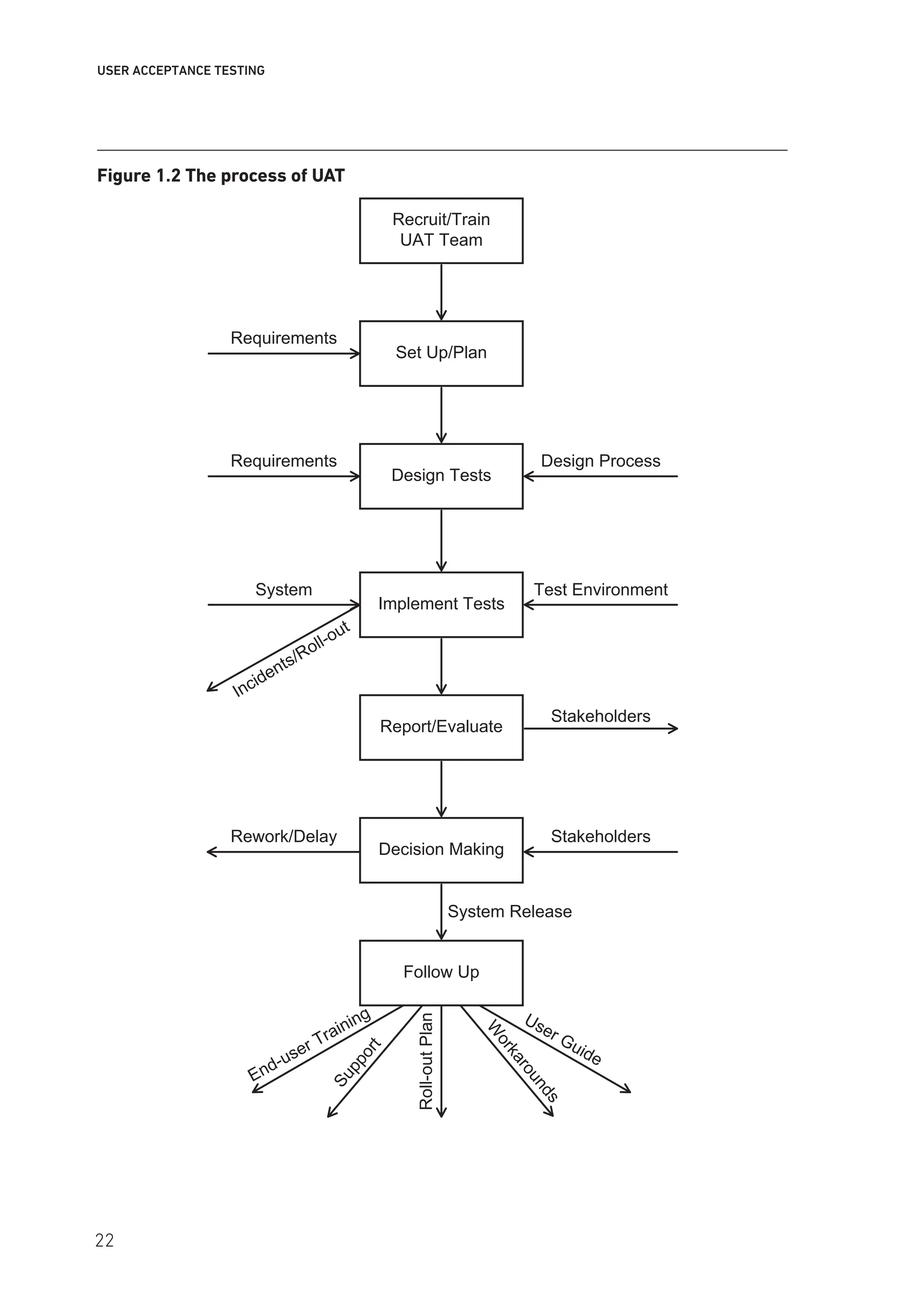
  • 11.
    CONTENTS List of figuresand tables viii Authorsx INTRODUCTION1 What this book is about 2 The role of UAT 5 The costs and benefits of UAT 5 The value of UAT – the reasons we need to do it 6 Stakeholders – who this book is for 10 How to get the best from this book 11 Checklists12 Case studies 13 1. THE IMPORTANCE OF UAT 15 What is UAT? 15 Why test ISs? 17 Business vulnerability 19 The UAT process 21 From UAT to service delivery 24 UAT and contracts 26 Stakeholders in UAT 29 Chapter summary 31 2. BUSINESS REQUIREMENTS 34 Business requirements 34 Business intent and user expectations 38 Acceptance criteria 39 The requirement types 40 Prioritising business requirements 42 The relationship between business requirements and UAT 43 The relationship between development and UAT 45 Scope of UAT 46 Building a test basis for UAT 48 Chapter summary 54 3. TESTING BASICS FOR UAT 56 What is testing? 56 Test types 58 Testing processes 62 Test-case design techniques 68 v
  • 12.
    CONTENTS Testing approaches forUAT 70 Reviews72 Chapter summary 73 4. THE UAT TEAM 75 Stakeholders and the UAT team 75 Key roles in a UAT team 77 Creating a successful team 80 Training the team 82 UAT training content 84 The team life cycle 86 Dealing with team conflict 88 The working environment and working patterns 89 Basic disciplines 90 Chapter summary 91 5. UAT AS TRANSITION 93 The IS life cycle as a series of transitions 93 Planning for transitions 95 UAT as a transitional phase 96 UAT as an event and UAT as a process 96 Chapter summary 98 6. PREPARING FOR UAT – PLANNING 99 Deciding what we want to achieve 100 Acceptance criteria 101 UAT objectives 103 Entry criteria 103 Defining the testing we will need 105 Creating a test basis for UAT 107 Setting up the test management controls 119 Chapter summary 120 7. TEST DESIGN FOR UAT 122 The hierarchy of test design 122 Identifying test conditions 124 Designing test cases 128 Designing test scripts 133 Data creation 138 Chapter summary 142 8. IMPLEMENTING THE TESTS 144 The testing schedule 144 Implementing the test schedule 150 Identifying progress 155 The status report 156 The post-testing summary 156 Chapter summary 158 9. EVALUATING THE SYSTEM 159 How do we decide whether or not to accept a system? 159 When the testing has to stop 161 vi
  • 13.
    CONTENTS The risk ofrelease 162 Measuring the risk of release 163 Defining and evaluating emergency-release criteria 163 Decision process for evaluating UAT results 165 Test summary report conclusions 168 The final release decision 169 Chapter summary 169 10. LIFE AFTER UAT 171 Post-UAT reporting 171 End-user training 175 Preparing a roll-out strategy 175 Implementation176 Post-implementation defect corrections 176 Measuring business benefits 176 The end of UAT? 177 Chapter summary 177 APPENDIX A UAT Checklists 178 Initiating the UAT project checklist (sponsor) 178 Planning the UAT project checklist (UAT team leader) 180 UAT test design checklist 182 UAT test execution checklist 183 UAT release decision checklist 184 Post-UAT actions checklist 184 APPENDIX B ANSWERS AND COMMENTS 186 Chapter 1 186 Chapter 2 188 Chapter 3 190 Chapter 4 191 Chapter 5 193 Chapter 6 194 Chapter 7 196 Chapter 8 198 Chapter 9 200 APPENDIX C UAT TRAINING 202 The training process 202 The training consultant role 203 References210 Index211 vii
  • 14.
    LIST OF FIGURESAND TABLES Figure 0.1 An information system 3 Figure 0.2 Life cycle of an IS 4 Figure 1.1 End-to-end testing of a transaction in an online retail system17 Figure 1.2 The process of UAT 22 Figure 1.3 The transition to live use 25 Figure 2.1 A sequential development life cycle 45 Figure 2.2 An iterative development life cycle 46 Figure 3.1 Functional testing 59 Figure 3.2 Business process end-to-end testing 61 Figure 5.1 The IS life cycle 94 Figure 5.2 A map of transitions 94 Figure 5.3 Preparation for transitions 95 Figure 5.4 UAT as transition 97 Figure 6.1 The cost and value of a system 106 Figure 7.1 The test design hierarchy 123 Figure 8.1 The life cycle of a test 146 Figure 8.2 Example of an incident report 154 Figure 8.3 Example status report contents 157 Figure 9.1 Process for deciding go/no go for release 160 Figure 9.2 UAT completion report format 167 Figure 10.1 UAT completion report outline 173 Figure 10.2 Post-UAT analysis report 174 Figure C.1 The training process 204 Table 2.1 Business requirements 35 Table 2.2 The requirements document 36 Table 2.3 Excelsior requirement 37 Table 2.4 Use case 53 Table 3.1 Test conditions table 63 Table 3.2 Test cases 64 Table 3.3 Test script 65 Table 6.1 Absence requirements 109 Table 6.2 ATM use cases 112 Table 6.3 Expenses use cases 115 Table 7.1 Login requirements 124 Table 7.2 Test condition matrix 126 Table 7.3 Login use case 129 Table 7.4 Simple login test script 134 viii
  • 15.
    LIST OF FIGURESAND TABLES Table 7.5 A contract data input sheet 141 Table 8.1 Example of a test schedule 149 Table 8.2 Example of a test log 152 ix
  • 16.
    AUTHORS Pauline van Goethemis a freelance UAT and IT training consultant. She has 17 years’ experience of change management, testing and training, helping to deliver IT and change management projects in industries as diverse as financial services, energy and utilities and TV and social media. She is a certified tester and Scrum Master and has been employed as a project manager, business analyst, UA tester, UAT manager, end user trainer and UAT trainer. She started her own implementation support company in 2006, specialising in offering training and UAT consultancy and services. Pauline is a member of the International Software Testing Qualification Board (ISTQB) Glossary review team. Brian Hambling has spent nearly 40 years in the IT industry in a wide variety of development, testing and quality management and project management roles. His first task as a software professional was to acceptance test flight software on behalf of the RAF and he has maintained a strong interest in the achievement of software quality throughout his career. He has been an active member of the testing community through the BCS Special Interest Group in Software Testing, at BCS Professional Certification (formerly ISEB) as Chair of the Software Testing Examination Board, and at the ISTQB as a contributor to examination processes and as an examiner. x
  • 17.
    INTRODUCTION This is abook about user acceptance testing (UAT) in its many forms and the uses to which it is put. It draws together many strands of material about testing, project management, quality management, team behaviour and other relevant pieces of the complete UAT experience and weaves them into a strong and reliable lifeline for the novice UA tester or stakeholder. The book has been written to meet the needs of three disparate groups of people. The first of these groups is those who are directly involved in the UAT exercise. For this group we aim to provide a practical and fairly complete guide to the testing of information systems that contain software. As the subtitle indicates, we have adopted a step-by-step approach to enable them to acquire the necessary terminology (jargon) and basic principles as they learn about the practical challenges of UAT and how to deal with them. Within this group we include not only those asked to do the testing (usually end-users of the system) but also those who will have commissioned the system and the testing (sponsors) and those who will be expected to deliver the expected benefits (business managers). The book addresses this group as a whole, but also identifies the specific challenges and provides a practical guide for each of the subgroups within it. The second group is the professional testers or developers who have been asked to support UAT, or who may simply wish to better understand why UAT is both important and challenging. For this group we explain what kind of support may be needed and why, and we explain where UAT fits within the overall context of structured testing and development life cycles. The third group is made up of those professionals for whom UAT is an essential ‘tool of the trade’; project managers, quality managers and test managers for example. For this group we seek to place UAT within the overall disciplines of testing, quality management and project management. Above all the book is intended to explain and explore the significance of an exercise that is commonly neglected in books about testing and often overlooked in books about project management and quality management, yet which is a bridge between these disciplines and, in some respects, is an essential practical expression of each of them. 1
  • 18.
    USER ACCEPTANCE TESTING WHATTHIS BOOK IS ABOUT Information systems (ISs) Generally speaking we acquire software to enable us to achieve something of value to us, such as playing a game, making our first million on the stock exchange, or making our business run more efficiently. In some cases software can achieve its purpose without human involvement (except to press a button), but in most cases software interacts with people in a way that achieves a desired result. For example an air traffic control system might provide information to air traffic controllers about where aircraft are, where they are going, how fast and so on. The air traffic controller makes decisions about where each aircraft should go to ensure they are all safely separated and the system relays this information to the pilots of the aircraft. So the purpose of the overall system is to keep aircraft safe and to do that it needs suitably trained people, the air traffic control software, some hardware and some organisation (for example to provide communications between air traffic controllers and pilots). Although this is quite a complex example, it has all the characteristics of an IS. What it most importantly demonstrates is that software is not something that operates in isolation. What users are interested in is not just whether the software does what it should do but whether the system as a whole achieves its purpose and whether they, as users, will be able to operate the system effectively (and without undue stress). Characteristics of a system A system is a collection of interdependent components that interact according to a plan to achieve a specific goal. The key thing to remember about a system is that ‘the whole is greater than the sum of the parts’. So a team focused on a goal can achieve much more than the team members could achieve individually if they were not a team. Interdependence means that every part is vital. Systems only behave like systems when they have a clear purpose. Characteristics of an IS An IS is a system comprising humans, computers, organisation, processes and a single purpose – the business intent. It is the business intent that makes this collection a system. The components are interdependent, so neither the computers nor the humans can achieve the business intent on their own. Organisation and processes manage the interactions. When we build or test an IS we must consider all the components, and the interactions, and the common business intent. Figure 0.1 provides a schematic view of an IS for a business. 2
  • 19.
    INTRODUCTION Figure 0.1 Aninformation system Customers Business Orders Information System Deliveries Suppliers Orders Deliveries Computer(s) and Software In a business context we would have business processes that involve human beings using information to add business value, such as a supermarket checkout assistant adding up all the retail values of the items purchased by a customer, preparing a bill for the customer to pay, accepting payment and providing a receipt. All of this could be done manually, but this is a process that is usually automated for reasons of efficiency and for the advantage of having all the details of each transaction available as information to be processed in making other decisions such as when to restock. In this example the effectiveness of the overall process would probably be measured by how quickly and accurately a single customer’s shopping can be handled. Here again the whole process is measured, not just the part the software does, because that is the process that adds value to the business. From a user perspective a checkout operator will be sitting at a checkout for perhaps hours at a stretch. To them it will be vitally important that the efficient operation of the checkout is achievable routinely and without heroic effort. If the scanner refused to scan some items, the conveyor broke down at regular intervals or the bills produced were even occasionally incorrect, the impact on the user would undoubtedly be increased stress. So this book is about testing ISs and not just software, and it is also about considering all the perspectives of all the people involved in building, operating and using the system to achieve its expected business benefits. 3
  • 20.
    USER ACCEPTANCE TESTING TestingISs When we set up a UAT exercise we are testing a system and not just a piece of software, which means we are really interested in knowing whether the overall IS works. If the system does not work as we expect, there could be a number of reasons, and among these is the possibility that the software does not do what it should. But the software could be working perfectly and some other aspect of the system could be at fault. To make this as clear as possible we need to take a brief look at how ISs are created – not in detail but as a high-level view of what happens to an IS from the first idea through to the realisation. This high-level perspective is usually called a life cycle. The life cycle of an IS is simply a model of everything that happens to it from the time it is first envisaged to the time it is retired. Figure 0.2 shows a simple schematic view of what an IS life cycle might look like. What this life-cycle model describes is a process that begins with requirements (which are the means of describing what the system needs to do), proceeds through a vague and shadowy phase called development (which we will only delve into occasionally and only if we absolutely need to understand something about it) before reaching UAT as the final stage before the system is ‘released’ into service. We will take a closer look at how requirements are arrived at and documented in Chapter 2. Figure 0.2 Life cycle of an IS 20% 80% Requirements User Acceptance Testing Release to Service Utilise Maintain Retire Development 4
  • 21.
    INTRODUCTION One key featureof this life cycle is the balance of time, effort and money spent on it. The part of the life cycle that usually gets most of the attention is the initial development, even though that accounts for only about 20 per cent of the total spend. Most of a system’s life is spent in being used, maintained, modified and repaired. The better the system is at the end of development, the lower that large chunk of life-cycle cost is likely to be – and the ‘gatekeeper’ between development and the rest of the life cycle is UAT. Effective UAT can avoid excessive maintenance costs (for example repairing defects), reduce the cost of modifications (for example to improve the system’s usability) and prolong the life of the system, so giving a better return on the original investment in development. UAT is the final frontier between initial development and the rest of the system’s life, a frontier beyond which could be a world in which your new IT system makes your life easier, anticipates your needs, saves you time and always turns out great results – or a world where using your IT system is a nightmare in which nothing functions, the system seems determined to prevent you completing your work and the outputs are never what you wanted. Anyone accustomed to using IT systems knows that these two ‘parallel universes’ are actually very close together and that predicting which of those worlds you will be transported to when your system is declared operational is not easy. That is the role of UAT – to provide a glimpse of the future (just) in time to avert a disaster if that is what you foresee and to give the users the best possible start with using the system. THE ROLE OF UAT UAT is a test of an IS from the perspective of the users and other stakeholders for whom it has been built or acquired. UAT is not just a test of the software, nor of the functionality, performance, reliability and security, nor of the usability of the system. That does not mean UAT is not concerned with any or all of those areas, but that its primary concern and absolute focus is on whether or not the system can deliver the expected business benefits when operated by its designated users. All of the specialist areas mentioned will have, or certainly should have, been tested during development. None of those tests, however, answers the question ‘Is the system fit for purpose?’ UAT answers that question unequivocally by testing it against the reason it was built or acquired, using the eventual end-users as testers and, as far as possible, utilising the user documentation prepared to support their use of the system. This will entail not just exercising the system in some random or even structured way; it will entail using the system to enable business processes that deliver value using realistic (or actual) scenarios, data and operations. UAT is the nearest we get to ‘the real thing’ without actually taking the risk of releasing the system into service, and it is the exercise that will enable us to make a rational judgement about whether to take the risk of releasing it into service. THE COSTS AND BENEFITS OF UAT UAT is an expensive exercise. As well as the hard costs of actually doing the testing, we have to factor in the additional time that development resources are tied up before roll-out of the system allows them to be released to other projects. 5
  • 22.
    USER ACCEPTANCE TESTING Thelargest components of the direct cost of UAT are: y y The cost of diverting end-user staff from their normal work to plan and carry out UAT. As well as salary costs there is the loss of whatever revenue the staff would have generated or the delay in realising that revenue. y y The cost of training or familiarisation for the UAT team (and subsequently for all end-users). y y The cost of test environments for UAT. A UAT exercise with a team of six staff that takes two weeks to complete might have direct costs of around £6,000–£10,000 for salaries alone. What do we have to offset this cost? THE VALUE OF UAT – THE REASONS WE NEED TO DO IT In case you are not convinced of the need to go to the time and expense of a UAT exercise, we will take a brief look at the world of ISs and what can go wrong with them. Reason 1: risk management – avoiding expensive failures HIGH-PROFILE IT FAILURES US trading systems, unable to cope with the number of transactions, fail causing panic among sellers. On Friday 17 October 1987, after a number of Securities and Exchange Commission (SEC) investigations of insider trading and the London stock market closing due to severe weather conditions, it looked like a sustained period of growth was going to come to a sudden halt for the US stock market. On Black Monday the crash started in Far Eastern markets and, after a weekend of worrying about their shares, investors sold stock in a mass exodus of the market, generating a flood of sell orders and crashing trading systems. As a result more than 20 per cent was wiped off the value of the US stock market in a single day. A new computer system means 500,000 UK passports cannot be issued on time. In the summer of 1999 the UK Passport Agency brought in a new Siemens computer system without sufficiently testing it or sufficiently training staff on how to use it. At the same time an unusually high demand for passports was driven by a change in the law, which meant that children under the age of 16 required their own passport when travelling abroad. As a result the Home Office had to pay millions in compensation for missed holidays and staff overtime. A memory leak in the London Ambulance Service’s new emergency dispatch system leaves 46 people dead. Before 1992, office staff decided what ambulances should be dispatched where and it seemed that there were efficiencies that could be achieved by using a 6
  • 23.
    INTRODUCTION computerised system. Justa few hours after it was deployed problems began to arise with the new system. The root cause of the main breakdown of the system was a memory leak in a small portion of code. The system retained memory about incident information on the file server even after it was no longer needed. As with any memory leak, after enough time, the memory filled up and caused the system to fail. The next day, the Ambulance Service switched back to a part-manual system, and shut down the computer system completely when it stopped working altogether eight days later. In those nine days the lives of up to 46 people might have been saved had an ambulance been able to get to them in time. Microsoft rushes to release a flawed games console to stay ahead of the competition. The Xbox 360 games console was released by Microsoft in November of 2005, just ahead of Nintendo’s PlayStation. It quickly became clear that the Xbox was subject to a number of technical problems and failures; a series of glowing red lights flashing on the face of the console, later nicknamed the ‘Red Ring of Death’, being the most well known. It was not until 5 July 2007 that Microsoft published an open letter recognising the console’s problems, as well as announcing a three-year warranty for every Xbox 360 console that experienced the general hardware failure. The design issues were alleged to be the end results of management decisions and inadequate testing resources prior to the console’s release. Not all ISs end in high-profile failure; many are highly successful and trouble free over a long life, but it is nevertheless true that the statistical likelihood of failure for an IS is relatively high. In 1995 The Standish Group published a report based on research into a large number of failures in software systems. It was called the CHAOS report (The Standish Group has never revealed what the acronym stands for, only conceding that a few select people in the organisation know) and it contained some frightening statistics, for example that only 16.2 per cent of IS projects were completed on time and on budget. Worse still, completion often required significant watering down of the original specification for these systems. The statistics relate to system failures and these are not necessarily related to UAT, but the CHAOS report analysed their statistical evidence and identified key factors that contributed to failure. These factors point to problems in some aspects of system development that UAT can throw some light on, such as lack of user involvement and poorly defined requirements. The original CHAOS report was published quite a long time ago, but The Standish Group has repeated its research and published updated results over a number of years. The results have gradually been improving with the introduction of agile project models and a greater awareness of the issues that cause projects to fail. The 2011 edition of the CHAOS report found that 37 per cent of all projects succeeded and Jim Johnson, Chairman of The Standish Group, stated, ‘This year’s results represent the highest success rate in the history of the CHAOS research. We clearly are entering a new understanding of why projects succeed or fail.’ Although the results show a significant improvement on the original 1995 figures, it is a sobering thought that, even with these 7
  • 24.
    USER ACCEPTANCE TESTING unprecedentedresults, 63 per cent of projects in the study did not succeed. Although other researchers have criticised The Standish Group for providing little or no context to its figures, for instance by not distinguishing between projects where going over the deadline means failure and those where an reasonable overrun can be easily tolerated, nevertheless the CHAOS report presents a very useful list of the key factors that contribute to project failures, the knowledge and application of which can benefit any project. We shall explore some of these factors and how we can learn from them in Chapter 1. Avoiding high-profile disasters or even low-profile mishaps is not solely about performing effective UAT of course. By the time we get to UAT the seeds of failure have not only been sown, they may well have already germinated; but well-planned UAT may still be able to highlight the potential for disaster before it actually happens. This is an important reason, but not the only one, for doing UAT. Reason 2: confidence building – achieving expected business benefits If we have acquired some expensive software or some software designed to do something really important for our business, we need to be sure before we accept it that we have minimised the risk of it not doing the job we acquired it for. This is not just a repetition of disaster avoidance, but a form of ‘good housekeeping’ that ensures we have addressed all the things that could go wrong when we start to use the system. Many of these may be only small things, but they can add up to a problem in service, and some of these smaller issues may not have been addressed by the testing done during development, which was designed to ensure the system meets its specification rather than ensuring that the users will be able to use it effectively. In Chapter 3 we will show how risk-based testing can be used to minimise the risk. We will also need to be sure that the people who use the software will get the expected productivity or other benefits and that the business will get the efficiency or other improvements we intended. To do this we need to put the system to use in a realistic environment and work through some examples of situations in which it is expected to add value, such as streamlining processes or reducing the cost of production. This kind of testing will be based on an understanding of how the system will be used to gain business benefits and setting up a realistic ‘trial’ to see that it is capable of delivering those benefits. We explain in Chapter 6 how we can set up this kind of test. Reason 3: assessment – getting the business processes right As well as making sure that the system will not only do what it is supposed to do but will also be usable by our staff, we need to give the end-users an opportunity to exercise the system in whatever way they have agreed to work to make it effective. Users will need to check system behaviour as part of the overall business processes, using it in the way that has been agreed. We will not only treat the system as an IS and test its behaviour when the intended business transactions are passed through it, but we will also test that end-users can operate the system in the way that is needed to make those processes work effectively. One further benefit of UAT is that the act of determining a system’s fitness for purpose necessarily involves comparing the system’s behaviour with user expectations. If the 8
  • 25.
    INTRODUCTION comparison is donesystematically and formally, then the primary ‘result’ of UAT may be to accept or not to accept the system. A valuable secondary result, though, is that the comparison will have generated a detailed understanding of how well the system matches expectations. This comparison can be made the basis of an assessment of the system’s current capability and value to the business, which in turn can be used to underpin a strategy for future development or enhancement. It enables us to know exactly what the strengths and weaknesses of the system are and to assess value for money and potential for improving business value from the investment in development. Reason 4: preparation – assessing readiness for service Finally we want to be sure that the software is fit to release into the business and that the business is ready to make use of it, so we will need to assess readiness. After we have completed the testing based on risks, benefits and usability, we may have discovered some problems that need to be resolved, some defects that need to be corrected or some other aspect that needs to be addressed (such as training). The combination of these things will have an impact on when a system will be completely ready for the users to take on. This aspect of readiness is about how robust the system is in operation, how closely it fits expectations, how many ‘workarounds’ have been found necessary and a host of other factors that may affect whether or not the system is ready to deliver value to the business. This is usually a matter of discussion and negotiation, and results in a decision to release the software. Chapter 9 will explore the mechanisms we can put in place to make that decision as objective as possible. If we consider this aspect of UAT well in advance (as we should), we can define a set of acceptance criteria that will be used to come to a decision about release and so avoid the conflicts that can arise at this stage. One important thing to say in this context is that UAT is distinct from training, familiarisation and all other aspects of roll-out. It has its own set of objectives that would be seriously jeopardised if UAT was carried out by unprepared, untrained end- users who were unfamiliar with the system. Having said that, however, the experience of UAT will be a learning exercise that is second to none and the experience gained during UAT can be captured and utilised in training, familiarising and preparing the end-user population for using the system effectively – including dealing with any issues raised by UAT for which ‘workarounds’ have been defined. THE ENIGMA OF SOFTWARE It is always difficult to pin down the cost of software, but it is true that the case usually made for acquiring software – that it saves staff costs – has been shown to be invalid in most cases. Software is expensive to acquire and operate over its complete life cycle from inception to disposal. A second key characteristic of software is its inflexibility. We imagine software to be very elastic, so that we can change it at will, but this is far from the truth. While it is very easy to change a line of code (in the sense that code can be updated at almost no cost because it is electronic and lives on a machine that can alter its contents instantly), it is very difficult to change the behaviour of a software application in a way that has no negative consequences and meets all our expectations. Software 9
  • 26.
    USER ACCEPTANCE TESTING isactually very inflexible as a tool for achieving a business purpose. Once installed the cost and impact of modification can be, and often is, very high. Thirdly, software is not visible. It has no moving parts and so has nothing that we can see operating. When it stops working it does not ‘break’ in the way that physical systems do. The computers usually keep operating and doing something; they just stop doing what we want them to. This can be very frustrating especially if we find that the software is not malfunctioning at all, but just responding to some unexpected input. These three characteristics make software a difficult medium to work with and a difficult business tool to operate unless it is working exactly as we expect it to. The enigmatic nature of software as a medium makes the risk associated with deploying ISs containing software significant and UAT is the best mechanism we have for managing that risk for the user community. We have already stated that the main reason why UAT is a worthwhile exercise is that it can help to avoid some of the costs of dealing with failures and of modifying the software after its acceptance. The potential costs of failure can be judged from the case study examples, but the cost of failure is invariably higher than expected in a business context because of the ramifications of failure in the tightly knit relationship between business processes and ISs. There is also one other major benefit from UAT.The skills and newly acquired experience, combined with the invaluable experience that stakeholders bring with them to UAT, have enormous potential value in preparing for and achieving a painless roll-out. Beyond that, the insights gained by those spending time in testing a system can be harnessed to enhance future business process development, training and support. There is potentially a massive benefit to be reaped from the experience of UAT for the individuals concerned and for the business as a whole. STAKEHOLDERS – WHO THIS BOOK IS FOR This book is aimed at the groups of people who together comprise the principal stakeholders of UAT: y y sponsors (typically owners or senior managers who have decided to acquire software of some kind to enhance their business); y y business managers, who will be responsible for ensuring the IS delivers the expected business benefits; y y end-users, who will be most interested in the way they are able to interact with the system to achieve their tasks; y y professional developers and testers, who will be concerned with providing the most effective support for UAT; y y managers of processes, practices and standards, who will take an interest in making UAT a cost-effective process using best practice. 10
  • 27.
    INTRODUCTION In each ofthese groups there may be some who have no experience of testing at all and for whom an assignment to a UAT team is a daunting prospect. If you are in this category then this book is for you, and it speaks to you very directly: y y by using non-technical language wherever possible; y y by assuming no prior knowledge of testing at all; y y by identifying what you need to do in a step-by-step fashion; y y by providing case studies, examples and exercises for you to practise at least some of the tasks. If you are a sponsor and are in the process of acquiring a new IS, the book will identify the role of UAT in ensuring you get the system you are expecting, but it will also help you to understand how UAT fits into your overall planning and what benefits it brings in terms of training and supporting the inevitable change to working practices that new ISs invariably bring. If you are a business manager who will be responsible for the effective operation of the system in achieving business benefits, the book will explain how those benefits are defined and measured and how you can ensure UAT is shaped to provide you with the information you need to prepare for the system’s release into service in your part of the business. If you are an end-user tasked with testing an IS, the book will provide you with all the tools and techniques you will need to be an effective UA tester. If you are in the group of ‘interested professionals’ who may need to support UAT, you will find in this book a clear exposition of how and where the world of UAT interfaces with the work of professional developers and testers and how best to manage that interface and support the UAT activity. Finally, if your role involves managing and enhancing practice of some kind as a test manager,quality manager or project manager,you will find the book useful as a manual of key techniques, methods and tools. Quality managers wanting to improve UAT practices, for example, will find here a comprehensive review of UAT from which best practice can be distilled and then customised to fit your organisational culture, size and budget. HOW TO GET THE BEST FROM THIS BOOK The two main premises of this book are: 1. We can and must make UAT effective to reduce the risk and cost of underperforming ISs. 2. The benefits of UAT outweigh the costs. To explain why and how these results can be achieved the book has been structured as described below. 11
  • 28.
    USER ACCEPTANCE TESTING Thefirst three chapters provide all the background and justification for a step-by-step approach to UAT: y y Chapter 1 – The Importance of UAT; y y Chapter 2 – Business Requirements; y y Chapter 3 – Testing Basics for UAT. The next two chapters are dedicated to the practical issues of creating, shaping, training and deploying an effective UAT team: y y Chapter 4 – The UAT Team; y y Chapter 5 – UAT as Transition. The remaining chapters explain the step-by-step approach in practical detail: y y Chapter 6 – Preparing for UAT – Planning; y y Chapter 7 – Test Design for UAT; y y Chapter 8 – Implementing the Tests; y y Chapter 9 – Evaluating the System; y y Chapter 10 – Life after UAT. We sincerely hope that all readers of the book will find it interesting and rewarding enough to want to read it from cover to cover. However, the first encounter with any book of this kind needs some kind of plan to extract the maximum value in the minimum time to provide a starting point from which a more detailed exploration of the content can begin. The initial route through the book naturally depends on your starting point. All readers are strongly advised to read Chapters 1–3 as general background and as preparation for the practical approach later in the book. Those responsible for managing a UAT team should read Chapters 4 and 5, and all those selected to take part in UAT will gain an understanding of the skills needed and the style of operation for a UAT team by reading these two chapters. All readers are encouraged to read Chapters 6–10 although some chapters will be more relevant to some groups than to others. Within these chapters all of the stakeholders are considered and information of particular importance to one group or another is labelled appropriately to guide your initial reading. CHECKLISTS Whatever approach you take to reading the book you will be guided through all the key steps in UAT through Chapters 6 – 10. Your reading should help you to understand what the key steps are and why they are ordered as they are. 12
  • 29.
    INTRODUCTION To help youin applying what you learn from the book, you will find a set of checklists for all the major steps in UAT at Appendix A. The purpose of the checklists is to present the key steps in a logical order, uncluttered by explanation, but also indicate where you can find supporting material in the book. We hope you will find these useful when you come to apply the step-by-step approach to your projects. CASE STUDIES Throughout the book we will make use of case studies, examples and exercises. The case studies are used to provide documented real-life examples of the things we are talking about; the examples will give you practical guidance on how to use the techniques, methods and approaches we present; the exercises will provide you with opportunities to try out some of the techniques. In addition to these in-text components we end each chapter with a few multiple-choice questions that you can use as a check that you have understood the key ideas in the chapter and we also provide you with questions that you might like to think about. These raise some of the issues and challenges that you might face as a user acceptance (UA) tester and give you an opportunity to think about them before you have to deal with any real challenges in a project context. We have provided answers to all the exercises in Appendix B so you can check your answers against ours. The more open-ended questions at the end of the chapters have no correct answer, but we have included some of our own thoughts on these questions that you can read if you want to. We make no claims about these being the best responses to the questions, but they are the ones that we have developed from our experience. Finally, before we progress on to Chapter 1 and take the first step in introducing the UAT process, we are going to introduce you to a small imaginary company called HMF that is acquiring an IS. We will use the HMF case study mainly to wrap around the more significant examples we provide, especially in Chapters 6–9, to provide continuity of ideas and hopefully to help you see how information is built up at each step of the approach for use in later stages. CASE STUDY – HMF AND THE EXCELSIOR SYSTEM HMF is a web-based insurance company offering low-cost insurance solutions for a broad range of domestic and commercial risks. HMF has rapidly developed its product range by acquiring smaller specialised insurance providers and integrating their specialised products into its own platform. HMF has recently conducted a rationalisation programme to ensure that staff numbers and skills are optimal for the integrated product range and to harmonise processes across the business. The rationalisation exercise revealed that accounting and human resource (HR) practices had become fragmented after multiple acquisitions and integrations, and a decision was taken to develop an IS to support common accounting practices across the business and, as a secondary objective, to enhance HR process integration. At the heart of the IS a new software package, known as Excelsior, was specified to run on existing HMF servers. 13
  • 30.
    USER ACCEPTANCE TESTING TheExcelsior accounting system was commissioned as a custom-built accounting solution based on a collection of standard accounting modules configured in an architecture that supports full integration of all the modules’ services and also enables selected HR applications to be incorporated. The development will be incremental to allow basic functions to become well established before adding further complexity and the first incremental delivery is now ready for UAT. At the current stage of development the accounting functions available will be: y y general accounting; y y purchase orders; y y contracts; y y payments. In addition the following HR services will be available: y y absence (to book days off, sickness and other absence and manage requests for absence for a team); y y expenses (to enable submission of expenses forms and receipts for payment and to approve expenses related to a team); y y changing contact and bank details and updating personal details held by HR; y y internal purchase orders (request purchases and approve purchases related to a team, marking a purchase order as fulfilled); y y training (request training, take online training, record training attendance); y y administration (support and managerial functionality); y y jobs (search for, list or apply for vacancies, approve applications related to a team). Each module has a unique title related to Excelsior, for example Excelsior – Training. Every service is listed on the main menu on the Excelsior home page but access is restricted for some modules. Users are granted access to services based on their role-based login profile. Where access is denied, a link appears that allows users to request access from the appropriate person. We hope you find HMF and Excelsior, and all the case studies, examples, exercises and the questions at the chapter ends, helpful in bringing the ideas to life and enabling you to gain some insight into what is happening during a real UAT exercise. 14
  • 31.
    1 THE IMPORTANCEOF UAT The introduction presented some general concepts that help to get a better understand- ing of UAT and introduced examples of high-profile project failures that, if not caused by UAT, were certainly not prevented by it. Chapter 1 provides an overview of UAT, its purpose and its relationship to an implementation project and the people who take part in it. You will find out why UAT is different from other types of testing and yet often uses the same processes – one of which is the fundamental test process. Finally you will discover what the different types of UAT are, who the stakeholders of UAT are and what each role has to offer to and to gain from the UAT process. Topics covered in this chapter y y What is UAT? y y Why test information systems? y y Business vulnerability y y The UAT process y y From UAT to service delivery y y UAT and contracts y y Stakeholders in UAT WHAT IS UAT? UAT stands for user acceptance testing and is commonly used to refer to the end-user software testing carried out prior to a new information system (IS) being introduced to an organisation. The primary objective of UAT is to ensure the new system does what it set out to do and meets the requirements the business has of it. Here is a definition of the term UAT taken from the ISTQB Glossary of Testing Terms: Formal testing with respect to user needs, requirements, and business processes, conducted to determine whether or not a system satisfies the acceptance criteria and to enable the user, customers or other authorized entity to determine whether or not to accept the system. 15
  • 32.
    USER ACCEPTANCE TESTING THEINTERNATIONAL SOFTWARE TESTING QUALIFICATIONS BOARD (ISTQB) ISTQB provides certification at Foundation, Advanced and Expert levels for software testers. The certificates are supported by a glossary available free from www.istqb. org/downloads/glossary.html. We will use the ISTQB Glossary throughout this book because it is widely used in the testing community and in tester certification programmes. You may also find the following related books, which also use the ISTQB Glossary, helpful if you want to increase your knowledge of testing: Software Testing: an ISTQB- ISEB Foundation Guide by Brian Hambling (Ed), Peter Morgan, Angelina Samaroo, Geoff Thompson and Peter Williams; Software Testing: An ISEB Intermediate Certificate by Brian Hambling and Angelina Samaroo. Three aspects of this definition are important and will drive what we do in preparing and implementing UAT: 1. UAT requires ‘formal testing’, which means that tests should be designed and executed in a structured way that provides objective evidence of the acceptability or otherwise of the system. 2. The definition speaks of testing with respect to ‘user needs, requirements, and business processes’. It does not mention any particular specification document but it does draw attention to what users need and it goes beyond testing software to include business processes. 3. The definition speaks of satisfying ‘acceptance criteria’, which define what is acceptable to the users. We will explore all three of these key ideas in the book and we will be developing our UAT around acceptance criteria and formal testing of user needs and business processes. Although other testing takes place before UAT is carried out, UAT is unique in that it is the first time the completed system is tested by users against user needs. Testing during development is based on ensuring that what is delivered matches the corresponding technical specification,but the fit between an IS and its business users is more intimate and it is the unique user perspective that can identify the problems of fitness for purpose in a business context.Without it a system that has been tested by developers and professional testers, and which has passed every test, can still fail at the first hurdle of real use. That is why UAT needs to include ‘end-to-end’ testing that exercises complete business processes, including the computer system, rather than testing the computer system in isolation (Figure 1.1). For example in an online retail system, a test of the ordering process must check that an order placed by a customer is accepted and that it triggers identifying, packaging and shipping of the correct product. But these processes must trigger other processes to complete a transaction, for example that the order generates and sends a correct invoice and that payment received is correctly matched with the invoice to close the transaction. Although the scenario is simple, this is a fairly complex set of interacting processes and there is also a time lapse between the initial order and the payment of the invoice, so a full end-to-end test of the transaction will need to follow 16
  • 33.
    THE IMPORTANCE OFUAT an order through the system and over time to ensure all the necessary interactions happen correctly and produce a successful result. Figure 1.1 End-to-end testing of a transaction in an online retail system Customers Business Orders Information System Deliveries End-to-end Test End-to-end Test Suppliers Orders Deliveries Computer(s) and Software WHY TEST ISs? Software is one of the greatest examples of human creativity and endeavour. The growth in what can be achieved with computers and software in recent decades has been phenomenal and the trend is likely to continue. Software and software-based systems such as IS are becoming ever more endemic in business life. As the complexity and subtlety of the relationship between IS and business increase, so the impact of failure, by which we mean any mismatch between what an IS actually does and what we need it to do, becomes greater. This increase in the risk of using an IS must be balanced by increased attention to risk management. There are many facets of risk management but, in the world of software and IS, testing remains one of the key risk management disciplines. As software has become more complex, testing has had to become more effective at identifying problems and potential problems so that they can be resolved before a system fails. As we will explain in Chapter 3, where the sophistication of development activity 17
  • 34.
    USER ACCEPTANCE TESTING hasincreased, testing has also had to become more sophisticated. Why? Because with greater complexity comes greater risk of human mistakes in design and in implementation; because greater integration between human activity and the systems that enable it brings more opportunities for mismatch; and because the many essential characteristics of ISs (such as reliability, usability and security) all need to be assured before the system can be trusted to deliver its services in a real business situation. The increased dependence of business on IS has also made the relationship between systems and business processes more critical to business success, and in many cases the desired behaviour of an IS cannot be adequately described in technical specifications. Most testing during development is based on ensuring that what is delivered matches the corresponding technical specification, but the fit between an IS and its business users is more intimate and more critical than the fit between craftspeople and their tools; it is rather more like the fit of a garment that is ‘made to measure’ so that an individual can work comfortably and effectively in it all day and every day. Whether that kind of fit has been achieved is not something that can be determined by anyone other than the user. That is why UAT is different from all other kinds of testing and also why users must take part in it. It is the unique user perspective that can identify the problems of fitness for purpose in a business context and, without it, a system that has been tested by developers and professional testers, and which has passed every test, can still fail at the first hurdle of real use. REASONS WHY WE NEED TO TEST The fact that we live in an imperfect world is, at the most basic level, why we may have trouble creating a perfect IS and why it is important to test them. There may be many reasons why requirements do not exist at all or are not complete and up to date: y y It is often hard for the sponsor or end-users to imagine what their requirements are going to be. Ideas about what the system should become change over time and in the context of development. y y Even when the requirements are clear in the minds of the sponsor or end-user, they may have trouble communicating the requirement. What is written in the requirements document may therefore not reflect what was intended. y y If the requirements reflect what was intended by the sponsor or end-user, the developers may interpret requirements incorrectly because they will bring their own assumptions to the process. y y Even if correctly imagined, communicated, written and interpreted, developers may make mistakes when writing the code that creates the functionality described in the requirements because they are human and therefore fallible. All of these have been cited as significant issues in studies of why systems fail. 18
  • 35.
    THE IMPORTANCE OFUAT BUSINESS VULNERABILITY The relationship we have with IS in business is a unique one. In most cases the system does not just make our lives a little easier; it actually carries on some or all of our business processes in a way that may be difficult or even impossible to do manually once the system is in place. The intimate relationship between businesses and the ISs that serve them makes us particularly vulnerable when a system is first introduced or when it is changed or updated. The term ‘business critical’ is often used for systems that have a significant impact on the way a business operates and delivers its services. To be clear, this is not just about avoiding high-profile failure; it is about ensuring that each and every time we initiate a new IS or change the relationship between a business and its IS, we take care that the new relationship will be as we expected and planned it to be. The UAT process is the last, and arguably the most important check, before an IS is rolled out. ISs are becoming more and more embedded in business processes and in delivery of business value and, as a result, they are also becoming more complex. The combination of the complexity and business criticality of ISs leaves little margin for error. THE CHAOS REPORT – THE STANDISH GROUP The Standish Group was formed in1985 by a group of IT professionals whose aim was to collect case information on real-life IT failures in order to improve IT project success rates. The original CHAOS report, published in 1994, examined 8,380 projects in order to determine whether they were successful and, if not, what the causes of the failures were. The report found the following percentages of projects were successful, unsuccessful or impaired: y y Successful projects completed on time, within budget, containing all the features and functions initially specified – 16 per cent. y y Challenged projects completed and working, but over budget, over time and offering fewer features and functions than initially specified – 53 per cent. y y Impaired projects cancelled at any point during the development cycle or not used post-completion – 31 per cent. The report also identified the reasons for the failures, listed from the most often occurring to the least often occurring: 1. incomplete requirements; 2. lack of user involvement; 3. lack of resources; 4. unrealistic expectations; 5. other; 6. lack of executive support; 19
  • 36.
    USER ACCEPTANCE TESTING 7.changing requirements and specifications; 8. lack of planning; 9. did not need it any longer; 10. lack of IT management; 11. technology illiteracy. The 2011 edition of the CHAOS Manifesto, an annual report from The Standish Group that examines trends in software project success, found that in a marked improvement on the 1994 figures 37 per cent of all projects succeeded, 42 per cent of projects were challenged and the remaining 21 per cent were considered a failure. Notably, however, the majority of projects are still challenged or impaired according to their findings. Not all the reasons listed are relevant to UAT, but those that are relevant will be at the forefront of our thinking when planning and executing UAT activities. The massive disruption to NatWest Group customers following a routine update to its software is an example of what can happen when systems do not perform as expected in a business-critical environment such as banking. The introduction of a new baggage-handling system for Heathrow Airport’s new Terminal 5 is another recent example. THE HEATHROW TERMINAL 5 OPENING In March 2008 Willie Walsh, CEO of British Airways (BA), gave evidence to the House of Commons Transport Committee about the problems with the opening of London Heathrow Airport’s Terminal 5. In his evidence he said: ... we had compromised on the testing regime as a result of delays in completing the building programme and the fact that we compromised on the testing of the building did impact on the operation of T5 in the first few days after its opening. In the first five days of operation the cost to BA of the operational problems was estimated at £16 million and a total of 23,205 bags were ‘misconnected’. The extensive delays experienced by passengers, the sight of the unfinished buildings and the problems caused by delays and unprepared staff also caused embarrassment to BA, the British Airports Authority (BAA) and the UK government (House of Commons Transport Committee 2008). One of our main aims in this book is to explain why these kinds of outcomes happen and how they can be avoided. Meticulous planning, use of highly experienced and competent practitioners and good project management are all essential to success, but they are not enough. We need 20
  • 37.
    THE IMPORTANCE OFUAT to know exactly what will happen from the point when the first real user logs on to a system, and no amount of time and money spent on modelling, problem solving, focus groups, contingency planning or any other discipline will tell us what we need to know as effectively as a well-planned, well-structured and well-designed UAT. The immediate cost of failure (£16 million in a few days in BA’s case) and the ongoing impact on a business of even a small interruption in a key service, such as paying bills through a bank, have a huge impact – significant enough to cause even large companies to fail. It is important to understand at this stage that although UAT has so far been described as the activity that can verify the usefulness of the new IS and save a project from going horribly wrong, UAT may not be perceived as such by others. UAT is sometimes perceived as an expensive evil that interrupts ‘business as usual’, diverts important staff, and costs a disproportionate amount of time and money. The number of high- profile failures associated with releasing software systems that were not ready ensures that most organisations make at least some attempt at an acceptance test, often by pressing reluctant users into an activity in which they feel well outside their ‘comfort zone’. Does this have to be the case? Can we make UAT an exercise that is independent of the IT community that built the system yet in partnership with it to achieve the best possible result? The premise of the book as a whole is that we can. Before we embark on UAT we need to be sure that the cost and effort are worthwhile and we also need to understand the activity well enough to do the best job with the fewest resources. If we understand the activities of UAT well enough to carry them out effectively, the parties involved in UAT should be well prepared, the testing should prove the usefulness of the system and little testing time should be wasted or subject to delay. THE UAT PROCESS The process we will describe in this book will take you through each stage of achieving successful UAT in a step-by-step fashion. We will first explain enough background to enable you to see how the parts of the process fit together and we will provide you with tools and techniques that you will need to do your testing. Next we will describe how to recruit and prepare an effective UAT team. Finally we will take you through the stages of a UAT project, again step by step, so that you can apply all the tools and techniques at the right time and in the right way. The basic process is shown in Figure 1.2 and it is based around the fundamental test process as defined in the ISTQB Glossary so that you can compare it with other testing processes you may read about elsewhere. 21
  • 38.
    USER ACCEPTANCE TESTING Figure1.2 The process of UAT Recruit/Train UAT Team Requirements Set Up/Plan Requirements Design Process Design Tests System Test Environment Implement Tests Incidents/Roll-out Stakeholders Report/Evaluate Rework/Delay Stakeholders Decision Making System Release Follow Up End-user Training t Roll-out Plan W o r k a r o u n d User Guid S u p p o r e s 22
  • 39.
    THE IMPORTANCE OFUAT The fundamental test process (FTP) has five stages. The fundamental test process (FTP) The ISTQB Glossary describes the FTP as comprising five test stages: 1. test planning and control; 2. test analysis and design; 3. test implementation and execution; 4. evaluating exit criteria and reporting; 5. test closure activities. Each stage represents a number of key tasks that need to be carried out in order to complete the formal testing as described in the ISTQB definition of UAT. The stages also represent the order in which these tasks are carried out, although we will see that in real life we will probably need to move between these stages, especially when additional functionality is identified that needs to be tested or faults are repaired that need to be retested. The FTP can be applied to any testing level or to an overall testing project. For our UAT process we will add an additional stage at the beginning for the unique element of UAT of recruiting and forming a UAT team – unique because UAT is conducted by end-users rather than test professionals; it does not simply follow on as one more testing stage for the professional testers to do. UAT team recruitment, development and training are explained in Chapter 4. The second stage aligns with the FTP’s ‘test planning and control’ stage; it entails setting up the UAT project, identifying its purpose and goals, ensuring that we have a sound basis for testing, and planning all the remaining stages. The key input is requirements, which can be problematic, and Chapter 2 explains how we ensure we have the right requirements to work from. Chapter 6 explains in detail what we have to do at this stage. The third stage aligns with the FTP’s ‘test analysis and design’ stage; it entails generating tests from the requirements, using well-defined processes that we will explain in Chapter 3. The output from this step will be a complete set of tests that we need to implement to achieve our overall goal; this is explained in detail in Chapter 7. The fourth stage aligns with the FTP’s ‘test implementation and execution’ stage. At this point we need the system itself and any test environments needed to enable all the tests to be successfully executed. As we test we will generate data about the status of the system that we can report to stakeholders and we report any problems we find to the development team for investigation and, if appropriate, correction. This is explained in detail in Chapter 8. Next comes a step that aligns with the FTP’s ‘evaluating exit criteria and reporting’ stage. In our UAT process this is the point at which we gather together all the information from all the testing to determine whether the acceptance criteria have been met and, if not, how far short the system falls and what could be done about any problems. This vital information enables the final acceptance decision to be taken and guides the follow-up from UAT to system deployment. This is explained in detail in Chapter 9. 23
  • 40.
    USER ACCEPTANCE TESTING Thefinal step aligns with the FTP’s ‘test closure activities’ stage and extends it to consider the implications of what was found in UAT and what was decided about deployment. Valuable experience and knowledge gained in UAT can now be used to identify any ‘workaround’ solutions needed to overcome shortcomings of the system, guide end-user training and the user documentation needed to support users, shape the kind and level of technical support needed, and plan deployment mechanisms and timescales. This is all explained in Chapter 10. THE MANY FACES OF UAT Contract acceptance testing Testing to determine whether contractual conditions have been met, so UAT is based on the requirements defined in the original contract for a system acquired from a third-party supplier. Factory/site acceptance testing For systems requiring installation after build, there may be a factory acceptance test to establish that the system meets requirements on completion of factory build before installation. Installation may have its own contractual conditions and there may be stage payments for completion of each stage, especially if installation involves shipping overseas. In this case factory acceptance will normally be based on requirements in the contract and site acceptance will be based on achieving the same set of requirements in an installed location. Alpha/beta testing When requirements are difficult to define or deliberately open-ended, a conventional contract acceptance may not be possible. In this case some form of ‘testing in use’ may be done. Alpha testing would be conducted at the developers’ premises and beta testing would be at the customers’ premises. The actual testing may be based on specific activities but more often is left to the users’ discretion. For obvious reasons this is seldom used for custom-built systems, but may be used for releases of commercial products to the marketplace. Field testing Field testing is needed for systems that are deployed when in use, such as a control system for fire services. The system elements that are used in deployed locations are tested in their deployed environment to ensure that they are fit for purpose and sufficiently robust, and that communications with base facilities are effective. FROM UAT TO SERVICE DELIVERY The importance of testing throughout the development of an IS should not be underestimated and, as The Standish Group has shown, there is a strong argument for 24
  • 41.
    THE IMPORTANCE OFUAT getting the eventual users involved as early as possible and for keeping them engaged throughout development. Some systems are built this way, but many more are not – and however we build a system, at some point it has to be transitioned from development to use. It is at this transition that most problems with a system become visible (though the root cause may have occurred much earlier). The choice is between unearthing the problems before and during the transition or living with them after the transition. Given that, for most systems, the transition involves some kind of handover from development to users that involves money or some other form of exchange, we need a mechanism for making the transition. Figure 1.3 shows the transition phase at the end of development. It may have several steps, but UAT will be a critical step that will enable others. The transition may take many forms in different organisations and the UAT step will have to be shaped to the overall transition process, so UAT can also take many forms. Figure 1.3 The transition to live use Development UAT Team Training/ Familiarisation End-users Training/ Familiarisation Prepare for Roll-out Trials Pilot Operation User Acceptance Testing Roll-out Roll-out 25
  • 42.
    USER ACCEPTANCE TESTING Thetested system will then move on through other steps in transition that might involve running a pilot project to ensure that the system is capable of meeting the business need on a small scale before roll-out. At some point users will need training and familiarisation with the new system. Roll-out may need to be phased to reduce the impact on existing systems and processes. There may be many factors that can affect the transition mechanism, some of which are outlined below. The choice of transition mechanism will affect the nature of UAT and the way we plan it. MANAGING THE TRANSITION TO LIVE USE Pilot projects A pilot project is a scaled-down implementation, usually in a controlled environment and with specially selected staff. The aim is to demonstrate that the system is ready for implementation and to identify any problems that might affect a full-scale roll-out. Phased transitions Following a successful pilot a phased roll-out can be used to gradually increase the scale of operations. The aim in this case is to provide an opportunity to confirm what was found in the pilot and to manage any issues that arise related to scale, for example logistics. Training and familiarisation All users will need training before roll-out is complete. This may be incremental with a phased implementation. Users will also need to become familiar with the system following training so that they do not lose the knowledge and skills acquired during training and so that they are reasonably proficient when the system goes into live operation. This is a separate exercise from UAT, although UAT will certainly enhance the system knowledge of the testers. If UAT is used for training or familiarisation, the effect is not only to slow down the testing but also to compromise the quality of testing because testers not trained on the system will be likely to make errors in designing and/or executing tests. UAT AND CONTRACTS In the development of an IS we typically see requirements evolve throughout development, so that the system delivered to UAT is typically rather different from that specified in the initial requirements specification. Where a contractual agreement exists, however, the contract is normally based on an agreed requirements specification, and that specification will have been defined at the beginning of the contract and, therefore, also at the beginning of the project. Even if some allowances are made through the contractual mechanism for changes, it is almost inevitable that the contractual requirements (on which contractual acceptance must be based) will not completely describe the evolved business and user expectations 26
  • 43.
    THE IMPORTANCE OFUAT at the end of the project. UAT must therefore embed contract acceptance within a wider UAT exercise. We need to make a distinction between the acquisition of an IS and the development of an IS. We speak of developing an IS when we build the system in-house using our own resources so a contractual relationship is not necessary (although some organisations may use an internal contract to enable one part of the business to buy services from another). Even though the relationship between sponsor, business managers, end-users and developers may be relatively formal, the possibility of coming to a final agreement about what is an acceptable outcome always exists. If an IS is acquired from a third party, or if a third party is instrumental in developing and delivering it, the scope for flexibility in the end result is very limited. FOUR WAYS TO ACQUIRE SOFTWARE FOR AN IS There are at least four different ways we can acquire software: 1. Build the system in-house (with our own resources). 2. Outsource the development to a third party (who could be offshore). 3. Acquire a commercial off-the-shelf (COTS) solution configured to our specific needs. 4. License software for our use (software as a service). An IS may use any of these to acquire the software part of the system and this will have an effect on how UAT is performed. Build in-house Within this category of systems, requirements may be documented before development begins or they may have evolved incrementally during development. In extreme cases, requirements may never have been documented at all or not documented in any detail. In all these cases some work will need to be done to match what has been captured in requirements with current user expectations. The main advantage of building software in-house is that the key stakeholders – developers, sponsor(s), manager(s) and end-users – should all be available for consultation. Outsource A system acquired via outsourcing development will most likely have been designed and developed in a place remote from the location where it will be used. The requirements in this case may have been written by the acquirer, the developer or in some form of collaborative effort, but the likelihood is that they will be similar to the requirements we would get from an in-house development. The development process may also be similar to that used in-house. 27
  • 44.
    USER ACCEPTANCE TESTING Wherethe similarity ends is in the availability of information and the accessibility of key stakeholders. Sponsor, manager(s) and end-users should all be available, but developers will be off-site, making communication about requirements, testing and other aspects of the development activity more difficult. Essentially this acquisition is similar to in-house development but communication channels will be potentially less reliable, communication lines will typically be longer and information may be harder to get and take longer to acquire. COTS COTS software covers a wide range of systems from simple productivity tools to sophisticated decision support systems. COTS solutions are already defined and built in modular form so implementation involves selecting modules, configuring individual modules, where this is feasible, and installation. In this case there is no access to the requirements from which the modules were built and the purchaser (sponsor) must make any changes necessary to make the solution work by changing business processes. UAT for a COTS system is, in some respects, very simple because the modules will typically be in use in other organisations and will have been in use for some time. There should be very few, if any, issues with the way the software functions. On the other hand, the fit with the business processes is likely to be less than ideal and assessing how well the solution will work in the business context and how well users will be able to adjust to its approach will be much larger concerns. UAT in this case is much more about assessing a solution than about testing software. Software as a service Software as a service (SaaS) may be used to provide services that the purchasing organisation does not wish to develop or host on its own systems. The service is provided under a licensing arrangement and is usually a ‘standard’ service that will be in use in many organisations; as a result, it should be stable and reliable in use. In some cases the service can be customised to generate changed or additional functionality to fit a particular business need. In the case of SaaS solutions the main focus of UAT will need to be the fit of the solution to the organisation’s business processes. Whenever we do business with a third party we enter into some form of contract and, where a contract is in place, contract acceptance will be essential to enable completion of the contract and any payment associated with that event. However, contract acceptance does not fulfil all the objectives of UAT so we will need to ensure that UAT includes an agreed contract acceptance. That does not mean that UAT will be limited solely to contract acceptance; we will still need to plan to achieve all the other outcomes that give us benefits from UAT. 28
  • 45.
    THE IMPORTANCE OFUAT STAKEHOLDERS IN UAT There are many stakeholders in an implementation, drawn from the business, its staff and its customers, the development organisation, any suppliers and potentially a host of others. In an ideal world all these stakeholders would be identified, consulted and informed of progress at every stage. In the real world this is hardly ever the case, but we still need to take account of the expressed needs of at least some stakeholders. For the purposes of UAT the most important stakeholder groups will be: y y the sponsor, which means the person or group that commissioned the system (and defined the business intent); y y the manager(s) who will be responsible for delivering expected business benefits from the IS implementation; y y the end-user(s) who will actually operate the system; y y developers and other technical staff who are responsible for implementation and who will support the UAT effort. Each of these stakeholder groups has a unique viewpoint that will influence UAT and each group has a set of responsibilities. Each group will be expected to deliver certain information and services and each will have information needs to enable it to carry out its role successfully. Sponsors The sponsor is the person who signs the cheques. In a small company the sponsor will typically be the owner; in a larger company a sponsor will typically be an executive at some level who has a budget to acquire software for the organisation. In both cases the sponsor’s interest is in getting value for money by ensuring that the acquired software is fit for purpose, usable by the people for whom it has been acquired and meets the acceptance criteria. The sponsor will normally initiate the risk analysis on which test prioritisation is based and subsequently be the person who makes the release decision. Unless the company is very small (sole trader or partnership), the sponsor is unlikely to be the user who will conduct the tests but may be involved in planning the UAT exercise. The sponsor’s main concern is with achieving the expected business benefits, so their focus of attention will be on identifying potential risks and barriers to success. Following risk analysis the sponsor will be most interested in defining test scenarios that will exercise the software in a realistic environment and take some measurements that give comfort in the performance of the software and its effectiveness in driving the key business success parameters, such as revenue, profit and cost. Business managers Business managers are those who will be commissioning the software and delivering the expected benefits so they will need reassurance that the software is usable and 29
  • 46.
    USER ACCEPTANCE TESTING capableof achieving the claimed benefits. For this group the scope of interest is likely to be wider than simple fitness for purpose and the tests defined will need to enable the business processes designed around the software to be exercised by users in realistic scenarios. The scenarios will be based on the success criteria set by the sponsor and will ensure that users interact with the software and the business processes at a realistic level over a realistic time frame. An example might be to carry out a few days’ transactions, using saved data from real processing using the existing system, to ensure that the results are better than those achieved when the transactions were first exercised. This kind of exercise would need the original transaction details to be saved and stored, and it would need the complete system to be set up, with users suitably prepared, to repeat the set of transactions with the new system and measure the results. This is an exercise that may go beyond UAT but will necessarily include a UAT component that can be designed to achieve the desired test coverage and measure outcomes against acceptance criteria. The overall exercise, a form of trial or pilot, can achieve effective UAT as well as a benchmark of business performance for the new system. There are also other management roles that will be involved in the UAT exercise. One of the most important of these may be a quality manager, who would be primarily interested in the overall quality of the delivered system, or a test manager, who would be responsible for the overall quality and effectiveness of testing and would advise and guide the UAT team to enable them to achieve the best possible UAT with the resources available. End-users End-users are those who will directly interact with the system, either inside the organisation (staff) or outside the organisation (suppliers and customers). So a group of end-users is not necessarily a homogeneous group with a single set of expectations; there may be multiple viewpoints and sets of expectations to be satisfied. Since end- users directly interact with the system it is clearly appropriate for this group to carry out the actual testing at the user interface and a team made up of as many end-user viewpoints as possible should be formed for that purpose. The primary role of this team will be to assist in designing the tests and then to execute them and report on the results. A vital secondary role, however, is to raise any issues or insights that arise as they carry out the tests so that the user perception of the system is as fully explored and documented as possible. For end-users the nature of testing will be in a practical context, so test cases should replicate realistic scenarios and use realistic data to enable the testers to operate the software as it will be utilised to achieve the IS’s overall purpose. End-users of software may be drawn from any specialism or none. They may have lots of previous computer experience or none. Their common characteristic is that they will be expected to use the new system to achieve their own business targets. Depending on the level of previous experience with computers and especially with systems of the kind being tested, users can be encouraged to identify scenarios that will entail use of the software to achieve a particular business outcome. Those with significant experience will be able to suggest scenarios of interest in testing, such as those that will 30
  • 47.
    THE IMPORTANCE OFUAT be particularly challenging for the system, those that will be particularly prone to errors and those that will involve high levels of user interaction. These scenarios will ensure that the testing is based on real business activity, while other tests can be defined to provide adequate test coverage and ensure that all the higher risk areas of operation are adequately exercised. While end-users are expected to make up the body of a UAT team, it is important that business managers and sponsors are aware that the UAT exercise should also involve exercising their expected interaction with the system. In a well-balanced UAT team all three roles will have some part to play directly in the UAT exercise, but even if this is not possible the dependencies between the roles need to be well understood. Developers and technical support staff Although the developers’ main work should be completed by the time UAT begins and the work of technical support will not yet have started in earnest, these two groups can make a vital contribution to successful UAT. Developers have an important role in helping UA testers to gain familiarisation with the built system and they will be assessing any incident reports raised during UAT to determine what remedial work may be required. Getting this work done promptly can have a significant impact on the time it takes to complete UAT. Technical support staff will be responsible for managing any test environments put in place for UAT and for keeping the system under test in a serviceable and usable condition. Without them the whole exercise could grind to a halt before it gets properly started. CHAPTER SUMMARY The main purpose of this chapter was to provide an overall view of what UAT is about at the broadest level. It has provided a basic understanding of what UAT is and outlined its unique role and purpose in preparation for the content covered in the rest of the book. The definition of UAT identified the need for formal testing and the importance of acceptance criteria and of understanding the users’ real needs rather than relying on a specification written at the beginning of the development project. The basic concept of the business requirement has been introduced and this will be expanded in Chapter 2, but we need to remember that business requirements represent the reason a system is being constructed and this may be quite different to what was originally captured in the requirements specification. We have shown where UAT fits into the overall process of implementing ISs, where UAT fits into the sequence of testing (regardless of the model the project follows), who carries out UAT and whose needs are primarily considered during UAT. We have also identified how UAT may be affected by the way a system has been built or acquired. We have considered the evidence that ISs often fail at introduction or after change and we have examined the characteristics of ISs that make them vulnerable to potential mishaps. An analysis of the CHAOS report provides surprising and interesting information about how closely ISs reflect the original business 31
  • 48.
    USER ACCEPTANCE TESTING requirements,and important conclusions can be drawn about the value of keeping stakeholders involved throughout the development process. The way UAT is carried out to avoid damaging failures represents UAT as a form of risk management, and UAT also has an important role to play in building user confidence, assessing the readiness of the system for deployment, and preparing for roll-out. Finally we have identified the key stakeholders in UAT and their roles and we have outlined the main areas of cost associated with UAT. After reading Chapter 1 you should understand the purpose and the benefits of UAT, and who is involved in UAT, and understand and justify its costs. What have you learned? Test your knowledge of Chapter 1 by answering the following questions. The correct answers can be found in Appendix B. 1. In what way does UAT differ from other testing carried out during development? A. UAT takes longer to do than other kinds of testing B. UAT must be carried out by end-users C. UAT evaluates the system against the requirements specification D. UAT can be informal testing as long as it is done by users 2. Which three of the following are used as the basis of UAT? A. Technical specifications B. User needs C. Requirements specification D. Acceptance criteria E. Business processes F. Tests developed for system testing G. Automated tests designed by the developers 3. Why is it vital for users to carry out UAT? Select three options. A. Because they have more time available than developers and testers B. Because they are not experts on the technical performance of the system C. Because the users’ ability to use the system as a tool to achieve business benefit is critical to success D. Because only users will be able to recognise some situations in which the system’s behaviour may be counterproductive E. Because developer testing has less value than UAT F. Because the system must be evaluated against user needs and use actual business processes. 32
  • 49.
    THE IMPORTANCE OFUAT Some questions to consider (our responses are in Appendix B) 1. What questions would you ask if your organisation asked you to carry out UAT on a new piece of software that is being introduced to support the sales activity in your business? 2. How would you react if your boss told you that the development project for which you will be doing UAT is running late and he wants you to do UAT in parallel with the developers completing the development? 3. Why not just get professional testers to do UAT? After all they have experience of formal testing and know all the techniques. 33
  • 50.
    2 BUSINESS REQUIREMENTS Nowthat we understand the context and purpose of UAT the next stage is to understand the business requirements. This chapter explains what requirements are, how requirements are written and how the business requirements relate to UAT. It will also become clear why requirements may be out of sync with the real business requirements by the time UAT takes place and how this limitation can be overcome. Topics covered in this chapter y y Business requirements y y Business intent and user expectations y y Acceptance criteria y y The requirement types y y Prioritising business requirements y y The relationship between business requirements and UAT y y The relationship between development and UAT y y Scope of UAT y y Building a UA test basis BUSINESS REQUIREMENTS In Chapter 1 the fit between an IS and its business users was referred to as being like the fit of a garment that is ‘made to measure’. Using the same analogy a requirement identifies something that the customer wants to specify about the item of clothing about to be made for them. Similarly, a business requirement is something a business wants to specify about the IS it is about to have built or is about to acquire. In other words a requirement is simply something that we need and in the context of an IS, a requirement is something we need from the system. The better the desired outcomes and the detail of what the system ought to do is understood, the better the chance of delivering what is needed. Requirements describe what a system ought to do, what will be built and what will be tested during UAT. 34
  • 51.
    BUSINESS REQUIREMENTS Having capturedthe needs of the organisation the project team will document them in a requirements document using clear and simple language and using the terminology of the user. These requirements, if too general to be of use to developers, can then be translated into a more technical version using a structure aimed at helping the development team to understand and build the system. The resulting document is known as a requirements specification (RS) and the detailed needs of the business contained in it are the requirements. UNDERSTANDING THE SYNTAX OF REQUIREMENTS What do requirements look like? Requirements can be expressed in many different ways and they do not all look the same. Requirements may be recorded in a document, in a spreadsheet or in software designed specifically for recording requirements. Here are some simple examples of requirements but bear in mind that any requirements document you are given for UAT may contain much more than this very basic information. Example 2.1 Table 2.1 Business requirements CR1 An administrator is able to add a new user CR2 An administrator is able to adjust existing user details DB1 The system supports that 100 previous versions of a contract are available in a version history As long as the language and terminology used is familiar to the people who requested it and to those who will develop it, then these are good examples of what requirements ought to be; namely a clear description of a requirement of the system. However you may find that the requirements document you have been given contains much more than just this very basic information. Example 2.2 These requirements, related to the security of a website, were entered into a system as opposed to written in a document. As well as a description of the requirements this document also contains some other valuable information. 35
  • 52.
    USER ACCEPTANCE TESTING Table2.2 The requirements document Project Reference Category Description Priority Current Actions status UNT v0.2 S_01 Security Users will be able 1 None Edit/ to change their Delete own password UNT v0.2 S_01.1 Security There will be an 3 None Edit/ option for users Delete to change their password on the main menu UNT v0.2 S_01.2 Security There will be an 3 None Edit/ option from the Delete login page for users to request a password reset if they have forgotten their password The name of the project This field may not be needed where a requirements document relates to one project only; however, it may be relevant to software that can record requirements related to multiple projects. A unique identifier of the requirement Every requirement should have a unique identifier, which ensures that any further project documentation that is created can refer back to which requirement an activity or line item relates to. Because the purpose of the project is to meet the business requirements, the unique identifier is one of the cornerstones of all the project documentation that follows the RS. Note that there is a difference between the unique identifiers in the two examples above. In the second example you can see that there are two different IDs that split the requirements into one larger overall requirement (S_01), and the detailed requirements that belong to it (S_01.1 and S_01.2), whereas there is just one level of ID in the first example (CR1). The category It probably makes sense for most RS documents to group together requirements in categories that cover similar ground. These categories cover any related parts of the functionality that the project is delivering and can be logically grouped together under headings such as: ‘Creating a contract’, ‘Invoicing’, ‘Proposal maintenance’, ‘Workflow’ or 36
  • 53.
    BUSINESS REQUIREMENTS ‘Userinterfacedesign’.Categories mayincludefunctionalaspectsofthe system–whatit oughttodo–aswellasnon-functionalaspects–howitdoeswhatitoughttodo.Thenon- functional requirements may be written by the project team if they were not requested by the business and cover topics such as the speed and usability of the system. The priority It is useful in most, if not all, cases to understand the priority of a requirement as it will help to schedule the development work and prioritise testing. In theory it is possible to use any scale; however, it is quite common to use ‘critical’ and ‘non-critical’, or to use a scale of 1–3 or 1–5, 1 being the highest priority and 3 or 5 being less important. The assumption made when writing the RS is that all the requirements are needed – hence the name ‘requirement’ – but that some are more critical than others. Current status It may or may not be important to track in the requirements document whether the requirement has simply been requested or whether it has been built or tested. If it is important, a status field or column can be created for the purpose in the RS. Edit/Delete In the example for project UNT v.02, the system that the requirements are logged on keeps track of the version history of requirements and the Edit/Delete buttons allow users of the document to make changes to the requirements. This may not be relevant in your case; however, it is useful to remember that requirements can, and often do, change. The RS should be revisited and reviewed during its life in order to make sure that the documented requirements still reflect what is happening on the project and what the current business needs are. Exercise 2.1 The case study we will use throughout the text is of an accounting system named Excelsior, which has been created to deal with the accounting-related processes such as purchase orders, contracts and payments. It also has a number of modules that allow staff to carry out HR-related tasks. HR details can be updated and Table 2.3 Excelsior requirement Key Name and description Rank Priority Assigned to Status Request saving and background updating BW4 The system will allow 34.0 High Nobody In saved requests to be progress automatically updated Once a request has been saved, users will receive request updates when and if they become available 37
  • 54.
    USER ACCEPTANCE TESTING requestscan be made for other changes such as absence, training or expenses. What information can you glean from the following business requirement? The answer can be found in Appendix B. Please note that if you are asked to review a requirements document or specification and you do not understand the requirements in that document, you may need to ask some questions of those that do. BUSINESS INTENT AND USER EXPECTATIONS We established that requirements are gathered and documented in a business requirements document, a set of statements that describes all of what a user community wants from the IS. The requirements as a whole should reflect the overall objectives and expectations of the business. These overall objectives and expectations, although they are often forgotten, should also be documented. Every IS is created for a purpose: to achieve some business benefit such as improved productivity for staff or reduced costs of operation. The purpose of the system is usually called its ‘business intent’. Business intent is important because it identifies what the business is expecting to be able to achieve when it has the system installed and operating. Arising from the business intent the sponsor, managers and end-users will have a perception about what the system should do and how it should behave. Users of systems already in place will also have expectations based on their perception of the way they currently work and the way they are expecting to work with the system. Expectations may not be exactly aligned with business intent but they are an important element of perceived success, so they should be captured as an input to UAT. A key driver of success in IS implementation is the transparency of business intent and user expectations so that all stakeholders, including the developers, have a common understanding of what is required and what is expected in an IS solution. The absence of effective transparency is a key risk factor because the parties may be operating from different assumptions, and UAT is the final opportunity to identify and resolve any misunderstandings that may have arisen during development. If the business requirements match the business intent and the system meets the business requirements, the business intent will have been achieved. Example 2.3 – Business intent y y The system will enable the business to manage 250 customer accounts simultaneously. y y The system will enhance throughput of widgets by 10 per cent. y y The system will enable the business to offer five new services. y y The system will enable the business to deliver customer orders within 48 hours of order. 38
  • 55.
    Random documents withunrelated content Scribd suggests to you:
  • 56.
    TUESDAY (1906) U.S.Senators played a farce entitled Who's a Liar, by Pitchrake Tillman, to crowded houses. WEDNESDAY THURSDAY FRIDAY (996) Clocks, giving good time, invented by Gebert, Benedictine monk. (Same year) Benedictine, giving good time, invented by same monks. SATURDAY MAY Where ignorance is bliss it is blister to be wise.
  • 57.
    Society Hint: Even if you can'tget into Who's who in America, you can get into the Telephone Book, and it costs lots more. DEPOSIT DAYS OF MONTH .01 1 .02 2 .04 3 .08 4 .16 5 .32 6 .64 7 1.28 8 2.56 9 5.12 10 10.24 11 20.48 12 40.96 13 81.92 14 HOW TO GET RICH Getting rich is a simple matter if one goes about it right. If you will deposit one penny in the bank on the first day of the month and double each deposit each day thereafter, until the end of the month (30 days), you will find yourself rich beyond the dreams of avarice. Thus:—
  • 58.
    163.84 15 327.68 16 655.3617 1,310.72 18 2.621.44 19 5,242.88 20 10,485.76 21 20,971.52 22 41,943.04 23 83,886.08 24 167,772.16 25 335,544.32 26 671,088.64 27 1,342,177.28 28 2,684,354.56 29 5,368,709.12 30 $10,737,418.23 Total The reason more people do not succeed in this Get-Rich-Quick scheme is that they become discouraged when they get about 75 cents in bank and give it up. SUNDAY (1867) Russia thought she was selling United States a gold brick in Alaska.
  • 59.
    MONDAY (1894) Goldbrick proved 24 carat; Russia heartbroken. TUESDAY WEDNESDAY (1796) Napoleon weds Josephine, hoping his troubles will be little ones. (1809) Napoleon divorces Josephine. Great trouble being his troubles were not little ones. THURSDAY FRIDAY (1887) Congress passed the anti-polygamy bill. Great anxiety at Newport. SATURDAY MAY Beauty may be only skin deep, but the average observer does not see below the skin.
  • 60.
    A Feat in Contortion: Tomake both ends meet on $8 per week. Farm Hint: Make the sled runners of slippery elm. MATERIA MEDICA When Willie was young he cried for Mayoria. When Willie grew older he sought Governoria. When Willie woke up he'd lost his donoria. Now Willie is dead: they gave him Castoria.
  • 61.
    SUNDAY MONDAY (1305) Dante'sInferno first noted description of hell. (1906) Upton Sinclair's Jungle a close second. TUESDAY WEDNESDAY (1540) Gomera planned Panama Canal. (1640) The Dutch took it up—then laid it down. THURSDAY (1879) DeLesseps tries it, but gets snarled up in the Muck Rake. (1906) Work progressing as rapidly as hot air will allow. FRIDAY SATURDAY MAY There's many a slip 'twixt the stock and the tip.
  • 62.
    Hotel Hint: No firstclass inn will permit guests to indulge in such undignified gymnastics as running through the corridors, or jumping board bills. Seasonable Advice: Look out for the open work lawn hose and accompanying shower baths. FORECAST FOR JUNE From the 1st to the last will be marked by mosquito showers. From the 11th to the 18th weddings will exceed divorces, followed by thunder and lightning. From June 18th to June 30th ice-cream sodas will be in the ascendancy. On June 21st the sun reaches the most northerly point in the Zodiac and enters the constellation of Cancer. Cancer is the sign for June. Cancer is an old sign and something that ought to be cut out. Sidelights on Science If all the oceans should evaporate they would leave a deposit of 235 feet of salt. This, it is estimated, would salt enough pretzels to supply the world for several years. It is claimed that if the power concealed in the sting of a hornet could be harnessed and utilized in commercial channels, it would lower the cost of transportation by a good many per cent. An interesting experiment for little boys is to go into the dimly lit parlor where the big sister and her young man are sitting. Do not shuffle the feet or make any noise, and you will see a spark.
  • 63.
    A hen willlay 200 eggs a year. A mosquito will lay 200,000,000 in one short summer. Are you gladder that hens are not mosquitoes, or that mosquitoes are not as big as hens? SUNDAY (1906) Czar gives three minutes of his time in a talk to put the Douma down and out. Douma gives all its time to blow Czar up and out. MONDAY TUESDAY WEDNESDAY THURSDAY May 7—Cannon's boom set off by speech from Uncle Joe—Presidential Bee taking terrible risk at Cannon's mouth. FRIDAY If two wrongs do not make a right—how many franchises make a wrong? SATURDAY JUNE The man who is down is looking for the other fellow who kicked out some rungs from the ladder of success.
  • 64.
    Fashion Note: It is nolonger good form to serenade young ladies. If you wish to win their favor, toot an automobile horn. Health Hint: For Seeing things at night try a Welsh Rarebit. LITTLE STUDIES IN NATURAL HISTORY The Secretary-bird, or Loebriole. This little creature belongs to the Knowitall class and has no fear, often perching on the Big Stick itself. His distinguishing characteristic is a thick oak board where most birds wear tail-feathers. He only sings when there is a storm coming, and then his song has a plaintive note as he warbles Ki-yi, blame it on me. How to Make Credit Grow. Select a choice bluff. Prepare this carefully, for the size of the credit depends entirely upon the general appearance of the bluff. When you think the bluff is strong enough, take it to a bank. If it goes there, you will have no further trouble. Your credit is now ready to transplant. Should it begin to droop, give it a check. Be careful not to use too many, for the proper use of the credit-plant is to enable its owner to live without money.
  • 65.
    SUNDAY (1905) Russo-Jappeace treaty at Portsmouth, N.H. —Japanese description of Portsmouth, A mos' honorable plaze where they dispenz mos' dizhonorable liquor! MONDAY TUESDAY (2000 B.C.) Proverbs invented by Solomon, who gazed upon his wives and exclaimed, Variety is the spice of life! P. S.—Adam couldn't say this because he was handicapped. WEDNESDAY THURSDAY (1258) Mad Parliament meets. (1906) Congress mad, still in session. FRIDAY SATURDAY If a man tells you that he had darned hard work getting out of bed this morning, the chances are that the bed was a folding one. JUNE Woman's love is chaotic; man's idiotic.
  • 66.
    Incendiary Warning: To save money from fire,—don't burnit. Etiquette Query: Is the game worth the scandal? DECKLE-EDGE FRECKLES Summer begins June 20. By this time your freckles ought to have a good start. Do you know what a freckle is, children? It is a golden-brown splash on the northwest corner of a young woman's nose, although her dearest friend says it is a fright. A freckle is the same to a druggist as a pipe line is to Rockefeller—ready money and a lot of it. One large deckle-edge freckle will cause a girl to buy nine kinds of cold cream, a dozen lemons, a pint of three-*ply acid, and a gross of poudre-de-phiz every Saturday afternoon. All this gives vigor to the freckle.
  • 67.
    SUNDAY MONDAY About ayear ago the Ground 'og cast a shadow in Packingtown. What's the answer? TUESDAY WEDNESDAY (1904) It was reported that Cassie Chadwick and 'Lijah Dowie had formed a Confidence Trust, whereupon Madam Bartrand prayed the Interstate Commerce Commission to issue an injunction against them under the plea of restraint of trade. The injunction was issued, and withdrawn later when the Supreme Court decided that confidence was too universal to be made the basis of a monopoly. THURSDAY FRIDAY SATURDAY JUNE The poet associates his larks with high heaven; the realist associates his larks with high-balls.
  • 68.
    Pest Note: If troubled with Junebugstry sweeping the cobwebs out of the attic; if troubled with aunts close up the house and go to the country. RAISING CORN Great care should be exercised in raising corn, especially the variety Johnus Barleycornicus. This may be raised with either hand. Some superstitious agriculturists believe in the efficacy of a simple incantation to be used in the act of raising this variety, such as Here's how! Over the hot sands! etc. This kind has never been known to fail in getting to a head. Kernels of Barleycorn originated in Kentucky.
  • 69.
    SUNDAY MONDAY (390 B.C.)Rome saved by the cackling of geese. (1905) Reputations ruined by the cackling of Alexander and Hyde. TUESDAY WEDNESDAY (1906) T. Roosevelt decided to write no more magazine articles, except for the Congressional Record. THURSDAY FRIDAY (1876) Alexander Graham Bell invented the telephone. (1877) American Humorists invented the telephone girl. SATURDAY JUNE Many a woman prefers a love of a hat to the love of a husband.
  • 70.
    THERMOMETER ECONOMY: This is thebest time to buy thermometers. They cost no more than during the winter months and contain more than twice as much mercury. HOW TO PLANT A BEER GARDEN Now is the time for the ruddy faced beer gardener to lay out his beer garden. First procure a license and a few nice rustic chairs and tables. Next extract the seeds from a couple of seedy old suits and get your wife to sew them. Your barber will gladly supply you with cuttings, or, if you have the chance, unscrew a dozen or so bulbs from some healthy young electric light plant. With ordinary summer weather you should soon have a blooming fine lot of Anheuser bushes. As soon as the buds begin to pop, pack the roots with ice. Care should be taken to keep the plants from drying out. Bottle flies, while annoying, do no real injury to the plant, and a judicious use of fly-paper will hold them in check. In weeding, the beer gardener should be careful to distinguish between true widow's weeds and grass widow's weeds. The latter not only add color and beauty to the garden, but also give life to the plant.
  • 71.
    Beer was neverworn so much or used so extensively for interior decoration as it is today. There is a ready market for it at five cents a small bunch, and with intelligent grafting the bearing of the plant can be increased tenfold. SUNDAY MONDAY (858 B.C.) Sardanapulus dies on a bier 400 feet high. Great envy among the thirsty. TUESDAY WEDNESDAY THURSDAY July 4th is a great day for those who love to tell us that all men are created free and equal; it is also a great day for other Fourth of Juliars. FRIDAY SATURDAY (1839) John D. Rockefeller born. First in the wells, first in the pipes, first in the lamps of his countrymen. JULY Never look a gift mule in the hind leg.
  • 72.
    Carving Note: A chicken neck served toa guest is the most unkindest cut of all. HELPFUL HINT FOR JULY The best authorities agree that it is inadvisable to attach a pack of lighted firecrackers to the tail of the household cat—without first making sure that the insurance policy on the house has been placed in a cold storage vault. A cat loves its favorite corner when it is mentally disquieted.
  • 73.
    SUNDAY (1906) LucreziaBorgia rose to assert that she never used embalmed beef at her banquets. MONDAY TUESDAY (1586 B.C.) Nebuchadnezzar saw the handwriting on the wall. (1906) John D. Rockefeller sailed for Europe. WEDNESDAY THURSDAY (1905) New song published by Cassie Chadwick, I've worked every one but father. FRIDAY SATURDAY Boy, gun, Joy, fun, Gun bust. Boy dust. JULY Friendship is between men a convenience; between women, a commodity.
  • 74.
    Advice to Wives: It isbetter to let your husband bring a friend home to dinner than it is to have a friend bring him home after dinner. HINTS ON DRESS Parasols should be carried on Sun-day. Persons attending services in poorly heated churches are justified in making a cloak of their religion. Eton jackets may be worn at the dinner table. Silks with watered effects are popular with milkmen's wives. The smart set is devoting a good deal of attention of late to the costuming of house dogs. Embroidered blankets during the winter and short pants during the hot summer weather are quite popular. Shrinkable dress-patterns should always be sponged before they are made up, but the custom of putting an overcoat in soak after it has been worn awhile is still followed by gentlemen who are financially embarrassed.
  • 75.
    SUNDAY MONDAY (1896) Abas Dreyfus! (1906) Vive le Dreyfus! TUESDAY (1840) First Cunarder arrives in Boston. P. S.—Do not confound with canard, which arrived with Boston to remain always. WEDNESDAY THURSDAY HONOR TO WHOM, ETC. We're all of us selfishly slow to confess How much others aid us in winning success; But the Fourth of July and the Oyster must see How stupid, without any Crackers, they'd be. FRIDAY SATURDAY JULY Many a Glad Hand turns out to be The Hook.
  • 76.
    Health Hint: For aturned ankle—a nicely turned feminine ankle —a low shoe, a short skirt, and a drop- stitch stocking are recommended. SIGNS OF THE ZODIAC (Recent Interpretations) AQUARIUS, the waterman, indicating what many a man becomes on the first of January. PISCES, the fishes, indicating that by February he begins to be just as thirsty. ARIES, the ram, indicating that in March he begins to meditate on the virtues of bock beer. TAURUS, the bull, indicating that by April his disposition is surly and it's a toss-up whether he really remains a waterman. GEMINI, the twins, indicating the result of the toss- up and how he feels toward his fellowman in May. CANCER, the crab, indicating the backward interest with which he listens to his wife's plans for the summer. (Continued on next left-hand page.)
  • 77.
    SUNDAY MONDAY (1851) VigilanceCommittee organized in San Francisco. (1906) Order of Muck-rakers established in Washington. TUESDAY WEDNESDAY (1525 B.C.) Pharaoh's daughter finds Moses in the Bull-rushes. (1906 A.D.) Roosevelt finds a joker in the meat bill. THURSDAY INFINITUDE! Man looks at the stars and with wonder unspeakable He thinks on their source which he knows is unseekable: He asks who designed all the planets so beautiful, But no one has ever unscrewed the unscrutable. FRIDAY SATURDAY JULY An earthquake is not what it is cracked up to be.
  • 78.
    A Milk Pointer: Milkmen, too, havetheir troubles. If they do not water their cows, or if they do water their milk, somebody has the law on them. SIGNS OF THE ZODIAC (Continued) LEO, the Lion, indicating the state of mind with which in July he agrees with them. VIRGO, the Virgin, indicating that in August he usually hears of his daughter's engagement. LIBRA, the scales, indicating that in September various interested persons weight his family's summer enjoyments and send him the bills. SCORPIO, the scorpion, indicating the state of mind with which he pays them in October. SAGITTARIUS, the archer, indicating some fine shooting on the part of his conscience toward the end of November. CAPRICORNUS, the goat, indicating what he feels like as he decides that next year shall be different.
  • 79.
    SUNDAY MONDAY (1852) Crystalpalace opened at New York. Next week—New York people discover they cannot live in glass houses. TUESDAY WEDNESDAY (1841) London Punch first issued. Same week—Great Gloom settles over London. THURSDAY FRIDAY (1906) Secretary Taft visits Greenville, S.C., and opens campaign. Same date—Democrats of Solid South gaze at Taft in dismay and exclaim, We are lost, we had no idea the Republican party was so large! SATURDAY JULY Matches are made in heaven—they don't need 'em in the other place. Report to the Secretary of War on the Russo-Japanese War by Gen. Buzfuz, U.S.A.
  • 80.
    Political Note: Politicians are bought, not made. HealthHint: Persons too serious to take a joke should take a vacation. The war was contrary to all rules of warfare adopted by civilized nations because: 1. It was not started by a newspaper. 2. The scene of operations was not laid near a fashionable resort. 3. Photographers and correspondents were not allowed to inspect the officers' wardrobes. 4. There was no San Juan Hill. 5. The officers gave no afternoon teas, dinners, or balls. 6. The officers looked after their commands instead of writing magazine articles. 7. The soldiers were fed real food. 8. Thousands upon thousands of soldiers were killed. 9. The ships sunk in the naval battle were sunk in deep water. 10. No great scandal arose from the purchase of food, clothing, or ammunition. 11. No newspaper or magazine controversy has been started over who won the battles. SUNDAY MONDAY (1886) Dumb piano invented by Virgil. Rejoicing in Harlem. TUESDAY
  • 81.
    WEDNESDAY THURSDAY (1547) Silkstockings first worn by Henry II of France. Rainy days become popular. FRIDAY The woman who wears a short bathing skirt is not necessarily immodest. She may be the wife of a popular magazine editor and cultivate exposure because she has caught the habit. —Supton Eclair. SATURDAY AUGUST No successful business man ever spends his own money.
  • 82.
    Advice on Care ofYour Rubber Plant: A Turkish Bath Factory needs constant attention to make it pay. USEFUL FARM HINTS Take good care of the farm tools. A crow-bar, if carefully housed when not in use, may, at a hundred years of age be just as pry as ever. The man who sells six onions for a nickel cannot thrive, For all can see that no one ought to give six scents for five. In delivering a chair to the repairman to bottom he should be made to give a re-seat for it. Feed the pigs well. A pig resembles a tree in one respect. It is by his root that he survives. Farmers should encourage song birds to nest about the premises, but the lay of the hen must still bring them the most substantial delight. It is when the farmer sees his fine crop maturing that he feels like singing, In this wheat by and by. In working about a mule that kicks, it should be remembered that his head-quarters are not his real
  • 83.
    business end. SUNDAY MONDAY (1906)Boston Convention of Flies pass vote of thanks to John B. Moran for removing screens from hotel windows. TUESDAY WEDNESDAY The greatest blessing of all is that I am no longer kept awake nights by persons who are making modern improvements. —Robinson Crusoe. THURSDAY FRIDAY (1066) William prepares to invade England with 696 ships and 60,000 men. (1906) Alice prepares to invade England with 696 trunks and 1 man. SATURDAY AUGUST A woman wears a veil for the same reason that distance lends enchantment.
  • 84.
    A Hint on Luck: ALucky-piece is a good mascot; a piece of luck is the real thing. Fashion Hint: With peek-a- boo waist and short sleeves, a woman must wear her heart in her hand-bag. HELPFUL HINTS FOR AUGUST A cabbage leaf in the hat is an excellent means of keeping the head cool. The experiment is more successful if on top of the cabbage leaf you will place about two handfuls of chipped ice, renewing it as fast as it melts, and you might try sipping something from a high glass decorated with mint leaves—sipping it through a straw is favored by many eminent practitioners at the bar. A Bread and Milk Cow The farmer with a Jersey cow Can live as fine as silk For he has got, you must allow, His thorough-bred and milk.
  • 85.
    SUNDAY MONDAY (449) Robbers'Synod held at Ephesus. (1908) Extra session of Congress held at Washington. TUESDAY WEDNESDAY Do not take this day off. It is a dog day and he may want it. THURSDAY FRIDAY (697) The Venetians elect their first doge. (1906) The beef packers try their last dodge. SATURDAY AUGUST A girl in a hammock is worth two in a corps de ballet.
  • 86.
    Health Hint: Many are cold,but few are frozen. APPROPRIATE SALUTATIONS To the fireman: Go to blazes! To the butcher: May you never make a miss-steak in your endeavor to make both ends meat! To the baker: May you always have the dough, not too much crust, and the means to loaf whenever you wish to! To the spinster: May you ever be the matchless but not the mateless woman you are now! To the young physician: May you wait, like Patience on a monument, till finally you shall have lots of monuments on your patients! To the seamstress: May life always seam sew-sew in your hemmysphere! To the dentist: May you always enjoy a pull and be able to fill many an aching void and long-felt want! To the poet: May you have many more verses than reverses.
  • 87.
    SUNDAY A GREATJAG A man may think he's a terror to drink When he really is nothing to brag on, For it's true, we infer, that a big chestnut burr Gets the awfullest, all-around jag on. MONDAY TUESDAY WEDNESDAY (6,99,950 B.C.) Eve appears in a peek-a-boo waist. THURSDAY FRIDAY (1509) Henry VIII began to get married. SATURDAY AUGUST A man admires a woman for what he thinks she is; a woman admires a man for what she thinks he has.
  • 88.
    Welcome to ourwebsite – the perfect destination for book lovers and knowledge seekers. We believe that every book holds a new world, offering opportunities for learning, discovery, and personal growth. That’s why we are dedicated to bringing you a diverse collection of books, ranging from classic literature and specialized publications to self-development guides and children's books. More than just a book-buying platform, we strive to be a bridge connecting you with timeless cultural and intellectual values. With an elegant, user-friendly interface and a smart search system, you can quickly find the books that best suit your interests. Additionally, our special promotions and home delivery services help you save time and fully enjoy the joy of reading. Join us on a journey of knowledge exploration, passion nurturing, and personal growth every day! ebookbell.com