Usability and Internationalization of
Information Technology 1st Edition Nuray Aykin
(Editor) pdf download
https://ebookgate.com/product/usability-and-internationalization-
of-information-technology-1st-edition-nuray-aykin-editor/
Get the full ebook with Bonus Features for a Better Reading Experience on ebookgate.com
Instant digital products (PDF, ePub, MOBI) available
Download now and explore formats that suit you...
Usability and Internationalization of Information
Technology 1st Edition Nuray Aykin (Editor)

https://ebookgate.com/product/usability-and-internationalization-of-
information-technology-1st-edition-nuray-aykin-editor/
ebookgate.com
Fundamentals of Information Technology 1st Edition Anoop
Mathew
https://ebookgate.com/product/fundamentals-of-information-
technology-1st-edition-anoop-mathew/
ebookgate.com
Cases on the Human Side of Information Technology Cases on
Information Technology Series Mehdi Khosrow-Pour
https://ebookgate.com/product/cases-on-the-human-side-of-information-
technology-cases-on-information-technology-series-mehdi-khosrow-pour/
ebookgate.com
Information Technology and Authentic Learning Angela
Mcfarlane
https://ebookgate.com/product/information-technology-and-authentic-
learning-angela-mcfarlane/
ebookgate.com
Information Arts Intersections of Art Science and
Technology 1st Edition Stephen Wilson
https://ebookgate.com/product/information-arts-intersections-of-art-
science-and-technology-1st-edition-stephen-wilson/
ebookgate.com
Encyclopedia of Information Science and Technology 2nd
Edition Mehdi Khosrow-Pour
https://ebookgate.com/product/encyclopedia-of-information-science-and-
technology-2nd-edition-mehdi-khosrow-pour/
ebookgate.com
Information Processes and Technology 2nd Edition Sam Davis
https://ebookgate.com/product/information-processes-and-
technology-2nd-edition-sam-davis/
ebookgate.com
Business Processes and Information Technology 1st Edition
Ulric J. Gelinas
https://ebookgate.com/product/business-processes-and-information-
technology-1st-edition-ulric-j-gelinas/
ebookgate.com
The Industrial Communication Technology Handbook
Industrial Information Technology 1st Edition Richard
Zurawski
https://ebookgate.com/product/the-industrial-communication-technology-
handbook-industrial-information-technology-1st-edition-richard-
zurawski/
ebookgate.com
Usability and Internationalization
of Information Technology
Human Factors and Ergonomics
Gavriel Salvendy, Series Editor
Aykin, N. (Ed.): Usability and Internationalization of Information Technology.
Hendrick, H., and Kleiner, B. (Eds.): Macroergonomics: Theory, Methods and
Applications.
Hollnagel, E. (Ed.): Handbook of Cognitive Task Design.
Jacko, J.A., and Sears, A. (Eds.): The Human-Computer Interaction Handbook:
Fundamentals, Evolving Technologies and Emerging Applications.
Meister, D. (Au.): Conceptual Foundations of Human Factors Measurement.
Meister, D., and Enderwick, T. (Eds.): Human Factors in System Design, Development,
and Testing.
Stanney, K. M. (Ed.): Handbook of Virtual Environments: Design, Implementation, and
Applications.
Stephanidis, C. (Ed.): User Interfaces for All: Concepts, Methods, and Tools.
Ye, Nong (Ed.): The Handbook of Data Mining.
Also in This Series
HCI INTERNATIONAL 1999 Proceedings 2 Volume Set
• Bullinger, H.-J., and Ziegler, J. (Eds.): Human-Computer Interaction: Ergonomics
and User Interfaces.
• Bullinger, H.-J., and Ziegler, J. (Eds.): Human-Computer Interaction:
Communication, Cooperation, and Application Design.
HCI INTERNATIONAL 2001 Proceedings 3 Volume Set
• Smith, M.J., Salvendy, G., Harris, D., and Koubek, R.J. (Eds.): Usability
Evaluation and Interface Design: Cognitive Engineering, Intelligent Agents and Virtual
Reality.
• Smith, M.J., and Salvendy, G. (Eds.): Systems, Social and Internationalization
Design Aspects of Human-Computer Interaction.
• Stephanidis, C. (Ed.): Universal Access in HCI: Towards an Information Society for All.
HCI INTERNATIONAL 2003 Proceedings 4 Volume Set
• Jacko, J.A. and Stephanidis, C. (Eds.): Human-Computer Interaction: Theory and
Practice (Part I).
• Stephanidis, C. and Jacko, J.A. (Eds.): Human-Computer Interaction: Theory and
Practice (Part II).
• Harris, D., Duffy, V., Smith, M. and Stephanidis, C. (Eds.): Human-Centered
Computing: Cognitive, Social and Ergonomic Aspects.
• Stephanidis, C. (Ed.): Universal Access in HCI: Inclusive Design in the Information
Society.
Usability and Internationalization
of Information Technology
Edited by
Nuray Aykin
Siemens Corporate Research, Princeton, NJ
LAWRENCE ERLBAUM ASSOCIATES, PUBLISHERS
2005 Mahwah, New Jersey London
CRC Press
Taylor & Francis Group
6000 Broken Sound Parkway NW, Suite 300
Boca Raton, FL 33487-2742
© 2005 by Taylor & Francis Group, LLC
CRC Press is an imprint of Taylor & Francis Group, an Informa business
No claim to original U.S. Government works
Version Date: 20130731
International Standard Book Number-13: 978-1-4106-1109-3 (eBook - PDF)
This book contains information obtained from authentic and highly regarded sources. Reason-
able efforts have been made to publish reliable data and information, but the author and publisher
cannot assume responsibility for the validity of all materials or the consequences of their use. The
authors and publishers have attempted to trace the copyright holders of all material reproduced in
this publication and apologize to copyright holders if permission to publish in this form has not
been obtained. If any copyright material has not been acknowledged please write and let us know so
we may rectify in any future reprint.
Except as permitted under U.S. Copyright Law, no part of this book may be reprinted, reproduced,
transmitted, or utilized in any form by any electronic, mechanical, or other means, now known or
hereafter invented, including photocopying, microfilming, and recording, or in any information
storage or retrieval system, without written permission from the publishers.
For permission to photocopy or use material electronically from this work, please access www.
copyright.com (http://www.copyright.com/) or contact the Copyright Clearance Center, Inc.
(CCC), 222 Rosewood Drive, Danvers, MA 01923, 978-750-8400. CCC is a not-for-profit organiza-
tion that provides licenses and registration for a variety of users. For organizations that have been
granted a photocopy license by the CCC, a separate system of payment has been arranged.
Trademark Notice: Product or corporate names may be trademarks or registered trademarks, and
are used only for identification and explanation without intent to infringe.
Visit the Taylor & Francis Web site at
http://www.taylorandfrancis.com
and the CRC Press Web site at
http://www.crcpress.com
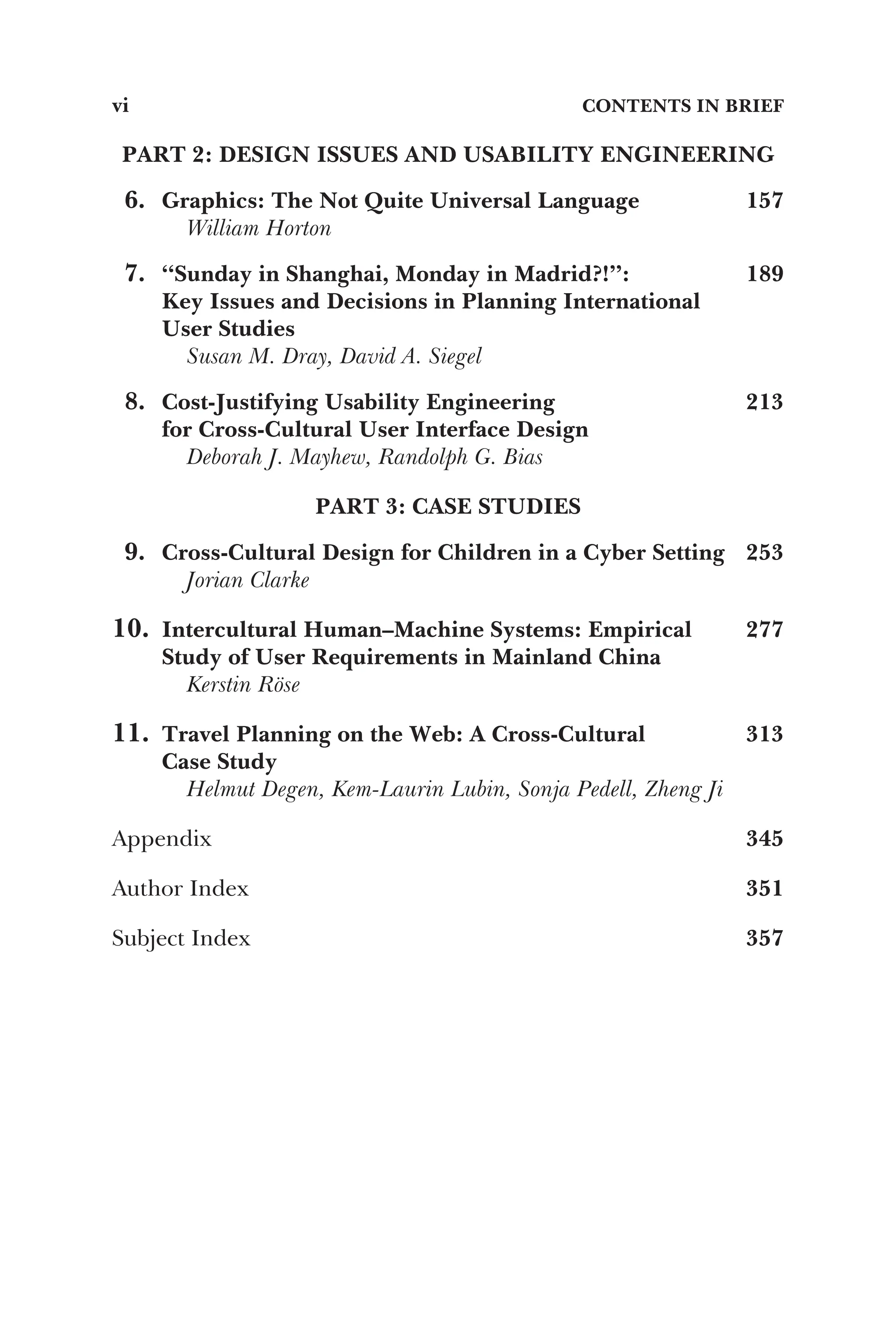
Contents in Brief
Series Foreword—Gavriel Salvendy xiii
Foreword to Book—Jakob Nielsen xv
Preface xix
PART 1: INTRODUCTION
AND CULTURAL CONSIDERATIONS
1. Overview: Where to Start and What to Consider 3
Nuray Aykin
2. Practical Issues and Guidelines
for International Information Display
21
Nuray Aykin, Allen E. Milewski
3. User Interface Design and Culture 51
Aaron Marcus
4. Synthesizing the Literature on Cultural Values 79
Emilie W. Gould
5. Managing Multicultural Content in the Global
Enterprise
123
Jorden Woods
v
PART 2: DESIGN ISSUES AND USABILITY ENGINEERING
6. Graphics: The Not Quite Universal Language 157
William Horton
7. “Sunday in Shanghai, Monday in Madrid?!”:
Key Issues and Decisions in Planning International
User Studies
189
Susan M. Dray, David A. Siegel
8. Cost-Justifying Usability Engineering
for Cross-Cultural User Interface Design
213
Deborah J. Mayhew, Randolph G. Bias
PART 3: CASE STUDIES
9. Cross-Cultural Design for Children in a Cyber Setting 253
Jorian Clarke
10. Intercultural Human–Machine Systems: Empirical
Study of User Requirements in Mainland China
277
Kerstin Röse
11. Travel Planning on the Web: A Cross-Cultural
Case Study
313
Helmut Degen, Kem-Laurin Lubin, Sonja Pedell, Zheng Ji
Appendix 345
Author Index 351
Subject Index 357
vi CONTENTS IN BRIEF
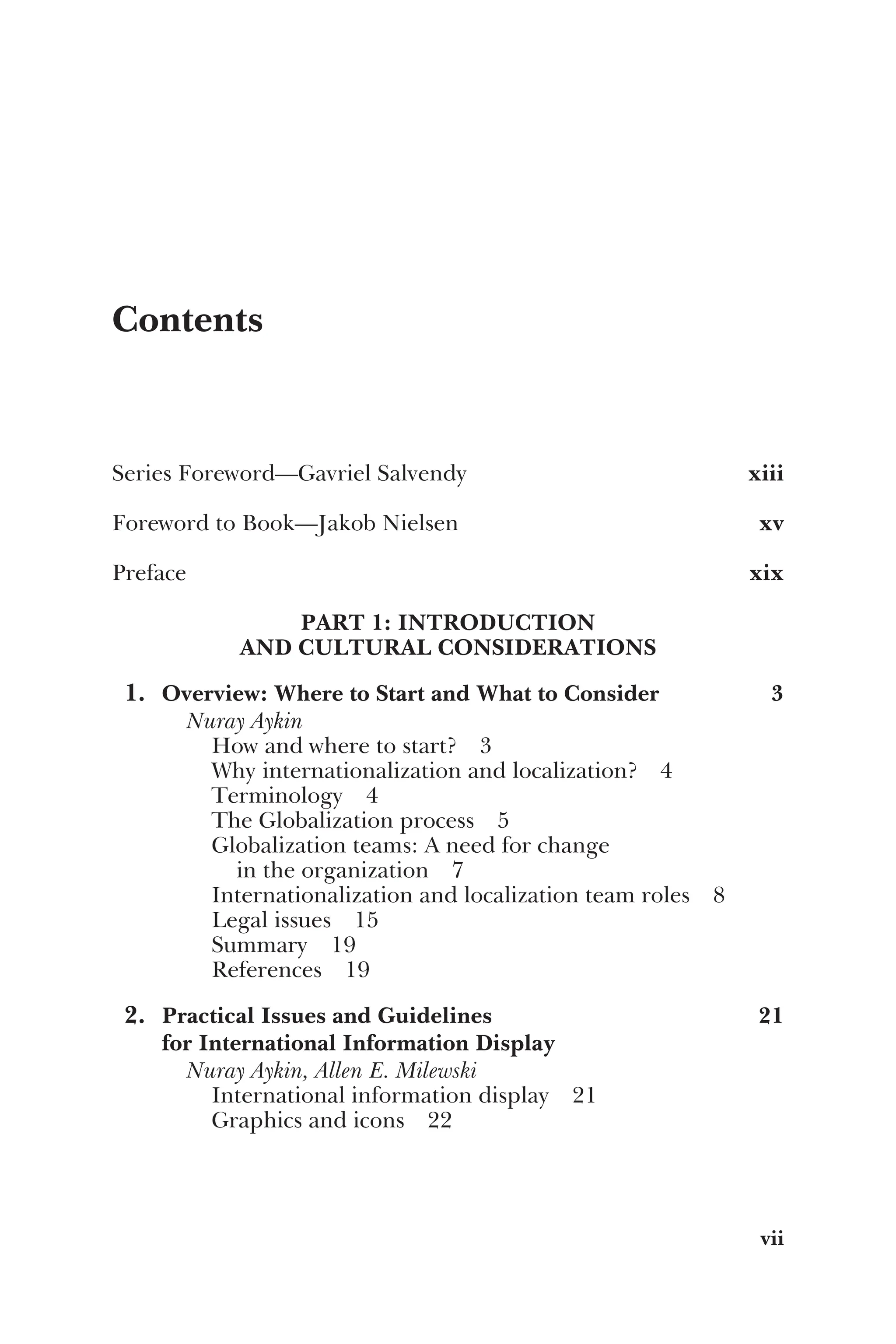
Contents
Series Foreword—Gavriel Salvendy xiii
Foreword to Book—Jakob Nielsen xv
Preface xix
PART 1: INTRODUCTION
AND CULTURAL CONSIDERATIONS
1. Overview: Where to Start and What to Consider 3
Nuray Aykin
How and where to start? 3
Why internationalization and localization? 4
Terminology 4
The Globalization process 5
Globalization teams: A need for change
in the organization 7
Internationalization and localization team roles 8
Legal issues 15
Summary 19
References 19
2. Practical Issues and Guidelines
for International Information Display
21
Nuray Aykin, Allen E. Milewski
International information display 21
Graphics and icons 22
vii
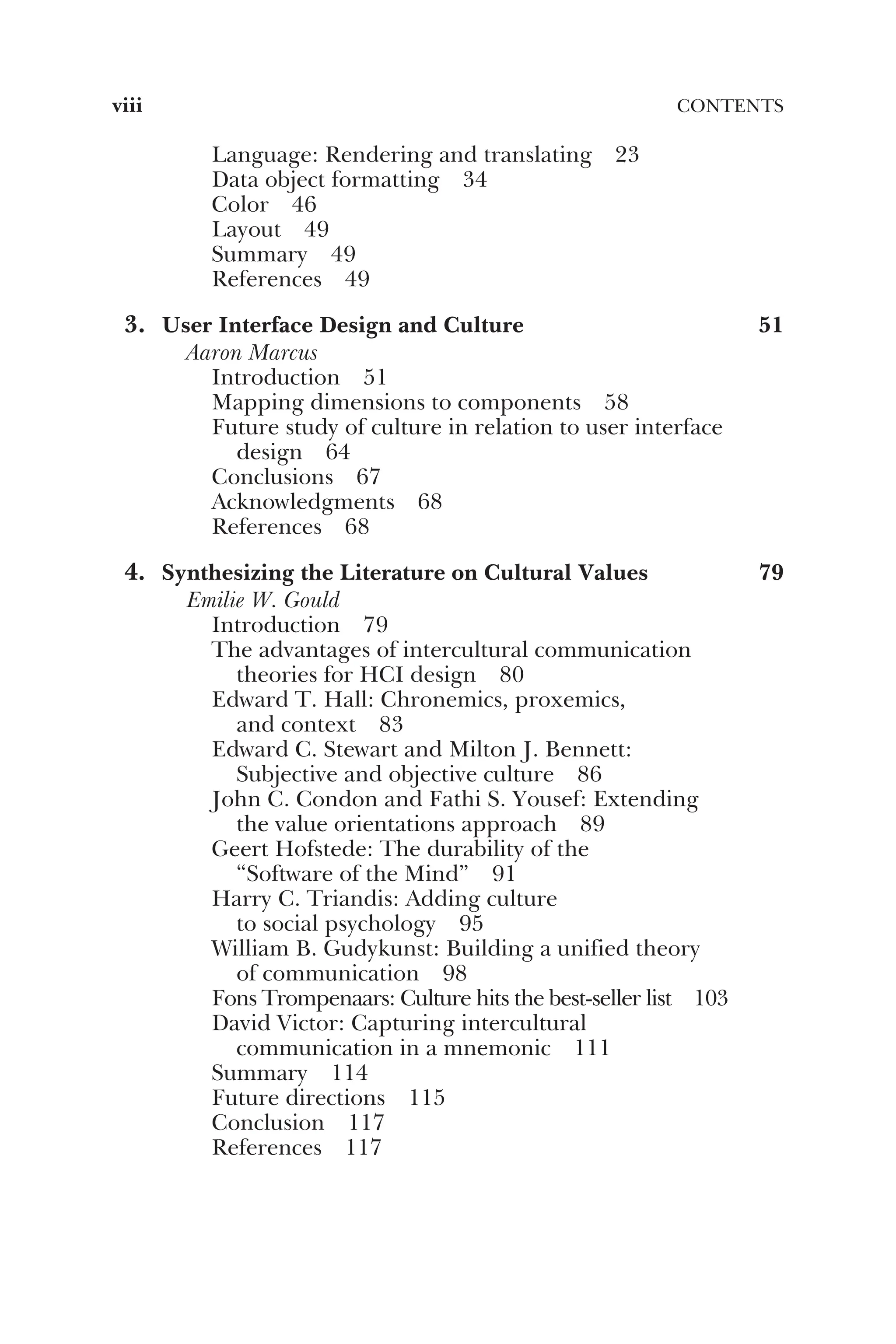
Language: Rendering and translating 23
Data object formatting 34
Color 46
Layout 49
Summary 49
References 49
3. User Interface Design and Culture 51
Aaron Marcus
Introduction 51
Mapping dimensions to components 58
Future study of culture in relation to user interface
design 64
Conclusions 67
Acknowledgments 68
References 68
4. Synthesizing the Literature on Cultural Values 79
Emilie W. Gould
Introduction 79
The advantages of intercultural communication
theories for HCI design 80
Edward T. Hall: Chronemics, proxemics,
and context 83
Edward C. Stewart and Milton J. Bennett:
Subjective and objective culture 86
John C. Condon and Fathi S. Yousef: Extending
the value orientations approach 89
Geert Hofstede: The durability of the
“Software of the Mind” 91
Harry C. Triandis: Adding culture
to social psychology 95
William B. Gudykunst: Building a unified theory
of communication 98
Fons Trompenaars: Culture hits the best-seller list 103
David Victor: Capturing intercultural
communication in a mnemonic 111
Summary 114
Future directions 115
Conclusion 117
References 117
viii CONTENTS
5. Managing Multicultural Content in the Global
Enterprise
123
Jorden Woods
Introduction and the ideal enterprise 123
Challenges to successful globalization 127
Best practices 131
The details of implementing best practices 136
Workflow and process automation 146
Linguistic technologies 151
Translation service providers 153
Overview and conclusions 154
PART 2: DESIGN ISSUES AND USABILITY ENGINEERING
6. Graphics: The Not Quite Universal Language 157
William Horton
Introduction 157
Why use graphics if they are not universal? 158
Select an approach 158
First, globalize 160
Second, localize 178
Summary 184
References 186
7. “Sunday in Shanghai, Monday in Madrid?!”:
Key Issues and Decisions in Planning International
User Studies
189
Susan M. Dray, David A. Siegel
Introduction 189
Selecting where to go 191
Arranging for research resources in-country 196
Modifying a recruiting strategy and screener
to reflect local cultural issues 200
Preparing or adapting the protocol and/or test
plan 204
Arranging for translation 206
Training local facilitators and preparing
facilities 208
Multicountry studies: serial or parallel? 211
Conclusions 212
References 212
CONTENTS ix
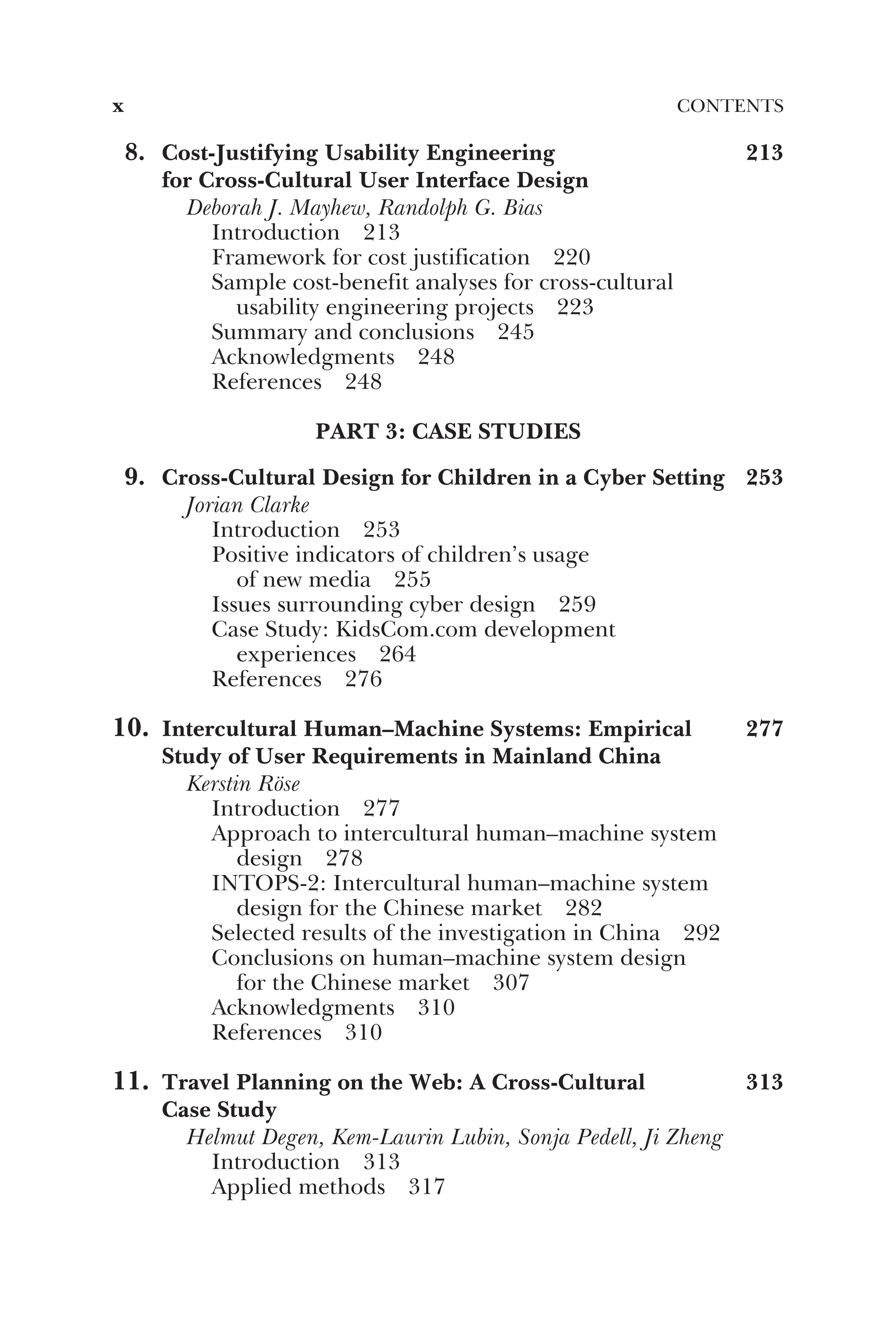
8. Cost-Justifying Usability Engineering
for Cross-Cultural User Interface Design
213
Deborah J. Mayhew, Randolph G. Bias
Introduction 213
Framework for cost justification 220
Sample cost-benefit analyses for cross-cultural
usability engineering projects 223
Summary and conclusions 245
Acknowledgments 248
References 248
PART 3: CASE STUDIES
9. Cross-Cultural Design for Children in a Cyber Setting 253
Jorian Clarke
Introduction 253
Positive indicators of children’s usage
of new media 255
Issues surrounding cyber design 259
Case Study: KidsCom.com development
experiences 264
References 276
10. Intercultural Human–Machine Systems: Empirical
Study of User Requirements in Mainland China
277
Kerstin Röse
Introduction 277
Approach to intercultural human–machine system
design 278
INTOPS-2: Intercultural human–machine system
design for the Chinese market 282
Selected results of the investigation in China 292
Conclusions on human–machine system design
for the Chinese market 307
Acknowledgments 310
References 310
11. Travel Planning on the Web: A Cross-Cultural
Case Study
313
Helmut Degen, Kem-Laurin Lubin, Sonja Pedell, Ji Zheng
Introduction 313
Applied methods 317
x CONTENTS
Results 320
Interpretation of cross-country results 336
Summary and conclusions 342
Acknowledgments 343
References 343
Appendix 345
Author Index 351
Subject Index 357
CONTENTS xi
Series Foreword
With the rapid introduction of highly sophisticated computers, (tele)com-
munication, service, and manufacturing systems, a major shift has occurred
in the way people use technology and work with it. The objective of this
book series on Human Factors and Ergonomics is to provide researchers
and practitioners a platform where important issues related to these
changes can be discussed, and methods and recommendations can be pre-
sented for ensuring that emerging technologies provide increased produc-
tivity, quality, satisfaction, safety, and health in the new workplace and in
the Information Society.
The present volume is published at a very opportune time when industry
and commerce is internationalized and products and services are marketed
across national and cultural boundaries. This book provides a theoretical
foundation and practical examples and guidelines for designing information
technology for different cultures, languages, and economic standing and the
methods to be utilized to ensure their usability across cultural boundaries.
The book’s 11 chapters are authored by some of the foremost practitioners
from the United States, Europe, and Asia. The book starts with two chapters on
guidelines and practices for internationalization and localization, and includes
four chapters on cultural consideration and guidelines in the design of infor-
mation technology; two chapters on usability evaluation methodology and
cost-benefit analysis for cross-cultural design; and three chapters on case stud-
ies of cross-cultural design. The book’s 368 references, 62 figures, and 45 ta-
bles provide useful modes for further in-depth study of the subject.
The book’s editor is a leading international figure in the subject area.
The book should be of special value to people designing and evaluating in-
formation technology products and services for international use and for
researchers in the subject area.
—Gavriel Salvendy
Series Editor
xiii
Foreword
You are probably wondering about how to better serve the international
users of your product, Web site, or intranet. Why else would you have
bought this book? :-) Simply being aware that there is an issue is a great
first step. A lot of designers and project managers have no clue that people
in other countries are different and need special attention in a user inter-
face design project.
I have three simple messages:
1. International usability is not small potatoes; it has a major impact
on your success.
2. Truly serving international users well is a deep design problem that
requires serious work.
3. Despite message #2, you should not give up if you only have a small
budget to devote to international usability.
First, what’s the magnitude of the problem? In one project,1
we tested
20 American e-commerce sites with both American and European users.
The users’ ability to successfully shop on the sites was 61% on the average
for American users and only 47% for European users. In other words, these
sites would be able to increase their overseas sales by almost 33% if only they
could deliver the same usability to international customers as to domestic
customers. Averaged across several studies we have conducted, measured
usability was 46% higher for domestic users than for international users.
Second, why is international usability a deep design problem that re-
lates to more than simply translation? Because a user interface is acted on,
not simply read. In one of our projects, we tested the Web site for a big Euro-
pean bank in a variety of countries, including the United States and several
European countries. The Web site was available in several languages, in-
xv
1
For more information on this project and the detailed guidelines that resulted from it,
please see www.nngroup.com/reports/ecommerce.
cluding English, and the translation was of excellent quality (contrary to the
sloppy translation jobs we often see). Still, the American users had great dif-
ficulties using the site, because of a variety of cultural differences between
the United States and Europe. For example, the American users could not
use the feature for choosing their language because it was presented in a
way that made sense to Europeans but not to Americans who are used to al-
ways seeing everything in a single language. The English version of the site
was great in terms of language, but the user interface elements didn’t work
for American users.
In another example, we tested a customer service site for an American
technology product in Korea. Even though the interface was in Korean, the
Korean users had difficulty navigating the site because they had difficulty
understanding the information architecture (i.e., the way the information
was structured).
In a user interface, it’s not enough to understand the words. You have to
understand the features and you have to be able to navigate the information
space. Web sites and intranets are particularly vulnerable to difficulties in-
troduced by poor international usability: One wrong click and you are in
the wrong area of the site, but you may never discover that.
The basic tenet of usability is that good design depends on the users and
their tasks. People in different countries will often approach similar tasks in
different ways because of cultural differences. Furthermore, the users are
certainly different. When a user interface is being used in a different coun-
try, it’s really a different user interface, whether or not it has been trans-
lated. With different users and different tasks come different usability
requirements for the design. That’s why international usability doesn’t
come simply from wishing for it. Catering to international users requires in-
ternational usability studies: You need to modify your design to handle
those usability problems that have been discovered by testing users in each
of your important target countries.
Third, isn’t this impossible? I just said to “test users in each important
target country,” but that would cost a fortune for any company that tries to
target more than two or three countries. Yes, truly ideal international us-
ability will indeed be expensive. There are hundreds of countries in the
world, and each will have its own considerations. Unfortunately it’s also sev-
eral times as expensive to conduct international user testing as it is to test
with local users in your own country.
Despite these facts, don’t despair. It is possible to conduct most usability
activities domestically, where user research is cheap, and supplement with a
smaller number of smaller studies in a few countries, sampling the main re-
gions of the world. At a minimum, make sure that you have test data from
the Big Three: United States, Japan, and Germany, all of which are very dif-
ferent. This strategy will not be ideal, and I don’t think it will be considered
xvi FOREWORD
acceptable 20 years from now, but for now it works. You can increase usabil-
ity substantially for your most important customers in the most important
countries through a fairly small effort. They will not get the same quality as
your domestic customers, but they will get much better quality than if you
hadn’t done any international testing. Even customers in smaller countries
where you do not test will still benefit somewhat from your increased aware-
ness of the needs of users outside your own country.
Any international usability efforts are better than none. If you only have a
small budget for international usability, you may not be able to close the en-
tire 46% quality gap between the domestic user experience and the interna-
tional one. But if you can just cut the problem in half, you will now be
serving your international customers 23% better than you did in the past.
That’s surely worth a small investment, considering the market potential of
the rest of the world.
—Jakob Nielsen
www.useit.com
FOREWORD xvii
Preface
On entering a country, ask what is forbidden;
on entering a village, ask what are the customs;
on entering a private house, ask what should not be mentioned.
—Chinese Proverb
If this book were published about 10 or even 5 years ago, I would be spend-
ing a lot of time explaining why internationalization is so important. And I
would need to provide all those statistics about the trends on how compa-
nies are going global, how e-business is shaping up global commerce, and
how the number of multilingual sites is increasing rapidly. It is not that I do
not believe in providing statistics to show the readers the importance of
globalization in design. There is no need now to provide all those statistics
to convince people about the importance of being part of the global market
trends. It is happening now and it is everywhere. Not designing with lan-
guage and cultural differences in mind is no longer an option that compa-
nies can afford. The second reason is that the statistics reflect the moment
they are referred to and by the time this book is published, any statistics
shown here will be almost obsolete given the fast trends in the Internet in-
dustry. However, there is one clear fact that remains the same: Only 8% to
10% of the world’s population speaks English as their primary language.
Even in the United States, there are Spanish and Japanese TV stations that
address the needs of the high percentage of non-English-speaking ethnic
groups. In cases where two countries speak the same language, a design for
one may not work well in the other. Designers often face questions such as,
“My customers read English, so why should I localize (or should we spell it
localise) my product?” The answer is easy. Just superficially looking at the
differences in the language and time/date formatting, we can clearly see is-
sues that would lead to confusion. For example, the United Kingdom uses
xix
the 24-hour clock, whereas the United States uses a 12-hour clock; centre in
the United Kingdom is spelled center in U.S. English; and the toilet in the
United Kingdom means bathroom in the United States.
Today, more and more web sites are providing content in multiple lan-
guages, and more and more products are being designed with cultural dif-
ferences in mind. The concept of cross-cultural design, however, has not yet
become a priority issue on the practitioners’ and educators’ agenda. There
is a lot of work that still needs to be done to make internationalization a
standard part of the design process that lead to successful product launches
in different parts of the world.
I remember a full page advertisement that the Japan Automobile Associa-
tion placed in the New York Times in 1995. They listed reasons why American
cars were not selling in Japan. The list included a number of bloopers that
were not thought through clearly by the U.S. automobile manufacturers: (a)
the size of the cars was not practical, (b) the steering wheel was on the wrong
side, (c) seat sizes and adjustments did not fit the average Japanese, (d) en-
gines weren’t designed to run on Japan’s lower octane fuel and thus per-
formed poorly, (e) the letters R, D, and L on the shift had no meaning for
Japanese drivers, and (f) repairs required hard-to-find English-based tools.
Everyone has his or her favorite examples related to translations. In
some cases, bloopers even occur when a company uses its native language.
For example, in 1997, Reebok named their new sneaker line Incubus, which
means “an evil spirit supposed to descend upon and have sexual inter-
course with women as they sleep.” When the gaffe was disclosed, they had to
trash all packaging and advertising. The moral is: We need to do our home-
work very carefully, even when we think we know our language well.
Another great blooper is the use of flags to represent languages on
Web sites. Flags represent countries, not languages. In some cases, a lan-
guage is shared by many countries. For example, English, although
there are differences, is the language in Great Britain, the United States,
Australia, and New Zealand. In other cases, some countries have multi-
ple languages. For example, the official languages in Belgium are Dutch,
French, and German. There are also cultural and political issues regard-
ing how a nation treats its flag, and we should be very careful about how
we use flags in our designs.
In using examples, however, we need to be careful about not to fall into
the urban legends. We see examples of bloopers related to pitfalls in doing
business in other countries. One of the most widely told stories is about the
Chevy Nova. According to sources, the car did not sell well in Span-
ish-speaking countries because its name translates as “doesn’t go” in Span-
ish. This, however, is actually an urban legend. The car did sell well in
Spanish-speaking countries. “Nova” in Spanish means “star” as in English.
xx PREFACE
The phrase “doesn’t go” is no va in Spanish and has nothing to do with the
word Nova. There is even a government-owned oil company in Mexico,
Pemex, that sells gasoline under the name of Nova.
Although many designers and developers do tackle various issues on in-
ternationalization, the main questions remain the same: What does it take to
design products and services, including software applications and Internet
sites, for multiple markets? How much will it cost? Can we justify the cost?
As the Internet has moved toward ubiquity, the need for international-
ization is apparent. Initially in the United States, designers felt no immi-
nent need to make sites available in multiple languages. The rationalization
was that “the world knows English.” Perhaps this is no longer true. Why else
would Microsoft spend millions of dollars to release Microsoft Office XP in
more than 40 languages?
While several books have been written since the late 1980s on interna-
tionalization and localization, this remains an ever-expanding field and
there is no book that covers it all. Some emphasize the developers’ and soft-
ware engineers’ perspective, some emphasize management’s perspective,
and some emphasize the designers’ perspective.
Our goal, as contributors to this book, is to provide designers with con-
crete tools and processes—design practices, guidelines, case studies, and
lessons learned. Further, we hope to provide you with extensive resources
to aid you in your work. This book does not attempt to cover all design as-
pects of internationalization and localization, and it is definitely not in-
tended to be a software internationalization reference book. We list those
books, along with the design-related ones, in the appendix section at the
end. As designers, we need to be intimately familiar with the software inter-
nationalization terminology and processes, but we should also emphasize
the cultural studies that really help us understand cultures in a much more
detailed level than just learning to choose the right colors from tables show-
ing color–culture pairs. And it is not just using the right data formatting
(e.g., date and time) provided in software tools either. We all believe that
this is a vast and wonderful area to explore, and we invite our readers to
share their experiences and learnings with others. The more we learn, the
more we will make a difference in design practices.
This book is organized into three sections. Part I includes four chapters.
Chapter 1, by Aykin, approaches the topic from a management perspective,
defining roles and responsibilities. Chapter 2, by Aykin and Milewski, cov-
ers the practical issues and guidelines regarding international information
displays, what we call the tip of the iceberg of internationalization and local-
ization. Chapters 3, 4, and 5 go deeper into the lower layers of the iceberg
and talk about the cultural dimensions and the impact of culture on design.
Chapter 3, by Marcus, looks in depth at Hofstede’s study on cultural dimen-
PREFACE xxi
sions, while chapter 4, by Gould, describes the studies looking at and theo-
ries regarding cultural differences. In chapter 5, Woods describes how to
manage multilingual content in the global enterprise setting, as well as
methodologies for managing the internationalization and localization of
web sites.
Part II focuses on some specific aspects of design, cost justification, and
international usability evaluations. In chapter 6, Horton provides a vast ar-
ray of information on global icon design and includes lots of examples and
do’s and don’ts that are very useful for designers. Dray and Siegel put all
their experiences, along with their knowledge regarding international user
studies, into chapter 7. They provide not only a good perspective on con-
ducting international user studies, but also a lot of practical tips for the
practitioner. In chapter 8, Mayhew and Bias apply their expertise in
cost-justifying usability to cross-cultural user interface design, which costs
much more than designing for a single target market.
Part III covers three case studies on international user interface design.
In chapter 9, Clarke describes the differences in web site design for children
in different countries. Chapter 10, by Röse, looks into various design issues
for China. In chapter 11, Degen, Pedell, Lubin, and Zheng discuss design-
ing a travel reservations site for three different countries: Germany, the
United States, and China.
At the end of this book is a list of books and magazines on the topic of inter-
nationalization in user interface design, project management, and software
design and development. Other valuable resources, leading journals, and
nonprofit organizations that deal with internationalization are also listed.
I regret not being able to include more topics on internationalization
and localization from the design perspective. However, I hope this book
will become one of those dog-eared, often used volumes on your bookshelf
and remind you that the world is an amazing place where we learn some-
thing new every day. As the Dalai Lama’s Instructions for Life says: “Once a
year, go someplace you’ve never been before.”
And I hope this book will show that the internationalization and localiza-
tion do not merely mean translation of content, or redesigning and devel-
oping an entire new product every time a new market is identified, or just
expecting your local offices to handle the adaptation of your product to
their markets. It is much more than that, and we hope we have touched
many aspects of it.
ACKNOWLEDGMENTS
I would like to thank Gavriel Salvendy for encouraging me to edit a book on
this topic and providing in-depth comments on content. My thanks also go
to LEA, especially Anne Duffy, Kristin Duch, and Sarah Wahlert for pub-
xxii PREFACE
lishing this book and working hard with us to make it happen. I have been
grateful for the suggestions and insights I received from my long-time
friend, Diane Z. Lehder, who also shared my early years in evangelizing in-
ternationalization at AT&T.
Many special thanks go to my husband, Al, and my son Bora for giving
me the time and for understanding the sacrifices they made while support-
ing me in this effort.
PREFACE xxiii
PART 1
INTRODUCTION
AND CULTURAL CONSIDERATIONS
Chapter 
Overview: Where to Start
and What to Consider
Nuray Aykin
Siemens Corporate Research, Princeton, NJ
HOW AND WHERE TO START?
In this book, the contributors discuss many aspects of internationalization
and localization and provide valuable insights regarding cultural differ-
ences, design practices, globalization, content management, and so on.
This chapter is intended to give the reader an overall firm basis for under-
standing why we need to localize our products to target cultures, and how to
begin doing so. In addition to summarizing key points made by all the au-
thors throughout this book, it also addresses the roles and responsibilities
within an organization dealing with internationalization and localization,
and provides an action checklist along with practical “how to” guidelines.
The content provided in this chapter is by no means complete. The
globalization of a product has many facets and it is almost impossible to
cover them all here. However, this chapter, and also this book, is a good
starting point when your company decides to move into global markets
with the goals of making products suitable, usable, and preferred by the
users in the target locale.
3
WHY INTERNATIONALIZATION AND LOCALIZATION?
The world is a diverse place. The environment in which software applica-
tions are designed often is not. It takes a Herculean effort to keep a design
team focused on what is required to successfully design products for global
markets. But, the change is here, the challenge is real, and we need to face
it. The facts about differences in languages and cultures are spread
throughout many resources. Consider these facts:
• Only 8% to 10% of the world’s population of 6.1 billion speaks Eng-
lish as its primary language.
• In some cities in the United States, large populations speak a lan-
guage other than English as their native language: 78% in Miami,
49% in Los Angeles, 45% in San Francisco, and 42% in New York
City (25% of subway users in New York City do not speak any Eng-
lish at all). Eighty percent of European-based corporate sites are
multilingual (Dunlop, 1999). Globally, there are 580 million peo-
ple with Internet access as compared to 563 million in the last quar-
ter of 2002: In the United States, 29% of the population has
Internet access. This compares to 23% in Europe, 13% in Asia-Pa-
cific, and 2% in Latin America (CIO, 2003).
• U.S.-based Palm has a 68% share of the Latin American market
(CIO, 2002a).
• The United States is responsible for shipping 38.8% of personal
computers worldwide, followed by Europe with 25%, and Asia-Pa-
cific with 12%. The total personal computers shipped worldwide
reached 1 billion in 2002 (CIO, 2002b).
Whether to expand to global markets and localize your product for target
locales is your company’s decision, and it should be based on business needs,
user needs, and technology considerations. But if the decision is to go global,
your company will need to define new roles and processes if it is to carry out
the internationalization process successfully. In this chapter, I touch on these
issues. Additionally, I cover some legal issues you need to consider when ex-
panding into global markets, especially in designing global Web sites.
TERMINOLOGY
As defined by the Localization Industry Standards Association (LISA) in The
Localization Industry Primer (LISA, 2001), here are definitions of the basic
terminology used throughout this book.
Globalization: The general process of worldwide economic, political,
technological, and social integration. More specifically, the process of mak-
4 AYKIN
ing all the necessary technical, managerial, personnel, marketing, and
other enterprise decisions necessary to facilitate localization. Globalization
addresses the business issues associated with taking a product global. It in-
volves integrating localization throughout a company including product
design and development, as well as marketing, sales, and support in the
world market.
Internationalization (I18N): The process of ensuring, at a technical/design
level, that a product can be easily localized. Internationalization is thus part
of globalization. Internationalization helps define the core content and
processes so that they can be easily modified for localization to specific mar-
kets. To abbreviate the lengthy word Internationalization, the term I18N was
introduced in the early 1990s. The I and N represent the first and last let-
ters of the word Internationalization, and 18 represents the number of letters
between I and N.
Localization (L10N): The process of modifying products or services to ac-
commodate differences in distinct markets. The term L10N was derived in
the same way as I18N. Localization makes products or services usable in,
and therefore acceptable by, target cultures.
There are two other terms that are related to the field and that are en-
countered often:
Translation: The linguistic component of localization. It is choosing the
appropriate text in a target language to convey the proper meaning from a
source language text.
Locale: That part of the user’s environment that is dependent on lan-
guage, country/region, and cultural conventions. For example, Argentina,
Spain, and Mexico represent three different locales even though their com-
mon language is Spanish.
THE GLOBALIZATION PROCESS
Because globalization involves “the process of making all the necessary
technical, managerial, personnel, marketing, and other enterprise deci-
sions necessary to facilitate localization” (LISA, 2001, p. 34), it is important
to understand where to start.
The first question a company must address is whether it makes sense to
expand into global markets. If the answer is yes, then the company must de-
fine global business strategy, which includes identifying target markets, and
how to enter them, and restructuring the organization to facilitate global-
ization efforts. These initial steps are beyond the scope of this book. There
are excellent books and references available on this topic; see, for example,
O’Hara-Devereaux and Johansen (1994), Rhinesmith (1993), and
DePalma (2002). Instead, this book concentrates on the internationaliza-
tion and localization parts of this process, which include (a) ensuring that
1. OVERVIEW 5
your product and web site are designed and developed free of any cul-
ture-specific attributes, so they can be easily localized (Internationaliza-
tion), and (b) making the necessary resource files and design changes so
your products and web site are culturally and technically suited for the tar-
get culture (Localization).
The internationalization and localization processes follow the same basic
steps. First, define the core product or web site that will be localized for the
target markets. This involves defining the software architecture, common
software, and user interface elements that will constitute the core, regard-
less of the target locale. The resource files that define the target locale’s spe-
cific elements, as well as the common global user interface design that
accommodates different languages, text expansion, navigation structures,
and different content within a corporate defined look and feel (without sac-
rificing brand) are all considered in this step. If there is no existing product,
you can define the core product to be free of any cultural elements. It will
then be easier to localize the components for different cultures.
For example, assume date and time will be displayed on a web site. If
the software developers use separable resource variables for date and
time rather than the fixed U.S. date and time in the code, it will be easier
to retrieve the correct date and time representation from the resource
files for a particular target locale and place them in the software when
needed, even during runtime. If the user interface designers can leave
enough space on the screen to accommodate different lengths and for-
mats in displaying date and time, the insertion can be accomplished
without changing the layout design. In most cases, however, the prod-
ucts are designed for one country at the beginning, and the need to glob-
alize comes later. In this case, the product must be reengineered, which
includes conducting a code inspection to make the software internation-
alized. For example, if the date and time code is fixed in the core prod-
uct, it would be replaced by resource variables so that resource files for a
particular target locale could be inserted to provide the correct date and
time on the screen.
Second, localize the internationalized core product for different target
locales. Using the core product and core user interface design guidelines,
software designers and developers can add the locale-specific formats and
content to the design. In this way, the usage of common elements is opti-
mized. Internationalizing the product first facilitates the localization of the
product and makes it more likely that the final product will meet your cus-
tomers’ needs and expectations.
Creating successfully localized products requires a tightly integrated
corporate team, and successful integration is dependent on clearly de-
fined roles, responsibilities, and tasks. These are discussed in the remain-
der of this chapter.
6 AYKIN
GLOBALIZATION TEAMS: A NEED FOR CHANGE
IN THE ORGANIZATION
If your company is moving into global markets and your products need lo-
calization, then it is time to start building the corporate infrastructure to
carry out the necessary tasks. When a company goes global, all units within
the company need to understand the meaning and scope of going global
and the impact on their own roles and responsibilities. It is definitely not
merely having your product manuals or your web site content translated
into a target language, without any changes. While this is a common strat-
egy, it really is not the way to meet the needs and expectations of customers
“over there” (a place we sometimes know little about). Starting from the
market analysis and continuing until the localized versions of the product
are out the door there is a lot of work to do. This work does not end with
maintenance and the definition of future releases; it continues as long as we
operate in outside markets.
In this section, I talk about the roles in the organization and the changes
needed to accommodate the globalization process. The following teams in
an organization carry out specific roles in the internationalization and lo-
calization processes. Of course, it is possible that some of these teams can be
combined under one umbrella. However, the roles and the work that needs
to be done should not be sacrificed to save time and money. If it is not done
right at the beginning, getting it right later will be far more costly.
• Management Team: Without buy-in from the management team
and without a clear understanding of what it takes to international-
ize and localize a product, it is very difficult to get the synergy and
enthusiasm along with a commitment from the other teams. The
management team includes all top-level managers, including
country managers if you have a global presence. It is very important
to identify a champion who is also accountable for the company’s
globalization efforts. This champion will ensure the globalization
process is overseen properly and will serve as the globalization ad-
vocate within the company.
• Marketing Team: The marketing department can easily play the
lead role in globalization efforts. They understand and select target
countries, define business needs, conduct research/studies in the
target cultures to understand needs and preferences, perform
branding analyses, validate globalization decisions by defining the
return on investment (ROI) from moving into global targets, help
the sales team to form distribution channels or partnerships, and
work with the legal department to understand the target country’s
standards, legal issues, customs, and business conduct.
1. OVERVIEW 7
• Implementation (Internationalization/Localization) Team: This is
the core team that will work on day-to-day activities as well as the
overall project management. While actual team size depends on
the complexity and the magnitude of work involved, each imple-
mentation team should include:
• Project managers—who can manage the entire process of inter-
nationalization and localization.
• User interface designers—who can design user interfaces, and
know how to study the needs and preferences in the target cul-
tures. Their work requires an understanding of languages spo-
ken, cultural preferences, interests in the types of products and
services you offer, use of colors and icons, work practices, ethics
and relationships, daily life, learning styles, religion, gender
roles, purchasing habits, political influences, customs, and so
forth. This is the group that plays a crucial role in defining what
the final product looks and feels like when it is finally shipped to
the target country.
• Software engineers and developers—who can (a) define the soft-
ware architecture based on the target culture’s technological ad-
vances or limitations, interoperability with other systems, and
infrastructure; and (b) develop software that is internationalized
and ready to be localized to different target markets. This group
must understand how to internationalize a product from the soft-
ware design perspective.
• Technical writers and translators—who can (a) write documents
with the international audience in mind, so that the text is easily
translated into different languages; and (b) translate documents
and customize them for the target languages. Translation is a
major expense in the localization process. Creating the right
documents up front can save time and money in the translation
process. Following guidelines on writing text for translation (see
Aykin  Milewski, chap. 2, this volume, for more details), identi-
fying clearly what is translated and what is not, and creating a
translation process are key elements in translation.
The following section provides high-level guidelines for each of these
teams to carry out a smooth internationalization and localization process.
INTERNATIONALIZATION AND LOCALIZATION TEAM ROLES
The three teams (management, marketing, and internationalization/lo-
calization implementation) should be able to define strategies and pro-
8 AYKIN
cesses together to ensure a smooth flow of information among teams. In
this section, I do not cover the roles of management and marketing teams
but focus instead on the implementation team, beginning with the key
role of the project manager. The project manager is the glue for the entire
process and is responsible for getting the localized product out to the tar-
get culture on time.
Role of the Project Manager
As the person managing the internationalization and localization process,
the project manager has to understand that localization is not just the trans-
lation of the documentation and the user interface content. He or she has to
help the team understand the extent of internationalization and localiza-
tion and be a strong advocate for this work. The project manager is respon-
sible for the following:
• A Well-Defined Strategy. Working closely with the management
and marketing teams, the project manager must define the prod-
uct’s globalization strategy and localization process. Without a solid
strategy, it is not possible to decide whether to go global or not,
what level of globalization to aim for, what the target markets are,
time to deliver, and what changes are required in the organization
structure.
• A Statement of Work. This includes localization methodology, lo-
calization vendor information if work is to be outsourced, and a
high-level project schedule which includes milestones and budget.
The localization vendor can be responsible only for translation, or
can include software localization. Adding languages can affect the
processes in terms of scaling and re-engineering costs.
• Vendor Management. In most cases, the companies use outside ven-
dorstohandletranslation.Inthiscase,itisabsolutelycriticaltochoose
the right vendor, as this work is a key component of the international-
ization process. There is a need to have a clear project structure and
guidelines for the translators to avoid “garbage in—garbage out.” For
a project manager, this responsibility includes:
• Evaluating and qualifying vendors.
• Establishing corporate pricing structures for translation and lo-
calization.
• Developing long-term partnerships with vendors.
• Setting clear guidelines on intellectual property and other tools
or guides that are generated for the project.
• Communication. Without good communication channels, it is dif-
ficult to coordinate activities, reach milestones, and keep budget
1. OVERVIEW 9
and project schedules under control. The communication should
be established to ensure a continuous interaction with the entire
team. A few suggestions include:
• Scheduled meetings. Nothing beats the face-to-face project meet-
ings where project issues are discussed, goals are communicated,
and proactive measures are taken to ensure milestones are met. De-
pending on the geographic locations of the team members, face-
to-face meetings can be replaced with video- or teleconferencing.
However, the project manager still needs to go to the other loca-
tions to meet with the team members face-to-face. This increases
the team’s cohesiveness and productivity.
• Online. Build a strong communication infrastructure for teams
to share work. A good way to enhance communication and
share resources is via company intranets, separate shared links
where all documentation and resources can be posted, shared,
and discussed.
• Content Management. Manage international corporate content
centrally, and leverage the expertise of locals to generate lo-
cale-specific content. Communicate with the locale experts re-
garding new content, changes on the site, branding requirements,
user interface guidelines, and so forth. What works for localiza-
tion of software applications often isn’t good enough for web con-
tent. Simply translating the words from English is not a good fit
for pre-sales and marketing content typically found on web pages.
Overall content needs to be reworked for different markets and
must “feel right” for a given language. It should be conversational
with appropriate style and local expressions. The portions of the
content that change when targeted to a specific locale need to be
identified. This is achieved by understanding the users of that lo-
cale and specifying what works and what the users need. If not
done, the customers from the target culture can easily detect con-
tent that has been “just translated” rather than created specifically
for them.
• A Common Glossary. Developing a central glossary management
system prevents using multiple words for the same thing. This fa-
cilitates translation, reduces translation cost, and improves the
quality of translation. In developing web sites for different target
countries, the project manager can choose to make regional teams
responsible for maintaining and updating the sites, given that the
content and the layout are reviewed by the central office for con-
formation to company standards including complying with the
common glossary.
10 AYKIN
• Localization Kit. This includes all pertinent information that needs
to be communicated to the localization vendor:
• Product overview
• Target audience
• Contact information for the localization managers, engineers,
developers, and user interface designers
• Project description
• Project scope and metrics
• Detailed project schedule
• Specific localization instructions (source and target languages,
translation instructions [what and what not to translate], test-
ing instructions [browsers, operating systems], formatting
guidelines, etc.)
• Tools to be used by the localization vendor
• Directories and files required to build localized versions, and
testing tools.
• A Repository of User Interface and Software Elements. It is ex-
tremely valuable if there is a central repository that includes com-
pany branding tools and guides, all internationalized and localized
graphics and icons, reusable code, templates, et cetera.
• An International Quality Assurance Methodology. To ensure de-
livery of quality products, quality assurance should be carried out
throughout the product development and deployment process.
This includes defining metrics for quality and methods to carry
out quality assurance, including in-country reviews and testing.
• Maintenance of Internationalization and Localization Guidelines.
These guidelines are created with input from the internationaliza-
tion and localization team. They can include international and
country-specific user interface design guidelines and software in-
ternationalization guidelines.
• A Post- Localization Issues List. This list may include deploying and
maintaining updates, analyzing user feedback, and refining pro-
cesses. For example, managing updates in the content can be a
nightmare if a structure is not placed around it. This involves iden-
tifying changes, translating only the changes, and incorporating
them back into the content.
• Legal Issues. Working with marketing and legal teams to identify
any legal limitations, international and national laws, tariffs and
customs, tax laws, and export/import structure is crucial to ensur-
ing smooth entry into the target markets. There is a separate sec-
tion at the end of this chapter that provides high-level guidelines
regarding legal issues in internationalization.
1. OVERVIEW 11
Role of the User Interface Designer
A solid background in user interface design is essential here as in any design
work, and gathering user requirements before anything else is done must
be a top priority. It does not matter what our target culture is, a strong re-
quirements-gathering process can help prevent future problems when go-
ing global. We have heard embarrassing anecdotes related to the
internationalization efforts of companies. But, we definitely would not want
them to happen to us. And more important, we don’t want to lose sales be-
cause we did not meet the customer needs. Dealing effectively with interna-
tionalization and localization process and design issues demands more
than just a solid background in user interface design. There are, unfortu-
nately, still user interface designers who do not understand why we are lo-
calizing products. These designers may even believe that people from other
countries are used to the “American” way and that they like to be “Ameri-
canized.” This may be true in part: We see kids wearing Hard Rock Café
T-shirts in a rural town in Tibet, and we see kids playing Pokeman games
(from Japan) in Greece. But what we don’t see is kids playing American foot-
ball in Tibet and people waiting excitingly for the baseball season to start in
Greece. It is true that the boundaries are getting grayer every day, but cul-
tural differences do exist and are a key part of usability that designers need
to confront. The topic of designing for different cultures is becoming more
and more visible at conferences and in publications. Learning from others
and reading about cultural differences is a good start. The real understand-
ing comes from going “over there” and observing and collecting data. If
that is too expensive, working with in-country people to collect data for you
and educate you about their culture regarding design issues will also work.
Here are a few items to consider while designing for different cultures:
• Design with internationalization in mind - If your company has
plans to expand its customer base globally, it is important to con-
sider design characteristics that would be acceptable for most coun-
tries. It starts from branding your products to developing icons that
are acceptable and understandable worldwide. The more design
decisions that are truly global, the fewer will have to be localized for
individual markets.
• Icon design: A simple well-known example of a global icon is
“mail/e-mail.” Instead of having to accommodate different mail-
boxes/slots around the world, one common icon, “an envelope,”
solves this design problem. And you do not need to localize it for
different cultures. Other examples of commonly accepted and
understood icons include books, cameras, movie projectors,
clocks, eye glasses, microphones, planes, trains, scissors, no
12 AYKIN
smoking signs, and so on. Horton (chap. 6, this volume) de-
scribes the rules on icon design in detail.
• Religious references: Unless your site is related directly to reli-
gion, it is best to avoid religious references. This way, you do not
need to worry about who visits your site and who may be of-
fended by it. It is also important to respect the beliefs and prac-
tices of different religions. For example, showing uncovered
body parts is not appropriate in Islamic countries.
• Culture-specific examples: Referring to culture-specific heroes,
symbols, puns, and idioms either may not translate well into
other cultures or may be misinterpreted—and both may cause
problems. For example, referral to heroes in content is very cul-
ture-specific. Presidents Jefferson and Lincoln may be the great
heroes in American culture, but cannot replace Mandela in
South Africa. Benjamin Franklin is better known as a scientist to
the rest of the world, as compared to the United States, where he
is better known as one of its first political figures. Similarly, yel-
low school buses are the transportation vehicles for children go-
ing to school in the United States. Other countries have different
ways for children to get to school, including walking.
• Cultural preferences: This can include everything from learn-
ing styles to color choices. Whereas some cultures may prefer
to read the manual before operating a device, others may pre-
fer to talk to sales representatives, and still others may prefer
to go with trial and error.
• Data formatting: Choosing the right formatting for the target
cultures is the start of any design for international markets.
Many times, there may not be any common formatting for all
target cultures, and a localized version of the data becomes nec-
essary. In some cases, such as address formats that differ widely
from country to country, the designer can still create a generic
address format to accommodate most of the world address for-
mats. Aykin and Milewski (chap. 2, this volume) cover many of
the data-formatting issues.
• Perform usability evaluations with cultural differences in mind-
Early testing of localized versions of the product is very important
because testing in one country does not guarantee product usability
in other countries. Usability testing uncovers design problems that
may need to be corrected in the early stages of development. Susan
Dray and David Siegel’s chapter on international user studies
(chap. 7, this volume) covers a vast amount of information about
conducting global usability studies in the trenches of the globe.
Anyone who has worked on any global project can tell you stories
1. OVERVIEW 13
about how difficult usability studies can be. One thing is clear: You
need to accept that any event can go wrong in your studies. The
more prepared you are, the less chance you will have for surprises
that cause costly delays in the study.
The main principle in global usability testing is to go to the target locale
and run the requirements gathering before the design and testing, and per-
form usability evaluation during and after the design. Of course, this “best
case” scenario is more expensive in the short term, but the return on your
investment will be tremendous.
Here are some guidelines on global usability testing. (See Dray  Siegel,
chap. 7, this volume, for more details.)
• Leverage in-country resources.
• Obtain early and ongoing feedback using a variety of sources of
input (customer visits, expert evaluation, user evaluation of pro-
totypes, user trials, etc.).
• Use well-defined processes and modify them when necessary.
• Translate and adapt materials as needed.
• Develop generous schedules; consider local holidays.
• Expect the unexpected (equipment specifications/failure, re-
cruiting, etc.).
• Interpret behavior within the context of the target culture.
• Run the test with local users and in their native language.
Role of the Software Engineer and Developer
Software engineers and developers are the key people who will be imple-
menting all the internationalization concepts and design issues into the
product. They are indeed lucky if management calls for a product that must
be designed and developed from the beginning with internationalization in
mind. Unfortunately, in most cases, the product is an existing one, de-
signed initially with a single country and culture in mind, one with little or
no flexibility in the software. Before translating anything, before changing
code, and so forth, the software needs to be assessed as to whether it can
handle internationalization or not, and whether it can be reengineered to
be internationalized. It is important that the software be sufficiently flexible
to handle all localization changes for multiple locales. A truly localized
product should include:
• One set of source code.
• A single bug-tracking system.
14 AYKIN
• Isolated localizable resources, including dialogs, macro language,
status bars, messages, menus, prompts, toolbars, and sounds.
• Localizable elements, such as time, date, currency, address, names,
and so on, that are not hard-coded and should support different
character sets.
• Buffers large enough to handle translated text in cases where the
text expands.
• Character parsing that is not limited to Latin script.
• Code clearly marked showing what must and must not be translated.
• Content that is presentable in users’ language and character set.
• User input that can be received in users’ native language and char-
acter set.
Role of the Technical Writer and Translator
Technical writers create content that may end up being translated to many
languages. In chapter 2 of this volume, Milewski and I cover the general
rules on how to write for translation. Besides these general rules, it is very
important to pay extra attention to:
• Common glossary/dictionary: For an organization, especially going
global, it is very important to create a standard and consistent ter-
minology that is shared by all parties involved in generating con-
tent and user interface elements. Placing this standard and
consistent terminology in a common glossary is the best way to
share among the team members.
• Spell checker: Regardless of the language, a spell checker should be
used consistently throughout content generation to ensure correct
spelling and use of accents in the target language.
• Culture-specific language: Eliminate all culture-specific meta-
phors, acronyms, abbreviations, humor, puns, idioms, slang,
sports, and other culture-specific analogies from the content to
make the content truly internationalized.
A well-written, concise, and culture-free source document serves as a good
starting point for translation. If there is a need to include any culture-specific
referrals, clear communication among all team members will ensure correct
translation and interpretation of these culture-specific examples.
LEGAL ISSUES
Introducing a product into a new country or locale requires more than
adapting it to the country’s cultural and linguistic requirements. It includes
1. OVERVIEW 15
dealing with a variety of legal issues, tax laws, duty fees, value-added taxes,
advertisement rules, and warranty policies. Most of these issues are best
handled by experts in international and in-country laws and standards.
Microsoft (2002) describes their introduction of Windows in mainland
China as a good case study for businesses expanding into global markets.
Apparently, Microsoft was not aware of the political issues surrounding de-
veloping the Simplified Chinese edition of Windows offshore and then im-
porting into the People’s Republic of China. Microsoft had to change its
strategy after angering the Chinese government and then had to work very
closely with the Chinese government and local developers to ensure the
success of Windows XP.
Sullivan (2003) reports that the Google search engine has 3.3 billions of
text documents indexed as of September 2, 2003. This figure does not in-
clude Google discussion posts, image and multimedia files. These docu-
ments, discussion posts, and images are from all around the world. NUA
(2002) reports that the estimated number of online users in September
2002 was 605.6 million. Not all online users come from a single region or
country. Out of this total, there are 190.91 million in Europe, 187.24 mil-
lion in Asia/Pacific, 182.67 million in Canada and the United States, 33.35
million in Latin America, 6.31 million in Africa, and 5.12 million in the
Middle East. Considering these statistics, legal issues become more compli-
cated. Given that there are more than 3.3 billion documents posted from all
around the world and 605 million users accessing these documents from all
around the world, whose laws will apply?
Ellis (2001) and Aykin (2001) give examples of how cultural differences
can have legal implications if one is not careful.
The Internet is full of stories about who is suing whom for damages,
copyrights, privacy issues, and so forth. For example, France sued Yahoo
for selling Nazi memorabilia on their auction site, and it was not Yahoo’s
French site that was sued, but its U.S. site. Although the server is located in
the United States, the French people could access the site and see the Nazi
memorabilia being auctioned there (Aykin, 2001). Hongladarom (2000)
lists several guidelines regarding messages on the Internet in Thailand.
The guidelines state that messages critical of the King and his royal family
are absolutely prohibited, and suggest not posting any messages that con-
tain foul language, sexually explicit content, insults, criticism of any reli-
gion, or personal data of any kind.
Finally, the governments of Italy, England, and Scotland have seized
computer equipment of anarchist groups that advocate antigovernment vi-
olence via the Internet (Schönberger  Foster, 1997).
Currently, there is no single solution, and there is no one legal entity to
resolve the legal issues that arise due to the Internet. However, we see some
actions now being taken by e-commerce companies, governments, interna-
16 AYKIN
tional organizations, and regulatory agencies to bring resolutions to the
conflicts raised by the Internet. The following organizations and regula-
tions deal with issues of this type.
The International Organisation for Economic Co-Operation and Devel-
opment (OECD) (adopted OECD Guidelines for Consumer Protection
in the Context of Electronic Commerce (December 1999) for consumer
protection in online commerce.)
Global Information Infrastructure Commission (GIIC).
American Bar Association.
Hague Convention on Jurisdiction  Foreign Judgments in Civil and
Commercial Matters (HCCH).
E.U. Data Protection Directive.
European Council of Ministers, Brussels 1 regulation.
Safe Harbor Privacy Principles signed by the United States Commerce
Department and the E.U. Commission.
These are just a few organizations that are trying to deal with the interna-
tional issues related to global use of the Internet.
Sinrod (2000) and Ellis (2001) provide a few recommendations on how
to protect an entity and its content on the Internet from the laws of various
countries around the world:
• Domain Names: Under the Anti-Cybersquatting Consumer Protec-
tion Act (1999), rightful owners of trademarks or personal names
may now bring an action against anyone who, with a bad intent to
profit, registers, traffics in, or uses a domain name that is identical
or confusingly similar to a mark that was distinctive or famous when
the domain name was registered. However, this does not prevent
cases of having same domain names in other countries. An example
includes a battle over the use of “Bud” or “Budweiser” between St.
Louis-based Anheuser-Busch and Czech brewer Budvar. The two
companies signed an agreement in 1939 that kept Budvar out of
the United States and Anheuser-Busch’s Budweiser from using that
name in many European countries. In 2000, Budejovicky Budvar
introduced their beer to the United States under the Czechvar
brand (Realbeer, 2001).
• Privacy: Since the explosion of the Internet, privacy laws have
gained a lot of attention due to the fact that people enter their
names and credit cards online, and that information about people
1. OVERVIEW 17
can be shared by many online providers. People need to trust the
confidentiality of the process and the security of their personal
data. If your web site collects personal information, there should be
a clear privacy policy regarding the handling of the information
that is collected. The European Union Data Protection Directive
(1995) requires companies that collect information from individu-
als in Europe to disclose how the information is used. It also re-
quires that individuals be allowed to edit or delete this information
(Ellis, 2001). Having a U.S.-based site does not exclude the site
owners from this directive. Additionally, the directive bars transfers
of personal information from E.U. countries to non-E.U. countries
if they do not meet the directive’s standards.
• Arbitration: A corporate site should include provision for arbitra-
tion. There are more than 100 countries that recognize arbitration
as a solution to international disputes.
• Terms of use and legal page: Including a Terms of Use/Legal page that
provides rules about using the site helps avoid and resolve disputes
and misunderstandings.
• Insurance: Businesses can purchase insurance to cover their liability
for claims resulting from online transactions across borders.
• Tax: If a company has a physical presence in a country that has a
value-added tax (VAT), the company’s online transactions, even
with customers outside that country’s borders, may also be subject
to that tax. If the company does not have a presence in the country
in which the customer is located, the online transaction may be sub-
ject to import taxes. There are a lot of resources to get information
on what taxes apply in which countries, including legal entities,
shippers, customs brokers, and freight forwarders.
• Physical location of assets: If a company has a physical presence in a
country, this office is considered to be legally responsible for any is-
sues regarding the company’s web site even if the web site server
may not be located in that country.
• Third-party content: Hosting third-party content or chat lines can
become a headache if the content is not monitored carefully. Any
offensive material published or advertised becomes the host’s li-
ability. For example, eBay was sued by the French government
for auctioning Nazi and other racist items to French citizens
(Morris, 2000).
There are also government regulations on use of languages in many
countries. For example, Quebec in Canada enforces that the language of
any published content should be first in French, and other languages can
only be introduced after the French version is implemented.
18 AYKIN
SUMMARY
As was mentioned at the beginning of this chapter, it is very hard to explain
all aspects of globalization in one book, let alone in one chapter. This chap-
ter is intended to give a real-world checklist of actions required to success-
fully globalize a product. In addition, it highlights a few key issues. In the
remaining chapters, experts in this field describe the issues in more detail
and provide information regarding how differences across cultures and
languages affect design.
REFERENCES
Aykin, N. (2001). Legal issues reconsidered: Do the country boundaries matter any-
more? In M. J. Smith  G. Salvendy (Eds.), Systems, social and internationalization
design aspects of human–computer interaction (Vol. 2, pp. 548–552). Mahwah, NJ:
Lawrence Erlbaum Associates.
CIO. (2002a). Metrics: PDA Shipments grow 13.8 percent in Latin America. October 1,
2002. Source: Gartner Dataquest. Retrieved January 22, 2004, from
http://www2.cio.com/metrics/2002/metric445.html?CATEGORY=11 NAME
=Globalization
CIO. (2002b). Metrics: One billion PCs shipped, July 2, 2002. source: Gartner
Dataquest. Retrieved January 22, 2004, from http://www2.cio.com/met-
rics/2002/metric397.html?CATEGORY=11NAME=Globalization
CIO. (2003). Metrics: Internet population reaches 580 million (source: Niel-
sen/Netratings), February 27, 2003. Retrieved January 22, 2004, from
http://www2.cio.com/metrics/2003/metric508.html?CATEGORY=11NAME=
Globalization
DePalma, D. D. (2002). Business without borders; A strategic guide to global marketing.
New York: Wiley.
Dunlop, B. (1999). Success in any language. March 9, 1999. Retrieved January 22,
2004, from http://www.clickz.com/int_comm/article.php/812791
EU Data Protection Directive. (1995). EU Directive 95/46/EC. The Data Protection Di-
rective. 24 October 1995. Retrieved January 22, 2004, from http://www.
dataprivacy.ie/6aii.htm
Ellis, R. L. (2001). Web site globalization and the law. IQPC Seventh International Con-
ference on Web Site Globalization, San Francisco, March 25–28, 2001.
Hongladarom, S. (2000). Negotiating the global and the local: How Thai culture co-opts
the Internet. Retrieved January 22, 2004. First Monday, http://www.first mon-
day.dk/issues/issue5_8/hongladarom/
Localisation Industry Standards Association. (2001). The localization industry primer.
Retrieved January 22, 2004, from http://www.lisa.org/products/primer.html
Microsoft (Dr. International Team). (2002). Developing international software.
Redmond: WA, Microsoft Press.
Morris, S. (2000). The importance of international laws for web publishers. June 2000. Re-
trieved January 22, 2004, from http://www.gigalaw.com/articles/2000/mor-
ris-2000-06.html
1. OVERVIEW 19
O’Hara-Devereaux, M.,  Johansen, R. (1994). Global work: Bridging distance, culture
and time. San Francisco: Jossey-Bass.
Sullivan, D. (2003). Search engine sizes. September 2, 2003. Retrieved January 22,
2004, from http://searchenginewatch.com/reports/article.php/2156481
NUA. (2002). How many online? Retrieved January 22, 2004, from http://www.
nva.ie/surveys/how_many_online/
Schönberger, V. M.,  Foster, T. E. (2001). A regulatory web: Free speech and the
global information infrastructure. Michigan Telecomm. Tech Law Review, 45,
University of Michigan Law School. Retrieved January 22, 2004, from
http://www.mttlr.org/volthree/foster_art/html
Sinrod, E. J. (2000). Upside counsel: Know the laws of cyberspace. Retrieved January 22,
2004, from http://listweb.bilkent.edu.tr/anti-spam/2000/nov/ att-0000/01-up-
side_counsel.htm
Realbeer. (2001). A Bud by any other name …. Retrieved January 22, 2004, from
http://www.realbeer.com/news/articles/news-001477.php
Rhinesmith, S. H. (1993). A manager’s guide to globalization: Six keys to success in a
changing world. Alexandria, VA: McGraw Hill.
20 AYKIN
Exploring the Variety of Random
Documents with Different Content
small donations ($1 to $5,000) are particularly important to
maintaining tax exempt status with the IRS.
The Foundation is committed to complying with the laws regulating
charities and charitable donations in all 50 states of the United
States. Compliance requirements are not uniform and it takes a
considerable effort, much paperwork and many fees to meet and
keep up with these requirements. We do not solicit donations in
locations where we have not received written confirmation of
compliance. To SEND DONATIONS or determine the status of
compliance for any particular state visit www.gutenberg.org/donate.
While we cannot and do not solicit contributions from states where
we have not met the solicitation requirements, we know of no
prohibition against accepting unsolicited donations from donors in
such states who approach us with offers to donate.
International donations are gratefully accepted, but we cannot make
any statements concerning tax treatment of donations received from
outside the United States. U.S. laws alone swamp our small staff.
Please check the Project Gutenberg web pages for current donation
methods and addresses. Donations are accepted in a number of
other ways including checks, online payments and credit card
donations. To donate, please visit: www.gutenberg.org/donate.
Section 5. General Information About
Project Gutenberg™ electronic works
Professor Michael S. Hart was the originator of the Project
Gutenberg™ concept of a library of electronic works that could be
freely shared with anyone. For forty years, he produced and
distributed Project Gutenberg™ eBooks with only a loose network of
volunteer support.
Project Gutenberg™ eBooks are often created from several printed
editions, all of which are confirmed as not protected by copyright in
the U.S. unless a copyright notice is included. Thus, we do not
necessarily keep eBooks in compliance with any particular paper
edition.
Most people start at our website which has the main PG search
facility: www.gutenberg.org.
This website includes information about Project Gutenberg™,
including how to make donations to the Project Gutenberg Literary
Archive Foundation, how to help produce our new eBooks, and how
to subscribe to our email newsletter to hear about new eBooks.
Welcome to Our Bookstore - The Ultimate Destination for Book Lovers
Are you passionate about books and eager to explore new worlds of
knowledge? At our website, we offer a vast collection of books that
cater to every interest and age group. From classic literature to
specialized publications, self-help books, and children’s stories, we
have it all! Each book is a gateway to new adventures, helping you
expand your knowledge and nourish your soul
Experience Convenient and Enjoyable Book Shopping Our website is more
than just an online bookstore—it’s a bridge connecting readers to the
timeless values of culture and wisdom. With a sleek and user-friendly
interface and a smart search system, you can find your favorite books
quickly and easily. Enjoy special promotions, fast home delivery, and
a seamless shopping experience that saves you time and enhances your
love for reading.
Let us accompany you on the journey of exploring knowledge and
personal growth!
ebookgate.com

Usability and Internationalization of Information Technology 1st Edition Nuray Aykin (Editor)

  • 1.
    Usability and Internationalizationof Information Technology 1st Edition Nuray Aykin (Editor) pdf download https://ebookgate.com/product/usability-and-internationalization- of-information-technology-1st-edition-nuray-aykin-editor/ Get the full ebook with Bonus Features for a Better Reading Experience on ebookgate.com

  • 2.
    Instant digital products(PDF, ePub, MOBI) available Download now and explore formats that suit you... Usability and Internationalization of Information Technology 1st Edition Nuray Aykin (Editor) https://ebookgate.com/product/usability-and-internationalization-of- information-technology-1st-edition-nuray-aykin-editor/ ebookgate.com Fundamentals of Information Technology 1st Edition Anoop Mathew https://ebookgate.com/product/fundamentals-of-information- technology-1st-edition-anoop-mathew/ ebookgate.com Cases on the Human Side of Information Technology Cases on Information Technology Series Mehdi Khosrow-Pour https://ebookgate.com/product/cases-on-the-human-side-of-information- technology-cases-on-information-technology-series-mehdi-khosrow-pour/ ebookgate.com Information Technology and Authentic Learning Angela Mcfarlane https://ebookgate.com/product/information-technology-and-authentic- learning-angela-mcfarlane/ ebookgate.com

  • 3.
    Information Arts Intersectionsof Art Science and Technology 1st Edition Stephen Wilson https://ebookgate.com/product/information-arts-intersections-of-art- science-and-technology-1st-edition-stephen-wilson/ ebookgate.com Encyclopedia of Information Science and Technology 2nd Edition Mehdi Khosrow-Pour https://ebookgate.com/product/encyclopedia-of-information-science-and- technology-2nd-edition-mehdi-khosrow-pour/ ebookgate.com Information Processes and Technology 2nd Edition Sam Davis https://ebookgate.com/product/information-processes-and- technology-2nd-edition-sam-davis/ ebookgate.com Business Processes and Information Technology 1st Edition Ulric J. Gelinas https://ebookgate.com/product/business-processes-and-information- technology-1st-edition-ulric-j-gelinas/ ebookgate.com The Industrial Communication Technology Handbook Industrial Information Technology 1st Edition Richard Zurawski https://ebookgate.com/product/the-industrial-communication-technology- handbook-industrial-information-technology-1st-edition-richard- zurawski/ ebookgate.com
  • 6.
  • 7.
    Human Factors andErgonomics Gavriel Salvendy, Series Editor Aykin, N. (Ed.): Usability and Internationalization of Information Technology. Hendrick, H., and Kleiner, B. (Eds.): Macroergonomics: Theory, Methods and Applications. Hollnagel, E. (Ed.): Handbook of Cognitive Task Design. Jacko, J.A., and Sears, A. (Eds.): The Human-Computer Interaction Handbook: Fundamentals, Evolving Technologies and Emerging Applications. Meister, D. (Au.): Conceptual Foundations of Human Factors Measurement. Meister, D., and Enderwick, T. (Eds.): Human Factors in System Design, Development, and Testing. Stanney, K. M. (Ed.): Handbook of Virtual Environments: Design, Implementation, and Applications. Stephanidis, C. (Ed.): User Interfaces for All: Concepts, Methods, and Tools. Ye, Nong (Ed.): The Handbook of Data Mining. Also in This Series HCI INTERNATIONAL 1999 Proceedings 2 Volume Set • Bullinger, H.-J., and Ziegler, J. (Eds.): Human-Computer Interaction: Ergonomics and User Interfaces. • Bullinger, H.-J., and Ziegler, J. (Eds.): Human-Computer Interaction: Communication, Cooperation, and Application Design. HCI INTERNATIONAL 2001 Proceedings 3 Volume Set • Smith, M.J., Salvendy, G., Harris, D., and Koubek, R.J. (Eds.): Usability Evaluation and Interface Design: Cognitive Engineering, Intelligent Agents and Virtual Reality. • Smith, M.J., and Salvendy, G. (Eds.): Systems, Social and Internationalization Design Aspects of Human-Computer Interaction. • Stephanidis, C. (Ed.): Universal Access in HCI: Towards an Information Society for All. HCI INTERNATIONAL 2003 Proceedings 4 Volume Set • Jacko, J.A. and Stephanidis, C. (Eds.): Human-Computer Interaction: Theory and Practice (Part I). • Stephanidis, C. and Jacko, J.A. (Eds.): Human-Computer Interaction: Theory and Practice (Part II). • Harris, D., Duffy, V., Smith, M. and Stephanidis, C. (Eds.): Human-Centered Computing: Cognitive, Social and Ergonomic Aspects. • Stephanidis, C. (Ed.): Universal Access in HCI: Inclusive Design in the Information Society.
  • 8.
    Usability and Internationalization ofInformation Technology Edited by Nuray Aykin Siemens Corporate Research, Princeton, NJ LAWRENCE ERLBAUM ASSOCIATES, PUBLISHERS 2005 Mahwah, New Jersey London
  • 9.
    CRC Press Taylor &Francis Group 6000 Broken Sound Parkway NW, Suite 300 Boca Raton, FL 33487-2742 © 2005 by Taylor & Francis Group, LLC CRC Press is an imprint of Taylor & Francis Group, an Informa business No claim to original U.S. Government works Version Date: 20130731 International Standard Book Number-13: 978-1-4106-1109-3 (eBook - PDF) This book contains information obtained from authentic and highly regarded sources. Reason- able efforts have been made to publish reliable data and information, but the author and publisher cannot assume responsibility for the validity of all materials or the consequences of their use. The authors and publishers have attempted to trace the copyright holders of all material reproduced in this publication and apologize to copyright holders if permission to publish in this form has not been obtained. If any copyright material has not been acknowledged please write and let us know so we may rectify in any future reprint. Except as permitted under U.S. Copyright Law, no part of this book may be reprinted, reproduced, transmitted, or utilized in any form by any electronic, mechanical, or other means, now known or hereafter invented, including photocopying, microfilming, and recording, or in any information storage or retrieval system, without written permission from the publishers. For permission to photocopy or use material electronically from this work, please access www. copyright.com (http://www.copyright.com/) or contact the Copyright Clearance Center, Inc. (CCC), 222 Rosewood Drive, Danvers, MA 01923, 978-750-8400. CCC is a not-for-profit organiza- tion that provides licenses and registration for a variety of users. For organizations that have been granted a photocopy license by the CCC, a separate system of payment has been arranged. Trademark Notice: Product or corporate names may be trademarks or registered trademarks, and are used only for identification and explanation without intent to infringe. Visit the Taylor & Francis Web site at http://www.taylorandfrancis.com and the CRC Press Web site at http://www.crcpress.com
  • 10.
    Contents in Brief SeriesForeword—Gavriel Salvendy xiii Foreword to Book—Jakob Nielsen xv Preface xix PART 1: INTRODUCTION AND CULTURAL CONSIDERATIONS 1. Overview: Where to Start and What to Consider 3 Nuray Aykin 2. Practical Issues and Guidelines for International Information Display 21 Nuray Aykin, Allen E. Milewski 3. User Interface Design and Culture 51 Aaron Marcus 4. Synthesizing the Literature on Cultural Values 79 Emilie W. Gould 5. Managing Multicultural Content in the Global Enterprise 123 Jorden Woods v
  • 11.
    PART 2: DESIGNISSUES AND USABILITY ENGINEERING 6. Graphics: The Not Quite Universal Language 157 William Horton 7. “Sunday in Shanghai, Monday in Madrid?!”: Key Issues and Decisions in Planning International User Studies 189 Susan M. Dray, David A. Siegel 8. Cost-Justifying Usability Engineering for Cross-Cultural User Interface Design 213 Deborah J. Mayhew, Randolph G. Bias PART 3: CASE STUDIES 9. Cross-Cultural Design for Children in a Cyber Setting 253 Jorian Clarke 10. Intercultural Human–Machine Systems: Empirical Study of User Requirements in Mainland China 277 Kerstin Röse 11. Travel Planning on the Web: A Cross-Cultural Case Study 313 Helmut Degen, Kem-Laurin Lubin, Sonja Pedell, Zheng Ji Appendix 345 Author Index 351 Subject Index 357 vi CONTENTS IN BRIEF
  • 12.
    Contents Series Foreword—Gavriel Salvendyxiii Foreword to Book—Jakob Nielsen xv Preface xix PART 1: INTRODUCTION AND CULTURAL CONSIDERATIONS 1. Overview: Where to Start and What to Consider 3 Nuray Aykin How and where to start? 3 Why internationalization and localization? 4 Terminology 4 The Globalization process 5 Globalization teams: A need for change in the organization 7 Internationalization and localization team roles 8 Legal issues 15 Summary 19 References 19 2. Practical Issues and Guidelines for International Information Display 21 Nuray Aykin, Allen E. Milewski International information display 21 Graphics and icons 22 vii
  • 13.
    Language: Rendering andtranslating 23 Data object formatting 34 Color 46 Layout 49 Summary 49 References 49 3. User Interface Design and Culture 51 Aaron Marcus Introduction 51 Mapping dimensions to components 58 Future study of culture in relation to user interface design 64 Conclusions 67 Acknowledgments 68 References 68 4. Synthesizing the Literature on Cultural Values 79 Emilie W. Gould Introduction 79 The advantages of intercultural communication theories for HCI design 80 Edward T. Hall: Chronemics, proxemics, and context 83 Edward C. Stewart and Milton J. Bennett: Subjective and objective culture 86 John C. Condon and Fathi S. Yousef: Extending the value orientations approach 89 Geert Hofstede: The durability of the “Software of the Mind” 91 Harry C. Triandis: Adding culture to social psychology 95 William B. Gudykunst: Building a unified theory of communication 98 Fons Trompenaars: Culture hits the best-seller list 103 David Victor: Capturing intercultural communication in a mnemonic 111 Summary 114 Future directions 115 Conclusion 117 References 117 viii CONTENTS
  • 14.
    5. Managing MulticulturalContent in the Global Enterprise 123 Jorden Woods Introduction and the ideal enterprise 123 Challenges to successful globalization 127 Best practices 131 The details of implementing best practices 136 Workflow and process automation 146 Linguistic technologies 151 Translation service providers 153 Overview and conclusions 154 PART 2: DESIGN ISSUES AND USABILITY ENGINEERING 6. Graphics: The Not Quite Universal Language 157 William Horton Introduction 157 Why use graphics if they are not universal? 158 Select an approach 158 First, globalize 160 Second, localize 178 Summary 184 References 186 7. “Sunday in Shanghai, Monday in Madrid?!”: Key Issues and Decisions in Planning International User Studies 189 Susan M. Dray, David A. Siegel Introduction 189 Selecting where to go 191 Arranging for research resources in-country 196 Modifying a recruiting strategy and screener to reflect local cultural issues 200 Preparing or adapting the protocol and/or test plan 204 Arranging for translation 206 Training local facilitators and preparing facilities 208 Multicountry studies: serial or parallel? 211 Conclusions 212 References 212 CONTENTS ix
  • 15.
    8. Cost-Justifying UsabilityEngineering for Cross-Cultural User Interface Design 213 Deborah J. Mayhew, Randolph G. Bias Introduction 213 Framework for cost justification 220 Sample cost-benefit analyses for cross-cultural usability engineering projects 223 Summary and conclusions 245 Acknowledgments 248 References 248 PART 3: CASE STUDIES 9. Cross-Cultural Design for Children in a Cyber Setting 253 Jorian Clarke Introduction 253 Positive indicators of children’s usage of new media 255 Issues surrounding cyber design 259 Case Study: KidsCom.com development experiences 264 References 276 10. Intercultural Human–Machine Systems: Empirical Study of User Requirements in Mainland China 277 Kerstin Röse Introduction 277 Approach to intercultural human–machine system design 278 INTOPS-2: Intercultural human–machine system design for the Chinese market 282 Selected results of the investigation in China 292 Conclusions on human–machine system design for the Chinese market 307 Acknowledgments 310 References 310 11. Travel Planning on the Web: A Cross-Cultural Case Study 313 Helmut Degen, Kem-Laurin Lubin, Sonja Pedell, Ji Zheng Introduction 313 Applied methods 317 x CONTENTS
  • 16.
    Results 320 Interpretation ofcross-country results 336 Summary and conclusions 342 Acknowledgments 343 References 343 Appendix 345 Author Index 351 Subject Index 357 CONTENTS xi
  • 18.
    Series Foreword With therapid introduction of highly sophisticated computers, (tele)com- munication, service, and manufacturing systems, a major shift has occurred in the way people use technology and work with it. The objective of this book series on Human Factors and Ergonomics is to provide researchers and practitioners a platform where important issues related to these changes can be discussed, and methods and recommendations can be pre- sented for ensuring that emerging technologies provide increased produc- tivity, quality, satisfaction, safety, and health in the new workplace and in the Information Society. The present volume is published at a very opportune time when industry and commerce is internationalized and products and services are marketed across national and cultural boundaries. This book provides a theoretical foundation and practical examples and guidelines for designing information technology for different cultures, languages, and economic standing and the methods to be utilized to ensure their usability across cultural boundaries. The book’s 11 chapters are authored by some of the foremost practitioners from the United States, Europe, and Asia. The book starts with two chapters on guidelines and practices for internationalization and localization, and includes four chapters on cultural consideration and guidelines in the design of infor- mation technology; two chapters on usability evaluation methodology and cost-benefit analysis for cross-cultural design; and three chapters on case stud- ies of cross-cultural design. The book’s 368 references, 62 figures, and 45 ta- bles provide useful modes for further in-depth study of the subject. The book’s editor is a leading international figure in the subject area. The book should be of special value to people designing and evaluating in- formation technology products and services for international use and for researchers in the subject area. —Gavriel Salvendy Series Editor xiii
  • 20.
    Foreword You are probablywondering about how to better serve the international users of your product, Web site, or intranet. Why else would you have bought this book? :-) Simply being aware that there is an issue is a great first step. A lot of designers and project managers have no clue that people in other countries are different and need special attention in a user inter- face design project. I have three simple messages: 1. International usability is not small potatoes; it has a major impact on your success. 2. Truly serving international users well is a deep design problem that requires serious work. 3. Despite message #2, you should not give up if you only have a small budget to devote to international usability. First, what’s the magnitude of the problem? In one project,1 we tested 20 American e-commerce sites with both American and European users. The users’ ability to successfully shop on the sites was 61% on the average for American users and only 47% for European users. In other words, these sites would be able to increase their overseas sales by almost 33% if only they could deliver the same usability to international customers as to domestic customers. Averaged across several studies we have conducted, measured usability was 46% higher for domestic users than for international users. Second, why is international usability a deep design problem that re- lates to more than simply translation? Because a user interface is acted on, not simply read. In one of our projects, we tested the Web site for a big Euro- pean bank in a variety of countries, including the United States and several European countries. The Web site was available in several languages, in- xv 1 For more information on this project and the detailed guidelines that resulted from it, please see www.nngroup.com/reports/ecommerce.
  • 21.
    cluding English, andthe translation was of excellent quality (contrary to the sloppy translation jobs we often see). Still, the American users had great dif- ficulties using the site, because of a variety of cultural differences between the United States and Europe. For example, the American users could not use the feature for choosing their language because it was presented in a way that made sense to Europeans but not to Americans who are used to al- ways seeing everything in a single language. The English version of the site was great in terms of language, but the user interface elements didn’t work for American users. In another example, we tested a customer service site for an American technology product in Korea. Even though the interface was in Korean, the Korean users had difficulty navigating the site because they had difficulty understanding the information architecture (i.e., the way the information was structured). In a user interface, it’s not enough to understand the words. You have to understand the features and you have to be able to navigate the information space. Web sites and intranets are particularly vulnerable to difficulties in- troduced by poor international usability: One wrong click and you are in the wrong area of the site, but you may never discover that. The basic tenet of usability is that good design depends on the users and their tasks. People in different countries will often approach similar tasks in different ways because of cultural differences. Furthermore, the users are certainly different. When a user interface is being used in a different coun- try, it’s really a different user interface, whether or not it has been trans- lated. With different users and different tasks come different usability requirements for the design. That’s why international usability doesn’t come simply from wishing for it. Catering to international users requires in- ternational usability studies: You need to modify your design to handle those usability problems that have been discovered by testing users in each of your important target countries. Third, isn’t this impossible? I just said to “test users in each important target country,” but that would cost a fortune for any company that tries to target more than two or three countries. Yes, truly ideal international us- ability will indeed be expensive. There are hundreds of countries in the world, and each will have its own considerations. Unfortunately it’s also sev- eral times as expensive to conduct international user testing as it is to test with local users in your own country. Despite these facts, don’t despair. It is possible to conduct most usability activities domestically, where user research is cheap, and supplement with a smaller number of smaller studies in a few countries, sampling the main re- gions of the world. At a minimum, make sure that you have test data from the Big Three: United States, Japan, and Germany, all of which are very dif- ferent. This strategy will not be ideal, and I don’t think it will be considered xvi FOREWORD
  • 22.
    acceptable 20 yearsfrom now, but for now it works. You can increase usabil- ity substantially for your most important customers in the most important countries through a fairly small effort. They will not get the same quality as your domestic customers, but they will get much better quality than if you hadn’t done any international testing. Even customers in smaller countries where you do not test will still benefit somewhat from your increased aware- ness of the needs of users outside your own country. Any international usability efforts are better than none. If you only have a small budget for international usability, you may not be able to close the en- tire 46% quality gap between the domestic user experience and the interna- tional one. But if you can just cut the problem in half, you will now be serving your international customers 23% better than you did in the past. That’s surely worth a small investment, considering the market potential of the rest of the world. —Jakob Nielsen www.useit.com FOREWORD xvii
  • 24.
    Preface On entering acountry, ask what is forbidden; on entering a village, ask what are the customs; on entering a private house, ask what should not be mentioned. —Chinese Proverb If this book were published about 10 or even 5 years ago, I would be spend- ing a lot of time explaining why internationalization is so important. And I would need to provide all those statistics about the trends on how compa- nies are going global, how e-business is shaping up global commerce, and how the number of multilingual sites is increasing rapidly. It is not that I do not believe in providing statistics to show the readers the importance of globalization in design. There is no need now to provide all those statistics to convince people about the importance of being part of the global market trends. It is happening now and it is everywhere. Not designing with lan- guage and cultural differences in mind is no longer an option that compa- nies can afford. The second reason is that the statistics reflect the moment they are referred to and by the time this book is published, any statistics shown here will be almost obsolete given the fast trends in the Internet in- dustry. However, there is one clear fact that remains the same: Only 8% to 10% of the world’s population speaks English as their primary language. Even in the United States, there are Spanish and Japanese TV stations that address the needs of the high percentage of non-English-speaking ethnic groups. In cases where two countries speak the same language, a design for one may not work well in the other. Designers often face questions such as, “My customers read English, so why should I localize (or should we spell it localise) my product?” The answer is easy. Just superficially looking at the differences in the language and time/date formatting, we can clearly see is- sues that would lead to confusion. For example, the United Kingdom uses xix
  • 25.
    the 24-hour clock,whereas the United States uses a 12-hour clock; centre in the United Kingdom is spelled center in U.S. English; and the toilet in the United Kingdom means bathroom in the United States. Today, more and more web sites are providing content in multiple lan- guages, and more and more products are being designed with cultural dif- ferences in mind. The concept of cross-cultural design, however, has not yet become a priority issue on the practitioners’ and educators’ agenda. There is a lot of work that still needs to be done to make internationalization a standard part of the design process that lead to successful product launches in different parts of the world. I remember a full page advertisement that the Japan Automobile Associa- tion placed in the New York Times in 1995. They listed reasons why American cars were not selling in Japan. The list included a number of bloopers that were not thought through clearly by the U.S. automobile manufacturers: (a) the size of the cars was not practical, (b) the steering wheel was on the wrong side, (c) seat sizes and adjustments did not fit the average Japanese, (d) en- gines weren’t designed to run on Japan’s lower octane fuel and thus per- formed poorly, (e) the letters R, D, and L on the shift had no meaning for Japanese drivers, and (f) repairs required hard-to-find English-based tools. Everyone has his or her favorite examples related to translations. In some cases, bloopers even occur when a company uses its native language. For example, in 1997, Reebok named their new sneaker line Incubus, which means “an evil spirit supposed to descend upon and have sexual inter- course with women as they sleep.” When the gaffe was disclosed, they had to trash all packaging and advertising. The moral is: We need to do our home- work very carefully, even when we think we know our language well. Another great blooper is the use of flags to represent languages on Web sites. Flags represent countries, not languages. In some cases, a lan- guage is shared by many countries. For example, English, although there are differences, is the language in Great Britain, the United States, Australia, and New Zealand. In other cases, some countries have multi- ple languages. For example, the official languages in Belgium are Dutch, French, and German. There are also cultural and political issues regard- ing how a nation treats its flag, and we should be very careful about how we use flags in our designs. In using examples, however, we need to be careful about not to fall into the urban legends. We see examples of bloopers related to pitfalls in doing business in other countries. One of the most widely told stories is about the Chevy Nova. According to sources, the car did not sell well in Span- ish-speaking countries because its name translates as “doesn’t go” in Span- ish. This, however, is actually an urban legend. The car did sell well in Spanish-speaking countries. “Nova” in Spanish means “star” as in English. xx PREFACE
  • 26.
    The phrase “doesn’tgo” is no va in Spanish and has nothing to do with the word Nova. There is even a government-owned oil company in Mexico, Pemex, that sells gasoline under the name of Nova. Although many designers and developers do tackle various issues on in- ternationalization, the main questions remain the same: What does it take to design products and services, including software applications and Internet sites, for multiple markets? How much will it cost? Can we justify the cost? As the Internet has moved toward ubiquity, the need for international- ization is apparent. Initially in the United States, designers felt no immi- nent need to make sites available in multiple languages. The rationalization was that “the world knows English.” Perhaps this is no longer true. Why else would Microsoft spend millions of dollars to release Microsoft Office XP in more than 40 languages? While several books have been written since the late 1980s on interna- tionalization and localization, this remains an ever-expanding field and there is no book that covers it all. Some emphasize the developers’ and soft- ware engineers’ perspective, some emphasize management’s perspective, and some emphasize the designers’ perspective. Our goal, as contributors to this book, is to provide designers with con- crete tools and processes—design practices, guidelines, case studies, and lessons learned. Further, we hope to provide you with extensive resources to aid you in your work. This book does not attempt to cover all design as- pects of internationalization and localization, and it is definitely not in- tended to be a software internationalization reference book. We list those books, along with the design-related ones, in the appendix section at the end. As designers, we need to be intimately familiar with the software inter- nationalization terminology and processes, but we should also emphasize the cultural studies that really help us understand cultures in a much more detailed level than just learning to choose the right colors from tables show- ing color–culture pairs. And it is not just using the right data formatting (e.g., date and time) provided in software tools either. We all believe that this is a vast and wonderful area to explore, and we invite our readers to share their experiences and learnings with others. The more we learn, the more we will make a difference in design practices. This book is organized into three sections. Part I includes four chapters. Chapter 1, by Aykin, approaches the topic from a management perspective, defining roles and responsibilities. Chapter 2, by Aykin and Milewski, cov- ers the practical issues and guidelines regarding international information displays, what we call the tip of the iceberg of internationalization and local- ization. Chapters 3, 4, and 5 go deeper into the lower layers of the iceberg and talk about the cultural dimensions and the impact of culture on design. Chapter 3, by Marcus, looks in depth at Hofstede’s study on cultural dimen- PREFACE xxi
  • 27.
    sions, while chapter4, by Gould, describes the studies looking at and theo- ries regarding cultural differences. In chapter 5, Woods describes how to manage multilingual content in the global enterprise setting, as well as methodologies for managing the internationalization and localization of web sites. Part II focuses on some specific aspects of design, cost justification, and international usability evaluations. In chapter 6, Horton provides a vast ar- ray of information on global icon design and includes lots of examples and do’s and don’ts that are very useful for designers. Dray and Siegel put all their experiences, along with their knowledge regarding international user studies, into chapter 7. They provide not only a good perspective on con- ducting international user studies, but also a lot of practical tips for the practitioner. In chapter 8, Mayhew and Bias apply their expertise in cost-justifying usability to cross-cultural user interface design, which costs much more than designing for a single target market. Part III covers three case studies on international user interface design. In chapter 9, Clarke describes the differences in web site design for children in different countries. Chapter 10, by Röse, looks into various design issues for China. In chapter 11, Degen, Pedell, Lubin, and Zheng discuss design- ing a travel reservations site for three different countries: Germany, the United States, and China. At the end of this book is a list of books and magazines on the topic of inter- nationalization in user interface design, project management, and software design and development. Other valuable resources, leading journals, and nonprofit organizations that deal with internationalization are also listed. I regret not being able to include more topics on internationalization and localization from the design perspective. However, I hope this book will become one of those dog-eared, often used volumes on your bookshelf and remind you that the world is an amazing place where we learn some- thing new every day. As the Dalai Lama’s Instructions for Life says: “Once a year, go someplace you’ve never been before.” And I hope this book will show that the internationalization and localiza- tion do not merely mean translation of content, or redesigning and devel- oping an entire new product every time a new market is identified, or just expecting your local offices to handle the adaptation of your product to their markets. It is much more than that, and we hope we have touched many aspects of it. ACKNOWLEDGMENTS I would like to thank Gavriel Salvendy for encouraging me to edit a book on this topic and providing in-depth comments on content. My thanks also go to LEA, especially Anne Duffy, Kristin Duch, and Sarah Wahlert for pub- xxii PREFACE
  • 28.
    lishing this bookand working hard with us to make it happen. I have been grateful for the suggestions and insights I received from my long-time friend, Diane Z. Lehder, who also shared my early years in evangelizing in- ternationalization at AT&T. Many special thanks go to my husband, Al, and my son Bora for giving me the time and for understanding the sacrifices they made while support- ing me in this effort. PREFACE xxiii
  • 30.
  • 32.
    Chapter Overview: Whereto Start and What to Consider Nuray Aykin Siemens Corporate Research, Princeton, NJ HOW AND WHERE TO START? In this book, the contributors discuss many aspects of internationalization and localization and provide valuable insights regarding cultural differ- ences, design practices, globalization, content management, and so on. This chapter is intended to give the reader an overall firm basis for under- standing why we need to localize our products to target cultures, and how to begin doing so. In addition to summarizing key points made by all the au- thors throughout this book, it also addresses the roles and responsibilities within an organization dealing with internationalization and localization, and provides an action checklist along with practical “how to” guidelines. The content provided in this chapter is by no means complete. The globalization of a product has many facets and it is almost impossible to cover them all here. However, this chapter, and also this book, is a good starting point when your company decides to move into global markets with the goals of making products suitable, usable, and preferred by the users in the target locale. 3
  • 33.
    WHY INTERNATIONALIZATION ANDLOCALIZATION? The world is a diverse place. The environment in which software applica- tions are designed often is not. It takes a Herculean effort to keep a design team focused on what is required to successfully design products for global markets. But, the change is here, the challenge is real, and we need to face it. The facts about differences in languages and cultures are spread throughout many resources. Consider these facts: • Only 8% to 10% of the world’s population of 6.1 billion speaks Eng- lish as its primary language. • In some cities in the United States, large populations speak a lan- guage other than English as their native language: 78% in Miami, 49% in Los Angeles, 45% in San Francisco, and 42% in New York City (25% of subway users in New York City do not speak any Eng- lish at all). Eighty percent of European-based corporate sites are multilingual (Dunlop, 1999). Globally, there are 580 million peo- ple with Internet access as compared to 563 million in the last quar- ter of 2002: In the United States, 29% of the population has Internet access. This compares to 23% in Europe, 13% in Asia-Pa- cific, and 2% in Latin America (CIO, 2003). • U.S.-based Palm has a 68% share of the Latin American market (CIO, 2002a). • The United States is responsible for shipping 38.8% of personal computers worldwide, followed by Europe with 25%, and Asia-Pa- cific with 12%. The total personal computers shipped worldwide reached 1 billion in 2002 (CIO, 2002b). Whether to expand to global markets and localize your product for target locales is your company’s decision, and it should be based on business needs, user needs, and technology considerations. But if the decision is to go global, your company will need to define new roles and processes if it is to carry out the internationalization process successfully. In this chapter, I touch on these issues. Additionally, I cover some legal issues you need to consider when ex- panding into global markets, especially in designing global Web sites. TERMINOLOGY As defined by the Localization Industry Standards Association (LISA) in The Localization Industry Primer (LISA, 2001), here are definitions of the basic terminology used throughout this book. Globalization: The general process of worldwide economic, political, technological, and social integration. More specifically, the process of mak- 4 AYKIN
  • 34.
    ing all thenecessary technical, managerial, personnel, marketing, and other enterprise decisions necessary to facilitate localization. Globalization addresses the business issues associated with taking a product global. It in- volves integrating localization throughout a company including product design and development, as well as marketing, sales, and support in the world market. Internationalization (I18N): The process of ensuring, at a technical/design level, that a product can be easily localized. Internationalization is thus part of globalization. Internationalization helps define the core content and processes so that they can be easily modified for localization to specific mar- kets. To abbreviate the lengthy word Internationalization, the term I18N was introduced in the early 1990s. The I and N represent the first and last let- ters of the word Internationalization, and 18 represents the number of letters between I and N. Localization (L10N): The process of modifying products or services to ac- commodate differences in distinct markets. The term L10N was derived in the same way as I18N. Localization makes products or services usable in, and therefore acceptable by, target cultures. There are two other terms that are related to the field and that are en- countered often: Translation: The linguistic component of localization. It is choosing the appropriate text in a target language to convey the proper meaning from a source language text. Locale: That part of the user’s environment that is dependent on lan- guage, country/region, and cultural conventions. For example, Argentina, Spain, and Mexico represent three different locales even though their com- mon language is Spanish. THE GLOBALIZATION PROCESS Because globalization involves “the process of making all the necessary technical, managerial, personnel, marketing, and other enterprise deci- sions necessary to facilitate localization” (LISA, 2001, p. 34), it is important to understand where to start. The first question a company must address is whether it makes sense to expand into global markets. If the answer is yes, then the company must de- fine global business strategy, which includes identifying target markets, and how to enter them, and restructuring the organization to facilitate global- ization efforts. These initial steps are beyond the scope of this book. There are excellent books and references available on this topic; see, for example, O’Hara-Devereaux and Johansen (1994), Rhinesmith (1993), and DePalma (2002). Instead, this book concentrates on the internationaliza- tion and localization parts of this process, which include (a) ensuring that 1. OVERVIEW 5
  • 35.
    your product andweb site are designed and developed free of any cul- ture-specific attributes, so they can be easily localized (Internationaliza- tion), and (b) making the necessary resource files and design changes so your products and web site are culturally and technically suited for the tar- get culture (Localization). The internationalization and localization processes follow the same basic steps. First, define the core product or web site that will be localized for the target markets. This involves defining the software architecture, common software, and user interface elements that will constitute the core, regard- less of the target locale. The resource files that define the target locale’s spe- cific elements, as well as the common global user interface design that accommodates different languages, text expansion, navigation structures, and different content within a corporate defined look and feel (without sac- rificing brand) are all considered in this step. If there is no existing product, you can define the core product to be free of any cultural elements. It will then be easier to localize the components for different cultures. For example, assume date and time will be displayed on a web site. If the software developers use separable resource variables for date and time rather than the fixed U.S. date and time in the code, it will be easier to retrieve the correct date and time representation from the resource files for a particular target locale and place them in the software when needed, even during runtime. If the user interface designers can leave enough space on the screen to accommodate different lengths and for- mats in displaying date and time, the insertion can be accomplished without changing the layout design. In most cases, however, the prod- ucts are designed for one country at the beginning, and the need to glob- alize comes later. In this case, the product must be reengineered, which includes conducting a code inspection to make the software internation- alized. For example, if the date and time code is fixed in the core prod- uct, it would be replaced by resource variables so that resource files for a particular target locale could be inserted to provide the correct date and time on the screen. Second, localize the internationalized core product for different target locales. Using the core product and core user interface design guidelines, software designers and developers can add the locale-specific formats and content to the design. In this way, the usage of common elements is opti- mized. Internationalizing the product first facilitates the localization of the product and makes it more likely that the final product will meet your cus- tomers’ needs and expectations. Creating successfully localized products requires a tightly integrated corporate team, and successful integration is dependent on clearly de- fined roles, responsibilities, and tasks. These are discussed in the remain- der of this chapter. 6 AYKIN
  • 36.
    GLOBALIZATION TEAMS: ANEED FOR CHANGE IN THE ORGANIZATION If your company is moving into global markets and your products need lo- calization, then it is time to start building the corporate infrastructure to carry out the necessary tasks. When a company goes global, all units within the company need to understand the meaning and scope of going global and the impact on their own roles and responsibilities. It is definitely not merely having your product manuals or your web site content translated into a target language, without any changes. While this is a common strat- egy, it really is not the way to meet the needs and expectations of customers “over there” (a place we sometimes know little about). Starting from the market analysis and continuing until the localized versions of the product are out the door there is a lot of work to do. This work does not end with maintenance and the definition of future releases; it continues as long as we operate in outside markets. In this section, I talk about the roles in the organization and the changes needed to accommodate the globalization process. The following teams in an organization carry out specific roles in the internationalization and lo- calization processes. Of course, it is possible that some of these teams can be combined under one umbrella. However, the roles and the work that needs to be done should not be sacrificed to save time and money. If it is not done right at the beginning, getting it right later will be far more costly. • Management Team: Without buy-in from the management team and without a clear understanding of what it takes to international- ize and localize a product, it is very difficult to get the synergy and enthusiasm along with a commitment from the other teams. The management team includes all top-level managers, including country managers if you have a global presence. It is very important to identify a champion who is also accountable for the company’s globalization efforts. This champion will ensure the globalization process is overseen properly and will serve as the globalization ad- vocate within the company. • Marketing Team: The marketing department can easily play the lead role in globalization efforts. They understand and select target countries, define business needs, conduct research/studies in the target cultures to understand needs and preferences, perform branding analyses, validate globalization decisions by defining the return on investment (ROI) from moving into global targets, help the sales team to form distribution channels or partnerships, and work with the legal department to understand the target country’s standards, legal issues, customs, and business conduct. 1. OVERVIEW 7
  • 37.
    • Implementation (Internationalization/Localization)Team: This is the core team that will work on day-to-day activities as well as the overall project management. While actual team size depends on the complexity and the magnitude of work involved, each imple- mentation team should include: • Project managers—who can manage the entire process of inter- nationalization and localization. • User interface designers—who can design user interfaces, and know how to study the needs and preferences in the target cul- tures. Their work requires an understanding of languages spo- ken, cultural preferences, interests in the types of products and services you offer, use of colors and icons, work practices, ethics and relationships, daily life, learning styles, religion, gender roles, purchasing habits, political influences, customs, and so forth. This is the group that plays a crucial role in defining what the final product looks and feels like when it is finally shipped to the target country. • Software engineers and developers—who can (a) define the soft- ware architecture based on the target culture’s technological ad- vances or limitations, interoperability with other systems, and infrastructure; and (b) develop software that is internationalized and ready to be localized to different target markets. This group must understand how to internationalize a product from the soft- ware design perspective. • Technical writers and translators—who can (a) write documents with the international audience in mind, so that the text is easily translated into different languages; and (b) translate documents and customize them for the target languages. Translation is a major expense in the localization process. Creating the right documents up front can save time and money in the translation process. Following guidelines on writing text for translation (see Aykin Milewski, chap. 2, this volume, for more details), identi- fying clearly what is translated and what is not, and creating a translation process are key elements in translation. The following section provides high-level guidelines for each of these teams to carry out a smooth internationalization and localization process. INTERNATIONALIZATION AND LOCALIZATION TEAM ROLES The three teams (management, marketing, and internationalization/lo- calization implementation) should be able to define strategies and pro- 8 AYKIN
  • 38.
    cesses together toensure a smooth flow of information among teams. In this section, I do not cover the roles of management and marketing teams but focus instead on the implementation team, beginning with the key role of the project manager. The project manager is the glue for the entire process and is responsible for getting the localized product out to the tar- get culture on time. Role of the Project Manager As the person managing the internationalization and localization process, the project manager has to understand that localization is not just the trans- lation of the documentation and the user interface content. He or she has to help the team understand the extent of internationalization and localiza- tion and be a strong advocate for this work. The project manager is respon- sible for the following: • A Well-Defined Strategy. Working closely with the management and marketing teams, the project manager must define the prod- uct’s globalization strategy and localization process. Without a solid strategy, it is not possible to decide whether to go global or not, what level of globalization to aim for, what the target markets are, time to deliver, and what changes are required in the organization structure. • A Statement of Work. This includes localization methodology, lo- calization vendor information if work is to be outsourced, and a high-level project schedule which includes milestones and budget. The localization vendor can be responsible only for translation, or can include software localization. Adding languages can affect the processes in terms of scaling and re-engineering costs. • Vendor Management. In most cases, the companies use outside ven- dorstohandletranslation.Inthiscase,itisabsolutelycriticaltochoose the right vendor, as this work is a key component of the international- ization process. There is a need to have a clear project structure and guidelines for the translators to avoid “garbage in—garbage out.” For a project manager, this responsibility includes: • Evaluating and qualifying vendors. • Establishing corporate pricing structures for translation and lo- calization. • Developing long-term partnerships with vendors. • Setting clear guidelines on intellectual property and other tools or guides that are generated for the project. • Communication. Without good communication channels, it is dif- ficult to coordinate activities, reach milestones, and keep budget 1. OVERVIEW 9
  • 39.
    and project schedulesunder control. The communication should be established to ensure a continuous interaction with the entire team. A few suggestions include: • Scheduled meetings. Nothing beats the face-to-face project meet- ings where project issues are discussed, goals are communicated, and proactive measures are taken to ensure milestones are met. De- pending on the geographic locations of the team members, face- to-face meetings can be replaced with video- or teleconferencing. However, the project manager still needs to go to the other loca- tions to meet with the team members face-to-face. This increases the team’s cohesiveness and productivity. • Online. Build a strong communication infrastructure for teams to share work. A good way to enhance communication and share resources is via company intranets, separate shared links where all documentation and resources can be posted, shared, and discussed. • Content Management. Manage international corporate content centrally, and leverage the expertise of locals to generate lo- cale-specific content. Communicate with the locale experts re- garding new content, changes on the site, branding requirements, user interface guidelines, and so forth. What works for localiza- tion of software applications often isn’t good enough for web con- tent. Simply translating the words from English is not a good fit for pre-sales and marketing content typically found on web pages. Overall content needs to be reworked for different markets and must “feel right” for a given language. It should be conversational with appropriate style and local expressions. The portions of the content that change when targeted to a specific locale need to be identified. This is achieved by understanding the users of that lo- cale and specifying what works and what the users need. If not done, the customers from the target culture can easily detect con- tent that has been “just translated” rather than created specifically for them. • A Common Glossary. Developing a central glossary management system prevents using multiple words for the same thing. This fa- cilitates translation, reduces translation cost, and improves the quality of translation. In developing web sites for different target countries, the project manager can choose to make regional teams responsible for maintaining and updating the sites, given that the content and the layout are reviewed by the central office for con- formation to company standards including complying with the common glossary. 10 AYKIN
  • 40.
    • Localization Kit.This includes all pertinent information that needs to be communicated to the localization vendor: • Product overview • Target audience • Contact information for the localization managers, engineers, developers, and user interface designers • Project description • Project scope and metrics • Detailed project schedule • Specific localization instructions (source and target languages, translation instructions [what and what not to translate], test- ing instructions [browsers, operating systems], formatting guidelines, etc.) • Tools to be used by the localization vendor • Directories and files required to build localized versions, and testing tools. • A Repository of User Interface and Software Elements. It is ex- tremely valuable if there is a central repository that includes com- pany branding tools and guides, all internationalized and localized graphics and icons, reusable code, templates, et cetera. • An International Quality Assurance Methodology. To ensure de- livery of quality products, quality assurance should be carried out throughout the product development and deployment process. This includes defining metrics for quality and methods to carry out quality assurance, including in-country reviews and testing. • Maintenance of Internationalization and Localization Guidelines. These guidelines are created with input from the internationaliza- tion and localization team. They can include international and country-specific user interface design guidelines and software in- ternationalization guidelines. • A Post- Localization Issues List. This list may include deploying and maintaining updates, analyzing user feedback, and refining pro- cesses. For example, managing updates in the content can be a nightmare if a structure is not placed around it. This involves iden- tifying changes, translating only the changes, and incorporating them back into the content. • Legal Issues. Working with marketing and legal teams to identify any legal limitations, international and national laws, tariffs and customs, tax laws, and export/import structure is crucial to ensur- ing smooth entry into the target markets. There is a separate sec- tion at the end of this chapter that provides high-level guidelines regarding legal issues in internationalization. 1. OVERVIEW 11
  • 41.
    Role of theUser Interface Designer A solid background in user interface design is essential here as in any design work, and gathering user requirements before anything else is done must be a top priority. It does not matter what our target culture is, a strong re- quirements-gathering process can help prevent future problems when go- ing global. We have heard embarrassing anecdotes related to the internationalization efforts of companies. But, we definitely would not want them to happen to us. And more important, we don’t want to lose sales be- cause we did not meet the customer needs. Dealing effectively with interna- tionalization and localization process and design issues demands more than just a solid background in user interface design. There are, unfortu- nately, still user interface designers who do not understand why we are lo- calizing products. These designers may even believe that people from other countries are used to the “American” way and that they like to be “Ameri- canized.” This may be true in part: We see kids wearing Hard Rock Café T-shirts in a rural town in Tibet, and we see kids playing Pokeman games (from Japan) in Greece. But what we don’t see is kids playing American foot- ball in Tibet and people waiting excitingly for the baseball season to start in Greece. It is true that the boundaries are getting grayer every day, but cul- tural differences do exist and are a key part of usability that designers need to confront. The topic of designing for different cultures is becoming more and more visible at conferences and in publications. Learning from others and reading about cultural differences is a good start. The real understand- ing comes from going “over there” and observing and collecting data. If that is too expensive, working with in-country people to collect data for you and educate you about their culture regarding design issues will also work. Here are a few items to consider while designing for different cultures: • Design with internationalization in mind - If your company has plans to expand its customer base globally, it is important to con- sider design characteristics that would be acceptable for most coun- tries. It starts from branding your products to developing icons that are acceptable and understandable worldwide. The more design decisions that are truly global, the fewer will have to be localized for individual markets. • Icon design: A simple well-known example of a global icon is “mail/e-mail.” Instead of having to accommodate different mail- boxes/slots around the world, one common icon, “an envelope,” solves this design problem. And you do not need to localize it for different cultures. Other examples of commonly accepted and understood icons include books, cameras, movie projectors, clocks, eye glasses, microphones, planes, trains, scissors, no 12 AYKIN
  • 42.
    smoking signs, andso on. Horton (chap. 6, this volume) de- scribes the rules on icon design in detail. • Religious references: Unless your site is related directly to reli- gion, it is best to avoid religious references. This way, you do not need to worry about who visits your site and who may be of- fended by it. It is also important to respect the beliefs and prac- tices of different religions. For example, showing uncovered body parts is not appropriate in Islamic countries. • Culture-specific examples: Referring to culture-specific heroes, symbols, puns, and idioms either may not translate well into other cultures or may be misinterpreted—and both may cause problems. For example, referral to heroes in content is very cul- ture-specific. Presidents Jefferson and Lincoln may be the great heroes in American culture, but cannot replace Mandela in South Africa. Benjamin Franklin is better known as a scientist to the rest of the world, as compared to the United States, where he is better known as one of its first political figures. Similarly, yel- low school buses are the transportation vehicles for children go- ing to school in the United States. Other countries have different ways for children to get to school, including walking. • Cultural preferences: This can include everything from learn- ing styles to color choices. Whereas some cultures may prefer to read the manual before operating a device, others may pre- fer to talk to sales representatives, and still others may prefer to go with trial and error. • Data formatting: Choosing the right formatting for the target cultures is the start of any design for international markets. Many times, there may not be any common formatting for all target cultures, and a localized version of the data becomes nec- essary. In some cases, such as address formats that differ widely from country to country, the designer can still create a generic address format to accommodate most of the world address for- mats. Aykin and Milewski (chap. 2, this volume) cover many of the data-formatting issues. • Perform usability evaluations with cultural differences in mind- Early testing of localized versions of the product is very important because testing in one country does not guarantee product usability in other countries. Usability testing uncovers design problems that may need to be corrected in the early stages of development. Susan Dray and David Siegel’s chapter on international user studies (chap. 7, this volume) covers a vast amount of information about conducting global usability studies in the trenches of the globe. Anyone who has worked on any global project can tell you stories 1. OVERVIEW 13
  • 43.
    about how difficultusability studies can be. One thing is clear: You need to accept that any event can go wrong in your studies. The more prepared you are, the less chance you will have for surprises that cause costly delays in the study. The main principle in global usability testing is to go to the target locale and run the requirements gathering before the design and testing, and per- form usability evaluation during and after the design. Of course, this “best case” scenario is more expensive in the short term, but the return on your investment will be tremendous. Here are some guidelines on global usability testing. (See Dray Siegel, chap. 7, this volume, for more details.) • Leverage in-country resources. • Obtain early and ongoing feedback using a variety of sources of input (customer visits, expert evaluation, user evaluation of pro- totypes, user trials, etc.). • Use well-defined processes and modify them when necessary. • Translate and adapt materials as needed. • Develop generous schedules; consider local holidays. • Expect the unexpected (equipment specifications/failure, re- cruiting, etc.). • Interpret behavior within the context of the target culture. • Run the test with local users and in their native language. Role of the Software Engineer and Developer Software engineers and developers are the key people who will be imple- menting all the internationalization concepts and design issues into the product. They are indeed lucky if management calls for a product that must be designed and developed from the beginning with internationalization in mind. Unfortunately, in most cases, the product is an existing one, de- signed initially with a single country and culture in mind, one with little or no flexibility in the software. Before translating anything, before changing code, and so forth, the software needs to be assessed as to whether it can handle internationalization or not, and whether it can be reengineered to be internationalized. It is important that the software be sufficiently flexible to handle all localization changes for multiple locales. A truly localized product should include: • One set of source code. • A single bug-tracking system. 14 AYKIN
  • 44.
    • Isolated localizableresources, including dialogs, macro language, status bars, messages, menus, prompts, toolbars, and sounds. • Localizable elements, such as time, date, currency, address, names, and so on, that are not hard-coded and should support different character sets. • Buffers large enough to handle translated text in cases where the text expands. • Character parsing that is not limited to Latin script. • Code clearly marked showing what must and must not be translated. • Content that is presentable in users’ language and character set. • User input that can be received in users’ native language and char- acter set. Role of the Technical Writer and Translator Technical writers create content that may end up being translated to many languages. In chapter 2 of this volume, Milewski and I cover the general rules on how to write for translation. Besides these general rules, it is very important to pay extra attention to: • Common glossary/dictionary: For an organization, especially going global, it is very important to create a standard and consistent ter- minology that is shared by all parties involved in generating con- tent and user interface elements. Placing this standard and consistent terminology in a common glossary is the best way to share among the team members. • Spell checker: Regardless of the language, a spell checker should be used consistently throughout content generation to ensure correct spelling and use of accents in the target language. • Culture-specific language: Eliminate all culture-specific meta- phors, acronyms, abbreviations, humor, puns, idioms, slang, sports, and other culture-specific analogies from the content to make the content truly internationalized. A well-written, concise, and culture-free source document serves as a good starting point for translation. If there is a need to include any culture-specific referrals, clear communication among all team members will ensure correct translation and interpretation of these culture-specific examples. LEGAL ISSUES Introducing a product into a new country or locale requires more than adapting it to the country’s cultural and linguistic requirements. It includes 1. OVERVIEW 15
  • 45.
    dealing with avariety of legal issues, tax laws, duty fees, value-added taxes, advertisement rules, and warranty policies. Most of these issues are best handled by experts in international and in-country laws and standards. Microsoft (2002) describes their introduction of Windows in mainland China as a good case study for businesses expanding into global markets. Apparently, Microsoft was not aware of the political issues surrounding de- veloping the Simplified Chinese edition of Windows offshore and then im- porting into the People’s Republic of China. Microsoft had to change its strategy after angering the Chinese government and then had to work very closely with the Chinese government and local developers to ensure the success of Windows XP. Sullivan (2003) reports that the Google search engine has 3.3 billions of text documents indexed as of September 2, 2003. This figure does not in- clude Google discussion posts, image and multimedia files. These docu- ments, discussion posts, and images are from all around the world. NUA (2002) reports that the estimated number of online users in September 2002 was 605.6 million. Not all online users come from a single region or country. Out of this total, there are 190.91 million in Europe, 187.24 mil- lion in Asia/Pacific, 182.67 million in Canada and the United States, 33.35 million in Latin America, 6.31 million in Africa, and 5.12 million in the Middle East. Considering these statistics, legal issues become more compli- cated. Given that there are more than 3.3 billion documents posted from all around the world and 605 million users accessing these documents from all around the world, whose laws will apply? Ellis (2001) and Aykin (2001) give examples of how cultural differences can have legal implications if one is not careful. The Internet is full of stories about who is suing whom for damages, copyrights, privacy issues, and so forth. For example, France sued Yahoo for selling Nazi memorabilia on their auction site, and it was not Yahoo’s French site that was sued, but its U.S. site. Although the server is located in the United States, the French people could access the site and see the Nazi memorabilia being auctioned there (Aykin, 2001). Hongladarom (2000) lists several guidelines regarding messages on the Internet in Thailand. The guidelines state that messages critical of the King and his royal family are absolutely prohibited, and suggest not posting any messages that con- tain foul language, sexually explicit content, insults, criticism of any reli- gion, or personal data of any kind. Finally, the governments of Italy, England, and Scotland have seized computer equipment of anarchist groups that advocate antigovernment vi- olence via the Internet (Schönberger Foster, 1997). Currently, there is no single solution, and there is no one legal entity to resolve the legal issues that arise due to the Internet. However, we see some actions now being taken by e-commerce companies, governments, interna- 16 AYKIN
  • 46.
    tional organizations, andregulatory agencies to bring resolutions to the conflicts raised by the Internet. The following organizations and regula- tions deal with issues of this type. The International Organisation for Economic Co-Operation and Devel- opment (OECD) (adopted OECD Guidelines for Consumer Protection in the Context of Electronic Commerce (December 1999) for consumer protection in online commerce.) Global Information Infrastructure Commission (GIIC). American Bar Association. Hague Convention on Jurisdiction Foreign Judgments in Civil and Commercial Matters (HCCH). E.U. Data Protection Directive. European Council of Ministers, Brussels 1 regulation. Safe Harbor Privacy Principles signed by the United States Commerce Department and the E.U. Commission. These are just a few organizations that are trying to deal with the interna- tional issues related to global use of the Internet. Sinrod (2000) and Ellis (2001) provide a few recommendations on how to protect an entity and its content on the Internet from the laws of various countries around the world: • Domain Names: Under the Anti-Cybersquatting Consumer Protec- tion Act (1999), rightful owners of trademarks or personal names may now bring an action against anyone who, with a bad intent to profit, registers, traffics in, or uses a domain name that is identical or confusingly similar to a mark that was distinctive or famous when the domain name was registered. However, this does not prevent cases of having same domain names in other countries. An example includes a battle over the use of “Bud” or “Budweiser” between St. Louis-based Anheuser-Busch and Czech brewer Budvar. The two companies signed an agreement in 1939 that kept Budvar out of the United States and Anheuser-Busch’s Budweiser from using that name in many European countries. In 2000, Budejovicky Budvar introduced their beer to the United States under the Czechvar brand (Realbeer, 2001). • Privacy: Since the explosion of the Internet, privacy laws have gained a lot of attention due to the fact that people enter their names and credit cards online, and that information about people 1. OVERVIEW 17
  • 47.
    can be sharedby many online providers. People need to trust the confidentiality of the process and the security of their personal data. If your web site collects personal information, there should be a clear privacy policy regarding the handling of the information that is collected. The European Union Data Protection Directive (1995) requires companies that collect information from individu- als in Europe to disclose how the information is used. It also re- quires that individuals be allowed to edit or delete this information (Ellis, 2001). Having a U.S.-based site does not exclude the site owners from this directive. Additionally, the directive bars transfers of personal information from E.U. countries to non-E.U. countries if they do not meet the directive’s standards. • Arbitration: A corporate site should include provision for arbitra- tion. There are more than 100 countries that recognize arbitration as a solution to international disputes. • Terms of use and legal page: Including a Terms of Use/Legal page that provides rules about using the site helps avoid and resolve disputes and misunderstandings. • Insurance: Businesses can purchase insurance to cover their liability for claims resulting from online transactions across borders. • Tax: If a company has a physical presence in a country that has a value-added tax (VAT), the company’s online transactions, even with customers outside that country’s borders, may also be subject to that tax. If the company does not have a presence in the country in which the customer is located, the online transaction may be sub- ject to import taxes. There are a lot of resources to get information on what taxes apply in which countries, including legal entities, shippers, customs brokers, and freight forwarders. • Physical location of assets: If a company has a physical presence in a country, this office is considered to be legally responsible for any is- sues regarding the company’s web site even if the web site server may not be located in that country. • Third-party content: Hosting third-party content or chat lines can become a headache if the content is not monitored carefully. Any offensive material published or advertised becomes the host’s li- ability. For example, eBay was sued by the French government for auctioning Nazi and other racist items to French citizens (Morris, 2000). There are also government regulations on use of languages in many countries. For example, Quebec in Canada enforces that the language of any published content should be first in French, and other languages can only be introduced after the French version is implemented. 18 AYKIN
  • 48.
    SUMMARY As was mentionedat the beginning of this chapter, it is very hard to explain all aspects of globalization in one book, let alone in one chapter. This chap- ter is intended to give a real-world checklist of actions required to success- fully globalize a product. In addition, it highlights a few key issues. In the remaining chapters, experts in this field describe the issues in more detail and provide information regarding how differences across cultures and languages affect design. REFERENCES Aykin, N. (2001). Legal issues reconsidered: Do the country boundaries matter any- more? In M. J. Smith G. Salvendy (Eds.), Systems, social and internationalization design aspects of human–computer interaction (Vol. 2, pp. 548–552). Mahwah, NJ: Lawrence Erlbaum Associates. CIO. (2002a). Metrics: PDA Shipments grow 13.8 percent in Latin America. October 1, 2002. Source: Gartner Dataquest. Retrieved January 22, 2004, from http://www2.cio.com/metrics/2002/metric445.html?CATEGORY=11 NAME =Globalization CIO. (2002b). Metrics: One billion PCs shipped, July 2, 2002. source: Gartner Dataquest. Retrieved January 22, 2004, from http://www2.cio.com/met- rics/2002/metric397.html?CATEGORY=11NAME=Globalization CIO. (2003). Metrics: Internet population reaches 580 million (source: Niel- sen/Netratings), February 27, 2003. Retrieved January 22, 2004, from http://www2.cio.com/metrics/2003/metric508.html?CATEGORY=11NAME= Globalization DePalma, D. D. (2002). Business without borders; A strategic guide to global marketing. New York: Wiley. Dunlop, B. (1999). Success in any language. March 9, 1999. Retrieved January 22, 2004, from http://www.clickz.com/int_comm/article.php/812791 EU Data Protection Directive. (1995). EU Directive 95/46/EC. The Data Protection Di- rective. 24 October 1995. Retrieved January 22, 2004, from http://www. dataprivacy.ie/6aii.htm Ellis, R. L. (2001). Web site globalization and the law. IQPC Seventh International Con- ference on Web Site Globalization, San Francisco, March 25–28, 2001. Hongladarom, S. (2000). Negotiating the global and the local: How Thai culture co-opts the Internet. Retrieved January 22, 2004. First Monday, http://www.first mon- day.dk/issues/issue5_8/hongladarom/ Localisation Industry Standards Association. (2001). The localization industry primer. Retrieved January 22, 2004, from http://www.lisa.org/products/primer.html Microsoft (Dr. International Team). (2002). Developing international software. Redmond: WA, Microsoft Press. Morris, S. (2000). The importance of international laws for web publishers. June 2000. Re- trieved January 22, 2004, from http://www.gigalaw.com/articles/2000/mor- ris-2000-06.html 1. OVERVIEW 19
  • 49.
    O’Hara-Devereaux, M., Johansen, R. (1994). Global work: Bridging distance, culture and time. San Francisco: Jossey-Bass. Sullivan, D. (2003). Search engine sizes. September 2, 2003. Retrieved January 22, 2004, from http://searchenginewatch.com/reports/article.php/2156481 NUA. (2002). How many online? Retrieved January 22, 2004, from http://www. nva.ie/surveys/how_many_online/ Schönberger, V. M., Foster, T. E. (2001). A regulatory web: Free speech and the global information infrastructure. Michigan Telecomm. Tech Law Review, 45, University of Michigan Law School. Retrieved January 22, 2004, from http://www.mttlr.org/volthree/foster_art/html Sinrod, E. J. (2000). Upside counsel: Know the laws of cyberspace. Retrieved January 22, 2004, from http://listweb.bilkent.edu.tr/anti-spam/2000/nov/ att-0000/01-up- side_counsel.htm Realbeer. (2001). A Bud by any other name …. Retrieved January 22, 2004, from http://www.realbeer.com/news/articles/news-001477.php Rhinesmith, S. H. (1993). A manager’s guide to globalization: Six keys to success in a changing world. Alexandria, VA: McGraw Hill. 20 AYKIN
  • 50.
    Exploring the Varietyof Random Documents with Different Content
  • 51.
    small donations ($1to $5,000) are particularly important to maintaining tax exempt status with the IRS. The Foundation is committed to complying with the laws regulating charities and charitable donations in all 50 states of the United States. Compliance requirements are not uniform and it takes a considerable effort, much paperwork and many fees to meet and keep up with these requirements. We do not solicit donations in locations where we have not received written confirmation of compliance. To SEND DONATIONS or determine the status of compliance for any particular state visit www.gutenberg.org/donate. While we cannot and do not solicit contributions from states where we have not met the solicitation requirements, we know of no prohibition against accepting unsolicited donations from donors in such states who approach us with offers to donate. International donations are gratefully accepted, but we cannot make any statements concerning tax treatment of donations received from outside the United States. U.S. laws alone swamp our small staff. Please check the Project Gutenberg web pages for current donation methods and addresses. Donations are accepted in a number of other ways including checks, online payments and credit card donations. To donate, please visit: www.gutenberg.org/donate. Section 5. General Information About Project Gutenberg™ electronic works Professor Michael S. Hart was the originator of the Project Gutenberg™ concept of a library of electronic works that could be freely shared with anyone. For forty years, he produced and distributed Project Gutenberg™ eBooks with only a loose network of volunteer support.
  • 52.
    Project Gutenberg™ eBooksare often created from several printed editions, all of which are confirmed as not protected by copyright in the U.S. unless a copyright notice is included. Thus, we do not necessarily keep eBooks in compliance with any particular paper edition. Most people start at our website which has the main PG search facility: www.gutenberg.org. This website includes information about Project Gutenberg™, including how to make donations to the Project Gutenberg Literary Archive Foundation, how to help produce our new eBooks, and how to subscribe to our email newsletter to hear about new eBooks.
  • 53.
    Welcome to OurBookstore - The Ultimate Destination for Book Lovers Are you passionate about books and eager to explore new worlds of knowledge? At our website, we offer a vast collection of books that cater to every interest and age group. From classic literature to specialized publications, self-help books, and children’s stories, we have it all! Each book is a gateway to new adventures, helping you expand your knowledge and nourish your soul Experience Convenient and Enjoyable Book Shopping Our website is more than just an online bookstore—it’s a bridge connecting readers to the timeless values of culture and wisdom. With a sleek and user-friendly interface and a smart search system, you can find your favorite books quickly and easily. Enjoy special promotions, fast home delivery, and a seamless shopping experience that saves you time and enhances your love for reading. Let us accompany you on the journey of exploring knowledge and personal growth! ebookgate.com