
U.S. CUSTOMS AND
STANDARDS REGULATIONS

         Peter Quinter, U.S. Attorney
      Director, Customs & International Trade Law Group
                   GrayRobinson, P.A.
                     (954) 270-1864
            Peter.Quinter@Gray-Robinson.com
                       August 2012

                                       www.gray-robinson.com
Questions?


www.gray-robinson.com                2
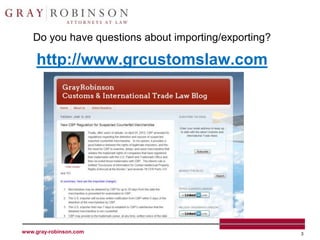
Do you have questions about importing/exporting?

    http://www.grcustomslaw.com


www.gray-robinson.com                                 3
Today’s Agenda
1) About U.S. Customs and Border Protection (CBP)
2) CBP’s Reasonable Care Checklist
3) Special Requirements for Certain Goods
   1) Cosmetics
   2) Drugs
   3) Medical Devices
   4) Food


www.gray-robinson.com                               4
U.S. Department of Homeland Security (DHS)
 • Created in response to 9/11 terrorist attacks
 • DHS goal: prepare for, prevent, and respond to domestic
   emergencies, particularly terrorism.
 • DHS is responsible for:
    – Managing the nation’s borders and ports-of-entry.
           – Preventing the passage of individuals or goods from
             entering the United States unlawfully
           – Working overseas to strengthen U.S. defenses
             against illegal smuggling and immigration


 www.gray-robinson.com                                             5
U.S. Customs and Border Protection
              (CBP)
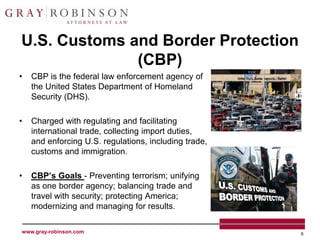
•   CBP is the federal law enforcement agency of
    the United States Department of Homeland
    Security (DHS).

•   Charged with regulating and facilitating
    international trade, collecting import duties,
    and enforcing U.S. regulations, including trade,
    customs and immigration.

•   CBP’s Goals - Preventing terrorism; unifying
    as one border agency; balancing trade and
    travel with security; protecting America;
    modernizing and managing for results.

www.gray-robinson.com                                  6
ON A TYPICAL DAY, CBP:
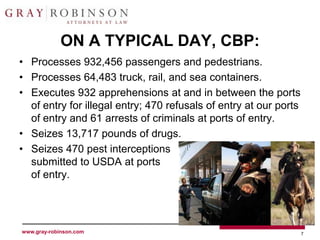
• Processes 932,456 passengers and pedestrians.
• Processes 64,483 truck, rail, and sea containers.
• Executes 932 apprehensions at and in between the ports
  of entry for illegal entry; 470 refusals of entry at our ports
  of entry and 61 arrests of criminals at ports of entry.
• Seizes 13,717 pounds of drugs.
• Seizes 470 pest interceptions
  submitted to USDA at ports
  of entry.


www.gray-robinson.com                                              7
Customs Trade Partnership
          Against Terrorism (C-TPAT)
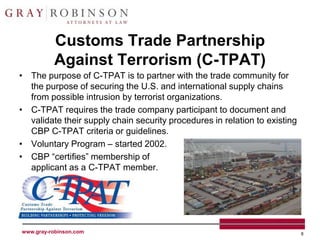
• The purpose of C-TPAT is to partner with the trade community for
  the purpose of securing the U.S. and international supply chains
  from possible intrusion by terrorist organizations.
• C-TPAT requires the trade company participant to document and
  validate their supply chain security procedures in relation to existing
  CBP C-TPAT criteria or guidelines.
• Voluntary Program – started 2002.
• CBP “certifies” membership of
  applicant as a C-TPAT member.


www.gray-robinson.com                                                       8
CBP Reasonable Care – A Checklist
• Merchandise Description &
  Tariff Classification
• Customs Valuation
• Country of Origin Marking
• Intellectual Property Rights
• Free Trade Agreements
     We will now go through each one.

www.gray-robinson.com                   9
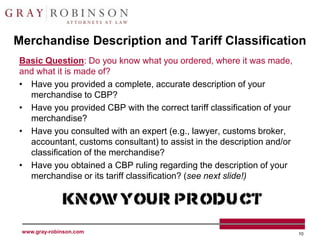
Merchandise Description and Tariff Classification
Basic Question: Do you know what you ordered, where it was made,
and what it is made of?
• Have you provided a complete, accurate description of your
  merchandise to CBP?
• Have you provided CBP with the correct tariff classification of your
  merchandise?
• Have you consulted with an expert (e.g., lawyer, customs broker,
  accountant, customs consultant) to assist in the description and/or
  classification of the merchandise?
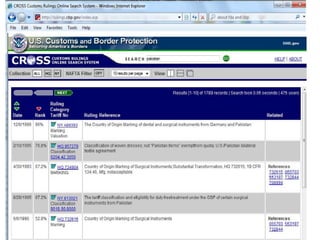
• Have you obtained a CBP ruling regarding the description of your
  merchandise or its tariff classification? (see next slide!)


 www.gray-robinson.com                                                   10
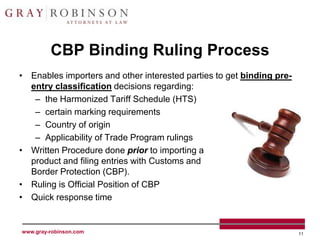
CBP Binding Ruling Process
• Enables importers and other interested parties to get binding pre-
  entry classification decisions regarding:
   – the Harmonized Tariff Schedule (HTS)
   – certain marking requirements
   – Country of origin
   – Applicability of Trade Program rulings
• Written Procedure done prior to importing a
  product and filing entries with Customs and
  Border Protection (CBP).
• Ruling is Official Position of CBP
• Quick response time


www.gray-robinson.com                                                  11
www.gray-robinson.com   12
Customs Valuation - GSP
If you are claiming a conditionally free or special tariff
classification or provision for your merchandise like GSP,
have you reported the required value information and
obtained the documentation necessary to support the
claim?

          See Bill Jackson’s presentation regarding
                        GSP eligibility


www.gray-robinson.com                                        13
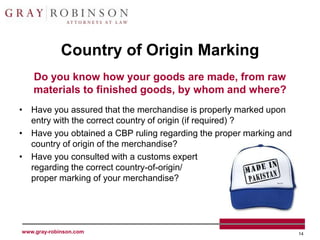
Country of Origin Marking
   Do you know how your goods are made, from raw
   materials to finished goods, by whom and where?
• Have you assured that the merchandise is properly marked upon
  entry with the correct country of origin (if required) ?
• Have you obtained a CBP ruling regarding the proper marking and
  country of origin of the merchandise?
• Have you consulted with a customs expert
  regarding the correct country-of-origin/
  proper marking of your merchandise?


www.gray-robinson.com                                               14
Intellectual Property Rights
  Basic Question: Have you determined
     whether your merchandise or its
     packaging use any trademarks or
 copyrighted material or are patented? If
  so, can you establish that you have a
   legal right to import those items into
  and/or use them in the United States?


www.gray-robinson.com                        15
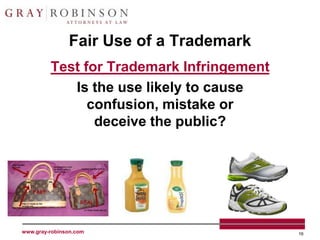
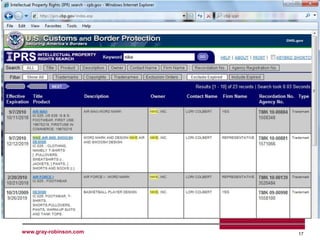
Fair Use of a Trademark
         Test for Trademark Infringement
            Is the use likely to cause
               confusion, mistake or
                deceive the public?


www.gray-robinson.com                      16
www.gray-robinson.com   17
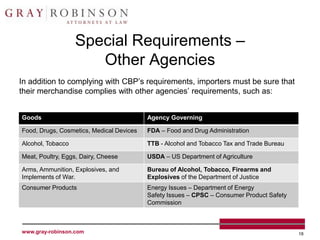
Special Requirements –
                      Other Agencies
In addition to complying with CBP’s requirements, importers must be sure that
their merchandise complies with other agencies’ requirements, such as:


Goods                                     Agency Governing

Food, Drugs, Cosmetics, Medical Devices   FDA – Food and Drug Administration

Alcohol, Tobacco                          TTB - Alcohol and Tobacco Tax and Trade Bureau

Meat, Poultry, Eggs, Dairy, Cheese        USDA – US Department of Agriculture

Arms, Ammunition, Explosives, and         Bureau of Alcohol, Tobacco, Firearms and
Implements of War.                        Explosives of the Department of Justice
Consumer Products                         Energy Issues – Department of Energy
                                          Safety Issues – CPSC – Consumer Product Safety
                                          Commission


www.gray-robinson.com                                                                      18
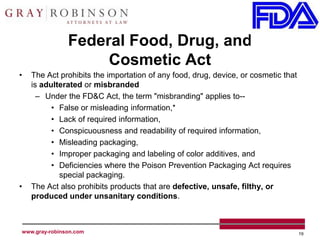
Federal Food, Drug, and
                    Cosmetic Act
•   The Act prohibits the importation of any food, drug, device, or cosmetic that
    is adulterated or misbranded
      – Under the FD&C Act, the term "misbranding" applies to--
          • False or misleading information,*
          • Lack of required information,
          • Conspicuousness and readability of required information,
          • Misleading packaging,
          • Improper packaging and labeling of color additives, and
          • Deficiencies where the Poison Prevention Packaging Act requires
            special packaging.
•   The Act also prohibits products that are defective, unsafe, filthy, or
    produced under unsanitary conditions.


www.gray-robinson.com                                                               19
Cosmetics
•   Cosmetics = Articles intended to be rubbed, poured, sprinkled, or sprayed
    on, introduced into, or otherwise applied to the human body...for cleansing,
    beautifying, promoting attractiveness, or altering the appearance
•   Examples - skin moisturizers, perfumes, lipsticks, fingernail polishes, eye
    and facial makeup preparations, cleansing shampoos, permanent waves,
    hair colors, and deodorants, as well as any substance intended for use as a
    component of a cosmetic product.

•   Voluntary Cosmetic Registration Program, or VCRP, for
    cosmetic establishments and formulations. As its name
    indicates, this program is voluntary. The FD&C Act does not
    require cosmetic firms to register their establishments or list
    their product formulations with FDA. But…..
•   A cosmetic product must be labeled according to
    cosmetic labeling regulations.

www.gray-robinson.com                                                              20
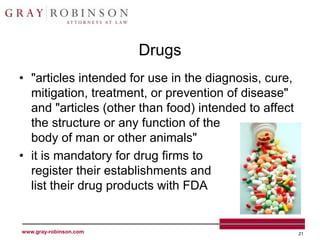
Drugs
• "articles intended for use in the diagnosis, cure,
  mitigation, treatment, or prevention of disease"
  and "articles (other than food) intended to affect
  the structure or any function of the
  body of man or other animals"
• it is mandatory for drug firms to
  register their establishments and
  list their drug products with FDA


www.gray-robinson.com                                  21
What is a Medical Device?
•      A device is: An instrument, apparatus, implement machine, contrivance, implant, in
       vitro reagent, or other similar or related including any component, part, or accessory
       which is:

         – (1) recognized in the official National Formulary, or the United States
            Pharmacopeia, or any supplement to them,
         – (2) intended for use in the diagnosis of disease or other conditions, or in the cure,
            mitigation, treatment, or prevention of disease, in man or other animals, or
         – (3) intended to affect the structure or any function of the body of man or other
            animals, which does not achieve its primary intended purposed through chemical
            action within or on the body of man or other animal and which is not dependent
            upon being metabolized for the achievement of its primary intended purposes.
•      If the primary intended use of the product is achieved through chemical action
       or by being metabolized by the body, the product is usually a drug.


    www.gray-robinson.com                                                                       22
Which of the following products is
               NOT a medical device?

1.    Tongue Depressor
2.    Lipstick
3.    Eyeglasses
4.    Pacemaker


www.gray-robinson.com                           23
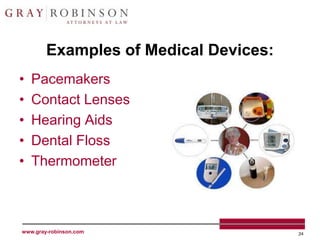
Examples of Medical Devices:
•   Pacemakers
•   Contact Lenses
•   Hearing Aids
•   Dental Floss
•   Thermometer


www.gray-robinson.com                  24
Checklist to Import Medical Devices
• Premarket Notification (510(k)), unless exempt, or
  Premarket Approval (PMA)
• FDA Establishment Registration on Form FDA--2891
• FDA Device Listing on Form FDA--2892
• Quality System Regulation (QSR) (sometimes referred to
  as good manufacturing practices or GMPs)
• Labeling Requirements
• Medical Device Reporting
• U.S. Designated Agent (for imported devices)
  (http://usagent www.fda.gov/cdrh/usagent) )

www.gray-robinson.com                                  25
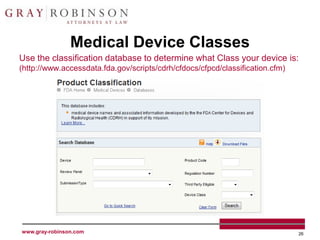
Medical Device Classes
Use the classification database to determine what Class your device is:
(http://www.accessdata.fda.gov/scripts/cdrh/cfdocs/cfpcd/classification.cfm)


www.gray-robinson.com                                                          26
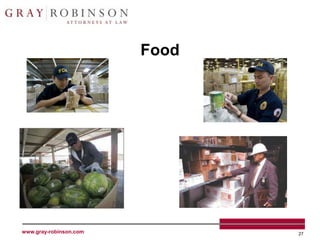
Food


www.gray-robinson.com          27
Food
• “Food” is defined as:
   – Articles used for food or drink for man or other
     animals,
   – Chewing gum,
   – Articles used for components or any such article.
• Imported foods must be pure, wholesome, safe to eat,
  and produced under sanitary conditions.
• Under FDA's laws and regulations, FDA does not pre-
  approve labels for food products.


www.gray-robinson.com                                    28
Bioterrorism Act of 2003
                         (BTA)
• Public Health Security and Bio-Terrorism Preparedness
  and Response Act of 2002, or BTA, was implemented on
  December 12, 2003
The BTA’s purpose is to ensure the security of
     food for human and consumption.
• BTA requires that:
   – manufacturers, processers, packers, and shippers register the
     facilities from which they export food and food products to the
     U.S. with the Food and Drug Administration.
   – FDA be given advance notice on shipments of imported food.


www.gray-robinson.com                                                  29
Useful Links
• CBP Import Information
   – www.cbp.gov/xp/cgov/trade/basic_trade
• U.S. Consumer Product Safety Commission
   – www.cpsc.gov
• FDA
   – www.fda.gov/ora/import
• Reasonable Care Checklist
   – http://www.cbp.gov/linkhandler/cgov/newsroom/publications/trad
     e/iius.ctt/iius.pdf
• My Blog – GR Customs Law
   – www.grcustomslaw.com


www.gray-robinson.com                                                 30
QUESTIONS??


www.gray-robinson.com                 31
U.S. Customs and
Standards Regulations
       Peter Quinter, U.S. Attorney
      Director, Customs & International Trade Law Group
                 GrayRobinson, P.A.
                   (954) 270-1864
          Peter.Quinter@Gray-Robinson.com
                     August 2012


                                        www.gray-robinson.com

U.S. Customs and Standards Regulations

  • 1.
    U.S. CUSTOMS AND STANDARDSREGULATIONS Peter Quinter, U.S. Attorney Director, Customs & International Trade Law Group GrayRobinson, P.A. (954) 270-1864 Peter.Quinter@Gray-Robinson.com August 2012 www.gray-robinson.com
  • 2.
  • 3.
    Do you havequestions about importing/exporting? http://www.grcustomslaw.com www.gray-robinson.com 3
  • 4.
    Today’s Agenda 1) AboutU.S. Customs and Border Protection (CBP) 2) CBP’s Reasonable Care Checklist 3) Special Requirements for Certain Goods 1) Cosmetics 2) Drugs 3) Medical Devices 4) Food www.gray-robinson.com 4
  • 5.
    U.S. Department ofHomeland Security (DHS) • Created in response to 9/11 terrorist attacks • DHS goal: prepare for, prevent, and respond to domestic emergencies, particularly terrorism. • DHS is responsible for: – Managing the nation’s borders and ports-of-entry. – Preventing the passage of individuals or goods from entering the United States unlawfully – Working overseas to strengthen U.S. defenses against illegal smuggling and immigration www.gray-robinson.com 5
  • 6.
    U.S. Customs andBorder Protection (CBP) • CBP is the federal law enforcement agency of the United States Department of Homeland Security (DHS). • Charged with regulating and facilitating international trade, collecting import duties, and enforcing U.S. regulations, including trade, customs and immigration. • CBP’s Goals - Preventing terrorism; unifying as one border agency; balancing trade and travel with security; protecting America; modernizing and managing for results. www.gray-robinson.com 6
  • 7.
    ON A TYPICALDAY, CBP: • Processes 932,456 passengers and pedestrians. • Processes 64,483 truck, rail, and sea containers. • Executes 932 apprehensions at and in between the ports of entry for illegal entry; 470 refusals of entry at our ports of entry and 61 arrests of criminals at ports of entry. • Seizes 13,717 pounds of drugs. • Seizes 470 pest interceptions submitted to USDA at ports of entry. www.gray-robinson.com 7
  • 8.
    Customs Trade Partnership Against Terrorism (C-TPAT) • The purpose of C-TPAT is to partner with the trade community for the purpose of securing the U.S. and international supply chains from possible intrusion by terrorist organizations. • C-TPAT requires the trade company participant to document and validate their supply chain security procedures in relation to existing CBP C-TPAT criteria or guidelines. • Voluntary Program – started 2002. • CBP “certifies” membership of applicant as a C-TPAT member. www.gray-robinson.com 8
  • 9.
    CBP Reasonable Care– A Checklist • Merchandise Description & Tariff Classification • Customs Valuation • Country of Origin Marking • Intellectual Property Rights • Free Trade Agreements We will now go through each one. www.gray-robinson.com 9
  • 10.
    Merchandise Description andTariff Classification Basic Question: Do you know what you ordered, where it was made, and what it is made of? • Have you provided a complete, accurate description of your merchandise to CBP? • Have you provided CBP with the correct tariff classification of your merchandise? • Have you consulted with an expert (e.g., lawyer, customs broker, accountant, customs consultant) to assist in the description and/or classification of the merchandise? • Have you obtained a CBP ruling regarding the description of your merchandise or its tariff classification? (see next slide!) www.gray-robinson.com 10
  • 11.
    CBP Binding RulingProcess • Enables importers and other interested parties to get binding pre- entry classification decisions regarding: – the Harmonized Tariff Schedule (HTS) – certain marking requirements – Country of origin – Applicability of Trade Program rulings • Written Procedure done prior to importing a product and filing entries with Customs and Border Protection (CBP). • Ruling is Official Position of CBP • Quick response time www.gray-robinson.com 11
  • 12.
  • 13.
    Customs Valuation -GSP If you are claiming a conditionally free or special tariff classification or provision for your merchandise like GSP, have you reported the required value information and obtained the documentation necessary to support the claim? See Bill Jackson’s presentation regarding GSP eligibility www.gray-robinson.com 13
  • 14.
    Country of OriginMarking Do you know how your goods are made, from raw materials to finished goods, by whom and where? • Have you assured that the merchandise is properly marked upon entry with the correct country of origin (if required) ? • Have you obtained a CBP ruling regarding the proper marking and country of origin of the merchandise? • Have you consulted with a customs expert regarding the correct country-of-origin/ proper marking of your merchandise? www.gray-robinson.com 14
  • 15.
    Intellectual Property Rights Basic Question: Have you determined whether your merchandise or its packaging use any trademarks or copyrighted material or are patented? If so, can you establish that you have a legal right to import those items into and/or use them in the United States? www.gray-robinson.com 15
  • 16.
    Fair Use ofa Trademark Test for Trademark Infringement Is the use likely to cause confusion, mistake or deceive the public? www.gray-robinson.com 16
  • 17.
  • 18.
    Special Requirements – Other Agencies In addition to complying with CBP’s requirements, importers must be sure that their merchandise complies with other agencies’ requirements, such as: Goods Agency Governing Food, Drugs, Cosmetics, Medical Devices FDA – Food and Drug Administration Alcohol, Tobacco TTB - Alcohol and Tobacco Tax and Trade Bureau Meat, Poultry, Eggs, Dairy, Cheese USDA – US Department of Agriculture Arms, Ammunition, Explosives, and Bureau of Alcohol, Tobacco, Firearms and Implements of War. Explosives of the Department of Justice Consumer Products Energy Issues – Department of Energy Safety Issues – CPSC – Consumer Product Safety Commission www.gray-robinson.com 18
  • 19.
    Federal Food, Drug,and Cosmetic Act • The Act prohibits the importation of any food, drug, device, or cosmetic that is adulterated or misbranded – Under the FD&C Act, the term "misbranding" applies to-- • False or misleading information,* • Lack of required information, • Conspicuousness and readability of required information, • Misleading packaging, • Improper packaging and labeling of color additives, and • Deficiencies where the Poison Prevention Packaging Act requires special packaging. • The Act also prohibits products that are defective, unsafe, filthy, or produced under unsanitary conditions. www.gray-robinson.com 19
  • 20.
    Cosmetics • Cosmetics = Articles intended to be rubbed, poured, sprinkled, or sprayed on, introduced into, or otherwise applied to the human body...for cleansing, beautifying, promoting attractiveness, or altering the appearance • Examples - skin moisturizers, perfumes, lipsticks, fingernail polishes, eye and facial makeup preparations, cleansing shampoos, permanent waves, hair colors, and deodorants, as well as any substance intended for use as a component of a cosmetic product. • Voluntary Cosmetic Registration Program, or VCRP, for cosmetic establishments and formulations. As its name indicates, this program is voluntary. The FD&C Act does not require cosmetic firms to register their establishments or list their product formulations with FDA. But….. • A cosmetic product must be labeled according to cosmetic labeling regulations. www.gray-robinson.com 20
  • 21.
    Drugs • "articles intendedfor use in the diagnosis, cure, mitigation, treatment, or prevention of disease" and "articles (other than food) intended to affect the structure or any function of the body of man or other animals" • it is mandatory for drug firms to register their establishments and list their drug products with FDA www.gray-robinson.com 21
  • 22.
    What is aMedical Device? • A device is: An instrument, apparatus, implement machine, contrivance, implant, in vitro reagent, or other similar or related including any component, part, or accessory which is: – (1) recognized in the official National Formulary, or the United States Pharmacopeia, or any supplement to them, – (2) intended for use in the diagnosis of disease or other conditions, or in the cure, mitigation, treatment, or prevention of disease, in man or other animals, or – (3) intended to affect the structure or any function of the body of man or other animals, which does not achieve its primary intended purposed through chemical action within or on the body of man or other animal and which is not dependent upon being metabolized for the achievement of its primary intended purposes. • If the primary intended use of the product is achieved through chemical action or by being metabolized by the body, the product is usually a drug. www.gray-robinson.com 22
  • 23.
    Which of thefollowing products is NOT a medical device? 1. Tongue Depressor 2. Lipstick 3. Eyeglasses 4. Pacemaker www.gray-robinson.com 23
  • 24.
    Examples of MedicalDevices: • Pacemakers • Contact Lenses • Hearing Aids • Dental Floss • Thermometer www.gray-robinson.com 24
  • 25.
    Checklist to ImportMedical Devices • Premarket Notification (510(k)), unless exempt, or Premarket Approval (PMA) • FDA Establishment Registration on Form FDA--2891 • FDA Device Listing on Form FDA--2892 • Quality System Regulation (QSR) (sometimes referred to as good manufacturing practices or GMPs) • Labeling Requirements • Medical Device Reporting • U.S. Designated Agent (for imported devices) (http://usagent www.fda.gov/cdrh/usagent) ) www.gray-robinson.com 25
  • 26.
    Medical Device Classes Usethe classification database to determine what Class your device is: (http://www.accessdata.fda.gov/scripts/cdrh/cfdocs/cfpcd/classification.cfm) www.gray-robinson.com 26
  • 27.
  • 28.
    Food • “Food” isdefined as: – Articles used for food or drink for man or other animals, – Chewing gum, – Articles used for components or any such article. • Imported foods must be pure, wholesome, safe to eat, and produced under sanitary conditions. • Under FDA's laws and regulations, FDA does not pre- approve labels for food products. www.gray-robinson.com 28
  • 29.
    Bioterrorism Act of2003 (BTA) • Public Health Security and Bio-Terrorism Preparedness and Response Act of 2002, or BTA, was implemented on December 12, 2003 The BTA’s purpose is to ensure the security of food for human and consumption. • BTA requires that: – manufacturers, processers, packers, and shippers register the facilities from which they export food and food products to the U.S. with the Food and Drug Administration. – FDA be given advance notice on shipments of imported food. www.gray-robinson.com 29
  • 30.
    Useful Links • CBPImport Information – www.cbp.gov/xp/cgov/trade/basic_trade • U.S. Consumer Product Safety Commission – www.cpsc.gov • FDA – www.fda.gov/ora/import • Reasonable Care Checklist – http://www.cbp.gov/linkhandler/cgov/newsroom/publications/trad e/iius.ctt/iius.pdf • My Blog – GR Customs Law – www.grcustomslaw.com www.gray-robinson.com 30
  • 31.
  • 32.
    U.S. Customs and StandardsRegulations Peter Quinter, U.S. Attorney Director, Customs & International Trade Law Group GrayRobinson, P.A. (954) 270-1864 Peter.Quinter@Gray-Robinson.com August 2012 www.gray-robinson.com