U.S. Census of Agriculture
Victoria Calderon
David Luckenbach
National Agricultural Statistics Service
United States Department of Agriculture
Regional workshop on sampling
for agricultural censuses and surveys
Montevideo, Uruguay
12-16 December 2016
U.S. Census of Agriculture
National Agricultural Statistics Service:
Mission
to provide
timely, accurate and useful statistics
in service to U.S. agriculture
U.S. Census of Agriculture
National Agricultural Statistics Service:
on-going sample survey program
weekly, monthly, quarterly & annual reports
basic statistics on
crops, livestock, chemical use,
farm demographics, income & expenses
over 400 reports each year
120 crop items
45 livestock items
U.S. Census of Agriculture
National Agricultural Statistics Service:
Agricultural Census
U.S. Census of Agriculture
Purpose:
to provide
uniform, comprehensive statistics
on farms & farm productivity
for every county in the U.S.
every 5 years
U.S. Census of Agriculture
Legal Authority:
conducted under legal authority
granted by United States Code
Title 7, Chapter 55, Section 2204g
type, frequency & geographic scope
confidentiality of data
mandatory reporting
U.S. Census of Agriculture
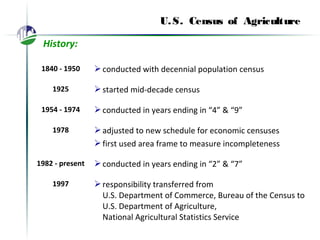
History:
1840 - 1950 conducted with decennial population census
1925 started mid-decade census
1954 - 1974 conducted in years ending in “4” & “9”
1978 adjusted to new schedule for economic censuses
first used area frame to measure incompleteness
1982 - present conducted in years ending in “2” & “7”
1997 responsibility transferred from
U.S. Department of Commerce, Bureau of the Census to
U.S. Department of Agriculture,
National Agricultural Statistics Service
U.S. Census of Agriculture
Farm definition:
any place that produced and sold,
or normally would have produced and sold,
$1,000 or more of agricultural products
during the census year
~ currently about 2.2 million farms ~
U.S. Census of Agriculture
Uses:
analyze structure, productivity & trends
of U.S. agriculture
farmers
farm organizations
agribusinesses & other private sector businesses
agriculture-oriented news media
administrative & legislative bodies
Federal, state & local government agencies
develop list sampling frame
for agricultural surveys
U.S. Census of Agriculture
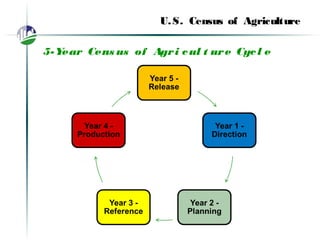
5-Year Cens us of Agri cul t ure Cycl e
U.S. Census of Agriculture
Year 1 - Di rect i on
 Monitor products from previous Census of
Agriculture (CoA)
 Continue follow-ons from previous Census
 List building - National Agricultural Classification
Survey (240,000 forms mailed)
 Begin working on processing and analysis systems
 Determine Content
U.S. Census of Agriculture
Cont ent Det ermi nat i on
• Consider new content from:
– Data Users
– Public Comment
– USDA
– Advisory Committees
– NASS Staff
• Consider removing content
U.S. Census of Agriculture
Content Determination – Guiding Principles
• Include items that:
– Are mandated/supported by Congress
– Are requested by Federal agencies where
legislation called for data to be provided to
Congress
– Assist in the evaluation of existing Federal
programs
– If omitted, would result in additional
respondent burden and cost for a new survey
for other agencies or users
U.S. Census of Agriculture
Cont ent Det ermi nat i on – Gui di ng
Pri nci pl es , cont .
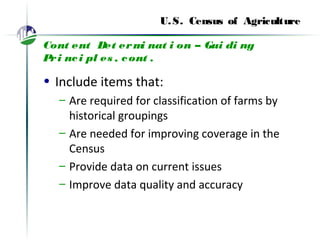
• Include items that:
– Are required for classification of farms by
historical groupings
– Are needed for improving coverage in the
Census
– Provide data on current issues
– Improve data quality and accuracy
U.S. Census of Agriculture
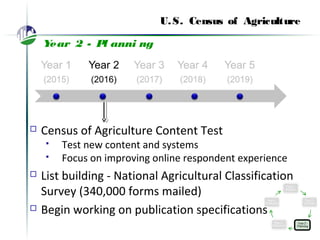
Year 2 - Pl anni ng
 Census of Agriculture Content Test
 Test new content and systems
 Focus on improving online respondent experience
 List building - National Agricultural Classification
Survey (340,000 forms mailed)
 Begin working on publication specifications
U.S. Census of Agriculture
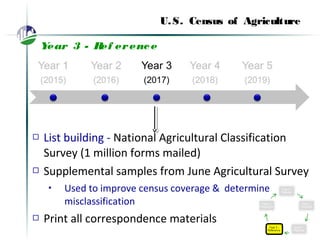
Year 3 - Ref erence
 List building - National Agricultural Classification
Survey (1 million forms mailed)
 Supplemental samples from June Agricultural Survey
 Used to improve census coverage & determine
misclassification
 Print all correspondence materials
U.S. Census of Agriculture
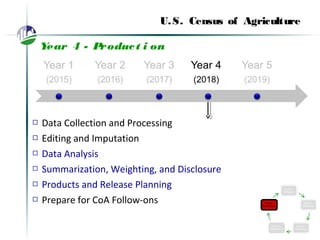
Year 4 - Product i on
 Data Collection and Processing
 Editing and Imputation
 Data Analysis
 Summarization, Weighting, and Disclosure
 Products and Release Planning
 Prepare for CoA Follow-ons
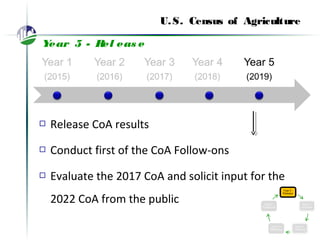
U.S. Census of Agriculture
Year 5 - Rel eas e
 Release CoA results
 Conduct first of the CoA Follow-ons
 Evaluate the 2017 CoA and solicit input for the
2022 CoA from the public
U.S. Census of Agriculture
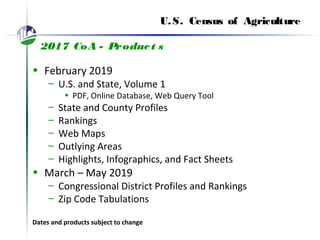
2017 CoA - Product s
• February 2019
– U.S. and State, Volume 1
• PDF, Online Database, Web Query Tool
– State and County Profiles
– Rankings
– Web Maps
– Outlying Areas
– Highlights, Infographics, and Fact Sheets
• March – May 2019
– Congressional District Profiles and Rankings
– Zip Code Tabulations
Dates and products subject to change
U.S. Census of Agriculture
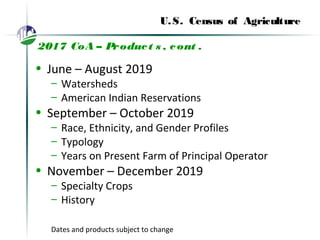
2017 CoA – Product s , cont .
• June – August 2019
– Watersheds
– American Indian Reservations
• September – October 2019
– Race, Ethnicity, and Gender Profiles
– Typology
– Years on Present Farm of Principal Operator
• November – December 2019
– Specialty Crops
– History
Dates and products subject to change
U.S. Census of Agriculture
GRACIAS!
THANKYOU!
OBRIGADO!

US - Census of Agriculture

  • 1.
    U.S. Census ofAgriculture Victoria Calderon David Luckenbach National Agricultural Statistics Service United States Department of Agriculture Regional workshop on sampling for agricultural censuses and surveys Montevideo, Uruguay 12-16 December 2016
  • 2.
    U.S. Census ofAgriculture National Agricultural Statistics Service: Mission to provide timely, accurate and useful statistics in service to U.S. agriculture
  • 3.
    U.S. Census ofAgriculture National Agricultural Statistics Service: on-going sample survey program weekly, monthly, quarterly & annual reports basic statistics on crops, livestock, chemical use, farm demographics, income & expenses over 400 reports each year 120 crop items 45 livestock items
  • 4.
    U.S. Census ofAgriculture National Agricultural Statistics Service: Agricultural Census
  • 5.
    U.S. Census ofAgriculture Purpose: to provide uniform, comprehensive statistics on farms & farm productivity for every county in the U.S. every 5 years
  • 6.
    U.S. Census ofAgriculture Legal Authority: conducted under legal authority granted by United States Code Title 7, Chapter 55, Section 2204g type, frequency & geographic scope confidentiality of data mandatory reporting
  • 7.
    U.S. Census ofAgriculture History: 1840 - 1950 conducted with decennial population census 1925 started mid-decade census 1954 - 1974 conducted in years ending in “4” & “9” 1978 adjusted to new schedule for economic censuses first used area frame to measure incompleteness 1982 - present conducted in years ending in “2” & “7” 1997 responsibility transferred from U.S. Department of Commerce, Bureau of the Census to U.S. Department of Agriculture, National Agricultural Statistics Service
  • 8.
    U.S. Census ofAgriculture Farm definition: any place that produced and sold, or normally would have produced and sold, $1,000 or more of agricultural products during the census year ~ currently about 2.2 million farms ~
  • 9.
    U.S. Census ofAgriculture Uses: analyze structure, productivity & trends of U.S. agriculture farmers farm organizations agribusinesses & other private sector businesses agriculture-oriented news media administrative & legislative bodies Federal, state & local government agencies develop list sampling frame for agricultural surveys
  • 10.
    U.S. Census ofAgriculture 5-Year Cens us of Agri cul t ure Cycl e
  • 11.
    U.S. Census ofAgriculture Year 1 - Di rect i on  Monitor products from previous Census of Agriculture (CoA)  Continue follow-ons from previous Census  List building - National Agricultural Classification Survey (240,000 forms mailed)  Begin working on processing and analysis systems  Determine Content
  • 12.
    U.S. Census ofAgriculture Cont ent Det ermi nat i on • Consider new content from: – Data Users – Public Comment – USDA – Advisory Committees – NASS Staff • Consider removing content
  • 13.
    U.S. Census ofAgriculture Content Determination – Guiding Principles • Include items that: – Are mandated/supported by Congress – Are requested by Federal agencies where legislation called for data to be provided to Congress – Assist in the evaluation of existing Federal programs – If omitted, would result in additional respondent burden and cost for a new survey for other agencies or users
  • 14.
    U.S. Census ofAgriculture Cont ent Det ermi nat i on – Gui di ng Pri nci pl es , cont . • Include items that: – Are required for classification of farms by historical groupings – Are needed for improving coverage in the Census – Provide data on current issues – Improve data quality and accuracy
  • 15.
    U.S. Census ofAgriculture Year 2 - Pl anni ng  Census of Agriculture Content Test  Test new content and systems  Focus on improving online respondent experience  List building - National Agricultural Classification Survey (340,000 forms mailed)  Begin working on publication specifications
  • 16.
    U.S. Census ofAgriculture Year 3 - Ref erence  List building - National Agricultural Classification Survey (1 million forms mailed)  Supplemental samples from June Agricultural Survey  Used to improve census coverage & determine misclassification  Print all correspondence materials
  • 17.
    U.S. Census ofAgriculture Year 4 - Product i on  Data Collection and Processing  Editing and Imputation  Data Analysis  Summarization, Weighting, and Disclosure  Products and Release Planning  Prepare for CoA Follow-ons
  • 18.
    U.S. Census ofAgriculture Year 5 - Rel eas e  Release CoA results  Conduct first of the CoA Follow-ons  Evaluate the 2017 CoA and solicit input for the 2022 CoA from the public
  • 19.
    U.S. Census ofAgriculture 2017 CoA - Product s • February 2019 – U.S. and State, Volume 1 • PDF, Online Database, Web Query Tool – State and County Profiles – Rankings – Web Maps – Outlying Areas – Highlights, Infographics, and Fact Sheets • March – May 2019 – Congressional District Profiles and Rankings – Zip Code Tabulations Dates and products subject to change
  • 20.
    U.S. Census ofAgriculture 2017 CoA – Product s , cont . • June – August 2019 – Watersheds – American Indian Reservations • September – October 2019 – Race, Ethnicity, and Gender Profiles – Typology – Years on Present Farm of Principal Operator • November – December 2019 – Specialty Crops – History Dates and products subject to change
  • 21.
    U.S. Census ofAgriculture GRACIAS! THANKYOU! OBRIGADO!

Editor's Notes

  • #12 Continual updating of frames