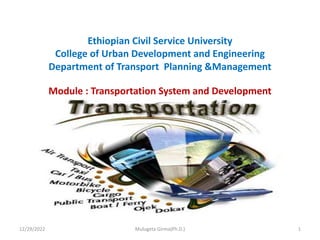
Module : Transportation System and Development
Ethiopian Civil Service University
College of Urban Development and Engineering
Department of Transport Planning &Management
1
12/29/2022 Mulugeta Girma(Ph.D.)
Outline
 Objective
 Introduction to transport
system
- Definition
- importance
- Modes /classification
 Discussion
 Objectives
- have a general overview of
transportation
- state the different modes of
transportation
12/29/2022 Mulugeta Girma(Ph.D.) 2
The basics of Transportation system
-Definition of Transport
- Transport system
-Importance of Transport
-Mode of Transport
12/29/2022 Mulugeta Girma(Ph.D.) 3
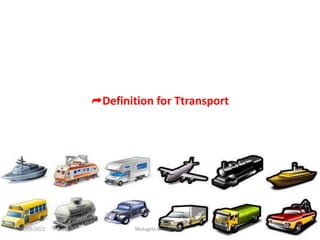
Definition for Ttransport
12/29/2022 Mulugeta Girma(Ph.D.) 4
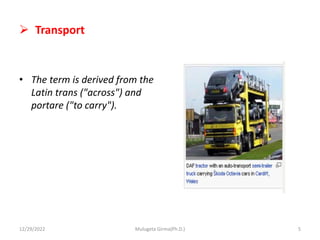
 Transport
• The term is derived from the
Latin trans ("across") and
portare ("to carry").
12/29/2022 Mulugeta Girma(Ph.D.) 5
CONT’D
Transportation:
 Is the process of moving goods and people from one place to
another which involve all activities that facilitate the
movement of goods and people.
 It provides access to natural resources and promotes trade,
allowing a nation to accumulate wealth and power because
it’s a vital to a nation’s economy.
 it is also an important factor for every country to
- maintain a strong economy, and
- for access to and between country’s people
 Transport sector plays a significant role in the overall
development of a country
12/29/2022 Mulugeta Girma(Ph.D.) 6
Cont’d
- The most common element in any definition of
transportation is movement.
 Movement is changing of physical location of freight,
passenger
12/29/2022 Mulugeta Girma(Ph.D.) 7
Cont’d
 the purpose of transportation is to overcome space, which is
shaped by a variety of human and physical constraints –
i.e. distance, time, administrative divisions and topography
 The fundamental purpose of transport is consequently
geographic in nature, meaning that it facilitates movement
between different locations.
12/29/2022 Mulugeta Girma(Ph.D.) 8
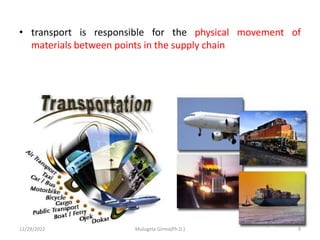
• transport is responsible for the physical movement of
materials between points in the supply chain
12/29/2022 Mulugeta Girma(Ph.D.) 9
Cont’d
• Transport ,in fact , provides a vital link between;
- production centers ,
- distribution areas and
- the ultimate customers.
12/29/2022 Mulugeta Girma(Ph.D.) 10
Cont’d
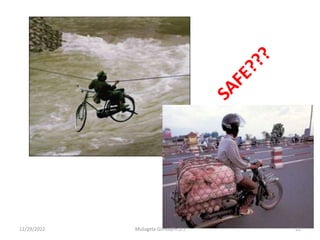
 Transportation is the movement of people and goods over
time and space...
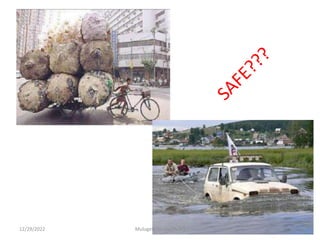
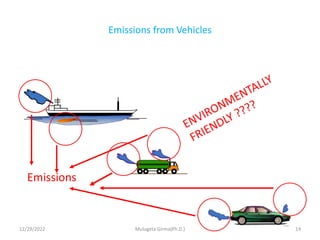
• Transportation should be…
- Safe
- Environmentally Friendly
12/29/2022 Mulugeta Girma(Ph.D.) 11
12/29/2022 Mulugeta Girma(Ph.D.) 12
12/29/2022 Mulugeta Girma(Ph.D.) 13
Emissions from Vehicles
Emissions
12/29/2022 Mulugeta Girma(Ph.D.) 14
 Framework of transportation system
• Transportation system ???
• defined as a planned network of elements or physical
components that play different roles in the transportation of
goods and persons from one place to another.
• The elements or physical components of a transport system
are referred to as the facilities.
12/29/2022 Mulugeta Girma(Ph.D.) 15
Cont’d
• A transport system can therefore be considered as consisting
of fixed facilities, the flow entities, and control system
• that permit people and goods to overcome the friction of
geographical space efficiently in order to participate in a
timely manner in some desired activity.
12/29/2022 Mulugeta Girma(Ph.D.) 16
Fixed Facilities
• are the physical components of the system that are fixed in
space and constitutes the network of links and nodes of the
transportation system.
• For example, the links could be ;
- roadway segment and railway track and
- the nodes could be intersections, interchanges, transit
terminals, and airports
12/29/2022 Mulugeta Girma(Ph.D.) 17
Flow Entities
• are the units that travel the fixed facilities.
e.g vehicles, container units, railroad cars, and so on.
• In the case of a road system, the fixed facilities are expected
to accommodate a wide variety of vehicle types, ranging from
bicycles to large tractor-trailer combinations.
12/29/2022 Mulugeta Girma(Ph.D.) 18
Control System
 The control system consists of
i. vehicular control and ii. flow control.
• Vehicular control refers to the technological way in which
individual vehicles are guided on fixed facilities.
- Such controls can be manual or automated.
12/29/2022 Mulugeta Girma(Ph.D.) 19
Cont’d
• The flow control system consists ;
- the means that permit the efficient and smooth operation of
streams of vehicles and the reduction of conflicts between
vehicles.
- This system includes various types of signing, marking, and
signal systems and the underlying rules of operation.
12/29/2022 Mulugeta Girma(Ph.D.) 20
Classification of Transportation
• Transportation is classified according to:
- what is transported,
- transportation infrastructure,
- transport modes and in terms of aims (purposes)
A-What is transported
i.e. transportation of: - persons- (buses, taxis, rail, air, etc),
- goods (freight, etc),
- fluid (pipe lines).
B- transportation infrastructure
Road, Rail, Air , Water, Pipe etc.
12/29/2022 Mulugeta Girma(Ph.D.) 21
Cont’d
C-Transportation modes
• Motorized transport,
• Non motorized transport.
D- Transportation aims: to and from
• place of work,
• service centers,
• schools, universities / Education /
• shopping areas,
• entertaining centers etc
12/29/2022 Mulugeta Girma(Ph.D.) 22
Significance of Transport
• In general transport helps to :
- make available to a community the
goods produced elsewhere
- extend the market
- reduce regional price variability
- increase productivity and efficiency
and lead to
- large scale production
- reduction of the cost of goods
- encourages competition,
- Creates valuable links between
regions and economic activities ,
between populations and the rest of
the world.
- etc
i- economic significance
- Transport – linked to
economic development
- An indispensible
component of the
economy and plays a
major role in spatial
relations between
locations
- The transport sector is
also an economic
factor in the
production of good and
services
12/29/2022 Mulugeta Girma(Ph.D.) 23
Cont’d
 Its importance is manifested through several points of view :
• Better utilization of the backward areas linking with the
advanced areas / rural – urban linkage /
• For rapid industrialization & urbanization
• For removing the scarcity of goods
• movement people and bringing them in contact with each
other
12/29/2022 Mulugeta Girma(Ph.D.) 24
II- social significance
 Modern transport has
- widened cultural opportunities,
- permitting people to examine the
artistic treasures of other countries
and
- to explore their own national
heritage
 It enhance the health and welfare of
a population as
- medical persons can move rapidly
from one place to another or
- sick persons can be transported to
higher health institutions easily
 Improved
transportation and
communication reduce
isolation of one
community from
another.
 It allows people to live
and work apart.
12/29/2022 Mulugeta Girma(Ph.D.) 25
iii- political significance
• It helps to uniformly administer the laws of the country
• A country’s military success also depends on a certain
extent on the availability of transportation network.
• Transportation increases government revenue by
facilitating the collection of taxes.
12/29/2022 Mulugeta Girma(Ph.D.) 26
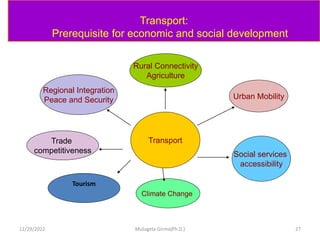
Tourism
Transport
Urban Mobility
Regional Integration
Peace and Security
Trade
competitiveness Social services
accessibility
Rural Connectivity
Agriculture
Climate Change
Transport:
Prerequisite for economic and social development
12/29/2022 Mulugeta Girma(Ph.D.) 27
Transportation Modes
What are the Modes of transport ?
12/29/2022 Mulugeta Girma(Ph.D.) 28
Transportation Modes
■ Transport modes:
• Vehicles:
• Mobile segment.
• Supporting the mobility of passengers, freight and information.
• Infrastructures:
• Fixed segment.
• Supporting movements.
• Three basic types:
• Land (road, rail and pipelines).
• Water (shipping).
• Air.
• Each mode had a set of technical, operational and
commercial characteristics.
29
Cont’d
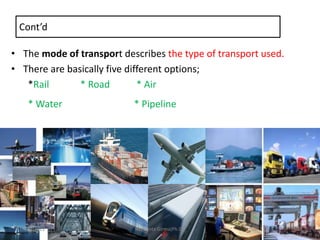
• The mode of transport describes the type of transport used.
• There are basically five different options;
*Rail * Road * Air
* Water * Pipeline
12/29/2022 Mulugeta Girma(Ph.D.) 30
Rail Transport
 Overview
• Composed of a traced path on which are bound vehicles.
• Heavy industries are traditionally linked with rail transport
systems.
12/29/2022 Mulugeta Girma(Ph.D.) 31
Rail Transport
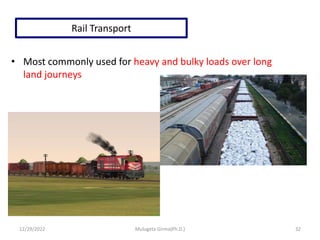
• Most commonly used for heavy and bulky loads over long
land journeys
12/29/2022 Mulugeta Girma(Ph.D.) 32
cont’d
 Advantages
 It is a convenient mode of transport for travelling long distances.
 It is relatively faster than road transport.
 It is suitable for carrying heavy goods in large quantities over long distances.
 Its operation is less affected by adverse weathers conditions like rain,
floods, fog, etc.
 Limitations
 It is relatively expensive for carrying goods and passengers over short
distances.
 It provides service according to fixed time schedule and is not flexible for
loading or unloading of goods at any place.
 It involves heavy losses of life as well as goods in case of accident.
12/29/2022 Mulugeta Girma(Ph.D.) 33
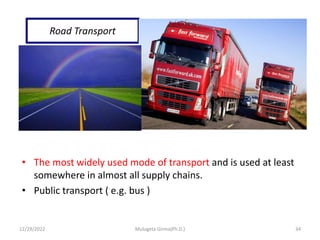
Road Transport
• The most widely used mode of transport and is used at least
somewhere in almost all supply chains.
• Public transport ( e.g. bus )
12/29/2022 Mulugeta Girma(Ph.D.) 34
Cont’d
■ Overview
• Large consumers of space.
• Lowest level of physical constraints among transportation
modes.
• Average operational flexibility (vehicles can serve several
purposes).
• High maintenance costs, both for the vehicles and
infrastructures.
12/29/2022 Mulugeta Girma(Ph.D.) 35
Cont’d
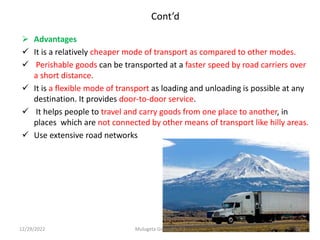
 Advantages
 It is a relatively cheaper mode of transport as compared to other modes.
 Perishable goods can be transported at a faster speed by road carriers over
a short distance.
 It is a flexible mode of transport as loading and unloading is possible at any
destination. It provides door-to-door service.
 It helps people to travel and carry goods from one place to another, in
places which are not connected by other means of transport like hilly areas.
 Use extensive road networks
12/29/2022 Mulugeta Girma(Ph.D.) 36
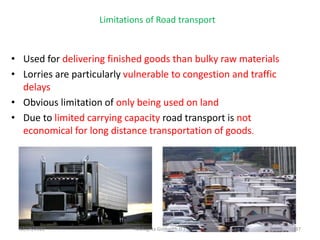
Limitations of Road transport
• Used for delivering finished goods than bulky raw materials
• Lorries are particularly vulnerable to congestion and traffic
delays
• Obvious limitation of only being used on land
• Due to limited carrying capacity road transport is not
economical for long distance transportation of goods.
12/29/2022 Mulugeta Girma(Ph.D.) 37
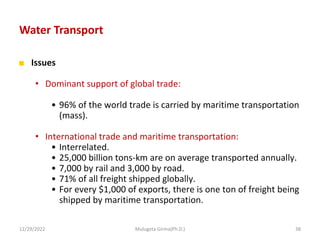
Water Transport
■ Issues
• Dominant support of global trade:
• 96% of the world trade is carried by maritime transportation
(mass).
• International trade and maritime transportation:
• Interrelated.
• 25,000 billion tons-km are on average transported annually.
• 7,000 by rail and 3,000 by road.
• 71% of all freight shipped globally.
• For every $1,000 of exports, there is one ton of freight being
shipped by maritime transportation.
12/29/2022 Mulugeta Girma(Ph.D.) 38
Water Transport
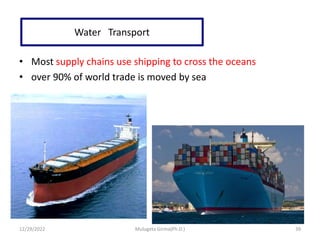
• Most supply chains use shipping to cross the oceans
• over 90% of world trade is moved by sea
12/29/2022 Mulugeta Girma(Ph.D.) 39
Cont’d
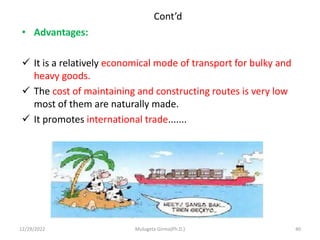
• Advantages:
 It is a relatively economical mode of transport for bulky and
heavy goods.
 The cost of maintaining and constructing routes is very low
most of them are naturally made.
 It promotes international trade.......
12/29/2022 Mulugeta Girma(Ph.D.) 40
Cont’d
 Disadvantages:
 The depth and navigability of rivers and canals vary and thus, affect
operations of different transport vessels.
 It is a slow moving mode of transport and therefore not suitable for
transport of perishable goods.
(Longer delivery times and slow)
 It is adversely affected by weather conditions.
 Sea transport requires large investment on ships and their
maintenance.
 Transfers to ships take time
12/29/2022 Mulugeta Girma(Ph.D.) 41
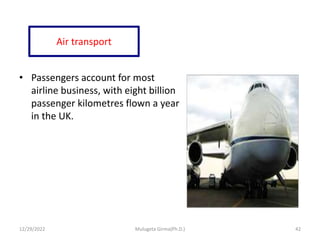
Air transport
• Passengers account for most
airline business, with eight billion
passenger kilometres flown a year
in the UK.
12/29/2022 Mulugeta Girma(Ph.D.) 42
Cont’d
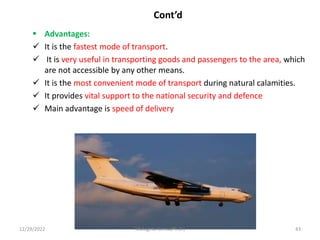
 Advantages:
 It is the fastest mode of transport.
 It is very useful in transporting goods and passengers to the area, which
are not accessible by any other means.
 It is the most convenient mode of transport during natural calamities.
 It provides vital support to the national security and defence
 Main advantage is speed of delivery
12/29/2022 Mulugeta Girma(Ph.D.) 43
Cont’d
 Disadvantages:
 It is relatively more expensive mode of transport.
 It is not suitable for transporting heavy and bulky goods.
 It is affected by adverse weather conditions.
 It is not suitable for short distance travel.
 In case of accidents, it results in heavy losses of goods,
property and life.
12/29/2022 Mulugeta Girma(Ph.D.) 44
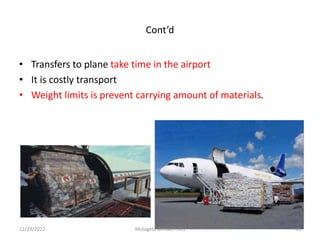
Cont’d
• Transfers to plane take time in the airport
• It is costly transport
• Weight limits is prevent carrying amount of materials.
12/29/2022 Mulugeta Girma(Ph.D.) 45
Pipeline Transport
■ Overview
• Single purpose: carry one commodity from a location to another.
• Large quantities of products where no other feasible means of
transport (usually water) is available.
• Two main products dominate pipeline traffic:
• Oil and gas.
• Locally pipelines are significant for the transport of water.
12/29/2022 Mulugeta Girma(Ph.D.) 46
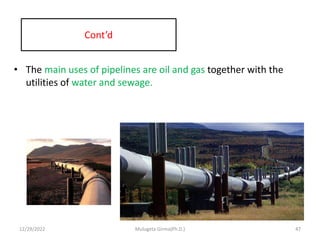
Cont’d
• The main uses of pipelines are oil and gas together with the
utilities of water and sewage.
12/29/2022 Mulugeta Girma(Ph.D.) 47
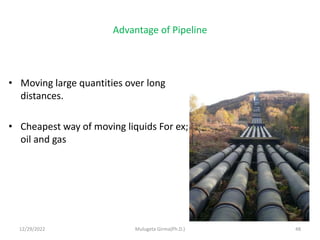
Advantage of Pipeline
• Moving large quantities over long
distances.
• Cheapest way of moving liquids For ex;
oil and gas
12/29/2022 Mulugeta Girma(Ph.D.) 48
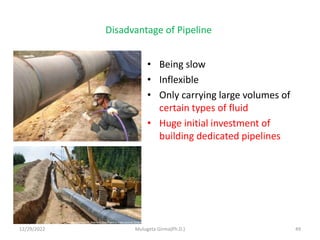
Disadvantage of Pipeline
• Being slow
• Inflexible
• Only carrying large volumes of
certain types of fluid
• Huge initial investment of
building dedicated pipelines
12/29/2022 Mulugeta Girma(Ph.D.) 49
* Choice of mode depends on a variety of factors.
- The main ones are the nature of materials to move, the
volume and distance.
 Other factors include:
• Value of materials
• Importance
• Transit times
• Reliability
• Cost and flexibility to
negotiate rates
• stability of carrier
• Security, loss and damage
• Schedules and frequency of
delivery
12/29/2022 Mulugeta Girma(Ph.D.) 50
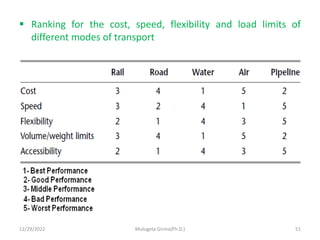
 Ranking for the cost, speed, flexibility and load limits of
different modes of transport
12/29/2022 Mulugeta Girma(Ph.D.) 51
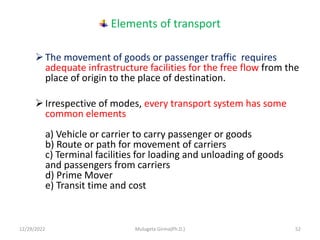
Elements of transport
The movement of goods or passenger traffic requires
adequate infrastructure facilities for the free flow from the
place of origin to the place of destination.
Irrespective of modes, every transport system has some
common elements
a) Vehicle or carrier to carry passenger or goods
b) Route or path for movement of carriers
c) Terminal facilities for loading and unloading of goods
and passengers from carriers
d) Prime Mover
e) Transit time and cost
12/29/2022 Mulugeta Girma(Ph.D.) 52
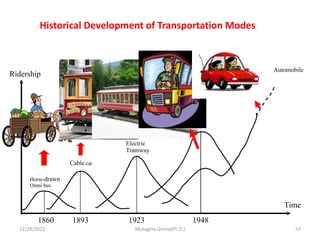
Historical Development of Transportation Modes
1860 1893 1923 1948
Time
Ridership
Horse-drawn
Omni bus
Cable car
Electric
Tramway
Bus
Automobile
12/29/2022 Mulugeta Girma(Ph.D.) 53
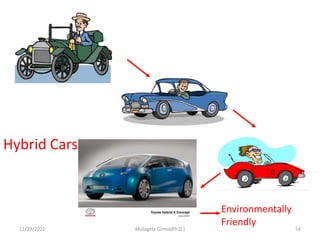
Hybrid Cars
Environmentally
Friendly
12/29/2022 Mulugeta Girma(Ph.D.) 54
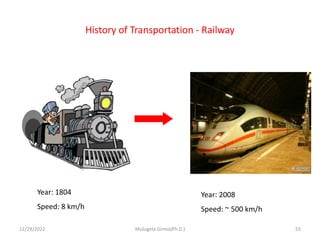
History of Transportation - Railway
Year: 1804
Speed: 8 km/h
Year: 2008
Speed: ~ 500 km/h
12/29/2022 Mulugeta Girma(Ph.D.) 55
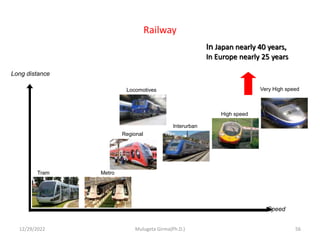
Railway
Tram Metro
Regional
Locomotives
Interurban
High speed
Long distance
Speed
Very High speed
In Japan nearly 40 years,
In Europe nearly 25 years
12/29/2022 Mulugeta Girma(Ph.D.) 56
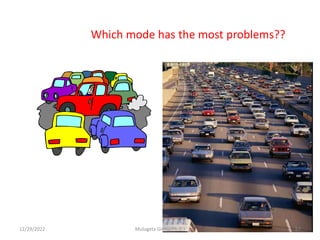
Which mode has the most problems??
12/29/2022 Mulugeta Girma(Ph.D.) 57
12/29/2022 Mulugeta Girma(Ph.D.) 58

urban transport system.pptx

  • 1.
    Module : TransportationSystem and Development Ethiopian Civil Service University College of Urban Development and Engineering Department of Transport Planning &Management 1 12/29/2022 Mulugeta Girma(Ph.D.)
  • 2.
    Outline  Objective  Introductionto transport system - Definition - importance - Modes /classification  Discussion  Objectives - have a general overview of transportation - state the different modes of transportation 12/29/2022 Mulugeta Girma(Ph.D.) 2
  • 3.
    The basics ofTransportation system -Definition of Transport - Transport system -Importance of Transport -Mode of Transport 12/29/2022 Mulugeta Girma(Ph.D.) 3
  • 4.
  • 5.
     Transport • Theterm is derived from the Latin trans ("across") and portare ("to carry"). 12/29/2022 Mulugeta Girma(Ph.D.) 5
  • 6.
    CONT’D Transportation:  Is theprocess of moving goods and people from one place to another which involve all activities that facilitate the movement of goods and people.  It provides access to natural resources and promotes trade, allowing a nation to accumulate wealth and power because it’s a vital to a nation’s economy.  it is also an important factor for every country to - maintain a strong economy, and - for access to and between country’s people  Transport sector plays a significant role in the overall development of a country 12/29/2022 Mulugeta Girma(Ph.D.) 6
  • 7.
    Cont’d - The mostcommon element in any definition of transportation is movement.  Movement is changing of physical location of freight, passenger 12/29/2022 Mulugeta Girma(Ph.D.) 7
  • 8.
    Cont’d  the purposeof transportation is to overcome space, which is shaped by a variety of human and physical constraints – i.e. distance, time, administrative divisions and topography  The fundamental purpose of transport is consequently geographic in nature, meaning that it facilitates movement between different locations. 12/29/2022 Mulugeta Girma(Ph.D.) 8
  • 9.
    • transport isresponsible for the physical movement of materials between points in the supply chain 12/29/2022 Mulugeta Girma(Ph.D.) 9
  • 10.
    Cont’d • Transport ,infact , provides a vital link between; - production centers , - distribution areas and - the ultimate customers. 12/29/2022 Mulugeta Girma(Ph.D.) 10
  • 11.
    Cont’d  Transportation isthe movement of people and goods over time and space... • Transportation should be… - Safe - Environmentally Friendly 12/29/2022 Mulugeta Girma(Ph.D.) 11
  • 12.
  • 13.
  • 14.
  • 15.
     Framework oftransportation system • Transportation system ??? • defined as a planned network of elements or physical components that play different roles in the transportation of goods and persons from one place to another. • The elements or physical components of a transport system are referred to as the facilities. 12/29/2022 Mulugeta Girma(Ph.D.) 15
  • 16.
    Cont’d • A transportsystem can therefore be considered as consisting of fixed facilities, the flow entities, and control system • that permit people and goods to overcome the friction of geographical space efficiently in order to participate in a timely manner in some desired activity. 12/29/2022 Mulugeta Girma(Ph.D.) 16
  • 17.
    Fixed Facilities • arethe physical components of the system that are fixed in space and constitutes the network of links and nodes of the transportation system. • For example, the links could be ; - roadway segment and railway track and - the nodes could be intersections, interchanges, transit terminals, and airports 12/29/2022 Mulugeta Girma(Ph.D.) 17
  • 18.
    Flow Entities • arethe units that travel the fixed facilities. e.g vehicles, container units, railroad cars, and so on. • In the case of a road system, the fixed facilities are expected to accommodate a wide variety of vehicle types, ranging from bicycles to large tractor-trailer combinations. 12/29/2022 Mulugeta Girma(Ph.D.) 18
  • 19.
    Control System  Thecontrol system consists of i. vehicular control and ii. flow control. • Vehicular control refers to the technological way in which individual vehicles are guided on fixed facilities. - Such controls can be manual or automated. 12/29/2022 Mulugeta Girma(Ph.D.) 19
  • 20.
    Cont’d • The flowcontrol system consists ; - the means that permit the efficient and smooth operation of streams of vehicles and the reduction of conflicts between vehicles. - This system includes various types of signing, marking, and signal systems and the underlying rules of operation. 12/29/2022 Mulugeta Girma(Ph.D.) 20
  • 21.
    Classification of Transportation •Transportation is classified according to: - what is transported, - transportation infrastructure, - transport modes and in terms of aims (purposes) A-What is transported i.e. transportation of: - persons- (buses, taxis, rail, air, etc), - goods (freight, etc), - fluid (pipe lines). B- transportation infrastructure Road, Rail, Air , Water, Pipe etc. 12/29/2022 Mulugeta Girma(Ph.D.) 21
  • 22.
    Cont’d C-Transportation modes • Motorizedtransport, • Non motorized transport. D- Transportation aims: to and from • place of work, • service centers, • schools, universities / Education / • shopping areas, • entertaining centers etc 12/29/2022 Mulugeta Girma(Ph.D.) 22
  • 23.
    Significance of Transport •In general transport helps to : - make available to a community the goods produced elsewhere - extend the market - reduce regional price variability - increase productivity and efficiency and lead to - large scale production - reduction of the cost of goods - encourages competition, - Creates valuable links between regions and economic activities , between populations and the rest of the world. - etc i- economic significance - Transport – linked to economic development - An indispensible component of the economy and plays a major role in spatial relations between locations - The transport sector is also an economic factor in the production of good and services 12/29/2022 Mulugeta Girma(Ph.D.) 23
  • 24.
    Cont’d  Its importanceis manifested through several points of view : • Better utilization of the backward areas linking with the advanced areas / rural – urban linkage / • For rapid industrialization & urbanization • For removing the scarcity of goods • movement people and bringing them in contact with each other 12/29/2022 Mulugeta Girma(Ph.D.) 24
  • 25.
    II- social significance Modern transport has - widened cultural opportunities, - permitting people to examine the artistic treasures of other countries and - to explore their own national heritage  It enhance the health and welfare of a population as - medical persons can move rapidly from one place to another or - sick persons can be transported to higher health institutions easily  Improved transportation and communication reduce isolation of one community from another.  It allows people to live and work apart. 12/29/2022 Mulugeta Girma(Ph.D.) 25
  • 26.
    iii- political significance •It helps to uniformly administer the laws of the country • A country’s military success also depends on a certain extent on the availability of transportation network. • Transportation increases government revenue by facilitating the collection of taxes. 12/29/2022 Mulugeta Girma(Ph.D.) 26
  • 27.
    Tourism Transport Urban Mobility Regional Integration Peaceand Security Trade competitiveness Social services accessibility Rural Connectivity Agriculture Climate Change Transport: Prerequisite for economic and social development 12/29/2022 Mulugeta Girma(Ph.D.) 27
  • 28.
    Transportation Modes What arethe Modes of transport ? 12/29/2022 Mulugeta Girma(Ph.D.) 28
  • 29.
    Transportation Modes ■ Transportmodes: • Vehicles: • Mobile segment. • Supporting the mobility of passengers, freight and information. • Infrastructures: • Fixed segment. • Supporting movements. • Three basic types: • Land (road, rail and pipelines). • Water (shipping). • Air. • Each mode had a set of technical, operational and commercial characteristics. 29
  • 30.
    Cont’d • The modeof transport describes the type of transport used. • There are basically five different options; *Rail * Road * Air * Water * Pipeline 12/29/2022 Mulugeta Girma(Ph.D.) 30
  • 31.
    Rail Transport  Overview •Composed of a traced path on which are bound vehicles. • Heavy industries are traditionally linked with rail transport systems. 12/29/2022 Mulugeta Girma(Ph.D.) 31
  • 32.
    Rail Transport • Mostcommonly used for heavy and bulky loads over long land journeys 12/29/2022 Mulugeta Girma(Ph.D.) 32
  • 33.
    cont’d  Advantages  Itis a convenient mode of transport for travelling long distances.  It is relatively faster than road transport.  It is suitable for carrying heavy goods in large quantities over long distances.  Its operation is less affected by adverse weathers conditions like rain, floods, fog, etc.  Limitations  It is relatively expensive for carrying goods and passengers over short distances.  It provides service according to fixed time schedule and is not flexible for loading or unloading of goods at any place.  It involves heavy losses of life as well as goods in case of accident. 12/29/2022 Mulugeta Girma(Ph.D.) 33
  • 34.
    Road Transport • Themost widely used mode of transport and is used at least somewhere in almost all supply chains. • Public transport ( e.g. bus ) 12/29/2022 Mulugeta Girma(Ph.D.) 34
  • 35.
    Cont’d ■ Overview • Largeconsumers of space. • Lowest level of physical constraints among transportation modes. • Average operational flexibility (vehicles can serve several purposes). • High maintenance costs, both for the vehicles and infrastructures. 12/29/2022 Mulugeta Girma(Ph.D.) 35
  • 36.
    Cont’d  Advantages  Itis a relatively cheaper mode of transport as compared to other modes.  Perishable goods can be transported at a faster speed by road carriers over a short distance.  It is a flexible mode of transport as loading and unloading is possible at any destination. It provides door-to-door service.  It helps people to travel and carry goods from one place to another, in places which are not connected by other means of transport like hilly areas.  Use extensive road networks 12/29/2022 Mulugeta Girma(Ph.D.) 36
  • 37.
    Limitations of Roadtransport • Used for delivering finished goods than bulky raw materials • Lorries are particularly vulnerable to congestion and traffic delays • Obvious limitation of only being used on land • Due to limited carrying capacity road transport is not economical for long distance transportation of goods. 12/29/2022 Mulugeta Girma(Ph.D.) 37
  • 38.
    Water Transport ■ Issues •Dominant support of global trade: • 96% of the world trade is carried by maritime transportation (mass). • International trade and maritime transportation: • Interrelated. • 25,000 billion tons-km are on average transported annually. • 7,000 by rail and 3,000 by road. • 71% of all freight shipped globally. • For every $1,000 of exports, there is one ton of freight being shipped by maritime transportation. 12/29/2022 Mulugeta Girma(Ph.D.) 38
  • 39.
    Water Transport • Mostsupply chains use shipping to cross the oceans • over 90% of world trade is moved by sea 12/29/2022 Mulugeta Girma(Ph.D.) 39
  • 40.
    Cont’d • Advantages:  Itis a relatively economical mode of transport for bulky and heavy goods.  The cost of maintaining and constructing routes is very low most of them are naturally made.  It promotes international trade....... 12/29/2022 Mulugeta Girma(Ph.D.) 40
  • 41.
    Cont’d  Disadvantages:  Thedepth and navigability of rivers and canals vary and thus, affect operations of different transport vessels.  It is a slow moving mode of transport and therefore not suitable for transport of perishable goods. (Longer delivery times and slow)  It is adversely affected by weather conditions.  Sea transport requires large investment on ships and their maintenance.  Transfers to ships take time 12/29/2022 Mulugeta Girma(Ph.D.) 41
  • 42.
    Air transport • Passengersaccount for most airline business, with eight billion passenger kilometres flown a year in the UK. 12/29/2022 Mulugeta Girma(Ph.D.) 42
  • 43.
    Cont’d  Advantages:  Itis the fastest mode of transport.  It is very useful in transporting goods and passengers to the area, which are not accessible by any other means.  It is the most convenient mode of transport during natural calamities.  It provides vital support to the national security and defence  Main advantage is speed of delivery 12/29/2022 Mulugeta Girma(Ph.D.) 43
  • 44.
    Cont’d  Disadvantages:  Itis relatively more expensive mode of transport.  It is not suitable for transporting heavy and bulky goods.  It is affected by adverse weather conditions.  It is not suitable for short distance travel.  In case of accidents, it results in heavy losses of goods, property and life. 12/29/2022 Mulugeta Girma(Ph.D.) 44
  • 45.
    Cont’d • Transfers toplane take time in the airport • It is costly transport • Weight limits is prevent carrying amount of materials. 12/29/2022 Mulugeta Girma(Ph.D.) 45
  • 46.
    Pipeline Transport ■ Overview •Single purpose: carry one commodity from a location to another. • Large quantities of products where no other feasible means of transport (usually water) is available. • Two main products dominate pipeline traffic: • Oil and gas. • Locally pipelines are significant for the transport of water. 12/29/2022 Mulugeta Girma(Ph.D.) 46
  • 47.
    Cont’d • The mainuses of pipelines are oil and gas together with the utilities of water and sewage. 12/29/2022 Mulugeta Girma(Ph.D.) 47
  • 48.
    Advantage of Pipeline •Moving large quantities over long distances. • Cheapest way of moving liquids For ex; oil and gas 12/29/2022 Mulugeta Girma(Ph.D.) 48
  • 49.
    Disadvantage of Pipeline •Being slow • Inflexible • Only carrying large volumes of certain types of fluid • Huge initial investment of building dedicated pipelines 12/29/2022 Mulugeta Girma(Ph.D.) 49
  • 50.
    * Choice ofmode depends on a variety of factors. - The main ones are the nature of materials to move, the volume and distance.  Other factors include: • Value of materials • Importance • Transit times • Reliability • Cost and flexibility to negotiate rates • stability of carrier • Security, loss and damage • Schedules and frequency of delivery 12/29/2022 Mulugeta Girma(Ph.D.) 50
  • 51.
     Ranking forthe cost, speed, flexibility and load limits of different modes of transport 12/29/2022 Mulugeta Girma(Ph.D.) 51
  • 52.
    Elements of transport Themovement of goods or passenger traffic requires adequate infrastructure facilities for the free flow from the place of origin to the place of destination. Irrespective of modes, every transport system has some common elements a) Vehicle or carrier to carry passenger or goods b) Route or path for movement of carriers c) Terminal facilities for loading and unloading of goods and passengers from carriers d) Prime Mover e) Transit time and cost 12/29/2022 Mulugeta Girma(Ph.D.) 52
  • 53.
    Historical Development ofTransportation Modes 1860 1893 1923 1948 Time Ridership Horse-drawn Omni bus Cable car Electric Tramway Bus Automobile 12/29/2022 Mulugeta Girma(Ph.D.) 53
  • 54.
  • 55.
    History of Transportation- Railway Year: 1804 Speed: 8 km/h Year: 2008 Speed: ~ 500 km/h 12/29/2022 Mulugeta Girma(Ph.D.) 55
  • 56.
    Railway Tram Metro Regional Locomotives Interurban High speed Longdistance Speed Very High speed In Japan nearly 40 years, In Europe nearly 25 years 12/29/2022 Mulugeta Girma(Ph.D.) 56
  • 57.
    Which mode hasthe most problems?? 12/29/2022 Mulugeta Girma(Ph.D.) 57
  • 58.