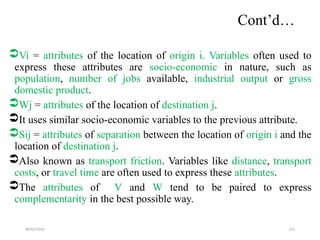
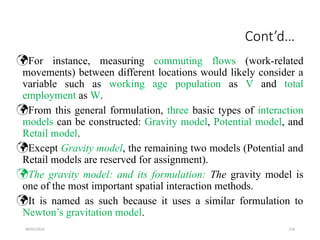
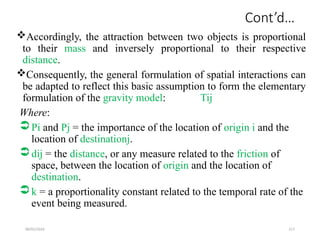
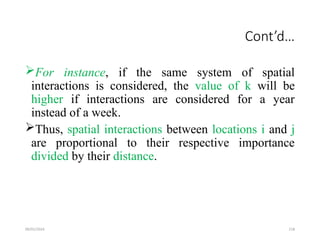
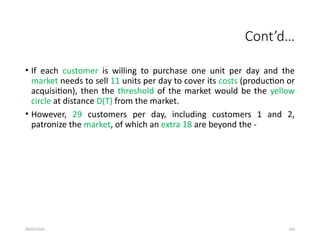
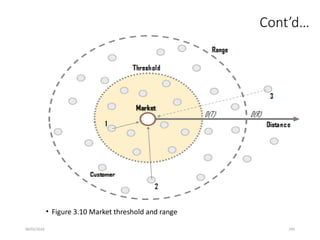
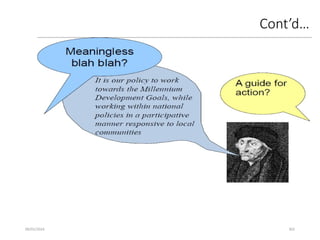
09/01/2024 1
Chapter one: Transport Geography
Main Contents
Introduction
Definition of transport and transportation geography, principles of
transport geography
The importance and evolution of transport, Concepts and
dimensions of transport geography
Transport and space
Transportation Systems and Networks
Transport network accessibility
09/01/2024 2
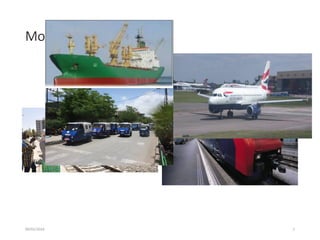
Modes of transport
09/01/2024 3
What is transport or transportation?
• Transport or transportation: is the movement of people,
animals, freight/goods and information from one location to
another through different modes of transport: air, rail, road,
water, cable, pipeline, etc.
• What is transport Geography?
• transport Geography is a sub-discipline of geography
concerned about the mobility of people, freight and
information and its spatial organization considering attributes
and constraints related to the origin, destination, extent,
nature and purpose of movements.
09/01/2024 4
The purpose of Transportation
Some of the purposes of transport geography are:
to overcome space
to fulfill a demand for mobility
The goal of transportation is thus to transform the
geographical attributes of freight, people or information,
from an origin to a destination.
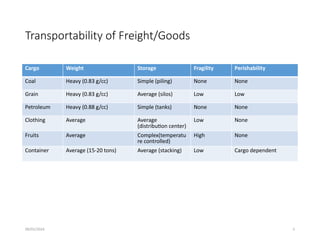
• Transportability refers to the ease of movement of
passengers, freight or information. It is related to transport
costs as well as to the attributes of what is being
transported (fragility, perishable, price).
09/01/2024 5
Transportability of Freight/Goods
Cargo Weight Storage Fragility Perishability
Coal Heavy (0.83 g/cc) Simple (piling) None None
Grain Heavy (0.83 g/cc) Average (silos) Low Low
Petroleum Heavy (0.88 g/cc) Simple (tanks) None None
Clothing Average Average
(distribution center)
Low None
Fruits Average Complex(temperatu
re controlled)
High None
Container Average (15-20 tons) Average (stacking) Low Cargo dependent
09/01/2024 6
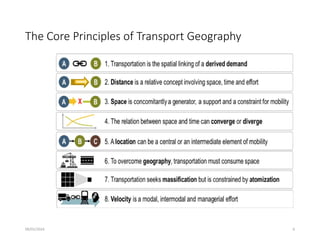
The Core Principles of Transport Geography
09/01/2024 7
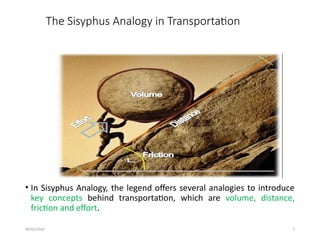
The Sisyphus Analogy in Transportation
• In Sisyphus Analogy, the legend offers several analogies to introduce
key concepts behind transportation, which are volume, distance,
friction and effort.
09/01/2024 8
Cont’d…
• Volume represents a load of passengers or freight that can
be carried as a single load.
• Friction is the difficulty of moving a volume per unit of
distance; the friction of distance. It can be related for
instance to the quality of transport infrastructure.
• Effort is the amount of energy required to move the volume
per unit of distance, considering the friction. It is commonly
represented as the cost of transport. Essentially, Effort =
f(volume, distance, friction).
09/01/2024 9
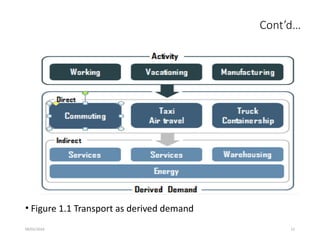
Transportation as a Derived Demand
• There are two major types of derived transport demand:
• Direct derived demand: Refers to movements that are
directly the outcome of economic activities, without which
they would not take place.
• For instance, work related activities commonly involve
commuting between the place of residence and the
workplace.
• There is a supply of work in one location (residence) and a
demand of labor in another (workplace).
09/01/2024 10
Cont’d…
• For freight transportation, all the components of a supply
chain require movements of raw materials, parts and
finished products on modes such as trucks, rail or
containerships.
• Indirect derived demand: Considers movements created by
the requirements of other movements.
• The most obvious example is energy where fuel
consumption from transportation activities must be supplied
by an energy production system requiring movements from
zones of extraction to refineries and storage facilities and,
finally, to places of consumption.
09/01/2024 11
Cont’d…
• Warehousing can also be labeled as an indirect derived
demand since it is a “non-movement” of a freight element.
• Warehousing exists because it is virtually impossible to move
commodities instantly from where they are produced to
where they are consumed.
09/01/2024 12
Cont’d…
• Figure 1.1 Transport as derived demand
09/01/2024 13
Different Representations of Distance
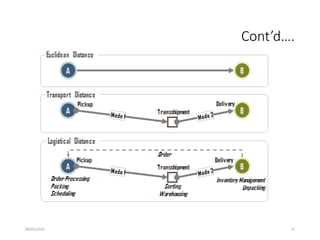
• Euclidean distance: A simple function of a straight line
between two locations where distance is expressed in
geographical units such as kilometers.
• Transport distance: a set of activities related to circulation
(loading, unloading and transshipment, costs and time).
• Logistical distance: encompasses all the tasks required so
that a movement between two locations can take place.
09/01/2024 14
Cont’d….
• Logistical distance thus includes flows and a set of activities
necessary for the management of these flows.
 Flows: movements of people, freight and information over
their network. Flows have origins, intermediary locations
and destinations.
• E.g. For freight movements, among the most significant tasks
are order, processing, packing and sorting and inventory
management.
09/01/2024 15
Cont’d….
09/01/2024 16
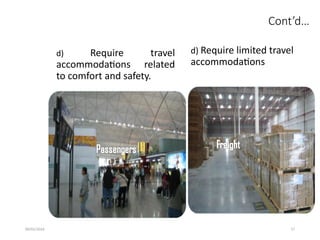
Operational Differences between Passengers and
Freight Transportation
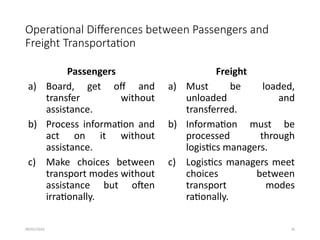
Passengers
a) Board, get off and
transfer without
assistance.
b) Process information and
act on it without
assistance.
c) Make choices between
transport modes without
assistance but often
irrationally.
Freight
a) Must be loaded,
unloaded and
transferred.
b) Information must be
processed through
logistics managers.
c) Logistics managers meet
choices between
transport modes
rationally.
09/01/2024 17
Cont’d…
d) Require travel
accommodations related
to comfort and safety.
d) Require limited travel
accommodations
09/01/2024 18
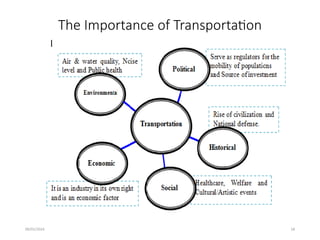
The Importance of Transportation
09/01/2024 19
Trends of Importance of Transport
• The importance of transportation is growing due to the
following issues:
Growth of the demand: demand related to individual
(passengers) as well as freight mobility
Reduction of costs: costs per unit transported have dropped
significantly over recent decades. This has made it possible
to overcome larger distances and further exploit the
comparative advantages of space.
Expansion of infrastructures: the above two trends have
obviously extended the requirements for transport
infrastructures both quantitatively and qualitatively.
09/01/2024 20
Cont’d…
for transport infrastructures both quantitatively and
qualitatively.
• Roads, harbors, airports, telecommunication facilities
and pipelines have expanded considerably to service
new areas and add capacity to existing networks.
09/01/2024 21
Why do geographers show interest in transport?
• Geographers were interested in transportation for two main
reasons:
a) First, transport infrastructures, terminals, equipment and
networks occupy an important place in space and
constitute the basis of a complex spatial system.
b) Second, since geography seeks to explain spatial
relationships, transport networks are of specific interest
because they are the main support of these interactions.
09/01/2024 22
Historical Evolution of Transportation
• The following is the summary of the historical
development of transportation technology.
• Transportation in the pre-industrial era (pre-1800s)
• The industrial revolution and transportation (1800–70)
• Emergence of modern transportation systems (1870–
1920)
• Transportation in the Fordist era (1920–70)
• A new context for transportation: the post-Fordist era
(1970–)
• Future transportation
09/01/2024 23
Fields of Transport Geography: Concepts and
Dimensions
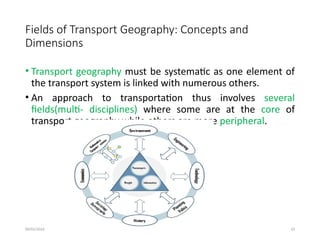
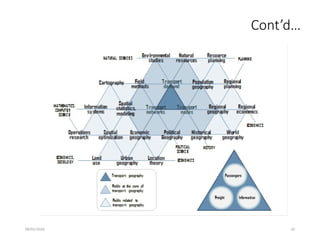
• Transport geography must be systematic as one element of
the transport system is linked with numerous others.
• An approach to transportation thus involves several
fields(multi- disciplines) where some are at the core of
transport geography while others are more peripheral.
09/01/2024 24
Cont’d…
09/01/2024 25
Transportation Systems and Networks
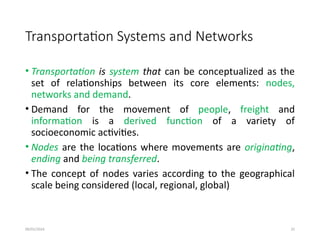
• Transportation is system that can be conceptualized as the
set of relationships between its core elements: nodes,
networks and demand.
• Demand for the movement of people, freight and
information is a derived function of a variety of
socioeconomic activities.
• Nodes are the locations where movements are originating,
ending and being transferred.
• The concept of nodes varies according to the geographical
scale being considered (local, regional, global)
09/01/2024 26
Cont’d…
• Networks are a set of linkages derived from transport
infrastructures.
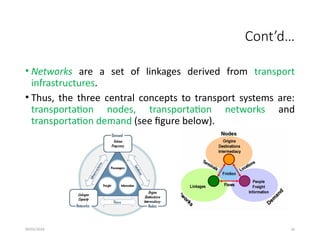
• Thus, the three central concepts to transport systems are:
transportation nodes, transportation networks and
transportation demand (see figure below).
09/01/2024 27
Cont’d…
• The analysis of these concepts (Transportation nodes,
networks and demands) relies on methodologies often
developed by other disciplines such as economics,
mathematics, planning and demography each providing a
different dimension to transport geography.
• For instance, the spatial structure of transportation networks
can be analyzed with Graph theory which was initially
developed for mathematics.
09/01/2024 28
Transportation and Space
• Transport geography is concerned with movements that take
place over space.
• Physical Constraints
• The physical features of this space impose major constraints
on transportation systems. these are topography, hydrology
& climate.
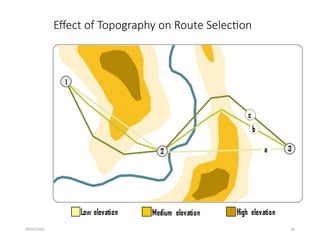
Topography: Features such as mountains and valleys have
strongly influenced the structure of networks, the cost and
feasibility of transportation projects. Topography can
complicate, postpone or prevent the activities of the
transport industry.
09/01/2024 29
Cont’d…
• Hydrology: The properties, distribution and circulation of
water play an important role in the transport industry.
Maritime transport is influenced greatly by the availability of
navigable channels through rivers, lakes and shallow seas.
• Climate: temperature, wind and precipitation. Their impacts
on transportation modes and infrastructure range from
negligible to severe.
• Barriers: are of three types:
Absolute
Relative and
Arbitrary Barriers.
09/01/2024 30
Cont’d…
• Absolute barriers: are geographical features that entirely
prevent a movement. They must either be bypassed or be
overcome by specific infrastructures.
• For instance, a river is considered as an absolute barrier for land
transportation and can only be overcome if a tunnel or a bridge is
constructed.
• A body of water forms a similar absolute barrier and could be
overcome if ports are built and a maritime service (ferry, cargo
ships, etc.) is established.
• Conversely, land acts as an absolute barrier for maritime
transportation, with discontinuities (barriers) that can be
overcome with costly infrastructures such as navigation channels
and canals.
09/01/2024 31
Cont’d…
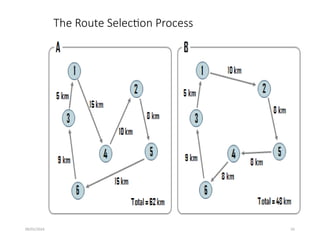
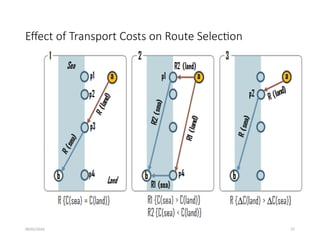
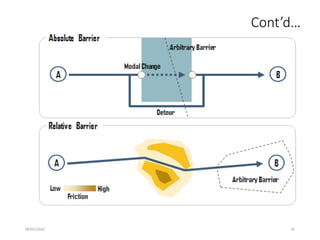
Relative barriers: are geographical features that force a
degree of friction on a movement. In turn, this friction is
likely to influence the path (route) selected to link two
locations (A and B on next figure).
• Topography is a classic example of a relative barrier that
influences land transportation routes along paths having the
least possible friction (e.g. plains and valleys).
• For maritime transportation, relative barriers, such as straits,
channels or ice, generally slow down circulation.
09/01/2024 32
Cont’d…
09/01/2024 33
Space / Time Relationships
• One of the most basic relationships of transportation
involves how much space can be overcome within a given
amount of time.
• The faster the mode, the larger is the distance that can be
overcome within the same amount of time.
• Transportation, notably improvements in transport systems,
changes the relationship between time and space.
• When this relationship involves easier, faster and cheaper
access between places, this result is defined as a space /
time convergence because the amount of space that can be
overcome for a similar amount of time increases
significantly.
09/01/2024 34
Cont’d…
09/01/2024 35
Cont’d…
• There is thus a relationship between space / time
convergence and the integration of a region in to a global
trade.
• Five major factors are of particular relevance in this process:
(Speed, economies of scale, expansion of transport
infrastructures, efficiency of transport terminals and the role
of IT (Substitution of transportation by telecommunications).
• However, space/time convergence can also be inverted or
changed under specific circumstances, which means that a
process of space/time divergence takes place.
09/01/2024 36
Cont’d…
• For instance, congestion is increasing in many metropolitan
areas, implying additional delays (consuming more times) for
activities such as commuting. Traffic in congested urban
areas is moving at the same speed that it did one hundred
years ago on horse carriages.
• Air transportation, despite having dramatically contributed
to the space / time convergence is also experiencing growing
delays.
• Flight times are getting longer between many destinations,
mainly because of takeoff, landing and gate access delays.
09/01/2024 37
The Notion of Accessibility
• Accessibility is a key element to transport geography, and to
geography in general, since it is a direct expression of
mobility either in terms of people, freight or information.
• Accessibility is defined as the measure of the capacity of a
location to be reached by, or to reach different locations.
• Hence, the capacity and the arrangement of transport
infrastructure are key elements in the determination of
accessibility.
09/01/2024 38
Cont’d…
• All locations are not equal because some are more
accessible than others, which imply inequalities.
• The notion of accessibility consequently relies on two core
concepts: location and distance.
• There are two spatial categories applicable to accessibility
problems, which are interdependent: topological
accessibility and contiguous accessibility.
09/01/2024 39
Cont’d…
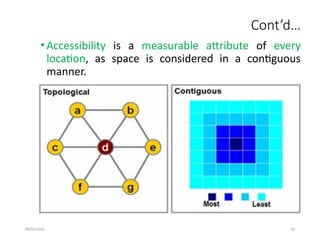
A. Topological accessibility: is measuring accessibility in a
system of nodes and paths (a transportation network). It
is assumed that accessibility is a measurable attribute
significant only to specific elements of a transportation
system, such as terminals (airports, ports or subway
stations).
B. Contiguous accessibility: involves measuring accessibility
over a surface.
09/01/2024 40
Cont’d…
• Accessibility is a measurable attribute of every
location, as space is considered in a contiguous
manner.
09/01/2024 41
Connectivity
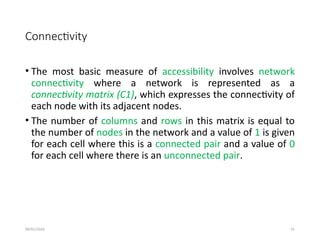
• The most basic measure of accessibility involves network
connectivity where a network is represented as a
connectivity matrix (C1), which expresses the connectivity of
each node with its adjacent nodes.
• The number of columns and rows in this matrix is equal to
the number of nodes in the network and a value of 1 is given
for each cell where this is a connected pair and a value of 0
for each cell where there is an unconnected pair.
09/01/2024 42
Cont’d…
• The summation of this matrix provides a very basic measure
of accessibility, also known as the degree of a node:
• Where:
• C1 = degree of a node.
• cij = connectivity between node i and node j (either 1 or 0).
• n = number of nodes.
09/01/2024 43
Cont’d….
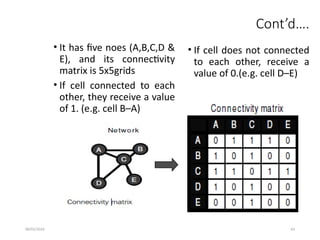
• It has five noes (A,B,C,D &
E), and its connectivity
matrix is 5x5grids
• If cell connected to each
other, they receive a value
of 1. (e.g. cell B–A)
• If cell does not connected
to each other, receive a
value of 0.(e.g. cell D–E)
09/01/2024 44
Geographic and potential accessibility
• There are two simple but highly practical measures, defined
as geographic and potential accessibility.
 Geographic accessibility: considers that the accessibility of
a location is the summation of all distances between other
locations divided by the number of locations.
• the most accessible place has the lowest summation of
distances.
09/01/2024 45
Procedures for constructing Geographical Accessibility
Matrix: A(G)matrix
a) Build the connectivity matrix for all nodes based on the
nature of their linkages label it as L matrix.
b) Construct the A(G)matrix with the summation of rows
and columns.
c) Divide the summation of rows and columns by the
number of locations in the network.
d) Check the summation values are the same for columns
and rows since this is a transposable matrix.
e) The cell having the lowest value is thus the most
accessible place.
09/01/2024 46
Cont’d…
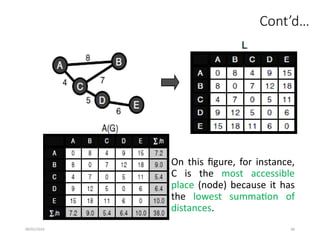
• On this figure, for instance,
C is the most accessible
place (node) because it has
the lowest summation of
distances.
09/01/2024 47
Potential accessibility matrix (PAM)
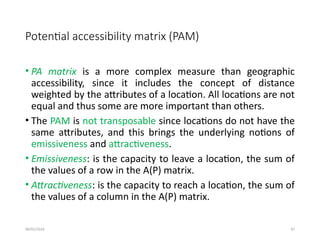
• PA matrix is a more complex measure than geographic
accessibility, since it includes the concept of distance
weighted by the attributes of a location. All locations are not
equal and thus some are more important than others.
• The PAM is not transposable since locations do not have the
same attributes, and this brings the underlying notions of
emissiveness and attractiveness.
• Emissiveness: is the capacity to leave a location, the sum of
the values of a row in the A(P) matrix.
• Attractiveness: is the capacity to reach a location, the sum of
the values of a column in the A(P) matrix.
09/01/2024 48
Cont’d…
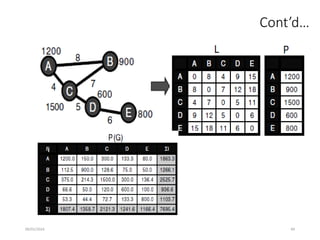
• By considering the same shortest distance matrix (L) and the
population matrix P, the potential accessibility matrix, P(G),
can be calculated.
09/01/2024 49
Cont’d…
Fig. potential accessibility
matrix
09/01/2024 50
Cont’d…
• The value of all corresponding cells (A–A, B–B, etc.) equals
the value of their respective attributes (P).
• The value of all non-corresponding cells equals their
attribute divided by the corresponding cell in the L matrix.
• The higher the value, the more a location is accessible, node
C being the most accessible.
• The matrix being non-transposable, the summation of rows
is different from the summation of columns, bringing
forward the issue of implying different levels of
attractiveness and emissiveness.
09/01/2024 51
Cont’d…
• Node C has more emissiveness than Attractiveness (2525.7
versus 2121.3), while Node B has more attractiveness than
emissiveness (1358.7 versus 1266.1).
09/01/2024 52
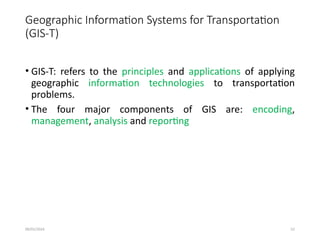
Geographic Information Systems for Transportation
(GIS-T)
• GIS-T: refers to the principles and applications of applying
geographic information technologies to transportation
problems.
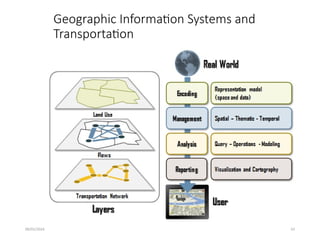
• The four major components of GIS are: encoding,
management, analysis and reporting
09/01/2024 53
Geographic Information Systems and
Transportation
09/01/2024 54
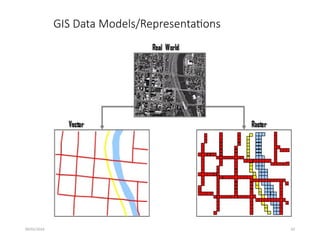
GIS Data Models/Representations
09/01/2024 55
The Route Selection Process
09/01/2024 56
Effect of Topography on Route Selection
09/01/2024 57
Effect of Transport Costs on Route Selection
09/01/2024 58
Cost Minimization and Efficiency Maximization in
Route Selection
09/01/2024 59
Chapter Two: Transport Systems and
Networks
Introduction:
• Transportation systems are composed of a complex set of
relationships between the demand, the locations they
service and the networks that support movements.
• They are mainly dependent on the commercial environment
from which are derived operational attributes such as TCs,
capacity, efficiency, reliability and speed.
• Such conditions are closely related to the development of
transportation networks, both in capacity and in spatial
extent.
09/01/2024 60
Cont’d…
• Transportation systems are also evolving within a complex
set of relationships between transport supply, mainly the
operational capacity of the network, and transport demand,
the mobility requirements of a territory.
• This chapter consequently investigates the relationships
between transportation networks and their spatial structure.
09/01/2024 61
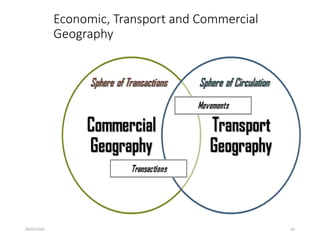
Transportation and commercial geography
• Trade and commercial geography: Economic systems are
based on trade and transactions since specialization and
efficiency require interdependency.
• People trade their labor for a wage while corporations trade
their output for capital.
• Trade is the transmission of a possession in return for a
counterpart, generally money.
09/01/2024 62
Cont’d…
• The exchange involves a transaction and its associated flows
of capital, information, commodities, parts, or finished
products.
• All this necessitates the understanding of commercial
geography.
• Commercial geography: investigates the spatial
characteristics of trade and transactions in terms of their
cause, nature, origin and destination.
• It leans on the analysis of contracts and transactions.
09/01/2024 63
Cont’d…
• From a simple commercial transaction involving an
individual purchasing a product at a store, to the complex
network of transactions maintained between a multinational
corporations (MNCs) and its suppliers, the scale and scope of
commercial geography varies significantly.
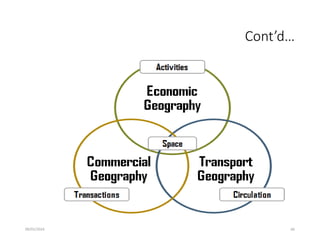
• Commercial geography is concerned with transactions.
09/01/2024 64
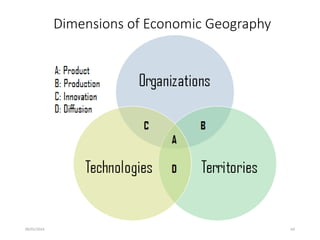
Dimensions of Economic Geography
09/01/2024 65
Economic, Transport and Commercial
Geography
09/01/2024 66
Cont’d…
09/01/2024 67
The Geography of Transportation
Networks
• Transportation systems are commonly represented using networks as
an analogy for their structure and flows.
• The term network refers to the framework of routes within a system
of locations, identified as nodes.
• A route is a single link between two nodes that are part of a larger
network that can refer to tangible routes like roads & rails or less
tangible routes like air & sea corridors.
09/01/2024 68
Topology of Transport Networks /Network
Structures
•The arrangement and connectivity of a network is
known as its topology.
•Each transport network has consequently a specific
topology.
•The most fundamental elements of such a structure
are the network geometry and the level of
connectivity.
09/01/2024 69
Cont’d…
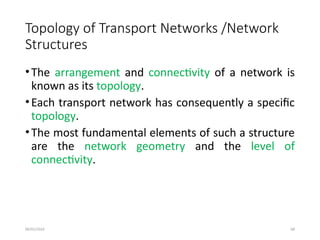
• Depending upon the
arrangement of nodes and
links, a specific network
topology is created
a) Mesh networks: Networks
where there are at least
two nodes with two or
more links between them.
09/01/2024 70
Cont’d…
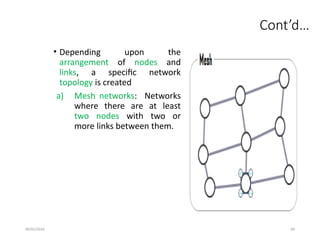
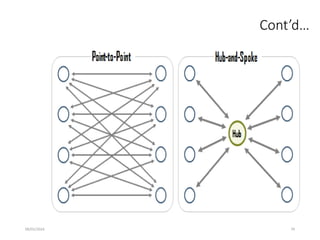
b)Hub-and-spoke networks:
Networks where peripheral
nodes are connected to a central
node(i.e.the hub)
c)Pont-to-point Network:
When traffic becomes
sufficient, direct point-to-
point services tend to be
established as they better
reflect the preference of
users.
09/01/2024 71
Cont’d…
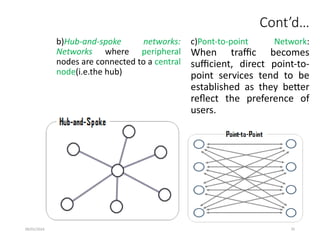
d)Linear networks: Networks
where there is only one link
between each node pairs and
where each node has a
maximum of two links.
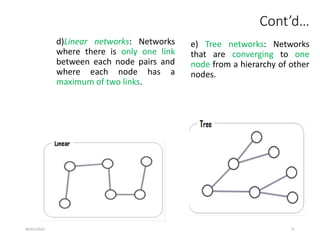
e) Tree networks: Networks
that are converging to one
node from a hierarchy of other
nodes.
09/01/2024 72
Structural Components of Transport Networks
•Node: Any location that has access to a transportation
network.
•Link: Physical transport infrastructures that enable to
connect two nodes.(e.g. roads, rail)
•Flow: The amount of traffic that circulates on a link
between two nodes and the amount of traffic going
through a node.
•Hub / Interface: A node that is handling a substantial
amount of traffic and which acts as compulsory
passage for various flows.
09/01/2024 73
Cont’d…
•An intermodal function is often performed at
hubs.
•Many economic and transport activities as
generally located at hubs, including
distribution, warehousing, finance and
retailing.
Feeder: A node that is linked to a hub.
•It organizes the direction of flows along a
corridor and can be considered as
consolidation and distribution point.
09/01/2024 74
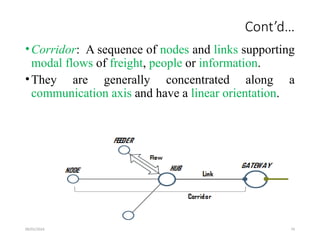
Cont’d…
•Corridor: A sequence of nodes and links supporting
modal flows of freight, people or information.
•They are generally concentrated along a
communication axis and have a linear orientation.
09/01/2024 75
Centripetal and Centrifugal Networks
•Networks tend to have two major spatial
effects on flows, which are centrifugal and
centripetal.
•This effect depends on the structure of the
network and its relationship with the
distribution of origins and destinations.
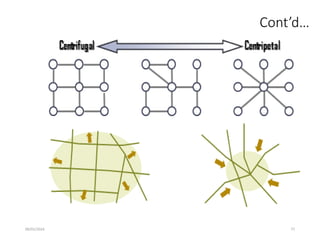
Centrifugal networks: have no specific
centrality as no node is significantly more
connected than others.
09/01/2024 76
Cont’d…
•They typically have a grid-like pattern.
Centripetal networks: have a strong
centrality where one or several nodes are
much more connected than the others.
Centripetal force (centri : center; petal: to
push toward).
They typically have a radial pattern.
09/01/2024 77
Cont’d…
09/01/2024 78
Point-to-Point and Hub-and-Spoke Networks
•Evidence underlines that the emergence of
hub-and-spoke networks is a transitional form
of network development rationalizing limited
volumes through a limited number of routes.
•When traffic becomes sufficient, direct point-
to-point services tend to be established as
they better reflect the preference of users.
09/01/2024 79
Cont’d…
09/01/2024 80
Typology of Transport Network/Types of
Networks
• Physical/structural
• Relational/virtual
• Distribution
09/01/2024 81
Methods in Transport Systems: Graph
Theory
•Basic Graph Definition:
•A graph is a symbolic representation of a
network and of its connectivity.
•It implies an abstraction of the reality so it
can be simplified as a set of linked nodes.
•Graph theory is a branch of mathematics
concerned about how networks can be
encoded and their properties measured.
09/01/2024 82
Cont’d…
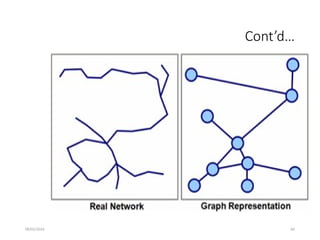
•The goal of a graph is representing the
structure, not the appearance of a network.
•The conversion of a real network into a
planar graph is a straightforward process
which follows some basic rules:
Rule1: every terminal and intersection point
becomes a node.
Rule2: each connected nodes is then linked
by a straight segment.
09/01/2024 83
Cont’d…
09/01/2024 84
The Fundamental Elements to Understanding Graph Theory
•Graph: A graph G is a set of vertex (nodes) v
connected by edges (links) e. Thus G=(v , e).
•Vertex (Node): A node v is a terminal point or an
intersection point of a graph.
•It is the abstraction of a location such as a city, an
administrative division, a road intersection or a
transport terminal (stations, terminuses, harbors
and airports).
09/01/2024 85
Cont’d…
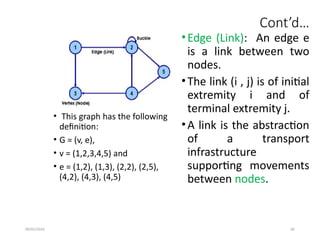
• This graph has the following
definition:
• G = (v, e),
• v = (1,2,3,4,5) and
• e = (1,2), (1,3), (2,2), (2,5),
(4,2), (4,3), (4,5)
•Edge (Link): An edge e
is a link between two
nodes.
•The link (i , j) is of initial
extremity i and of
terminal extremity j.
•A link is the abstraction
of a transport
infrastructure
supporting movements
between nodes.
09/01/2024 86
Cont’d…
• It has a direction that is commonly represented as an arrow.
• When an arrow is not used, it is assumed the link is bi-directional.
• Sub-Graph: A sub-graph is a subset of a graph G where p is the
number of sub-graphs.
• For instance G’ = (v’, e’) can be a distinct sub-graph of G.
09/01/2024 87
Cont’d…
• Unless the global transport system is considered in its whole, every
transport network is in theory a sub-graph of another.
• For instance, the road transportation network of a city is a sub-graph
of a regional transportation network, which is itself a sub-graph of a
national transportation network.
09/01/2024 88
Cont’d…
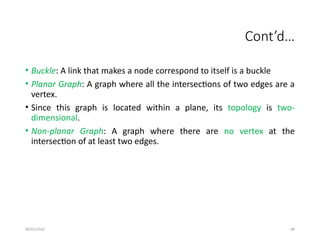
• Buckle: A link that makes a node correspond to itself is a buckle
• Planar Graph: A graph where all the intersections of two edges are a
vertex.
• Since this graph is located within a plane, its topology is two-
dimensional.
• Non-planar Graph: A graph where there are no vertex at the
intersection of at least two edges.
09/01/2024 89
Cont’d…
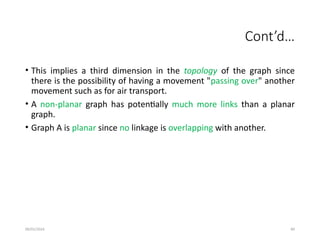
• This implies a third dimension in the topology of the graph since
there is the possibility of having a movement "passing over" another
movement such as for air transport.
• A non-planar graph has potentially much more links than a planar
graph.
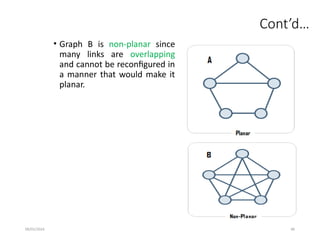
• Graph A is planar since no linkage is overlapping with another.
09/01/2024 90
Cont’d…
• Graph B is non-planar since
many links are overlapping
and cannot be reconfigured in
a manner that would make it
planar.
09/01/2024 91
Links and their Structures
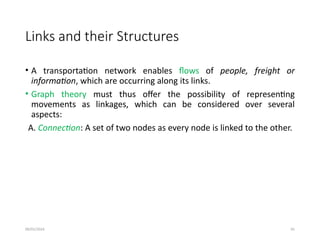
• A transportation network enables flows of people, freight or
information, which are occurring along its links.
• Graph theory must thus offer the possibility of representing
movements as linkages, which can be considered over several
aspects:
A. Connection: A set of two nodes as every node is linked to the other.
09/01/2024 92
Cont’d…
• Considers if a movement between two nodes is possible, whatever its
direction.
• Knowing connections makes it possible to find if it is possible to reach
a node from another node within a graph.
B. Path: A sequence of links that are traveled in the same direction.
• For a path to exist between two nodes, it must be possible to travel
an uninterrupted sequence of links.
09/01/2024 93
Cont’d…
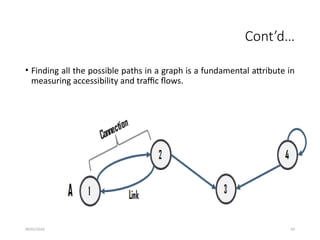
• Finding all the possible paths in a graph is a fundamental attribute in
measuring accessibility and traffic flows.
09/01/2024 94
Cont’d…
• On graph A, there are 5 links [(1,2), (2,1), (2,3), (4,3), (4,4)] and 3
connections [(1-2), (2-3), (3-4)].
• On graph B, there is path between 1 and 3, but on graph C there is no
path between 1 and 3.
09/01/2024 95
Cont’d…
c) Length of a Link, Connection or Path: Refers to the label associated
with a link, a connection or a path.
This label can be distance, the amount of traffic, the capacity or any
attribute of that link.
The length of a path is the number of links (or connections) in this
path.
09/01/2024 96
Cont’d…
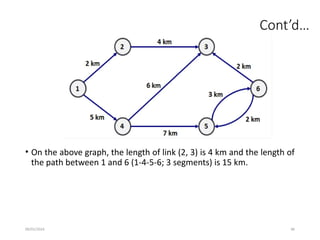
• On the above graph, the length of link (2, 3) is 4 km and the length of
the path between 1 and 6 (1-4-5-6; 3 segments) is 15 km.
09/01/2024 97
Cont’d…
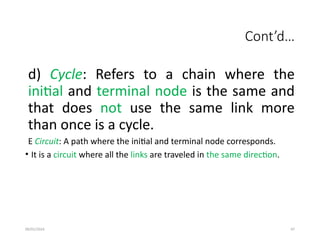
d) Cycle: Refers to a chain where the
initial and terminal node is the same and
that does not use the same link more
than once is a cycle.
E Circuit: A path where the initial and terminal node corresponds.
• It is a circuit where all the links are traveled in the same direction.
09/01/2024 98
Cont’d…
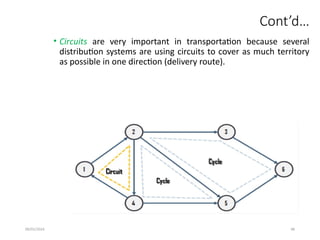
• Circuits are very important in transportation because several
distribution systems are using circuits to cover as much territory
as possible in one direction (delivery route).
09/01/2024 99
Cont’d…
• Figure: Cycle and Circuit
• On this graph, 2-3-6-5-2 is a cycle but not a circuit.
• 1-2-4-1 is a cycle and a circuit.
09/01/2024 100
Indices at the Network Level
• Indices are more complex methods to represent the structural
properties of a graph since they involve the comparison of a measure
over another.
• Some indices take into account spatial features (distance, surface) as
well as the level of activity (traffic), while others solely rest on the
topological dimension of the network.
09/01/2024 101
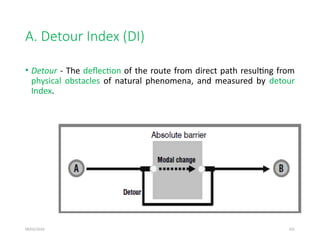
A. Detour Index (DI)
• Detour - The deflection of the route from direct path resulting from
physical obstacles of natural phenomena, and measured by detour
Index.
09/01/2024 102
Cont’d…
• Detour index is a measure of the efficiency of a transport network in
terms of how well it overcomes distance or the friction of distance.
• The closer the detour index gets to 1, the more the network is
spatially efficient.
• Networks having a detour index of 1 are rarely, if ever, seen and most
networks would fit on an asymptotic curve getting close to 1, but
never reaching it.
09/01/2024 103
Cont’d…
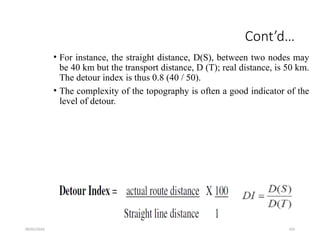
• For instance, the straight distance, D(S), between two nodes may
be 40 km but the transport distance, D (T); real distance, is 50 km.
The detour index is thus 0.8 (40 / 50).
• The complexity of the topography is often a good indicator of the
level of detour.
09/01/2024 104
Cont’d…
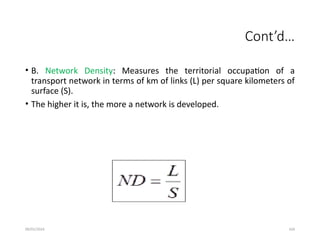
• B. Network Density: Measures the territorial occupation of a
transport network in terms of km of links (L) per square kilometers of
surface (S).
• The higher it is, the more a network is developed.
09/01/2024 105
Cont’d…
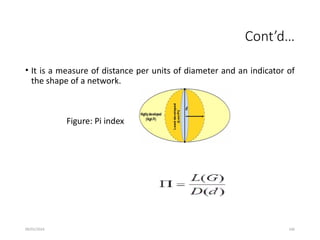
• C. Pi Index: The relationship between the total length of the graph
L(G) and the distance along its diameter D(d).
• It is labeled as Pi because of its similarity with the real Pi value (3.14),
which is expressing the ratio between the circumference and the
diameter of a circle.
• A high index shows a developed network.
09/01/2024 106
Cont’d…
• It is a measure of distance per units of diameter and an indicator of
the shape of a network.
Figure: Pi index
09/01/2024 107
Cont’d…
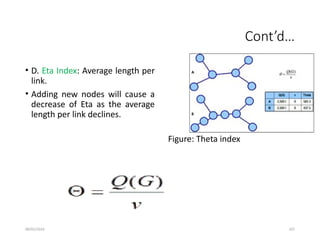
• D. Eta Index: Average length per
link.
• Adding new nodes will cause a
decrease of Eta as the average
length per link declines.
Figure: Theta index
09/01/2024 108
Cont’d…
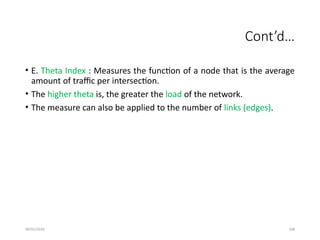
• E. Theta Index : Measures the function of a node that is the average
amount of traffic per intersection.
• The higher theta is, the greater the load of the network.
• The measure can also be applied to the number of links (edges).
09/01/2024 109
Cont’d…
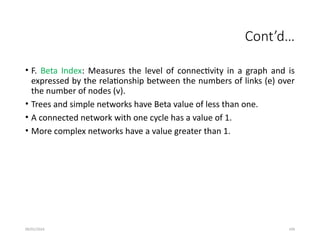
• F. Beta Index: Measures the level of connectivity in a graph and is
expressed by the relationship between the numbers of links (e) over
the number of nodes (v).
• Trees and simple networks have Beta value of less than one.
• A connected network with one cycle has a value of 1.
• More complex networks have a value greater than 1.
09/01/2024 110
Cont’d…
• In a network with a fixed number of nodes, the higher the number of
links, the higher the number of paths possible in the network.
• Complex networks have a high value of Beta.
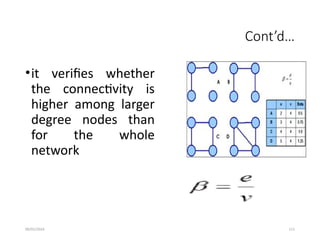
• The rich-club coefficient is the Beta index applied to relations among
larger order (degree) nodes;
09/01/2024 111
Cont’d…
•it verifies whether
the connectivity is
higher among larger
degree nodes than
for the whole
network
09/01/2024 112
Cont’d…
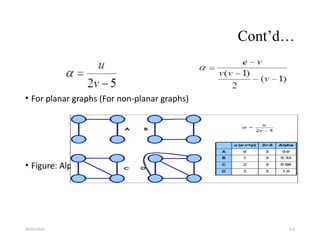
• G. Alpha Index : A measure of connectivity which evaluates the
number of cycles in a graph in comparison with the maximum
number of cycles.
• The higher the alpha index, the more a network is connected.
• Trees and simple networks will have a value of 0. A value of 1
indicates a completely connected network.
09/01/2024 113
Cont’d…
• It measures the level of connectivity independently of the number of
nodes.
• It is very rare that a network will have an alpha value of 1, because
this would imply very serious redundancies.
• This index is also called Meshedness Coefficient in the literature on
planar networks.
09/01/2024 114
Cont’d…
• For planar graphs (For non-planar graphs)
• Figure: Alpha index (planar graph)
09/01/2024 115
Cont’d…
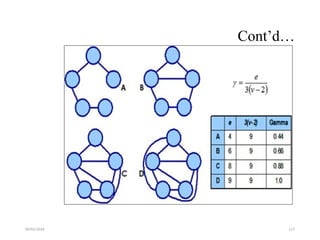
• H. Gamma Index (g): A measure of connectivity that considers the
relationship between the number of observed links and the number
of possible links.
• The value of gamma is between 0 and 1 where a value of 1 indicates
a completely connected network and would be extremely unlikely in
reality.
09/01/2024 116
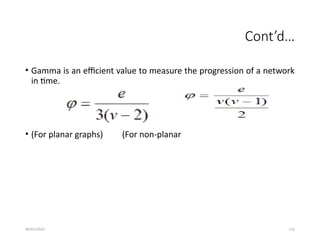
Cont’d…
• Gamma is an efficient value to measure the progression of a network
in time.
• (For planar graphs) (For non-planar
09/01/2024 117
Cont’d…
09/01/2024 118
Chapter 3 : Transportation Modes:
An Overview
Introduction:
• Transportation modes are an essential component of
transport systems since they are the means by which
mobility is supported.
• Geographers consider a wide range of modes that may be
grouped into three broad categories based on the medium
they exploit: land, water and air.
• Each mode has its own requirements and features, and is
adapted to serve the specific demands of freight and
passenger traffic.
09/01/2024 119
Cont’d…
• This gives rise to marked differences in the ways the modes
are deployed and utilized in different parts of the world.
• Recently, there is a trend towards integrating the modes
through intermodality and linking the modes ever more
closely into production and distribution activities.
• At the same time, however, passenger and freight activity is
becoming increasingly separated across most modes.
09/01/2024 120
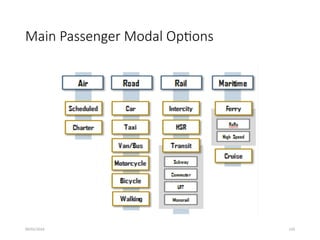
Main Passenger Modal Options
09/01/2024 121
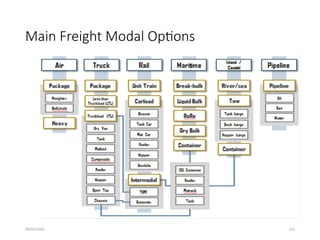
Main Freight Modal Options
09/01/2024 122
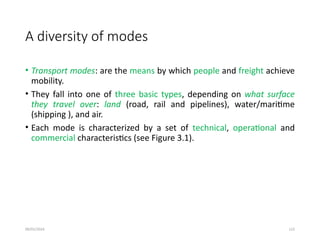
A diversity of modes
• Transport modes: are the means by which people and freight achieve
mobility.
• They fall into one of three basic types, depending on what surface
they travel over: land (road, rail and pipelines), water/maritime
(shipping ), and air.
• Each mode is characterized by a set of technical, operational and
commercial characteristics (see Figure 3.1).
09/01/2024 123
Cont’d…
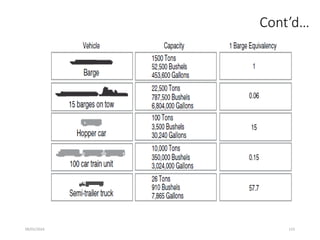
• Figure 3.1 Performance comparison for selected freight modes
09/01/2024 124
Road transportation
• This has become the dominant land transport system today.
• Automobiles, buses and trucks require a road bed.
• Such infrastructures are moderately expensive to provide, but there
is a wide divergence of costs, from a gravel road to a multi-lane
urban expressway.
09/01/2024 125
Cont’d…
• Because vehicles have the means to climb moderate slopes, physical
obstacles are less important than for some other land modes.
• Most roads are provided as a public good by governments, while the
vast majority of vehicles are owned privately.
• The capital costs, therefore, are shared, and do not fall as heavily on
one source as is the case for other modes.
09/01/2024 126
Cont’d…
• All road transport modes have limited abilities to achieve scale
economies.
• Road transport, however, possesses significant advantages over
other modes.
• The capital cost of vehicles is relatively small.
• the high relative speed of vehicles
• flexibility of route choice
09/01/2024 127
Rail transportation
• The initial capital costs are high because the construction of rail
tracks and the provision of rolling stock are expensive.
• The ability of trains to haul large quantities of goods and significant
numbers of people over long distances is the mode’s primary asset.
• Rail transport is a “green” system, in that its consumption of energy
per unit load per km is lower than road modes.
09/01/2024 128
Cont’d…
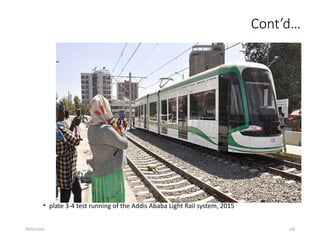
• plate 3-4 test running of the Addis Ababa Light Rail system, 2015
09/01/2024 129
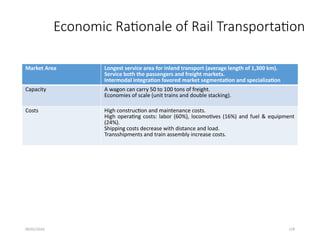
Economic Rationale of Rail Transportation
Market Area Longest service area for inland transport (average length of 1,300 km).
Service both the passengers and freight markets.
Intermodal integration favored market segmentation and specialization
Capacity A wagon can carry 50 to 100 tons of freight.
Economies of scale (unit trains and double stacking).
Costs High construction and maintenance costs.
High operating costs: labor (60%), locomotives (16%) and fuel & equipment
(24%).
Shipping costs decrease with distance and load.
Transshipments and train assembly increase costs.
09/01/2024 130
Cont’d…
Benefits Accelerated industrialization.
Support agricultural and energy supply systems.
Intermodal connecting with international trade.
Regulations Conventionally highly dependent from government
subsidies.
Governments financing, mainly for the sake of
national economic imperatives.
From regulation to deregulation.
Private ownership and operations.
09/01/2024 131
Pipeline
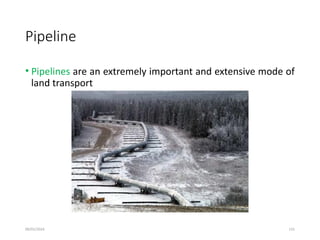
• Pipelines are an extremely important and extensive mode of
land transport
09/01/2024 132
Air Transport
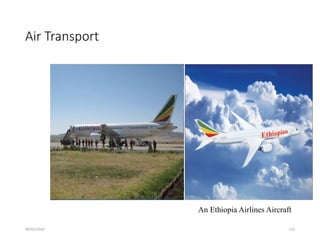
An Ethiopia Airlines Aircraft
09/01/2024 133
Cont’d…
• Air transport, compared with other modes, has the obvious
advantage of speed.
• Like maritime transport, the airline industry is highly capital
intensive.
• Air transport makes use of air space that theoretically gives
it great freedom of route choice.
• In 1944, an International Convention was held in Chicago to
establish the framework for all future bilateral and
multilateral agreements for the use of international air
spaces.
09/01/2024 134
Cont’d…
• Five freedom rights were designed, but a multilateral
agreement went only as far as the first two freedoms (right
to over-fly and right to make a technical stop).
• The 1944 Convention has been extended since then, there
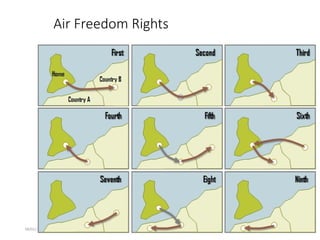
are currently nine different freedoms:
• First Freedom: The right to fly from a home country over
another country (A) en-route to another (B) without landing.
Also called the transit freedom.
09/01/2024 135
Cont’d…
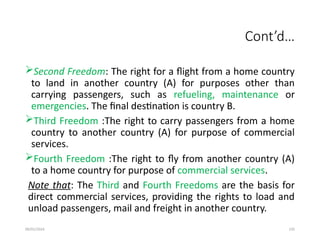
Second Freedom: The right for a flight from a home country
to land in another country (A) for purposes other than
carrying passengers, such as refueling, maintenance or
emergencies. The final destination is country B.
Third Freedom :The right to carry passengers from a home
country to another country (A) for purpose of commercial
services.
Fourth Freedom :The right to fly from another country (A)
to a home country for purpose of commercial services.
Note that: The Third and Fourth Freedoms are the basis for
direct commercial services, providing the rights to load and
unload passengers, mail and freight in another country.
09/01/2024 136
Cont’d…
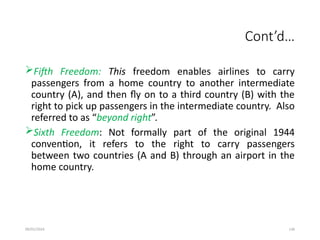
Fifth Freedom: This freedom enables airlines to carry
passengers from a home country to another intermediate
country (A), and then fly on to a third country (B) with the
right to pick up passengers in the intermediate country. Also
referred to as “beyond right”.
Sixth Freedom: Not formally part of the original 1944
convention, it refers to the right to carry passengers
between two countries (A and B) through an airport in the
home country.
09/01/2024 137
Cont’d…
Seventh Freedom: Covers the right to operate a passenger
service between two countries (A and B) outside the home
country.
Eighth Freedom. It involves the right to move passengers on
a route from a home country to a destination country (A)
that uses more than one stop along which passengers may
be loaded and unloaded. Also called as “cabotage”
privileges.
Ninth Freedom: It involves the right of a home country to
move passengers within another country (A). Also referred
to as “full cabotage” or “open-skies” privileges.
09/01/2024 138
Air Freedom Rights
09/01/2024 139
Maritime Transport
• tt
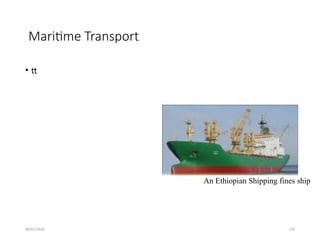
An Ethiopian Shipping fines ship
09/01/2024 140
Modal Competition =B&C
• A general analysis of transport modes reveals that they each
possess key operational and commercial advantages and
properties.
• Modes can compete or complement each other in terms of
cost, speed, reliability, frequency, safety, comfort, etc.
• Cost is one of the most important considerations in the
choice of mode.
09/01/2024 141
Cont’d…
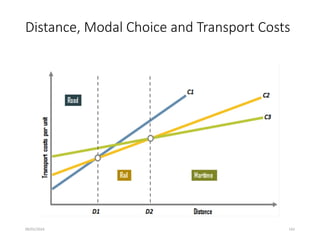
• Because each mode has its own price/performance profile,
the actual competition between the modes depends
primarily upon the distance traveled, the quantities that
have to be shipped and the value of the goods.
• Thus, while maritime transport might offer the lowest
variable costs, over short distances and for small bundles of
goods, road transport tends to be most competitive.
09/01/2024 142
Distance, Modal Choice and Transport Costs
09/01/2024 143
Cont’d…
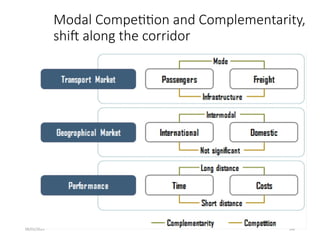
• Although intermodal transportation has opened many
opportunities for a complementarity between modes, there
is intense competition as companies are now competing
over many modes in the transport chain.
• A growing paradigm thus involves supply chain competition
with the modal competition component occurring over
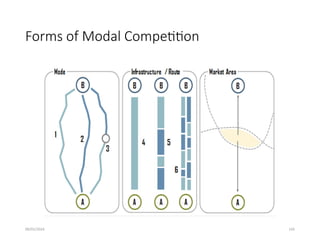
three dimensions:
Modal usage. Competition that involves the comparative
advantage of using a specific or a combination of modes.
Distance remains one of the basic determinants of modal
usage for passenger transportation.
09/01/2024 144
Cont’d…
• However, for a similar distance, costs, speed and comfort
can be significant factors behind the choice of a mode.
Infrastructure usage. Competition resulting from the
presence of freight and passenger traffic on the same
itineraries linking the same nodes.
• Each level of capacity used by a mode is therefore at the
expense of the other mode.
Market area. Competition being experienced between
transport terminals for using new space (terminal relocation
or expansion) or capturing new markets (hinterland).
09/01/2024 145
Forms of Modal Competition
09/01/2024 146
Modal Competition and Complementarity,
shift along the corridor
09/01/2024 147
Inter-modalism
• A system of transport whereby two or more modes of transport are
used to transport the same loading unit or truck in an integrated
manner, without loading or unloading, in a transport chain.
• Typically used in three contexts:
a) Most narrowly, it refers to containerization, piggyback service, or
other technologies that provide the seamless movement of goods
and people by
09/01/2024 148
Cont’d…
more than one modes of transportation.
More broadly, intermodalism refers to the provision of connections
between different modes, such as adequate highways to ports or bus
feeder services to rail transit.
In its broadest interpretation, intermodalism refers to a holistic view
of transportation in which individual modes work together or within
their own niches
09/01/2024 149
Cont’d…
to provide the user with the best choices of service, and in which
the consequences on all modes of policies for a single mode are
considered.
• This view has been called balanced, integrated, or comprehensive
transportation in the past.
09/01/2024 150
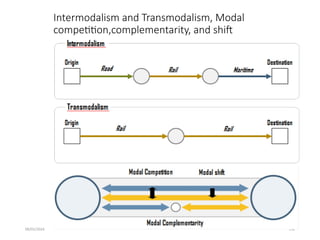
Intermodalism and Transmodalism, Modal
competition,complementarity, and shift
09/01/2024 151
Inter-modalism, the Container and maritime
Transport
• Inter-modalism originated in maritime space, with the development
of the container and then spread to other modes.
• Maritime sector should have been the first mode to pursue
containerization.
• Containerization permits the mechanized handling of cargoes.
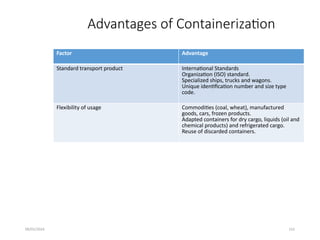
• There are numerous advantages of using containers in the
international transport.
09/01/2024 152
Advantages of Containerization
Factor Advantage
Standard transport product International Standards
Organization (ISO) standard.
Specialized ships, trucks and wagons.
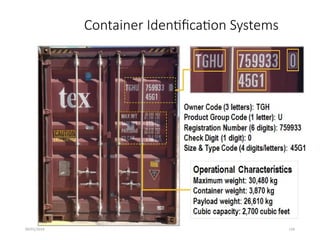
Unique identification number and size type
code.
Flexibility of usage Commodities (coal, wheat), manufactured
goods, cars, frozen products.
Adapted containers for dry cargo, liquids (oil and
chemical products) and refrigerated cargo.
Reuse of discarded containers.
09/01/2024 153
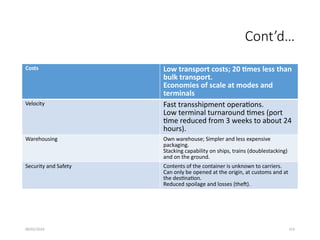
Cont’d…
Costs Low transport costs; 20 times less than
bulk transport.
Economies of scale at modes and
terminals
Velocity Fast transshipment operations.
Low terminal turnaround times (port
time reduced from 3 weeks to about 24
hours).
Warehousing Own warehouse; Simpler and less expensive
packaging.
Stacking capability on ships, trains (doublestacking)
and on the ground.
Security and Safety Contents of the container is unknown to carriers.
Can only be opened at the origin, at customs and at
the destination.
Reduced spoilage and losses (theft).
09/01/2024 154
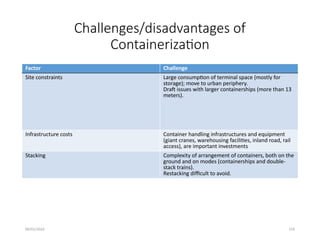
Challenges/disadvantages of
Containerization
Factor Challenge
Site constraints Large consumption of terminal space (mostly for
storage); move to urban periphery.
Draft issues with larger containerships (more than 13
meters).
Infrastructure costs Container handling infrastructures and equipment
(giant cranes, warehousing facilities, inland road, rail
access), are important investments
Stacking Complexity of arrangement of containers, both on the
ground and on modes (containerships and double-
stack trains).
Restacking difficult to avoid.
09/01/2024 155
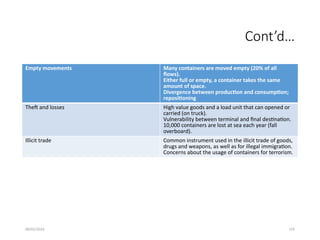
Cont’d…
Empty movements Many containers are moved empty (20% of all
flows).
Either full or empty, a container takes the same
amount of space.
Divergence between production and consumption;
repositioning
Theft and losses High value goods and a load unit that can opened or
carried (on truck).
Vulnerability between terminal and final destination.
10,000 containers are lost at sea each year (fall
overboard).
Illicit trade Common instrument used in the illicit trade of goods,
drugs and weapons, as well as for illegal immigration.
Concerns about the usage of containers for terrorism.
09/01/2024 156
Container Identification Systems
09/01/2024 157
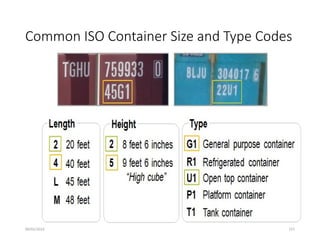
Common ISO Container Size and Type Codes
09/01/2024 158
Technical Performance Indicators=A&C
• Geographers and economists use performance indicators to
empirically assess the technical performance of different modes of
transport,(i.e. their capacity to move goods or passengers around).
• Hence, basic technical performance calculations can be particularly
useful for networks’ global performance analysis
09/01/2024 159
Cont’d…
as well as modal comparison, analysis, evaluation by bridging both
physical attributes(length, distance, configurations, etc.) and time-
based attributes (punctuality, regularity, reliance, etc.) of networks.
• Some indicators are currently used to measure freight and passenger
transport.
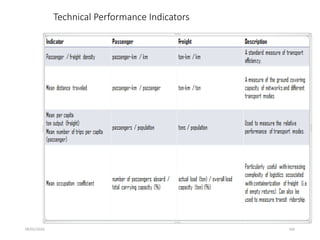
• Table 3.1:commonly used performance indicators
09/01/2024 160
Technical Performance Indicators
09/01/2024 161
Cont’d…
• Passenger-km or ton-km is standard units for measuring travel that
consider the number of people travelling or ton output and distance
travelled.
• for example,120 passenger-km represents 10 passengers travelling 12
kilometers or 2 passengers travelling 60 kilometers and son on.
09/01/2024 162
Economic Impact Indicators
• Economic impact indicators help to appreciate the relationship
between transport systems and the economy as well as to inform bon
the economic weight of this type of economy.
• Geographers should be familiar with basic econometric impact
indexes.
• Efficiency : is the ratio of input to output, or the output per each unit
of input.
09/01/2024 163
Cont’d…
• Modal variations in efficiency will depend heavily on what is to be
carried, the distance travelled, the degree and complexity of logistics
required as well as economies of scale.
• Freight transport chains rest up on the complementarity of cost-
efficient and time-efficient modes, seeking most of the time a
balanced compromise rather than an ideal or perfect equilibrium.
09/01/2024 164
Cont’d…
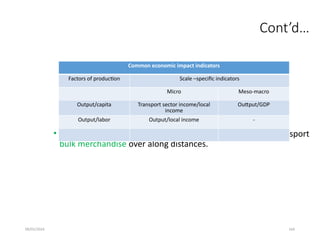
• Maritime transport is the most cost-efficient way to transport
bulk merchandise over along distances.
Common economic impact indicators
Factors of production Scale –specific indicators
Micro Meso-macro
Output/capita Transport sector income/local
income
Outtput/GDP
Output/labor Output/local income -
09/01/2024 165
Cont’d…
• On the other hand, air transport is recognized for its unsurpassed
time-efficiency than other modes over long distances, it remains an
expensive option.
• Thus, vertical integration, or the absorption of transportation
activities by producers, the search for these two efficiency attributes
by gaining direct control over inputs.
09/01/2024 166
Chapter 4: Transport Terminals
Introduction:
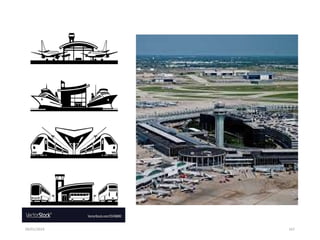
All spatial flows, with the exception of personal vehicular and
pedestrian trips, involve movements between terminals.
With these two exceptions, all transport modes require assembly
and distribution of their traffic, both passenger and freight.
For example, passengers have to go to bus terminals and airports
first in order to reach their final destinations, and freight has to be
consolidated at a port or a rail yard before onward shipment.
Terminals are, therefore, essential links in transportation chains.
The goal of this chapter is to examine the strong spatial and
functional character of transport terminals.
They occupy specific locations and they exert a strong influence
over their surroundings.
At the same time they perform specific economic functions and
serve as foci(central) for clusters of specialized services.
09/01/2024 167
09/01/2024 168
Definitions of transport terminals
Terminal can be defined as any facility where freight and
passengers are assembled/ gathered or dispersed.
They may be points of interchange involving the same mode
of transport.
Those are also points of interchange between different modes
of transport.
Transport terminals, therefore, are central and intermediate
locations in the movements of passengers and freight.
09/01/2024 169
Cont’d…
Terminal: any location where freight and passengers either
originate, terminates, or is handled in the transportation process.
In order to carry out the transfer and manhandling of freight and
passengers, specific equipment and infrastructures are required.
Differences in the nature, composition and timing of transfer
activities give rise to significant differentiations in the form and
function between terminals.
A basic distinction is between passenger and freight transfers,
because in order to carry out the transfer and bundling of each
type, specific equipment and infrastructures are required.
Types of terminals
1. Passenger terminals: passenger terminals require relatively little
specific equipment.
Activities taking place in passenger terminals tend to be simple
and require relatively little equipment.
09/01/2024 170
Cont’d…
 Airport terminals: Airports are of a different order. They
are among the most complex of terminals functionally. Why
Measurement: measuring activities in passenger terminals
is generally straightforward.
The most common indicator is the number of passengers
handled, sometimes differentiated according to arrivals and
departures.
•Transfer passengers are counted twice (once on arrival,
once on departure), and so airports that serve as major
transfer facilities inevitably record high passenger totals.
2. Freight terminals: Freight handling requires specific
loading and unloading equipment.
•Terminals are differentiated functionally both by the mode
involved and the commodities transferred.
09/01/2024 171
09/01/2024 172
Cont’d…
A basic distinction is that between bulk and general cargo:
Bulk: refers to goods that are handled in large quantities that are
unpackaged and are available in uniform dimensions. E.g.
Liquid bulk goods: crude oil and refined products.
Dry bulk goods: ores, coal and cereals.
General cargo: refers to goods that are of many shapes, dimensions
and weights, such as machinery and parts.
Because the goods are so uneven and irregular, handling is difficult to
mechanize.
General cargo handling usually requires a lot of labor/labor intensive.
A feature of most freight activity is the need for storage.
09/01/2024 173
Cont’d…
Assembling the individual bundles of goods may be time-consuming
and thus some storage may be required.
Freight terminals require specialized infrastructures such as grain
silos, storage tanks, and refrigerated warehouses, or simply space to
stockpile.
Measurement of freight traffic through terminals is more complicated
than for passengers.
Because freight is so diverse, standard measures of weight and value
are difficult to compare and combine.
What are terminal costs? Why are there different types of terminal
costs?
Terminal costs: since terminals perform transfer and consolidation
functions, they are important economically because of the costs
incurred in carrying out these activities.
Terminal costs represent an important component of total transport
costs.
09/01/2024 174
Cont’d…
They are fixed costs that are incurred regardless of the length of
the eventual trip, and vary significantly between the modes.
They can be of three types:
Infrastructure costs: Include construction and maintenance costs
of facilities such as piers (for landing), runways, cranes and
structures (warehouses, offices, etc.).
Transshipment costs: the costs of loading and unloading
passengers or freight.
Administration costs: many terminal facilities are managed by
institutions such as port or airport authorities or by private
companies. In both cases administration costs are incurred.
Because ships have the largest carrying capacities, they incur the
largest terminal costs, since it may take many days to load or
unload a vessel.
09/01/2024 175
09/01/2024 176
Cont’d…
Conversely, a truck or a passenger bus can be loaded much more
quickly, and hence the terminal costs for road transport are the
lowest.
Terminal costs play an important role in determining the
competitive position between the modes.
Because of their high freight terminal costs, ships and rail are
unsuitable for short-haul trips.
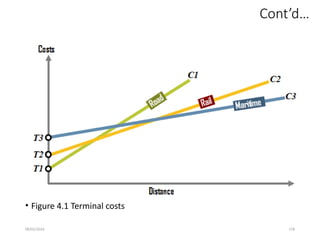
• Figure 4.1 represents a simplified assumption concerning transport
costs for three modes.
• It should be noticed that the cost curves all begin at some point up
the cost axis.
• This represents terminal costs, and as can be seen, shipping (T3)
and rail (T2) start with a significant disadvantage compared with
road (T1).
09/01/2024 177
Cont’d…
Competition between the modes is frequently measured by
cost comparisons.
Efforts to reduce transport costs can be achieved by
using the following techniques:
Fuel-efficient vehicles,
Large size of ships, and
Reducing the labor employed on trains
Over the last fourty years, very significant steps to reduce
terminal costs have been made.
09/01/2024 178
Cont’d…
• Figure 4.1 Terminal costs
09/01/2024 179
Cont’d…
These have included introducing information management
systems such as EDI (electronic data interchange) that have
greatly speeded up the processing of information, removing
delays typical of paper transactions.
The most significant development has been the
mechanization of loading and unloading activities/tasks.
Mechanization has been facilitated by the use of units of
standard dimensions such as the pallet and most importantly,
the container .
The container, in particular, has revolutionized terminal
operations.
09/01/2024 180
09/01/2024 181
Terminals and location
Location and spatial relations play a significant role in the
performance and development of transport terminals.
There are two components/dimensions involved: site, or
absolute location and relative location.
Site/absolute location: Terminals occupy very specific sites,
usually with stringent/strict requirements.
Their site determinants may play an important role in shaping
performance.
Relative location: It refers to the position of places (terminals)
with regard to other places.
The spatial relations of terminals are an extremely important
factor in shaping competition.
Together, absolute and relative locations provide justification
for the fundamental significance of geography in understanding
transport terminals.
09/01/2024 182
Terminals locations are determined on the basis of:
a) The modes they serve and the types of activities
carried on.
b) The period of time when site development take place
09/01/2024 183
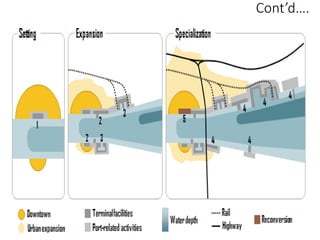
The Evolution of a Port
Port sites evolve through 3 developmental phases setout
below.
Setting: The initial setting of a port is strongly dependent
on geographical considerations.
Expansion: is the expansion of terminal , and
construction jetties to handle the growing amounts of
freight and passengers as well as larger ships.
Specialization: the construction of specialized piers to
handle freight such as containers, ores, grain, petroleum
and coal (4), which expanded warehousing needs
significantly.
Larger high-capacity ships often required dredging or the
construction of long jetties, granting access to greater
depths.
09/01/2024 184
09/01/2024 185
Cont’d….
• Figure 4.2: The evolution of a port (based on the Anyport model)
09/01/2024 186
Hinterland and foreland
One of the most continuing concepts in transport geography,
especially applied to ports, is the hinterland.
Hinterland: It refers to the market area of ports, the land areas
from which the port draws and distributes traffic.
Two types of hinterlands: Natural/primary and competitive.
1. Natural or primary hinterland: refers to the market area for
which the port is the closest terminal.
It is assumed that this zone’s traffic will normally pass through
the port, because of geographical proximity/nearness.
09/01/2024 187
Cont’d…
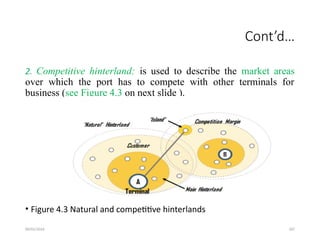
2. Competitive hinterland: is used to describe the market areas
over which the port has to compete with other terminals for
business (see Figure 4.3 on next slide ).
• Figure 4.3 Natural and competitive hinterlands
09/01/2024 188
The hinterland
Hinterland: is a land space over which a transport terminal (port),
sells its services and interacts with its clients.
It accounts for the regional market share that a terminal has relative
to a set of other terminals servicing this region.
It regroups all the customers directly bounded to the terminal.
The terminal, depending on its nature, serves as a place of
convergence for the traffic coming by roads, railways or by
sea/fluvial feeders.
Foreland: is the ocean ward mirror of hinterland, referring to the
ports and overseas markets linked by shipping services from the port
09/01/2024 189
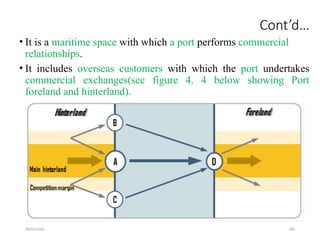
Cont’d…
• It is a maritime space with which a port performs commercial
relationships.
• It includes overseas customers with which the port undertakes
commercial exchanges(see figure 4. 4 below showing Port
foreland and hinterland).
09/01/2024 190
Terminals and security
In the freight industry, security concerns focuses on two areas:
a) worker safety and
b) Theft.
A)worker safety significant improvements have been made over the years
through workers education and better organization of operations, but
freight terminals are still comparatively dangerous areas.
b) Theft. The issue of theft has also been one of the most severe problems
confronting all types of freight terminals, especially where high value
goods are being handled.
Passengers Terminals
Airports have been the focus of security concerns for many decades.
Hijacking aircraft started in the 1970s, when terrorist groups in the Middle
East exploited the lack of security to seize planes for money and publicity.
Freight Terminals
Security in the freight industry has always been a major problem. Illegal
immigrants, drug smuggling, piracy, and the deployment of sub-standard
vessels have been some of the most important concerns.
09/01/2024 191
Indices measuring the Distribution Pattern
of terminal Traffic
•Different methods are used to measure the
distribution pattern of different traffic terminals.
These are:
a) The Gini Coefficient
b) Delphi forecasting and
c) The location coefficient
09/01/2024 192
a) The Gini Coefficient
The Gin coefficient was developed to measure the
distribution pattern of different human and physical
phenomena. It compares the Lorenz curve of a ranked
empirical distribution with the line of perfect equality.
The line of perfect equality assumes that each element
has
the same contribution to the total summation of the values
of a variable.
The value of Gin coefficient ranges between 0, where
there is no concentration (perfect equality) and 1, where
there is total concentration (perfect inequality).
09/01/2024 193
II) Delphi Forecasting
Unlike many other methods that use so-called objective
predictions involving quantitative analysis.
The Delphi method is based on expert opinions. The
selection of experts is, therefore, one of the tasks in Delphi
forecasting. The persons invited to participate must be
knowledgeable about the issue, and represent a variety of
backgrounds.
The number of experts must not be too small to make the
assessment too narrowly based, nor too large to be difficult to
coordinate. It is widely considered that 10 to 15 experts can
provide a good base for the forecast.
09/01/2024 194
III) Location Coefficient
Dear learner, location coefficient is also one of the indices used
to measure degree of specialization of transport terminals in
transporting commodities.
 Certain kinds of merchandise are often transshipped at particular
terminals rather than at others.
Thus, the degree of concentration of a certain type of traffic in a
terminal (port, airport, train station) compared with the average
for all the terminals, can be measured by using the location
coefficient.
09/01/2024 195
Chapter Five: International and Regional
Transportation
Globalization is not a new phenomenon either- “what is new is the
speed, the scale, the scope and the complexity of global
connections today.
Globalization is significantly shaping the socio-economic,
political and cultural development of both nations and cities
worldwide.
09/01/2024 196
The Drivers/facilitators of Globalization
Integration: Regulatory chains, harmonization of regulatory
régimes, Trade agreements).
Production: this include among others(supply chains, offshoring,
global production networks).
Transportation: this include;transport chains, containerisation,
Transborder transportation among others.
Transaction: Information chains (ICT),Capital for investments,
credit for transactions.
09/01/2024 197
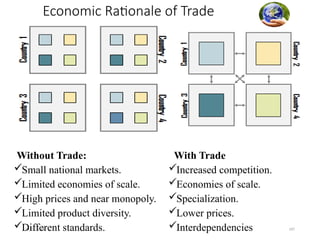
Economic Rationale of Trade
Without Trade:
Small national markets.
Limited economies of scale.
High prices and near monopoly.
Limited product diversity.
Different standards.
With Trade
Increased competition.
Economies of scale.
Specialization.
Lower prices.
Interdependencies
09/01/2024 198
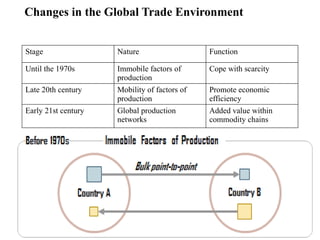
Changes in the Global Trade Environment
Stage Nature Function
Until the 1970s Immobile factors of
production
Cope with scarcity
Late 20th century Mobility of factors of
production
Promote economic
efficiency
Early 21st century Global production
networks
Added value within
commodity chains
09/01/2024 199
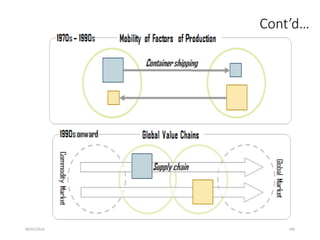
Cont’d…
09/01/2024 200
The Value Chain (or Commodity Chain)
Commodities: are resources that can be consumed.
They can be accumulated for a period of time while some are
perishable while others can be stored for centuries, exchanged as
part of transactions or purchased on specific markets.
some commodities are fixed, hence can’t be transferred except for
the title.
• E.g. land, mining, lodging(housing), and fishing rights.
Bulk commodities: are commodities that can be transferred (e.g.
grain, metals, livestock, oil, cotton, coffee, sugar, etc.).
Their value is derived from utility, supply and demand.
09/01/2024 201
Cont’d…
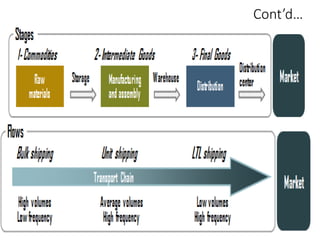
Commodity chain: A functionally integrated network of production,
trade and service activities that covers all the stages in a- supply
chain, from the transformation of raw materials, through
intermediate manufacturing stages, to the delivery of a finished
good to a market.
The chain is conceptualized as a series of nodes, linked by various
types of transactions, such as sales and intra-firm transfers.
Each successive node within a commodity chain involves the
acquisition or organization of inputs for the purpose of added
value.
09/01/2024 202
Cont’d…
• Figure5.1 the commodity chain
09/01/2024 203
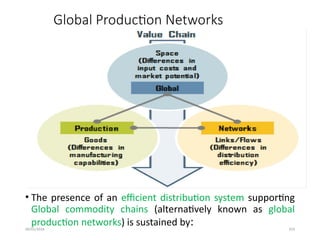
Global Production Networks
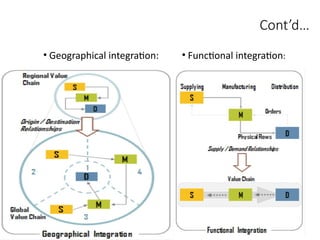
• The presence of an efficient distribution system supporting
Global commodity chains (alternatively known as global
production networks) is sustained by:
09/01/2024 204
Cont’d…
• Geographical integration: • Functional integration:
09/01/2024 205
Spatial Interaction (SI): An Overview
One methodology of particular importance to transport geography
relates to how to estimate flows between locations, since these flows,
known as spatial interactions, enable to evaluate the demand (existing
or potential) for transport services.
A spatial interaction is a recognized movement of people, freight or
information between an origin and a destination.
It is a transport demand/supply relationship expressed over a
geographical space.
Spatial interactions cover a wide variety of movements such as
journeys to work, migrations, tourism, the usage of public facilities, the
transmission of information or capital, the market areas of retailing
activities, international trade and freight distribution.
Economic activities are generating (supply) and attracting (demand)
flows.
09/01/2024 206
Cont’d…
A movement occur between an origin and a destination underlines
that the costs incurred by a spatial interaction are lower than the
benefits derived from such an interaction.
The three interdependent conditions necessary for a spatial
interaction to occur are : complementarity, intervening opportunity,
transferability.
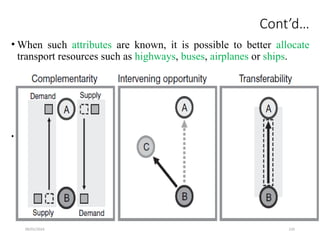
1. Complementarity
oThere must be a supply and a demand between the interacting
locations.
oA residential zone is complementary to an industrial zone because
the first is supplying workers while the second is supplying jobs.
oThe same can be said concerning the complementarity between a
store and its customers and between an industry and its suppliers
(movements of freight).
09/01/2024 207
Cont’d…
•If location B produces /generates something that
location A requires, then an interaction is possible
because a supply/ demand relationship has been
established between those two locations; they have
become complementary to one another.
•The same applies in the other direction (A to B),
which creates a situation of reciprocity (exchange)
common in commuting or international trade.
09/01/2024 208
Cont’d…
2. Intervening opportunity
 There must not be another location that may offer a
better alternative as a point of origin or as a point of
destination.
For instance, in order to have an interaction of a
customer to a store, there must not be a closer store
that offers a similar array of goods.
If location C offers the same characteristics (namely
complementarity) as location A and is also closer to
location B, an interaction between B and A will not
occur and will be replaced by an interaction between
B and C.
09/01/2024 209
Cont’d…
3. Transferability
Freight, persons or information being transferred must be
supported by transport infrastructures, implying that the origin
and the destination must be linked.
 Costs to overcome distance must not be higher than the
benefits of related interaction, even if there is complementarity
and no alternative opportunity.
 Transport infrastructures (modes and terminals) must be
present to support an-Interaction between B and A.
 Also, these infrastructures must have a capacity and
availability which are compatible with the requirements of
such an interaction.
 The goal of spatial interactions is to explain spatial flows.
 They provide ways to measure flows and predict the
consequences of changes in the conditions generating them.
09/01/2024 210
Cont’d…
• When such attributes are known, it is possible to better allocate
transport resources such as highways, buses, airplanes or ships.
• Figure 5.2 Conditions for the realization of a spatial interaction
09/01/2024 211
Origin/destination matrix
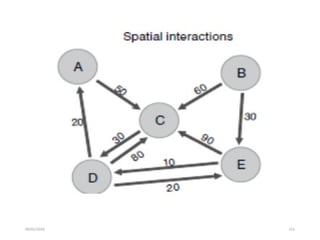
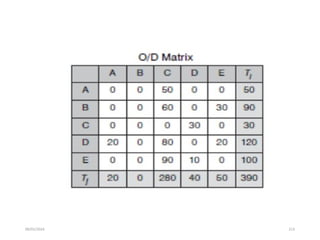
Each spatial interaction, as an analogy for a set of
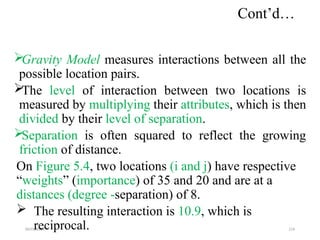
movements, is composed of an origin/ destination pair.
Each pair can itself be represented as a cell in a matrix
where rows are related to the locations (centroids) of origin,
while columns are related to locations (centroids) of
destination.
Such a matrix is commonly known as an origin/destination
matrix, or a spatial interaction matrix.
09/01/2024 212
09/01/2024 213
09/01/2024 214
The spatial interaction model/SIM=B&C, A&C
The basic assumption concerning many spatial interaction models is
that flows are a function of the attributes of the locations of origin, the
attributes of the locations of destination and the friction of distance
between the concerned origins and destinations.
The general formulation of the spatial interaction model is as follows
(Figure 5.3).
; where:
Tij = interaction between location i (origin) and location j
(destination).
Its units of measurement are varied and can involve people, tons of
freight, traffic volume, etc.
It also concerns a time period such as interactions by the hour, day,
month, or year.
09/01/2024 215
Cont’d…
Vi = attributes of the location of origin i. Variables often used to
express these attributes are socio-economic in nature, such as
population, number of jobs available, industrial output or gross
domestic product.
Wj = attributes of the location of destination j.
It uses similar socio-economic variables to the previous attribute.
Sij = attributes of separation between the location of origin i and the
location of destination j.
Also known as transport friction. Variables like distance, transport
costs, or travel time are often used to express these attributes.
The attributes of V and W tend to be paired to express
complementarity in the best possible way.
09/01/2024 216
Cont’d…
For instance, measuring commuting flows (work-related
movements) between different locations would likely consider a
variable such as working age population as V and total
employment as W.
From this general formulation, three basic types of interaction
models can be constructed: Gravity model, Potential model, and
Retail model.
Except Gravity model, the remaining two models (Potential and
Retail models are reserved for assignment).
The gravity model: and its formulation: The gravity model is
one of the most important spatial interaction methods.
It is named as such because it uses a similar formulation to
Newton’s gravitation model.
09/01/2024 217
Cont’d…
Accordingly, the attraction between two objects is proportional
to their mass and inversely proportional to their respective
distance.
Consequently, the general formulation of spatial interactions can
be adapted to reflect this basic assumption to form the elementary
formulation of the gravity model: Tij
Where:
Pi and Pj = the importance of the location of origin i and the
location of destinationj.
dij = the distance, or any measure related to the friction of
space, between the location of origin and the location of
destination.
k = a proportionality constant related to the temporal rate of the
event being measured.
09/01/2024 218
Cont’d…
For instance, if the same system of spatial
interactions is considered, the value of k will be
higher if interactions are considered for a year
instead of a week.
Thus, spatial interactions between locations i and j
are proportional to their respective importance
divided by their distance.
09/01/2024 219
Cont’d…

Gravity Model measures interactions between all the
possible location pairs.

The level of interaction between two locations is
measured by multiplying their attributes, which is then
divided by their level of separation.

Separation is often squared to reflect the growing
friction of distance.
On Figure 5.4, two locations (i and j) have respective
“weights” (importance) of 35 and 20 and are at a
distances (degree -separation) of 8.
 The resulting interaction is 10.9, which is
reciprocal.
09/01/2024 220
Cont’d…
09/01/2024 221
Chapter Six: Urban Transportation
Introduction:
Urbanization: is the process of transition from rural to
more urban society.
statistically, urbanization reflects an increasing
proportion of the population living in settlements defined
as urban.
This is the outcome of three main demographic trends:
Natural increase, rural-urban migration, international
migration.
09/01/2024 222
Transportation, Urban Form And Spatial
Structure
Transportation in urban areas in highly complex because
of the modes involved the multitude of origins and
destinations, and the amount and variety of traffic.
 At the urban level, demographic and mobility growth have been
shaped by the capacity and requirements of urban transport
infrastructures, be they roads, transit systems or simply walkways.
Elements of the urban form:
Urban form: is the spatial imprint (sign) of an urban
transport system as well as the adjacent / neighborhood
physical infrastructures.
Jointly, they confer a level of spatial arrangement to cities.
Urban (spatial) structure: it refers to the set of
relationships arising out of the urban form and its
underlying interactions of people, freight and information.
09/01/2024 223
Cont’d…
• Figure 61:the spatial imprint of an urban transport system
09/01/2024 224
Cont’d…
The urban form and its spatial structure are articulated by two
structural elements: Nodes and Linkages.
Nodes: These are reflected in the centrality of urban activities,
which can be related to the spatial accumulation of economic
activities or the accessibility to the transport system.
Terminals, such as ports, rail yards and stations, and airports, are
important nodes around which activities agglomerate at the local or
regional level.
Linkages: These are the infrastructures supporting flows from, to
and between nodes.
09/01/2024 225
Categories of urban transportation
Urban transportation is organized in three broad categories of
collective, individual and freight transportation.
1.Collective transportation (public transit):
its purpose is to provide publicly accessible mobility over specific
parts of a city.
Its efficiency is based upon transporting large numbers of people and
achieving economies of scale.
It includes modes such as tramways, buses, trains, subways and
ferryboats.
09/01/2024 226
Cont’d…
2. Individual transportation: it includes any mode where mobility is
the outcome of a personal choice and means such as the automobile,
walking, cycling and the motor-cycle.
The majority of people walk to satisfy their basic mobility but this
number varies according to the city considered.
For instance, walking accounts for 88% of all movements inside
Tokyo while this figure is only 3% for Los Angeles.
3. Freight transportation: As cities are dominant centers of
production and consumption, urban activities are accompanied by
large movements of freight.
Those movements are mostly characterized by delivery trucks
moving between industries, distribution centers, ware houses and
retail activates as well as from major terminals such as ports, rail
yards, distribution centers and airports.
09/01/2024 227
cont’d…
• Fig6.1Figure 6.2 Transportation and urban form
09/01/2024 228
Nodes, Linkages and Urban Form
• Fig 6.3 interaction between nodes, linkages and urban form
09/01/2024 229
The Spatial Imprint of Urban Transportation
• The amount of urban land allocated to transportation is often
correlated with the level of mobility.
• The major components of the spatial imprint of urban transportation
are:
Pedestrian areas: the amount of space devoted to walking. This
space is often shared with roads as sidewalks may use between 10
and 20 percent of a road’s right of way.
Roads and parking areas :The amount of space devoted to road
transportation, which has two states of activity: moving or parked.
In a motorized city, on average 30 percent of the surface is devoted
to roads while another 20 percent is required for off-street parking.
Cycling areas: cycling simply shares access to road space and many
attempts have been made to create spaces specifically for bicycles
in urban areas.
09/01/2024 230
Cont’d…
09/01/2024 231
Cont’d…
Pedestrian area
09/01/2024 232
Cont’d….
Transit systems: many transit systems, such as buses and
tramways, share road space with automobiles, which often
impairs their respective efficiency.
Transport terminals: the amount of space devoted to terminal
facilities such as ports, airports, transit stations, rail yards and
distribution centers.
09/01/2024 233
Transportation and Land Use Model (TLUM)
The land use – transport system:
The typology of land use can be of two types: formal and
functional.
Formal land use: representations are concerned with
qualitative attributes of space such as its form, pattern and
aspect and are descriptive in nature.
Functional land use: representations are concerned with
the economic nature of activities such as production,
consumption, residence, and transport, and are mainly a
socio-economic description of space.
09/01/2024 234
Cont’d…
• Fig 6.4 Transportation, activity systems and land use
09/01/2024 235
Chicken- Egg Issue
Transportation and land use interactions have often been
described as a chicken-and-egg problem since it is difficult to
identify the triggering cause of change.
09/01/2024 236
Cont’d…
09/01/2024 237
Cont’d…
• A transportation/land use system can be divided into three
subcategories of models: (Land use models, Spatial interactions
models and Transportation network models).
09/01/2024 238
Urban land use models
• Several descriptive and analytical models of urban land use have
been developed.
• All involve some consideration of transport in the explanations of
urban land use structure: these models are
a) Von Thunen’s regional land use model
b) The Burgess concentric model
c) Sector and nuclei land use models
d) Hybrid models
e) Land rent theory
09/01/2024 239
Urban mobility
• Urban movements are either obligatory, when they are linked to
scheduled activities (such as home-to-work movements), or
voluntary, when those generating it are free to decide their
scheduling (such as leisure).
• The most common types of urban movements are:
Pendular movements: are obligatory movements involving
commuting between locations of residence and work.
09/01/2024 240
Cont’d…
they are cyclical
they are predictable and
 recur on a regular basis of a daily occurrence.
Professional movements: are linked to professional, work-based
activities such as meetings and customer services, dominantly taking
place during work hours.
09/01/2024 241
Cont’d…
Personal movements: are voluntary movements linked to the
location of commercial activities, which includes shopping and
recreation.
Touristic movements: involve interactions between landmarks and
amenities such as hotels and restaurants. They are seasonal in nature
or occur at specific moments. e.g. World Cup or the Olympics.
09/01/2024 242
Cont’d…
Distribution movements: are concerned with the distribution of
freight to satisfy consumption and manufacturing requirements.
• They are linked to distribution centers and retail outlets.
09/01/2024 243
Types of Urban Movements
Movement Type Pattern Dominant Time Destination
Pendular Structured Morning and
afternoon
Localized (employment)
Professional Varied Workdays Localized
Personal Structured Evening Varied with some foci
Touristic Seasonal Day Highly localized
Distribution Structured Nighttime Localized
09/01/2024 244
Urban transport problems
Geographical challenges facing urban transportation: Among the most
notable urban transport problems are:
Traffic congestion and parking difficulties: congestion is the situation
in which transport demand exceeds transport supply in a specific
section of the transport system.
Public transport inadequacy/shortage
Difficulties for pedestrians
09/01/2024 245
Cont’d…
Loss of public space
Environmental impacts and energy consumption (chapter 8).
Accidents and safety (free from violence).
Land consumption: about 30-60 % of land is devoted to transport in
metropolitan areas.
Freight distribution
09/01/2024 246
The Lowry model
• Considered to be the first transportation/land use model (1964), it
links two spatial interaction components.
• The first calculates spatial interactions between basic employment
activities and zones of residence, while the second calculates spatial
interactions between service employment activities and zones of
residence (see Figure 6.5 below).
09/01/2024 247
Cont’d…
• The core of the model is exogenous, derived from a regional
economic model, where the location of basic (industrial)
employment is inputted.
• Fig 6.5 Lowry-type transportation/land use model
09/01/2024 248
Chapter Seven: Economic and Spatial
Structure of Transport Systems
Introduction:
• Transport systems are closely related to socio-economic changes.
• The mobility of people and freight and levels of territorial
accessibility are at the core of this relationship.
• Economic opportunities are likely to arise where transportation
infrastructures are able to answer mobility needs and insure access
to markets and resources.
09/01/2024 249
Cont’d…
• From the industrial revolution in the 19th
century to globalization and
economic integration processes of the late 20th
century, regions of
the world have been affected differently by economic development.
• International, regional and local transportation systems alike have
become fundamental components of economic activities.
09/01/2024 250
Cont’d…
• A growing share of the wealth is thus linked to trade and distribution.
• However, even if transportation has positive impacts on socio-
economic systems, there are also negative consequences such as
congestion, accidents and mobility gaps.
09/01/2024 251
Transport and economic development
•The economic importance of transportation: The
transport sector is an important component of the
economy, impacting on development and the
welfare of populations.
•When transport systems are efficient, they provide
economic and social opportunities and benefits that
impact throughout the economy.
•When transport systems are deficient, they can
have an economic cost in terms of reduced or
missed opportunities.
09/01/2024 252
Cont’d…
•From a general standpoint, the economic impacts of
transportation can be direct and indirect:
•Direct impacts: related to accessibility change
where transport enables larger markets and enables
to save time and costs.
•Indirect impacts: related to the economic multiplier
effect where the price of commodities drop and/or
their variety increases.
09/01/2024 253
Table 7.1 Economic benefits of transportation
09/01/2024 254
Cont’d…
• At the macroeconomic level (the importance of transportation for a
whole economy), transportation and the mobility it confers are linked
to a level of output, employment and income within a national
economy.
• In many developed countries, transportation accounts for between 6
and 12 percent of the GDP.
09/01/2024 255
Cont’d….
• At the microeconomic level (the importance of transportation for
specific parts of the economy), transportation is linked to producer,
consumer and production costs.
• The importance of specific transport activities and infrastructure can
thus be assessed for each sector of the economy.
• Transportation accounts for on average between 10 and 15 percent
of household expenditure while it accounts for around 4 percent of
the costs of each unit of output in manufacturing.
09/01/2024 256
Socio-economic impacts
• While many of the economic impacts of transportation are positive,
there are also significant negative impacts that are assumed by
individuals or by the society in one way or another.
• Among the most significant are:
Mobility gaps: b/n poor, medium and rich
Costs differences: Locations that have low levels of accessibility tend
to have higher costs for many goods
Congestion
09/01/2024 257
Cont’d…
Accidents
Air quality
Noise
Water quality
Land take/land consumption: Transport is a large consumer of space
when all of its supporting infrastructure and equipment are
considered.
09/01/2024 258
Transport and spatial organization=B$C
• transport networks have structured space on different scales.
• The fragmentation of production and consumption, the locational
specificities of resources, labor and markets generate a wide array of
flows of people, goods and information.
• Transportation not only stimulates economic development but also
helps structure space.
09/01/2024 259
Cont’d…
• Space shapes transport as much as transport shapes space.
• The relationship between transport and spatial organization can be
considered on three major geographical scales: the global, the
regional and the local.
09/01/2024 260
Global spatial organization
• At the global level, transportation supports and shapes economic
specialization and productivity through international trade .
• Improvements in transport are expanding markets and development
opportunities, but not uniformly.
• The inequalities of the global economy are reflected in its spatial
organization and transport systems.
09/01/2024 261
Cont’d…
• The patterns of globalization have created a growth in spatial flows
and increased interdependencies.
• Telecommunications, maritime transport and air transport support
the majority of global flows.
• The nature and spatial structure of these flows can be considered
from two major perspectives that seek to explain global differences in
growth and accessibility:
09/01/2024 262
Scales of Spatial Organization for
Transportation
• Fig7.1:
09/01/2024 263
Core / Periphery Division of the World
• the global spatial organization favors a few core areas that grow
faster than the periphery.
• This differential growth in time creates acute inequalities in levels of
development.
• Transportation is thus perceived as a factor of polarization and
unequal development.
09/01/2024 264
Cont’d…
• From this perspective, parts of the global economy are gaining,
because they are more accessible, while other are marginalized and
bound to dependency.
• Poles: Transportation is perceived as a factor of articulation in the
global economy where the circulation of passengers and freight is
regulated by poles corresponding to a high level of accumulation of
transport infrastructures,
09/01/2024 265
Cont’d…
• These poles are subject to centrifugal and centripetal forces that
have favored the geographical concentration of some activities and
the dispersion of others.
• Global flows are handled by the gateways of the global economy ,
each of which accounts for a significant share of the flows of people,
freight and information.
• Gateway: A location offering accessibility to a large system of
circulation of freight and passengers.
09/01/2024 266
Cont’d…
• Gateways reap the advantages of a favorable physical location such
as highway junctions, the confluence of rivers, a good port site, and
have been the object of a significant accumulation of transport
infrastructures such as terminals and their links.
• A gateway is commonly an origin, a destination and a point of transit.
09/01/2024 267
Cont’d…
• It generally commands the entrance to and the exit from its
catchment area.
• In other words, it is a pivotal point for the entrance and the exit of
merchandise in a region, a country, or a continent and often requires
intermodal transfers.
• However, services are following a spatial trend which appears to be
the opposite of production.
09/01/2024 268
Cont’d…
• As production disperses worldwide, services increasingly concentrate
into a relatively few large metropolitan areas, labeled as world cities.
• They are centers for financial services (banking, insurance), head
offices of major multinational corporations and the seats of major
governments.
• Thus, gateways and world cities may not necessarily correspond as
locations.
09/01/2024 269
Cont’d…
• Fig 7.2’ Scales of spatial organization for transportation
09/01/2024 270
Regional spatial organization
• Regions are commonly organized along an interdependent set of
cities forming what is often referred to as an urban system.
• The key spatial foundation of an urban system is based on a series of
market areas, which are a function of the level of activity of each
center divided by the friction of distance .
09/01/2024 271
Cont’d…
• The spatial structure of most regions can be subdivided into three
basic components:
• A set of locations of specialized industries,
• A set of service industry locations,
• A pattern of transport nodes and links,
09/01/2024 272
Cont’d…
• Three conceptual categories of regional spatial organization can be
observed:
a) Central places/urban systems models
b) Growth poles
c) Transport corridors
• Central places/urban systems models: try to find the relationships
between the size, the number and the geographic distribution of
cities in a region.
09/01/2024 273
Cont’d…
• Figure 7: 4:
09/01/2024 274
Cont’d…
• Growth poles: where economic development is the structural change
caused by the growth of new propulsive industries that are the poles
of growth.
• The location of these activities is the catalyst of the regional spatial
organization.
• Growth poles first initiate, then diffuse, development.
09/01/2024 275
Cont’d…
• fig
09/01/2024 276
Cont’d…
• It attempts to be a general theory of the initiation and diffusion of
development models.
• Growth gets distributed spatially within a regional urban system, but
this process is uneven with the core benefiting first and the periphery
eventually becoming integrated in a system of flows.
09/01/2024 277
Cont’d…
• In the growth poles theory, transportation is a factor of accessibility
which reinforces the importance of poles.
• Transport corridors represent an accumulation of flows and
infrastructures of various modes and their development is linked with
economic, infrastructural and technological processes.
09/01/2024 278
Cont’d…
• Figt7.2 Conceptual Corridor Development
09/01/2024 279
Cont’d…
• Fig7.3 : Transport Corridors and the Regional Spatial Structure
09/01/2024 280
Local spatial organization
• Although transport is an important element in rural spatial
organization, it is at the urban level that transportation has the most
significant local spatial impact.
• Urbanization and transport are interrelated concepts (see chapter 6
for detail).
• Every city relies on the need for mobility of passengers (residence,
work, purchases, and leisure) and freight (consumption
09/01/2024 281
Cont’d…
goods, food, energy, construction materials and waste disposal),
where the main nodes are employment zones.
• Employment and attraction zones are the most important elements
shaping the local urban spatial organization:
• Employment zones: The growing dissociation between the workplace
and the residence is largely due to the success of motorized
transport.
09/01/2024 282
Cont’d…
• Employment zones being located away from residential zones have
contributed to an increase in number and length of commuting trips.
• Attraction zones: Attraction zones linked to transport modes are
areas to which a majority of the population travels for varied reasons
such as shopping, professional services, education and leisure.
09/01/2024 283
Transport and location
The importance of transport in location: In addition to being a
factor of development both at the macro- and microeconomic
levels, transportation is linked with the location of socio-economic
activities, including retail, manufacturing and services.
• Location factors: Transport plays an important role in the location
of activities.
• It is a necessary condition, among others for
09/01/2024 284
Cont’d…
social and economic development
• The location of economic activities is a priori dependent on the
nature of the activity itself and on certain location factors such as the
attributes of the site, the level of accessibility and the socio-
economic environment (Figure 7.6).
• Location factors can be subdivided into three general functional
categories:
09/01/2024 285
Cont’d…
• Site: Specific micro-geographical characteristics of the site, including
the availability of land, basic utilities, visibility (prestige), amenities
(quality of life) and the nature and level of access to local
transportation (such as the proximity to a highway).
• These factors have an important effect on the costs associated with a
location.
09/01/2024 286
Cont’d…
• Accessibility: Includes a number of opportunity factors related to a
location, mainly labor (wages, availability, level of qualification),
materials (mainly for raw materials dependent activities), energy,
markets (local, regional and global) and accessibility to suppliers and
customers (important for intermediate activities).
• These factors tend to have a meso (regional) connotation.
09/01/2024 287
Cont’d…
• Socio-economic environment: Specific macro-geographical
characteristics that tend to apply to political units (nation, region,
locality).
• They consider the availability of capital (investment, venture), varied
subsidies, regulations, taxation and technology.
• each type of economic activity has its own set of location factors,
09/01/2024 288
Basic Location Factors
• Fig 7.2
09/01/2024 289
Market area analysis
• Market size and shape: Each economic activity possesses a location,
but the various demands (raw materials, labor, parts, services, etc.)
and flows it generates also have a spatial dimension called a market
area.
• A market area is the surface over which a demand or supply offered
at a specific location is expressed.
09/01/2024 290
Cont’d…
• For a factory it includes the areas to which its products are shipped;
for a retail store it is the tributary area from which it draws its
customers.
• Transportation is particularly important in market area analysis
because it impacts on the location of the activities as well as their
accessibility.
• The size of a market area is a function of its threshold and range:
09/01/2024 291
Cont’d…
• Market threshold: The minimum demand necessary to support an
economic activity such as a service.
• Since each demand has a distinct location, a threshold has a direct
spatial dimension.
• The size of a market has a direct relationship with its threshold.
• Market range: The maximum distance each unit of demand is willing
to travel to reach a service or the maximum distance
09/01/2024 292
Cont’d…
a product can be shipped to a customer.
• The range is a function of transport costs, time or convenience in
view of intervening opportunities.
• To be profitable, a market must have a range higher than its
threshold.
• Figure 7.1 considers a fairly uniform distribution of customers on an
isotropic plane and a single market where goods and services may be
purchased.
09/01/2024 293
Cont’d…
• If each customer is willing to purchase one unit per day and the
market needs to sell 11 units per day to cover its costs (production or
acquisition), then the threshold of the market would be the yellow
circle at distance D(T) from the market.
• However, 29 customers per day, including customers 1 and 2,
patronize the market, of which an extra 18 are beyond the -
09/01/2024 294
Cont’d…
• They contribute directly to the profitability of the market.
• The market range of all these customers is less than distance D(R).
• Beyond this range, customers, such as customer 3, are unwilling to go
to the market(Figure 7.4).
09/01/2024 295
Cont’d…
• Figure 3.10 Market threshold and range
09/01/2024 296
Economic definition of a market area
• A market depends on the relationship between supply and demand.
• It acts as a price fixing mechanism for goods and services.
• Demand is the quantity of a good or service that consumers are
willing to buy at a given price.
• It is high if the price of a commodity is low, while in the opposite
situation – a high price – demand would be low.
09/01/2024 297
Cont’d…
• Outside market price, demand can generally be influenced by the
various factors: Utility, Income levels, Inflation, Taxation, Savings.
• Supply: is the amount of goods or services which firms or individuals
are able to produce taking account of a selling price.
• Outside price, supply can generally be influenced by the following
factors:
09/01/2024 298
Cont’d…
• Profits: if profits are high an activity providing goods or services may
be satisfied with this situation (e.g. luxury goods).
• If profits are low, an activity can cease/stop, thus lowering the
supply.
• Competition: Where competition is absent (an oligopoly), or where
there is too much (over-competition), prices artificially influence
supply and demand.
09/01/2024 299
CHAPTER NINE: TRANSPORT PLANNING AND
POLICY
The nature of transport policy
Defining policy and planning
• What is policy? A set of principles that guide decision-making or the
processes of problems’ resolution (Studnicki-Gizbert, 1974).
• The process of regulating and controlling the provision of transport
(Tolley and Turton, 1995).
09/01/2024 300
Policy definitions
09/01/2024 301
Origins of the word
09/01/2024 302
Cont’d…
• Fig 9.1 Erasmus expression of the role of public policy
09/01/2024 303
Cont’d…
• Transport policy: the development of a set of constructs and
propositions that are established to achieve particular objectives
relating to socio-economic development, and the functioning and
performance of the transport system.
• Public policy is the means by which governments attempt to reconcile
the social, political, economic and environmental goals and
aspirations of society with reality.
09/01/2024 304
Cont’d…
• Transport planning deals with the preparation and implementation of
actions designed to address specific problems.
• distinction between the planning and policy:
• Policy: has a much stronger relation with legislation.
09/01/2024 305
Cont’d…
• Planning: does not necessarily involve legislative action, and is more
focused on the means of achieving a particular goal.
• Transport planning approach
The traditional transport planning process
Contemporary transport planning
09/01/2024 306
Transport planning (Generic Planning
Process)
Planning is still a multi-step process involving:
1) Problem Statement, Vision and Goals: (Safety, health, mobility,
equity, economic development)
2) Objectives: (Improve safety, improve roadway and trail facilities,
increase non-motorized travel)
3) Evaluation Criteria: (Accident / injury rates, Bicycle Compatibility
Index, non-motorized travel rate)
4) Program Evaluation: (Did program achieve its stated objectives?
What is the program’s acceptance? What are its costs and
benefits?
09/01/2024 307
Steps in policy formulation
• Figure 9.1: step policy cycle
09/01/2024 308
Relationship between policy and planning at
different levels
• Fig 9.2 relationship b/n policy and planning
09/01/2024 309
Cont’d…
END OF THE COURSE,
2020

Abel Ermias PPT_Transport (2016) tutorial.pptx

  • 1.
    09/01/2024 1 Chapter one:Transport Geography Main Contents Introduction Definition of transport and transportation geography, principles of transport geography The importance and evolution of transport, Concepts and dimensions of transport geography Transport and space Transportation Systems and Networks Transport network accessibility
  • 2.
  • 3.
    09/01/2024 3 What istransport or transportation? • Transport or transportation: is the movement of people, animals, freight/goods and information from one location to another through different modes of transport: air, rail, road, water, cable, pipeline, etc. • What is transport Geography? • transport Geography is a sub-discipline of geography concerned about the mobility of people, freight and information and its spatial organization considering attributes and constraints related to the origin, destination, extent, nature and purpose of movements.
  • 4.
    09/01/2024 4 The purposeof Transportation Some of the purposes of transport geography are: to overcome space to fulfill a demand for mobility The goal of transportation is thus to transform the geographical attributes of freight, people or information, from an origin to a destination. • Transportability refers to the ease of movement of passengers, freight or information. It is related to transport costs as well as to the attributes of what is being transported (fragility, perishable, price).
  • 5.
    09/01/2024 5 Transportability ofFreight/Goods Cargo Weight Storage Fragility Perishability Coal Heavy (0.83 g/cc) Simple (piling) None None Grain Heavy (0.83 g/cc) Average (silos) Low Low Petroleum Heavy (0.88 g/cc) Simple (tanks) None None Clothing Average Average (distribution center) Low None Fruits Average Complex(temperatu re controlled) High None Container Average (15-20 tons) Average (stacking) Low Cargo dependent
  • 6.
    09/01/2024 6 The CorePrinciples of Transport Geography
  • 7.
    09/01/2024 7 The SisyphusAnalogy in Transportation • In Sisyphus Analogy, the legend offers several analogies to introduce key concepts behind transportation, which are volume, distance, friction and effort.
  • 8.
    09/01/2024 8 Cont’d… • Volumerepresents a load of passengers or freight that can be carried as a single load. • Friction is the difficulty of moving a volume per unit of distance; the friction of distance. It can be related for instance to the quality of transport infrastructure. • Effort is the amount of energy required to move the volume per unit of distance, considering the friction. It is commonly represented as the cost of transport. Essentially, Effort = f(volume, distance, friction).
  • 9.
    09/01/2024 9 Transportation asa Derived Demand • There are two major types of derived transport demand: • Direct derived demand: Refers to movements that are directly the outcome of economic activities, without which they would not take place. • For instance, work related activities commonly involve commuting between the place of residence and the workplace. • There is a supply of work in one location (residence) and a demand of labor in another (workplace).
  • 10.
    09/01/2024 10 Cont’d… • Forfreight transportation, all the components of a supply chain require movements of raw materials, parts and finished products on modes such as trucks, rail or containerships. • Indirect derived demand: Considers movements created by the requirements of other movements. • The most obvious example is energy where fuel consumption from transportation activities must be supplied by an energy production system requiring movements from zones of extraction to refineries and storage facilities and, finally, to places of consumption.
  • 11.
    09/01/2024 11 Cont’d… • Warehousingcan also be labeled as an indirect derived demand since it is a “non-movement” of a freight element. • Warehousing exists because it is virtually impossible to move commodities instantly from where they are produced to where they are consumed.
  • 12.
    09/01/2024 12 Cont’d… • Figure1.1 Transport as derived demand
  • 13.
    09/01/2024 13 Different Representationsof Distance • Euclidean distance: A simple function of a straight line between two locations where distance is expressed in geographical units such as kilometers. • Transport distance: a set of activities related to circulation (loading, unloading and transshipment, costs and time). • Logistical distance: encompasses all the tasks required so that a movement between two locations can take place.
  • 14.
    09/01/2024 14 Cont’d…. • Logisticaldistance thus includes flows and a set of activities necessary for the management of these flows.  Flows: movements of people, freight and information over their network. Flows have origins, intermediary locations and destinations. • E.g. For freight movements, among the most significant tasks are order, processing, packing and sorting and inventory management.
  • 15.
  • 16.
    09/01/2024 16 Operational Differencesbetween Passengers and Freight Transportation Passengers a) Board, get off and transfer without assistance. b) Process information and act on it without assistance. c) Make choices between transport modes without assistance but often irrationally. Freight a) Must be loaded, unloaded and transferred. b) Information must be processed through logistics managers. c) Logistics managers meet choices between transport modes rationally.
  • 17.
    09/01/2024 17 Cont’d… d) Requiretravel accommodations related to comfort and safety. d) Require limited travel accommodations
  • 18.
  • 19.
    09/01/2024 19 Trends ofImportance of Transport • The importance of transportation is growing due to the following issues: Growth of the demand: demand related to individual (passengers) as well as freight mobility Reduction of costs: costs per unit transported have dropped significantly over recent decades. This has made it possible to overcome larger distances and further exploit the comparative advantages of space. Expansion of infrastructures: the above two trends have obviously extended the requirements for transport infrastructures both quantitatively and qualitatively.
  • 20.
    09/01/2024 20 Cont’d… for transportinfrastructures both quantitatively and qualitatively. • Roads, harbors, airports, telecommunication facilities and pipelines have expanded considerably to service new areas and add capacity to existing networks.
  • 21.
    09/01/2024 21 Why dogeographers show interest in transport? • Geographers were interested in transportation for two main reasons: a) First, transport infrastructures, terminals, equipment and networks occupy an important place in space and constitute the basis of a complex spatial system. b) Second, since geography seeks to explain spatial relationships, transport networks are of specific interest because they are the main support of these interactions.
  • 22.
    09/01/2024 22 Historical Evolutionof Transportation • The following is the summary of the historical development of transportation technology. • Transportation in the pre-industrial era (pre-1800s) • The industrial revolution and transportation (1800–70) • Emergence of modern transportation systems (1870– 1920) • Transportation in the Fordist era (1920–70) • A new context for transportation: the post-Fordist era (1970–) • Future transportation
  • 23.
    09/01/2024 23 Fields ofTransport Geography: Concepts and Dimensions • Transport geography must be systematic as one element of the transport system is linked with numerous others. • An approach to transportation thus involves several fields(multi- disciplines) where some are at the core of transport geography while others are more peripheral.
  • 24.
  • 25.
    09/01/2024 25 Transportation Systemsand Networks • Transportation is system that can be conceptualized as the set of relationships between its core elements: nodes, networks and demand. • Demand for the movement of people, freight and information is a derived function of a variety of socioeconomic activities. • Nodes are the locations where movements are originating, ending and being transferred. • The concept of nodes varies according to the geographical scale being considered (local, regional, global)
  • 26.
    09/01/2024 26 Cont’d… • Networksare a set of linkages derived from transport infrastructures. • Thus, the three central concepts to transport systems are: transportation nodes, transportation networks and transportation demand (see figure below).
  • 27.
    09/01/2024 27 Cont’d… • Theanalysis of these concepts (Transportation nodes, networks and demands) relies on methodologies often developed by other disciplines such as economics, mathematics, planning and demography each providing a different dimension to transport geography. • For instance, the spatial structure of transportation networks can be analyzed with Graph theory which was initially developed for mathematics.
  • 28.
    09/01/2024 28 Transportation andSpace • Transport geography is concerned with movements that take place over space. • Physical Constraints • The physical features of this space impose major constraints on transportation systems. these are topography, hydrology & climate. Topography: Features such as mountains and valleys have strongly influenced the structure of networks, the cost and feasibility of transportation projects. Topography can complicate, postpone or prevent the activities of the transport industry.
  • 29.
    09/01/2024 29 Cont’d… • Hydrology:The properties, distribution and circulation of water play an important role in the transport industry. Maritime transport is influenced greatly by the availability of navigable channels through rivers, lakes and shallow seas. • Climate: temperature, wind and precipitation. Their impacts on transportation modes and infrastructure range from negligible to severe. • Barriers: are of three types: Absolute Relative and Arbitrary Barriers.
  • 30.
    09/01/2024 30 Cont’d… • Absolutebarriers: are geographical features that entirely prevent a movement. They must either be bypassed or be overcome by specific infrastructures. • For instance, a river is considered as an absolute barrier for land transportation and can only be overcome if a tunnel or a bridge is constructed. • A body of water forms a similar absolute barrier and could be overcome if ports are built and a maritime service (ferry, cargo ships, etc.) is established. • Conversely, land acts as an absolute barrier for maritime transportation, with discontinuities (barriers) that can be overcome with costly infrastructures such as navigation channels and canals.
  • 31.
    09/01/2024 31 Cont’d… Relative barriers:are geographical features that force a degree of friction on a movement. In turn, this friction is likely to influence the path (route) selected to link two locations (A and B on next figure). • Topography is a classic example of a relative barrier that influences land transportation routes along paths having the least possible friction (e.g. plains and valleys). • For maritime transportation, relative barriers, such as straits, channels or ice, generally slow down circulation.
  • 32.
  • 33.
    09/01/2024 33 Space /Time Relationships • One of the most basic relationships of transportation involves how much space can be overcome within a given amount of time. • The faster the mode, the larger is the distance that can be overcome within the same amount of time. • Transportation, notably improvements in transport systems, changes the relationship between time and space. • When this relationship involves easier, faster and cheaper access between places, this result is defined as a space / time convergence because the amount of space that can be overcome for a similar amount of time increases significantly.
  • 34.
  • 35.
    09/01/2024 35 Cont’d… • Thereis thus a relationship between space / time convergence and the integration of a region in to a global trade. • Five major factors are of particular relevance in this process: (Speed, economies of scale, expansion of transport infrastructures, efficiency of transport terminals and the role of IT (Substitution of transportation by telecommunications). • However, space/time convergence can also be inverted or changed under specific circumstances, which means that a process of space/time divergence takes place.
  • 36.
    09/01/2024 36 Cont’d… • Forinstance, congestion is increasing in many metropolitan areas, implying additional delays (consuming more times) for activities such as commuting. Traffic in congested urban areas is moving at the same speed that it did one hundred years ago on horse carriages. • Air transportation, despite having dramatically contributed to the space / time convergence is also experiencing growing delays. • Flight times are getting longer between many destinations, mainly because of takeoff, landing and gate access delays.
  • 37.
    09/01/2024 37 The Notionof Accessibility • Accessibility is a key element to transport geography, and to geography in general, since it is a direct expression of mobility either in terms of people, freight or information. • Accessibility is defined as the measure of the capacity of a location to be reached by, or to reach different locations. • Hence, the capacity and the arrangement of transport infrastructure are key elements in the determination of accessibility.
  • 38.
    09/01/2024 38 Cont’d… • Alllocations are not equal because some are more accessible than others, which imply inequalities. • The notion of accessibility consequently relies on two core concepts: location and distance. • There are two spatial categories applicable to accessibility problems, which are interdependent: topological accessibility and contiguous accessibility.
  • 39.
    09/01/2024 39 Cont’d… A. Topologicalaccessibility: is measuring accessibility in a system of nodes and paths (a transportation network). It is assumed that accessibility is a measurable attribute significant only to specific elements of a transportation system, such as terminals (airports, ports or subway stations). B. Contiguous accessibility: involves measuring accessibility over a surface.
  • 40.
    09/01/2024 40 Cont’d… • Accessibilityis a measurable attribute of every location, as space is considered in a contiguous manner.
  • 41.
    09/01/2024 41 Connectivity • Themost basic measure of accessibility involves network connectivity where a network is represented as a connectivity matrix (C1), which expresses the connectivity of each node with its adjacent nodes. • The number of columns and rows in this matrix is equal to the number of nodes in the network and a value of 1 is given for each cell where this is a connected pair and a value of 0 for each cell where there is an unconnected pair.
  • 42.
    09/01/2024 42 Cont’d… • Thesummation of this matrix provides a very basic measure of accessibility, also known as the degree of a node: • Where: • C1 = degree of a node. • cij = connectivity between node i and node j (either 1 or 0). • n = number of nodes.
  • 43.
    09/01/2024 43 Cont’d…. • Ithas five noes (A,B,C,D & E), and its connectivity matrix is 5x5grids • If cell connected to each other, they receive a value of 1. (e.g. cell B–A) • If cell does not connected to each other, receive a value of 0.(e.g. cell D–E)
  • 44.
    09/01/2024 44 Geographic andpotential accessibility • There are two simple but highly practical measures, defined as geographic and potential accessibility.  Geographic accessibility: considers that the accessibility of a location is the summation of all distances between other locations divided by the number of locations. • the most accessible place has the lowest summation of distances.
  • 45.
    09/01/2024 45 Procedures forconstructing Geographical Accessibility Matrix: A(G)matrix a) Build the connectivity matrix for all nodes based on the nature of their linkages label it as L matrix. b) Construct the A(G)matrix with the summation of rows and columns. c) Divide the summation of rows and columns by the number of locations in the network. d) Check the summation values are the same for columns and rows since this is a transposable matrix. e) The cell having the lowest value is thus the most accessible place.
  • 46.
    09/01/2024 46 Cont’d… • Onthis figure, for instance, C is the most accessible place (node) because it has the lowest summation of distances.
  • 47.
    09/01/2024 47 Potential accessibilitymatrix (PAM) • PA matrix is a more complex measure than geographic accessibility, since it includes the concept of distance weighted by the attributes of a location. All locations are not equal and thus some are more important than others. • The PAM is not transposable since locations do not have the same attributes, and this brings the underlying notions of emissiveness and attractiveness. • Emissiveness: is the capacity to leave a location, the sum of the values of a row in the A(P) matrix. • Attractiveness: is the capacity to reach a location, the sum of the values of a column in the A(P) matrix.
  • 48.
    09/01/2024 48 Cont’d… • Byconsidering the same shortest distance matrix (L) and the population matrix P, the potential accessibility matrix, P(G), can be calculated.
  • 49.
  • 50.
    09/01/2024 50 Cont’d… • Thevalue of all corresponding cells (A–A, B–B, etc.) equals the value of their respective attributes (P). • The value of all non-corresponding cells equals their attribute divided by the corresponding cell in the L matrix. • The higher the value, the more a location is accessible, node C being the most accessible. • The matrix being non-transposable, the summation of rows is different from the summation of columns, bringing forward the issue of implying different levels of attractiveness and emissiveness.
  • 51.
    09/01/2024 51 Cont’d… • NodeC has more emissiveness than Attractiveness (2525.7 versus 2121.3), while Node B has more attractiveness than emissiveness (1358.7 versus 1266.1).
  • 52.
    09/01/2024 52 Geographic InformationSystems for Transportation (GIS-T) • GIS-T: refers to the principles and applications of applying geographic information technologies to transportation problems. • The four major components of GIS are: encoding, management, analysis and reporting
  • 53.
    09/01/2024 53 Geographic InformationSystems and Transportation
  • 54.
    09/01/2024 54 GIS DataModels/Representations
  • 55.
    09/01/2024 55 The RouteSelection Process
  • 56.
    09/01/2024 56 Effect ofTopography on Route Selection
  • 57.
    09/01/2024 57 Effect ofTransport Costs on Route Selection
  • 58.
    09/01/2024 58 Cost Minimizationand Efficiency Maximization in Route Selection
  • 59.
    09/01/2024 59 Chapter Two:Transport Systems and Networks Introduction: • Transportation systems are composed of a complex set of relationships between the demand, the locations they service and the networks that support movements. • They are mainly dependent on the commercial environment from which are derived operational attributes such as TCs, capacity, efficiency, reliability and speed. • Such conditions are closely related to the development of transportation networks, both in capacity and in spatial extent.
  • 60.
    09/01/2024 60 Cont’d… • Transportationsystems are also evolving within a complex set of relationships between transport supply, mainly the operational capacity of the network, and transport demand, the mobility requirements of a territory. • This chapter consequently investigates the relationships between transportation networks and their spatial structure.
  • 61.
    09/01/2024 61 Transportation andcommercial geography • Trade and commercial geography: Economic systems are based on trade and transactions since specialization and efficiency require interdependency. • People trade their labor for a wage while corporations trade their output for capital. • Trade is the transmission of a possession in return for a counterpart, generally money.
  • 62.
    09/01/2024 62 Cont’d… • Theexchange involves a transaction and its associated flows of capital, information, commodities, parts, or finished products. • All this necessitates the understanding of commercial geography. • Commercial geography: investigates the spatial characteristics of trade and transactions in terms of their cause, nature, origin and destination. • It leans on the analysis of contracts and transactions.
  • 63.
    09/01/2024 63 Cont’d… • Froma simple commercial transaction involving an individual purchasing a product at a store, to the complex network of transactions maintained between a multinational corporations (MNCs) and its suppliers, the scale and scope of commercial geography varies significantly. • Commercial geography is concerned with transactions.
  • 64.
    09/01/2024 64 Dimensions ofEconomic Geography
  • 65.
    09/01/2024 65 Economic, Transportand Commercial Geography
  • 66.
  • 67.
    09/01/2024 67 The Geographyof Transportation Networks • Transportation systems are commonly represented using networks as an analogy for their structure and flows. • The term network refers to the framework of routes within a system of locations, identified as nodes. • A route is a single link between two nodes that are part of a larger network that can refer to tangible routes like roads & rails or less tangible routes like air & sea corridors.
  • 68.
    09/01/2024 68 Topology ofTransport Networks /Network Structures •The arrangement and connectivity of a network is known as its topology. •Each transport network has consequently a specific topology. •The most fundamental elements of such a structure are the network geometry and the level of connectivity.
  • 69.
    09/01/2024 69 Cont’d… • Dependingupon the arrangement of nodes and links, a specific network topology is created a) Mesh networks: Networks where there are at least two nodes with two or more links between them.
  • 70.
    09/01/2024 70 Cont’d… b)Hub-and-spoke networks: Networkswhere peripheral nodes are connected to a central node(i.e.the hub) c)Pont-to-point Network: When traffic becomes sufficient, direct point-to- point services tend to be established as they better reflect the preference of users.
  • 71.
    09/01/2024 71 Cont’d… d)Linear networks:Networks where there is only one link between each node pairs and where each node has a maximum of two links. e) Tree networks: Networks that are converging to one node from a hierarchy of other nodes.
  • 72.
    09/01/2024 72 Structural Componentsof Transport Networks •Node: Any location that has access to a transportation network. •Link: Physical transport infrastructures that enable to connect two nodes.(e.g. roads, rail) •Flow: The amount of traffic that circulates on a link between two nodes and the amount of traffic going through a node. •Hub / Interface: A node that is handling a substantial amount of traffic and which acts as compulsory passage for various flows.
  • 73.
    09/01/2024 73 Cont’d… •An intermodalfunction is often performed at hubs. •Many economic and transport activities as generally located at hubs, including distribution, warehousing, finance and retailing. Feeder: A node that is linked to a hub. •It organizes the direction of flows along a corridor and can be considered as consolidation and distribution point.
  • 74.
    09/01/2024 74 Cont’d… •Corridor: Asequence of nodes and links supporting modal flows of freight, people or information. •They are generally concentrated along a communication axis and have a linear orientation.
  • 75.
    09/01/2024 75 Centripetal andCentrifugal Networks •Networks tend to have two major spatial effects on flows, which are centrifugal and centripetal. •This effect depends on the structure of the network and its relationship with the distribution of origins and destinations. Centrifugal networks: have no specific centrality as no node is significantly more connected than others.
  • 76.
    09/01/2024 76 Cont’d… •They typicallyhave a grid-like pattern. Centripetal networks: have a strong centrality where one or several nodes are much more connected than the others. Centripetal force (centri : center; petal: to push toward). They typically have a radial pattern.
  • 77.
  • 78.
    09/01/2024 78 Point-to-Point andHub-and-Spoke Networks •Evidence underlines that the emergence of hub-and-spoke networks is a transitional form of network development rationalizing limited volumes through a limited number of routes. •When traffic becomes sufficient, direct point- to-point services tend to be established as they better reflect the preference of users.
  • 79.
  • 80.
    09/01/2024 80 Typology ofTransport Network/Types of Networks • Physical/structural • Relational/virtual • Distribution
  • 81.
    09/01/2024 81 Methods inTransport Systems: Graph Theory •Basic Graph Definition: •A graph is a symbolic representation of a network and of its connectivity. •It implies an abstraction of the reality so it can be simplified as a set of linked nodes. •Graph theory is a branch of mathematics concerned about how networks can be encoded and their properties measured.
  • 82.
    09/01/2024 82 Cont’d… •The goalof a graph is representing the structure, not the appearance of a network. •The conversion of a real network into a planar graph is a straightforward process which follows some basic rules: Rule1: every terminal and intersection point becomes a node. Rule2: each connected nodes is then linked by a straight segment.
  • 83.
  • 84.
    09/01/2024 84 The FundamentalElements to Understanding Graph Theory •Graph: A graph G is a set of vertex (nodes) v connected by edges (links) e. Thus G=(v , e). •Vertex (Node): A node v is a terminal point or an intersection point of a graph. •It is the abstraction of a location such as a city, an administrative division, a road intersection or a transport terminal (stations, terminuses, harbors and airports).
  • 85.
    09/01/2024 85 Cont’d… • Thisgraph has the following definition: • G = (v, e), • v = (1,2,3,4,5) and • e = (1,2), (1,3), (2,2), (2,5), (4,2), (4,3), (4,5) •Edge (Link): An edge e is a link between two nodes. •The link (i , j) is of initial extremity i and of terminal extremity j. •A link is the abstraction of a transport infrastructure supporting movements between nodes.
  • 86.
    09/01/2024 86 Cont’d… • Ithas a direction that is commonly represented as an arrow. • When an arrow is not used, it is assumed the link is bi-directional. • Sub-Graph: A sub-graph is a subset of a graph G where p is the number of sub-graphs. • For instance G’ = (v’, e’) can be a distinct sub-graph of G.
  • 87.
    09/01/2024 87 Cont’d… • Unlessthe global transport system is considered in its whole, every transport network is in theory a sub-graph of another. • For instance, the road transportation network of a city is a sub-graph of a regional transportation network, which is itself a sub-graph of a national transportation network.
  • 88.
    09/01/2024 88 Cont’d… • Buckle:A link that makes a node correspond to itself is a buckle • Planar Graph: A graph where all the intersections of two edges are a vertex. • Since this graph is located within a plane, its topology is two- dimensional. • Non-planar Graph: A graph where there are no vertex at the intersection of at least two edges.
  • 89.
    09/01/2024 89 Cont’d… • Thisimplies a third dimension in the topology of the graph since there is the possibility of having a movement "passing over" another movement such as for air transport. • A non-planar graph has potentially much more links than a planar graph. • Graph A is planar since no linkage is overlapping with another.
  • 90.
    09/01/2024 90 Cont’d… • GraphB is non-planar since many links are overlapping and cannot be reconfigured in a manner that would make it planar.
  • 91.
    09/01/2024 91 Links andtheir Structures • A transportation network enables flows of people, freight or information, which are occurring along its links. • Graph theory must thus offer the possibility of representing movements as linkages, which can be considered over several aspects: A. Connection: A set of two nodes as every node is linked to the other.
  • 92.
    09/01/2024 92 Cont’d… • Considersif a movement between two nodes is possible, whatever its direction. • Knowing connections makes it possible to find if it is possible to reach a node from another node within a graph. B. Path: A sequence of links that are traveled in the same direction. • For a path to exist between two nodes, it must be possible to travel an uninterrupted sequence of links.
  • 93.
    09/01/2024 93 Cont’d… • Findingall the possible paths in a graph is a fundamental attribute in measuring accessibility and traffic flows.
  • 94.
    09/01/2024 94 Cont’d… • Ongraph A, there are 5 links [(1,2), (2,1), (2,3), (4,3), (4,4)] and 3 connections [(1-2), (2-3), (3-4)]. • On graph B, there is path between 1 and 3, but on graph C there is no path between 1 and 3.
  • 95.
    09/01/2024 95 Cont’d… c) Lengthof a Link, Connection or Path: Refers to the label associated with a link, a connection or a path. This label can be distance, the amount of traffic, the capacity or any attribute of that link. The length of a path is the number of links (or connections) in this path.
  • 96.
    09/01/2024 96 Cont’d… • Onthe above graph, the length of link (2, 3) is 4 km and the length of the path between 1 and 6 (1-4-5-6; 3 segments) is 15 km.
  • 97.
    09/01/2024 97 Cont’d… d) Cycle:Refers to a chain where the initial and terminal node is the same and that does not use the same link more than once is a cycle. E Circuit: A path where the initial and terminal node corresponds. • It is a circuit where all the links are traveled in the same direction.
  • 98.
    09/01/2024 98 Cont’d… • Circuitsare very important in transportation because several distribution systems are using circuits to cover as much territory as possible in one direction (delivery route).
  • 99.
    09/01/2024 99 Cont’d… • Figure:Cycle and Circuit • On this graph, 2-3-6-5-2 is a cycle but not a circuit. • 1-2-4-1 is a cycle and a circuit.
  • 100.
    09/01/2024 100 Indices atthe Network Level • Indices are more complex methods to represent the structural properties of a graph since they involve the comparison of a measure over another. • Some indices take into account spatial features (distance, surface) as well as the level of activity (traffic), while others solely rest on the topological dimension of the network.
  • 101.
    09/01/2024 101 A. DetourIndex (DI) • Detour - The deflection of the route from direct path resulting from physical obstacles of natural phenomena, and measured by detour Index.
  • 102.
    09/01/2024 102 Cont’d… • Detourindex is a measure of the efficiency of a transport network in terms of how well it overcomes distance or the friction of distance. • The closer the detour index gets to 1, the more the network is spatially efficient. • Networks having a detour index of 1 are rarely, if ever, seen and most networks would fit on an asymptotic curve getting close to 1, but never reaching it.
  • 103.
    09/01/2024 103 Cont’d… • Forinstance, the straight distance, D(S), between two nodes may be 40 km but the transport distance, D (T); real distance, is 50 km. The detour index is thus 0.8 (40 / 50). • The complexity of the topography is often a good indicator of the level of detour.
  • 104.
    09/01/2024 104 Cont’d… • B.Network Density: Measures the territorial occupation of a transport network in terms of km of links (L) per square kilometers of surface (S). • The higher it is, the more a network is developed.
  • 105.
    09/01/2024 105 Cont’d… • C.Pi Index: The relationship between the total length of the graph L(G) and the distance along its diameter D(d). • It is labeled as Pi because of its similarity with the real Pi value (3.14), which is expressing the ratio between the circumference and the diameter of a circle. • A high index shows a developed network.
  • 106.
    09/01/2024 106 Cont’d… • Itis a measure of distance per units of diameter and an indicator of the shape of a network. Figure: Pi index
  • 107.
    09/01/2024 107 Cont’d… • D.Eta Index: Average length per link. • Adding new nodes will cause a decrease of Eta as the average length per link declines. Figure: Theta index
  • 108.
    09/01/2024 108 Cont’d… • E.Theta Index : Measures the function of a node that is the average amount of traffic per intersection. • The higher theta is, the greater the load of the network. • The measure can also be applied to the number of links (edges).
  • 109.
    09/01/2024 109 Cont’d… • F.Beta Index: Measures the level of connectivity in a graph and is expressed by the relationship between the numbers of links (e) over the number of nodes (v). • Trees and simple networks have Beta value of less than one. • A connected network with one cycle has a value of 1. • More complex networks have a value greater than 1.
  • 110.
    09/01/2024 110 Cont’d… • Ina network with a fixed number of nodes, the higher the number of links, the higher the number of paths possible in the network. • Complex networks have a high value of Beta. • The rich-club coefficient is the Beta index applied to relations among larger order (degree) nodes;
  • 111.
    09/01/2024 111 Cont’d… •it verifieswhether the connectivity is higher among larger degree nodes than for the whole network
  • 112.
    09/01/2024 112 Cont’d… • G.Alpha Index : A measure of connectivity which evaluates the number of cycles in a graph in comparison with the maximum number of cycles. • The higher the alpha index, the more a network is connected. • Trees and simple networks will have a value of 0. A value of 1 indicates a completely connected network.
  • 113.
    09/01/2024 113 Cont’d… • Itmeasures the level of connectivity independently of the number of nodes. • It is very rare that a network will have an alpha value of 1, because this would imply very serious redundancies. • This index is also called Meshedness Coefficient in the literature on planar networks.
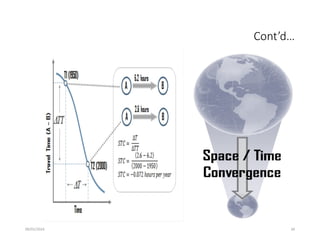
  • 114.
    09/01/2024 114 Cont’d… • Forplanar graphs (For non-planar graphs) • Figure: Alpha index (planar graph)
  • 115.
    09/01/2024 115 Cont’d… • H.Gamma Index (g): A measure of connectivity that considers the relationship between the number of observed links and the number of possible links. • The value of gamma is between 0 and 1 where a value of 1 indicates a completely connected network and would be extremely unlikely in reality.
  • 116.
    09/01/2024 116 Cont’d… • Gammais an efficient value to measure the progression of a network in time. • (For planar graphs) (For non-planar
  • 117.
  • 118.
    09/01/2024 118 Chapter 3: Transportation Modes: An Overview Introduction: • Transportation modes are an essential component of transport systems since they are the means by which mobility is supported. • Geographers consider a wide range of modes that may be grouped into three broad categories based on the medium they exploit: land, water and air. • Each mode has its own requirements and features, and is adapted to serve the specific demands of freight and passenger traffic.
  • 119.
    09/01/2024 119 Cont’d… • Thisgives rise to marked differences in the ways the modes are deployed and utilized in different parts of the world. • Recently, there is a trend towards integrating the modes through intermodality and linking the modes ever more closely into production and distribution activities. • At the same time, however, passenger and freight activity is becoming increasingly separated across most modes.
  • 120.
  • 121.
  • 122.
    09/01/2024 122 A diversityof modes • Transport modes: are the means by which people and freight achieve mobility. • They fall into one of three basic types, depending on what surface they travel over: land (road, rail and pipelines), water/maritime (shipping ), and air. • Each mode is characterized by a set of technical, operational and commercial characteristics (see Figure 3.1).
  • 123.
    09/01/2024 123 Cont’d… • Figure3.1 Performance comparison for selected freight modes
  • 124.
    09/01/2024 124 Road transportation •This has become the dominant land transport system today. • Automobiles, buses and trucks require a road bed. • Such infrastructures are moderately expensive to provide, but there is a wide divergence of costs, from a gravel road to a multi-lane urban expressway.
  • 125.
    09/01/2024 125 Cont’d… • Becausevehicles have the means to climb moderate slopes, physical obstacles are less important than for some other land modes. • Most roads are provided as a public good by governments, while the vast majority of vehicles are owned privately. • The capital costs, therefore, are shared, and do not fall as heavily on one source as is the case for other modes.
  • 126.
    09/01/2024 126 Cont’d… • Allroad transport modes have limited abilities to achieve scale economies. • Road transport, however, possesses significant advantages over other modes. • The capital cost of vehicles is relatively small. • the high relative speed of vehicles • flexibility of route choice
  • 127.
    09/01/2024 127 Rail transportation •The initial capital costs are high because the construction of rail tracks and the provision of rolling stock are expensive. • The ability of trains to haul large quantities of goods and significant numbers of people over long distances is the mode’s primary asset. • Rail transport is a “green” system, in that its consumption of energy per unit load per km is lower than road modes.
  • 128.
    09/01/2024 128 Cont’d… • plate3-4 test running of the Addis Ababa Light Rail system, 2015
  • 129.
    09/01/2024 129 Economic Rationaleof Rail Transportation Market Area Longest service area for inland transport (average length of 1,300 km). Service both the passengers and freight markets. Intermodal integration favored market segmentation and specialization Capacity A wagon can carry 50 to 100 tons of freight. Economies of scale (unit trains and double stacking). Costs High construction and maintenance costs. High operating costs: labor (60%), locomotives (16%) and fuel & equipment (24%). Shipping costs decrease with distance and load. Transshipments and train assembly increase costs.
  • 130.
    09/01/2024 130 Cont’d… Benefits Acceleratedindustrialization. Support agricultural and energy supply systems. Intermodal connecting with international trade. Regulations Conventionally highly dependent from government subsidies. Governments financing, mainly for the sake of national economic imperatives. From regulation to deregulation. Private ownership and operations.
  • 131.
    09/01/2024 131 Pipeline • Pipelinesare an extremely important and extensive mode of land transport
  • 132.
    09/01/2024 132 Air Transport AnEthiopia Airlines Aircraft
  • 133.
    09/01/2024 133 Cont’d… • Airtransport, compared with other modes, has the obvious advantage of speed. • Like maritime transport, the airline industry is highly capital intensive. • Air transport makes use of air space that theoretically gives it great freedom of route choice. • In 1944, an International Convention was held in Chicago to establish the framework for all future bilateral and multilateral agreements for the use of international air spaces.
  • 134.
    09/01/2024 134 Cont’d… • Fivefreedom rights were designed, but a multilateral agreement went only as far as the first two freedoms (right to over-fly and right to make a technical stop). • The 1944 Convention has been extended since then, there are currently nine different freedoms: • First Freedom: The right to fly from a home country over another country (A) en-route to another (B) without landing. Also called the transit freedom.
  • 135.
    09/01/2024 135 Cont’d… Second Freedom:The right for a flight from a home country to land in another country (A) for purposes other than carrying passengers, such as refueling, maintenance or emergencies. The final destination is country B. Third Freedom :The right to carry passengers from a home country to another country (A) for purpose of commercial services. Fourth Freedom :The right to fly from another country (A) to a home country for purpose of commercial services. Note that: The Third and Fourth Freedoms are the basis for direct commercial services, providing the rights to load and unload passengers, mail and freight in another country.
  • 136.
    09/01/2024 136 Cont’d… Fifth Freedom:This freedom enables airlines to carry passengers from a home country to another intermediate country (A), and then fly on to a third country (B) with the right to pick up passengers in the intermediate country. Also referred to as “beyond right”. Sixth Freedom: Not formally part of the original 1944 convention, it refers to the right to carry passengers between two countries (A and B) through an airport in the home country.
  • 137.
    09/01/2024 137 Cont’d… Seventh Freedom:Covers the right to operate a passenger service between two countries (A and B) outside the home country. Eighth Freedom. It involves the right to move passengers on a route from a home country to a destination country (A) that uses more than one stop along which passengers may be loaded and unloaded. Also called as “cabotage” privileges. Ninth Freedom: It involves the right of a home country to move passengers within another country (A). Also referred to as “full cabotage” or “open-skies” privileges.
  • 138.
  • 139.
    09/01/2024 139 Maritime Transport •tt An Ethiopian Shipping fines ship
  • 140.
    09/01/2024 140 Modal Competition=B&C • A general analysis of transport modes reveals that they each possess key operational and commercial advantages and properties. • Modes can compete or complement each other in terms of cost, speed, reliability, frequency, safety, comfort, etc. • Cost is one of the most important considerations in the choice of mode.
  • 141.
    09/01/2024 141 Cont’d… • Becauseeach mode has its own price/performance profile, the actual competition between the modes depends primarily upon the distance traveled, the quantities that have to be shipped and the value of the goods. • Thus, while maritime transport might offer the lowest variable costs, over short distances and for small bundles of goods, road transport tends to be most competitive.
  • 142.
    09/01/2024 142 Distance, ModalChoice and Transport Costs
  • 143.
    09/01/2024 143 Cont’d… • Althoughintermodal transportation has opened many opportunities for a complementarity between modes, there is intense competition as companies are now competing over many modes in the transport chain. • A growing paradigm thus involves supply chain competition with the modal competition component occurring over three dimensions: Modal usage. Competition that involves the comparative advantage of using a specific or a combination of modes. Distance remains one of the basic determinants of modal usage for passenger transportation.
  • 144.
    09/01/2024 144 Cont’d… • However,for a similar distance, costs, speed and comfort can be significant factors behind the choice of a mode. Infrastructure usage. Competition resulting from the presence of freight and passenger traffic on the same itineraries linking the same nodes. • Each level of capacity used by a mode is therefore at the expense of the other mode. Market area. Competition being experienced between transport terminals for using new space (terminal relocation or expansion) or capturing new markets (hinterland).
  • 145.
    09/01/2024 145 Forms ofModal Competition
  • 146.
    09/01/2024 146 Modal Competitionand Complementarity, shift along the corridor
  • 147.
    09/01/2024 147 Inter-modalism • Asystem of transport whereby two or more modes of transport are used to transport the same loading unit or truck in an integrated manner, without loading or unloading, in a transport chain. • Typically used in three contexts: a) Most narrowly, it refers to containerization, piggyback service, or other technologies that provide the seamless movement of goods and people by
  • 148.
    09/01/2024 148 Cont’d… more thanone modes of transportation. More broadly, intermodalism refers to the provision of connections between different modes, such as adequate highways to ports or bus feeder services to rail transit. In its broadest interpretation, intermodalism refers to a holistic view of transportation in which individual modes work together or within their own niches
  • 149.
    09/01/2024 149 Cont’d… to providethe user with the best choices of service, and in which the consequences on all modes of policies for a single mode are considered. • This view has been called balanced, integrated, or comprehensive transportation in the past.
  • 150.
    09/01/2024 150 Intermodalism andTransmodalism, Modal competition,complementarity, and shift
  • 151.
    09/01/2024 151 Inter-modalism, theContainer and maritime Transport • Inter-modalism originated in maritime space, with the development of the container and then spread to other modes. • Maritime sector should have been the first mode to pursue containerization. • Containerization permits the mechanized handling of cargoes. • There are numerous advantages of using containers in the international transport.
  • 152.
    09/01/2024 152 Advantages ofContainerization Factor Advantage Standard transport product International Standards Organization (ISO) standard. Specialized ships, trucks and wagons. Unique identification number and size type code. Flexibility of usage Commodities (coal, wheat), manufactured goods, cars, frozen products. Adapted containers for dry cargo, liquids (oil and chemical products) and refrigerated cargo. Reuse of discarded containers.
  • 153.
    09/01/2024 153 Cont’d… Costs Lowtransport costs; 20 times less than bulk transport. Economies of scale at modes and terminals Velocity Fast transshipment operations. Low terminal turnaround times (port time reduced from 3 weeks to about 24 hours). Warehousing Own warehouse; Simpler and less expensive packaging. Stacking capability on ships, trains (doublestacking) and on the ground. Security and Safety Contents of the container is unknown to carriers. Can only be opened at the origin, at customs and at the destination. Reduced spoilage and losses (theft).
  • 154.
    09/01/2024 154 Challenges/disadvantages of Containerization FactorChallenge Site constraints Large consumption of terminal space (mostly for storage); move to urban periphery. Draft issues with larger containerships (more than 13 meters). Infrastructure costs Container handling infrastructures and equipment (giant cranes, warehousing facilities, inland road, rail access), are important investments Stacking Complexity of arrangement of containers, both on the ground and on modes (containerships and double- stack trains). Restacking difficult to avoid.
  • 155.
    09/01/2024 155 Cont’d… Empty movementsMany containers are moved empty (20% of all flows). Either full or empty, a container takes the same amount of space. Divergence between production and consumption; repositioning Theft and losses High value goods and a load unit that can opened or carried (on truck). Vulnerability between terminal and final destination. 10,000 containers are lost at sea each year (fall overboard). Illicit trade Common instrument used in the illicit trade of goods, drugs and weapons, as well as for illegal immigration. Concerns about the usage of containers for terrorism.
  • 156.
  • 157.
    09/01/2024 157 Common ISOContainer Size and Type Codes
  • 158.
    09/01/2024 158 Technical PerformanceIndicators=A&C • Geographers and economists use performance indicators to empirically assess the technical performance of different modes of transport,(i.e. their capacity to move goods or passengers around). • Hence, basic technical performance calculations can be particularly useful for networks’ global performance analysis
  • 159.
    09/01/2024 159 Cont’d… as wellas modal comparison, analysis, evaluation by bridging both physical attributes(length, distance, configurations, etc.) and time- based attributes (punctuality, regularity, reliance, etc.) of networks. • Some indicators are currently used to measure freight and passenger transport. • Table 3.1:commonly used performance indicators
  • 160.
  • 161.
    09/01/2024 161 Cont’d… • Passenger-kmor ton-km is standard units for measuring travel that consider the number of people travelling or ton output and distance travelled. • for example,120 passenger-km represents 10 passengers travelling 12 kilometers or 2 passengers travelling 60 kilometers and son on.
  • 162.
    09/01/2024 162 Economic ImpactIndicators • Economic impact indicators help to appreciate the relationship between transport systems and the economy as well as to inform bon the economic weight of this type of economy. • Geographers should be familiar with basic econometric impact indexes. • Efficiency : is the ratio of input to output, or the output per each unit of input.
  • 163.
    09/01/2024 163 Cont’d… • Modalvariations in efficiency will depend heavily on what is to be carried, the distance travelled, the degree and complexity of logistics required as well as economies of scale. • Freight transport chains rest up on the complementarity of cost- efficient and time-efficient modes, seeking most of the time a balanced compromise rather than an ideal or perfect equilibrium.
  • 164.
    09/01/2024 164 Cont’d… • Maritimetransport is the most cost-efficient way to transport bulk merchandise over along distances. Common economic impact indicators Factors of production Scale –specific indicators Micro Meso-macro Output/capita Transport sector income/local income Outtput/GDP Output/labor Output/local income -
  • 165.
    09/01/2024 165 Cont’d… • Onthe other hand, air transport is recognized for its unsurpassed time-efficiency than other modes over long distances, it remains an expensive option. • Thus, vertical integration, or the absorption of transportation activities by producers, the search for these two efficiency attributes by gaining direct control over inputs.
  • 166.
    09/01/2024 166 Chapter 4:Transport Terminals Introduction: All spatial flows, with the exception of personal vehicular and pedestrian trips, involve movements between terminals. With these two exceptions, all transport modes require assembly and distribution of their traffic, both passenger and freight. For example, passengers have to go to bus terminals and airports first in order to reach their final destinations, and freight has to be consolidated at a port or a rail yard before onward shipment. Terminals are, therefore, essential links in transportation chains. The goal of this chapter is to examine the strong spatial and functional character of transport terminals. They occupy specific locations and they exert a strong influence over their surroundings. At the same time they perform specific economic functions and serve as foci(central) for clusters of specialized services.
  • 167.
  • 168.
    09/01/2024 168 Definitions oftransport terminals Terminal can be defined as any facility where freight and passengers are assembled/ gathered or dispersed. They may be points of interchange involving the same mode of transport. Those are also points of interchange between different modes of transport. Transport terminals, therefore, are central and intermediate locations in the movements of passengers and freight.
  • 169.
    09/01/2024 169 Cont’d… Terminal: anylocation where freight and passengers either originate, terminates, or is handled in the transportation process. In order to carry out the transfer and manhandling of freight and passengers, specific equipment and infrastructures are required. Differences in the nature, composition and timing of transfer activities give rise to significant differentiations in the form and function between terminals. A basic distinction is between passenger and freight transfers, because in order to carry out the transfer and bundling of each type, specific equipment and infrastructures are required. Types of terminals 1. Passenger terminals: passenger terminals require relatively little specific equipment. Activities taking place in passenger terminals tend to be simple and require relatively little equipment.
  • 170.
    09/01/2024 170 Cont’d…  Airportterminals: Airports are of a different order. They are among the most complex of terminals functionally. Why Measurement: measuring activities in passenger terminals is generally straightforward. The most common indicator is the number of passengers handled, sometimes differentiated according to arrivals and departures. •Transfer passengers are counted twice (once on arrival, once on departure), and so airports that serve as major transfer facilities inevitably record high passenger totals. 2. Freight terminals: Freight handling requires specific loading and unloading equipment. •Terminals are differentiated functionally both by the mode involved and the commodities transferred.
  • 171.
  • 172.
    09/01/2024 172 Cont’d… A basicdistinction is that between bulk and general cargo: Bulk: refers to goods that are handled in large quantities that are unpackaged and are available in uniform dimensions. E.g. Liquid bulk goods: crude oil and refined products. Dry bulk goods: ores, coal and cereals. General cargo: refers to goods that are of many shapes, dimensions and weights, such as machinery and parts. Because the goods are so uneven and irregular, handling is difficult to mechanize. General cargo handling usually requires a lot of labor/labor intensive. A feature of most freight activity is the need for storage.
  • 173.
    09/01/2024 173 Cont’d… Assembling theindividual bundles of goods may be time-consuming and thus some storage may be required. Freight terminals require specialized infrastructures such as grain silos, storage tanks, and refrigerated warehouses, or simply space to stockpile. Measurement of freight traffic through terminals is more complicated than for passengers. Because freight is so diverse, standard measures of weight and value are difficult to compare and combine. What are terminal costs? Why are there different types of terminal costs? Terminal costs: since terminals perform transfer and consolidation functions, they are important economically because of the costs incurred in carrying out these activities. Terminal costs represent an important component of total transport costs.
  • 174.
    09/01/2024 174 Cont’d… They arefixed costs that are incurred regardless of the length of the eventual trip, and vary significantly between the modes. They can be of three types: Infrastructure costs: Include construction and maintenance costs of facilities such as piers (for landing), runways, cranes and structures (warehouses, offices, etc.). Transshipment costs: the costs of loading and unloading passengers or freight. Administration costs: many terminal facilities are managed by institutions such as port or airport authorities or by private companies. In both cases administration costs are incurred. Because ships have the largest carrying capacities, they incur the largest terminal costs, since it may take many days to load or unload a vessel.
  • 175.
  • 176.
    09/01/2024 176 Cont’d… Conversely, atruck or a passenger bus can be loaded much more quickly, and hence the terminal costs for road transport are the lowest. Terminal costs play an important role in determining the competitive position between the modes. Because of their high freight terminal costs, ships and rail are unsuitable for short-haul trips. • Figure 4.1 represents a simplified assumption concerning transport costs for three modes. • It should be noticed that the cost curves all begin at some point up the cost axis. • This represents terminal costs, and as can be seen, shipping (T3) and rail (T2) start with a significant disadvantage compared with road (T1).
  • 177.
    09/01/2024 177 Cont’d… Competition betweenthe modes is frequently measured by cost comparisons. Efforts to reduce transport costs can be achieved by using the following techniques: Fuel-efficient vehicles, Large size of ships, and Reducing the labor employed on trains Over the last fourty years, very significant steps to reduce terminal costs have been made.
  • 178.
  • 179.
    09/01/2024 179 Cont’d… These haveincluded introducing information management systems such as EDI (electronic data interchange) that have greatly speeded up the processing of information, removing delays typical of paper transactions. The most significant development has been the mechanization of loading and unloading activities/tasks. Mechanization has been facilitated by the use of units of standard dimensions such as the pallet and most importantly, the container . The container, in particular, has revolutionized terminal operations.
  • 180.
  • 181.
    09/01/2024 181 Terminals andlocation Location and spatial relations play a significant role in the performance and development of transport terminals. There are two components/dimensions involved: site, or absolute location and relative location. Site/absolute location: Terminals occupy very specific sites, usually with stringent/strict requirements. Their site determinants may play an important role in shaping performance. Relative location: It refers to the position of places (terminals) with regard to other places. The spatial relations of terminals are an extremely important factor in shaping competition. Together, absolute and relative locations provide justification for the fundamental significance of geography in understanding transport terminals.
  • 182.
    09/01/2024 182 Terminals locationsare determined on the basis of: a) The modes they serve and the types of activities carried on. b) The period of time when site development take place

  • 183.
    09/01/2024 183 The Evolutionof a Port Port sites evolve through 3 developmental phases setout below. Setting: The initial setting of a port is strongly dependent on geographical considerations. Expansion: is the expansion of terminal , and construction jetties to handle the growing amounts of freight and passengers as well as larger ships. Specialization: the construction of specialized piers to handle freight such as containers, ores, grain, petroleum and coal (4), which expanded warehousing needs significantly. Larger high-capacity ships often required dredging or the construction of long jetties, granting access to greater depths.
  • 184.
  • 185.
    09/01/2024 185 Cont’d…. • Figure4.2: The evolution of a port (based on the Anyport model)
  • 186.
    09/01/2024 186 Hinterland andforeland One of the most continuing concepts in transport geography, especially applied to ports, is the hinterland. Hinterland: It refers to the market area of ports, the land areas from which the port draws and distributes traffic. Two types of hinterlands: Natural/primary and competitive. 1. Natural or primary hinterland: refers to the market area for which the port is the closest terminal. It is assumed that this zone’s traffic will normally pass through the port, because of geographical proximity/nearness.
  • 187.
    09/01/2024 187 Cont’d… 2. Competitivehinterland: is used to describe the market areas over which the port has to compete with other terminals for business (see Figure 4.3 on next slide ). • Figure 4.3 Natural and competitive hinterlands
  • 188.
    09/01/2024 188 The hinterland Hinterland:is a land space over which a transport terminal (port), sells its services and interacts with its clients. It accounts for the regional market share that a terminal has relative to a set of other terminals servicing this region. It regroups all the customers directly bounded to the terminal. The terminal, depending on its nature, serves as a place of convergence for the traffic coming by roads, railways or by sea/fluvial feeders. Foreland: is the ocean ward mirror of hinterland, referring to the ports and overseas markets linked by shipping services from the port
  • 189.
    09/01/2024 189 Cont’d… • Itis a maritime space with which a port performs commercial relationships. • It includes overseas customers with which the port undertakes commercial exchanges(see figure 4. 4 below showing Port foreland and hinterland).
  • 190.
    09/01/2024 190 Terminals andsecurity In the freight industry, security concerns focuses on two areas: a) worker safety and b) Theft. A)worker safety significant improvements have been made over the years through workers education and better organization of operations, but freight terminals are still comparatively dangerous areas. b) Theft. The issue of theft has also been one of the most severe problems confronting all types of freight terminals, especially where high value goods are being handled. Passengers Terminals Airports have been the focus of security concerns for many decades. Hijacking aircraft started in the 1970s, when terrorist groups in the Middle East exploited the lack of security to seize planes for money and publicity. Freight Terminals Security in the freight industry has always been a major problem. Illegal immigrants, drug smuggling, piracy, and the deployment of sub-standard vessels have been some of the most important concerns.
  • 191.
    09/01/2024 191 Indices measuringthe Distribution Pattern of terminal Traffic •Different methods are used to measure the distribution pattern of different traffic terminals. These are: a) The Gini Coefficient b) Delphi forecasting and c) The location coefficient
  • 192.
    09/01/2024 192 a) TheGini Coefficient The Gin coefficient was developed to measure the distribution pattern of different human and physical phenomena. It compares the Lorenz curve of a ranked empirical distribution with the line of perfect equality. The line of perfect equality assumes that each element has the same contribution to the total summation of the values of a variable. The value of Gin coefficient ranges between 0, where there is no concentration (perfect equality) and 1, where there is total concentration (perfect inequality).
  • 193.
    09/01/2024 193 II) DelphiForecasting Unlike many other methods that use so-called objective predictions involving quantitative analysis. The Delphi method is based on expert opinions. The selection of experts is, therefore, one of the tasks in Delphi forecasting. The persons invited to participate must be knowledgeable about the issue, and represent a variety of backgrounds. The number of experts must not be too small to make the assessment too narrowly based, nor too large to be difficult to coordinate. It is widely considered that 10 to 15 experts can provide a good base for the forecast.
  • 194.
    09/01/2024 194 III) LocationCoefficient Dear learner, location coefficient is also one of the indices used to measure degree of specialization of transport terminals in transporting commodities.  Certain kinds of merchandise are often transshipped at particular terminals rather than at others. Thus, the degree of concentration of a certain type of traffic in a terminal (port, airport, train station) compared with the average for all the terminals, can be measured by using the location coefficient.
  • 195.
    09/01/2024 195 Chapter Five:International and Regional Transportation Globalization is not a new phenomenon either- “what is new is the speed, the scale, the scope and the complexity of global connections today. Globalization is significantly shaping the socio-economic, political and cultural development of both nations and cities worldwide.
  • 196.
    09/01/2024 196 The Drivers/facilitatorsof Globalization Integration: Regulatory chains, harmonization of regulatory régimes, Trade agreements). Production: this include among others(supply chains, offshoring, global production networks). Transportation: this include;transport chains, containerisation, Transborder transportation among others. Transaction: Information chains (ICT),Capital for investments, credit for transactions.
  • 197.
    09/01/2024 197 Economic Rationaleof Trade Without Trade: Small national markets. Limited economies of scale. High prices and near monopoly. Limited product diversity. Different standards. With Trade Increased competition. Economies of scale. Specialization. Lower prices. Interdependencies
  • 198.
    09/01/2024 198 Changes inthe Global Trade Environment Stage Nature Function Until the 1970s Immobile factors of production Cope with scarcity Late 20th century Mobility of factors of production Promote economic efficiency Early 21st century Global production networks Added value within commodity chains
  • 199.
  • 200.
    09/01/2024 200 The ValueChain (or Commodity Chain) Commodities: are resources that can be consumed. They can be accumulated for a period of time while some are perishable while others can be stored for centuries, exchanged as part of transactions or purchased on specific markets. some commodities are fixed, hence can’t be transferred except for the title. • E.g. land, mining, lodging(housing), and fishing rights. Bulk commodities: are commodities that can be transferred (e.g. grain, metals, livestock, oil, cotton, coffee, sugar, etc.). Their value is derived from utility, supply and demand.
  • 201.
    09/01/2024 201 Cont’d… Commodity chain:A functionally integrated network of production, trade and service activities that covers all the stages in a- supply chain, from the transformation of raw materials, through intermediate manufacturing stages, to the delivery of a finished good to a market. The chain is conceptualized as a series of nodes, linked by various types of transactions, such as sales and intra-firm transfers. Each successive node within a commodity chain involves the acquisition or organization of inputs for the purpose of added value.
  • 202.
  • 203.
    09/01/2024 203 Global ProductionNetworks • The presence of an efficient distribution system supporting Global commodity chains (alternatively known as global production networks) is sustained by:
  • 204.
    09/01/2024 204 Cont’d… • Geographicalintegration: • Functional integration:
  • 205.
    09/01/2024 205 Spatial Interaction(SI): An Overview One methodology of particular importance to transport geography relates to how to estimate flows between locations, since these flows, known as spatial interactions, enable to evaluate the demand (existing or potential) for transport services. A spatial interaction is a recognized movement of people, freight or information between an origin and a destination. It is a transport demand/supply relationship expressed over a geographical space. Spatial interactions cover a wide variety of movements such as journeys to work, migrations, tourism, the usage of public facilities, the transmission of information or capital, the market areas of retailing activities, international trade and freight distribution. Economic activities are generating (supply) and attracting (demand) flows.
  • 206.
    09/01/2024 206 Cont’d… A movementoccur between an origin and a destination underlines that the costs incurred by a spatial interaction are lower than the benefits derived from such an interaction. The three interdependent conditions necessary for a spatial interaction to occur are : complementarity, intervening opportunity, transferability. 1. Complementarity oThere must be a supply and a demand between the interacting locations. oA residential zone is complementary to an industrial zone because the first is supplying workers while the second is supplying jobs. oThe same can be said concerning the complementarity between a store and its customers and between an industry and its suppliers (movements of freight).
  • 207.
    09/01/2024 207 Cont’d… •If locationB produces /generates something that location A requires, then an interaction is possible because a supply/ demand relationship has been established between those two locations; they have become complementary to one another. •The same applies in the other direction (A to B), which creates a situation of reciprocity (exchange) common in commuting or international trade.
  • 208.
    09/01/2024 208 Cont’d… 2. Interveningopportunity  There must not be another location that may offer a better alternative as a point of origin or as a point of destination. For instance, in order to have an interaction of a customer to a store, there must not be a closer store that offers a similar array of goods. If location C offers the same characteristics (namely complementarity) as location A and is also closer to location B, an interaction between B and A will not occur and will be replaced by an interaction between B and C.
  • 209.
    09/01/2024 209 Cont’d… 3. Transferability Freight,persons or information being transferred must be supported by transport infrastructures, implying that the origin and the destination must be linked.  Costs to overcome distance must not be higher than the benefits of related interaction, even if there is complementarity and no alternative opportunity.  Transport infrastructures (modes and terminals) must be present to support an-Interaction between B and A.  Also, these infrastructures must have a capacity and availability which are compatible with the requirements of such an interaction.  The goal of spatial interactions is to explain spatial flows.  They provide ways to measure flows and predict the consequences of changes in the conditions generating them.
  • 210.
    09/01/2024 210 Cont’d… • Whensuch attributes are known, it is possible to better allocate transport resources such as highways, buses, airplanes or ships. • Figure 5.2 Conditions for the realization of a spatial interaction
  • 211.
    09/01/2024 211 Origin/destination matrix Eachspatial interaction, as an analogy for a set of movements, is composed of an origin/ destination pair. Each pair can itself be represented as a cell in a matrix where rows are related to the locations (centroids) of origin, while columns are related to locations (centroids) of destination. Such a matrix is commonly known as an origin/destination matrix, or a spatial interaction matrix.
  • 212.
  • 213.
  • 214.
    09/01/2024 214 The spatialinteraction model/SIM=B&C, A&C The basic assumption concerning many spatial interaction models is that flows are a function of the attributes of the locations of origin, the attributes of the locations of destination and the friction of distance between the concerned origins and destinations. The general formulation of the spatial interaction model is as follows (Figure 5.3). ; where: Tij = interaction between location i (origin) and location j (destination). Its units of measurement are varied and can involve people, tons of freight, traffic volume, etc. It also concerns a time period such as interactions by the hour, day, month, or year.
  • 215.
    09/01/2024 215 Cont’d… Vi =attributes of the location of origin i. Variables often used to express these attributes are socio-economic in nature, such as population, number of jobs available, industrial output or gross domestic product. Wj = attributes of the location of destination j. It uses similar socio-economic variables to the previous attribute. Sij = attributes of separation between the location of origin i and the location of destination j. Also known as transport friction. Variables like distance, transport costs, or travel time are often used to express these attributes. The attributes of V and W tend to be paired to express complementarity in the best possible way.
  • 216.
    09/01/2024 216 Cont’d… For instance,measuring commuting flows (work-related movements) between different locations would likely consider a variable such as working age population as V and total employment as W. From this general formulation, three basic types of interaction models can be constructed: Gravity model, Potential model, and Retail model. Except Gravity model, the remaining two models (Potential and Retail models are reserved for assignment). The gravity model: and its formulation: The gravity model is one of the most important spatial interaction methods. It is named as such because it uses a similar formulation to Newton’s gravitation model.
  • 217.
    09/01/2024 217 Cont’d… Accordingly, theattraction between two objects is proportional to their mass and inversely proportional to their respective distance. Consequently, the general formulation of spatial interactions can be adapted to reflect this basic assumption to form the elementary formulation of the gravity model: Tij Where: Pi and Pj = the importance of the location of origin i and the location of destinationj. dij = the distance, or any measure related to the friction of space, between the location of origin and the location of destination. k = a proportionality constant related to the temporal rate of the event being measured.
  • 218.
    09/01/2024 218 Cont’d… For instance,if the same system of spatial interactions is considered, the value of k will be higher if interactions are considered for a year instead of a week. Thus, spatial interactions between locations i and j are proportional to their respective importance divided by their distance.
  • 219.
    09/01/2024 219 Cont’d…  Gravity Modelmeasures interactions between all the possible location pairs.  The level of interaction between two locations is measured by multiplying their attributes, which is then divided by their level of separation.  Separation is often squared to reflect the growing friction of distance. On Figure 5.4, two locations (i and j) have respective “weights” (importance) of 35 and 20 and are at a distances (degree -separation) of 8.  The resulting interaction is 10.9, which is reciprocal.
  • 220.
  • 221.
    09/01/2024 221 Chapter Six:Urban Transportation Introduction: Urbanization: is the process of transition from rural to more urban society. statistically, urbanization reflects an increasing proportion of the population living in settlements defined as urban. This is the outcome of three main demographic trends: Natural increase, rural-urban migration, international migration.
  • 222.
    09/01/2024 222 Transportation, UrbanForm And Spatial Structure Transportation in urban areas in highly complex because of the modes involved the multitude of origins and destinations, and the amount and variety of traffic.  At the urban level, demographic and mobility growth have been shaped by the capacity and requirements of urban transport infrastructures, be they roads, transit systems or simply walkways. Elements of the urban form: Urban form: is the spatial imprint (sign) of an urban transport system as well as the adjacent / neighborhood physical infrastructures. Jointly, they confer a level of spatial arrangement to cities. Urban (spatial) structure: it refers to the set of relationships arising out of the urban form and its underlying interactions of people, freight and information.
  • 223.
    09/01/2024 223 Cont’d… • Figure61:the spatial imprint of an urban transport system
  • 224.
    09/01/2024 224 Cont’d… The urbanform and its spatial structure are articulated by two structural elements: Nodes and Linkages. Nodes: These are reflected in the centrality of urban activities, which can be related to the spatial accumulation of economic activities or the accessibility to the transport system. Terminals, such as ports, rail yards and stations, and airports, are important nodes around which activities agglomerate at the local or regional level. Linkages: These are the infrastructures supporting flows from, to and between nodes.
  • 225.
    09/01/2024 225 Categories ofurban transportation Urban transportation is organized in three broad categories of collective, individual and freight transportation. 1.Collective transportation (public transit): its purpose is to provide publicly accessible mobility over specific parts of a city. Its efficiency is based upon transporting large numbers of people and achieving economies of scale. It includes modes such as tramways, buses, trains, subways and ferryboats.
  • 226.
    09/01/2024 226 Cont’d… 2. Individualtransportation: it includes any mode where mobility is the outcome of a personal choice and means such as the automobile, walking, cycling and the motor-cycle. The majority of people walk to satisfy their basic mobility but this number varies according to the city considered. For instance, walking accounts for 88% of all movements inside Tokyo while this figure is only 3% for Los Angeles. 3. Freight transportation: As cities are dominant centers of production and consumption, urban activities are accompanied by large movements of freight. Those movements are mostly characterized by delivery trucks moving between industries, distribution centers, ware houses and retail activates as well as from major terminals such as ports, rail yards, distribution centers and airports.
  • 227.
    09/01/2024 227 cont’d… • Fig6.1Figure6.2 Transportation and urban form
  • 228.
    09/01/2024 228 Nodes, Linkagesand Urban Form • Fig 6.3 interaction between nodes, linkages and urban form
  • 229.
    09/01/2024 229 The SpatialImprint of Urban Transportation • The amount of urban land allocated to transportation is often correlated with the level of mobility. • The major components of the spatial imprint of urban transportation are: Pedestrian areas: the amount of space devoted to walking. This space is often shared with roads as sidewalks may use between 10 and 20 percent of a road’s right of way. Roads and parking areas :The amount of space devoted to road transportation, which has two states of activity: moving or parked. In a motorized city, on average 30 percent of the surface is devoted to roads while another 20 percent is required for off-street parking. Cycling areas: cycling simply shares access to road space and many attempts have been made to create spaces specifically for bicycles in urban areas.
  • 230.
  • 231.
  • 232.
    09/01/2024 232 Cont’d…. Transit systems:many transit systems, such as buses and tramways, share road space with automobiles, which often impairs their respective efficiency. Transport terminals: the amount of space devoted to terminal facilities such as ports, airports, transit stations, rail yards and distribution centers.
  • 233.
    09/01/2024 233 Transportation andLand Use Model (TLUM) The land use – transport system: The typology of land use can be of two types: formal and functional. Formal land use: representations are concerned with qualitative attributes of space such as its form, pattern and aspect and are descriptive in nature. Functional land use: representations are concerned with the economic nature of activities such as production, consumption, residence, and transport, and are mainly a socio-economic description of space.
  • 234.
    09/01/2024 234 Cont’d… • Fig6.4 Transportation, activity systems and land use
  • 235.
    09/01/2024 235 Chicken- EggIssue Transportation and land use interactions have often been described as a chicken-and-egg problem since it is difficult to identify the triggering cause of change.
  • 236.
  • 237.
    09/01/2024 237 Cont’d… • Atransportation/land use system can be divided into three subcategories of models: (Land use models, Spatial interactions models and Transportation network models).
  • 238.
    09/01/2024 238 Urban landuse models • Several descriptive and analytical models of urban land use have been developed. • All involve some consideration of transport in the explanations of urban land use structure: these models are a) Von Thunen’s regional land use model b) The Burgess concentric model c) Sector and nuclei land use models d) Hybrid models e) Land rent theory
  • 239.
    09/01/2024 239 Urban mobility •Urban movements are either obligatory, when they are linked to scheduled activities (such as home-to-work movements), or voluntary, when those generating it are free to decide their scheduling (such as leisure). • The most common types of urban movements are: Pendular movements: are obligatory movements involving commuting between locations of residence and work.
  • 240.
    09/01/2024 240 Cont’d… they arecyclical they are predictable and  recur on a regular basis of a daily occurrence. Professional movements: are linked to professional, work-based activities such as meetings and customer services, dominantly taking place during work hours.
  • 241.
    09/01/2024 241 Cont’d… Personal movements:are voluntary movements linked to the location of commercial activities, which includes shopping and recreation. Touristic movements: involve interactions between landmarks and amenities such as hotels and restaurants. They are seasonal in nature or occur at specific moments. e.g. World Cup or the Olympics.
  • 242.
    09/01/2024 242 Cont’d… Distribution movements:are concerned with the distribution of freight to satisfy consumption and manufacturing requirements. • They are linked to distribution centers and retail outlets.
  • 243.
    09/01/2024 243 Types ofUrban Movements Movement Type Pattern Dominant Time Destination Pendular Structured Morning and afternoon Localized (employment) Professional Varied Workdays Localized Personal Structured Evening Varied with some foci Touristic Seasonal Day Highly localized Distribution Structured Nighttime Localized
  • 244.
    09/01/2024 244 Urban transportproblems Geographical challenges facing urban transportation: Among the most notable urban transport problems are: Traffic congestion and parking difficulties: congestion is the situation in which transport demand exceeds transport supply in a specific section of the transport system. Public transport inadequacy/shortage Difficulties for pedestrians
  • 245.
    09/01/2024 245 Cont’d… Loss ofpublic space Environmental impacts and energy consumption (chapter 8). Accidents and safety (free from violence). Land consumption: about 30-60 % of land is devoted to transport in metropolitan areas. Freight distribution
  • 246.
    09/01/2024 246 The Lowrymodel • Considered to be the first transportation/land use model (1964), it links two spatial interaction components. • The first calculates spatial interactions between basic employment activities and zones of residence, while the second calculates spatial interactions between service employment activities and zones of residence (see Figure 6.5 below).
  • 247.
    09/01/2024 247 Cont’d… • Thecore of the model is exogenous, derived from a regional economic model, where the location of basic (industrial) employment is inputted. • Fig 6.5 Lowry-type transportation/land use model
  • 248.
    09/01/2024 248 Chapter Seven:Economic and Spatial Structure of Transport Systems Introduction: • Transport systems are closely related to socio-economic changes. • The mobility of people and freight and levels of territorial accessibility are at the core of this relationship. • Economic opportunities are likely to arise where transportation infrastructures are able to answer mobility needs and insure access to markets and resources.
  • 249.
    09/01/2024 249 Cont’d… • Fromthe industrial revolution in the 19th century to globalization and economic integration processes of the late 20th century, regions of the world have been affected differently by economic development. • International, regional and local transportation systems alike have become fundamental components of economic activities.
  • 250.
    09/01/2024 250 Cont’d… • Agrowing share of the wealth is thus linked to trade and distribution. • However, even if transportation has positive impacts on socio- economic systems, there are also negative consequences such as congestion, accidents and mobility gaps.
  • 251.
    09/01/2024 251 Transport andeconomic development •The economic importance of transportation: The transport sector is an important component of the economy, impacting on development and the welfare of populations. •When transport systems are efficient, they provide economic and social opportunities and benefits that impact throughout the economy. •When transport systems are deficient, they can have an economic cost in terms of reduced or missed opportunities.
  • 252.
    09/01/2024 252 Cont’d… •From ageneral standpoint, the economic impacts of transportation can be direct and indirect: •Direct impacts: related to accessibility change where transport enables larger markets and enables to save time and costs. •Indirect impacts: related to the economic multiplier effect where the price of commodities drop and/or their variety increases.
  • 253.
    09/01/2024 253 Table 7.1Economic benefits of transportation
  • 254.
    09/01/2024 254 Cont’d… • Atthe macroeconomic level (the importance of transportation for a whole economy), transportation and the mobility it confers are linked to a level of output, employment and income within a national economy. • In many developed countries, transportation accounts for between 6 and 12 percent of the GDP.
  • 255.
    09/01/2024 255 Cont’d…. • Atthe microeconomic level (the importance of transportation for specific parts of the economy), transportation is linked to producer, consumer and production costs. • The importance of specific transport activities and infrastructure can thus be assessed for each sector of the economy. • Transportation accounts for on average between 10 and 15 percent of household expenditure while it accounts for around 4 percent of the costs of each unit of output in manufacturing.
  • 256.
    09/01/2024 256 Socio-economic impacts •While many of the economic impacts of transportation are positive, there are also significant negative impacts that are assumed by individuals or by the society in one way or another. • Among the most significant are: Mobility gaps: b/n poor, medium and rich Costs differences: Locations that have low levels of accessibility tend to have higher costs for many goods Congestion
  • 257.
    09/01/2024 257 Cont’d… Accidents Air quality Noise Waterquality Land take/land consumption: Transport is a large consumer of space when all of its supporting infrastructure and equipment are considered.
  • 258.
    09/01/2024 258 Transport andspatial organization=B$C • transport networks have structured space on different scales. • The fragmentation of production and consumption, the locational specificities of resources, labor and markets generate a wide array of flows of people, goods and information. • Transportation not only stimulates economic development but also helps structure space.
  • 259.
    09/01/2024 259 Cont’d… • Spaceshapes transport as much as transport shapes space. • The relationship between transport and spatial organization can be considered on three major geographical scales: the global, the regional and the local.
  • 260.
    09/01/2024 260 Global spatialorganization • At the global level, transportation supports and shapes economic specialization and productivity through international trade . • Improvements in transport are expanding markets and development opportunities, but not uniformly. • The inequalities of the global economy are reflected in its spatial organization and transport systems.
  • 261.
    09/01/2024 261 Cont’d… • Thepatterns of globalization have created a growth in spatial flows and increased interdependencies. • Telecommunications, maritime transport and air transport support the majority of global flows. • The nature and spatial structure of these flows can be considered from two major perspectives that seek to explain global differences in growth and accessibility:
  • 262.
    09/01/2024 262 Scales ofSpatial Organization for Transportation • Fig7.1:
  • 263.
    09/01/2024 263 Core /Periphery Division of the World • the global spatial organization favors a few core areas that grow faster than the periphery. • This differential growth in time creates acute inequalities in levels of development. • Transportation is thus perceived as a factor of polarization and unequal development.
  • 264.
    09/01/2024 264 Cont’d… • Fromthis perspective, parts of the global economy are gaining, because they are more accessible, while other are marginalized and bound to dependency. • Poles: Transportation is perceived as a factor of articulation in the global economy where the circulation of passengers and freight is regulated by poles corresponding to a high level of accumulation of transport infrastructures,
  • 265.
    09/01/2024 265 Cont’d… • Thesepoles are subject to centrifugal and centripetal forces that have favored the geographical concentration of some activities and the dispersion of others. • Global flows are handled by the gateways of the global economy , each of which accounts for a significant share of the flows of people, freight and information. • Gateway: A location offering accessibility to a large system of circulation of freight and passengers.
  • 266.
    09/01/2024 266 Cont’d… • Gatewaysreap the advantages of a favorable physical location such as highway junctions, the confluence of rivers, a good port site, and have been the object of a significant accumulation of transport infrastructures such as terminals and their links. • A gateway is commonly an origin, a destination and a point of transit.
  • 267.
    09/01/2024 267 Cont’d… • Itgenerally commands the entrance to and the exit from its catchment area. • In other words, it is a pivotal point for the entrance and the exit of merchandise in a region, a country, or a continent and often requires intermodal transfers. • However, services are following a spatial trend which appears to be the opposite of production.
  • 268.
    09/01/2024 268 Cont’d… • Asproduction disperses worldwide, services increasingly concentrate into a relatively few large metropolitan areas, labeled as world cities. • They are centers for financial services (banking, insurance), head offices of major multinational corporations and the seats of major governments. • Thus, gateways and world cities may not necessarily correspond as locations.
  • 269.
    09/01/2024 269 Cont’d… • Fig7.2’ Scales of spatial organization for transportation
  • 270.
    09/01/2024 270 Regional spatialorganization • Regions are commonly organized along an interdependent set of cities forming what is often referred to as an urban system. • The key spatial foundation of an urban system is based on a series of market areas, which are a function of the level of activity of each center divided by the friction of distance .
  • 271.
    09/01/2024 271 Cont’d… • Thespatial structure of most regions can be subdivided into three basic components: • A set of locations of specialized industries, • A set of service industry locations, • A pattern of transport nodes and links,
  • 272.
    09/01/2024 272 Cont’d… • Threeconceptual categories of regional spatial organization can be observed: a) Central places/urban systems models b) Growth poles c) Transport corridors • Central places/urban systems models: try to find the relationships between the size, the number and the geographic distribution of cities in a region.
  • 273.
  • 274.
    09/01/2024 274 Cont’d… • Growthpoles: where economic development is the structural change caused by the growth of new propulsive industries that are the poles of growth. • The location of these activities is the catalyst of the regional spatial organization. • Growth poles first initiate, then diffuse, development.
  • 275.
  • 276.
    09/01/2024 276 Cont’d… • Itattempts to be a general theory of the initiation and diffusion of development models. • Growth gets distributed spatially within a regional urban system, but this process is uneven with the core benefiting first and the periphery eventually becoming integrated in a system of flows.
  • 277.
    09/01/2024 277 Cont’d… • Inthe growth poles theory, transportation is a factor of accessibility which reinforces the importance of poles. • Transport corridors represent an accumulation of flows and infrastructures of various modes and their development is linked with economic, infrastructural and technological processes.
  • 278.
    09/01/2024 278 Cont’d… • Figt7.2Conceptual Corridor Development
  • 279.
    09/01/2024 279 Cont’d… • Fig7.3: Transport Corridors and the Regional Spatial Structure
  • 280.
    09/01/2024 280 Local spatialorganization • Although transport is an important element in rural spatial organization, it is at the urban level that transportation has the most significant local spatial impact. • Urbanization and transport are interrelated concepts (see chapter 6 for detail). • Every city relies on the need for mobility of passengers (residence, work, purchases, and leisure) and freight (consumption
  • 281.
    09/01/2024 281 Cont’d… goods, food,energy, construction materials and waste disposal), where the main nodes are employment zones. • Employment and attraction zones are the most important elements shaping the local urban spatial organization: • Employment zones: The growing dissociation between the workplace and the residence is largely due to the success of motorized transport.
  • 282.
    09/01/2024 282 Cont’d… • Employmentzones being located away from residential zones have contributed to an increase in number and length of commuting trips. • Attraction zones: Attraction zones linked to transport modes are areas to which a majority of the population travels for varied reasons such as shopping, professional services, education and leisure.
  • 283.
    09/01/2024 283 Transport andlocation The importance of transport in location: In addition to being a factor of development both at the macro- and microeconomic levels, transportation is linked with the location of socio-economic activities, including retail, manufacturing and services. • Location factors: Transport plays an important role in the location of activities. • It is a necessary condition, among others for
  • 284.
    09/01/2024 284 Cont’d… social andeconomic development • The location of economic activities is a priori dependent on the nature of the activity itself and on certain location factors such as the attributes of the site, the level of accessibility and the socio- economic environment (Figure 7.6). • Location factors can be subdivided into three general functional categories:
  • 285.
    09/01/2024 285 Cont’d… • Site:Specific micro-geographical characteristics of the site, including the availability of land, basic utilities, visibility (prestige), amenities (quality of life) and the nature and level of access to local transportation (such as the proximity to a highway). • These factors have an important effect on the costs associated with a location.
  • 286.
    09/01/2024 286 Cont’d… • Accessibility:Includes a number of opportunity factors related to a location, mainly labor (wages, availability, level of qualification), materials (mainly for raw materials dependent activities), energy, markets (local, regional and global) and accessibility to suppliers and customers (important for intermediate activities). • These factors tend to have a meso (regional) connotation.
  • 287.
    09/01/2024 287 Cont’d… • Socio-economicenvironment: Specific macro-geographical characteristics that tend to apply to political units (nation, region, locality). • They consider the availability of capital (investment, venture), varied subsidies, regulations, taxation and technology. • each type of economic activity has its own set of location factors,
  • 288.
    09/01/2024 288 Basic LocationFactors • Fig 7.2
  • 289.
    09/01/2024 289 Market areaanalysis • Market size and shape: Each economic activity possesses a location, but the various demands (raw materials, labor, parts, services, etc.) and flows it generates also have a spatial dimension called a market area. • A market area is the surface over which a demand or supply offered at a specific location is expressed.
  • 290.
    09/01/2024 290 Cont’d… • Fora factory it includes the areas to which its products are shipped; for a retail store it is the tributary area from which it draws its customers. • Transportation is particularly important in market area analysis because it impacts on the location of the activities as well as their accessibility. • The size of a market area is a function of its threshold and range:
  • 291.
    09/01/2024 291 Cont’d… • Marketthreshold: The minimum demand necessary to support an economic activity such as a service. • Since each demand has a distinct location, a threshold has a direct spatial dimension. • The size of a market has a direct relationship with its threshold. • Market range: The maximum distance each unit of demand is willing to travel to reach a service or the maximum distance
  • 292.
    09/01/2024 292 Cont’d… a productcan be shipped to a customer. • The range is a function of transport costs, time or convenience in view of intervening opportunities. • To be profitable, a market must have a range higher than its threshold. • Figure 7.1 considers a fairly uniform distribution of customers on an isotropic plane and a single market where goods and services may be purchased.
  • 293.
    09/01/2024 293 Cont’d… • Ifeach customer is willing to purchase one unit per day and the market needs to sell 11 units per day to cover its costs (production or acquisition), then the threshold of the market would be the yellow circle at distance D(T) from the market. • However, 29 customers per day, including customers 1 and 2, patronize the market, of which an extra 18 are beyond the -
  • 294.
    09/01/2024 294 Cont’d… • Theycontribute directly to the profitability of the market. • The market range of all these customers is less than distance D(R). • Beyond this range, customers, such as customer 3, are unwilling to go to the market(Figure 7.4).
  • 295.
    09/01/2024 295 Cont’d… • Figure3.10 Market threshold and range
  • 296.
    09/01/2024 296 Economic definitionof a market area • A market depends on the relationship between supply and demand. • It acts as a price fixing mechanism for goods and services. • Demand is the quantity of a good or service that consumers are willing to buy at a given price. • It is high if the price of a commodity is low, while in the opposite situation – a high price – demand would be low.
  • 297.
    09/01/2024 297 Cont’d… • Outsidemarket price, demand can generally be influenced by the various factors: Utility, Income levels, Inflation, Taxation, Savings. • Supply: is the amount of goods or services which firms or individuals are able to produce taking account of a selling price. • Outside price, supply can generally be influenced by the following factors:
  • 298.
    09/01/2024 298 Cont’d… • Profits:if profits are high an activity providing goods or services may be satisfied with this situation (e.g. luxury goods). • If profits are low, an activity can cease/stop, thus lowering the supply. • Competition: Where competition is absent (an oligopoly), or where there is too much (over-competition), prices artificially influence supply and demand.
  • 299.
    09/01/2024 299 CHAPTER NINE:TRANSPORT PLANNING AND POLICY The nature of transport policy Defining policy and planning • What is policy? A set of principles that guide decision-making or the processes of problems’ resolution (Studnicki-Gizbert, 1974). • The process of regulating and controlling the provision of transport (Tolley and Turton, 1995).
  • 300.
  • 301.
  • 302.
    09/01/2024 302 Cont’d… • Fig9.1 Erasmus expression of the role of public policy
  • 303.
    09/01/2024 303 Cont’d… • Transportpolicy: the development of a set of constructs and propositions that are established to achieve particular objectives relating to socio-economic development, and the functioning and performance of the transport system. • Public policy is the means by which governments attempt to reconcile the social, political, economic and environmental goals and aspirations of society with reality.
  • 304.
    09/01/2024 304 Cont’d… • Transportplanning deals with the preparation and implementation of actions designed to address specific problems. • distinction between the planning and policy: • Policy: has a much stronger relation with legislation.
  • 305.
    09/01/2024 305 Cont’d… • Planning:does not necessarily involve legislative action, and is more focused on the means of achieving a particular goal. • Transport planning approach The traditional transport planning process Contemporary transport planning
  • 306.
    09/01/2024 306 Transport planning(Generic Planning Process) Planning is still a multi-step process involving: 1) Problem Statement, Vision and Goals: (Safety, health, mobility, equity, economic development) 2) Objectives: (Improve safety, improve roadway and trail facilities, increase non-motorized travel) 3) Evaluation Criteria: (Accident / injury rates, Bicycle Compatibility Index, non-motorized travel rate) 4) Program Evaluation: (Did program achieve its stated objectives? What is the program’s acceptance? What are its costs and benefits?
  • 307.
    09/01/2024 307 Steps inpolicy formulation • Figure 9.1: step policy cycle
  • 308.
    09/01/2024 308 Relationship betweenpolicy and planning at different levels • Fig 9.2 relationship b/n policy and planning
  • 309.

Editor's Notes

  • #171 Why airports are complex
  • #172 Ores=Minerals Liquids=that can be handled using pumps to move the product along tubes and pipes Dry=More equipment for dry bulk handling is required
  • #175 piers
  • #180 pallet
  • #184 long jetties, pier,
  • #233 The word typology is simply a scientific term for grouping things together based on similarities.