Updates on Hypertension –
ISH 2020
Dr. Nayan Ray
MBBS
Mymensingh Medical College and Hospital
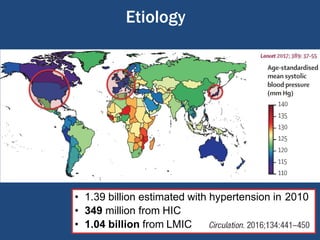
Etiology
• 1.39 billion estimated with hypertension in 2010
• 349 million from HIC
• 1.04 billion from LMIC
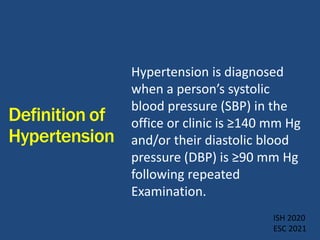
Definition of
Hypertension
Hypertension is diagnosed
when a person’s systolic
blood pressure (SBP) in the
office or clinic is ≥140 mm Hg
and/or their diastolic blood
pressure (DBP) is ≥90 mm Hg
following repeated
Examination.
ISH 2020
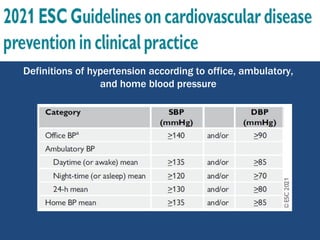
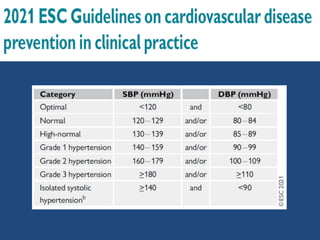
ESC 2021
Definitions of hypertension according to office, ambulatory,
and home blood pressure
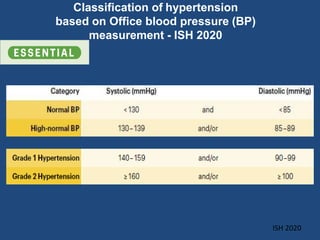
Classification of hypertension
based on Office blood pressure (BP)
measurement - ISH 2020
ISH 2020
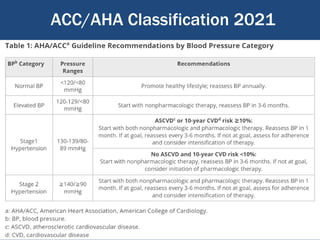
ACC/AHA Classification 2021
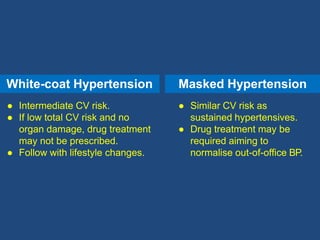
White-coat Hypertension
● Intermediate CV risk.
● If low total CV risk and no
organ damage, drug treatment
may not be prescribed.
● Follow with lifestyle changes.
Masked Hypertension
● Similar CV risk as
sustained hypertensives.
● Drug treatment may be
required aiming to
normalise out-of-office BP.
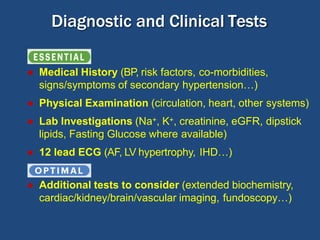
Diagnostic and Clinical Tests
● Medical History (BP, risk factors, co-morbidities,
signs/symptoms of secondary hypertension…)
● Physical Examination (circulation, heart, other systems)
● Lab Investigations (Na+, K+, creatinine, eGFR, dipstick
lipids, Fasting Glucose where available)
● 12 lead ECG (AF, LV hypertrophy, IHD…)
● Additional tests to consider (extended biochemistry,
cardiac/kidney/brain/vascular imaging, fundoscopy…)
Hypertension-mediated Organ Damage
● Hypertension-mediated organ damage (HMOD) defined as
structural or functional alterations of arterial vasculature
and/or organs it supplies caused by elevated BP.
● HMOD assessment can provide important therapeutic
guidance on:
1. management for hypertensive patients with low or
moderate overall risk through re-classification due to
presence of HMOD.
2. preferential selection of drug treatment based on the
specific impact on HMOD.
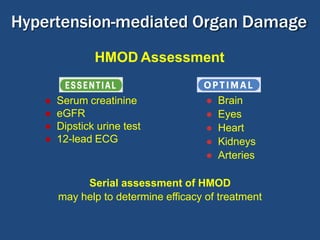
Hypertension-mediated Organ Damage
HMOD Assessment
● Brain
● Eyes
● Heart
● Kidneys
● Arteries
Serial assessment of HMOD
may help to determine efficacy of treatment
● Serum creatinine
● eGFR
● Dipstick urine test
● 12-lead ECG
Treatment
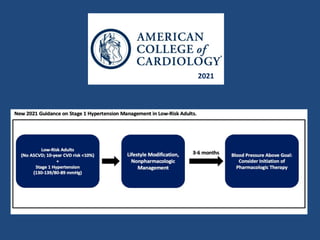
2021
Non-PharmacologicalTreatment
of Hypertension
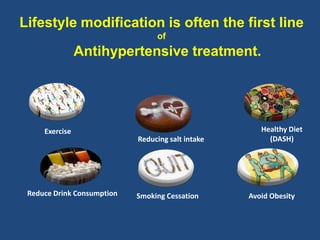
Lifestyle modification is often the first line
of
Antihypertensive treatment.
Exercise
Reducing salt intake
Healthy Diet
(DASH)
Reduce Drink Consumption Smoking Cessation Avoid Obesity
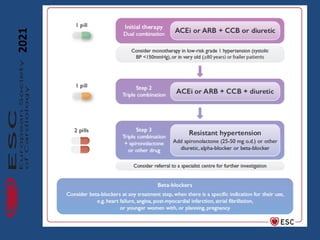
Drug Treatment ofHypertension
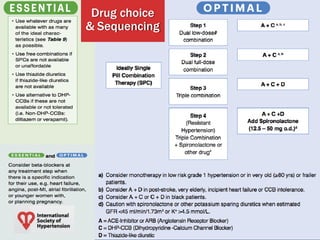
Drug choice
& Sequencing
2021
Specific Circumstances:
Resistant Hypertension
2020 ISHGlobal
Hypertension PracticeGuidelines
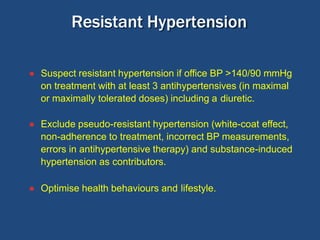
● Suspect resistant hypertension if office BP >140/90 mmHg
on treatment with at least 3 antihypertensives (in maximal
or maximally tolerated doses) including a diuretic.
● Exclude pseudo-resistant hypertension (white-coat effect,
non-adherence to treatment, incorrect BP measurements,
errors in antihypertensive therapy) and substance-induced
hypertension as contributors.
● Optimise health behaviours and lifestyle.
Resistant Hypertension
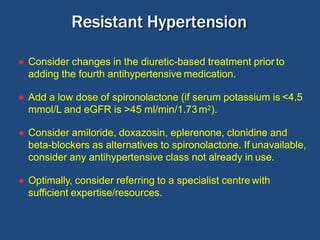
● Consider changes in the diuretic-based treatment prior to
adding the fourth antihypertensive medication.
● Add a low dose of spironolactone (if serum potassium is <4.5
mmol/L and eGFR is >45 ml/min/1.73m2).
● Consider amiloride, doxazosin, eplerenone, clonidine and
beta-blockers as alternatives to spironolactone. If unavailable,
consider any antihypertensive class not already in use.
● Optimally, consider referring to a specialist centre with
sufficient expertise/resources.
Resistant Hypertension
Specific Circumstances:
Secondary Hypertension
2020 ISHGlobal
Hypertension PracticeGuidelines
• Consider screening for secondary hypertension in:
early onset hypertension, resistant hypertension, sudden BP
control deterioration, hypertensive urgencies and emergencies,
high clinical probability of secondary hypertension.
• Exclude:
pseudo-resistant hypertension and drug/substance-induced
hypertension prior to investigations for secondary hypertension.
Secondary Hypertension
Basic screening for secondary hypertension
thorough history + physical examination (clinical clues) +
basic blood biochemistry (including serum sodium,
potassium, eGFR, TSH) + dipstick urine analysis.
Arrange other investigations for secondary hypertension
(additional biochemistry/imaging/others) based on information
from history, physical examination and basic clinical
investigations and/or if feasible refer to a specialist centre
Secondary Hypertension
Specific Circumstances:
Hypertensive Emergencies
Emergency:
• Severely elevated BP associated with acute
hypertension mediated organ damage (HMOD).
• Requires immediate BP lowering, usually with IV
therapy.
Urgency:
• Severely elevated BP without acute HMOD.
• Can be managed with oral antihypertensive agents.
Hypertensive Emergencies
Assessment
Essential:
• Clinical exam: Evaluate for HMOD including fundoscopy
• Investigations: Hemoglobin, platelets, creatinine, sodium,
potassium, lactate dehydrogenase, haptoglobin,
urinalysis for protein, urine sediment, ECG.
Optimal:
Assessment
In addition, context specific testing:
• Troponins (chest pain or anginal equivalent)
• Chest x-ray (congestion/fluid overload)
• Transthoracic echocardiogram (cardiac structure and
function)
• CT/MRI brain (cerebral hemorrhage/stroke)
• CT-angiography thorax/abdomen (acute aortic disease)
Hypertensive Emergencies
Management
● Requires immediate BP lowering to prevent or
limit further HMOD
● Sparse evidence to guiding management –
recommendations largely consensus based.
● Time to lower BP and magnitude of BP
reduction depends on clinical context.
● IV Labetalol and nicardipine generally safe to
use in all hypertensive emergencies
Hypertensive Emergencies
Thank You

Updates on Hypertension (Short)- ISH 2020.pdf

  • 1.
    Updates on Hypertension– ISH 2020 Dr. Nayan Ray MBBS Mymensingh Medical College and Hospital
  • 2.
    Etiology • 1.39 billionestimated with hypertension in 2010 • 349 million from HIC • 1.04 billion from LMIC
  • 3.
    Definition of Hypertension Hypertension isdiagnosed when a person’s systolic blood pressure (SBP) in the office or clinic is ≥140 mm Hg and/or their diastolic blood pressure (DBP) is ≥90 mm Hg following repeated Examination. ISH 2020 ESC 2021
  • 4.
    Definitions of hypertensionaccording to office, ambulatory, and home blood pressure
  • 6.
    Classification of hypertension basedon Office blood pressure (BP) measurement - ISH 2020 ISH 2020
  • 7.
  • 8.
    White-coat Hypertension ● IntermediateCV risk. ● If low total CV risk and no organ damage, drug treatment may not be prescribed. ● Follow with lifestyle changes. Masked Hypertension ● Similar CV risk as sustained hypertensives. ● Drug treatment may be required aiming to normalise out-of-office BP.
  • 9.
    Diagnostic and ClinicalTests ● Medical History (BP, risk factors, co-morbidities, signs/symptoms of secondary hypertension…) ● Physical Examination (circulation, heart, other systems) ● Lab Investigations (Na+, K+, creatinine, eGFR, dipstick lipids, Fasting Glucose where available) ● 12 lead ECG (AF, LV hypertrophy, IHD…) ● Additional tests to consider (extended biochemistry, cardiac/kidney/brain/vascular imaging, fundoscopy…)
  • 10.
    Hypertension-mediated Organ Damage ●Hypertension-mediated organ damage (HMOD) defined as structural or functional alterations of arterial vasculature and/or organs it supplies caused by elevated BP. ● HMOD assessment can provide important therapeutic guidance on: 1. management for hypertensive patients with low or moderate overall risk through re-classification due to presence of HMOD. 2. preferential selection of drug treatment based on the specific impact on HMOD.
  • 11.
    Hypertension-mediated Organ Damage HMODAssessment ● Brain ● Eyes ● Heart ● Kidneys ● Arteries Serial assessment of HMOD may help to determine efficacy of treatment ● Serum creatinine ● eGFR ● Dipstick urine test ● 12-lead ECG
  • 12.
  • 13.
  • 14.
  • 15.
    Lifestyle modification isoften the first line of Antihypertensive treatment. Exercise Reducing salt intake Healthy Diet (DASH) Reduce Drink Consumption Smoking Cessation Avoid Obesity
  • 16.
  • 17.
  • 18.
  • 19.
    Specific Circumstances: Resistant Hypertension 2020ISHGlobal Hypertension PracticeGuidelines
  • 20.
    ● Suspect resistanthypertension if office BP >140/90 mmHg on treatment with at least 3 antihypertensives (in maximal or maximally tolerated doses) including a diuretic. ● Exclude pseudo-resistant hypertension (white-coat effect, non-adherence to treatment, incorrect BP measurements, errors in antihypertensive therapy) and substance-induced hypertension as contributors. ● Optimise health behaviours and lifestyle. Resistant Hypertension
  • 21.
    ● Consider changesin the diuretic-based treatment prior to adding the fourth antihypertensive medication. ● Add a low dose of spironolactone (if serum potassium is <4.5 mmol/L and eGFR is >45 ml/min/1.73m2). ● Consider amiloride, doxazosin, eplerenone, clonidine and beta-blockers as alternatives to spironolactone. If unavailable, consider any antihypertensive class not already in use. ● Optimally, consider referring to a specialist centre with sufficient expertise/resources. Resistant Hypertension
  • 22.
    Specific Circumstances: Secondary Hypertension 2020ISHGlobal Hypertension PracticeGuidelines
  • 23.
    • Consider screeningfor secondary hypertension in: early onset hypertension, resistant hypertension, sudden BP control deterioration, hypertensive urgencies and emergencies, high clinical probability of secondary hypertension. • Exclude: pseudo-resistant hypertension and drug/substance-induced hypertension prior to investigations for secondary hypertension. Secondary Hypertension
  • 24.
    Basic screening forsecondary hypertension thorough history + physical examination (clinical clues) + basic blood biochemistry (including serum sodium, potassium, eGFR, TSH) + dipstick urine analysis. Arrange other investigations for secondary hypertension (additional biochemistry/imaging/others) based on information from history, physical examination and basic clinical investigations and/or if feasible refer to a specialist centre Secondary Hypertension
  • 25.
  • 26.
    Emergency: • Severely elevatedBP associated with acute hypertension mediated organ damage (HMOD). • Requires immediate BP lowering, usually with IV therapy. Urgency: • Severely elevated BP without acute HMOD. • Can be managed with oral antihypertensive agents. Hypertensive Emergencies
  • 27.
    Hypertensive Emergencies Assessment Essential: • Clinicalexam: Evaluate for HMOD including fundoscopy • Investigations: Hemoglobin, platelets, creatinine, sodium, potassium, lactate dehydrogenase, haptoglobin, urinalysis for protein, urine sediment, ECG.
  • 28.
    Optimal: Assessment In addition, contextspecific testing: • Troponins (chest pain or anginal equivalent) • Chest x-ray (congestion/fluid overload) • Transthoracic echocardiogram (cardiac structure and function) • CT/MRI brain (cerebral hemorrhage/stroke) • CT-angiography thorax/abdomen (acute aortic disease) Hypertensive Emergencies
  • 29.
    Management ● Requires immediateBP lowering to prevent or limit further HMOD ● Sparse evidence to guiding management – recommendations largely consensus based. ● Time to lower BP and magnitude of BP reduction depends on clinical context. ● IV Labetalol and nicardipine generally safe to use in all hypertensive emergencies Hypertensive Emergencies
  • 30.