DEFINITION OF HYPERTENSION
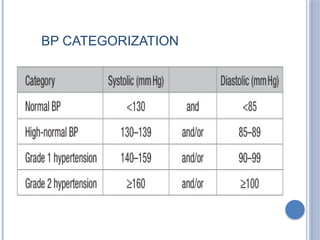
Hypertension (high blood pressure) is when the pressure
in your blood vessels is too high (140/90 mmHg or
higher). WHO
Hypertension is major contributor to cardiovascular
diseases and complications
Etiology is unknown in 80–95% of pts (“essential
hypertension”).
3.
DEFINITION
Always considera secondary correctable form of
hypertension, especially in pts aged ≤30 or those who
become hypertensive after 55.
Isolated systolic hypertension (systolic ≥140, diastolic
<90) most common in elderly pts, due to reduced
vascular compliance.
WHITE COAT ANDMASKED
HYPERTENSION
The use of office and out-of-office (home or ambulatory)
BP measurements identifies individuals with white coat
hypertension and masked hypertension.
White coat hypertension is elevated BP only in the
office (nonelevated ambulatory or home BP)
Masked hypertension is nonelevated BP in the office
but elevated BP out of the office (ambulatory or home)
About 10%–30% of subjects attending clinics due to
high BP have white coat hypertension and 10%–15%
have masked hypertension.
8.
SECONDARY HYPERTENSION
Secondaryhypertension is high blood pressure that
results from an identifiable and often treatable
underlying medical condition.
Unlike primary (essential) hypertension, which has no
clear cause, secondary hypertension is a symptom of
another disease or disorder.
9.
CAUSES OF SECONDARYHTN
Renal Artery Stenosis (Renovascular Hypertension)
Due to either atherosclerosis (older men) or fibro
muscular dysplasia (young women).
Presents with recent onset of hypertension, refractory to
usual antihypertensive therapy.
Abdominal bruit is present in 50% of cases;
Hypokalemia due to activation of the renin-angiotensin-
aldosterone system may be present.
Renal Parenchymal Disease
Elevated serum creatinine and/or abnormal urinalysis,
containing protein, cells, or casts.
10.
Coarctation of Aorta
Presents in children or young adults (including 35% of pts
with Turner syndrome)
Constriction is usually present in aorta at origin of left
subclavian artery.
Examination shows diminished, delayed femoral pulsations;
systolic murmur loudest at left infrascapular region.
CXR shows indentation of the aorta at the level of the
coarctation and rib notching (due to development of
collateral arterial flow).
Doppler echocardiography identifies region of constriction
and measures associated pressure gradient.
11.
Pheochromocytoma
A catecholamine-secretingtumor, typically of the adrenal medulla or
extraadrenal paraganglion tissue.
Presents as paroxysmal or sustained hypertension in young to middle-
aged pts.
Sudden episodes of headache, palpitations, and profuse diaphoresis are
common.
Associated findings include chronic weight loss, orthostatic
hypotension, and impaired glucose tolerance.
Pheochromocytomas may be localized to the bladder wall and may
present with micturition-associated symptoms of catecholamine excess.
Diagnosis is suggested by elevated plasma metanephrine level or
urinary catecholamine metabolites in a 24-h urine collection; the tumor
is then localized by CT or MRI.
12.
Hyperaldosteronism
Usually dueto aldosterone-secreting adenoma or bilateral
adrenal hyperplasia
A cause of refractory hypertension that should be suspected
when hypokalemia is present in a hypertensive pt off diuretics
Other Causes are: Oral contraceptive usage, obstructive sleep
apnea ,Cushing’s and adrenogenital syndromes, thyroid
disease , hypercalcemia (e.g., hyperparathyroidism), and
acromegaly.
In pts with systolic hypertension and wide pulse pressure,
consider thyrotoxicosis, aortic regurgitation , and systemic AV
fistula.
13.
APPROACH TO THEPATIENT
History:
Most pts are asymptomatic. So that is called silent killer
Severe hypertension may lead to headache, dizziness, or
blurred vision.
Clues to specific forms of secondary hypertension:
Use of medications (e.g., birth control pills, glucocorticoids,
decongestants, erythropoietin, NSAIDs, cyclosporine);
paroxysms of headache, sweating, or tachycardia
(pheochromocytoma)
history of renal disease or abdominal trauma (renal
hypertension);
daytime somnolence and snoring (sleep apnea).
14.
Physical examination:
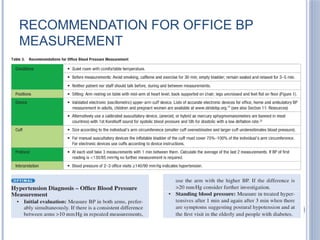
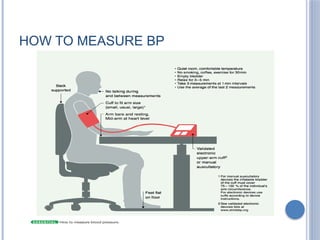
Measurebp with appropriate-sized cuff (large cuff for
large arm).
Measure bp in both arms as well as a leg (to evaluate for
aortic coarctation).
Signs of hypertension include retinal arteriolar changes
(narrowing/nicking);
left ventricular lift, loud A2 , S4 .
Clues to secondary forms of hypertension include
cushingoid appearance, thyromegaly, abdominal bruit
(renal artery stenosis), delayed femoral pulses
(coarctation of aorta).
15.
Laboratory Workup
Screeningtests for secondary hypertension: Should be
carried out on all pts with documented hypertension:
RFT, Serum electrolyte, U/A, CXR, ECG
blood tests including CBC, glucose, lipid levels,
calcium, uric acid;
TSH if thyroid disease suspected.
Abdominal U/S
Other hormonal analysis
DRUG THERAPY OFESSENTIAL HYPERTENSION
2017 Hypertension Guidelines recommend initiating
antihypertensive drug therapy for primary prevention
when systolic BP ≥140 mmHg or diastolic BP ≥90
mmHg
Note that if 10-year atherosclerotic event risk is ≥10%,
or if pt has had prior cardiovascular event, initiate drug
treatment for systolic BP ≥130 or diastolic BP ≥80.
Goal is to control hypertension with minimal side
effects.
18.
A combinationof medications with complementary
actions is often required.
First-line agents include diuretics, ACE inhibitors,
angiotensin receptor antagonists, calcium channel
antagonists, and sometimes beta blockers.
On-treatment blood pressure goal is <140/90 and if
comorbidity like CKD, CAD, CHF, Stroke, metabolic
syndrome exist goal is <130/80.
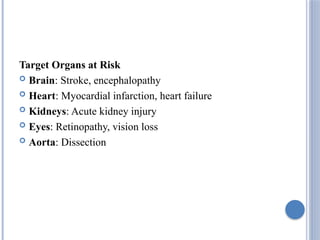
Neurological Complications
Stroke:Ischemic or hemorrhagic due to vessel damage
or rupture
Transient ischemic attacks (TIAs): Mini-strokes with
temporary symptoms
Vascular dementia: Chronic reduced cerebral perfusion
21.
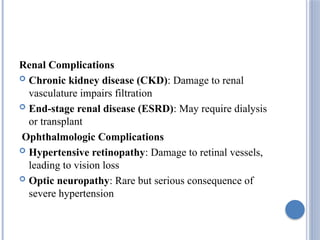
Renal Complications
Chronickidney disease (CKD): Damage to renal
vasculature impairs filtration
End-stage renal disease (ESRD): May require dialysis
or transplant
Ophthalmologic Complications
Hypertensive retinopathy: Damage to retinal vessels,
leading to vision loss
Optic neuropathy: Rare but serious consequence of
severe hypertension
22.
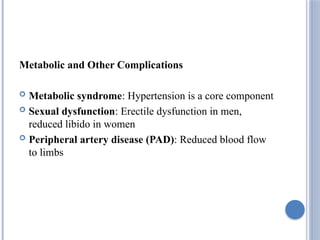
Metabolic and OtherComplications
Metabolic syndrome: Hypertension is a core component
Sexual dysfunction: Erectile dysfunction in men,
reduced libido in women
Peripheral artery disease (PAD): Reduced blood flow
to limbs
23.
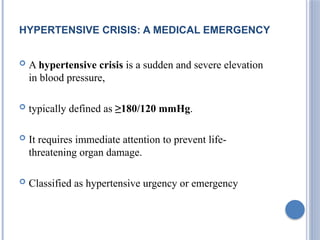
HYPERTENSIVE CRISIS: AMEDICAL EMERGENCY
A hypertensive crisis is a sudden and severe elevation
in blood pressure,
typically defined as ≥180/120 mmHg.
It requires immediate attention to prevent life-
threatening organ damage.
Classified as hypertensive urgency or emergency
24.
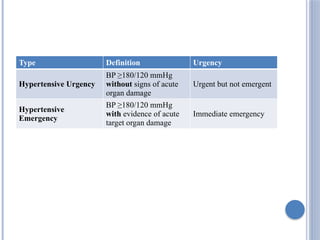
Type Definition Urgency
HypertensiveUrgency
BP ≥180/120 mmHg
without signs of acute
organ damage
Urgent but not emergent
Hypertensive
Emergency
BP ≥180/120 mmHg
with evidence of acute
target organ damage
Immediate emergency
25.
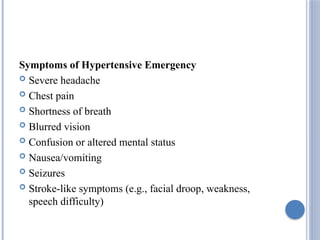
Symptoms of HypertensiveEmergency
Severe headache
Chest pain
Shortness of breath
Blurred vision
Confusion or altered mental status
Nausea/vomiting
Seizures
Stroke-like symptoms (e.g., facial droop, weakness,
speech difficulty)
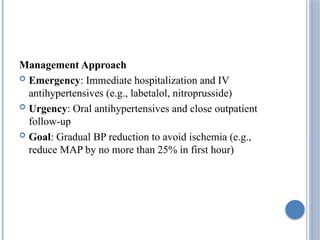
Management Approach
Emergency:Immediate hospitalization and IV
antihypertensives (e.g., labetalol, nitroprusside)
Urgency: Oral antihypertensives and close outpatient
follow-up
Goal: Gradual BP reduction to avoid ischemia (e.g.,
reduce MAP by no more than 25% in first hour)