HYPERTENSION
Dr. Chaitra M
Moderator: Prof. Rajeshwari S
www.anaesthesia.co.in
anaesthesia.co.in@gmail.com
INTRODUCTION AND
DEFINITIONS
HYPERTENSION - DEFINITION
 “Hypertension is a progressive cardiovascular
syndrome arising from complex and interrelated
etiologies. Early markers of the syndrome are often
present before blood pressure elevation is
sustained; therefore, hypertension cannot be
classified solely by discrete blood pressure
thresholds. Progression is strongly associated with
functional and structural cardiac and vascular
abnormalities that damage the heart, kidneys,
brain, vasculature, and other organs and lead to
premature morbidity and death.”
—American Society of Hypertension Writing
Group, 2006
HYPERTENSION - DEFINITION
 Essential hypertension can be defined as a rise in
blood pressure of unknown cause that increases
risk for cerebral, cardiac, and renal events.
Messerli et al, Lancet 2007; 370:591-603
 Secondary hypertension – rise in blood pressure
due to an identifiable cause
 Usually develops before the age of 35 or after 55
years
ISOLATED SYSTOLIC
HYPERTENSION
 ISH - SBP > 140 mm Hg and DBP < 90 mmHg
 Prevalence of systolic hypertension increases
with age
 Systolic hypertension represents the most
common form of hypertension above the age of 50
years
 Trials have shown that control of isolated systolic
hypertension reduces total mortality,
cardiovascular mortality, stroke, and HF events
Kostis et al. JAMA. 1997;278:212–216
Staessen et al. JAMA. 1999;282:539–546
WHITE COAT HYPERTENSION
 WCHT is an ill-defined phenomenon
 Most accepted definition is “…a high BP in the
physician's office with normal BP at rest or while
ambulatory”
Angeli et al. Blood Press Monit. 2005 Dec;10(6):301-5
 Patients who are diagnosed as being hypertensive on
first visit, BP drops by a mean of 15 mm Hg systolic
and 7 mm Hg diastolic by third visit
 Some patients do not reach a stable value until their
sixth visit
Watson et al. J Hypertens. 1987;5:207–211
HYPERTENSIVE URGENCY
 Definition of hypertensive urgency - diastolic BP
(DBP) >120 mm Hg
 Distinguished from hypertensive emergencies by
the lack of acute progressive target organ
damage
 Pt to be observed for a few hours following the
use of a short-acting agent
 Data suggest that an aggressive approach may be
harmful
Vidt, J Clin Hypertens 2004;6:520–525
HYPERTENSIVE EMERGENCY
 A hypertensive emergency is a clinical diagnosis that
is appropriate when marked hypertension is
associated with acute target-organ damage
Elliot Prog Cardiovasc Dis. 2006; 48(5):316-25
Examples of target-organ damage
 hypertensive encephalopathy
 intracerebral hemorrhage or infarction
 unstable angina pectoris or acute myocardial infarction
 acute left ventricular failure with pulmonary edema
 dissecting aortic aneurysm
 eclampsia of pregnancy
EVALUATION AND
CLASSIFICATION OF
HYPERTENSION
WHEN TO LABEL ‘HYPERTENSIVE”
 Elevated blood pressure on two separate
occasions, after initial screening measurement
which reveals high BP
 Measurement of BP for more occasions (~6) may
be needed in some individuals
MEASUREMENT OF BLOOD PRESSURE
 Equipment, whether aneroid, mercury, or electronic, should be
regularly inspected
 Operator should be trained and regularly retrained in the
standardized technique and patient must be properly prepared
and positioned
 Auscultatory method of BP measurement should be used
 Persons should be seated quietly for at least 5 minutes in a chair,
with feet on the floor, and arm supported at heart level
 Caffeine, exercise, and smoking should be avoided for at least 30
minutes prior to measurement
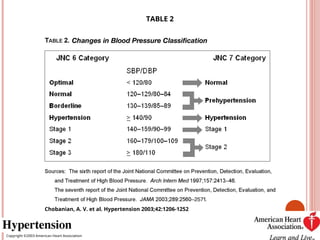
Copyright ©2003 American Heart Association
Chobanian, A. V. et al. Hypertension 2003;42:1206-1252
TABLE 2
IDENTIFIABLE CAUSES OF
HYPERTENSION
 Chronic kidney disease
 Coarctation of the aorta
 Cushing syndrome and other glucocorticoid excess states
including chronic steroid therapy
 Drug-induced or drug-related
 Obstructive uropathy
 Pheochromocytoma
 Primary aldosteronism and other mineralocorticoid excess
states
 Renovascular hypertension
 Sleep apnea
 Thyroid or parathyroid disease
TARGET ORGAN DAMAGE
IN HYPERTENSION
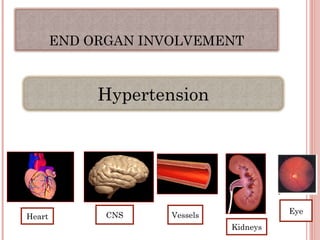
END ORGAN INVOLVEMENT
Hypertension
Eye
Kidneys
Vessels
CNS
Heart
TARGET ORGAN DAMAGE
 Heart
 Left ventricular hypertrophy
 Angina or myocardial infarction
 Heart failure
 Brain
 Transient ischemic attacks
 Cerebrovascular accident : infarcts/haemorrhage
 Global or focal neurodeficits
 Hypertensive encephalopathy
TARGET ORGAN DAMAGE
 Chronic kidney disease
• Arteriosclerosis of renal arterioles
• Proteinuria
• Haematuria
• Renal failure
 Peripheral arterial disease
• Generalised atherosclerosis
• Peripheral vascular disease
• Aortic dissection/aneurysms
 Retinopathy
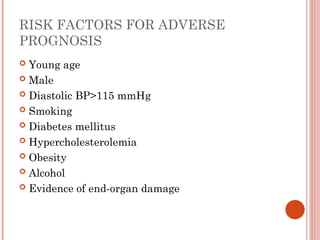
RISK FACTORS FOR ADVERSE
PROGNOSIS
 Young age
 Male
 Diastolic BP>115 mmHg
 Smoking
 Diabetes mellitus
 Hypercholesterolemia
 Obesity
 Alcohol
 Evidence of end-organ damage
HYPERTENSION - THERAPY
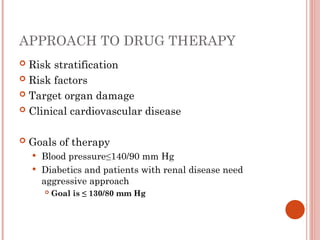
APPROACH TO DRUG THERAPY
 Risk stratification
 Risk factors
 Target organ damage
 Clinical cardiovascular disease
 Goals of therapy
 Blood pressure≤140/90 mm Hg
 Diabetics and patients with renal disease need
aggressive approach
 Goal is ≤ 130/80 mm Hg
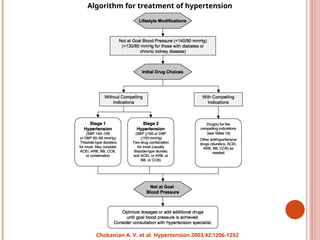
Chobanian A. V. et al. Hypertension 2003;42:1206-1252
Algorithm for treatment of hypertension
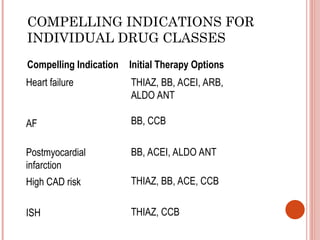
COMPELLING INDICATIONS FOR
INDIVIDUAL DRUG CLASSES
Compelling Indication Initial Therapy Options
THIAZ, BB, ACEI, ARB,
ALDO ANT
BB, CCB
BB, ACEI, ALDO ANT
THIAZ, BB, ACE, CCB
THIAZ, CCB
Heart failure
AF
Postmyocardial
infarction
High CAD risk
ISH
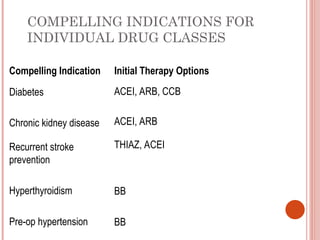
Diabetes
Chronic kidney disease
Recurrent stroke
prevention
Hyperthyroidism
Pre-op hypertension
COMPELLING INDICATIONS FOR
INDIVIDUAL DRUG CLASSES
Compelling Indication Initial Therapy Options
ACEI, ARB, CCB
ACEI, ARB
THIAZ, ACEI
BB
BB
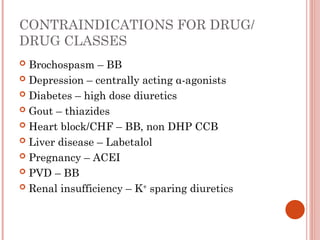
CONTRAINDICATIONS FOR DRUG/
DRUG CLASSES
 Brochospasm – BB
 Depression – centrally acting α-agonists
 Diabetes – high dose diuretics
 Gout – thiazides
 Heart block/CHF – BB, non DHP CCB
 Liver disease – Labetalol
 Pregnancy – ACEI
 PVD – BB
 Renal insufficiency – K+
sparing diuretics
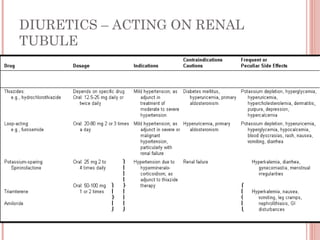
DIURETICS – ACTING ON RENAL
TUBULE
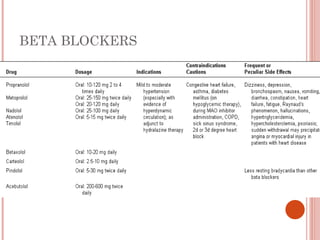
BETA BLOCKERS
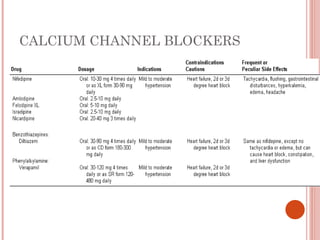
CALCIUM CHANNEL BLOCKERS
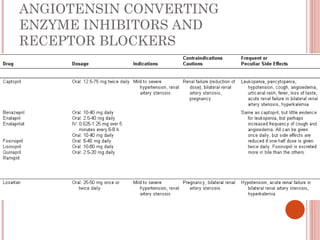
ANGIOTENSIN CONVERTING
ENZYME INHIBITORS AND
RECEPTOR BLOCKERS
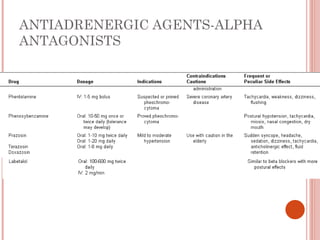
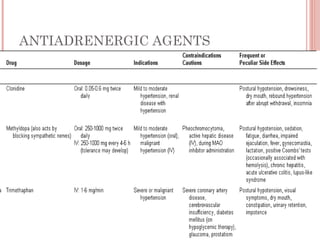
ANTIADRENERGIC AGENTS-ALPHA
ANTAGONISTS
ANTIADRENERGIC AGENTS
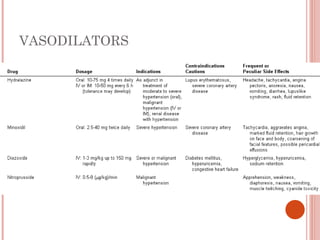
VASODILATORS
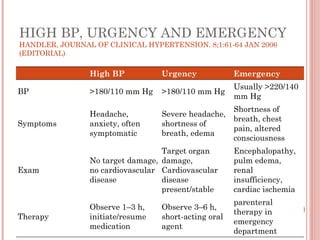
HIGH BP, URGENCY AND EMERGENCY
HANDLER, JOURNAL OF CLINICAL HYPERTENSION. 8;1:61-64 JAN 2006
(EDITORIAL)
High BP Urgency Emergency
BP >180/110 mm Hg >180/110 mm Hg
Usually >220/140
mm Hg
Symptoms
Headache,
anxiety, often
symptomatic
Severe headache,
shortness of
breath, edema
Shortness of
breath, chest
pain, altered
consciousness
Exam
No target damage,
no cardiovascular
disease
Target organ
damage,
Cardiovascular
disease
present/stable
Encephalopathy,
pulm edema,
renal
insufficiency,
cardiac ischemia
Therapy
Observe 1–3 h,
initiate/resume
medication
Observe 3–6 h,
short-acting oral
agent
parenteral
therapy in
emergency
department
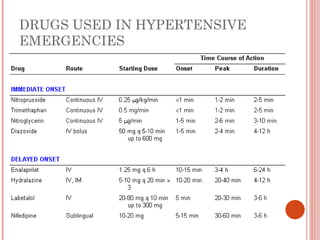
DRUGS USED IN HYPERTENSIVE
EMERGENCIES
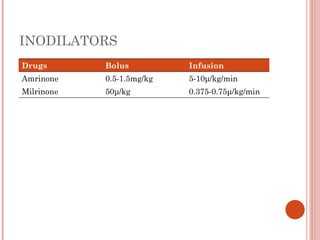
INODILATORS
Drugs Bolus Infusion
Amrinone 0.5-1.5mg/kg 5-10μ/kg/min
Milrinone 50μ/kg 0.375-0.75μ/kg/min
www.anaesthesia.co.in
anaesthesia.co.in@gmail.com

Hypertension anaesthesia management.pptx

  • 1.
    HYPERTENSION Dr. Chaitra M Moderator:Prof. Rajeshwari S www.anaesthesia.co.in anaesthesia.co.in@gmail.com
  • 2.
  • 3.
    HYPERTENSION - DEFINITION “Hypertension is a progressive cardiovascular syndrome arising from complex and interrelated etiologies. Early markers of the syndrome are often present before blood pressure elevation is sustained; therefore, hypertension cannot be classified solely by discrete blood pressure thresholds. Progression is strongly associated with functional and structural cardiac and vascular abnormalities that damage the heart, kidneys, brain, vasculature, and other organs and lead to premature morbidity and death.” —American Society of Hypertension Writing Group, 2006
  • 4.
    HYPERTENSION - DEFINITION Essential hypertension can be defined as a rise in blood pressure of unknown cause that increases risk for cerebral, cardiac, and renal events. Messerli et al, Lancet 2007; 370:591-603  Secondary hypertension – rise in blood pressure due to an identifiable cause  Usually develops before the age of 35 or after 55 years
  • 5.
    ISOLATED SYSTOLIC HYPERTENSION  ISH- SBP > 140 mm Hg and DBP < 90 mmHg  Prevalence of systolic hypertension increases with age  Systolic hypertension represents the most common form of hypertension above the age of 50 years  Trials have shown that control of isolated systolic hypertension reduces total mortality, cardiovascular mortality, stroke, and HF events Kostis et al. JAMA. 1997;278:212–216 Staessen et al. JAMA. 1999;282:539–546
  • 6.
    WHITE COAT HYPERTENSION WCHT is an ill-defined phenomenon  Most accepted definition is “…a high BP in the physician's office with normal BP at rest or while ambulatory” Angeli et al. Blood Press Monit. 2005 Dec;10(6):301-5  Patients who are diagnosed as being hypertensive on first visit, BP drops by a mean of 15 mm Hg systolic and 7 mm Hg diastolic by third visit  Some patients do not reach a stable value until their sixth visit Watson et al. J Hypertens. 1987;5:207–211
  • 7.
    HYPERTENSIVE URGENCY  Definitionof hypertensive urgency - diastolic BP (DBP) >120 mm Hg  Distinguished from hypertensive emergencies by the lack of acute progressive target organ damage  Pt to be observed for a few hours following the use of a short-acting agent  Data suggest that an aggressive approach may be harmful Vidt, J Clin Hypertens 2004;6:520–525
  • 8.
    HYPERTENSIVE EMERGENCY  Ahypertensive emergency is a clinical diagnosis that is appropriate when marked hypertension is associated with acute target-organ damage Elliot Prog Cardiovasc Dis. 2006; 48(5):316-25 Examples of target-organ damage  hypertensive encephalopathy  intracerebral hemorrhage or infarction  unstable angina pectoris or acute myocardial infarction  acute left ventricular failure with pulmonary edema  dissecting aortic aneurysm  eclampsia of pregnancy
  • 9.
  • 10.
    WHEN TO LABEL‘HYPERTENSIVE”  Elevated blood pressure on two separate occasions, after initial screening measurement which reveals high BP  Measurement of BP for more occasions (~6) may be needed in some individuals
  • 11.
    MEASUREMENT OF BLOODPRESSURE  Equipment, whether aneroid, mercury, or electronic, should be regularly inspected  Operator should be trained and regularly retrained in the standardized technique and patient must be properly prepared and positioned  Auscultatory method of BP measurement should be used  Persons should be seated quietly for at least 5 minutes in a chair, with feet on the floor, and arm supported at heart level  Caffeine, exercise, and smoking should be avoided for at least 30 minutes prior to measurement
  • 12.
    Copyright ©2003 AmericanHeart Association Chobanian, A. V. et al. Hypertension 2003;42:1206-1252 TABLE 2
  • 13.
    IDENTIFIABLE CAUSES OF HYPERTENSION Chronic kidney disease  Coarctation of the aorta  Cushing syndrome and other glucocorticoid excess states including chronic steroid therapy  Drug-induced or drug-related  Obstructive uropathy  Pheochromocytoma  Primary aldosteronism and other mineralocorticoid excess states  Renovascular hypertension  Sleep apnea  Thyroid or parathyroid disease
  • 14.
  • 15.
  • 16.
    TARGET ORGAN DAMAGE Heart  Left ventricular hypertrophy  Angina or myocardial infarction  Heart failure  Brain  Transient ischemic attacks  Cerebrovascular accident : infarcts/haemorrhage  Global or focal neurodeficits  Hypertensive encephalopathy
  • 17.
    TARGET ORGAN DAMAGE Chronic kidney disease • Arteriosclerosis of renal arterioles • Proteinuria • Haematuria • Renal failure  Peripheral arterial disease • Generalised atherosclerosis • Peripheral vascular disease • Aortic dissection/aneurysms  Retinopathy
  • 18.
    RISK FACTORS FORADVERSE PROGNOSIS  Young age  Male  Diastolic BP>115 mmHg  Smoking  Diabetes mellitus  Hypercholesterolemia  Obesity  Alcohol  Evidence of end-organ damage
  • 19.
  • 20.
    APPROACH TO DRUGTHERAPY  Risk stratification  Risk factors  Target organ damage  Clinical cardiovascular disease  Goals of therapy  Blood pressure≤140/90 mm Hg  Diabetics and patients with renal disease need aggressive approach  Goal is ≤ 130/80 mm Hg
  • 21.
    Chobanian A. V.et al. Hypertension 2003;42:1206-1252 Algorithm for treatment of hypertension
  • 22.
    COMPELLING INDICATIONS FOR INDIVIDUALDRUG CLASSES Compelling Indication Initial Therapy Options THIAZ, BB, ACEI, ARB, ALDO ANT BB, CCB BB, ACEI, ALDO ANT THIAZ, BB, ACE, CCB THIAZ, CCB Heart failure AF Postmyocardial infarction High CAD risk ISH
  • 23.
    Diabetes Chronic kidney disease Recurrentstroke prevention Hyperthyroidism Pre-op hypertension COMPELLING INDICATIONS FOR INDIVIDUAL DRUG CLASSES Compelling Indication Initial Therapy Options ACEI, ARB, CCB ACEI, ARB THIAZ, ACEI BB BB
  • 24.
    CONTRAINDICATIONS FOR DRUG/ DRUGCLASSES  Brochospasm – BB  Depression – centrally acting α-agonists  Diabetes – high dose diuretics  Gout – thiazides  Heart block/CHF – BB, non DHP CCB  Liver disease – Labetalol  Pregnancy – ACEI  PVD – BB  Renal insufficiency – K+ sparing diuretics
  • 25.
    DIURETICS – ACTINGON RENAL TUBULE
  • 26.
  • 27.
  • 28.
  • 29.
  • 30.
  • 31.
  • 32.
    HIGH BP, URGENCYAND EMERGENCY HANDLER, JOURNAL OF CLINICAL HYPERTENSION. 8;1:61-64 JAN 2006 (EDITORIAL) High BP Urgency Emergency BP >180/110 mm Hg >180/110 mm Hg Usually >220/140 mm Hg Symptoms Headache, anxiety, often symptomatic Severe headache, shortness of breath, edema Shortness of breath, chest pain, altered consciousness Exam No target damage, no cardiovascular disease Target organ damage, Cardiovascular disease present/stable Encephalopathy, pulm edema, renal insufficiency, cardiac ischemia Therapy Observe 1–3 h, initiate/resume medication Observe 3–6 h, short-acting oral agent parenteral therapy in emergency department
  • 33.
    DRUGS USED INHYPERTENSIVE EMERGENCIES
  • 34.
    INODILATORS Drugs Bolus Infusion Amrinone0.5-1.5mg/kg 5-10μ/kg/min Milrinone 50μ/kg 0.375-0.75μ/kg/min
  • 35.