
Up to Speed in
Domain Driven Design
Rick van der Arend
rvdarend@sogyo.nl
Agenda
 What is Domain Driven Design?
 An example of a domain model
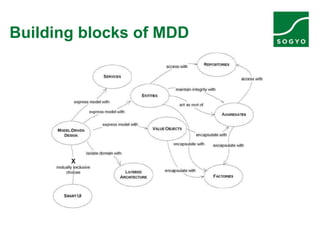
 The building blocks of a domain model
 Refactoring towards deeper insight
 What has been learned since the book?
 Wrap-up
SOFTWARE INNOVATORS 2
SOFTWARE INNOVATORS 3
What is DDD?
“Putting the Domain Model to work”
DDD in one sentence
 Domain Driven Design is a style of software
development which focuses on removing translation
barriers between domain, development team and
design of working software using a ubiquitous
language supported by a well refined livingmodel.
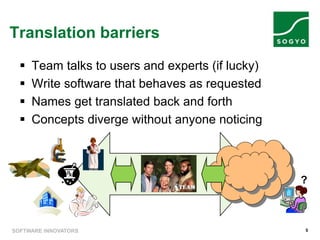
Translation barriers
 Team talks to users and experts (if lucky)
 Write software that behaves as requested
 Names get translated back and forth
 Concepts diverge without anyone noticing
SOFTWARE INNOVATORS 5
?
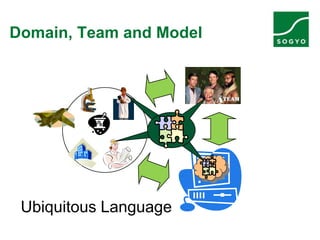
Domain, Team and Model
Ubiquitous Language
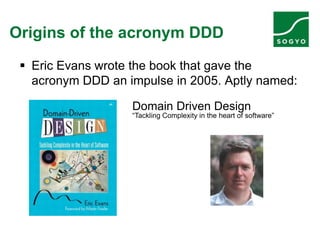
Origins of the acronym DDD
 Eric Evans wrote the book that gave the
acronym DDD an impulse in 2005. Aptly named:
Domain Driven Design
“Tackling Complexity in the heart of software”
SOFTWARE INNOVATORS 8
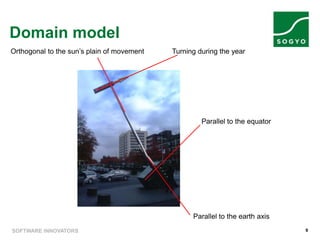
An Example of a domain model
Domain model
SOFTWARE INNOVATORS 9
Parallel to the equator
Parallel to the earth axis
Orthogonal to the sun’s plain of movement Turning during the year
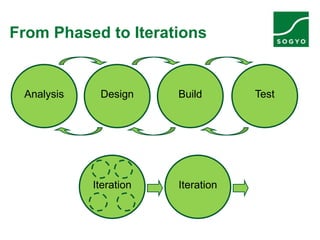
From Phased to Iterations
Analysis Design Build
Iteration Iteration
Test
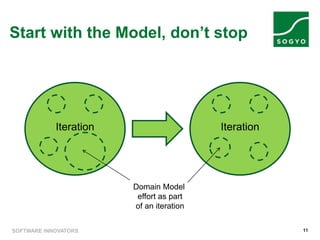
Start with the Model, don’t stop
SOFTWARE INNOVATORS 11
Iteration Iteration
Domain Model
effort as part
of an iteration
SOFTWARE INNOVATORS 12
The building blocks of a
Model-Driven Design
Building blocks of MDD
Entities & Value objects
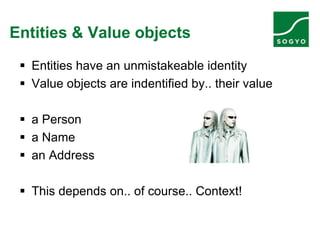
 Entities have an unmistakeable identity
 Value objects are indentified by.. their value
 a Person
 a Name
 an Address
 This depends on.. of course.. Context!
Factories , Repositories, Aggregates
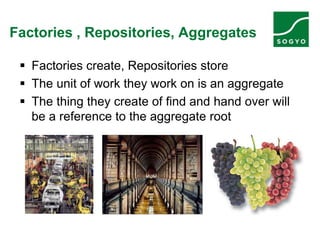
 Factories create, Repositories store
 The unit of work they work on is an aggregate
 The thing they create of find and hand over will
be a reference to the aggregate root
Services
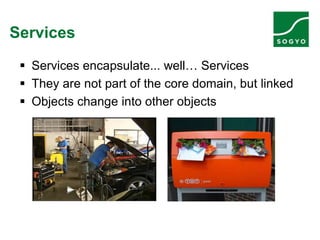
 Services encapsulate... well… Services
 They are not part of the core domain, but linked
 Objects change into other objects
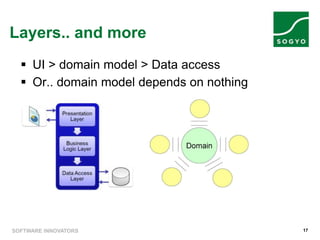
Layers.. and more
 UI > domain model > Data access
SOFTWARE INNOVATORS 17
 Or.. domain model depends on nothing
SOFTWARE INNOVATORS 18
Refactoring towards deeper
insight
Refactoring towards deeper insight
 Use patterns when appropriate
 Make Unit Tests
 Better yet, do TDD
 Better yet, do BDD
 DRY and YAGNI
 But: all a bit technical
Making Implicit Concepts explicit
 Listen to Language
 Scrutinize Awkwardness
 Contemplate Contradictions
 Read the Book
 Try, Try again
 Model the less-than-obvious: constraints,
processes, commands, relations, etc.
SOFTWARE INNOVATORS 21
Strategic Design
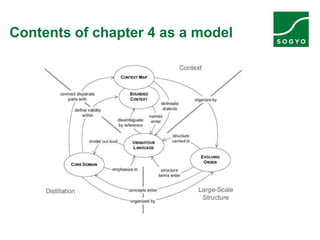
Contents of chapter 4 as a model
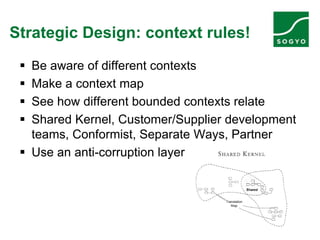
Strategic Design: context rules!
 Be aware of different contexts
 Make a context map
 See how different bounded contexts relate
 Shared Kernel, Customer/Supplier development
teams, Conformist, Separate Ways, Partner
 Use an anti-corruption layer
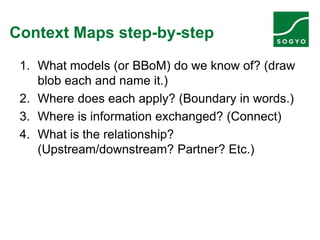
Context Maps step-by-step
1. What models (or BBoM) do we know of? (draw
blob each and name it.)
2. Where does each apply? (Boundary in words.)
3. Where is information exchanged? (Connect)
4. What is the relationship?
(Upstream/downstream? Partner? Etc.)
SOFTWARE INNOVATORS 25
What has been learned since
the book?
Highlights that Evans learned
 Building blocks are overemphasized
 But domain events added as a new type of block
 General advice
▫ Don’t spread modeling too thin
▫ Focus on the core domain
▫ Clean, bounded context (CM steps available)
▫ Iterative process
▫ Don’t bore your domain experts
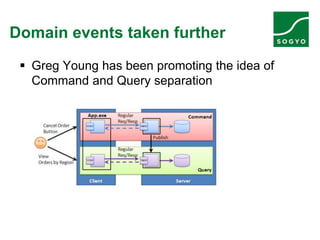
Domain events taken further
 Greg Young has been promoting the idea of
Command and Query separation
Techniques to explore
 Exploratory Modeling (xM)
 Model Driven Development environments
 Language Workbenches
 Naked Objects and other such platforms
SOFTWARE INNOVATORS 28
SOFTWARE INNOVATORS 29
Quick Wrap-up
Summary
 DDD highlights aspects of software design
 It focuses on the ‘core domain’ and uses a
ubiquitous language, based on a domain model
 The ubiquitous language brings out flaws
 A Domain Model is normally made up of certain
types of building blocks
 Thinks about context too: take control where and
whenever possible
Resources for Further study
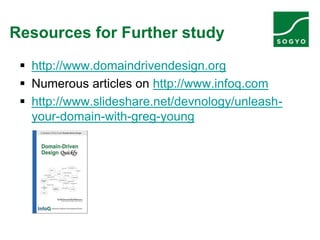
 http://www.domaindrivendesign.org
 Numerous articles on http://www.infoq.com
 http://www.slideshare.net/devnology/unleash-
your-domain-with-greg-young
DDD in C#
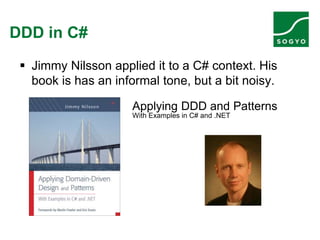
 Jimmy Nilsson applied it to a C# context. His
book is has an informal tone, but a bit noisy.
Applying DDD and Patterns
With Examples in C# and .NET
SOFTWARE INNOVATORS 33
Contact
Rick van der Arend
rvdarend@sogyo.nl
030 - 220 22 16
Web: www.sogyo.nl
Blog: www.software–innovators.nl

Up to speed in domain driven design

  • 1.
    Up to Speedin Domain Driven Design Rick van der Arend rvdarend@sogyo.nl
  • 2.
    Agenda  What isDomain Driven Design?  An example of a domain model  The building blocks of a domain model  Refactoring towards deeper insight  What has been learned since the book?  Wrap-up SOFTWARE INNOVATORS 2
  • 3.
    SOFTWARE INNOVATORS 3 Whatis DDD? “Putting the Domain Model to work”
  • 4.
    DDD in onesentence  Domain Driven Design is a style of software development which focuses on removing translation barriers between domain, development team and design of working software using a ubiquitous language supported by a well refined livingmodel.
  • 5.
    Translation barriers  Teamtalks to users and experts (if lucky)  Write software that behaves as requested  Names get translated back and forth  Concepts diverge without anyone noticing SOFTWARE INNOVATORS 5 ?
  • 6.
    Domain, Team andModel Ubiquitous Language
  • 7.
    Origins of theacronym DDD  Eric Evans wrote the book that gave the acronym DDD an impulse in 2005. Aptly named: Domain Driven Design “Tackling Complexity in the heart of software”
  • 8.
    SOFTWARE INNOVATORS 8 AnExample of a domain model
  • 9.
    Domain model SOFTWARE INNOVATORS9 Parallel to the equator Parallel to the earth axis Orthogonal to the sun’s plain of movement Turning during the year
  • 10.
    From Phased toIterations Analysis Design Build Iteration Iteration Test
  • 11.
    Start with theModel, don’t stop SOFTWARE INNOVATORS 11 Iteration Iteration Domain Model effort as part of an iteration
  • 12.
    SOFTWARE INNOVATORS 12 Thebuilding blocks of a Model-Driven Design
  • 13.
  • 14.
    Entities & Valueobjects  Entities have an unmistakeable identity  Value objects are indentified by.. their value  a Person  a Name  an Address  This depends on.. of course.. Context!
  • 15.
    Factories , Repositories,Aggregates  Factories create, Repositories store  The unit of work they work on is an aggregate  The thing they create of find and hand over will be a reference to the aggregate root
  • 16.
    Services  Services encapsulate...well… Services  They are not part of the core domain, but linked  Objects change into other objects
  • 17.
    Layers.. and more UI > domain model > Data access SOFTWARE INNOVATORS 17  Or.. domain model depends on nothing
  • 18.
    SOFTWARE INNOVATORS 18 Refactoringtowards deeper insight
  • 19.
    Refactoring towards deeperinsight  Use patterns when appropriate  Make Unit Tests  Better yet, do TDD  Better yet, do BDD  DRY and YAGNI  But: all a bit technical
  • 20.
    Making Implicit Conceptsexplicit  Listen to Language  Scrutinize Awkwardness  Contemplate Contradictions  Read the Book  Try, Try again  Model the less-than-obvious: constraints, processes, commands, relations, etc.
  • 21.
  • 22.
    Contents of chapter4 as a model
  • 23.
    Strategic Design: contextrules!  Be aware of different contexts  Make a context map  See how different bounded contexts relate  Shared Kernel, Customer/Supplier development teams, Conformist, Separate Ways, Partner  Use an anti-corruption layer
  • 24.
    Context Maps step-by-step 1.What models (or BBoM) do we know of? (draw blob each and name it.) 2. Where does each apply? (Boundary in words.) 3. Where is information exchanged? (Connect) 4. What is the relationship? (Upstream/downstream? Partner? Etc.)
  • 25.
    SOFTWARE INNOVATORS 25 Whathas been learned since the book?
  • 26.
    Highlights that Evanslearned  Building blocks are overemphasized  But domain events added as a new type of block  General advice ▫ Don’t spread modeling too thin ▫ Focus on the core domain ▫ Clean, bounded context (CM steps available) ▫ Iterative process ▫ Don’t bore your domain experts
  • 27.
    Domain events takenfurther  Greg Young has been promoting the idea of Command and Query separation
  • 28.
    Techniques to explore Exploratory Modeling (xM)  Model Driven Development environments  Language Workbenches  Naked Objects and other such platforms SOFTWARE INNOVATORS 28
  • 29.
  • 30.
    Summary  DDD highlightsaspects of software design  It focuses on the ‘core domain’ and uses a ubiquitous language, based on a domain model  The ubiquitous language brings out flaws  A Domain Model is normally made up of certain types of building blocks  Thinks about context too: take control where and whenever possible
  • 31.
    Resources for Furtherstudy  http://www.domaindrivendesign.org  Numerous articles on http://www.infoq.com  http://www.slideshare.net/devnology/unleash- your-domain-with-greg-young
  • 32.
    DDD in C# Jimmy Nilsson applied it to a C# context. His book is has an informal tone, but a bit noisy. Applying DDD and Patterns With Examples in C# and .NET
  • 33.
    SOFTWARE INNOVATORS 33 Contact Rickvan der Arend rvdarend@sogyo.nl 030 - 220 22 16 Web: www.sogyo.nl Blog: www.software–innovators.nl

Editor's Notes

  • #28 Command and Query Responsibility Segregation or CQRS according to Greg Young himself nowadays.