VENTURE
CAPITALISM
PRESENTED
BY:
NIDHI
INTRODUCTION
 Venture Capitalism is a form of financing provided by
firms to small early stage emerging firms.

 VC firms invest in these early stage firms in
exchange for equity or ownership stake.
STRUCTURE
 VC firms are partnership firms.

 There are two types of partners:

Venture capital Firm
(general partner)
Investors
(Limited Partners)
Eg-Public pension funds, Corporate pension funds,
Insurance companies etc
VENTURE CAPITAL FUND
Fund
management
Ownership
 The general partners serve as managers
of the fund and act as investment advisors
to the venture capital fund raised.


 Investors are known as limited partners
which include both high net worth
individuals and institutes with large
amount of public capital.
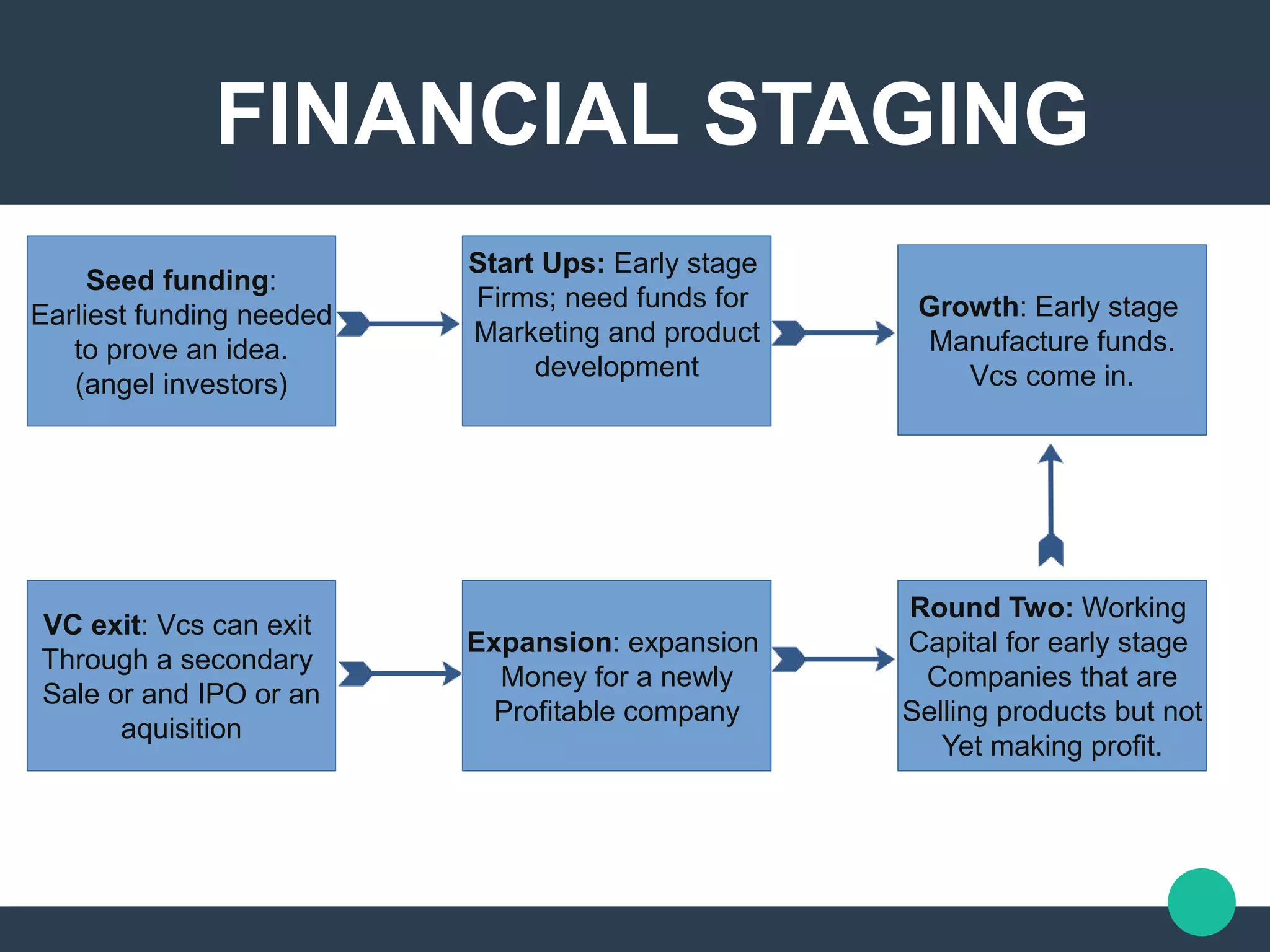
FINANCIAL STAGING
Seed funding:
Earliest funding needed
to prove an idea.
(angel investors)
Start Ups: Early stage
Firms; need funds for
Marketing and product
development
Growth: Early stage
Manufacture funds.
Vcs come in.
Round Two: Working
Capital for early stage
Companies that are
Selling products but not
Yet making profit.
Expansion: expansion
Money for a newly
Profitable company
VC exit: Vcs can exit
Through a secondary
Sale or and IPO or an
aquisition
COMPENSATION
 Payment is made to the venture capital fund managers
in the form of management fees and carried interest.

 Depending on the firm, roughly 20% of the profits are
paid to the company managing the private equity fund
while the rest goes to the limited partners who invested
into the fund.

 General partners are usually also due an additional 2%
fee.
VENTURE CAPITAL VS BANK
LOANS
 Venture capitalism provides advice, mentoring and
connections that most bussiness loans don’t.

 Venture capital provides more money as bank loan is provided
against collateral- which can be limited.

 With VC money focus can be laid on growth rather than cash
flow. With a bank loan cash flow is needed when payment
becomes due.
VS
ADVANTAGES
 Business Expertise: Aside from financial backing, a VC provides a
start up with valueable source of guidance and consultation.

 Additional resources: In a number of critical areas, including legal,
tax and personnel matters, a VC firm can provide active support.

 Connections: Venture capitalists are typically well connected in the
business community. Tapping into these connections could have
tremendous benefits.
DISADVANTAGES
 Loss of Control- With a large injection of cash and
professional investors, it is likely that the VC partners will
want to be involved. The size of their stake could determine
how much say they have in shaping the company’s
direction.

 Minority ownership status- Depending on the size of the
VC firm’s stake, which could be more than 50%, the start up
could lose management control.
THANK
YOU

Venture Capitalism

  • 1.
  • 2.
    INTRODUCTION  Venture Capitalismis a form of financing provided by firms to small early stage emerging firms.   VC firms invest in these early stage firms in exchange for equity or ownership stake.
  • 3.
    STRUCTURE  VC firmsare partnership firms.   There are two types of partners:  Venture capital Firm (general partner) Investors (Limited Partners) Eg-Public pension funds, Corporate pension funds, Insurance companies etc VENTURE CAPITAL FUND Fund management Ownership
  • 4.
     The generalpartners serve as managers of the fund and act as investment advisors to the venture capital fund raised.    Investors are known as limited partners which include both high net worth individuals and institutes with large amount of public capital.
  • 5.
    FINANCIAL STAGING Seed funding: Earliestfunding needed to prove an idea. (angel investors) Start Ups: Early stage Firms; need funds for Marketing and product development Growth: Early stage Manufacture funds. Vcs come in. Round Two: Working Capital for early stage Companies that are Selling products but not Yet making profit. Expansion: expansion Money for a newly Profitable company VC exit: Vcs can exit Through a secondary Sale or and IPO or an aquisition
  • 6.
    COMPENSATION  Payment ismade to the venture capital fund managers in the form of management fees and carried interest.   Depending on the firm, roughly 20% of the profits are paid to the company managing the private equity fund while the rest goes to the limited partners who invested into the fund.   General partners are usually also due an additional 2% fee.
  • 7.
    VENTURE CAPITAL VSBANK LOANS  Venture capitalism provides advice, mentoring and connections that most bussiness loans don’t.   Venture capital provides more money as bank loan is provided against collateral- which can be limited.   With VC money focus can be laid on growth rather than cash flow. With a bank loan cash flow is needed when payment becomes due. VS
  • 8.
    ADVANTAGES  Business Expertise:Aside from financial backing, a VC provides a start up with valueable source of guidance and consultation.   Additional resources: In a number of critical areas, including legal, tax and personnel matters, a VC firm can provide active support.   Connections: Venture capitalists are typically well connected in the business community. Tapping into these connections could have tremendous benefits.
  • 9.
    DISADVANTAGES  Loss ofControl- With a large injection of cash and professional investors, it is likely that the VC partners will want to be involved. The size of their stake could determine how much say they have in shaping the company’s direction.   Minority ownership status- Depending on the size of the VC firm’s stake, which could be more than 50%, the start up could lose management control.
  • 10.