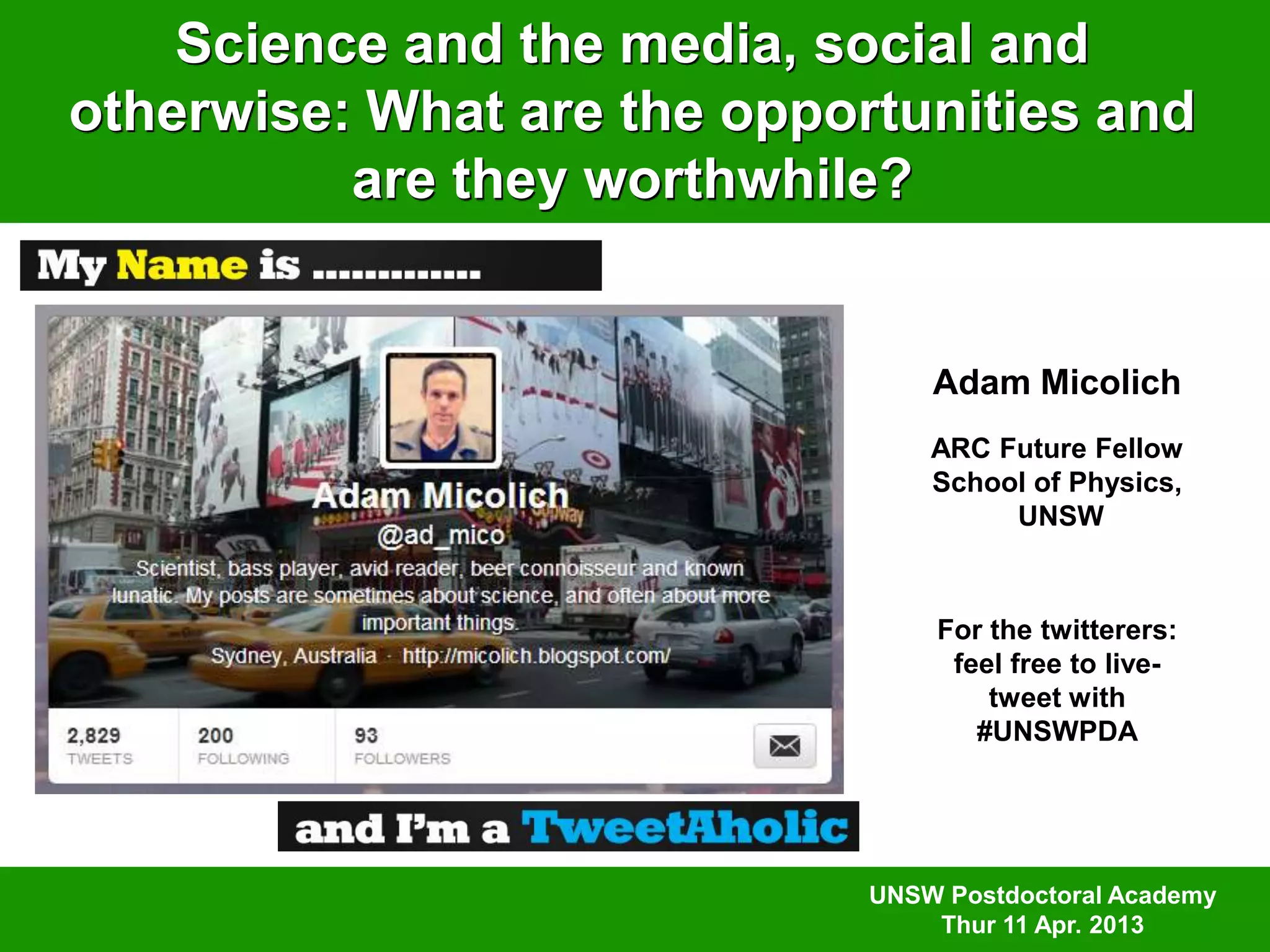
Science and the media, social and
otherwise: What are the opportunities and
          are they worthwhile?


                                 Adam Micolich
                                 ARC Future Fellow
                                 School of Physics,
                                      UNSW


                                 For the twitterers:
                                  feel free to live-
                                     tweet with
                                    #UNSWPDA


  UNSW                       UNSW Postdoctoral Academy
                                 Nanoelectronics
School of Physics                ThurGroup 2013
                                      11 Apr.
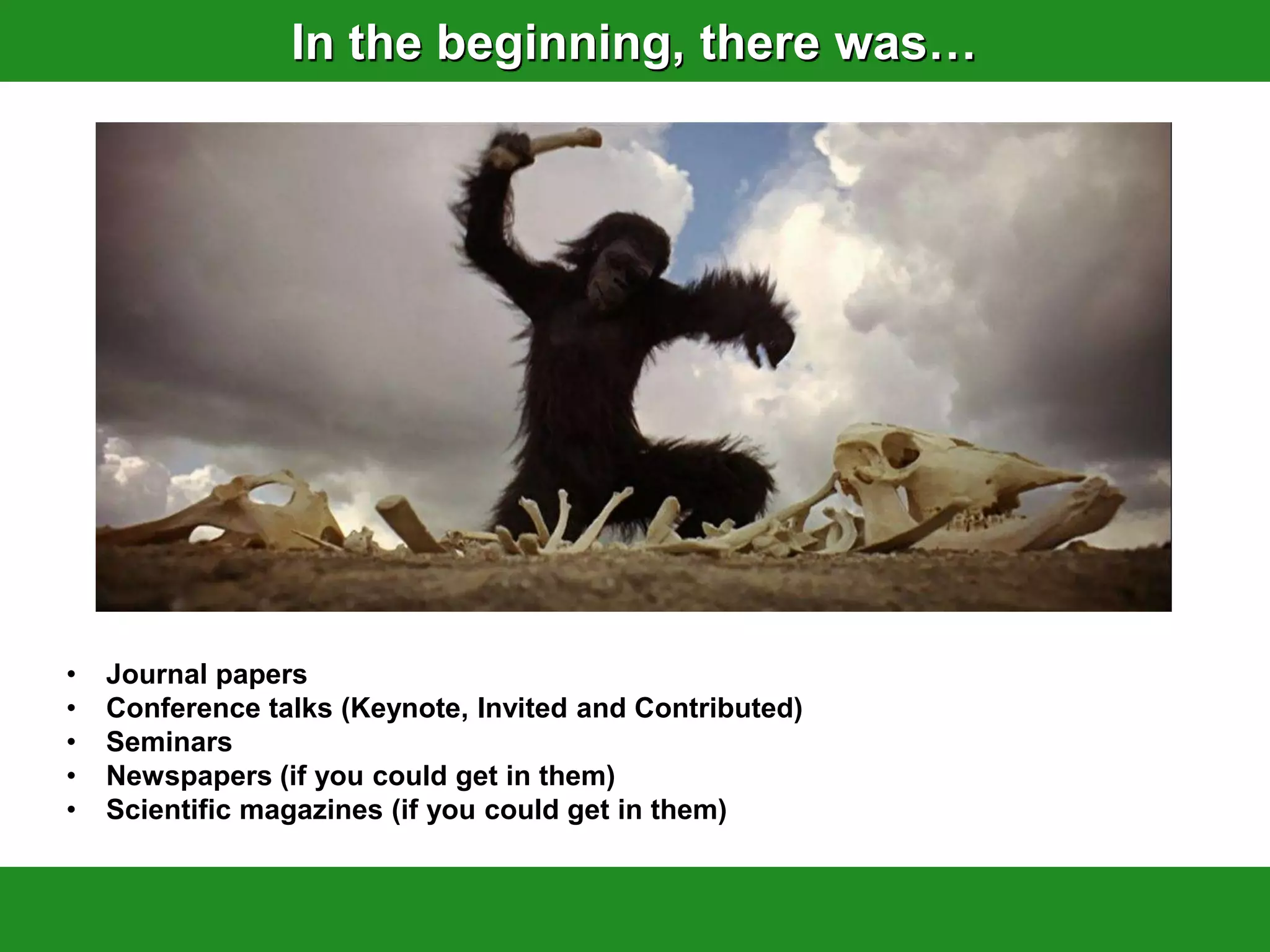
In the beginning, there was…


•   Journal papers
•   Conference talks (Keynote, Invited and Contributed)
•   Seminars
•   Newspapers (if you could get in them)
•   Scientific magazines (if you could get in them)
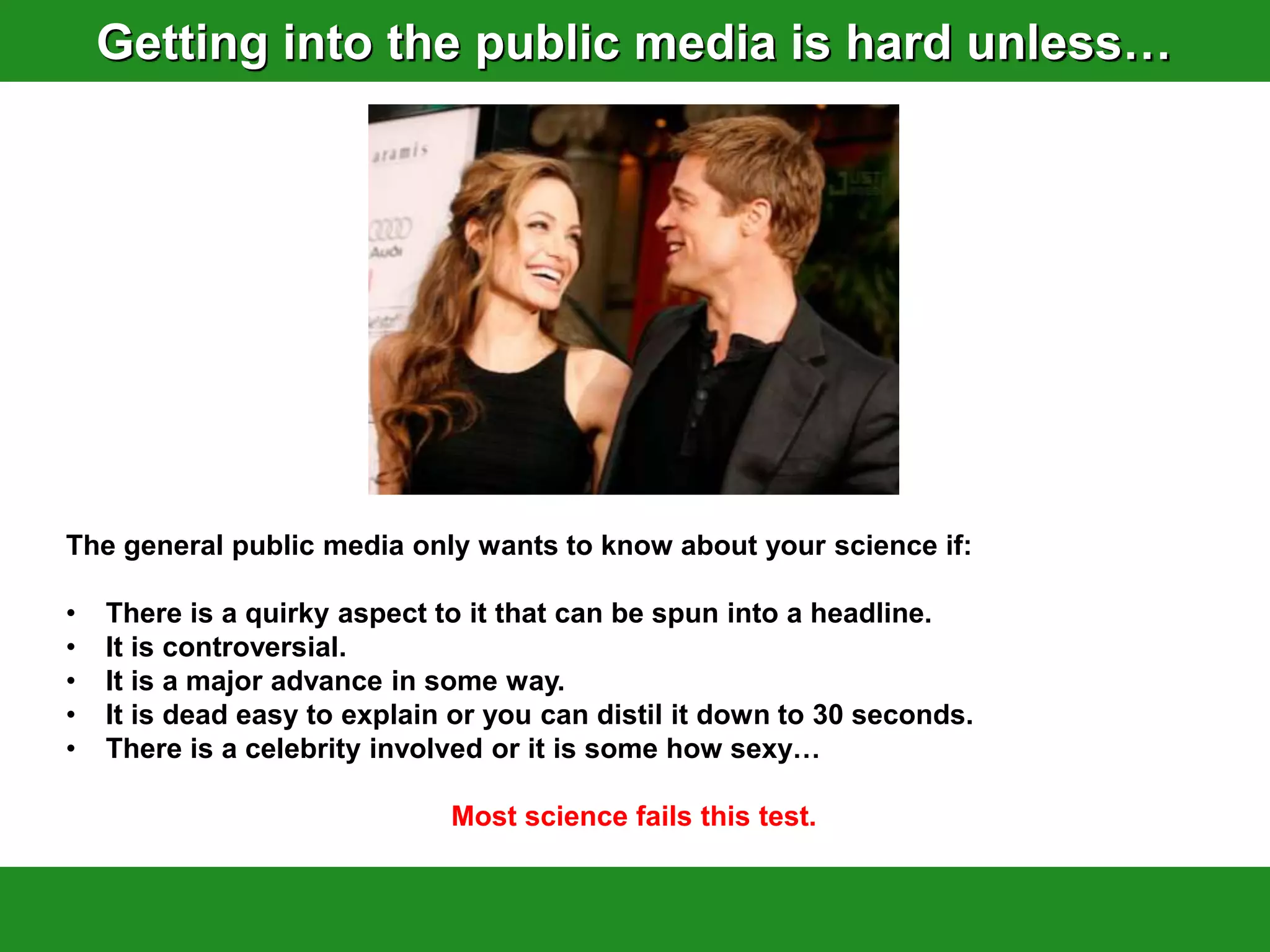
Getting into the public media is hard unless…


The general public media only wants to know about your science if:

•   There is a quirky aspect to it that can be spun into a headline.
•   It is controversial.
•   It is a major advance in some way.
•   It is dead easy to explain or you can distil it down to 30 seconds.
•   There is a celebrity involved or it is some how sexy…

                              Most science fails this test.
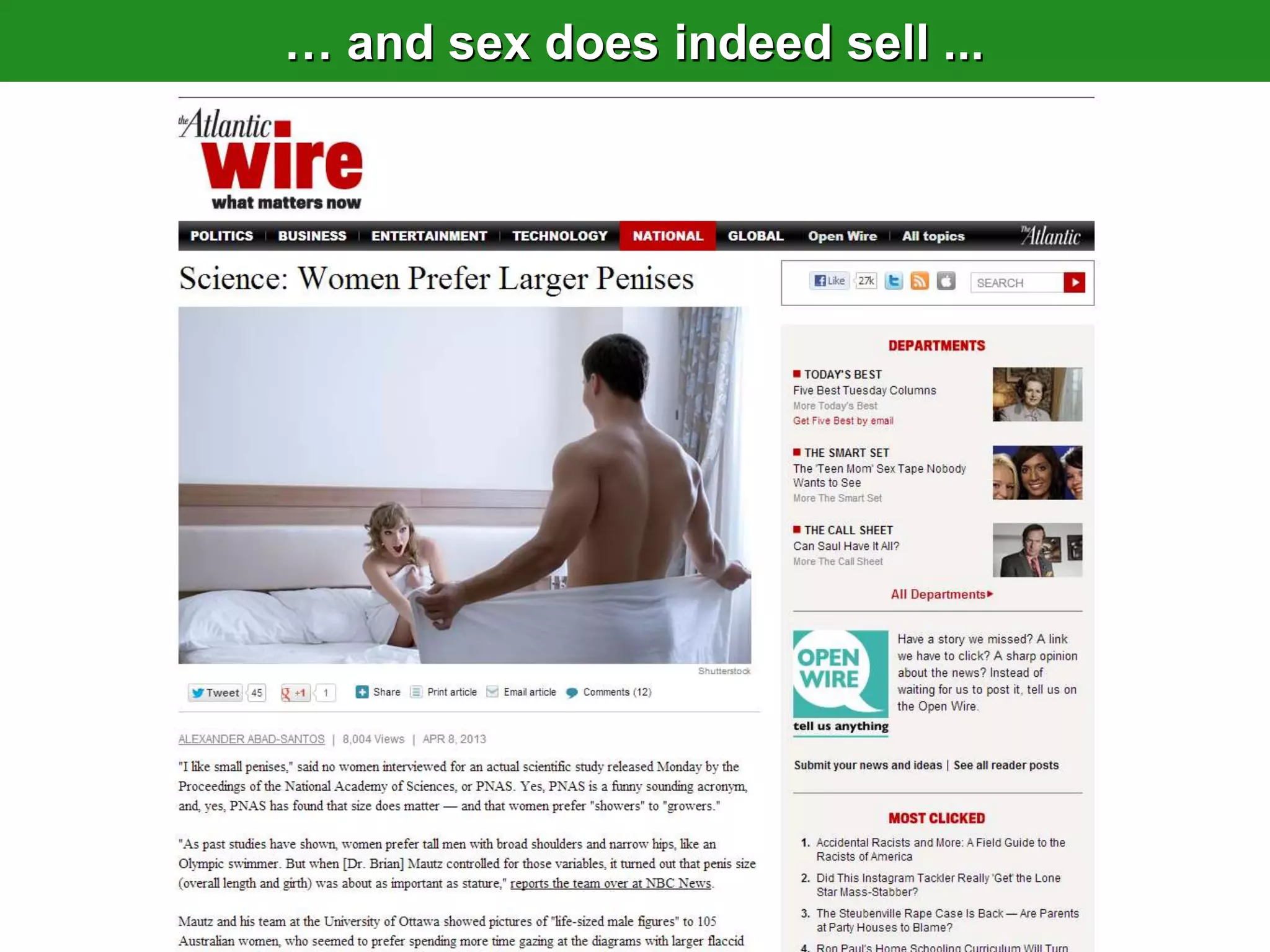
… and sex does indeed sell ...
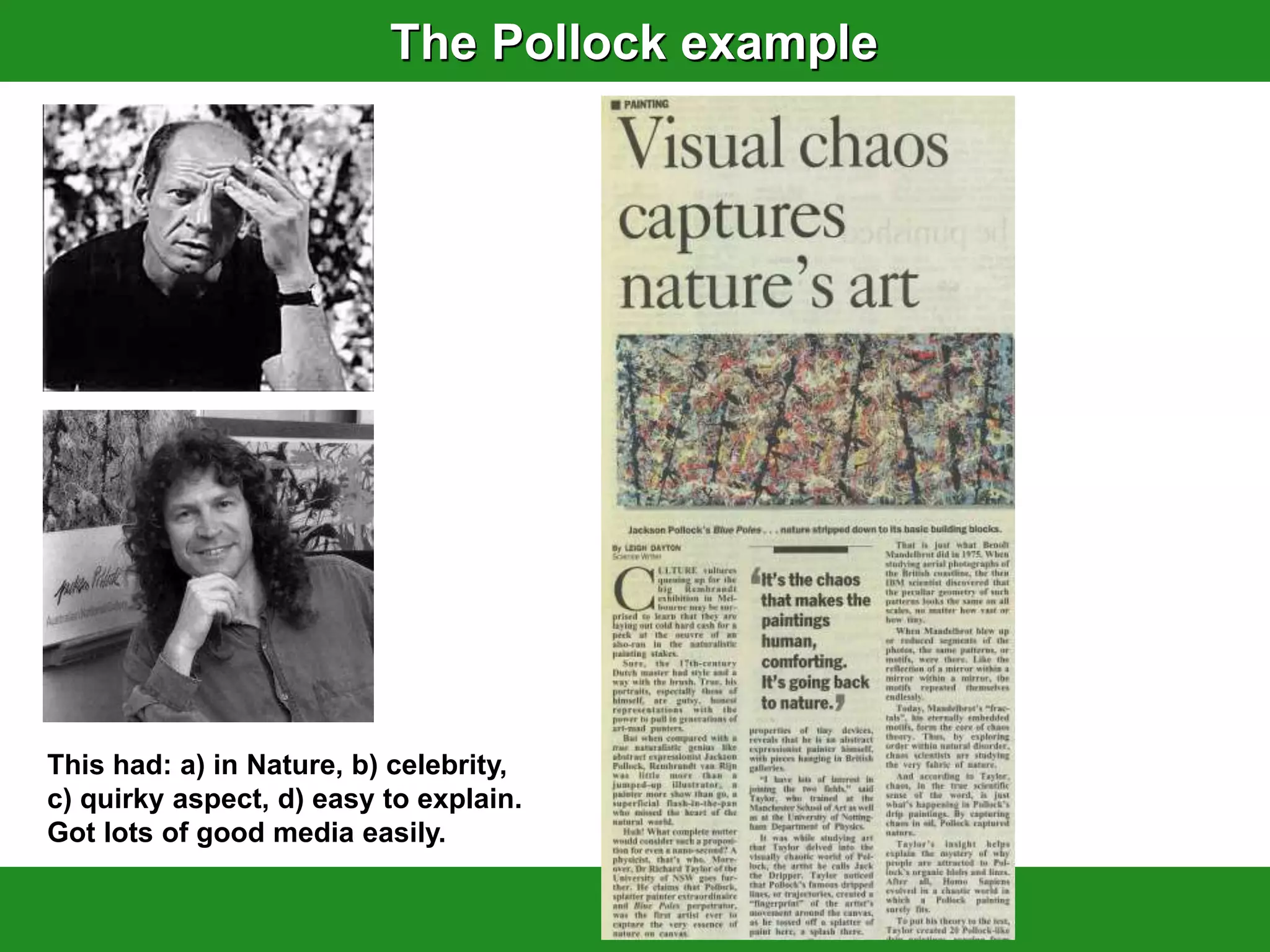
The Pollock example


This had: a) in Nature, b) celebrity,
c) quirky aspect, d) easy to explain.
Got lots of good media easily.
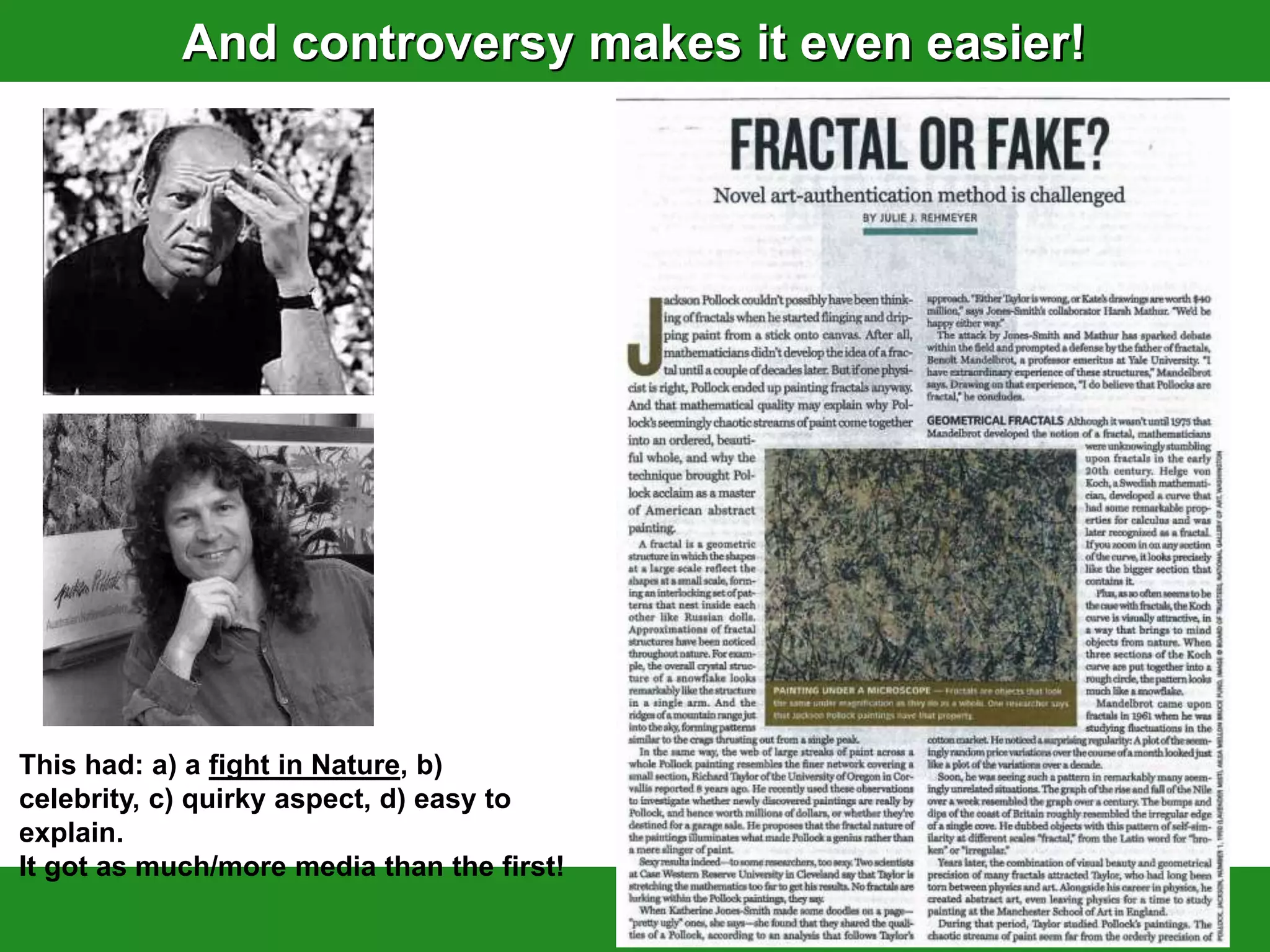
And controversy makes it even easier!


This had: a) a fight in Nature, b)
celebrity, c) quirky aspect, d) easy to
explain.
It got as much/more media than the first!
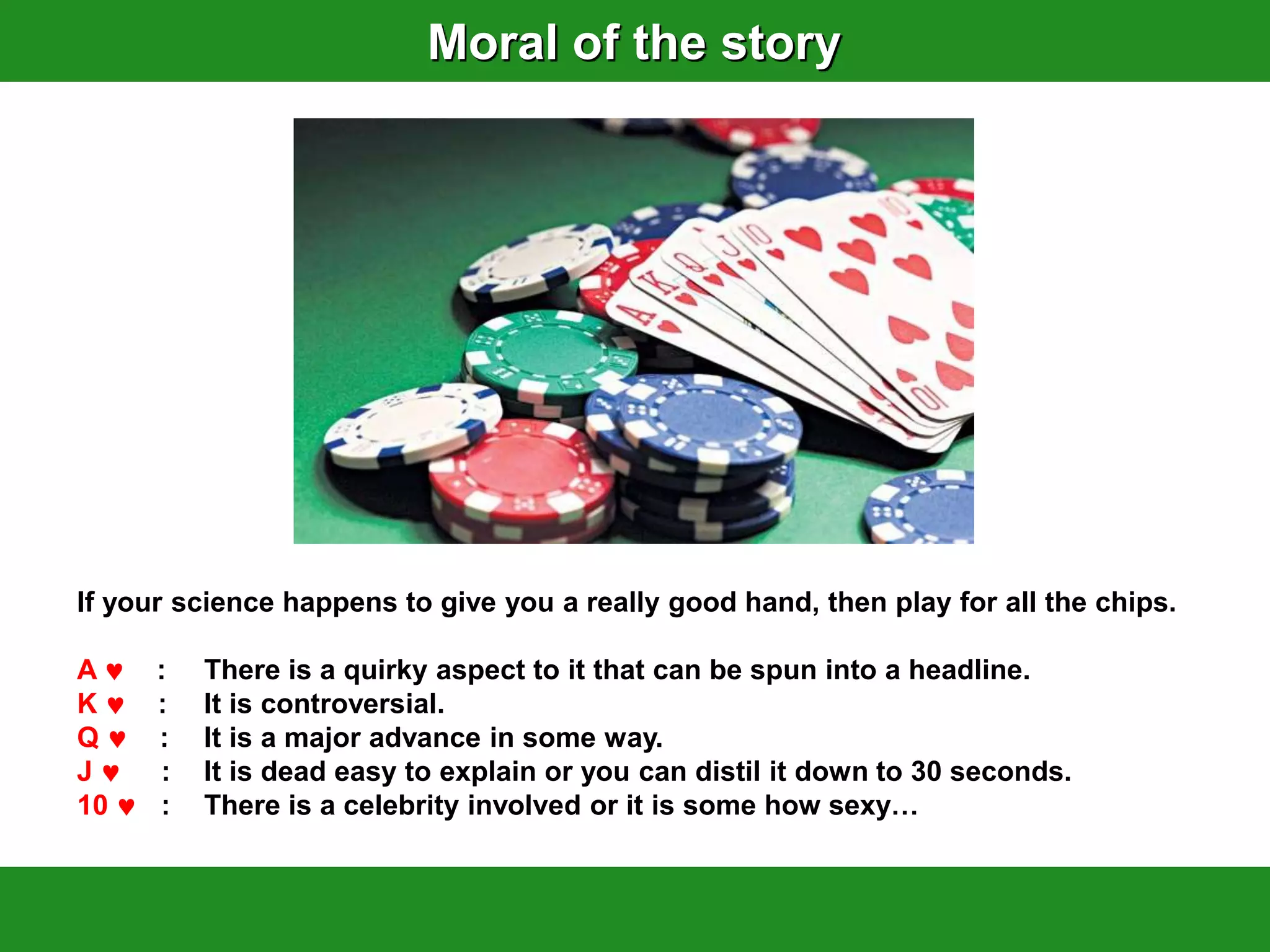
Moral of the story


If your science happens to give you a really good hand, then play for all the chips.

A     :   There is a quirky aspect to it that can be spun into a headline.
K     :   It is controversial.
Q     :   It is a major advance in some way.
J     :   It is dead easy to explain or you can distil it down to 30 seconds.
10    :   There is a celebrity involved or it is some how sexy…
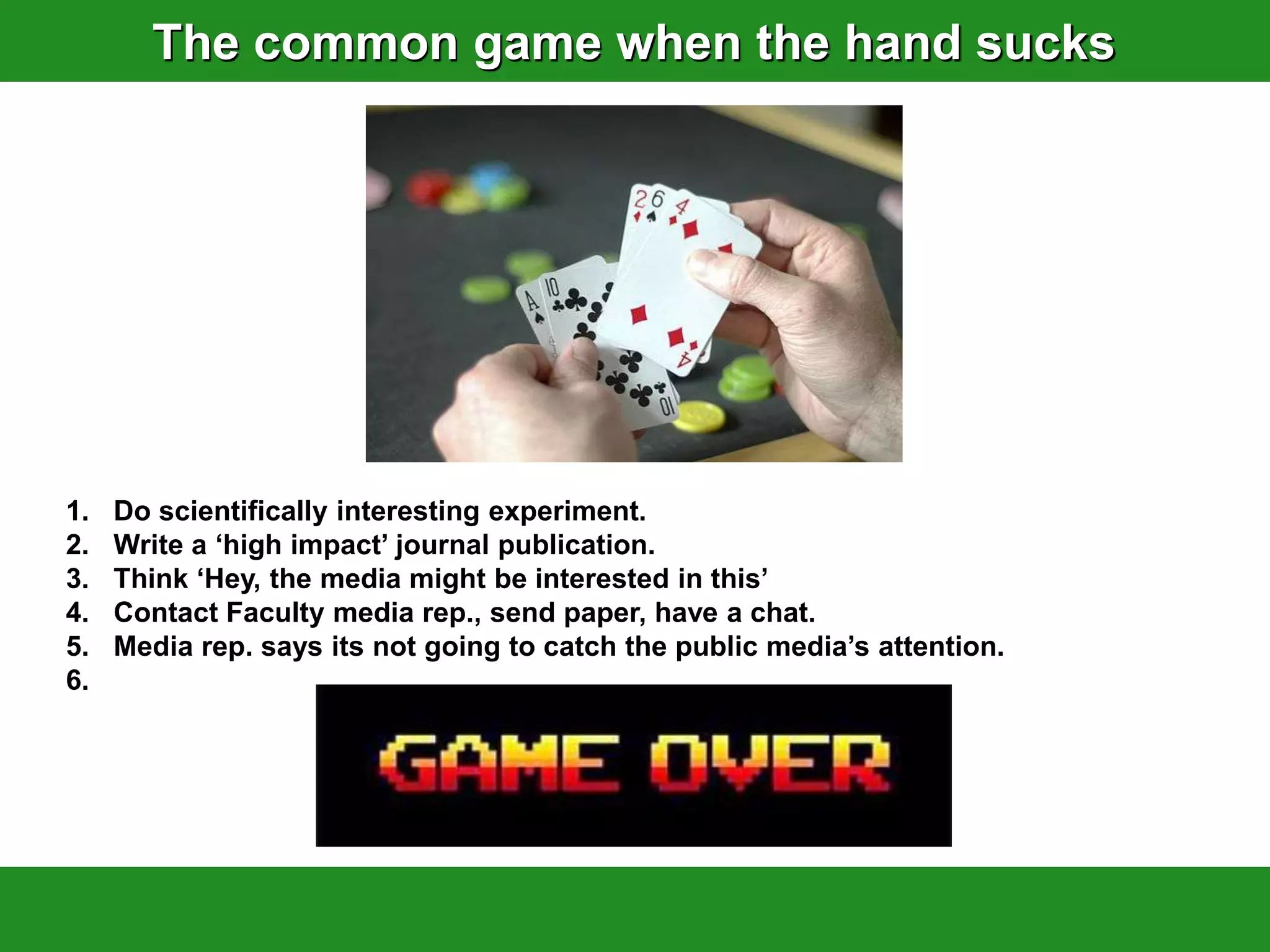
The common game when the hand sucks


1.   Do scientifically interesting experiment.
2.   Write a „high impact‟ journal publication.
3.   Think „Hey, the media might be interested in this‟
4.   Contact Faculty media rep., send paper, have a chat.
5.   Media rep. says its not going to catch the public media‟s attention.
6.
But you have other options!
•   The journal‟s own media or website for highlighting articles (ask the editor).


•   Trade journals, e.g., Materials Today, IEEE Spectrum, etc. (note these have
    limited capacity in print, but are often happy to give you online space.)


•   Online websites, e.g., Physorg.com, nanotechweb.org, reddit. Some have
    editors, some you submit yourself, some are popularity based.

Advantage: Sometimes these avenues will get you others! The media likes to copy
itself, journalists are often busy on tight deadlines and will happily adopt each
others stories.

The trick: You need to invest the time in managing your own media…
Managing your media


                                                        "Take it from me, there's nothing like
                                                          a job well done. Except the quiet
                                                        enveloping darkness at the bottom of
                                                        a bottle of Jim Beam after a job done
                                                                    any way at all."

                                                                Hunter S. Thompson


•   You need to learn a new style of writing, it will be frustrating. You need to sit yourself
    halfway between your media office and a normal paper-writer.

•   I write my own press releases. I distil to 500 words first copy, then 250 - 300
    words, and lastly a 100 word copy, so I have something ready for all lengths.

•   It is usually the 250-300 word copy that I go fishing with. Sometimes I will also get the
    media office to write a general release so I can fish in separate markets.
Case Study: Plastic Superconductors


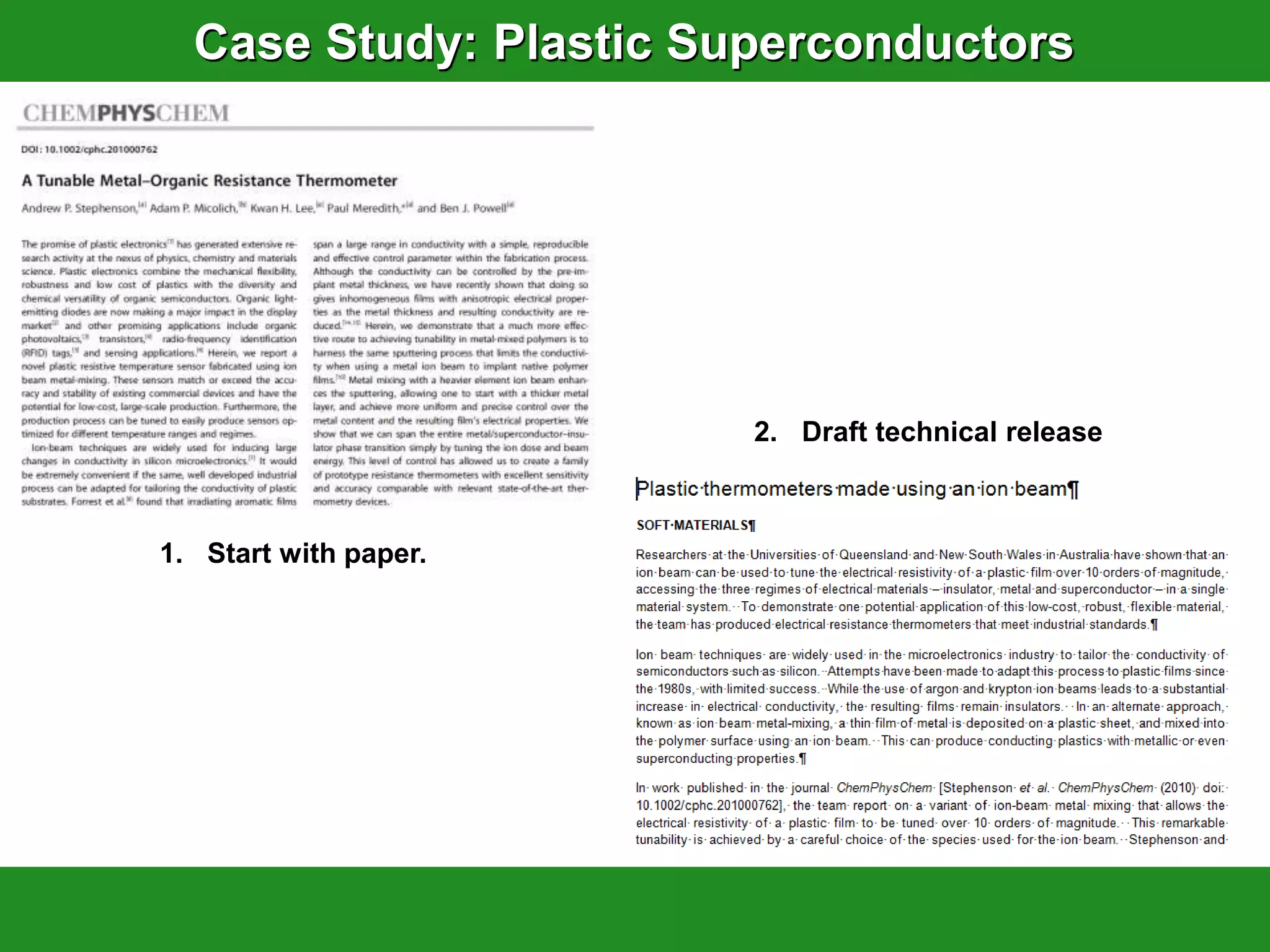
                        2. Draft technical release


1. Start with paper.
Case Study: Plastic Superconductors
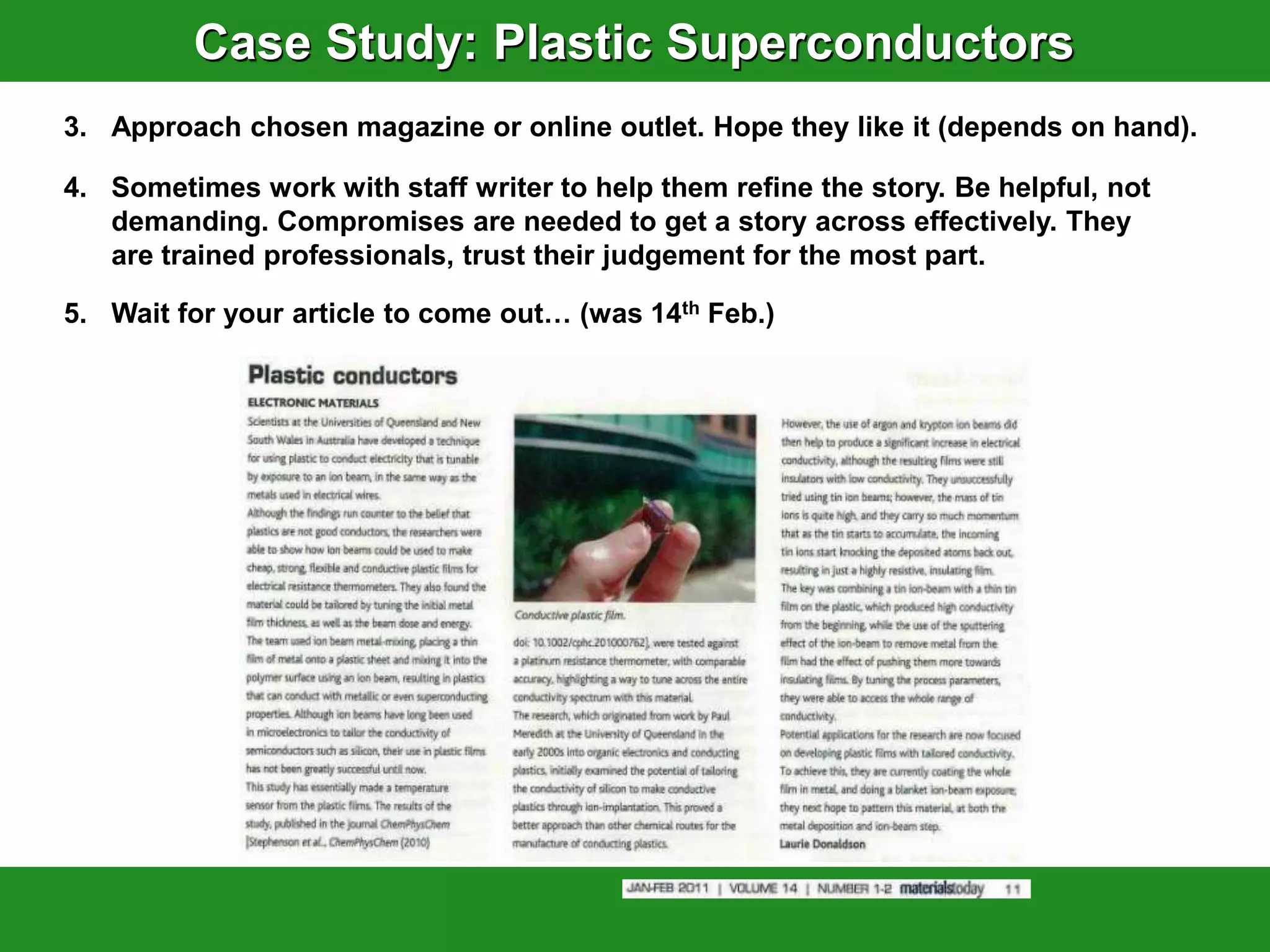
3. Approach chosen magazine or online outlet. Hope they like it (depends on hand).

4. Sometimes work with staff writer to help them refine the story. Be helpful, not
   demanding. Compromises are needed to get a story across effectively. They
   are trained professionals, trust their judgement for the most part.

5. Wait for your article to come out… (was 14th Feb.)
Case Study: Plastic Superconductors
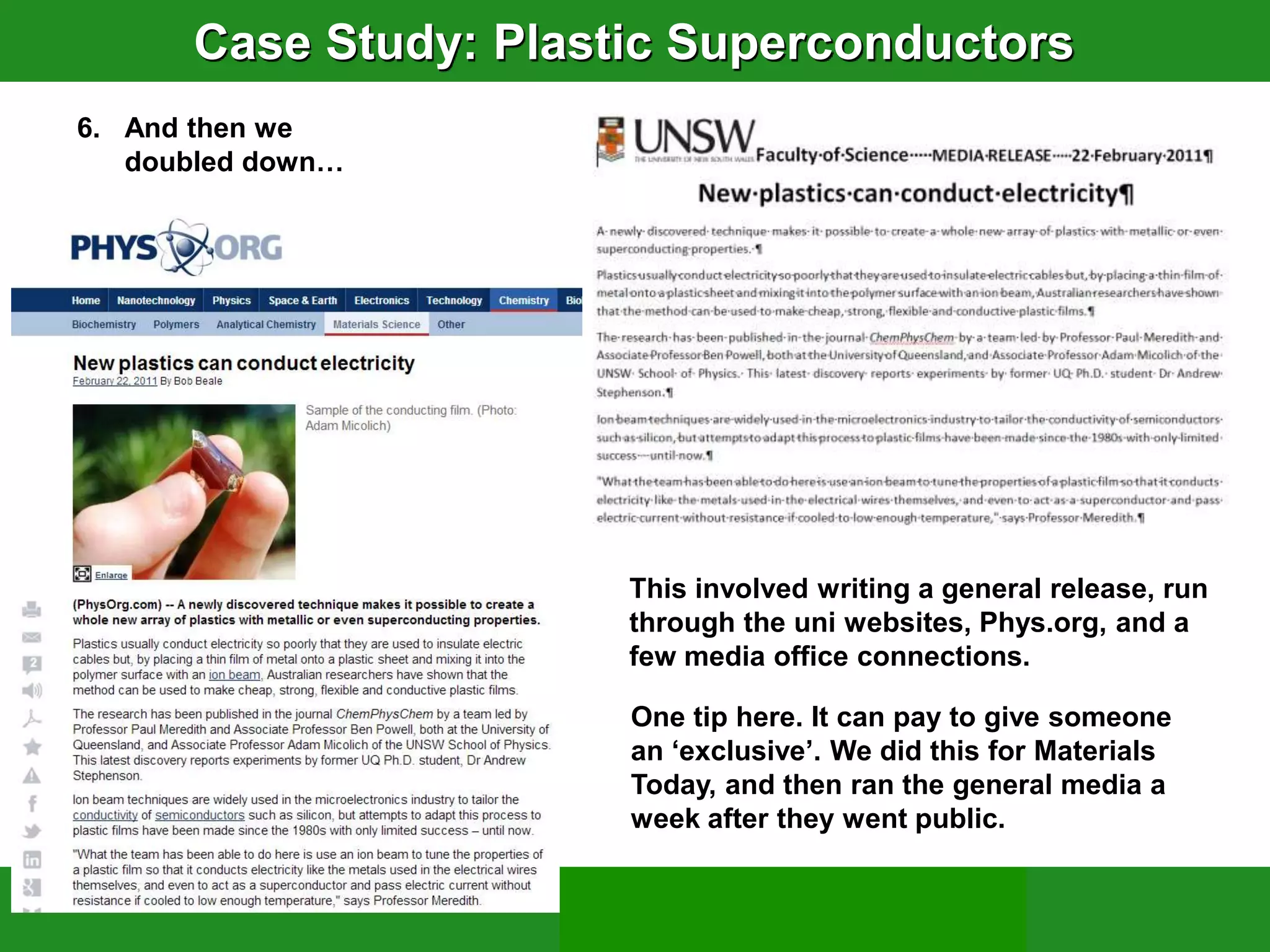
6. And then we
   doubled down…


                       This involved writing a general release, run
                       through the uni websites, Phys.org, and a
                       few media office connections.

                       One tip here. It can pay to give someone
                       an „exclusive‟. We did this for Materials
                       Today, and then ran the general media a
                       week after they went public.
Managing your media


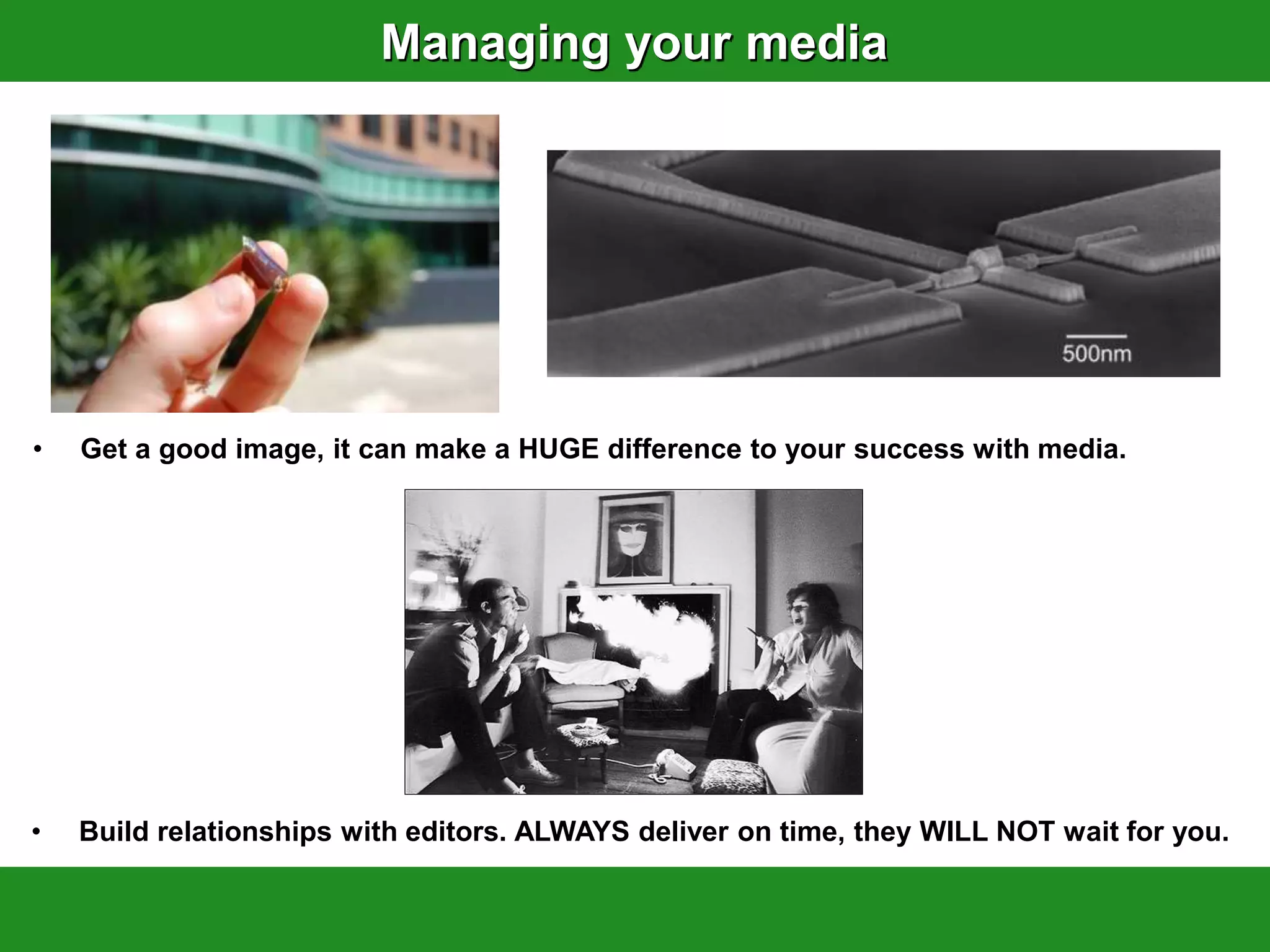
•   Get a good image, it can make a HUGE difference to your success with media.


•   Build relationships with editors. ALWAYS deliver on time, they WILL NOT wait for you.
Managing your media: Multi-institutions


•   Press releases made simultaneously by two or more institutions can be very
    powerful, but can be very dangerous. Each media office will tend to fight to make
    their institute look more important, involved, etc. than the other(s).

•   As a team of investigators, you need to agree on a common release, and bully your
    media office to release it as you (as a team) want it. This is the one time in media
    when you must rule with an iron fist. A rogue media office can create hell for you.

•   If your media office are fools, run through only one office to have a single message.
Managing your media: Multi-institutions


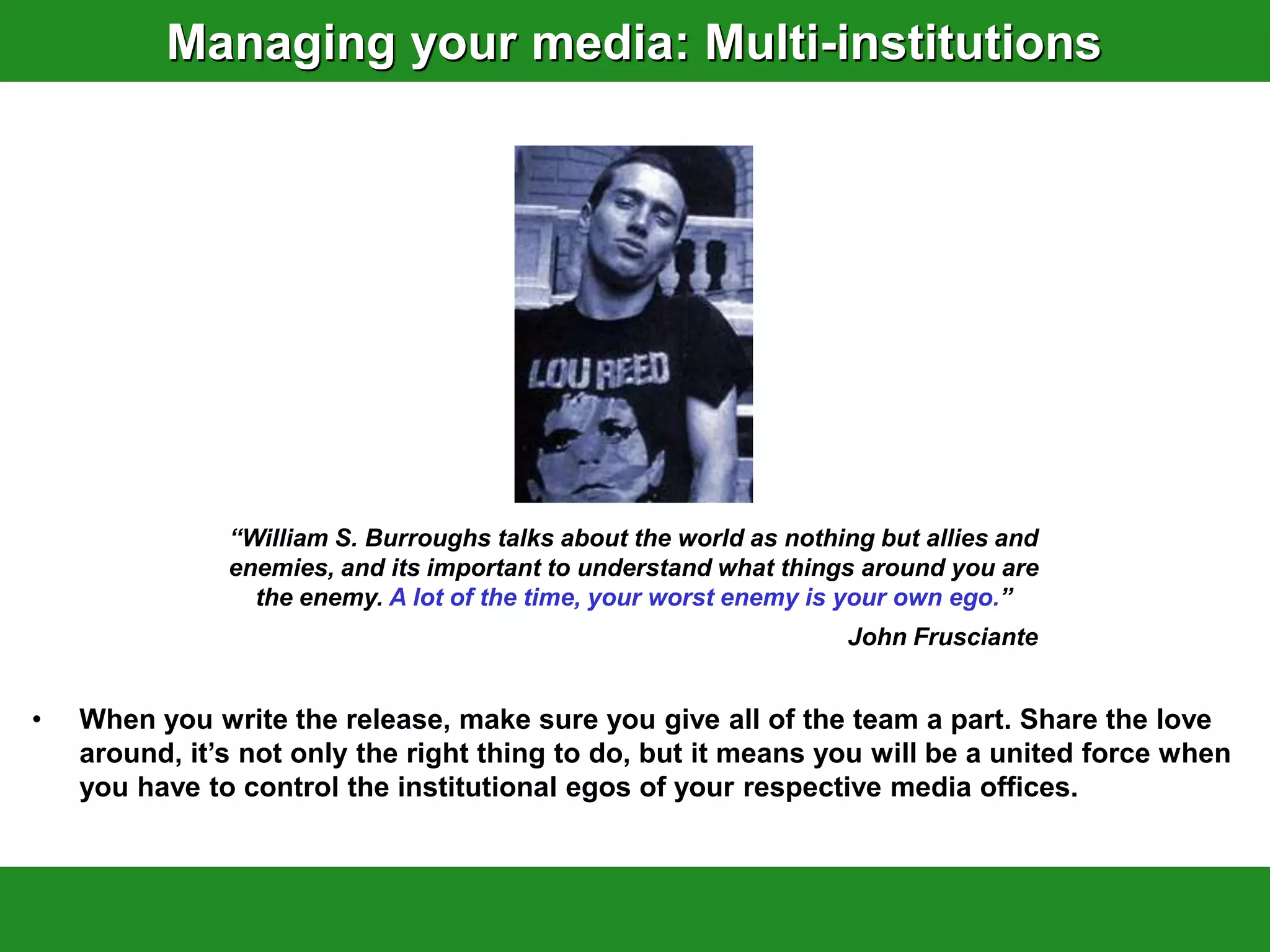
               “William S. Burroughs talks about the world as nothing but allies and
               enemies, and its important to understand what things around you are
                 the enemy. A lot of the time, your worst enemy is your own ego.”
                                                                   John Frusciante


•   When you write the release, make sure you give all of the team a part. Share the love
    around, it‟s not only the right thing to do, but it means you will be a united force when
    you have to control the institutional egos of your respective media offices.
Opinion pieces
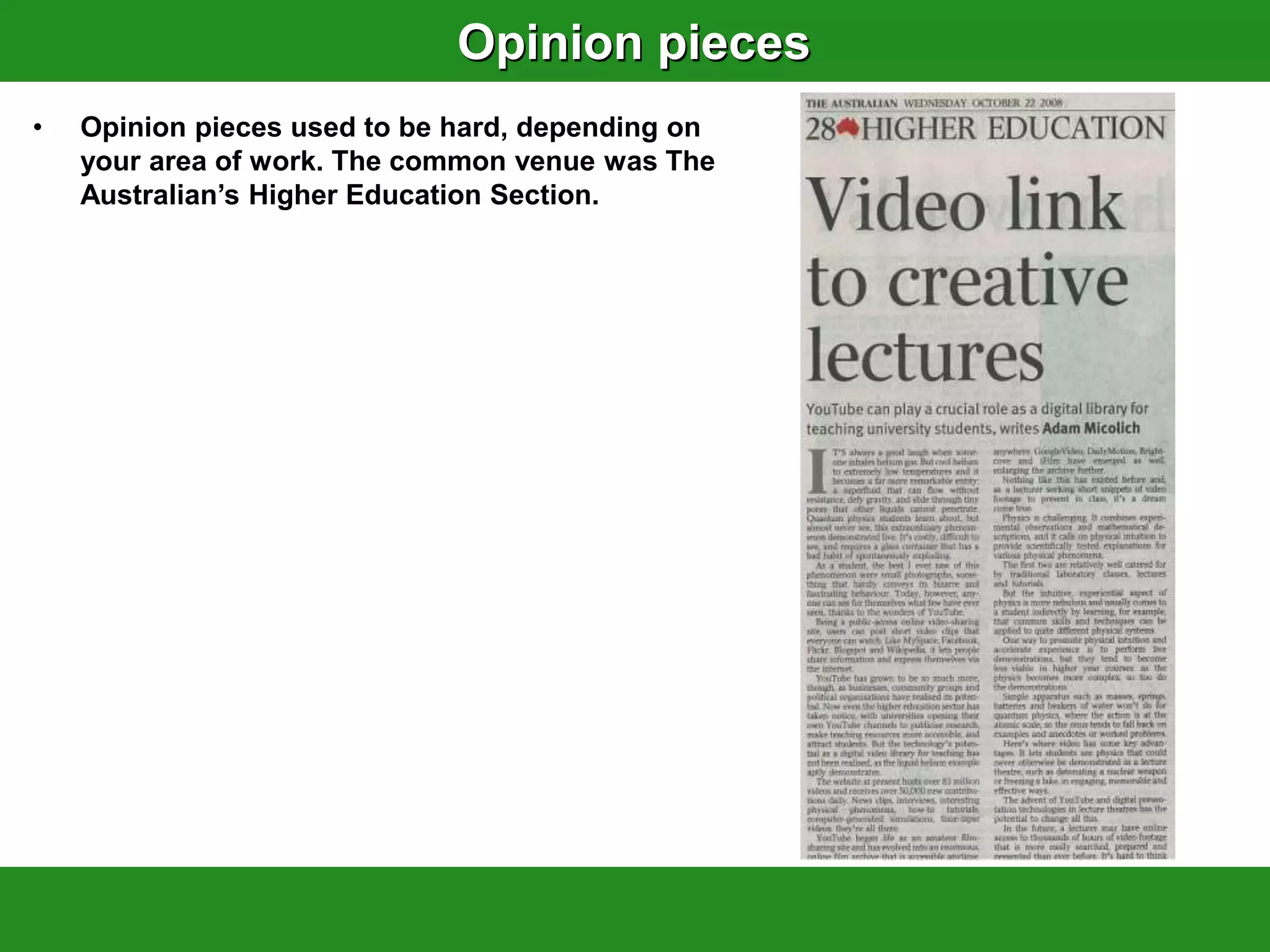
•   Opinion pieces used to be hard, depending on
    your area of work. The common venue was The
    Australian‟s Higher Education Section.
Opinion pieces: Beat the media!
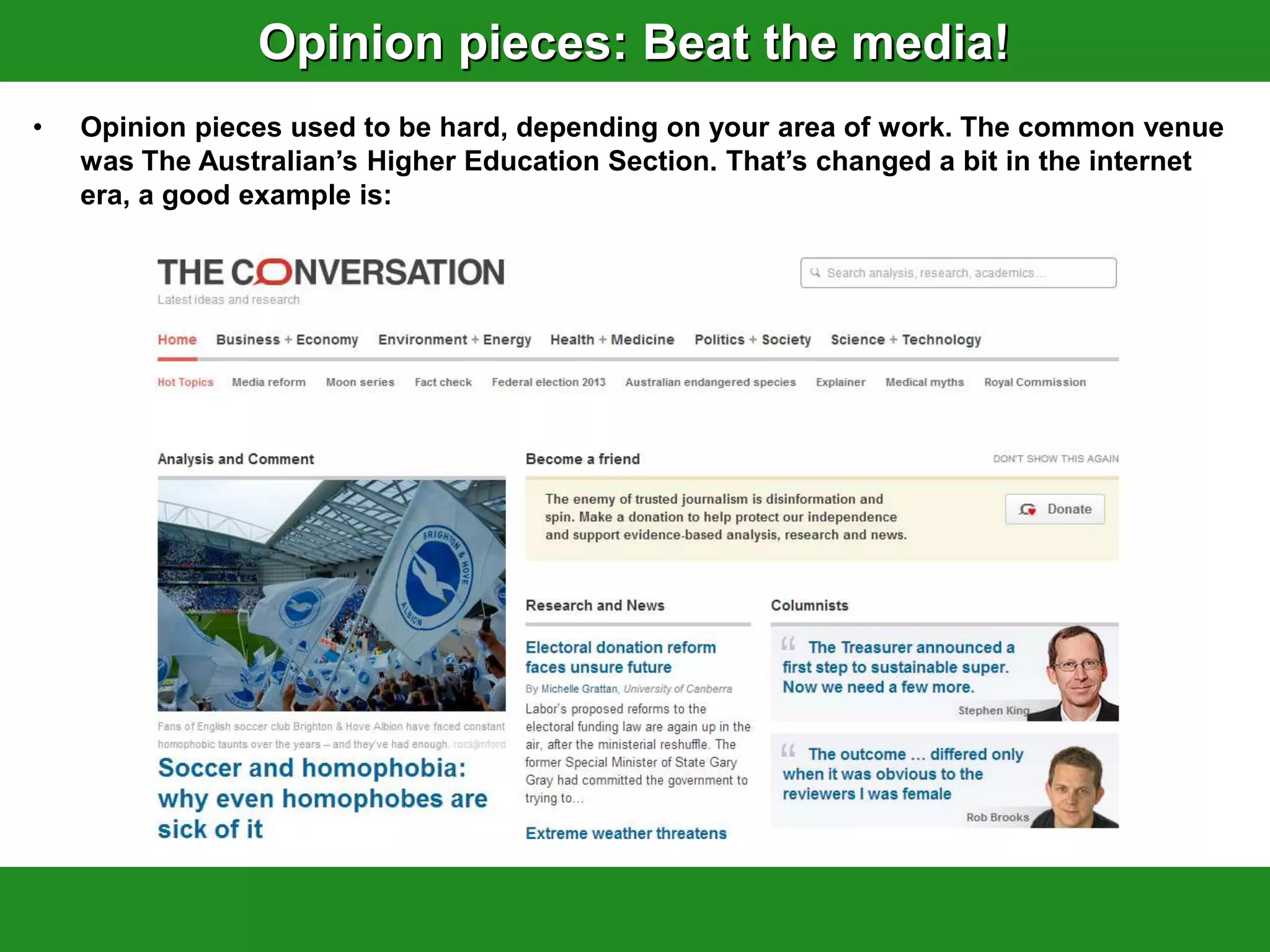
•   Opinion pieces used to be hard, depending on your area of work. The common venue
    was The Australian‟s Higher Education Section. That‟s changed a bit in the internet
    era, a good example is:
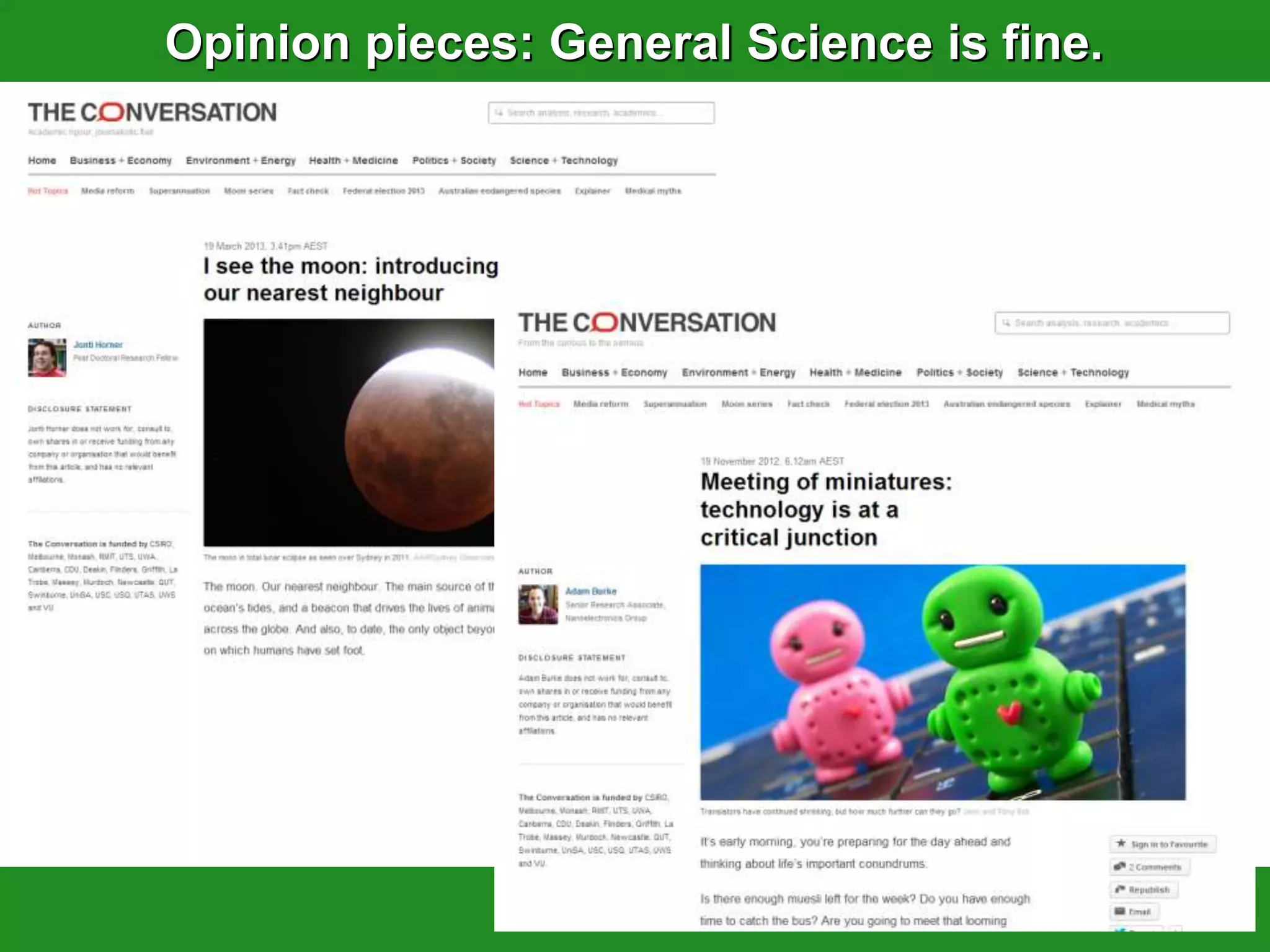
Opinion pieces: General Science is fine.
Opinion pieces: Beat the media!
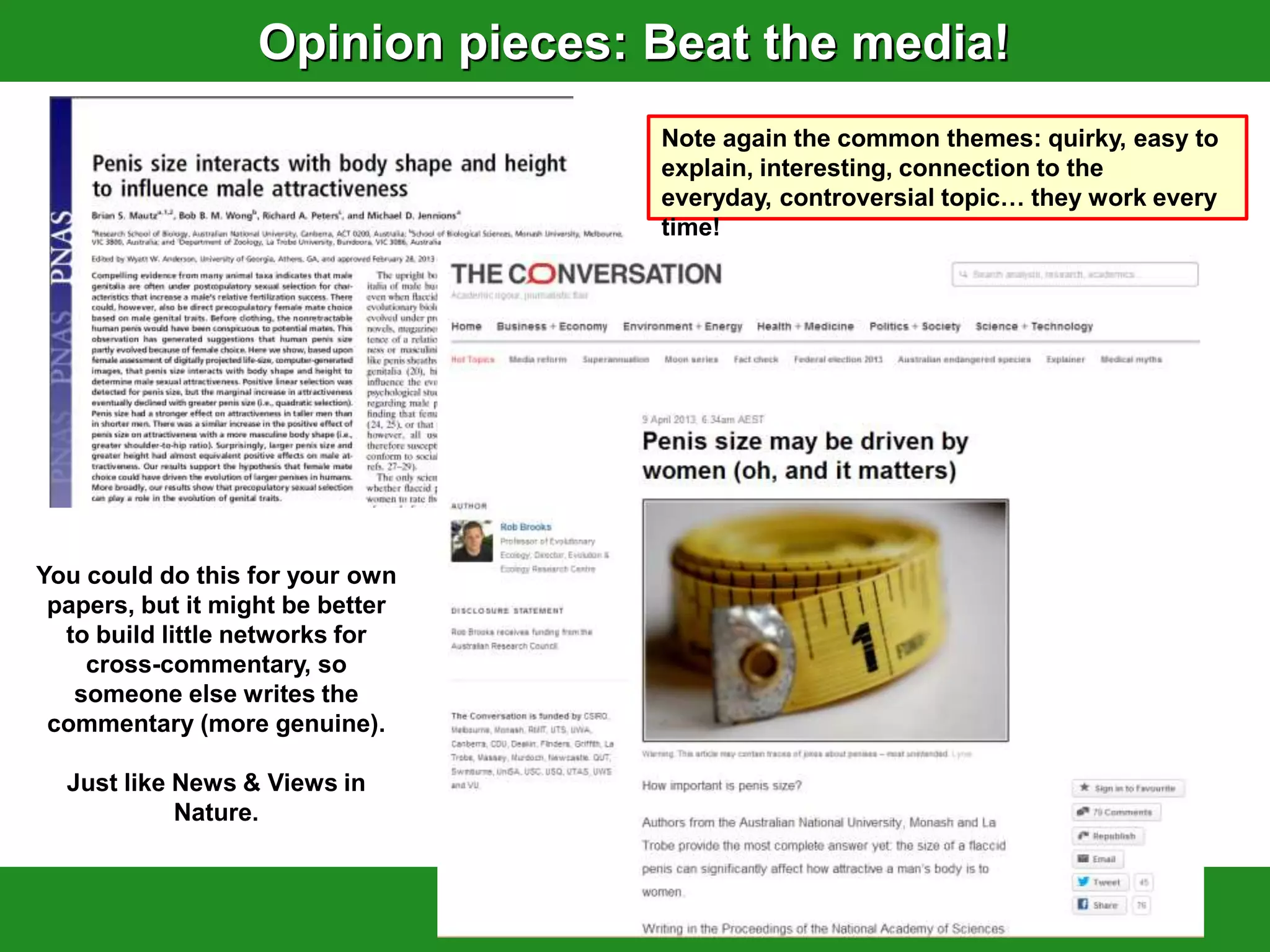
                                   Note again the common themes: quirky, easy to
                                   explain, interesting, connection to the
                                   everyday, controversial topic… they work every
                                   time!


You could do this for your own
 papers, but it might be better
  to build little networks for
    cross-commentary, so
   someone else writes the
 commentary (more genuine).

  Just like News & Views in
            Nature.
Blogging


•   Another possibility is to start your own blog… (which I‟ve never succeeded at).


•   Do not do this unless you:

a) Have a clear idea of interesting content to write

b) Can write well in an accessible manner on a short timescale

c) Intend to post regularly and consistently

d) Are willing to wait a significant amount of time to see readership gains

          Your journalistic skills should be well developed to do this effectively!
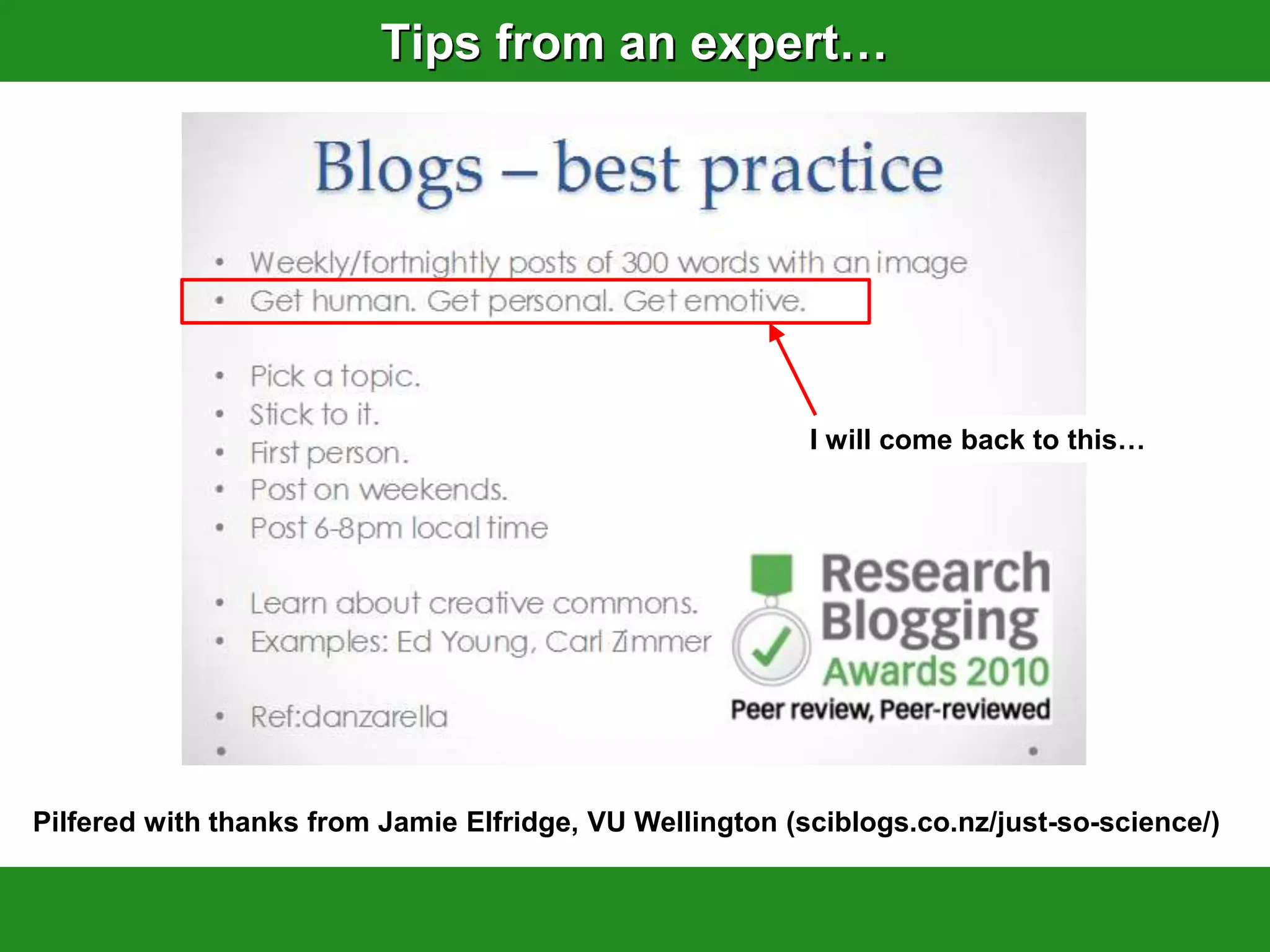
Tips from an expert…


                                                          I will come back to this…


Pilfered with thanks from Jamie Elfridge, VU Wellington (sciblogs.co.nz/just-so-science/)
To social media…
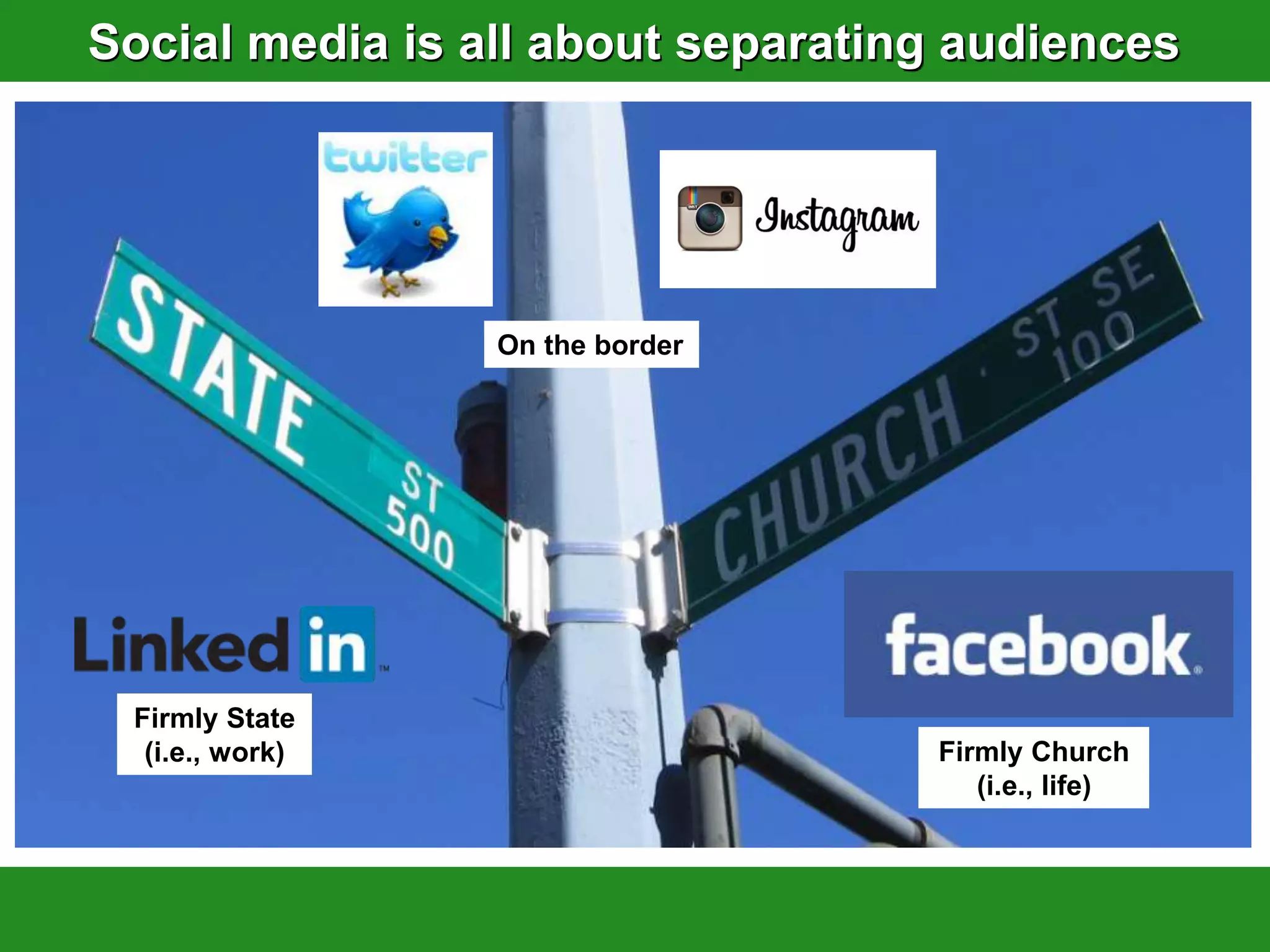
Social media is all about separating audiences


                 On the border


 Firmly State
  (i.e., work)                     Firmly Church
                                      (i.e., life)
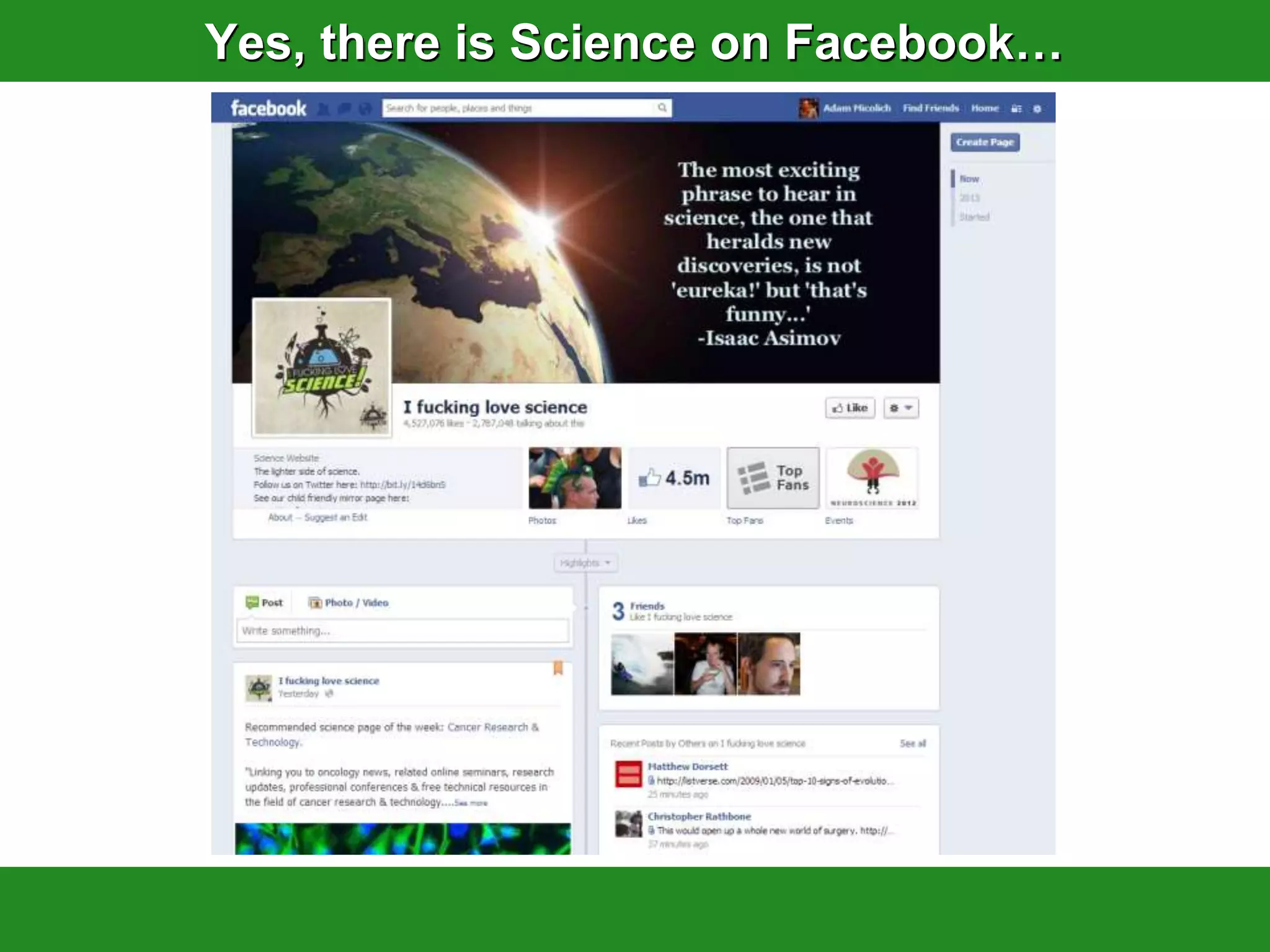
Yes, there is Science on Facebook…
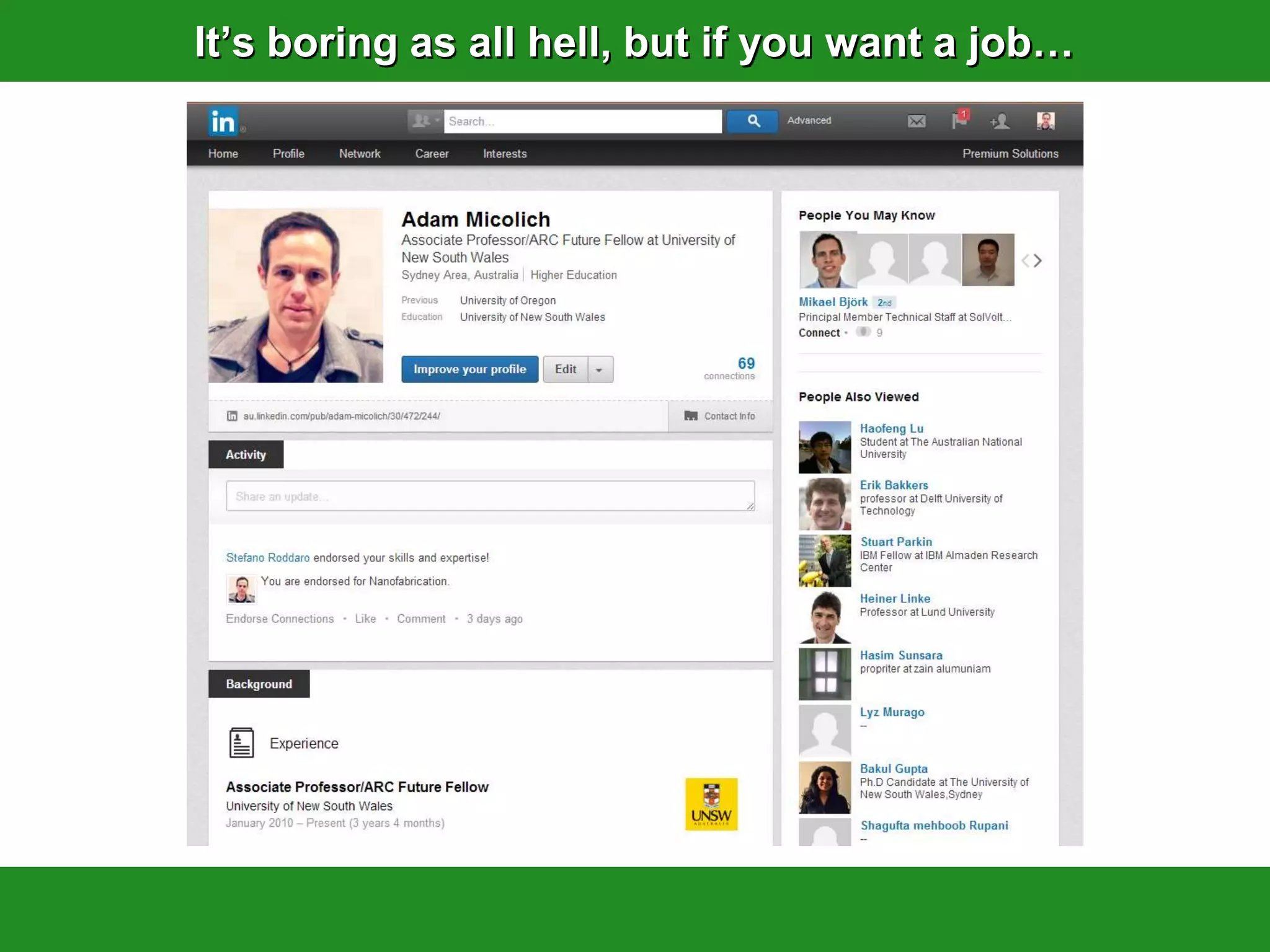
It‟s boring as all hell, but if you want a job…
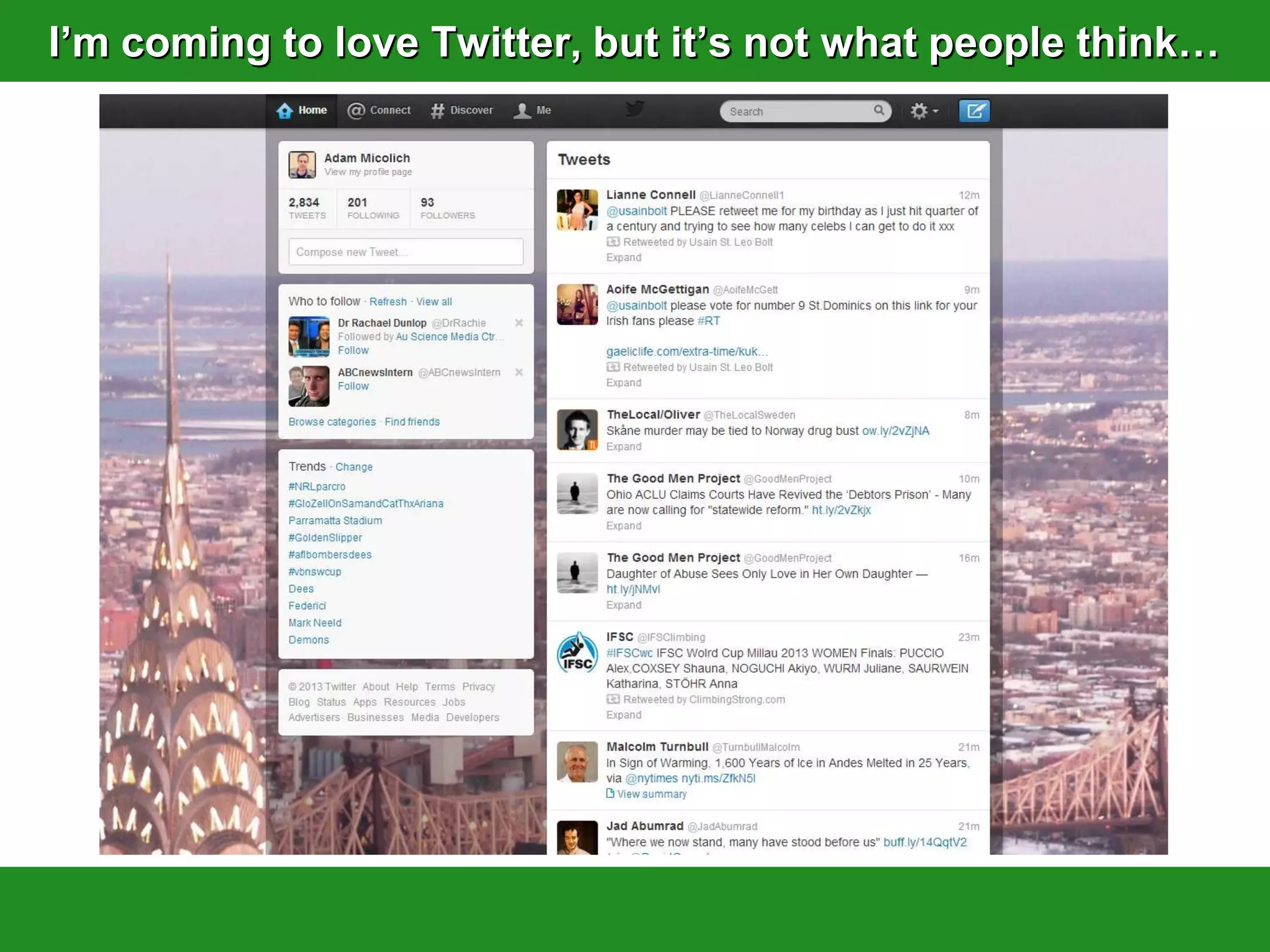
I‟m coming to love Twitter, but it‟s not what people think…
Key points on twitter

•   Have some patience, it takes time to get the hang of and build a follower base.

•   You need to make a decision about „who you are‟ and what you are trying to achieve.
    Are you:

a) A spokesperson for a group/organization.
b) An advocate (e.g., a person who tends to focus on one topic/user-base.
c) A general user who just happens to have a bit of an interest in science.

I personally recommend the latter (c), it gives you MUCH more freedom as a twitter user.
I think a) is somewhat effective, and b) only if you are already well known (i.e., celebrity).

•   Twitter is more or less useless for promoting your own science, I have seen almost
    no one do it effectively (even people who think they do).

•   Twitter is very useful for networking in meeting new people, esp. at conferences.

•   Twitter can be useful for science advocacy, since you have access to politicians.

•   Twitter can be fun! Don‟t forget that.
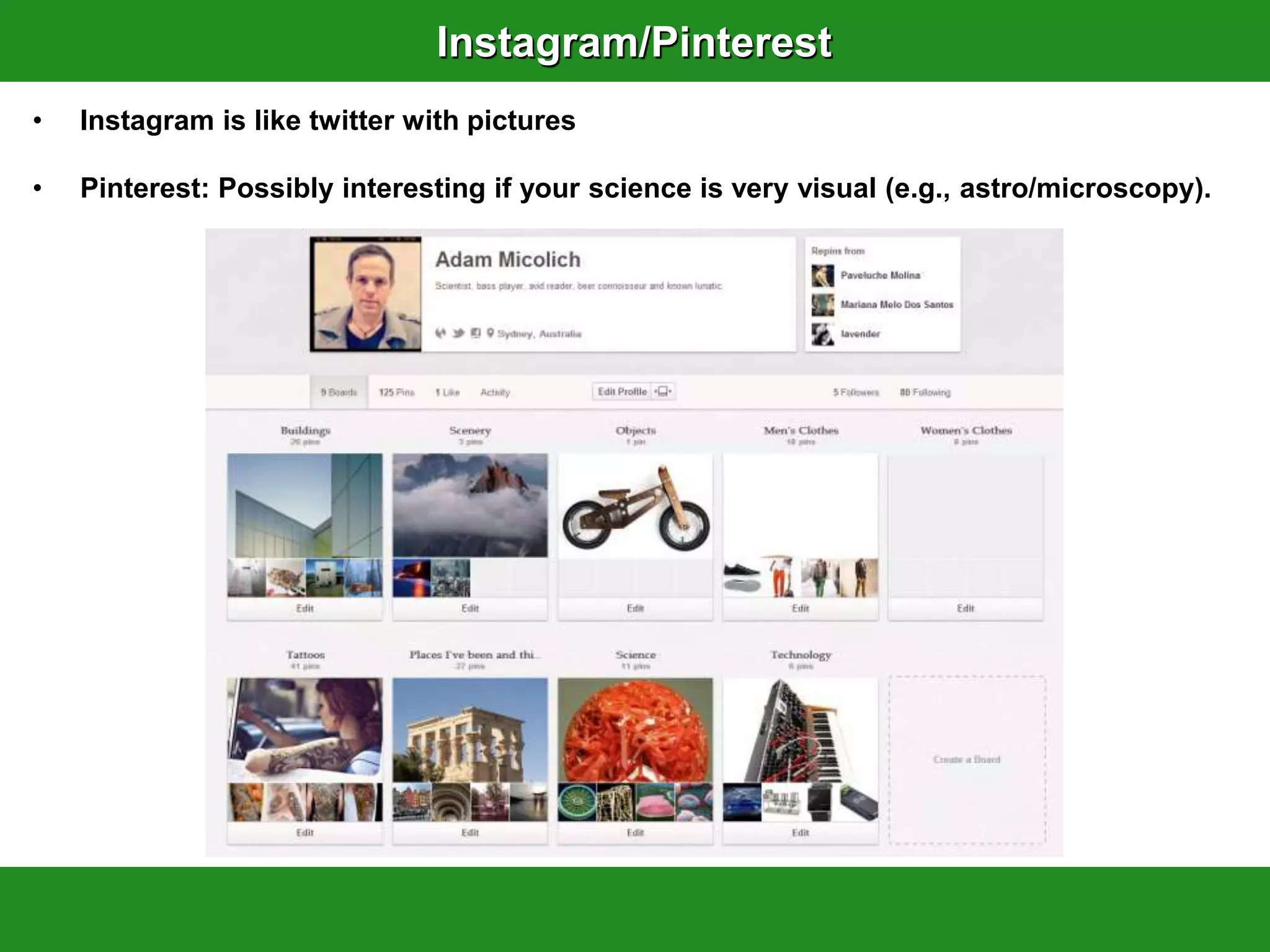
Instagram/Pinterest
•   Instagram is like twitter with pictures

•   Pinterest: Possibly interesting if your science is very visual (e.g., astro/microscopy).
YouTube
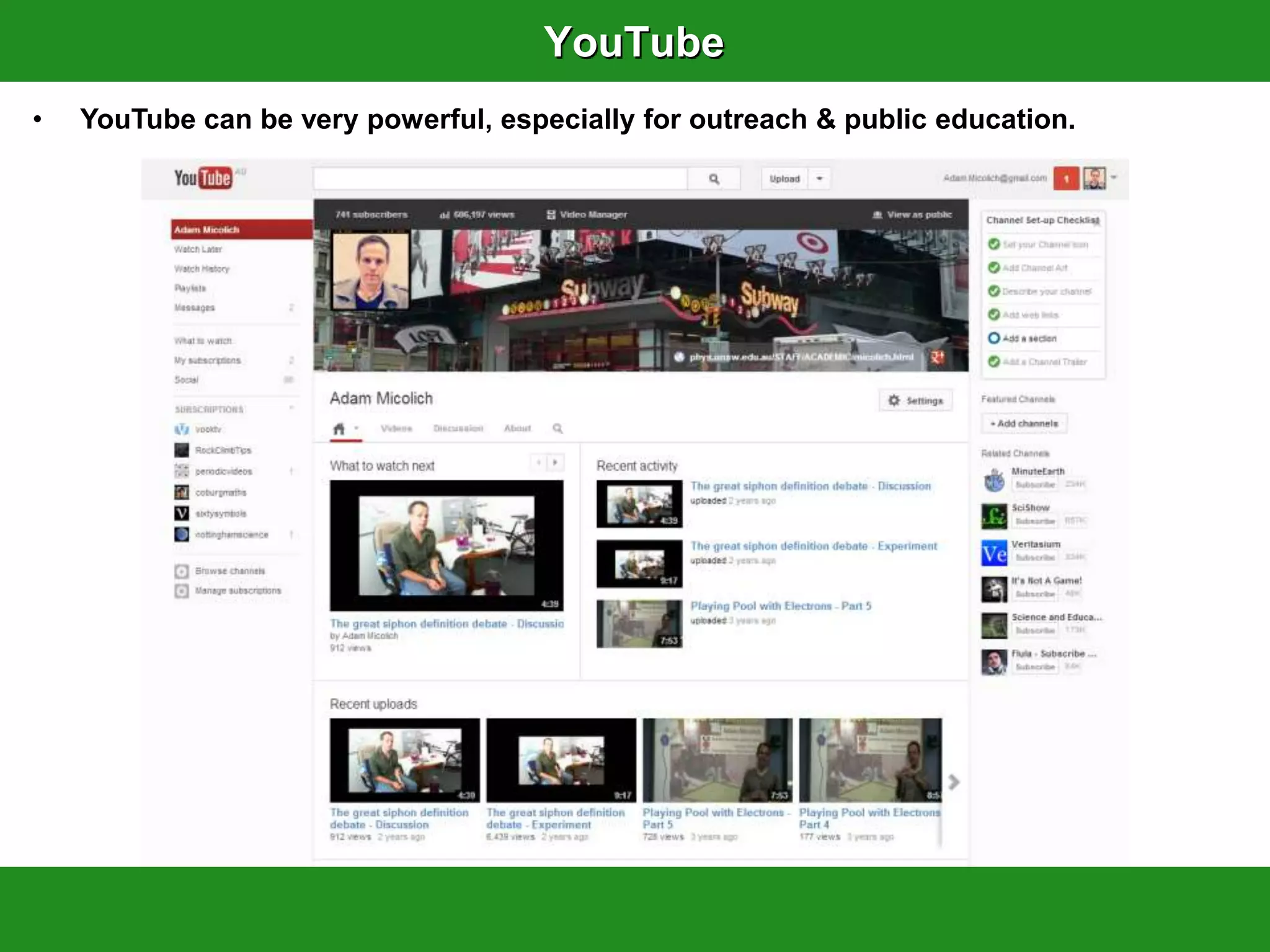
•   YouTube can be very powerful, especially for outreach & public education.
Key points on YouTube

•   Don‟t underestimate this one, it‟s going to take some work. If you aren‟t going to put
    in some time, don‟t start.

•   In particular, you need to learn two skills:

a) How to really simplify the science and not only explain it well but very concisely
b) Feel comfortable in front of a camera

You don‟t need to master them before you start, focus on continual improvement.

•   Demonstrations REALLY help, try to be as visual as you can be.

•   If there‟s a quirk, exploit it. You can “go viral” with a good quirk (use twitter/reddit to
    help this).

•   You can make money from videos. If you choose to do this, I encourage you to use it
    for a good cause: use it to improve your channel first. If you aren‟t willing to do
    this, don‟t make money – your values are worth more than $ (Decl.: I raise no money).

•   Wanna upgrade your channel?
Key points on YouTube
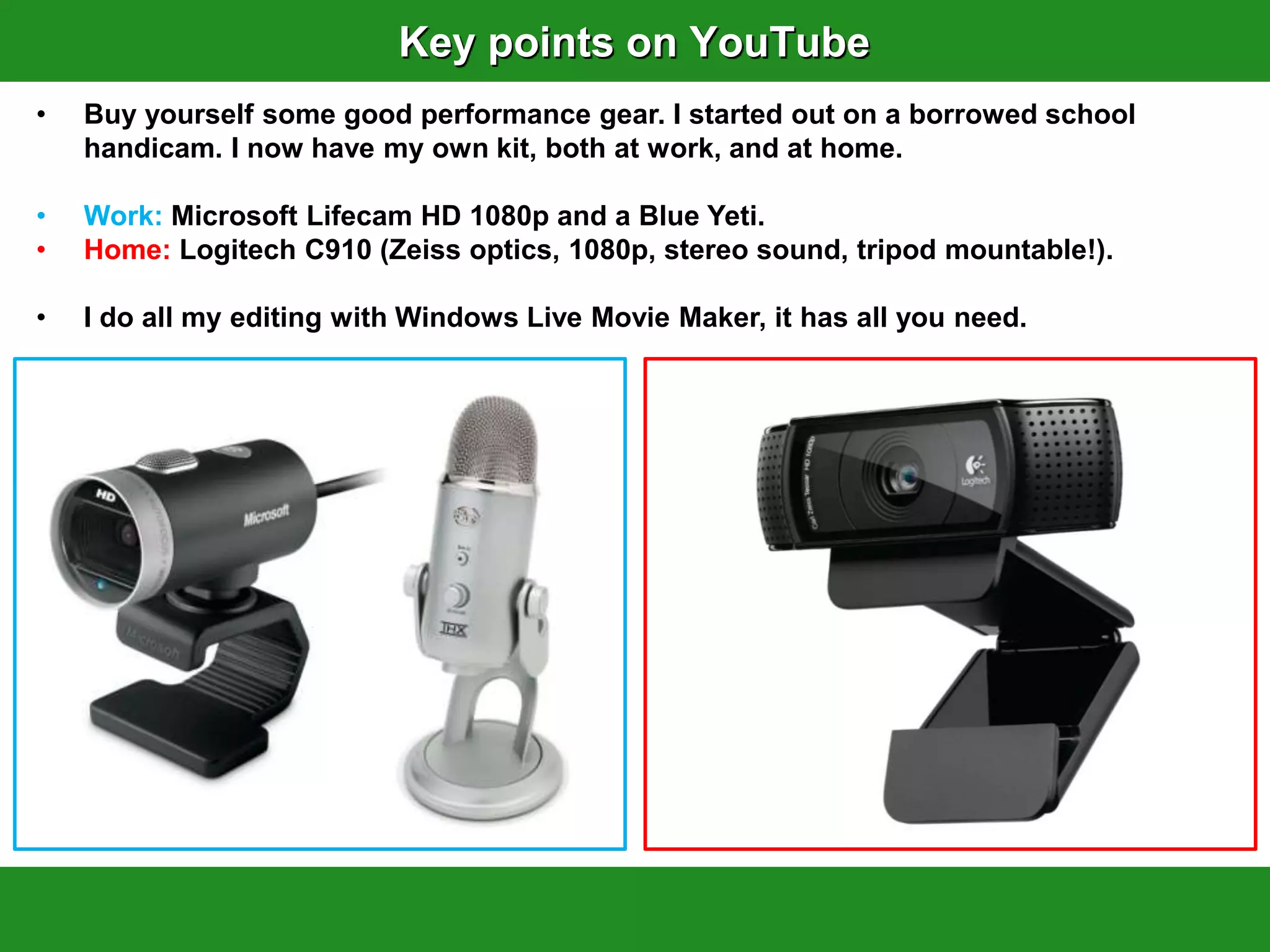
•   Buy yourself some good performance gear. I started out on a borrowed school
    handicam. I now have my own kit, both at work, and at home.

•   Work: Microsoft Lifecam HD 1080p and a Blue Yeti.
•   Home: Logitech C910 (Zeiss optics, 1080p, stereo sound, tripod mountable!).

•   I do all my editing with Windows Live Movie Maker, it has all you need.
Some logistical aspects for YouTube
•   Leave all the funky effects out, they will not help, in fact they distract.

•   Learn how to „sit‟ a few seconds before and after you talk so you can crop your
    sequences properly. This is the only way to avoid being really choppy or
    opening/closing with snarls on your face.

•   Try to talk clearly, and if necessary, more slowly (n.b., this is not always easy).

•   Be ruthless about cropping. Yes, you have 10 minutes, you don‟t have to use it all. It
    can help to have a test audience, someone who can say „I‟m bored at this bit‟.

•   Try to guess ahead to where possible confusions reside and head them off (e.g., the
    hypothesis example – rubber-band heat engine).

•   If you can exploit any media „high cards‟, do it. High cards always help.

•   Don‟t be afraid to take lots of takes but also bear in mind that perfection never
    happens. Look for the take that‟s good enough.

•   When you screw up a take, don‟t get frustrated, try to laugh instead. It not only makes
    you happier, it usually makes you come off better on camera in the next take.
One last key advocacy points: Be you!!
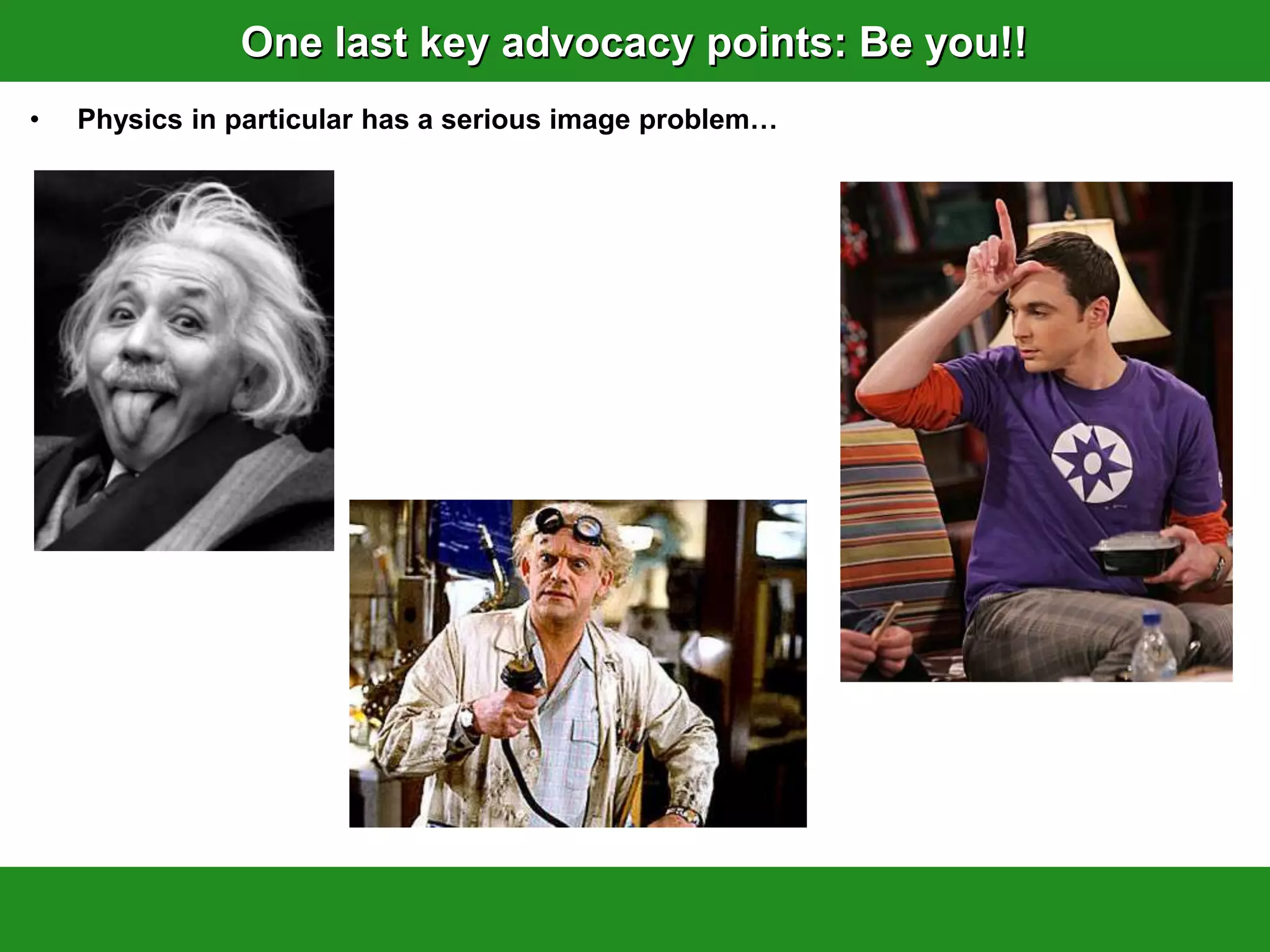
•   Physics in particular has a serious image problem…
One last key advocacy points: Be you!!
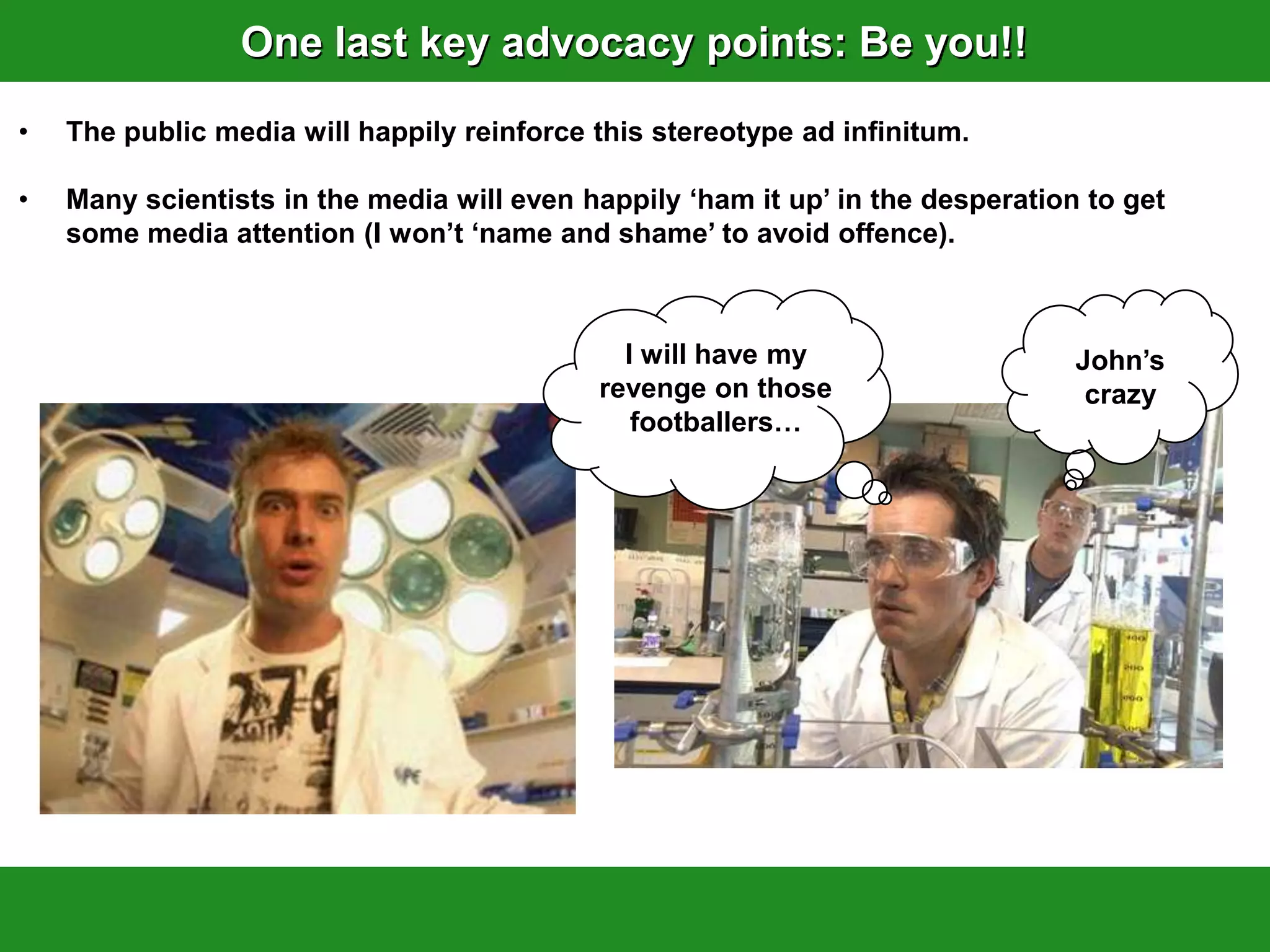
•   The public media will happily reinforce this stereotype ad infinitum.

•   Many scientists in the media will even happily „ham it up‟ in the desperation to get
    some media attention (I won‟t „name and shame‟ to avoid offence).


                                              I will have my                     John‟s
                                            revenge on those                      crazy
                                               footballers…
One last key advocacy points: Be you!!
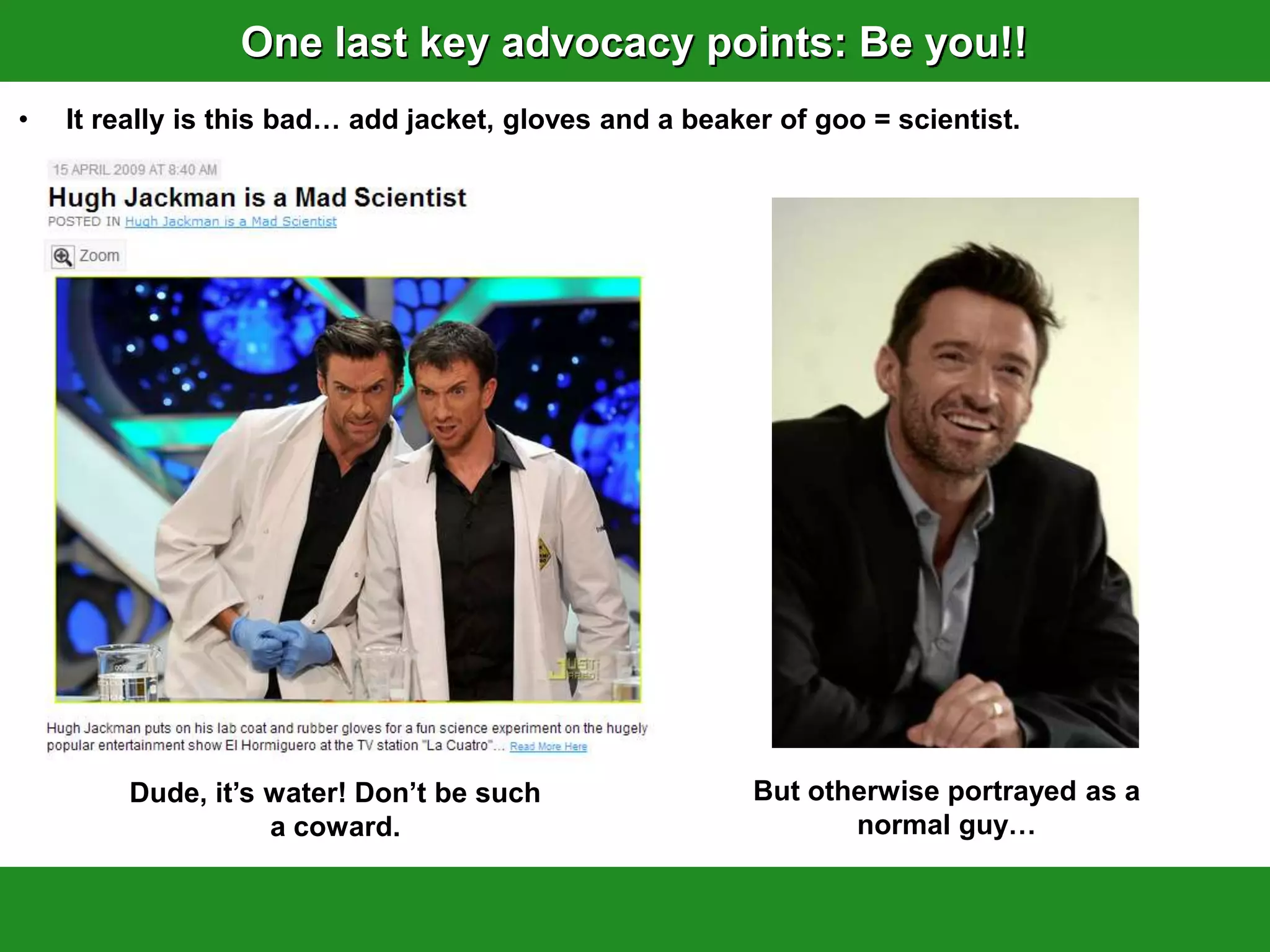
•   It really is this bad… add jacket, gloves and a beaker of goo = scientist.


        Dude, it‟s water! Don‟t be such                  But otherwise portrayed as a
                   a coward.                                    normal guy…
One last key advocacy points: Be you!!
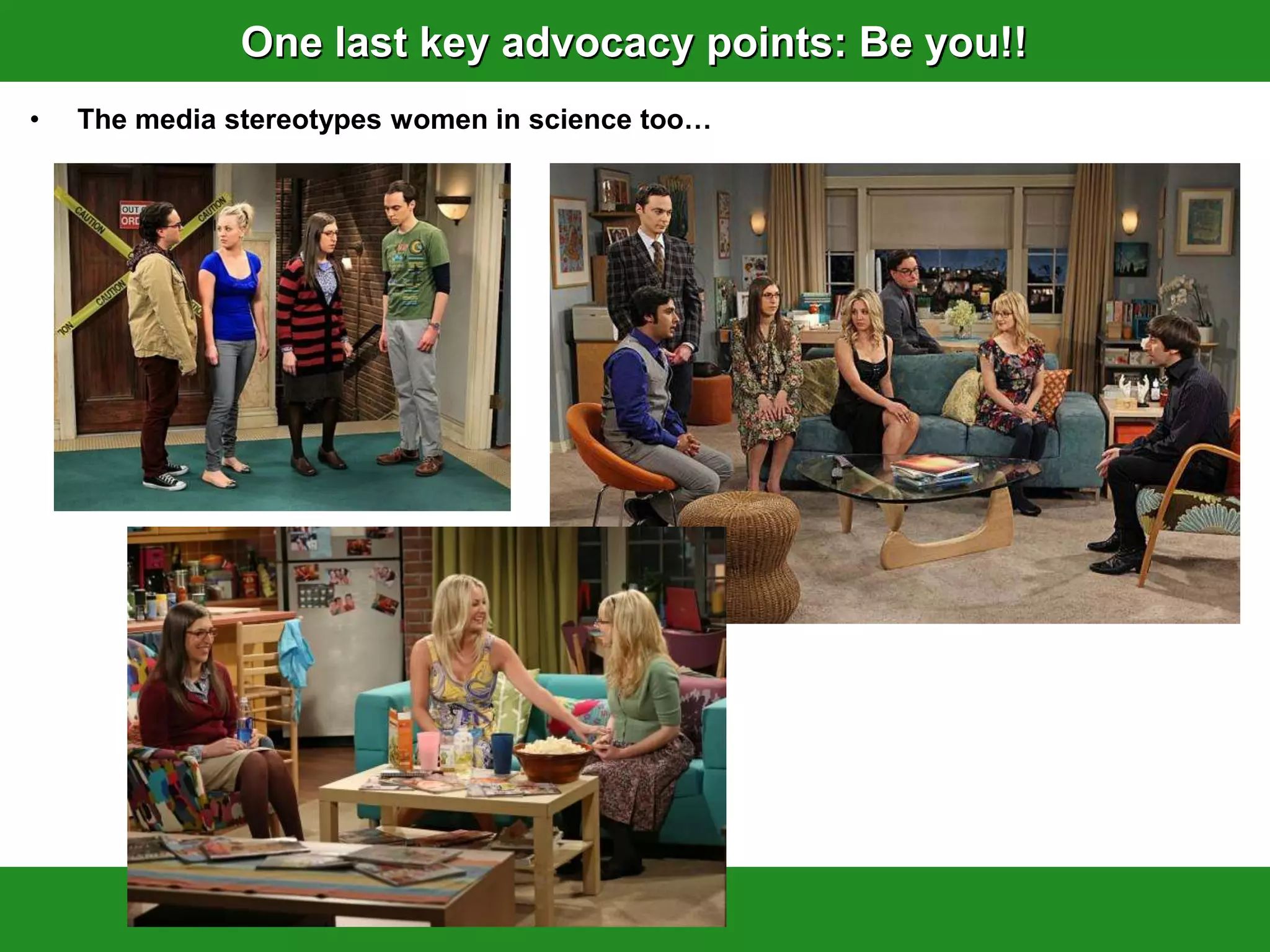
•   The media stereotypes women in science too…
One key advocacy point: Be you!!
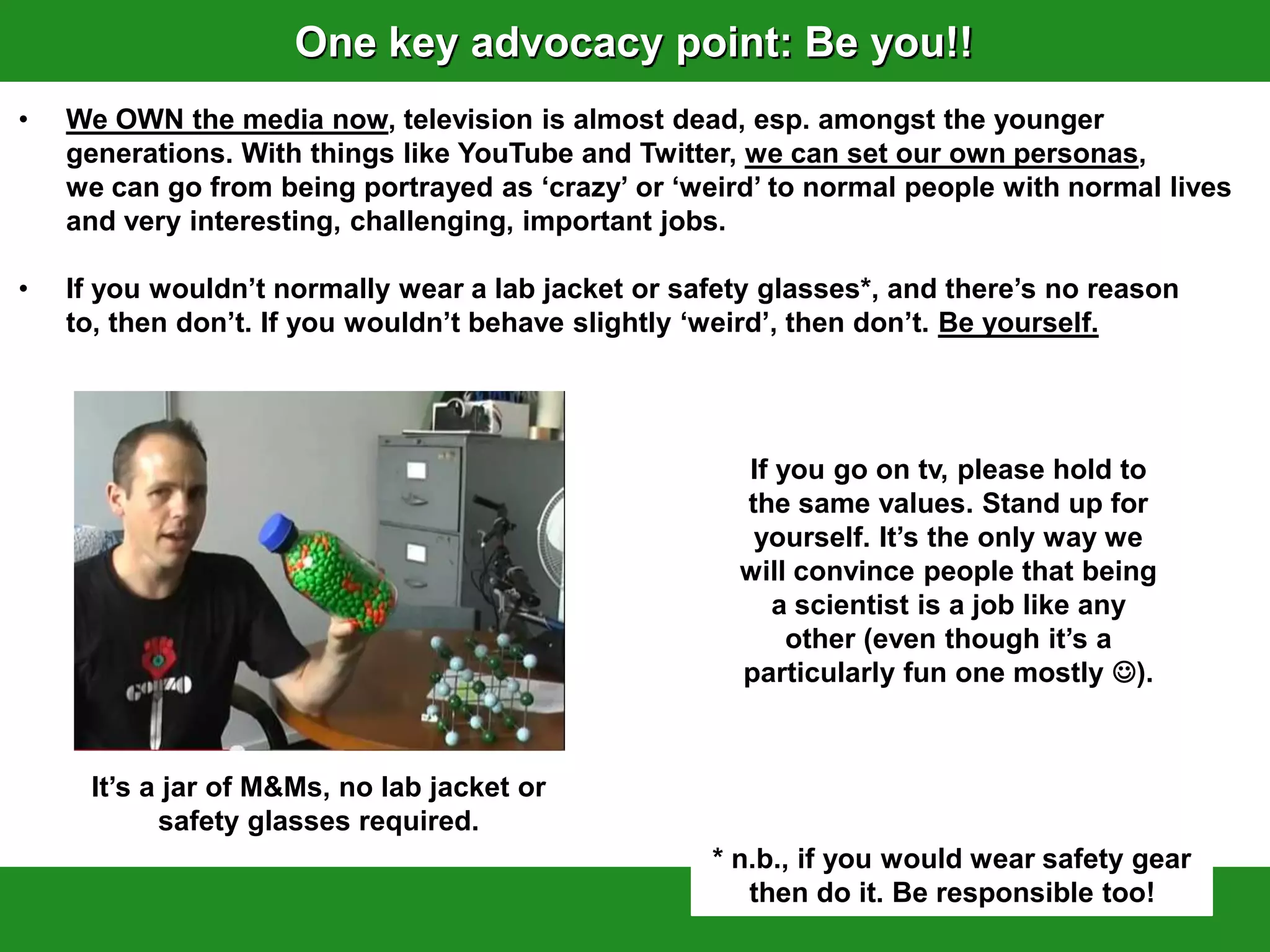
•   We OWN the media now, television is almost dead, esp. amongst the younger
    generations. With things like YouTube and Twitter, we can set our own personas,
    we can go from being portrayed as „crazy‟ or „weird‟ to normal people with normal lives
    and very interesting, challenging, important jobs.

•   If you wouldn‟t normally wear a lab jacket or safety glasses*, and there‟s no reason
    to, then don‟t. If you wouldn‟t behave slightly „weird‟, then don‟t. Be yourself.


                                                      If you go on tv, please hold to
                                                      the same values. Stand up for
                                                       yourself. It‟s the only way we
                                                      will convince people that being
                                                        a scientist is a job like any
                                                          other (even though it‟s a
                                                      particularly fun one mostly ).


     It‟s a jar of M&Ms, no lab jacket or
           safety glasses required.
                                                    * n.b., if you would wear safety gear
                                                       then do it. Be responsible too!
One key advocacy point: Be you!!

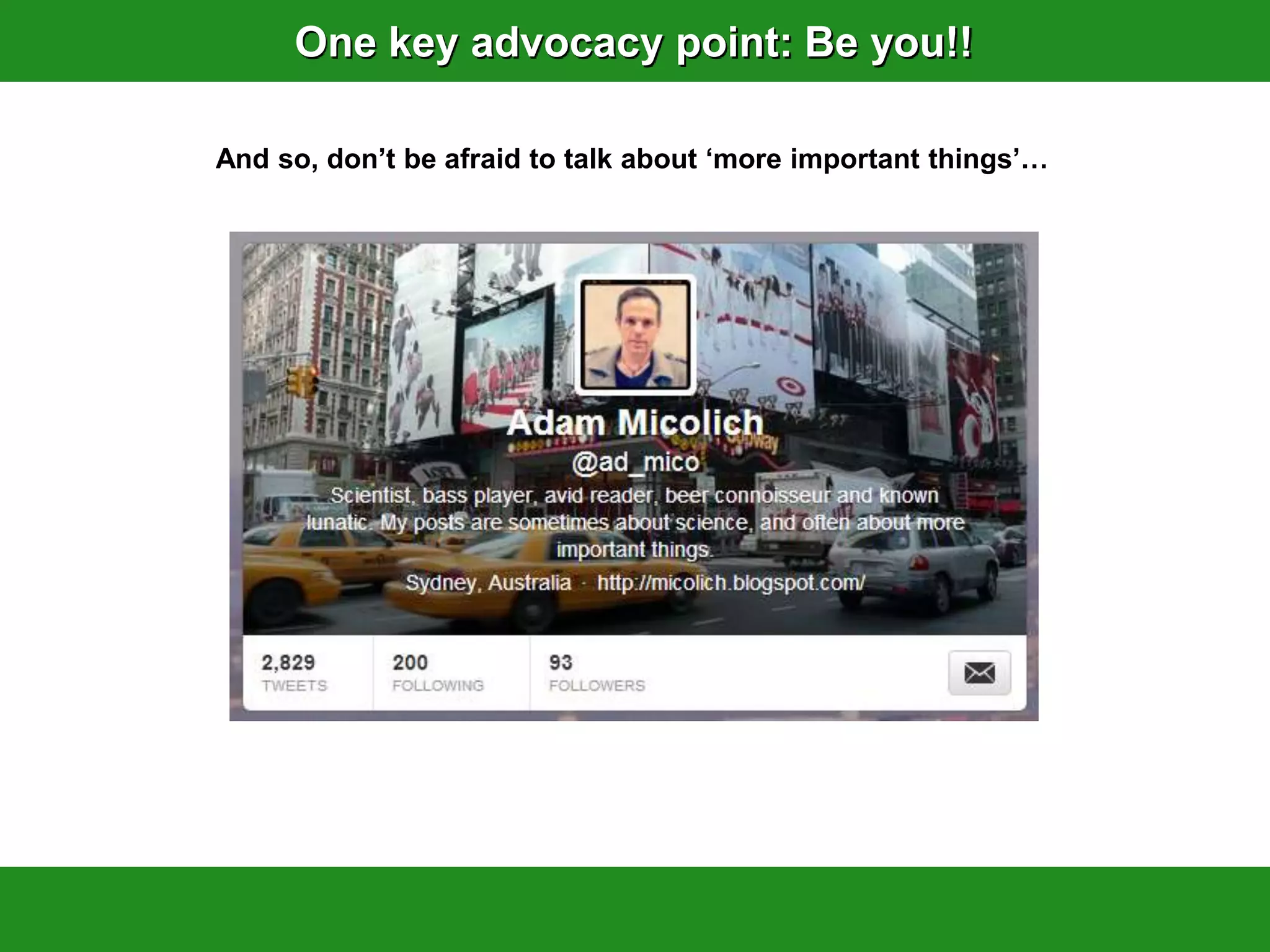
And so, don‟t be afraid to talk about „more important things‟…
Thanks for listening


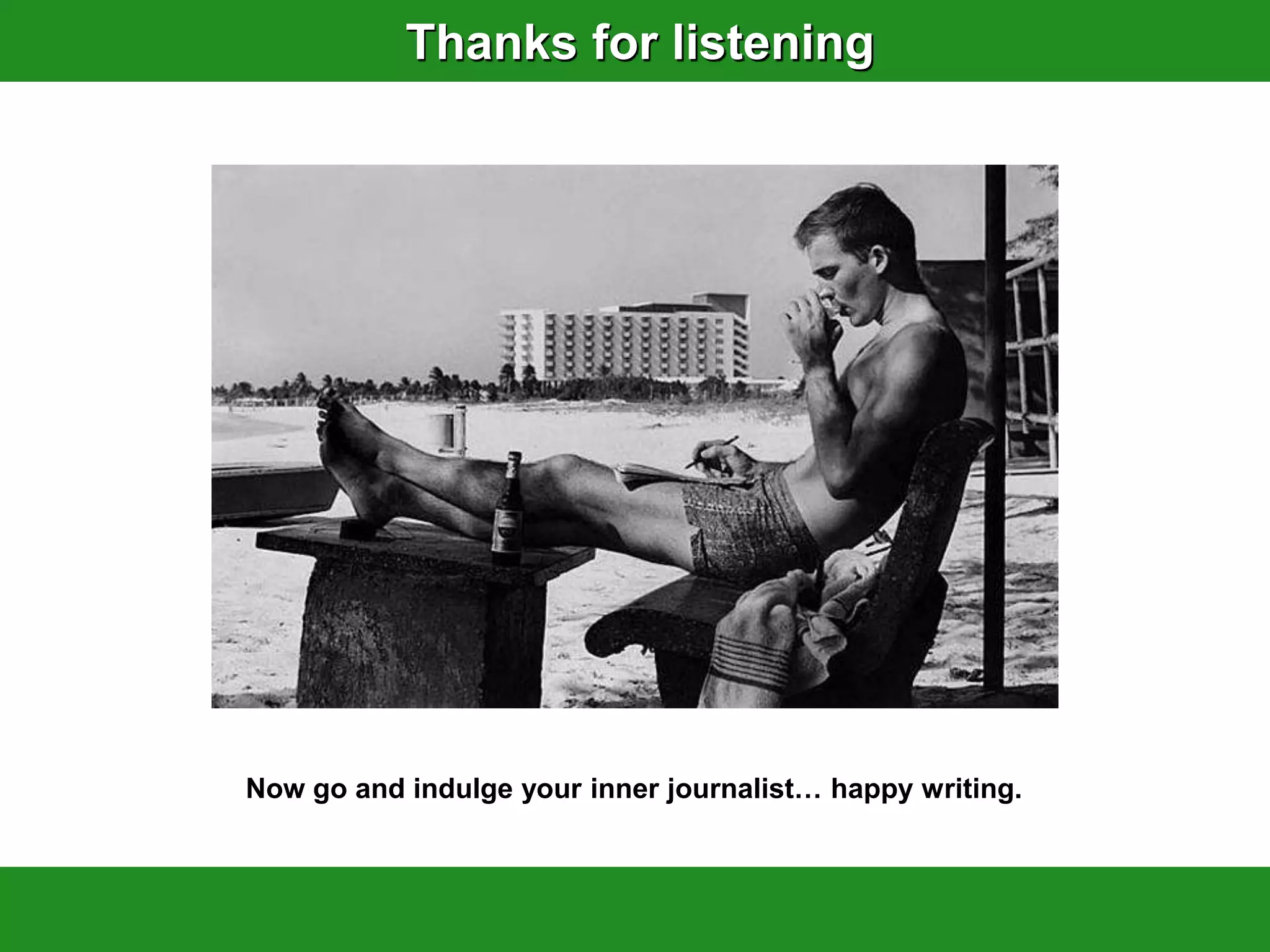
Now go and indulge your inner journalist… happy writing.

Science and the media, social and otherwise: What are the opportunities and are they worthwhile?

  • 1.
    Science and themedia, social and otherwise: What are the opportunities and are they worthwhile? Adam Micolich ARC Future Fellow School of Physics, UNSW For the twitterers: feel free to live- tweet with #UNSWPDA UNSW UNSW Postdoctoral Academy Nanoelectronics School of Physics ThurGroup 2013 11 Apr.
  • 2.
    In the beginning,there was… • Journal papers • Conference talks (Keynote, Invited and Contributed) • Seminars • Newspapers (if you could get in them) • Scientific magazines (if you could get in them)
  • 3.
    Getting into thepublic media is hard unless… The general public media only wants to know about your science if: • There is a quirky aspect to it that can be spun into a headline. • It is controversial. • It is a major advance in some way. • It is dead easy to explain or you can distil it down to 30 seconds. • There is a celebrity involved or it is some how sexy… Most science fails this test.
  • 4.
    … and sexdoes indeed sell ...
  • 5.
    The Pollock example Thishad: a) in Nature, b) celebrity, c) quirky aspect, d) easy to explain. Got lots of good media easily.
  • 6.
    And controversy makesit even easier! This had: a) a fight in Nature, b) celebrity, c) quirky aspect, d) easy to explain. It got as much/more media than the first!
  • 7.
    Moral of thestory If your science happens to give you a really good hand, then play for all the chips. A : There is a quirky aspect to it that can be spun into a headline. K : It is controversial. Q : It is a major advance in some way. J : It is dead easy to explain or you can distil it down to 30 seconds. 10  : There is a celebrity involved or it is some how sexy…
  • 8.
    The common gamewhen the hand sucks 1. Do scientifically interesting experiment. 2. Write a „high impact‟ journal publication. 3. Think „Hey, the media might be interested in this‟ 4. Contact Faculty media rep., send paper, have a chat. 5. Media rep. says its not going to catch the public media‟s attention. 6.
  • 9.
    But you haveother options! • The journal‟s own media or website for highlighting articles (ask the editor). • Trade journals, e.g., Materials Today, IEEE Spectrum, etc. (note these have limited capacity in print, but are often happy to give you online space.) • Online websites, e.g., Physorg.com, nanotechweb.org, reddit. Some have editors, some you submit yourself, some are popularity based. Advantage: Sometimes these avenues will get you others! The media likes to copy itself, journalists are often busy on tight deadlines and will happily adopt each others stories. The trick: You need to invest the time in managing your own media…
  • 10.
    Managing your media "Take it from me, there's nothing like a job well done. Except the quiet enveloping darkness at the bottom of a bottle of Jim Beam after a job done any way at all." Hunter S. Thompson • You need to learn a new style of writing, it will be frustrating. You need to sit yourself halfway between your media office and a normal paper-writer. • I write my own press releases. I distil to 500 words first copy, then 250 - 300 words, and lastly a 100 word copy, so I have something ready for all lengths. • It is usually the 250-300 word copy that I go fishing with. Sometimes I will also get the media office to write a general release so I can fish in separate markets.
  • 11.
    Case Study: PlasticSuperconductors 2. Draft technical release 1. Start with paper.
  • 12.
    Case Study: PlasticSuperconductors 3. Approach chosen magazine or online outlet. Hope they like it (depends on hand). 4. Sometimes work with staff writer to help them refine the story. Be helpful, not demanding. Compromises are needed to get a story across effectively. They are trained professionals, trust their judgement for the most part. 5. Wait for your article to come out… (was 14th Feb.)
  • 13.
    Case Study: PlasticSuperconductors 6. And then we doubled down… This involved writing a general release, run through the uni websites, Phys.org, and a few media office connections. One tip here. It can pay to give someone an „exclusive‟. We did this for Materials Today, and then ran the general media a week after they went public.
  • 14.
    Managing your media • Get a good image, it can make a HUGE difference to your success with media. • Build relationships with editors. ALWAYS deliver on time, they WILL NOT wait for you.
  • 15.
    Managing your media:Multi-institutions • Press releases made simultaneously by two or more institutions can be very powerful, but can be very dangerous. Each media office will tend to fight to make their institute look more important, involved, etc. than the other(s). • As a team of investigators, you need to agree on a common release, and bully your media office to release it as you (as a team) want it. This is the one time in media when you must rule with an iron fist. A rogue media office can create hell for you. • If your media office are fools, run through only one office to have a single message.
  • 16.
    Managing your media:Multi-institutions “William S. Burroughs talks about the world as nothing but allies and enemies, and its important to understand what things around you are the enemy. A lot of the time, your worst enemy is your own ego.” John Frusciante • When you write the release, make sure you give all of the team a part. Share the love around, it‟s not only the right thing to do, but it means you will be a united force when you have to control the institutional egos of your respective media offices.
  • 17.
    Opinion pieces • Opinion pieces used to be hard, depending on your area of work. The common venue was The Australian‟s Higher Education Section.
  • 18.
    Opinion pieces: Beatthe media! • Opinion pieces used to be hard, depending on your area of work. The common venue was The Australian‟s Higher Education Section. That‟s changed a bit in the internet era, a good example is:
  • 19.
    Opinion pieces: GeneralScience is fine.
  • 20.
    Opinion pieces: Beatthe media! Note again the common themes: quirky, easy to explain, interesting, connection to the everyday, controversial topic… they work every time! You could do this for your own papers, but it might be better to build little networks for cross-commentary, so someone else writes the commentary (more genuine). Just like News & Views in Nature.
  • 21.
    Blogging • Another possibility is to start your own blog… (which I‟ve never succeeded at). • Do not do this unless you: a) Have a clear idea of interesting content to write b) Can write well in an accessible manner on a short timescale c) Intend to post regularly and consistently d) Are willing to wait a significant amount of time to see readership gains Your journalistic skills should be well developed to do this effectively!
  • 22.
    Tips from anexpert… I will come back to this… Pilfered with thanks from Jamie Elfridge, VU Wellington (sciblogs.co.nz/just-so-science/)
  • 23.
  • 24.
    Social media isall about separating audiences On the border Firmly State (i.e., work) Firmly Church (i.e., life)
  • 25.
    Yes, there isScience on Facebook…
  • 26.
    It‟s boring asall hell, but if you want a job…
  • 27.
    I‟m coming tolove Twitter, but it‟s not what people think…
  • 28.
    Key points ontwitter • Have some patience, it takes time to get the hang of and build a follower base. • You need to make a decision about „who you are‟ and what you are trying to achieve. Are you: a) A spokesperson for a group/organization. b) An advocate (e.g., a person who tends to focus on one topic/user-base. c) A general user who just happens to have a bit of an interest in science. I personally recommend the latter (c), it gives you MUCH more freedom as a twitter user. I think a) is somewhat effective, and b) only if you are already well known (i.e., celebrity). • Twitter is more or less useless for promoting your own science, I have seen almost no one do it effectively (even people who think they do). • Twitter is very useful for networking in meeting new people, esp. at conferences. • Twitter can be useful for science advocacy, since you have access to politicians. • Twitter can be fun! Don‟t forget that.
  • 29.
    Instagram/Pinterest • Instagram is like twitter with pictures • Pinterest: Possibly interesting if your science is very visual (e.g., astro/microscopy).
  • 30.
    YouTube • YouTube can be very powerful, especially for outreach & public education.
  • 31.
    Key points onYouTube • Don‟t underestimate this one, it‟s going to take some work. If you aren‟t going to put in some time, don‟t start. • In particular, you need to learn two skills: a) How to really simplify the science and not only explain it well but very concisely b) Feel comfortable in front of a camera You don‟t need to master them before you start, focus on continual improvement. • Demonstrations REALLY help, try to be as visual as you can be. • If there‟s a quirk, exploit it. You can “go viral” with a good quirk (use twitter/reddit to help this). • You can make money from videos. If you choose to do this, I encourage you to use it for a good cause: use it to improve your channel first. If you aren‟t willing to do this, don‟t make money – your values are worth more than $ (Decl.: I raise no money). • Wanna upgrade your channel?
  • 32.
    Key points onYouTube • Buy yourself some good performance gear. I started out on a borrowed school handicam. I now have my own kit, both at work, and at home. • Work: Microsoft Lifecam HD 1080p and a Blue Yeti. • Home: Logitech C910 (Zeiss optics, 1080p, stereo sound, tripod mountable!). • I do all my editing with Windows Live Movie Maker, it has all you need.
  • 33.
    Some logistical aspectsfor YouTube • Leave all the funky effects out, they will not help, in fact they distract. • Learn how to „sit‟ a few seconds before and after you talk so you can crop your sequences properly. This is the only way to avoid being really choppy or opening/closing with snarls on your face. • Try to talk clearly, and if necessary, more slowly (n.b., this is not always easy). • Be ruthless about cropping. Yes, you have 10 minutes, you don‟t have to use it all. It can help to have a test audience, someone who can say „I‟m bored at this bit‟. • Try to guess ahead to where possible confusions reside and head them off (e.g., the hypothesis example – rubber-band heat engine). • If you can exploit any media „high cards‟, do it. High cards always help. • Don‟t be afraid to take lots of takes but also bear in mind that perfection never happens. Look for the take that‟s good enough. • When you screw up a take, don‟t get frustrated, try to laugh instead. It not only makes you happier, it usually makes you come off better on camera in the next take.
  • 34.
    One last keyadvocacy points: Be you!! • Physics in particular has a serious image problem…
  • 35.
    One last keyadvocacy points: Be you!! • The public media will happily reinforce this stereotype ad infinitum. • Many scientists in the media will even happily „ham it up‟ in the desperation to get some media attention (I won‟t „name and shame‟ to avoid offence). I will have my John‟s revenge on those crazy footballers…
  • 36.
    One last keyadvocacy points: Be you!! • It really is this bad… add jacket, gloves and a beaker of goo = scientist. Dude, it‟s water! Don‟t be such But otherwise portrayed as a a coward. normal guy…
  • 37.
    One last keyadvocacy points: Be you!! • The media stereotypes women in science too…
  • 38.
    One key advocacypoint: Be you!! • We OWN the media now, television is almost dead, esp. amongst the younger generations. With things like YouTube and Twitter, we can set our own personas, we can go from being portrayed as „crazy‟ or „weird‟ to normal people with normal lives and very interesting, challenging, important jobs. • If you wouldn‟t normally wear a lab jacket or safety glasses*, and there‟s no reason to, then don‟t. If you wouldn‟t behave slightly „weird‟, then don‟t. Be yourself. If you go on tv, please hold to the same values. Stand up for yourself. It‟s the only way we will convince people that being a scientist is a job like any other (even though it‟s a particularly fun one mostly ). It‟s a jar of M&Ms, no lab jacket or safety glasses required. * n.b., if you would wear safety gear then do it. Be responsible too!
  • 39.
    One key advocacypoint: Be you!! And so, don‟t be afraid to talk about „more important things‟…
  • 40.
    Thanks for listening Nowgo and indulge your inner journalist… happy writing.