1
GOVERNANCE - REGULATION,
PRUDENTIAL NORMS, SUPERVISION
- ROLE OF CORPORATE GOVERNANCE
by
Y.R.K. Reddy
yrk@academyofcg.org
yrk@yagaconsulting.com
23rd November,
Sandton, Johannesburg
2
Part One
 Governance - Regulation, Prudential,
Supervisory Issues
3
Governance
 Need to disaggregate to be meaningful. “Virtual descent view”©
 Governance – critical ideas of fairness, transparency,
responsibility, accountability….leading to MDG+++++
 Two broad approaches seen last two decades:
 Public policy & decisions, strengthening of institutional
structures – all types.
 Service delivery, efficiency, transparency, e-governance, etc
of “New Public Management” driven by managerial thought &
belief systems.
4
Public Policy, Regulation,
Supervisory Issues - Illustrative
 What type of financial system / actors ( NDBs, NBFO incl MFI,
….)
 Financing / Budgetary mechanisms ( transparency).
 Role of private, public, capital markets, institutions, government,
foreign institutions, multi-lateral
 Design / redesign of structures (incl, consolidation,
transformation).
 Regulatory architecture, redesign – who, how, capacity ( issues
of regulatory arbitrage).
5
 Regulatory mechanisms / Prudential norms – entry
norms, capital adequacy, liquidity, asset classifications,
mobilisation of funds / public deposits, types of lending,
restrictions on activities, Board – fit & proper/
composition/ committees / increasing integration with
CG principles – conflicts of interest, related party
transactions, insider trading / dealing, fixing
accountability etc.
 Supervisory Mechanisms – off-site surveillance, on-site
inspections, reporting, integration with CG principles –
such as guidance on sound CG; assessing CG; internal
control, audit, group structures, conflicts of interest &
giving feed-back.
 (Increasing differentiation of Governance / Directors
from Management)
6
Part Two: Corporate Governance
 Early 90`s concern for investor confidence.
 Asian Crisis
 IMF / World Bank / FSF/ ROSC / FSAP
 OECD Standards
 BIS / BCBS
 Commonwealth Initiatives
 GCGF`s Initiatives
 All assume market economy benefits – as well as
eventual linkages to socio-economic development &
contribution to meeting MDGs etc.
7
8
9
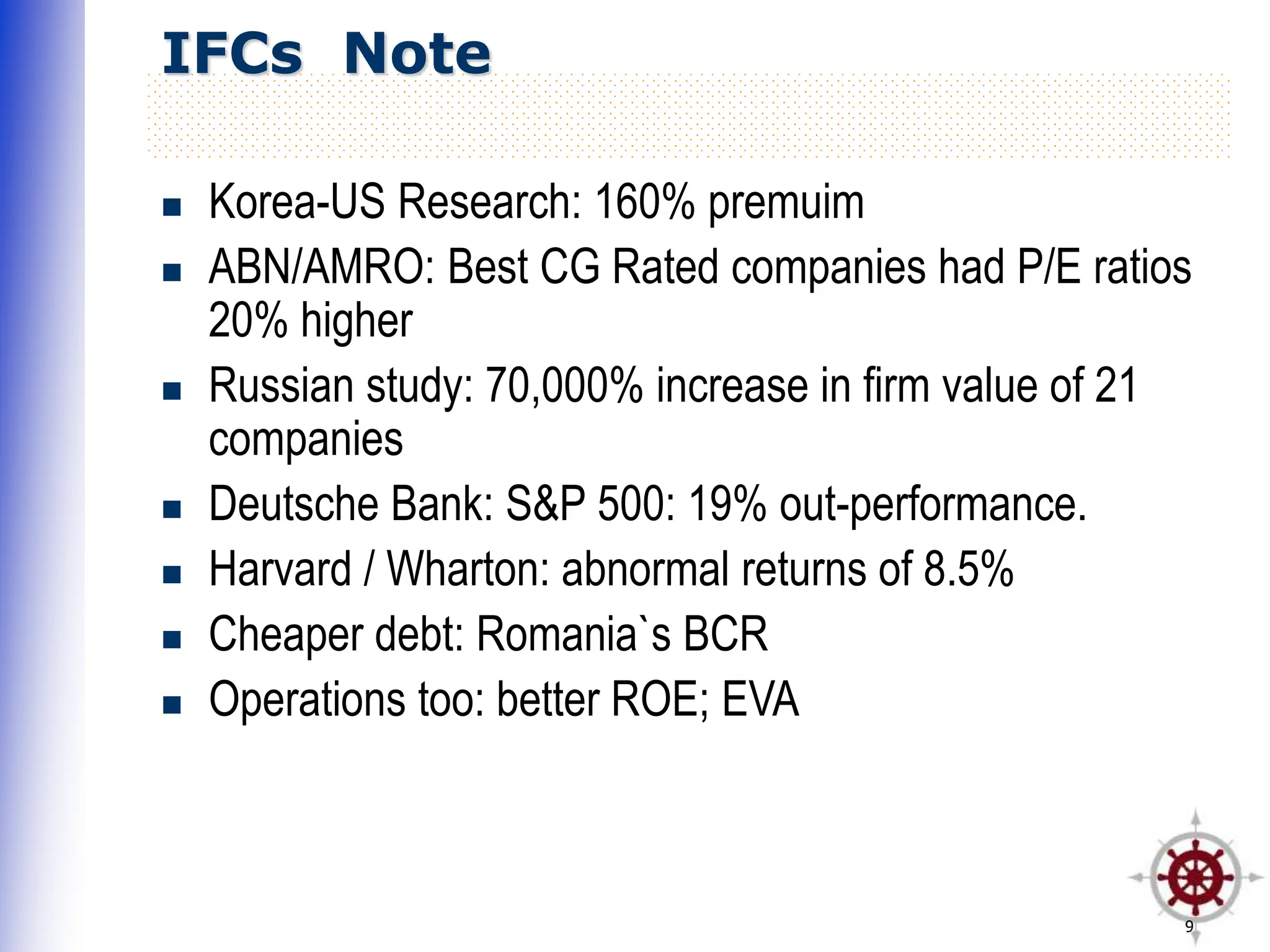
IFCs Note
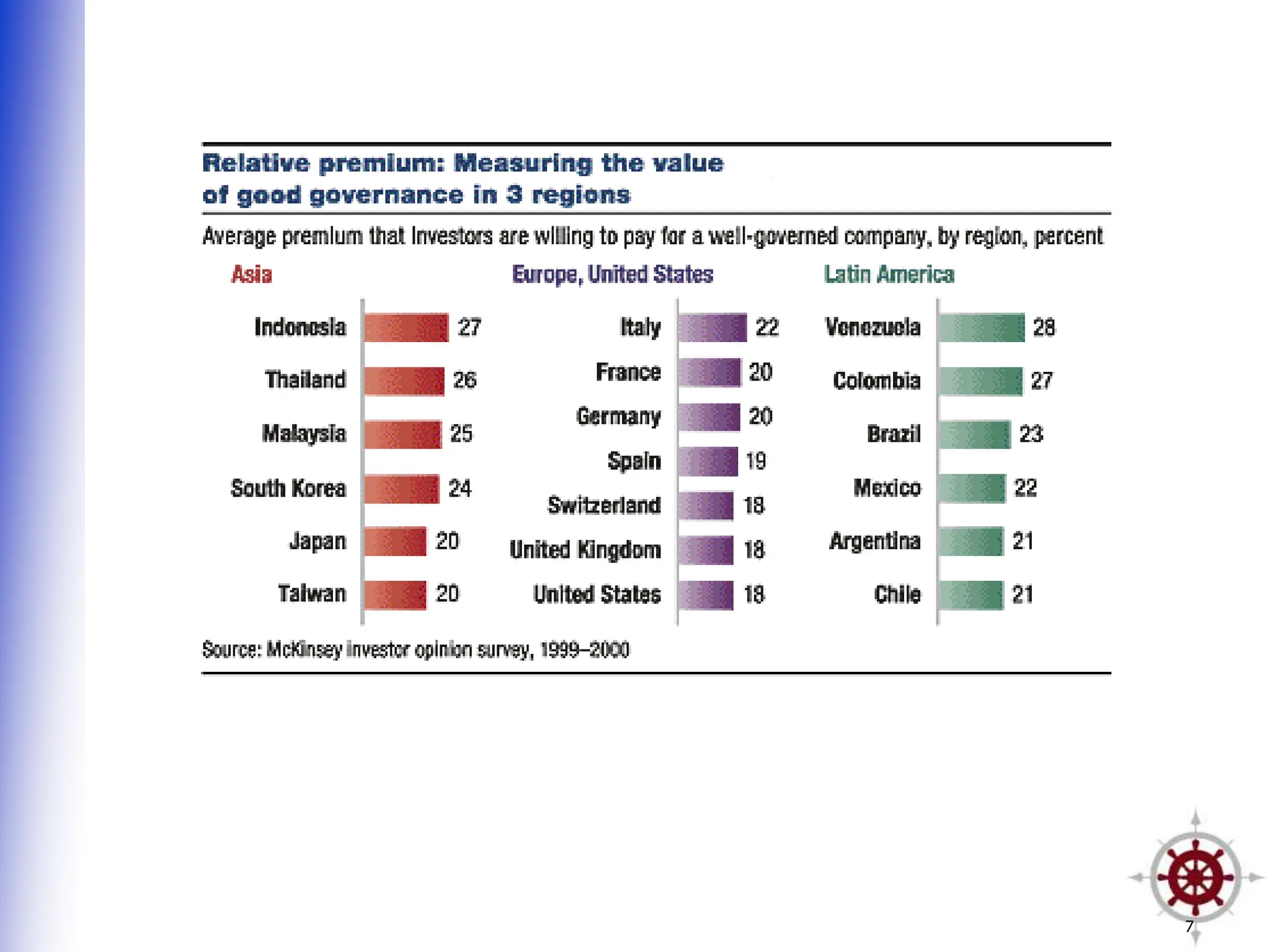
 Korea-US Research: 160% premuim
 ABN/AMRO: Best CG Rated companies had P/E ratios
20% higher
 Russian study: 70,000% increase in firm value of 21
companies
 Deutsche Bank: S&P 500: 19% out-performance.
 Harvard / Wharton: abnormal returns of 8.5%
 Cheaper debt: Romania`s BCR
 Operations too: better ROE; EVA
10
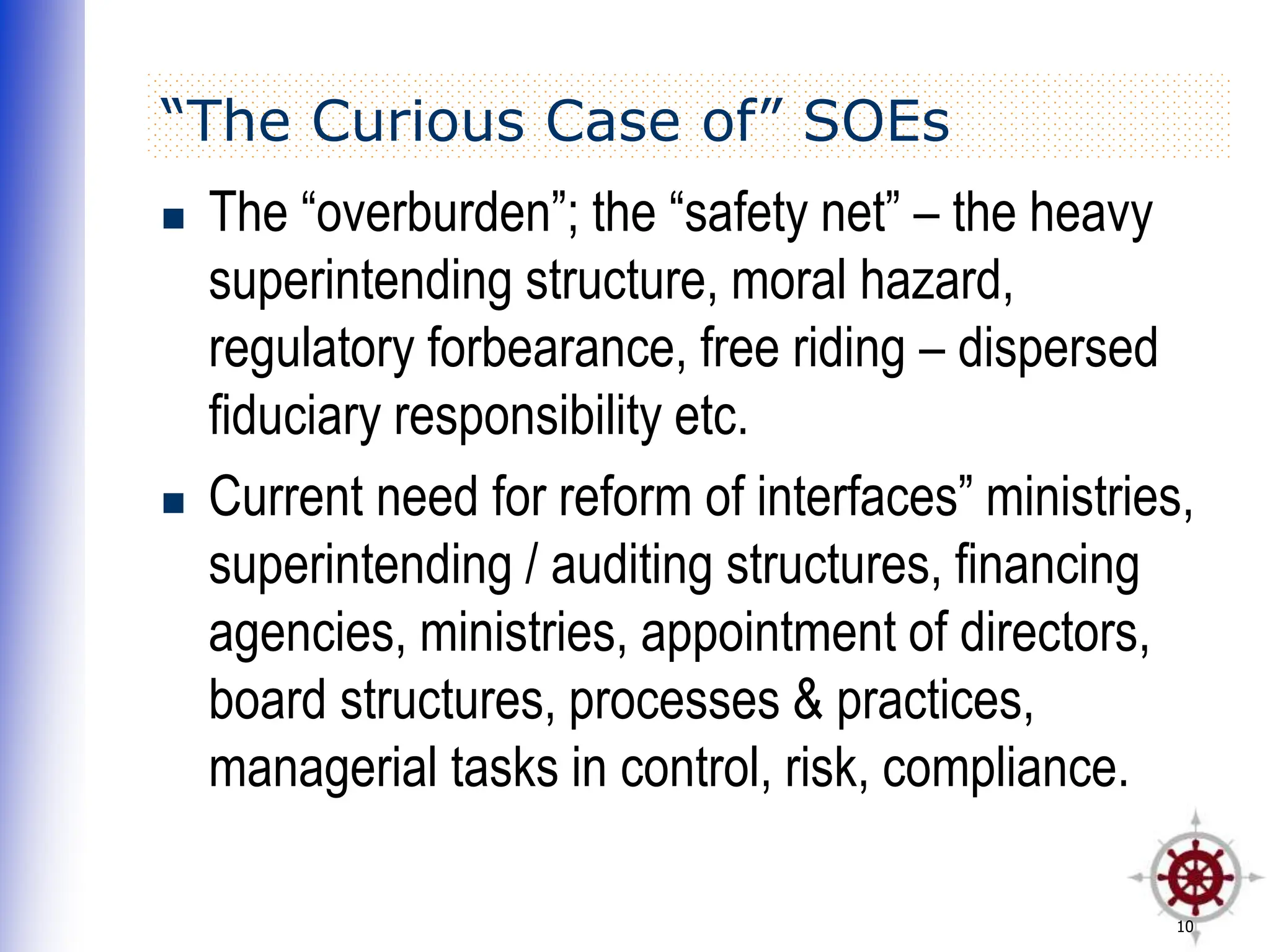
“The Curious Case of” SOEs
 The “overburden”; the “safety net” – the heavy
superintending structure, moral hazard,
regulatory forbearance, free riding – dispersed
fiduciary responsibility etc.
 Current need for reform of interfaces” ministries,
superintending / auditing structures, financing
agencies, ministries, appointment of directors,
board structures, processes & practices,
managerial tasks in control, risk, compliance.
11
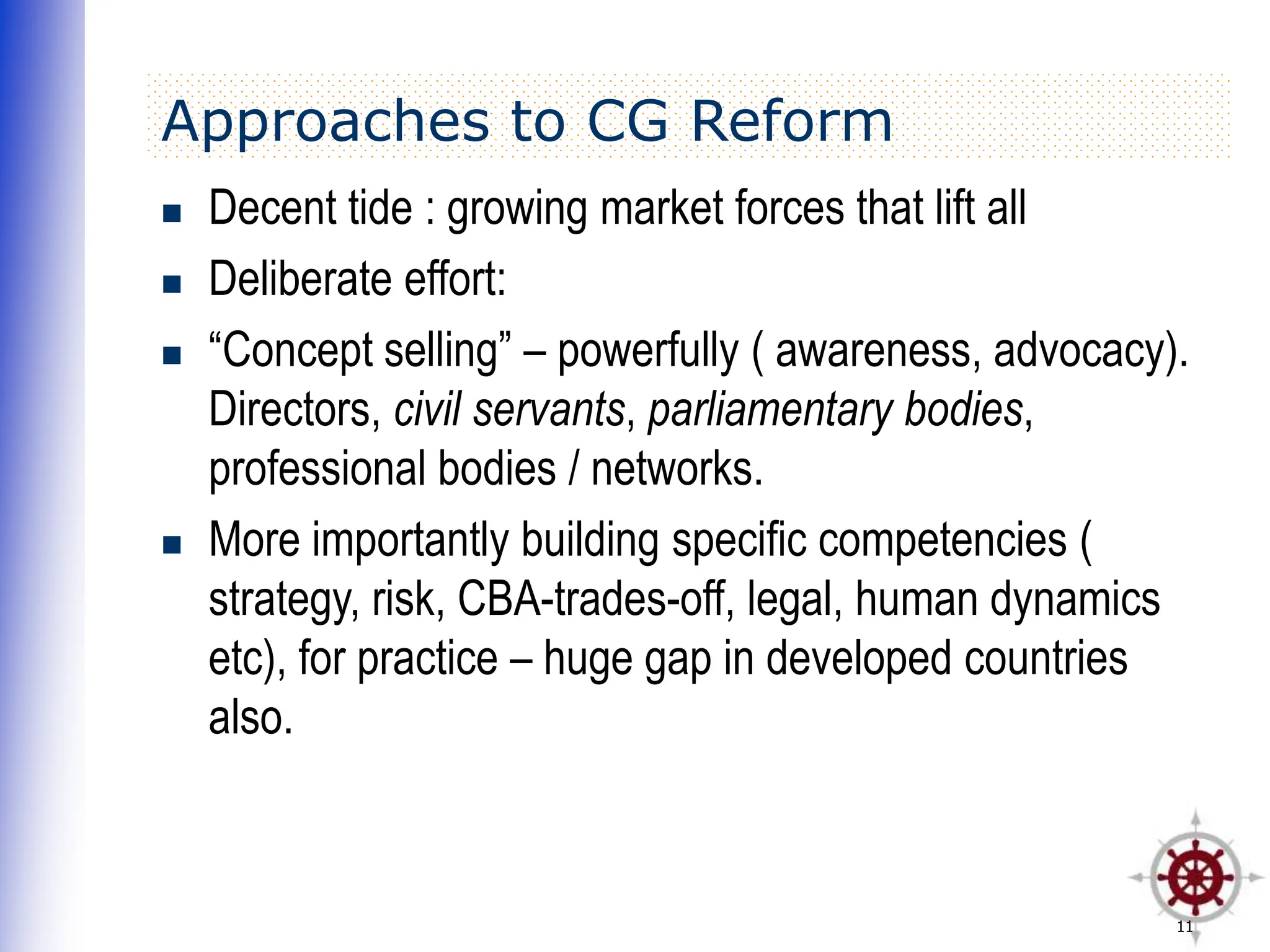
Approaches to CG Reform
 Decent tide : growing market forces that lift all
 Deliberate effort:
 “Concept selling” – powerfully ( awareness, advocacy).
Directors, civil servants, parliamentary bodies,
professional bodies / networks.
 More importantly building specific competencies (
strategy, risk, CBA-trades-off, legal, human dynamics
etc), for practice – huge gap in developed countries
also.
12
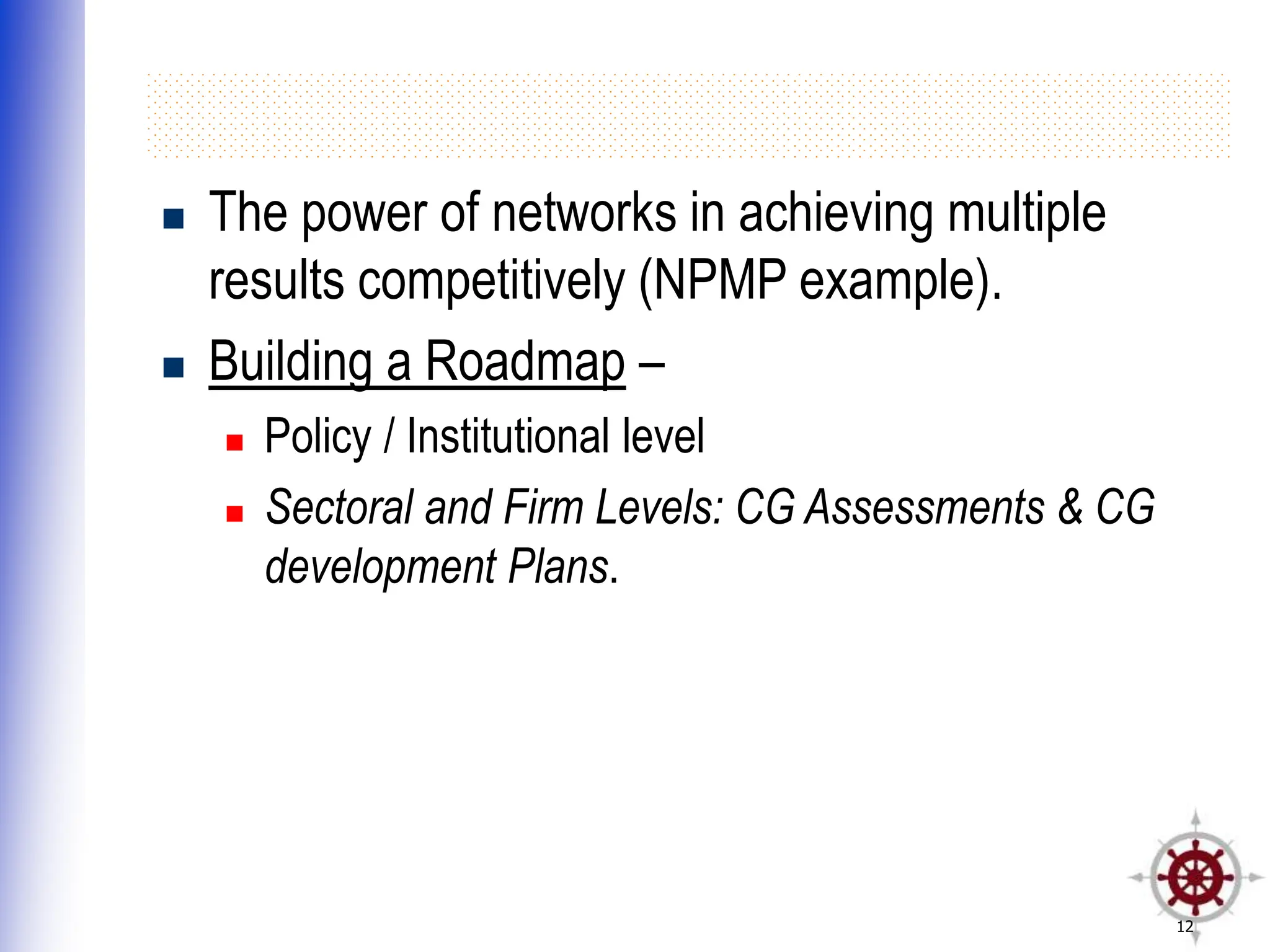
 The power of networks in achieving multiple
results competitively (NPMP example).
 Building a Roadmap –
 Policy / Institutional level
 Sectoral and Firm Levels: CG Assessments & CG
development Plans.
13
For Further Interest:
 BIS / BCBS document on enhancing CG.
 OECD Principles on CG.
 OECD Guidelines for CG of SOEs
 GCGF / IFC sites
 CACG documents – principles, Best Practce Manual for
SOEs
 First Principles of Corporate Governance for Public
Enterprises & various other information:
www.academyofcg.org
www.yagaconsulting.com

UN-Presentation about role of govarnance.ppt

  • 1.
    1 GOVERNANCE - REGULATION, PRUDENTIALNORMS, SUPERVISION - ROLE OF CORPORATE GOVERNANCE by Y.R.K. Reddy yrk@academyofcg.org yrk@yagaconsulting.com 23rd November, Sandton, Johannesburg
  • 2.
    2 Part One  Governance- Regulation, Prudential, Supervisory Issues
  • 3.
    3 Governance  Need todisaggregate to be meaningful. “Virtual descent view”©  Governance – critical ideas of fairness, transparency, responsibility, accountability….leading to MDG+++++  Two broad approaches seen last two decades:  Public policy & decisions, strengthening of institutional structures – all types.  Service delivery, efficiency, transparency, e-governance, etc of “New Public Management” driven by managerial thought & belief systems.
  • 4.
    4 Public Policy, Regulation, SupervisoryIssues - Illustrative  What type of financial system / actors ( NDBs, NBFO incl MFI, ….)  Financing / Budgetary mechanisms ( transparency).  Role of private, public, capital markets, institutions, government, foreign institutions, multi-lateral  Design / redesign of structures (incl, consolidation, transformation).  Regulatory architecture, redesign – who, how, capacity ( issues of regulatory arbitrage).
  • 5.
    5  Regulatory mechanisms/ Prudential norms – entry norms, capital adequacy, liquidity, asset classifications, mobilisation of funds / public deposits, types of lending, restrictions on activities, Board – fit & proper/ composition/ committees / increasing integration with CG principles – conflicts of interest, related party transactions, insider trading / dealing, fixing accountability etc.  Supervisory Mechanisms – off-site surveillance, on-site inspections, reporting, integration with CG principles – such as guidance on sound CG; assessing CG; internal control, audit, group structures, conflicts of interest & giving feed-back.  (Increasing differentiation of Governance / Directors from Management)
  • 6.
    6 Part Two: CorporateGovernance  Early 90`s concern for investor confidence.  Asian Crisis  IMF / World Bank / FSF/ ROSC / FSAP  OECD Standards  BIS / BCBS  Commonwealth Initiatives  GCGF`s Initiatives  All assume market economy benefits – as well as eventual linkages to socio-economic development & contribution to meeting MDGs etc.
  • 7.
  • 8.
  • 9.
    9 IFCs Note  Korea-USResearch: 160% premuim  ABN/AMRO: Best CG Rated companies had P/E ratios 20% higher  Russian study: 70,000% increase in firm value of 21 companies  Deutsche Bank: S&P 500: 19% out-performance.  Harvard / Wharton: abnormal returns of 8.5%  Cheaper debt: Romania`s BCR  Operations too: better ROE; EVA
  • 10.
    10 “The Curious Caseof” SOEs  The “overburden”; the “safety net” – the heavy superintending structure, moral hazard, regulatory forbearance, free riding – dispersed fiduciary responsibility etc.  Current need for reform of interfaces” ministries, superintending / auditing structures, financing agencies, ministries, appointment of directors, board structures, processes & practices, managerial tasks in control, risk, compliance.
  • 11.
    11 Approaches to CGReform  Decent tide : growing market forces that lift all  Deliberate effort:  “Concept selling” – powerfully ( awareness, advocacy). Directors, civil servants, parliamentary bodies, professional bodies / networks.  More importantly building specific competencies ( strategy, risk, CBA-trades-off, legal, human dynamics etc), for practice – huge gap in developed countries also.
  • 12.
    12  The powerof networks in achieving multiple results competitively (NPMP example).  Building a Roadmap –  Policy / Institutional level  Sectoral and Firm Levels: CG Assessments & CG development Plans.
  • 13.
    13 For Further Interest: BIS / BCBS document on enhancing CG.  OECD Principles on CG.  OECD Guidelines for CG of SOEs  GCGF / IFC sites  CACG documents – principles, Best Practce Manual for SOEs  First Principles of Corporate Governance for Public Enterprises & various other information: www.academyofcg.org www.yagaconsulting.com