Examples of OSS
Open Source vs. Closed Source Software
Open Source
Freedom to inspect,
modify, and distribute
code.
Closed Source
Restricts access, often
with licensing fees.
Linux, Apache, Mozilla Firefox:
Icons in tech history.
Generative AI: TensorFlow and PyTorch
driving innovation.
Ensuring OSS Security
Synopsys Offerings for OSS Security
Regular Updates: Stay vigilant for security updates.
Code Audits: Thorough reviews to identify vulnerabilities.
Authentication and Authorization: Implement robust mechanisms for access
control.
Black Duck: Tools and services for proactive management and security.
Reliability: Ensure a robust and secure software foundation.
Open Source Development
THE EVOLUTION OF
1970s: Pioneers like
Richard Stallman lay
the foundation with
the Free Software
Foundation.
Late 1990s: Open
Source Development
gains momentum,
transitioning to a
collaborative model.
1 2
3
4
Evolution of Open Source Development
The History of OSS The Open Source
Initiative (OSI)
1998: OSI formalizes
the definition of
open source
software.
Open Source
Definition: Ensures
freedom to view,
modify, and
distribute source
code.
Collaborative
Contribution:
Developers worldwide
collaborate on
platforms like GitHub.
Continuous Evolution:
Communal efforts lead
to constant iterations
and improvements.
How OSS Works Is OSS Bug-
Free?
Transparent
Development: Swift
identification and
resolution by the
community.
Source by: www.impressico.com
Pros of Open Source
Software
VS
Community Collaboration:
Diverse developers contribute.
Security Concerns: Openness
may expose vulnerabilities.
Cost-Efficiency:
No licensing fees.
Fragmentation: It may lead to
fragmented project versions.
Transparency: Source code
visibility ensures trust.
Support Challenges: Reliance on
community support may challenge.
Cons of Open Source
Software

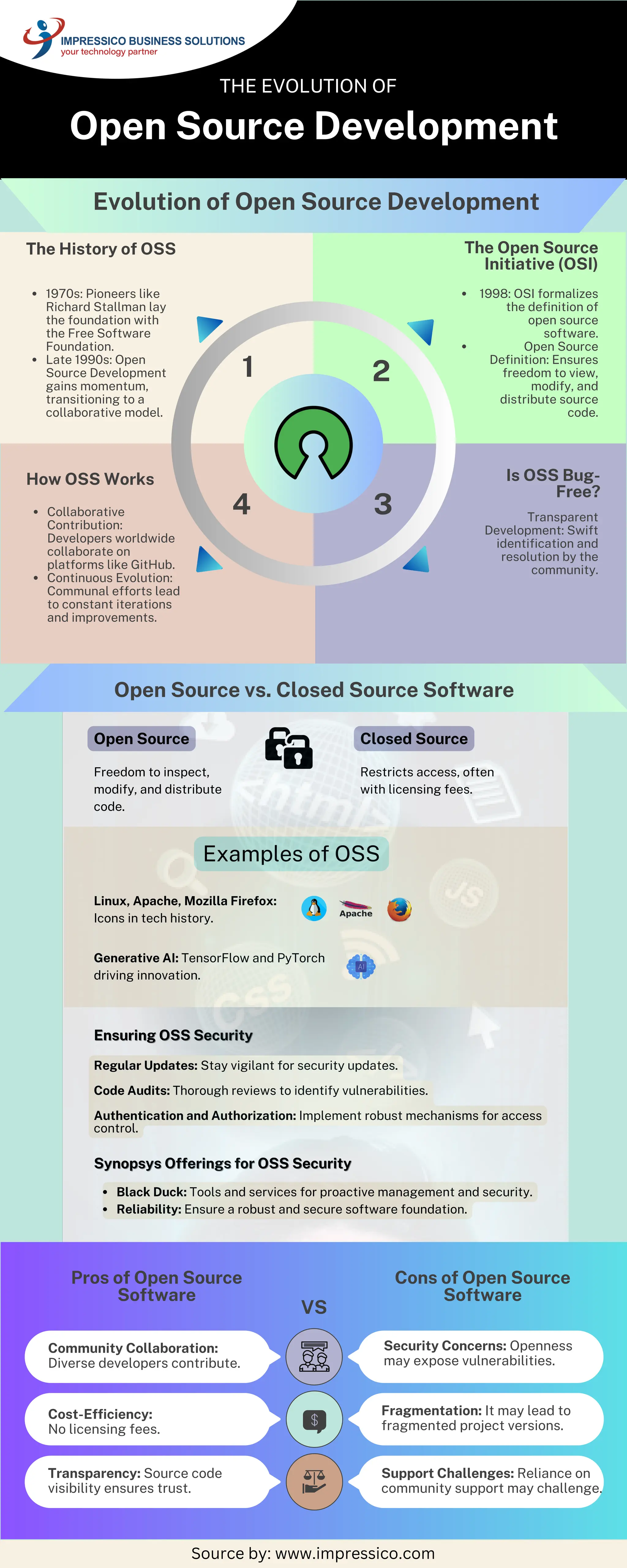
Unlocking the Code: A Journey through Open Source Development

  • 1.
    Examples of OSS OpenSource vs. Closed Source Software Open Source Freedom to inspect, modify, and distribute code. Closed Source Restricts access, often with licensing fees. Linux, Apache, Mozilla Firefox: Icons in tech history. Generative AI: TensorFlow and PyTorch driving innovation. Ensuring OSS Security Ensuring OSS Security Synopsys Offerings for OSS Security Synopsys Offerings for OSS Security Regular Updates: Stay vigilant for security updates. Code Audits: Thorough reviews to identify vulnerabilities. Authentication and Authorization: Implement robust mechanisms for access control. Black Duck: Tools and services for proactive management and security. Reliability: Ensure a robust and secure software foundation. Open Source Development THE EVOLUTION OF 1970s: Pioneers like Richard Stallman lay the foundation with the Free Software Foundation. Late 1990s: Open Source Development gains momentum, transitioning to a collaborative model. 1 2 3 4 Evolution of Open Source Development The History of OSS The Open Source Initiative (OSI) 1998: OSI formalizes the definition of open source software. Open Source Definition: Ensures freedom to view, modify, and distribute source code. Collaborative Contribution: Developers worldwide collaborate on platforms like GitHub. Continuous Evolution: Communal efforts lead to constant iterations and improvements. How OSS Works Is OSS Bug- Free? Transparent Development: Swift identification and resolution by the community. Source by: www.impressico.com Pros of Open Source Software VS Community Collaboration: Diverse developers contribute. Security Concerns: Openness may expose vulnerabilities. Cost-Efficiency: No licensing fees. Fragmentation: It may lead to fragmented project versions. Transparency: Source code visibility ensures trust. Support Challenges: Reliance on community support may challenge. Cons of Open Source Software