An Seong Hyun  06/05/09
  1. About Storyboard, Application Role, Trigger Event   2. Chapter 3.Common Observation Topic        Storyboards       Application Roles       Trigger Events       Refined Message Information Models(RMIM)       Hierarchical Message Descriptions(HMD)       Interactions 3. Chapter 4. CMETs Defined by this Domain      06/05/09
Storyboard     -  시간순서대로 스냅샷을 이용해서  Story 를 설명  -  각각의 스냅샷은 각 이벤트 순서에서 의미 있는 순간이다 .  -  스냅샷 전체는 완전한 프로세스 활동을 설명한다 . -  짧은 설명과  application role 들 사이에의  Interaction Diagram 으로 구성 -  실제 세계의 이벤트의 설명    06/05/09
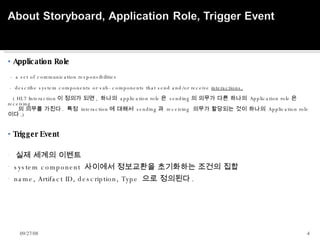
Application Role - a set of communication responsibilities  - describe system components or sub-components that send and/or receive  interactions. ( HL7 Interaction 이 정의가 되면 ,  하나의  application role 은  sending 의 의무가 다른 하나의  Application role 은  receiving 의 의무를 가진다 .  특정  interaction 에 대해서  sending 과  receiving  의무가 할당되는 것이 하나의  Application role 이다 .) Trigger Event 실제 세계의 이벤트 system component  사이에서 정보교환을 초기화하는 조건의 집합 name, Artifact ID, description, Type  으로 정의된다 .  06/05/09
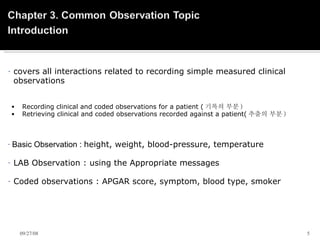
  covers all interactions related to recording simple measured clinical  observations   Recording clinical and coded observations for a patient ( 기록의 부분 ) Retrieving clinical and coded observations recorded against a patient( 추출의 부분 )   Basic Observation :  height, weight, blood-pressure, temperature LAB Observation : using the Appropriate messages Coded observations : APGAR score, symptom, blood type, smoker   06/05/09
3.1.1Heart Murmur Assessment(POOB_ST100001UV)  -  collected during a heart murmur assessment.     Precondition Dr. Patricia Primary is doing a cardiac assessment on Patient Everyman. Mr. Everyman has come to emergency room  following a syncopal episode and chest pain while running to catch his bus.  The information regarding the syncopal  episode and chest pain were entered in the EDIS (emergency department information system).      Activities On examination Mr. E has a harsh grade III mid-systolic murmur best appreciated lateral to the left costal margin towards  the laterally displaced PMI. There is a faint diastolic murmur intermittently heard over the right 2nd ICS at the right sternal  border. The systolic murmur diminishes with Valsalva and squatting.  Upon standing the murmur becomes  pronounced. Mr. Everyman's assessment findings are entered in the EDIS, and an Echocardiogram( 심초음파 ) is  ordered.      Post-condition Mr. Everyman's assessment findings and an Echocardiogram order are now present in the EDIS.        06/05/09
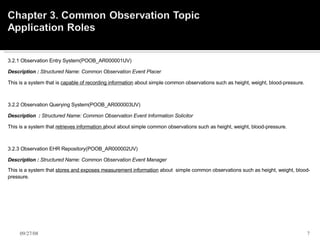
3.2.1 Observation Entry System(POOB_AR000001UV)    Description :  Structured Name: Common Observation Event Placer    This is a system that is  capable of recording information  about simple common observations such as height, weight, blood-pressure.        3.2.2 Observation Querying System(POOB_AR000003UV)    Description  :  Structured Name: Common Observation Event Information Solicitor     This is a system that  retrieves information a bout about simple common observations such as height, weight, blood-pressure.        3.2.3 Observation EHR Repository(POOB_AR000002UV)    Description :  Structured Name: Common Observation Event Manager  This is a system that  stores and exposes measurement information  about   simple common observations such as height, weight, blood-pressure. 06/05/09
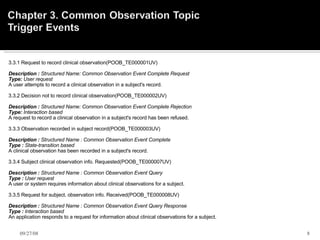
3.3.1 Request to record clinical observation(POOB_TE000001UV)    Description :  Structured Name: Common Observation Event Complete Request  Type:  User request  A user attempts to record a clinical observation in a subject's record.   3.3.2 Decision not to record clinical observation(POOB_TE000002UV)    Description :  Structured Name: Common Observation Event Complete Rejection  Type:  Interaction based  A request to record a clinical observation in a subject's record has been refused.   3.3.3 Observation recorded in subject record(POOB_TE000003UV)    Description :  Structured Name : Common Observation Event Complete  Type :  State-transition based  A clinical observation has been recorded in a subject's record.   3.3.4 Subject clinical observation info. Requested(POOB_TE000007UV)    Description :  Structured Name : Common Observation Event Query  Type :  User request  A user or system requires information about clinical observations for a subject.   3.3.5 Request for subject. observation info. Received(POOB_TE000008UV)    Description :  Structured Name : Common Observation Event Query Response  Type :  Interaction based   An application responds to a request for information about clinical observations for a subject. 06/05/09
  3.4.1 Common Observation (POOB_RM410000UV)      Focal Act(EventChoice)     ResultGroup : the grouping and reporting of multiple observations in one message.   - CommonObservationEvent : a single point-in-time observation              Observation. methodCode       :  code that provides additional detail about the means or technique used to ascertain the observation.          Examples :  Blood pressure measurement method                          arterial puncture vs. sphygmomanometer (Riva-Rocci), sitting vs. supine position         Contraints : Method 에 대해서는 이미  Act.code 에 의해서 부분적으로 설명하고 있기 때문에  methodCode 가 모두 필요한                         것은 아니다 . methodCode  정보는 검사 및 측정 방법에 대해서 좀더 분명하게 할때 ,  사용되어 질 것이다 .    06/05/09
       Observation .value       :  Information that is assigned or determined by the observation action.           The appropriate data type of the Observation.value varies with the kind of Observation   Quantitative measurement - numeric values  Titer( 농도 ) -  use two integer numbers  ex) 1: 64, 1:128 Index values - use a PQ with a dimensionless unit (e.g., 1 or %).  Ranges - ex)  <3; 12-20) Ordinals - use the Coded Ordinal (CO) data type. (e.g., +, ++, +++; or I, IIa, IIb, III, IV)  Nominal results - use any of the coded data types (CD, CE) (&quot;taxons&quot;, e.g., organism type) Imaging results  - use the Encapsulated Data (ED) type.image (e.g., chest X-ray) a movie (e.g., coronary angiography)  - inline binary data or as a reference to an external address where the data can be downloaded on demand.  Waveform - the Correlated Observation Sequences templates character string - may exceptionally be used to convey formalized expressions that do not fit in any of the existing data types. However, the string data type  must not  be used if the meaning can be represented by one of the existing data types.  Timestamps -  should not  be sent in Observations if there are usually Act.effectiveTime of some act. Sets of values of any data type - enumerated sets  sequences of observations - a Sequence (LIST) data type   06/05/09
        Observation. interpertationCode       :  One or more codes specifying a rough qualitative interpretation of the observation          Examples :  &quot;normal, &quot;abnormal,&quot; &quot;below normal,&quot; &quot;change up,&quot; &quot;resistant,&quot; &quot;susceptible,&quot; etc.              Observation .targetSiteCode             :  A code specifying detail about the anatomical site or system that is the focus of the observation        Component Act   - ObservationEventCriterion   - OldCommonObservationEvent   - NewCommonObservationEvent   - AnnotationIndicator   - WorkingListEvent   - SeverityObservation   - ObservationDefinition   - ActRequest         06/05/09
  3.4.2 Common Observation List Query (POOB_RM410002UV)   - SubjectID : Search by unique subject identifier.   - SubjectName : Subject name search parameter   - SubjectGender : Subject administrative gender search parameter   - SubjectDateofBirth : Subject administrative gender search parameter   - RecordID : Search by this specific record identifier.   - IncludeNotesIndicator : If valued as true, the query response should include annotations.                                         Otherwise, only the annotation indicator flag is set (indicating annotations are present, but not sent).   - RecordType : The test or event code search parameter.   EffectiveTimeRange : Search for records whose effectiveTime falls within this range (if the response record effectiveTime is a  range; then one of the <low> or <high> values are within the parameter range).   - AmendedSinceDateTime : Search for records updated since this date/time. - ResponsibleProviderID :    Search by responsible provider - RequestginProviderID  : Search by requesting or ordering provider.   - EventLocationID : Search for records (whose event) occurred at a specific location (identified).   - EventLocationType :    Search for records which occurred at a specific location type.   - EHRRepositoryID : Search within a specific respository (application and/or location).   - CareCompositionID : Search by identifier of encounter or other care composition type.  - CareCompositionType : Search by type of encounter or other care composition type.   - HealthCondition : by health condition. A health condition is managed over time (e.g. diabetes).   Indication : Search by indication or diagnosis. MostRecentByTypeIndicator : In a repository query, return the most recent common observation whose code is different than other  response records (in this same query response).   - EventCategory : Search by event category   06/05/09
3.6.1 Request to record subject observation (POOB_IN000001UV)        Description  :  Structured Name : Common Observation Event Complete Request     Requests that a clinical observation be recorded in a subject's record.    3.6.2 Record subject observation request accepted (POOB_IN000002UV)       Description :  Structured Name: Common Observation Event Complete Confirmation      Indicates that the requested observation has been  successfully recorded  in a subject's record.    3.6.3 Record subject observation request refused (POOB_IN000003UV)       Description :  Structured Name: Common Observation Event Complete Rejection      Indicates that the request to record the specified observation in the subject's record has been  refused.    3.6.4 Subject clinical observations query (POOB_IN000004UV)       Description :  Structured Name: Common Observation Event Query      Requests  retrieval  of the clinical observations which have been recorded for a particular patient, optionally filtered by the type        of observation and/or by the date-range for which the observation was recorded.    3.6.5 Subject clinical observations query response (POOB_IN000005UV)       Description :  Structured Name: Common Observation Event Query Response     Returns one or more clinical observations associated with a subject.   06/05/09
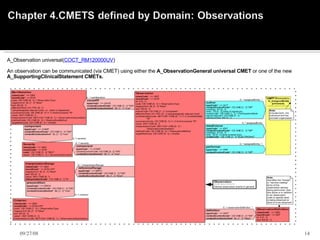
A_Observation universal( COCT_RM120000UV )      An observation can be communicated (via CMET) using either the  A_ObservationGeneral universal CMET  or one of the new  A_SupportingClinicalStatement CMETs.          06/05/09
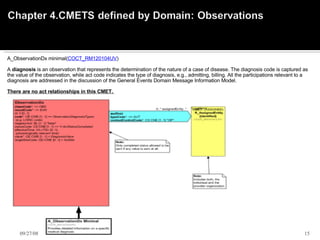
A_ObservationDx minimal( COCT_RM120104UV )      A  diagnosis  is an observation that represents the determination of the nature of a case of disease. The diagnosis code is captured as the value of the observation, while act code indicates the type of diagnosis, e.g., admitting, billing. All the participations relevant to a diagnosis are addressed in the discussion of the General Events Domain Message Information Model.    There are no act relationships in this CMET.         06/05/09
A_ObservationDx universal( COCT_RM120100UV )       This CMET also  includes a definition act relationship which identifies the &quot;master&quot; or &quot;service catalog&quot; entry of the observation service being performed.  Use this alone or in addition to an observation code to specify what is being observed or what is to be observed.            06/05/09
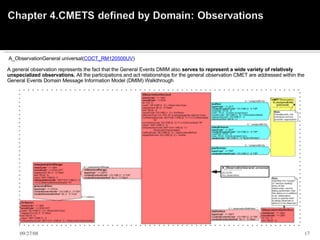
  A_ObservationGeneral universal( COCT_RM120500UV )   A general observation represents the fact that the General Events DMIM also  serves to represent a wide variety of relatively unspecialized observations.  All the participations and act relationships for the general observation CMET are addressed within the General Events Domain Message Information Model (DMIM) Walkthrough                     06/05/09
   A_ObservationIntolerence universal( COCT_RM120300UV )   Observation Intolerance CMET An observation intolerance (AKA allergy) provides the attributes and associations  needed for the specification of an intolerance or allergy.  An allergy is a hypersensitive state acquired through exposure to a particular allergen. All participations and act relationships that are valid for intolerances are described in the General Events Domain Message Information Model Walkthrough    Act Relationships   The following associations have particular relevance for an intolerance.        causeOf(Manifestation)      An intolerance can be associated with zero to many  adverse reactions (manifestations).  For the most part, intolerances         are discovered and confirmed through the observation of an adverse reaction.  However, an intolerance may be reported       without providing specific information on related adverse reactions. At the same time, an allergic person may       experience many  reactions as a result of multiple exposures.  This association is derived from the pertinent participation       in the General Events DMIM                  06/05/09
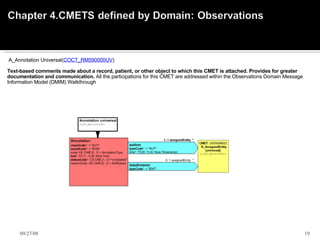
  A_Annotation Universal( COCT_RM590000UV )   Text-based comments made about a record, patient, or other object to which this CMET is attached. Provides for greater documentation and communication.  All the participations for this CMET are addressed within the Observations Domain Message Information Model (DMIM) Walkthrough           06/05/09

Universal Domain Common observation 20080808

  • 1.
    An Seong Hyun 06/05/09
  • 2.
      1. AboutStoryboard, Application Role, Trigger Event   2. Chapter 3.Common Observation Topic       Storyboards       Application Roles       Trigger Events       Refined Message Information Models(RMIM)       Hierarchical Message Descriptions(HMD)       Interactions 3. Chapter 4. CMETs Defined by this Domain     06/05/09
  • 3.
    Storyboard    - 시간순서대로 스냅샷을 이용해서 Story 를 설명 - 각각의 스냅샷은 각 이벤트 순서에서 의미 있는 순간이다 . - 스냅샷 전체는 완전한 프로세스 활동을 설명한다 . - 짧은 설명과 application role 들 사이에의 Interaction Diagram 으로 구성 - 실제 세계의 이벤트의 설명   06/05/09
  • 4.
    Application Role -a set of communication responsibilities - describe system components or sub-components that send and/or receive interactions. ( HL7 Interaction 이 정의가 되면 , 하나의 application role 은 sending 의 의무가 다른 하나의 Application role 은 receiving 의 의무를 가진다 . 특정 interaction 에 대해서 sending 과 receiving 의무가 할당되는 것이 하나의 Application role 이다 .) Trigger Event 실제 세계의 이벤트 system component 사이에서 정보교환을 초기화하는 조건의 집합 name, Artifact ID, description, Type 으로 정의된다 . 06/05/09
  • 5.
      covers allinteractions related to recording simple measured clinical observations   Recording clinical and coded observations for a patient ( 기록의 부분 ) Retrieving clinical and coded observations recorded against a patient( 추출의 부분 )   Basic Observation : height, weight, blood-pressure, temperature LAB Observation : using the Appropriate messages Coded observations : APGAR score, symptom, blood type, smoker   06/05/09
  • 6.
    3.1.1Heart Murmur Assessment(POOB_ST100001UV) - collected during a heart murmur assessment.     Precondition Dr. Patricia Primary is doing a cardiac assessment on Patient Everyman. Mr. Everyman has come to emergency room following a syncopal episode and chest pain while running to catch his bus. The information regarding the syncopal episode and chest pain were entered in the EDIS (emergency department information system).     Activities On examination Mr. E has a harsh grade III mid-systolic murmur best appreciated lateral to the left costal margin towards the laterally displaced PMI. There is a faint diastolic murmur intermittently heard over the right 2nd ICS at the right sternal border. The systolic murmur diminishes with Valsalva and squatting. Upon standing the murmur becomes pronounced. Mr. Everyman's assessment findings are entered in the EDIS, and an Echocardiogram( 심초음파 ) is ordered.     Post-condition Mr. Everyman's assessment findings and an Echocardiogram order are now present in the EDIS.       06/05/09
  • 7.
    3.2.1 Observation EntrySystem(POOB_AR000001UV)   Description : Structured Name: Common Observation Event Placer   This is a system that is capable of recording information about simple common observations such as height, weight, blood-pressure.        3.2.2 Observation Querying System(POOB_AR000003UV)   Description  :  Structured Name: Common Observation Event Information Solicitor   This is a system that retrieves information a bout about simple common observations such as height, weight, blood-pressure.        3.2.3 Observation EHR Repository(POOB_AR000002UV)   Description :  Structured Name: Common Observation Event Manager This is a system that stores and exposes measurement information about simple common observations such as height, weight, blood-pressure. 06/05/09
  • 8.
    3.3.1 Request torecord clinical observation(POOB_TE000001UV)   Description : Structured Name: Common Observation Event Complete Request Type: User request A user attempts to record a clinical observation in a subject's record.   3.3.2 Decision not to record clinical observation(POOB_TE000002UV)   Description : Structured Name: Common Observation Event Complete Rejection Type: Interaction based A request to record a clinical observation in a subject's record has been refused.   3.3.3 Observation recorded in subject record(POOB_TE000003UV)   Description : Structured Name : Common Observation Event Complete Type : State-transition based A clinical observation has been recorded in a subject's record.   3.3.4 Subject clinical observation info. Requested(POOB_TE000007UV)   Description : Structured Name : Common Observation Event Query Type :  User request A user or system requires information about clinical observations for a subject.   3.3.5 Request for subject. observation info. Received(POOB_TE000008UV)   Description : Structured Name : Common Observation Event Query Response Type : Interaction based An application responds to a request for information about clinical observations for a subject. 06/05/09
  • 9.
      3.4.1 CommonObservation (POOB_RM410000UV)     Focal Act(EventChoice)     ResultGroup : the grouping and reporting of multiple observations in one message.   - CommonObservationEvent : a single point-in-time observation            Observation. methodCode       : code that provides additional detail about the means or technique used to ascertain the observation.         Examples : Blood pressure measurement method                          arterial puncture vs. sphygmomanometer (Riva-Rocci), sitting vs. supine position        Contraints : Method 에 대해서는 이미 Act.code 에 의해서 부분적으로 설명하고 있기 때문에 methodCode 가 모두 필요한                        것은 아니다 . methodCode 정보는 검사 및 측정 방법에 대해서 좀더 분명하게 할때 , 사용되어 질 것이다 .   06/05/09
  • 10.
           Observation .value     : Information that is assigned or determined by the observation action.          The appropriate data type of the Observation.value varies with the kind of Observation   Quantitative measurement - numeric values Titer( 농도 ) -  use two integer numbers  ex) 1: 64, 1:128 Index values - use a PQ with a dimensionless unit (e.g., 1 or %). Ranges - ex)  <3; 12-20) Ordinals - use the Coded Ordinal (CO) data type. (e.g., +, ++, +++; or I, IIa, IIb, III, IV) Nominal results - use any of the coded data types (CD, CE) (&quot;taxons&quot;, e.g., organism type) Imaging results - use the Encapsulated Data (ED) type.image (e.g., chest X-ray) a movie (e.g., coronary angiography) - inline binary data or as a reference to an external address where the data can be downloaded on demand. Waveform - the Correlated Observation Sequences templates character string - may exceptionally be used to convey formalized expressions that do not fit in any of the existing data types. However, the string data type must not be used if the meaning can be represented by one of the existing data types. Timestamps - should not be sent in Observations if there are usually Act.effectiveTime of some act. Sets of values of any data type - enumerated sets sequences of observations - a Sequence (LIST) data type   06/05/09
  • 11.
          Observation. interpertationCode       : One or more codes specifying a rough qualitative interpretation of the observation          Examples :  &quot;normal, &quot;abnormal,&quot; &quot;below normal,&quot; &quot;change up,&quot; &quot;resistant,&quot; &quot;susceptible,&quot; etc.            Observation .targetSiteCode            : A code specifying detail about the anatomical site or system that is the focus of the observation     Component Act   - ObservationEventCriterion   - OldCommonObservationEvent   - NewCommonObservationEvent   - AnnotationIndicator   - WorkingListEvent   - SeverityObservation   - ObservationDefinition   - ActRequest       06/05/09
  • 12.
      3.4.2 CommonObservation List Query (POOB_RM410002UV)   - SubjectID : Search by unique subject identifier.   - SubjectName : Subject name search parameter   - SubjectGender : Subject administrative gender search parameter   - SubjectDateofBirth : Subject administrative gender search parameter   - RecordID : Search by this specific record identifier.   - IncludeNotesIndicator : If valued as true, the query response should include annotations.                                         Otherwise, only the annotation indicator flag is set (indicating annotations are present, but not sent).   - RecordType : The test or event code search parameter.   EffectiveTimeRange : Search for records whose effectiveTime falls within this range (if the response record effectiveTime is a range; then one of the <low> or <high> values are within the parameter range).   - AmendedSinceDateTime : Search for records updated since this date/time. - ResponsibleProviderID :  Search by responsible provider - RequestginProviderID  : Search by requesting or ordering provider.   - EventLocationID : Search for records (whose event) occurred at a specific location (identified).   - EventLocationType :  Search for records which occurred at a specific location type.   - EHRRepositoryID : Search within a specific respository (application and/or location).   - CareCompositionID : Search by identifier of encounter or other care composition type. - CareCompositionType : Search by type of encounter or other care composition type.   - HealthCondition : by health condition. A health condition is managed over time (e.g. diabetes).   Indication : Search by indication or diagnosis. MostRecentByTypeIndicator : In a repository query, return the most recent common observation whose code is different than other response records (in this same query response).   - EventCategory : Search by event category   06/05/09
  • 13.
    3.6.1 Request torecord subject observation (POOB_IN000001UV)     Description  : Structured Name : Common Observation Event Complete Request    Requests that a clinical observation be recorded in a subject's record.   3.6.2 Record subject observation request accepted (POOB_IN000002UV)     Description : Structured Name: Common Observation Event Complete Confirmation    Indicates that the requested observation has been successfully recorded in a subject's record.   3.6.3 Record subject observation request refused (POOB_IN000003UV)     Description : Structured Name: Common Observation Event Complete Rejection    Indicates that the request to record the specified observation in the subject's record has been refused.   3.6.4 Subject clinical observations query (POOB_IN000004UV)     Description : Structured Name: Common Observation Event Query    Requests retrieval of the clinical observations which have been recorded for a particular patient, optionally filtered by the type      of observation and/or by the date-range for which the observation was recorded.   3.6.5 Subject clinical observations query response (POOB_IN000005UV)     Description : Structured Name: Common Observation Event Query Response   Returns one or more clinical observations associated with a subject.   06/05/09
  • 14.
    A_Observation universal( COCT_RM120000UV)     An observation can be communicated (via CMET) using either the A_ObservationGeneral universal CMET or one of the new A_SupportingClinicalStatement CMETs.       06/05/09
  • 15.
    A_ObservationDx minimal( COCT_RM120104UV)     A diagnosis is an observation that represents the determination of the nature of a case of disease. The diagnosis code is captured as the value of the observation, while act code indicates the type of diagnosis, e.g., admitting, billing. All the participations relevant to a diagnosis are addressed in the discussion of the General Events Domain Message Information Model.   There are no act relationships in this CMET.       06/05/09
  • 16.
    A_ObservationDx universal( COCT_RM120100UV)      This CMET also includes a definition act relationship which identifies the &quot;master&quot; or &quot;service catalog&quot; entry of the observation service being performed.  Use this alone or in addition to an observation code to specify what is being observed or what is to be observed.           06/05/09
  • 17.
      A_ObservationGeneral universal(COCT_RM120500UV )   A general observation represents the fact that the General Events DMIM also serves to represent a wide variety of relatively unspecialized observations. All the participations and act relationships for the general observation CMET are addressed within the General Events Domain Message Information Model (DMIM) Walkthrough                   06/05/09
  • 18.
       A_ObservationIntolerence universal(COCT_RM120300UV )   Observation Intolerance CMET An observation intolerance (AKA allergy) provides the attributes and associations needed for the specification of an intolerance or allergy. An allergy is a hypersensitive state acquired through exposure to a particular allergen. All participations and act relationships that are valid for intolerances are described in the General Events Domain Message Information Model Walkthrough   Act Relationships The following associations have particular relevance for an intolerance.      causeOf(Manifestation)     An intolerance can be associated with zero to many adverse reactions (manifestations). For the most part, intolerances       are discovered and confirmed through the observation of an adverse reaction. However, an intolerance may be reported     without providing specific information on related adverse reactions. At the same time, an allergic person may     experience many  reactions as a result of multiple exposures. This association is derived from the pertinent participation     in the General Events DMIM                 06/05/09
  • 19.
      A_Annotation Universal(COCT_RM590000UV )   Text-based comments made about a record, patient, or other object to which this CMET is attached. Provides for greater documentation and communication. All the participations for this CMET are addressed within the Observations Domain Message Information Model (DMIM) Walkthrough         06/05/09