What is a trailer?
A trailer are a series of takes and shots taken from a full movie or broadcast and put
together into a video which is roughly 2 to 3 minutes long. Trailers can be used to
promote a film. Trailers can be seen as adverts for a film as they promote the movie
(which is soon to be released) so the audience could look forward to it. Many may
say that trailers are shorter versions of a film however, this depends on whether the
sequence of events that occur in the trailer are also shown in the same (or similar)
sequence in the film. Trailers can be advertised in ways such as in cinemas, TVs,
computers, portable devices (such as phones, tablets and laptops) and may even be
paper based (such as the newspaper).
Why do we have trailers?
There are other methods to promote an upcoming film. Movies can be advertised
through radios, newspapers, billboards and even posters, however the interest and
attention of the audience is a more complex and difficult task. For the movie’s
marketing campaign, the audience is what is important, the audience has a big
influence on the film’s marketing campaign. There is no campaign without the
audience and there is no audience without an eye catching and attention seeking
advertisement. Trailers can draw much of the audience’s attention (more) than
posters can. Many trailers can show much more to the audience without giving too
much away to the audience. This makes the audience think, wonder and try to
picture or imagine what the actual film will be like. Trailers also help the audience to
try to understand what genre is represented in the film; conventions for certain film
genres are shown in these trailers. For example, humour may be shown in
comedies. For the campaign, this can result in many people watching the movie as
well as hiring and purchasing copies of it which financially benefits the campaign as
they end up gaining money from it and potentially, profit.
Who are trailers aimed at?
Depending on the film itself, different trailers target different audiences because
there are individuals (in a group altogether) that like different things, they might be
appealed to certain features of a film which is why they like/ feel suited to the certain
genre of films or the movie itself. For example, you would not have little kids
watching horror or single adults with no sense of humour watching romantic comedy
films.
The trailers will be judged if they are conventional or not according to Tzvetan
Todorov’s narrative structure. Tzvetan Todorov theorised that all narratives are
structured into several stages which occur in chronological order. The first stage is
the “equilibrium” where there is an opening balance at the start of the narrative. The
second stage is the “disruption (of the equilibrium).” This is when (or where) the
opening balance to the narrative has been disrupted by someone or something.
Following this stage is “recognition (of the disruption)” and is when the characters
within the narrative have discovered/ recognised the danger/ threat caused by the
disruption or disequilibrium. The fourth stage is the attempt to repair or restore the
equilibrium that has been disrupted. There is always an “attempt” at repairing the
equilibrium as sometimes in cases such as in some horror movies (for example),
there is not always a happy ending. This is why the fourth stage contains the word
“attempt” rather than stating that the characters should or are always repairing the
balance. The final stage (which can be seen as the fifth or first) is the “new
equilibrium” meaning that there is now a new balance to the narrative structure or
that balance has been repaired and restored by the characters.*
Kong
Identifiable titles
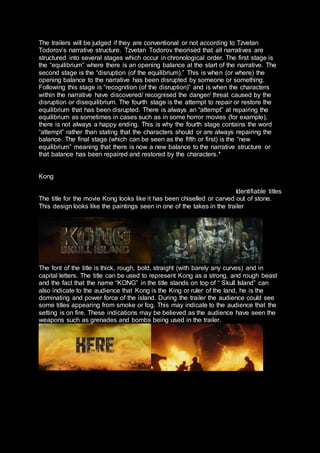
The title for the movie Kong looks like it has been chiselled or carved out of stone.
This design looks like the paintings seen in one of the takes in the trailer
The font of the title is thick, rough, bold, straight (with barely any curves) and in
capital letters. The title can be used to represent Kong as a strong, and rough beast
and the fact that the name “KONG” in the title stands on top of “ Skull Island” can
also indicate to the audience that Kong is the King or ruler of the land, he is the
dominating and power force of the island. During the trailer the audience could see
some titles appearing from smoke or fog. This may indicate to the audience that the
setting is on fire. These indications may be believed as the audience have seen the
weapons such as grenades and bombs being used in the trailer.
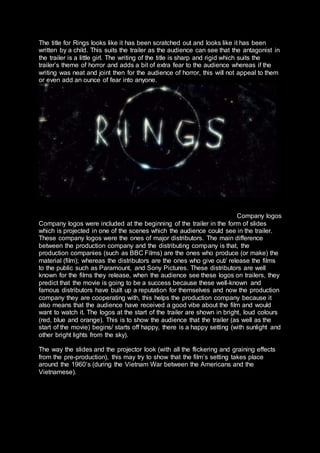
The title for Rings looks like it has been scratched out and looks like it has been
written by a child. This suits the trailer as the audience can see that the antagonist in
the trailer is a little girl. The writing of the title is sharp and rigid which suits the
trailer’s theme of horror and adds a bit of extra fear to the audience whereas if the
writing was neat and joint then for the audience of horror, this will not appeal to them
or even add an ounce of fear into anyone.
Company logos
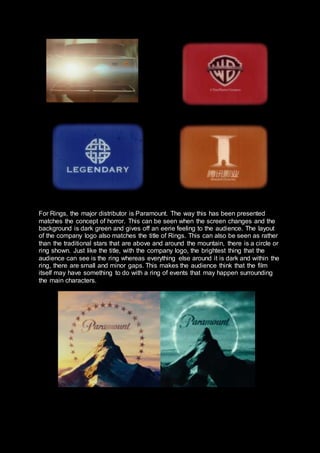
Company logos were included at the beginning of the trailer in the form of slides
which is projected in one of the scenes which the audience could see in the trailer.
These company logos were the ones of major distributors. The main difference
between the production company and the distributing company is that, the
production companies (such as BBC Films) are the ones who produce (or make) the
material (film); whereas the distributors are the ones who give out/ release the films
to the public such as Paramount, and Sony Pictures. These distributors are well
known for the films they release, when the audience see these logos on trailers, they
predict that the movie is going to be a success because these well-known and
famous distributors have built up a reputation for themselves and now the production
company they are cooperating with, this helps the production company because it
also means that the audience have received a good vibe about the film and would
want to watch it. The logos at the start of the trailer are shown in bright, loud colours
(red, blue and orange). This is to show the audience that the trailer (as well as the
start of the movie) begins/ starts off happy, there is a happy setting (with sunlight and
other bright lights from the sky).
The way the slides and the projector look (with all the flickering and graining effects
from the pre-production), this may try to show that the film’s setting takes place
around the 1960’s (during the Vietnam War between the Americans and the
Vietnamese).
For Rings, the major distributor is Paramount. The way this has been presented
matches the concept of horror. This can be seen when the screen changes and the
background is dark green and gives off an eerie feeling to the audience. The layout
of the company logo also matches the title of Rings. This can also be seen as rather
than the traditional stars that are above and around the mountain, there is a circle or
ring shown. Just like the title, with the company logo, the brightest thing that the
audience can see is the ring whereas everything else around it is dark and within the
ring, there are small and minor gaps. This makes the audience think that the film
itself may have something to do with a ring of events that may happen surrounding
the main characters.
Music and Sound
During most of the trailer in Rings, there was a lot of high pitched screeches which
sounds like glass being scratched (which makes the audience think back to the title
of the film).
As well as the slides with the bright colours from the company logos, the music starts
off happily. Music is what the Americans would use/ play to get themselves pumped
up before the engage in battle at Vietnam.
The song that is being played at the beginning of the trailer is “Bad Moon Rising” by
Creedence Clearwater. Some of the takes in the trailer matched the lyrics in the
song. The biggest example of this is when the audience hears the lyrics “I see
trouble on the way.” This was promptly before one of the pilots in the helicopter asks
“is that a monkey?” before the audience is first introduce to Kong (who in this case is
the “trouble”) when a helicopter gets destroyed and taken down by a flying tree and
from there, this is when the music stops. The music is brought to a halt with a low
and deep sound. From here the audience have been taken from a happy
environment to a straight and sudden danger. This is unconventional for a trailer as
usually the transition from happy vibes to danger/ vulnerable vibes is usually a fade
meaning that the audience can see the process of how the environment changes
around the characters as well as themselves. However, unlike most trailers, Kong:
Skull Island just takes the audience straight to the point of danger. From this there is
also dramatic irony as the audience know something that the audience doesn’t.
Although there is some asynchronous sound (for example with the helicopters
flying), there is not a lot of it. The main reasons as to why there is not a lot of
asynchronous sound is because the production company (company who produced
the trailer) do not want the audience to focus too much on the background as the
characters need to be focused on. Also, the production company want the music and
dialogue to have importance in the trailer. Music and dialogue in the trailer is also
very important which is why there is not a lot of asynchronous sound for the
audience to be distracted or drawn away from the main characters and the situation
surround them.
There’s a lot of sound for drama during the Rings as the tunes in the background
gives an eerie and paranormal feeling to the audience and could make them feel
scared. In contrast, there is also an upbeat tune during the Fast and Furious 8 trailer.
Which can make the audience feel the intensity from the action in the trailer. In Fast
and Furious, there is a lot of diegetic sound and in Home Alone, there is very little
non-diegetic sound. Altogether this helps keep the verisimilitude for the audience
which would make the storyline appear more real to the audience as the sound has
added believable logic to the text’s real world.
Incidental music is usually played during dramatic scenes which adds to the
atmosphere and feelings surrounding both the text’s world and the audience. An
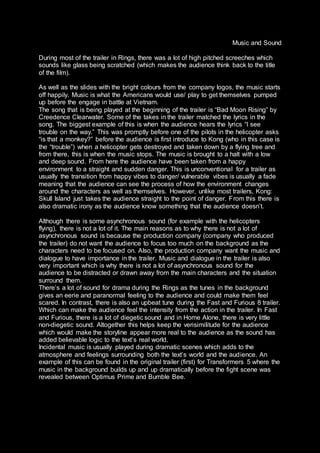
example of this can be found in the original trailer (first) for Transformers 5 where the
music in the background builds up and up dramatically before the fight scene was
revealed between Optimus Prime and Bumble Bee.
Incidental music builds up and intensifies…
Music stops…
Deep sound then shown as Optimus Prime and
Bumble Bee fight.
Age certification
Usually, the BBFC do not release the age rating of the movie on the trailers straight
away. What they generally do is they release a certificate to the company stating that
their movie is yet to be rated. Ratings are released 3 to 6 months prior to the release
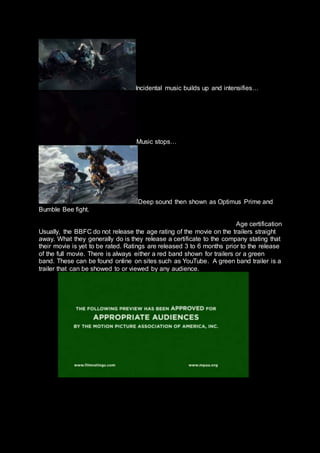
of the full movie. There is always either a red band shown for trailers or a green
band. These can be found online on sites such as YouTube. A green band trailer is a
trailer that can be showed to or viewed by any audience.
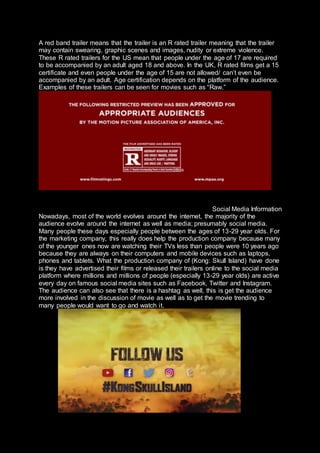
A red band trailer means that the trailer is an R rated trailer meaning that the trailer
may contain swearing, graphic scenes and images, nudity or extreme violence.
These R rated trailers for the US mean that people under the age of 17 are required
to be accompanied by an adult aged 18 and above. In the UK, R rated films get a 15
certificate and even people under the age of 15 are not allowed/ can’t even be
accompanied by an adult. Age certification depends on the platform of the audience.
Examples of these trailers can be seen for movies such as “Raw.”
Social Media Information
Nowadays, most of the world evolves around the internet, the majority of the
audience evolve around the internet as well as media; presumably social media.
Many people these days especially people between the ages of 13-29 year olds. For
the marketing company, this really does help the production company because many
of the younger ones now are watching their TVs less than people were 10 years ago
because they are always on their computers and mobile devices such as laptops,
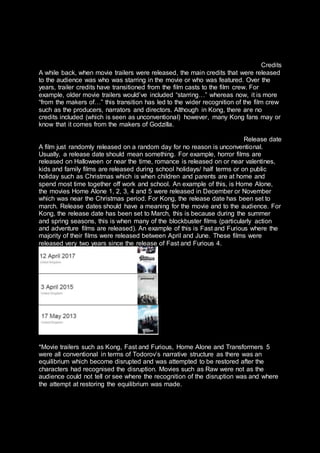
phones and tablets. What the production company of (Kong: Skull Island) have done
is they have advertised their films or released their trailers online to the social media
platform where millions and millions of people (especially 13-29 year olds) are active
every day on famous social media sites such as Facebook, Twitter and Instagram.
The audience can also see that there is a hashtag as well, this is get the audience
more involved in the discussion of movie as well as to get the movie trending to
many people would want to go and watch it.
Credits
A while back, when movie trailers were released, the main credits that were released
to the audience was who was starring in the movie or who was featured. Over the
years, trailer credits have transitioned from the film casts to the film crew. For
example, older movie trailers would’ve included “starring…” whereas now, it is more
“from the makers of…” this transition has led to the wider recognition of the film crew
such as the producers, narrators and directors. Although in Kong, there are no
credits included (which is seen as unconventional) however, many Kong fans may or
know that it comes from the makers of Godzilla.
Release date
A film just randomly released on a random day for no reason is unconventional.
Usually, a release date should mean something. For example, horror films are
released on Halloween or near the time, romance is released on or near valentines,
kids and family films are released during school holidays/ half terms or on public
holiday such as Christmas which is when children and parents are at home and
spend most time together off work and school. An example of this, is Home Alone,
the movies Home Alone 1, 2, 3, 4 and 5 were released in December or November
which was near the Christmas period. For Kong, the release date has been set to
march. Release dates should have a meaning for the movie and to the audience. For
Kong, the release date has been set to March, this is because during the summer
and spring seasons, this is when many of the blockbuster films (particularly action
and adventure films are released). An example of this is Fast and Furious where the
majority of their films were released between April and June. These films were
released very two years since the release of Fast and Furious 4.
*Movie trailers such as Kong, Fast and Furious, Home Alone and Transformers 5
were all conventional in terms of Todorov’s narrative structure as there was an
equilibrium which become disrupted and was attempted to be restored after the
characters had recognised the disruption. Movies such as Raw were not as the
audience could not tell or see where the recognition of the disruption was and where
the attempt at restoring the equilibrium was made.

Units 2, 3, 22: Task 3: Analysing Trailer conventions

  • 1.
    What is atrailer? A trailer are a series of takes and shots taken from a full movie or broadcast and put together into a video which is roughly 2 to 3 minutes long. Trailers can be used to promote a film. Trailers can be seen as adverts for a film as they promote the movie (which is soon to be released) so the audience could look forward to it. Many may say that trailers are shorter versions of a film however, this depends on whether the sequence of events that occur in the trailer are also shown in the same (or similar) sequence in the film. Trailers can be advertised in ways such as in cinemas, TVs, computers, portable devices (such as phones, tablets and laptops) and may even be paper based (such as the newspaper). Why do we have trailers? There are other methods to promote an upcoming film. Movies can be advertised through radios, newspapers, billboards and even posters, however the interest and attention of the audience is a more complex and difficult task. For the movie’s marketing campaign, the audience is what is important, the audience has a big influence on the film’s marketing campaign. There is no campaign without the audience and there is no audience without an eye catching and attention seeking advertisement. Trailers can draw much of the audience’s attention (more) than posters can. Many trailers can show much more to the audience without giving too much away to the audience. This makes the audience think, wonder and try to picture or imagine what the actual film will be like. Trailers also help the audience to try to understand what genre is represented in the film; conventions for certain film genres are shown in these trailers. For example, humour may be shown in comedies. For the campaign, this can result in many people watching the movie as well as hiring and purchasing copies of it which financially benefits the campaign as they end up gaining money from it and potentially, profit. Who are trailers aimed at? Depending on the film itself, different trailers target different audiences because there are individuals (in a group altogether) that like different things, they might be appealed to certain features of a film which is why they like/ feel suited to the certain genre of films or the movie itself. For example, you would not have little kids watching horror or single adults with no sense of humour watching romantic comedy films.
  • 2.
    The trailers willbe judged if they are conventional or not according to Tzvetan Todorov’s narrative structure. Tzvetan Todorov theorised that all narratives are structured into several stages which occur in chronological order. The first stage is the “equilibrium” where there is an opening balance at the start of the narrative. The second stage is the “disruption (of the equilibrium).” This is when (or where) the opening balance to the narrative has been disrupted by someone or something. Following this stage is “recognition (of the disruption)” and is when the characters within the narrative have discovered/ recognised the danger/ threat caused by the disruption or disequilibrium. The fourth stage is the attempt to repair or restore the equilibrium that has been disrupted. There is always an “attempt” at repairing the equilibrium as sometimes in cases such as in some horror movies (for example), there is not always a happy ending. This is why the fourth stage contains the word “attempt” rather than stating that the characters should or are always repairing the balance. The final stage (which can be seen as the fifth or first) is the “new equilibrium” meaning that there is now a new balance to the narrative structure or that balance has been repaired and restored by the characters.* Kong Identifiable titles The title for the movie Kong looks like it has been chiselled or carved out of stone. This design looks like the paintings seen in one of the takes in the trailer The font of the title is thick, rough, bold, straight (with barely any curves) and in capital letters. The title can be used to represent Kong as a strong, and rough beast and the fact that the name “KONG” in the title stands on top of “ Skull Island” can also indicate to the audience that Kong is the King or ruler of the land, he is the dominating and power force of the island. During the trailer the audience could see some titles appearing from smoke or fog. This may indicate to the audience that the setting is on fire. These indications may be believed as the audience have seen the weapons such as grenades and bombs being used in the trailer.
  • 3.
    The title forRings looks like it has been scratched out and looks like it has been written by a child. This suits the trailer as the audience can see that the antagonist in the trailer is a little girl. The writing of the title is sharp and rigid which suits the trailer’s theme of horror and adds a bit of extra fear to the audience whereas if the writing was neat and joint then for the audience of horror, this will not appeal to them or even add an ounce of fear into anyone. Company logos Company logos were included at the beginning of the trailer in the form of slides which is projected in one of the scenes which the audience could see in the trailer. These company logos were the ones of major distributors. The main difference between the production company and the distributing company is that, the production companies (such as BBC Films) are the ones who produce (or make) the material (film); whereas the distributors are the ones who give out/ release the films to the public such as Paramount, and Sony Pictures. These distributors are well known for the films they release, when the audience see these logos on trailers, they predict that the movie is going to be a success because these well-known and famous distributors have built up a reputation for themselves and now the production company they are cooperating with, this helps the production company because it also means that the audience have received a good vibe about the film and would want to watch it. The logos at the start of the trailer are shown in bright, loud colours (red, blue and orange). This is to show the audience that the trailer (as well as the start of the movie) begins/ starts off happy, there is a happy setting (with sunlight and other bright lights from the sky). The way the slides and the projector look (with all the flickering and graining effects from the pre-production), this may try to show that the film’s setting takes place around the 1960’s (during the Vietnam War between the Americans and the Vietnamese).
  • 4.
    For Rings, themajor distributor is Paramount. The way this has been presented matches the concept of horror. This can be seen when the screen changes and the background is dark green and gives off an eerie feeling to the audience. The layout of the company logo also matches the title of Rings. This can also be seen as rather than the traditional stars that are above and around the mountain, there is a circle or ring shown. Just like the title, with the company logo, the brightest thing that the audience can see is the ring whereas everything else around it is dark and within the ring, there are small and minor gaps. This makes the audience think that the film itself may have something to do with a ring of events that may happen surrounding the main characters.
  • 5.
    Music and Sound Duringmost of the trailer in Rings, there was a lot of high pitched screeches which sounds like glass being scratched (which makes the audience think back to the title of the film). As well as the slides with the bright colours from the company logos, the music starts off happily. Music is what the Americans would use/ play to get themselves pumped up before the engage in battle at Vietnam. The song that is being played at the beginning of the trailer is “Bad Moon Rising” by Creedence Clearwater. Some of the takes in the trailer matched the lyrics in the song. The biggest example of this is when the audience hears the lyrics “I see trouble on the way.” This was promptly before one of the pilots in the helicopter asks “is that a monkey?” before the audience is first introduce to Kong (who in this case is the “trouble”) when a helicopter gets destroyed and taken down by a flying tree and from there, this is when the music stops. The music is brought to a halt with a low and deep sound. From here the audience have been taken from a happy environment to a straight and sudden danger. This is unconventional for a trailer as usually the transition from happy vibes to danger/ vulnerable vibes is usually a fade meaning that the audience can see the process of how the environment changes around the characters as well as themselves. However, unlike most trailers, Kong: Skull Island just takes the audience straight to the point of danger. From this there is also dramatic irony as the audience know something that the audience doesn’t. Although there is some asynchronous sound (for example with the helicopters flying), there is not a lot of it. The main reasons as to why there is not a lot of asynchronous sound is because the production company (company who produced the trailer) do not want the audience to focus too much on the background as the characters need to be focused on. Also, the production company want the music and dialogue to have importance in the trailer. Music and dialogue in the trailer is also very important which is why there is not a lot of asynchronous sound for the audience to be distracted or drawn away from the main characters and the situation surround them. There’s a lot of sound for drama during the Rings as the tunes in the background gives an eerie and paranormal feeling to the audience and could make them feel scared. In contrast, there is also an upbeat tune during the Fast and Furious 8 trailer. Which can make the audience feel the intensity from the action in the trailer. In Fast and Furious, there is a lot of diegetic sound and in Home Alone, there is very little non-diegetic sound. Altogether this helps keep the verisimilitude for the audience which would make the storyline appear more real to the audience as the sound has added believable logic to the text’s real world. Incidental music is usually played during dramatic scenes which adds to the atmosphere and feelings surrounding both the text’s world and the audience. An example of this can be found in the original trailer (first) for Transformers 5 where the music in the background builds up and up dramatically before the fight scene was revealed between Optimus Prime and Bumble Bee.
  • 6.
    Incidental music buildsup and intensifies… Music stops… Deep sound then shown as Optimus Prime and Bumble Bee fight. Age certification Usually, the BBFC do not release the age rating of the movie on the trailers straight away. What they generally do is they release a certificate to the company stating that their movie is yet to be rated. Ratings are released 3 to 6 months prior to the release of the full movie. There is always either a red band shown for trailers or a green band. These can be found online on sites such as YouTube. A green band trailer is a trailer that can be showed to or viewed by any audience.
  • 7.
    A red bandtrailer means that the trailer is an R rated trailer meaning that the trailer may contain swearing, graphic scenes and images, nudity or extreme violence. These R rated trailers for the US mean that people under the age of 17 are required to be accompanied by an adult aged 18 and above. In the UK, R rated films get a 15 certificate and even people under the age of 15 are not allowed/ can’t even be accompanied by an adult. Age certification depends on the platform of the audience. Examples of these trailers can be seen for movies such as “Raw.” Social Media Information Nowadays, most of the world evolves around the internet, the majority of the audience evolve around the internet as well as media; presumably social media. Many people these days especially people between the ages of 13-29 year olds. For the marketing company, this really does help the production company because many of the younger ones now are watching their TVs less than people were 10 years ago because they are always on their computers and mobile devices such as laptops, phones and tablets. What the production company of (Kong: Skull Island) have done is they have advertised their films or released their trailers online to the social media platform where millions and millions of people (especially 13-29 year olds) are active every day on famous social media sites such as Facebook, Twitter and Instagram. The audience can also see that there is a hashtag as well, this is get the audience more involved in the discussion of movie as well as to get the movie trending to many people would want to go and watch it.
  • 8.
    Credits A while back,when movie trailers were released, the main credits that were released to the audience was who was starring in the movie or who was featured. Over the years, trailer credits have transitioned from the film casts to the film crew. For example, older movie trailers would’ve included “starring…” whereas now, it is more “from the makers of…” this transition has led to the wider recognition of the film crew such as the producers, narrators and directors. Although in Kong, there are no credits included (which is seen as unconventional) however, many Kong fans may or know that it comes from the makers of Godzilla. Release date A film just randomly released on a random day for no reason is unconventional. Usually, a release date should mean something. For example, horror films are released on Halloween or near the time, romance is released on or near valentines, kids and family films are released during school holidays/ half terms or on public holiday such as Christmas which is when children and parents are at home and spend most time together off work and school. An example of this, is Home Alone, the movies Home Alone 1, 2, 3, 4 and 5 were released in December or November which was near the Christmas period. For Kong, the release date has been set to march. Release dates should have a meaning for the movie and to the audience. For Kong, the release date has been set to March, this is because during the summer and spring seasons, this is when many of the blockbuster films (particularly action and adventure films are released). An example of this is Fast and Furious where the majority of their films were released between April and June. These films were released very two years since the release of Fast and Furious 4. *Movie trailers such as Kong, Fast and Furious, Home Alone and Transformers 5 were all conventional in terms of Todorov’s narrative structure as there was an equilibrium which become disrupted and was attempted to be restored after the characters had recognised the disruption. Movies such as Raw were not as the audience could not tell or see where the recognition of the disruption was and where the attempt at restoring the equilibrium was made.