USSOCOM Factbook 3
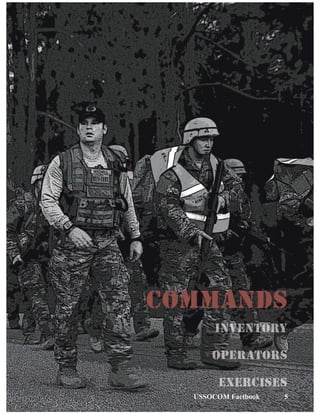
COMMANDS
6 U.S. Special Operations Command
14 U.S. Army Special Operations
Command
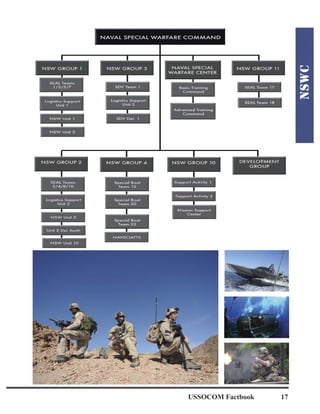
16 Naval Special Warfare Command
18 Air Force Special Operations
Command
20 Marine Corps Forces Special
Operations Command
22 Subordinate Special Operations
Commands
INVENTORY
26 Aircraft
30 Maritime
32 Ground
34 Weapons
36 Command, Control,
Communications, and Computers
37 Special Reconnaissance,
Surveillance, and Exploitation
OPERATORS
40 USASOC
41 NSWC
42 AFSOC
43 MARSOC
EXERCISES
46 Balikatan, Cold Response,
Flintlock, and Foal Eagle
47 Fuerzas Comando, Jackal Stone,
and Panamax
SOF POTPOURRI
48 SOF Truths
50 SOF Acronyms
51 The typical SOF warrior
4 www.socom.mil
USSOCOM Factbook 5
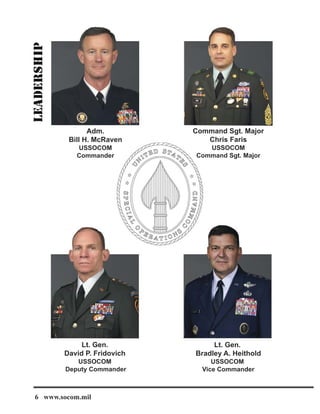
Adm.
Bill H. McRaven
USSOCOM
Commander
Command Sgt. Major
Chris Faris
USSOCOM
Command Sgt. Major
Lt. Gen.
Bradley A. Heithold
USSOCOM
Vice Commander
Lt. Gen.
David P. Fridovich
USSOCOM
Deputy Commander
6 www.socom.mil
Korea
Army Master Sgt. Ola L. Mize
Vietnam
Army Capt. Humbert Roque Versace
Army Capt. Roger H. C. Donlon
Army 1st Lt. Charles Q. Williams
Air Force Maj. Bernard F. Fisher
Army Capt. Ronald E. Ray
Navy Boatswain’s Mate 1st Class James E. Williams
Army 1st Lt. George K. Sisler
Navy Seaman David G. Ouellet
Army Master Sgt. Charles E. Hosking, Jr.
Army Sgt. Gordon D. Yntema
Army Staff Sgt. Drew D. Dix
Army Sgt. 1st Class Eugene Ashley, Jr.
Army Sgt. 1st Class Fred W. Zabitosky
Army Master Sgt. Roy P. Benavidez
Air Force Lt. Col. Joe M. Jackson
Army Specialist 5th Class John J. Kedenburg
Air Force Col. William A. Jones III
Army Staff Sgt. Laszlo Rabel
Air Force Capt. James P. Fleming
Army Staff Sgt. Robert L. Howard
Army Specialist 4th Class Robert D. Law
Air Force Airman 1st Class John L. Levitow
Navy Lt. j.g. (SEAL) Joseph R. Kerrey
Army Sgt. 1st Class William M. Bryant
Army Staff Sgt. Robert J. Pruden
Army Staff Sgt. Franklin D. Miller
Army Sgt. Gary B. Beikirch
Army Sgt. 1st Class Gary L. Littrell
Army Sgt. Brian L. Buker
Army Staff Sgt. John R. Cavaiani
Army 1st Lt. Loren D. Hagen
Navy Lt. (SEAL) Thomas R. Norris
Navy Engineman 2nd Class (SEAL) Michael T. Thornton
Somalia
Army Master Sgt. Gary I. Gordon
Army Sgt. 1st Class Randall D. Shughart
Afghanistan
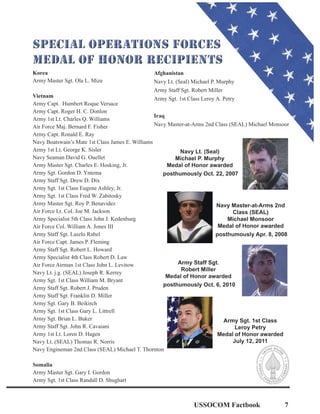
Navy Lt. (Seal) Michael P. Murphy
Army Staff Sgt. Robert Miller
Army Sgt. 1st Class Leroy A. Petry
Iraq
Navy Master-at-Arms 2nd Class (SEAL) Michael Monsoor
Navy Lt. (Seal)
Michael P. Murphy
Medal of Honor awarded
posthumously Oct. 22, 2007
Navy Master-at-Arms 2nd
Class (SEAL)
Michael Monsoor
Medal of Honor awarded
posthumously Apr. 8, 2008
Army Staff Sgt.
Robert Miller
Medal of Honor awarded
posthumously Oct. 6, 2010
Army Sgt. 1st Class
Leroy Petry
Medal of Honor awarded
July 12, 2011
USSOCOM Factbook 7
USSOCOM Mission
 Provide fully capable Special Operations Forces to defend the United States and its interests.
 Synchronize planning of global operations against terrorist networks.
 Develop special operations strategy, doc-
trine and tactics
 Prepare and submit budget proposals for
SOF
 Exercise authority, direction and control
over special operations expenditures
 Train assigned forces
 Conduct specialized courses of instruction
 Validate requirements
 Establish requirement priorities
 Ensure interoperability of
equipment and forces
 Formulate and submit intel-
ligence support requirements
 Monitor Special Operations
officers’ promotions, assignments, retention,
training and professional military education
 Ensure Special Operations Forces’ combat
readiness
 Monitor Special Operations Forces’
preparedness to carry out assigned missions
 Develop and acquire special operations-
peculiar equipment, materiel, supplies and
services
 Command and control of U.S. based
Special Operations Forces
 Provide Special Operations Forces to the
geographic combatant commanders
 Activities specified by the President or
Secretary of Defense
Title 10 Authorities and Responsibilities
8 www.socom.mil
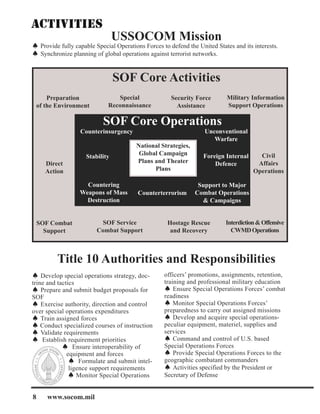
Preparation
of the Environment
Special
Reconnaissance
Security Force
Assistance
Military Information
Support Operations
Direct
Action
SOF Combat
Support
SOF Service
Combat Support
Hostage Rescue
and Recovery
Interdiction&Offensive
CWMDOperations
Civil
Affairs
Operations
SOF Core Operations
Counterinsurgency
Stability
Countering
Weapons of Mass
Destruction
Counterterrorism
Support to Major
Combat Operations
& Campaigns
Foreign Internal
Defence
Unconventional
Warfare
National Strategies,
Global Campaign
Plans and Theater
Plans
SOF Core Activities
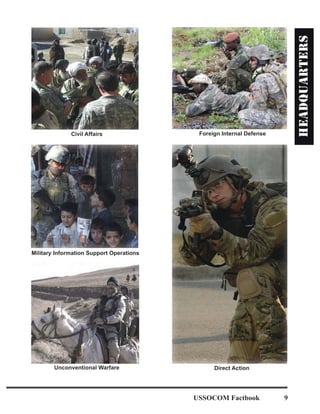
Civil Affairs
Military Information Support Operations
Unconventional Warfare Direct Action
Foreign Internal Defense
USSOCOM Factbook 9
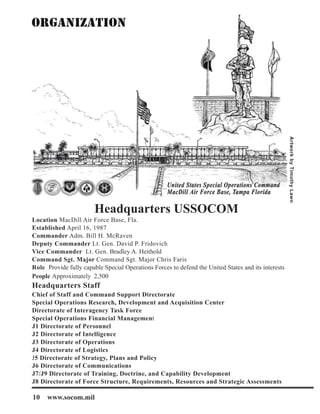
Headquarters USSOCOM
Location MacDill Air Force Base, Fla.
Established April 16, 1987
Commander Adm. Bill H. McRaven
Deputy Commander Lt. Gen. David P. Fridovich
Vice Commander Lt. Gen. Bradley A. Heithold
Command Sgt. Major Command Sgt. Major Chris Faris
Role Provide fully capable Special Operations Forces to defend the United States and its interests
People Approximately 2,500
Headquarters Staff
Chief of Staff and Command Support Directorate
Special Operations Research, Development and Acquisition Center
Directorate of Interagency Task Force
Special Operations Financial Management
J1 Directorate of Personnel
J2 Directorate of Intelligence
J3 Directorate of Operations
J4 Directorate of Logistics
J5 Directorate of Strategy, Plans and Policy
J6 Directorate of Communications
J7/J9 Directorate of Training, Doctrine, and Capability Development
J8 Directorate of Force Structure, Requirements, Resources and Strategic Assessments
Artwork
by
Timothy
Lawn
10 www.socom.mil
USSOCOM Factbook 11
12 www.socom.mil
USSOCOM Factbook 13
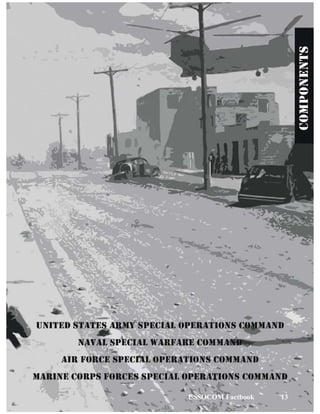
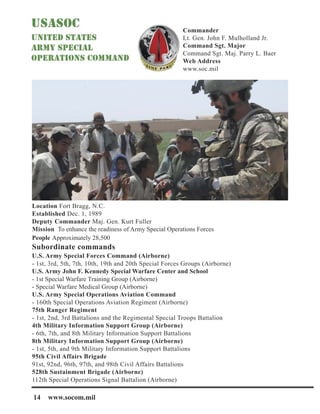
Location Fort Bragg, N.C.
Established Dec. 1, 1989
Deputy Commander Maj. Gen. Kurt Fuller
Mission To enhance the readiness of Army Special Operations Forces
People Approximately 28,500
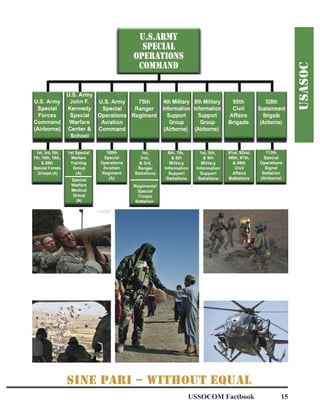
Subordinate commands
U.S. Army Special Forces Command (Airborne)
- 1st, 3rd, 5th, 7th, 10th, 19th and 20th Special Forces Groups (Airborne)
U.S. Army John F. Kennedy Special Warfare Center and School
- 1st Special Warfare Training Group (Airborne)
- Special Warfare Medical Group (Airborne)
U.S. Army Special Operations Aviation Command
- 160th Special Operations Aviation Regiment (Airborne)
75th Ranger Regiment
- 1st, 2nd, 3rd Battalions and the Regimental Special Troops Battalion
4th Military Information Support Group (Airborne)
- 6th, 7th, and 8th Military Information Support Battalions
8th Military Information Support Group (Airborne)
- 1st, 5th, and 9th Military Information Support Battalions
95th Civil Affairs Brigade
91st, 92nd, 96th, 97th, and 98th Civil Affairs Battalions
528th Sustainment Brigade (Airborne)
112th Special Operations Signal Battalion (Airborne)
Commander
Lt. Gen. John F. Mulholland Jr.
Command Sgt. Major
Command Sgt. Maj. Parry L. Baer
Web Address
www.soc.mil
14 www.socom.mil
USSOCOM Factbook 15
Commander
Rear Adm. Sean A. Pybus
Force Master Chief
Force Master Chief Stephen D. Link
WebAddress
www.public.navy.mil/nsw
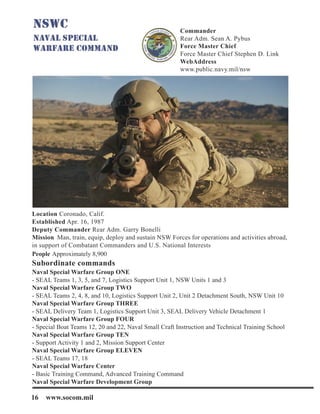
Location Coronado, Calif.
Established Apr. 16, 1987
Deputy Commander Rear Adm. Garry Bonelli
Mission Man, train, equip, deploy and sustain NSW Forces for operations and activities abroad,
in support of Combatant Commanders and U.S. National Interests
People Approximately 8,900
Subordinate commands
Naval Special Warfare Group ONE
- SEAL Teams 1, 3, 5, and 7, Logistics Support Unit 1, NSW Units 1 and 3
Naval Special Warfare Group TWO
- SEAL Teams 2, 4, 8, and 10, Logistics Support Unit 2, Unit 2 Detachment South, NSW Unit 10
Naval Special Warfare Group THREE
- SEAL Delivery Team 1, Logistics Support Unit 3, SEAL Delivery Vehicle Detachment 1
Naval Special Warfare Group FOUR
- Special Boat Teams 12, 20 and 22, Naval Small Craft Instruction and Technical Training School
Naval Special Warfare Group TEN
- Support Activity 1 and 2, Mission Support Center
Naval Special Warfare Group ELEVEN
- SEAL Teams 17, 18
Naval Special Warfare Center
- Basic Training Command, Advanced Training Command
Naval Special Warfare Development Group
16 www.socom.mil
USSOCOM Factbook 17
18 www.socom.mil
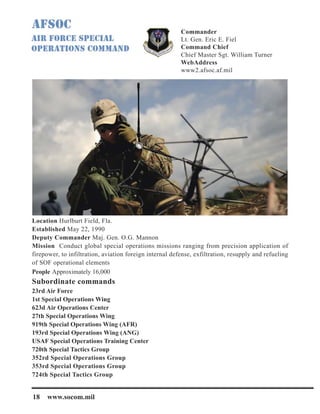
Location Hurlburt Field, Fla.
Established May 22, 1990
Deputy Commander Maj. Gen. O.G. Mannon
Mission Conduct global special operations missions ranging from precision application of
firepower, to infiltration, aviation foreign internal defense, exfiltration, resupply and refueling
of SOF operational elements
People Approximately 16,000
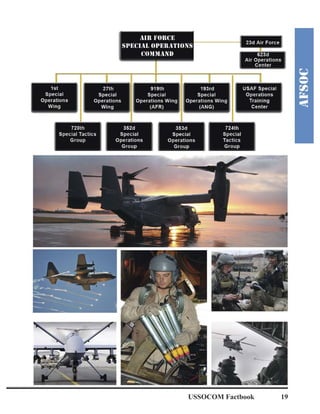
Subordinate commands
23rd Air Force
1st Special Operations Wing
623d Air Operations Center
27th Special Operations Wing
919th Special Operations Wing (AFR)
193rd Special Operations Wing (ANG)
USAF Special Operations Training Center
720th Special Tactics Group
352rd Special Operations Group
353rd Special Operations Group
724th Special Tactics Group
Commander
Lt. Gen. Eric E. Fiel
Command Chief
Chief Master Sgt. William Turner
WebAddress
www2.afsoc.af.mil
USSOCOM Factbook 19
20 www.socom.mil
Commander
Maj. Gen. Paul E. Lefebvre
MARSOC Sgt. Major
Sgt. Maj. Richard W. Ashton
WebAddress
www.marines.mil/unit/marsoc
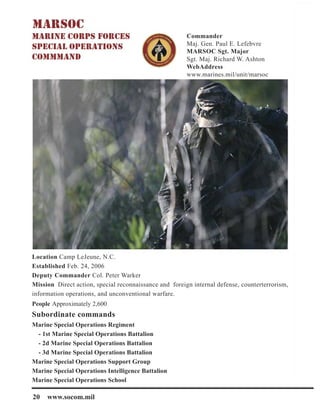
Location Camp LeJeune, N.C.
Established Feb. 24, 2006
Deputy Commander Col. Peter Warker
Mission Direct action, special reconnaissance and foreign internal defense, counterterrorism,
information operations, and unconventional warfare.
People Approximately 2,600
Subordinate commands
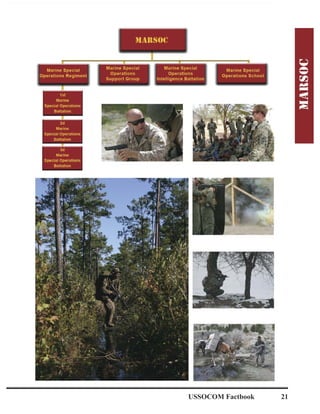
Marine Special Operations Regiment
- 1st Marine Special Operations Battalion
- 2d Marine Special Operations Battalion
- 3d Marine Special Operations Battalion
Marine Special Operations Support Group
Marine Special Operations Intelligence Battalion
Marine Special Operations School
USSOCOM Factbook 21
22 www.socom.mil
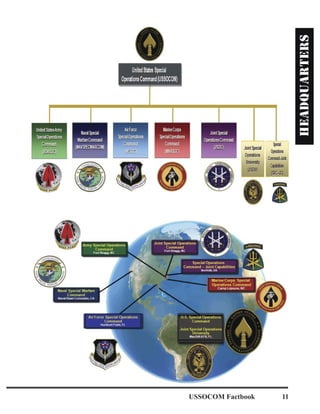
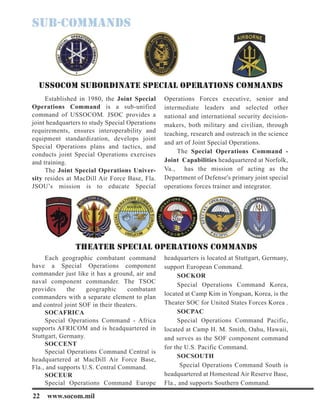
Established in 1980, the Joint Special
Operations Command is a sub-unified
command of USSOCOM. JSOC provides a
joint headquarters to study Special Operations
requirements, ensures interoperability and
equipment standardization, develops joint
Special Operations plans and tactics, and
conducts joint Special Operations exercises
and training.
The Joint Special Operations Univer-
sity resides at MacDill Air Force Base, Fla.
JSOU’s mission is to educate Special
Operations Forces executive, senior and
intermediate leaders and selected other
national and international security decision-
makers, both military and civilian, through
teaching, research and outreach in the science
and art of Joint Special Operations.
The Special Operations Command -
Joint Capabilities headquartered at Norfolk,
Va., has the mission of acting as the
Department of Defense's primary joint special
operations forces trainer and integrator.
Each geographic combatant command
have a Special Operations component
commander just like it has a ground, air and
naval component commander. The TSOC
provides the geographic combatant
commanders with a separate element to plan
and control joint SOF in their theaters.
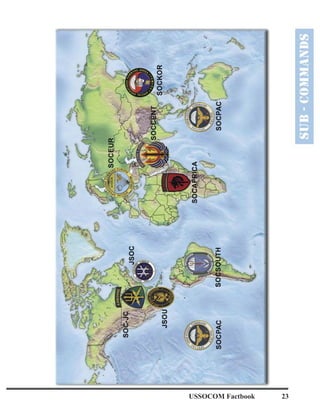
SOCAFRICA
Special Operations Command - Africa
supports AFRICOM and is headquartered in
Stuttgart, Germany.
SOCCENT
Special Operations Command Central is
headquartered at MacDill Air Force Base,
Fla., and supports U.S. Central Command.
SOCEUR
Special Operations Command Europe
headquarters is located at Stuttgart, Germany,
support European Command.
SOCKOR
Special Operations Command Korea,
located at Camp Kim in Yongsan, Korea, is the
Theater SOC for United States Forces Korea .
SOCPAC
Special Operations Command Pacific,
located at Camp H. M. Smith, Oahu, Hawaii,
and serves as the SOF component command
for the U.S. Pacific Command.
SOCSOUTH
Special Operations Command South is
headquartered at Homestead Air Reserve Base,
Fla., and supports Southern Command.
THEATER SPECIAL OPERATIONS COMMANDS
USSOCOM SUBORDINATE SPECIAL OPERATIONS COMMANDS
USSOCOM Factbook 23
24 www.socom.mil
USSOCOM Factbook 25
26 www.socom.mil
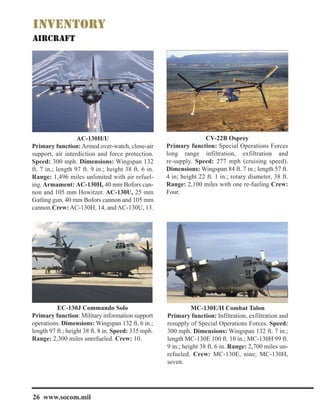
AC-130H/U
Primary function: Armed over-watch, close-air
support, air interdiction and force protection.
Speed: 300 mph. Dimensions: Wingspan 132
ft. 7 in.; length 97 ft. 9 in.; height 38 ft. 6 in.
Range: 1,496 miles unlimited with air refuel-
ing. Armament: AC-130H, 40 mm Bofors can-
non and 105 mm Howitzer. AC-130U, 25 mm
Gatling gun, 40 mm Bofors cannon and 105 mm
cannon.Crew: AC-130H, 14, and AC-130U, 13.
CV-22B Osprey
Primary function: Special Operations Forces
long range infiltration, exfiltration and
re-supply. Speed: 277 mph (cruising speed).
Dimensions: Wingspan 84 ft. 7 in.; length 57 ft.
4 in; height 22 ft. 1 in.; rotary diameter, 38 ft.
Range: 2,100 miles with one re-fueling Crew:
Four.
EC-130J Commando Solo
Primary function: Military information support
operations. Dimensions: Wingspan 132 ft. 6 in.;
length 97 ft.; height 38 ft. 8 in. Speed: 335 mph.
Range: 2,300 miles unrefueled. Crew: 10.
MC-130E/H Combat Talon
Primary function: Infiltration, exfiltration and
resupply of Special Operations Forces. Speed:
300 mph. Dimensions: Wingspan 132 ft. 7 in.;
length MC-130E 100 ft. 10 in.; MC-130H 99 ft.
9 in.; height 38 ft. 6 in. Range: 2,700 miles un-
refueled. Crew: MC-130E, nine; MC-130H,
seven.
USSOCOM Factbook 27
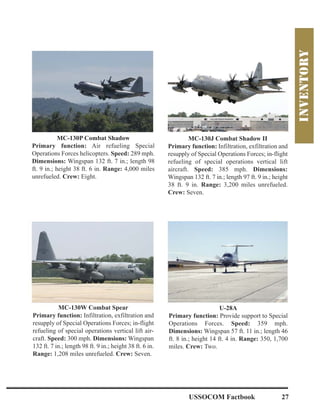
MC-130P Combat Shadow
Primary function: Air refueling Special
Operations Forces helicopters. Speed: 289 mph.
Dimensions: Wingspan 132 ft. 7 in.; length 98
ft. 9 in.; height 38 ft. 6 in. Range: 4,000 miles
unrefueled. Crew: Eight.
MC-130W Combat Spear
Primary function: Infiltration, exfiltration and
resupply of Special Operations Forces; in-flight
refueling of special operations vertical lift air-
craft. Speed: 300 mph. Dimensions: Wingspan
132 ft. 7 in.; length 98 ft. 9 in.; height 38 ft. 6 in.
Range: 1,208 miles unrefueled. Crew: Seven.
U-28A
Primary function: Provide support to Special
Operations Forces. Speed: 359 mph.
Dimensions: Wingspan 57 ft. 11 in.; length 46
ft. 8 in.; height 14 ft. 4 in. Range: 350, 1,700
miles. Crew: Two.
MC-130J Combat Shadow II
Primary function: Infiltration, exfiltration and
resupply of Special Operations Forces; in-flight
refueling of special operations vertical lift
aircraft. Speed: 385 mph. Dimensions:
Wingspan 132 ft. 7 in.; length 97 ft. 9 in.; height
38 ft. 9 in. Range: 3,200 miles unrefueled.
Crew: Seven.
28 www.socom.mil
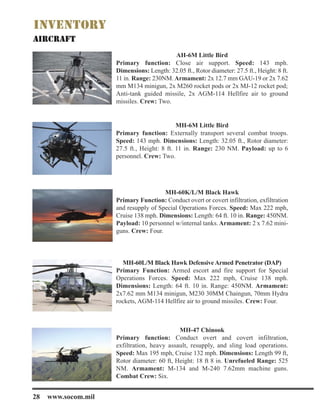
MH-6M Little Bird
Primary function: Externally transport several combat troops.
Speed: 143 mph. Dimensions: Length: 32.05 ft., Rotor diameter:
27.5 ft., Height: 8 ft. 11 in. Range: 230 NM. Payload: up to 6
personnel. Crew: Two.
MH-60K/L/M Black Hawk
Primary Function: Conduct overt or covert infiltration, exfiltration
and resupply of Special Operations Forces. Speed: Max 222 mph,
Cruise 138 mph. Dimensions: Length: 64 ft. 10 in. Range: 450NM.
Payload: 10 personnel w/internal tanks. Armament: 2 x 7.62 mini-
guns. Crew: Four.
MH-47 Chinook
Primary function: Conduct overt and covert infiltration,
exfiltration, heavy assault, resupply, and sling load operations.
Speed: Max 195 mph, Cruise 132 mph. Dimensions: Length 99 ft,
Rotor diameter: 60 ft, Height: 18 ft 8 in. Unrefueled Range: 525
NM. Armament: M-134 and M-240 7.62mm machine guns.
Combat Crew: Six.
AH-6M Little Bird
Primary function: Close air support. Speed: 143 mph.
Dimensions: Length: 32.05 ft., Rotor diameter: 27.5 ft., Height: 8 ft.
11 in. Range: 230NM. Armament: 2x 12.7 mm GAU-19 or 2x 7.62
mm M134 minigun, 2x M260 rocket pods or 2x MJ-12 rocket pod;
Anti-tank guided missile, 2x AGM-114 Hellfire air to ground
missiles. Crew: Two.
MH-60L/M Black Hawk Defensive Armed Penetrator (DAP)
Primary Function: Armed escort and fire support for Special
Operations Forces. Speed: Max 222 mph, Cruise 138 mph.
Dimensions: Length: 64 ft. 10 in. Range: 450NM. Armament:
2x7.62 mm M134 minigun, M230 30MM Chaingun, 70mm Hydra
rockets, AGM-114 Hellfire air to ground missiles. Crew: Four.
USSOCOM Factbook 29
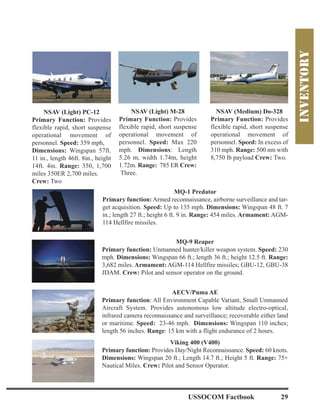
MQ-1 Predator
Primary function: Armed reconnaissance, airborne surveillance and tar-
get acquisition. Speed: Up to 135 mph. Dimensions: Wingspan 48 ft. 7
in.; length 27 ft.; height 6 ft. 9 in. Range: 454 miles. Armament: AGM-
114 Hellfire missiles.
MQ-9 Reaper
Primary function: Unmanned hunter/killer weapon system. Speed: 230
mph. Dimensions: Wingspan 66 ft.; length 36 ft.; height 12.5 ft. Range:
3,682 miles. Armament: AGM-114 Hellfire missiles; GBU-12, GBU-38
JDAM. Crew: Pilot and sensor operator on the ground.
NSAV (Light) PC-12
Primary Function: Provides
flexible rapid, short suspense
operational movement of
personnel. Speed: 359 mph,
Dimensions: Wingspan 57ft.
11 in., length 46ft. 8in., height
14ft. 4in. Range: 350, 1,700
miles 350ER 2,700 miles.
Crew: Two
NSAV (Light) M-28
Primary Function: Provides
flexible rapid, short suspense
operational movement of
personnel. Speed: Max 220
mph. Dimensions: Length
5.26 m, width 1.74m, height
1.72m. Range: 785 ER Crew:
Three.
NSAV (Medium) Do-328
Primary Function: Provides
flexible rapid, short suspense
operational movement of
personnel. Speed: In excess of
310 mph. Range: 500 nm with
8,750 lb payload Crew: Two.
AECV/Puma AE
Primary function: All Environment Capable Variant, Small Unmanned
Aircraft System. Provides autonomous low altitude electro-optical,
infrared camera reconnaissance and surveillance; recoverable either land
or maritime. Speed: 23-46 mph. Dimensions: Wingspan 110 inches;
length 56 inches. Range: 15 km with a flight endurance of 2 hours.
Viking 400 (V400)
Primary function: Provides Day/Night Reconnaissance. Speed: 60 knots.
Dimensions: Wingspan 20 ft.; Length 14.7 ft.; Height 5 ft. Range: 75+
Nautical Miles. Crew: Pilot and Sensor Operator.
30 www.socom.mil
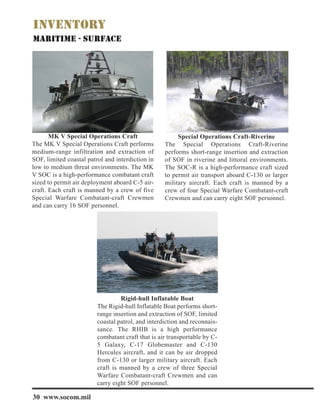
Special Operations Craft-Riverine
The Special Operations Craft-Riverine
performs short-range insertion and extraction
of SOF in riverine and littoral environments.
The SOC-R is a high-performance craft sized
to permit air transport aboard C-130 or larger
military aircraft. Each craft is manned by a
crew of four Special Warfare Combatant-craft
Crewmen and can carry eight SOF personnel.
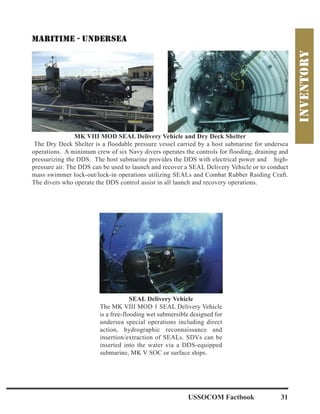
Rigid-hull Inflatable Boat
The Rigid-hull Inflatable Boat performs short-
range insertion and extraction of SOF, limited
coastal patrol, and interdiction and reconnais-
sance. The RHIB is a high performance
combatant craft that is air transportable by C-
5 Galaxy, C-17 Globemaster and C-130
Hercules aircraft, and it can be air dropped
from C-130 or larger military aircraft. Each
craft is manned by a crew of three Special
Warfare Combatant-craft Crewmen and can
carry eight SOF personnel.
MK V Special Operations Craft
The MK V Special Operations Craft performs
medium-range infiltration and extraction of
SOF, limited coastal patrol and interdiction in
low to medium threat environments. The MK
V SOC is a high-performance combatant craft
sized to permit air deployment aboard C-5 air-
craft. Each craft is manned by a crew of five
Special Warfare Combatant-craft Crewmen
and can carry 16 SOF personnel.
USSOCOM Factbook 31
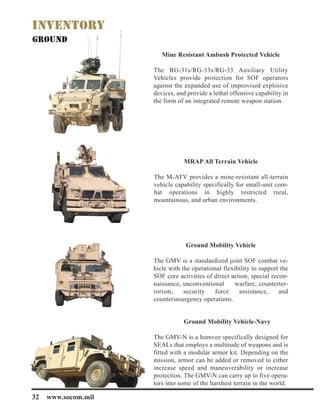
SEAL Delivery Vehicle
The MK VIII MOD 1 SEAL Delivery Vehicle
is a free-flooding wet submersible designed for
undersea special operations including direct
action, hydrographic reconnaissance and
insertion/extraction of SEALs. SDVs can be
inserted into the water via a DDS-equipped
submarine, MK V SOC or surface ships.
MK VIII MOD SEAL Delivery Vehicle and Dry Deck Shelter
The Dry Deck Shelter is a floodable pressure vessel carried by a host submarine for undersea
operations. A minimum crew of six Navy divers operates the controls for flooding, draining and
pressurizing the DDS. The host submarine provides the DDS with electrical power and high-
pressure air. The DDS can be used to launch and recover a SEAL Delivery Vehicle or to conduct
mass swimmer lock-out/lock-in operations utilizing SEALs and Combat Rubber Raiding Craft.
The divers who operate the DDS control assist in all launch and recovery operations.
32 www.socom.mil
Mine Resistant Ambush Protected Vehicle
The RG-31s/RG-33s/RG-33 Auxiliary Utility
Vehicles provide protection for SOF operators
against the expanded use of improvised explosive
devices, and provide a lethal offensive capability in
the form of an integrated remote weapon station.
MRAP All Terrain Vehicle
The M-ATV provides a mine-resistant all-terrain
vehicle capability specifically for small-unit com-
bat operations in highly restricted rural,
mountainous, and urban environments.
Ground Mobility Vehicle
The GMV is a standardized joint SOF combat ve-
hicle with the operational flexibility to support the
SOF core activities of direct action, special recon-
naissance, unconventional warfare, counterter-
rorism, security force assistance, and
counterinsurgency operations.
Ground Mobility Vehicle-Navy
The GMV-N is a humvee specifically designed for
SEALs that employs a multitude of weapons and is
fitted with a modular armor kit. Depending on the
mission, armor can be added or removed to either
increase speed and maneuverability or increase
protection. The GMV-N can carry up to five opera-
tors into some of the harshest terrain in the world.
USSOCOM Factbook 33
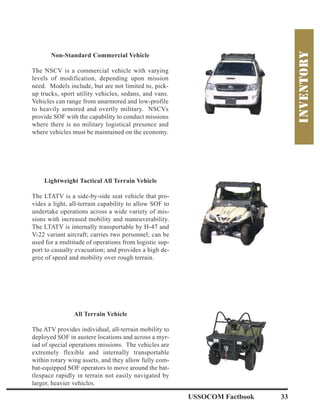
Non-Standard Commercial Vehicle
The NSCV is a commercial vehicle with varying
levels of modification, depending upon mission
need. Models include, but are not limited to, pick-
up trucks, sport utility vehicles, sedans, and vans.
Vehicles can range from unarmored and low-profile
to heavily armored and overtly military. NSCVs
provide SOF with the capability to conduct missions
where there is no military logistical presence and
where vehicles must be maintained on the economy.
All Terrain Vehicle
The ATV provides individual, all-terrain mobility to
deployed SOF in austere locations and across a myr-
iad of special operations missions. The vehicles are
extremely flexible and internally transportable
within rotary wing assets, and they allow fully com-
bat-equipped SOF operators to move around the bat-
tlespace rapidly in terrain not easily navigated by
larger, heavier vehicles.
Lightweight Tactical All Terrain Vehicle
The LTATV is a side-by-side seat vehicle that pro-
vides a light, all-terrain capability to allow SOF to
undertake operations across a wide variety of mis-
sions with increased mobility and maneuverability.
The LTATV is internally transportable by H-47 and
V-22 variant aircraft; carries two personnel; can be
used for a multitude of operations from logistic sup-
port to casualty evacuation; and provides a high de-
gree of speed and mobility over rough terrain.
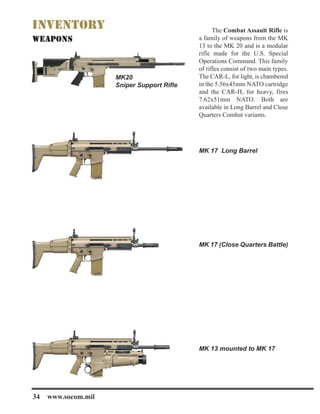
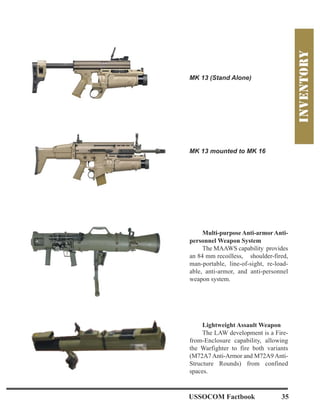
The Combat Assault Rifle is
a family of weapons from the MK
13 to the MK 20 and is a modular
rifle made for the U.S. Special
Operations Command. This family
of rifles consist of two main types.
The CAR-L, for light, is chambered
in the 5.56x45mm NATO cartridge
and the CAR-H, for heavy, fires
7.62x51mm NATO. Both are
available in Long Barrel and Close
Quarters Combat variants.
MK 17 Long Barrel
MK 17 (Close Quarters Battle)
MK 13 mounted to MK 17
MK20
Sniper Support Rifle
34 www.socom.mil
MK 13 (Stand Alone)
MK 13 mounted to MK 16
Multi-purposeAnti-armorAnti-
personnel Weapon System
The MAAWS capability provides
an 84 mm recoilless, shoulder-fired,
man-portable, line-of-sight, re-load-
able, anti-armor, and anti-personnel
weapon system.
Lightweight Assault Weapon
The LAW development is a Fire-
from-Enclosure capability, allowing
the Warfighter to fire both variants
(M72A7Anti-Armor and M72A9Anti-
Structure Rounds) from confined
spaces.
USSOCOM Factbook 35
The Enterprise Networks Division is
responsible for designing, acquiring, fielding, and
sustaining the garrison and tactical network
automation infrastructure systems. The programs
include the Special Operations Command
Research, Analysis, and Threat Evaluation
System (SOCRATES); C4 and Intelligence (C4I)
Automation Systems (C4IAS); and Tactical Local
Area Network (TACLAN).
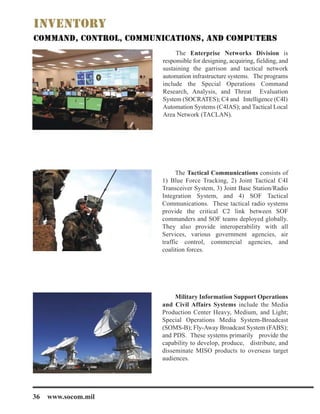
The Tactical Communications consists of
1) Blue Force Tracking, 2) Joint Tactical C4I
Transceiver System, 3) Joint Base Station/Radio
Integration System, and 4) SOF Tactical
Communications. These tactical radio systems
provide the critical C2 link between SOF
commanders and SOF teams deployed globally.
They also provide interoperability with all
Services, various government agencies, air
traffic control, commercial agencies, and
coalition forces.
Military Information Support Operations
and Civil Affairs Systems include the Media
Production Center Heavy, Medium, and Light;
Special Operations Media System-Broadcast
(SOMS-B); Fly-Away Broadcast System (FABS);
and PDS. These systems primarily provide the
capability to develop, produce, distribute, and
disseminate MISO products to overseas target
audiences.
36 www.socom.mil
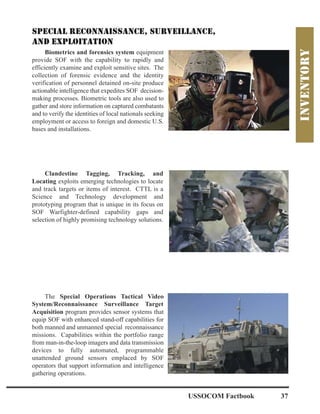
Biometrics and forensics system equipment
provide SOF with the capability to rapidly and
efficiently examine and exploit sensitive sites. The
collection of forensic evidence and the identity
verification of personnel detained on-site produce
actionable intelligence that expedites SOF decision-
making processes. Biometric tools are also used to
gather and store information on captured combatants
and to verify the identities of local nationals seeking
employment or access to foreign and domestic U.S.
bases and installations.
Clandestine Tagging, Tracking, and
Locating exploits emerging technologies to locate
and track targets or items of interest. CTTL is a
Science and Technology development and
prototyping program that is unique in its focus on
SOF Warfighter-defined capability gaps and
selection of highly promising technology solutions.
The Special Operations Tactical Video
System/Reconnaissance Surveillance Target
Acquisition program provides sensor systems that
equip SOF with enhanced stand-off capabilities for
both manned and unmanned special reconnaissance
missions. Capabilities within the portfolio range
from man-in-the-loop imagers and data transmission
devices to fully automated, programmable
unattended ground sensors emplaced by SOF
operators that support information and intelligence
gathering operations.
USSOCOM Factbook 37
38 www.socom.mil
USSOCOM Factbook 39
Special Forces
Special Forces units perform seven doctrinal missions:
Unconventional Warfare, Foreign Internal Defense, Special
Reconnaissance, DirectAction, Combatting Terrorism, Counter-
proliferation, and Information Operations. These missions make
Special Forces unique in the U.S. military, because they are
employed throughout the three stages of the operational
continuum: peacetime, conflict and war.
The "Quiet Professionals," Special Forces units are today
deployed worldwide displaying their dominance in full
spectrum operations through their unconventional warfare
expertise. From humanitarian assistance and training of
indigenous forces, to direct action and special reconnaissance
missions, Special Forces Soldiers live up to the Special Forces
motto: De Oppresso Liber, to Free the Oppressed.
Army Ranger
Rangers are capable of conducting squad through
regimental size operations using a variety of infiltration
techniques including airborne, air assault and ground platforms.
The 75th Ranger Regiment remains an all-volunteer force with
an intensive screening and selection process followed by
combat-focused training. Rangers are resourced to maintain
exceptional proficiency, experience and readiness. The 75th
Ranger Regiment is a proud unit and a team of teams serving the
Nation - Rangers Lead The Way.
40 www.socom.mil
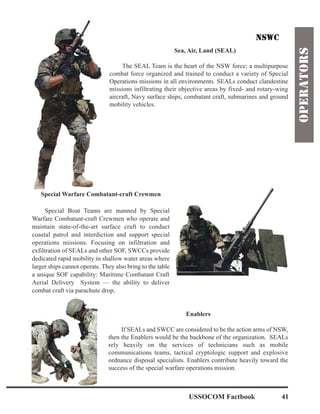
Sea, Air, Land (SEAL)
The SEAL Team is the heart of the NSW force; a multipurpose
combat force organized and trained to conduct a variety of Special
Operations missions in all environments. SEALs conduct clandestine
missions infiltrating their objective areas by fixed- and rotary-wing
aircraft, Navy surface ships, combatant craft, submarines and ground
mobility vehicles.
USSOCOM Factbook 41
Special Warfare Combatant-craft Crewmen
Special Boat Teams are manned by Special
Warfare Combatant-craft Crewmen who operate and
maintain state-of-the-art surface craft to conduct
coastal patrol and interdiction and support special
operations missions. Focusing on infiltration and
exfiltration of SEALs and other SOF, SWCCs provide
dedicated rapid mobility in shallow water areas where
larger ships cannot operate. They also bring to the table
a unique SOF capability: Maritime Combatant Craft
Aerial Delivery System — the ability to deliver
combat craft via parachute drop.
Enablers
If SEALs and SWCC are considered to be the action arms of NSW,
then the Enablers would be the backbone of the organization. SEALs
rely heavily on the services of technicians such as mobile
communications teams, tactical cryptologic support and explosive
ordnance disposal specialists. Enablers contribute heavily toward the
success of the special warfare operations mission.
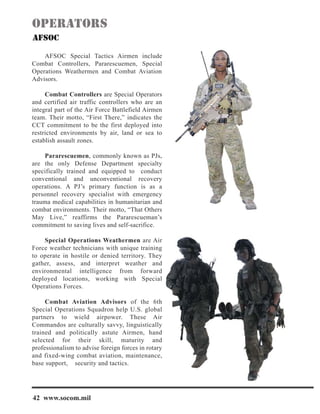
AFSOC Special Tactics Airmen include
Combat Controllers, Pararescuemen, Special
Operations Weathermen and Combat Aviation
Advisors.
Combat Controllers are Special Operators
and certified air traffic controllers who are an
integral part of the Air Force Battlefield Airmen
team. Their motto, “First There,” indicates the
CCT commitment to be the first deployed into
restricted environments by air, land or sea to
establish assault zones.
Pararescuemen, commonly known as PJs,
are the only Defense Department specialty
specifically trained and equipped to conduct
conventional and unconventional recovery
operations. A PJ’s primary function is as a
personnel recovery specialist with emergency
trauma medical capabilities in humanitarian and
combat environments. Their motto, “That Others
May Live,” reaffirms the Pararescueman’s
commitment to saving lives and self-sacrifice.
Special Operations Weathermen are Air
Force weather technicians with unique training
to operate in hostile or denied territory. They
gather, assess, and interpret weather and
environmental intelligence from forward
deployed locations, working with Special
Operations Forces.
Combat Aviation Advisors of the 6th
Special Operations Squadron help U.S. global
partners to wield airpower. These Air
Commandos are culturally savvy, linguistically
trained and politically astute Airmen, hand
selected for their skill, maturity and
professionalism to advise foreign forces in rotary
and fixed-wing combat aviation, maintenance,
base support, security and tactics.
42 www.socom.mil
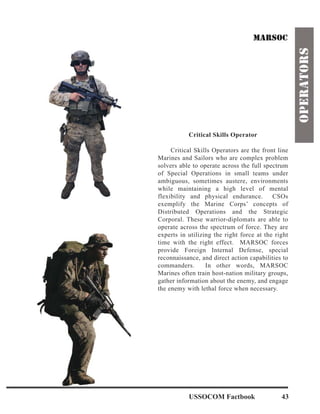
Critical Skills Operator
Critical Skills Operators are the front line
Marines and Sailors who are complex problem
solvers able to operate across the full spectrum
of Special Operations in small teams under
ambiguous, sometimes austere, environments
while maintaining a high level of mental
flexibility and physical endurance. CSOs
exemplify the Marine Corps’ concepts of
Distributed Operations and the Strategic
Corporal. These warrior-diplomats are able to
operate across the spectrum of force. They are
experts in utilizing the right force at the right
time with the right effect. MARSOC forces
provide Foreign Internal Defense, special
reconnaissance, and direct action capabilities to
commanders. In other words, MARSOC
Marines often train host-nation military groups,
gather information about the enemy, and engage
the enemy with lethal force when necessary.
USSOCOM Factbook 43
44 www.socom.mil
USSOCOM Factbook 45
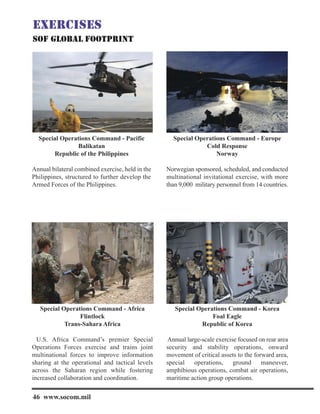
Special Operations Command - Pacific
Balikatan
Republic of the Philippines
Annual bilateral combined exercise, held in the
Philippines, structured to further develop the
Armed Forces of the Philippines.
Special Operations Command - Europe
Cold Response
Norway
Norwegian sponsored, scheduled, and conducted
multinational invitational exercise, with more
than 9,000 military personnel from 14 countries.
Special Operations Command - Africa
Flintlock
Trans-Sahara Africa
U.S. Africa Command’s premier Special
Operations Forces exercise and trains joint
multinational forces to improve information
sharing at the operational and tactical levels
across the Saharan region while fostering
increased collaboration and coordination.
Special Operations Command - Korea
Foal Eagle
Republic of Korea
Annual large-scale exercise focused on rear area
security and stability operations, onward
movement of critical assets to the forward area,
special operations, ground maneuver,
amphibious operations, combat air operations,
maritime action group operations.
46 www.socom.mil
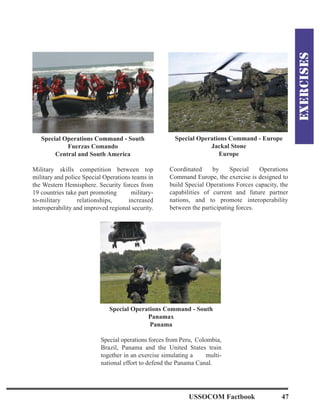
Special Operations Command - South
Fuerzas Comando
Central and South America
Military skills competition between top
military and police Special Operations teams in
the Western Hemisphere. Security forces from
19 countries take part promoting military-
to-military relationships, increased
interoperability and improved regional security.
Special Operations Command - South
Panamax
Panama
Special operations forces from Peru, Colombia,
Brazil, Panama and the United States train
together in an exercise simulating a multi-
national effort to defend the Panama Canal.
Special Operations Command - Europe
Jackal Stone
Europe
Coordinated by Special Operations
Command Europe, the exercise is designed to
build Special Operations Forces capacity, the
capabilities of current and future partner
nations, and to promote interoperability
between the participating forces.
USSOCOM Factbook 47
48 www.socom.mil
USSOCOM Factbook 49
50 www.socom.mil
Acronym Glossary
AFB Air Force Base
AFSOC Air Force Special Operations Command
ATV All Terrain Vehicle
C4 Command, Control, Communications and Computers
CCT Combat Controller
CSO Critical Skills Operator
DOD Department of Defense
FID Foreign Internal Defense
GMV Ground Mobility Vehicle
JSOC Joint Special Operations Command
JSOU Joint Special Operations University
LTATV Lightweight Tactical All Terrain Vehicle
MARSOC Marine Corps Forces Special Operations Command
MISO Military Information Support Operations
MRAP Mine Resistant Ambush Protected Vehicle
NSCV Non-Standard Commercial Vehicle
NSWC Naval Special Warfare Command
NSWG Naval Special Warfare Group
PJ Pararescueman
RHIB Rigid-hull Inflatable Boat
SDVT SEAL Delivery Vehicle Team
SEAL Sea-Air-Land forces
SF Special Forces
SFG(A) Special Forces Group (Airborne)
SOCAFRICA Special Operations Command Africa
SOCCENT Special Operations Command Central
SOCEUR Special Operations Command Europe
SOC-JC Special Operations Command-Joint Capabilities
SOCKOR Special Operations Command Korea
SOCPAC Special Operations Command Pacific
SOC-R Special Operations Craft-Riverine
SOCSOUTH Special Operations Command South
SOF Special Operations Forces
SRSE Special Reconnaissance, Surveillance and Exploitation
SWCC Special Warfare Combatant-craft Crewman
TSOC Theater Special Operations Command
UAV Unmanned Aerial Vehicle
USAJFKSWCS U.S. Army John F. Kennedy Special Warfare Center & School
USASOC U.S. Army Special Operations Command
USSOCOM U.S. Special Operations Command
USSOCOM Factbook 51
United States Special Operations Command 2012 Fact Book.pdf

United States Special Operations Command 2012 Fact Book.pdf

  • 3.
    USSOCOM Factbook 3 COMMANDS 6U.S. Special Operations Command 14 U.S. Army Special Operations Command 16 Naval Special Warfare Command 18 Air Force Special Operations Command 20 Marine Corps Forces Special Operations Command 22 Subordinate Special Operations Commands INVENTORY 26 Aircraft 30 Maritime 32 Ground 34 Weapons 36 Command, Control, Communications, and Computers 37 Special Reconnaissance, Surveillance, and Exploitation OPERATORS 40 USASOC 41 NSWC 42 AFSOC 43 MARSOC EXERCISES 46 Balikatan, Cold Response, Flintlock, and Foal Eagle 47 Fuerzas Comando, Jackal Stone, and Panamax SOF POTPOURRI 48 SOF Truths 50 SOF Acronyms 51 The typical SOF warrior
  • 4.
  • 5.
  • 6.
    Adm. Bill H. McRaven USSOCOM Commander CommandSgt. Major Chris Faris USSOCOM Command Sgt. Major Lt. Gen. Bradley A. Heithold USSOCOM Vice Commander Lt. Gen. David P. Fridovich USSOCOM Deputy Commander 6 www.socom.mil
  • 7.
    Korea Army Master Sgt.Ola L. Mize Vietnam Army Capt. Humbert Roque Versace Army Capt. Roger H. C. Donlon Army 1st Lt. Charles Q. Williams Air Force Maj. Bernard F. Fisher Army Capt. Ronald E. Ray Navy Boatswain’s Mate 1st Class James E. Williams Army 1st Lt. George K. Sisler Navy Seaman David G. Ouellet Army Master Sgt. Charles E. Hosking, Jr. Army Sgt. Gordon D. Yntema Army Staff Sgt. Drew D. Dix Army Sgt. 1st Class Eugene Ashley, Jr. Army Sgt. 1st Class Fred W. Zabitosky Army Master Sgt. Roy P. Benavidez Air Force Lt. Col. Joe M. Jackson Army Specialist 5th Class John J. Kedenburg Air Force Col. William A. Jones III Army Staff Sgt. Laszlo Rabel Air Force Capt. James P. Fleming Army Staff Sgt. Robert L. Howard Army Specialist 4th Class Robert D. Law Air Force Airman 1st Class John L. Levitow Navy Lt. j.g. (SEAL) Joseph R. Kerrey Army Sgt. 1st Class William M. Bryant Army Staff Sgt. Robert J. Pruden Army Staff Sgt. Franklin D. Miller Army Sgt. Gary B. Beikirch Army Sgt. 1st Class Gary L. Littrell Army Sgt. Brian L. Buker Army Staff Sgt. John R. Cavaiani Army 1st Lt. Loren D. Hagen Navy Lt. (SEAL) Thomas R. Norris Navy Engineman 2nd Class (SEAL) Michael T. Thornton Somalia Army Master Sgt. Gary I. Gordon Army Sgt. 1st Class Randall D. Shughart Afghanistan Navy Lt. (Seal) Michael P. Murphy Army Staff Sgt. Robert Miller Army Sgt. 1st Class Leroy A. Petry Iraq Navy Master-at-Arms 2nd Class (SEAL) Michael Monsoor Navy Lt. (Seal) Michael P. Murphy Medal of Honor awarded posthumously Oct. 22, 2007 Navy Master-at-Arms 2nd Class (SEAL) Michael Monsoor Medal of Honor awarded posthumously Apr. 8, 2008 Army Staff Sgt. Robert Miller Medal of Honor awarded posthumously Oct. 6, 2010 Army Sgt. 1st Class Leroy Petry Medal of Honor awarded July 12, 2011 USSOCOM Factbook 7
  • 8.
    USSOCOM Mission  Providefully capable Special Operations Forces to defend the United States and its interests.  Synchronize planning of global operations against terrorist networks.  Develop special operations strategy, doc- trine and tactics  Prepare and submit budget proposals for SOF  Exercise authority, direction and control over special operations expenditures  Train assigned forces  Conduct specialized courses of instruction  Validate requirements  Establish requirement priorities  Ensure interoperability of equipment and forces  Formulate and submit intel- ligence support requirements  Monitor Special Operations officers’ promotions, assignments, retention, training and professional military education  Ensure Special Operations Forces’ combat readiness  Monitor Special Operations Forces’ preparedness to carry out assigned missions  Develop and acquire special operations- peculiar equipment, materiel, supplies and services  Command and control of U.S. based Special Operations Forces  Provide Special Operations Forces to the geographic combatant commanders  Activities specified by the President or Secretary of Defense Title 10 Authorities and Responsibilities 8 www.socom.mil Preparation of the Environment Special Reconnaissance Security Force Assistance Military Information Support Operations Direct Action SOF Combat Support SOF Service Combat Support Hostage Rescue and Recovery Interdiction&Offensive CWMDOperations Civil Affairs Operations SOF Core Operations Counterinsurgency Stability Countering Weapons of Mass Destruction Counterterrorism Support to Major Combat Operations & Campaigns Foreign Internal Defence Unconventional Warfare National Strategies, Global Campaign Plans and Theater Plans SOF Core Activities
  • 9.
    Civil Affairs Military InformationSupport Operations Unconventional Warfare Direct Action Foreign Internal Defense USSOCOM Factbook 9
  • 10.
    Headquarters USSOCOM Location MacDillAir Force Base, Fla. Established April 16, 1987 Commander Adm. Bill H. McRaven Deputy Commander Lt. Gen. David P. Fridovich Vice Commander Lt. Gen. Bradley A. Heithold Command Sgt. Major Command Sgt. Major Chris Faris Role Provide fully capable Special Operations Forces to defend the United States and its interests People Approximately 2,500 Headquarters Staff Chief of Staff and Command Support Directorate Special Operations Research, Development and Acquisition Center Directorate of Interagency Task Force Special Operations Financial Management J1 Directorate of Personnel J2 Directorate of Intelligence J3 Directorate of Operations J4 Directorate of Logistics J5 Directorate of Strategy, Plans and Policy J6 Directorate of Communications J7/J9 Directorate of Training, Doctrine, and Capability Development J8 Directorate of Force Structure, Requirements, Resources and Strategic Assessments Artwork by Timothy Lawn 10 www.socom.mil
  • 11.
  • 12.
  • 13.
  • 14.
    Location Fort Bragg,N.C. Established Dec. 1, 1989 Deputy Commander Maj. Gen. Kurt Fuller Mission To enhance the readiness of Army Special Operations Forces People Approximately 28,500 Subordinate commands U.S. Army Special Forces Command (Airborne) - 1st, 3rd, 5th, 7th, 10th, 19th and 20th Special Forces Groups (Airborne) U.S. Army John F. Kennedy Special Warfare Center and School - 1st Special Warfare Training Group (Airborne) - Special Warfare Medical Group (Airborne) U.S. Army Special Operations Aviation Command - 160th Special Operations Aviation Regiment (Airborne) 75th Ranger Regiment - 1st, 2nd, 3rd Battalions and the Regimental Special Troops Battalion 4th Military Information Support Group (Airborne) - 6th, 7th, and 8th Military Information Support Battalions 8th Military Information Support Group (Airborne) - 1st, 5th, and 9th Military Information Support Battalions 95th Civil Affairs Brigade 91st, 92nd, 96th, 97th, and 98th Civil Affairs Battalions 528th Sustainment Brigade (Airborne) 112th Special Operations Signal Battalion (Airborne) Commander Lt. Gen. John F. Mulholland Jr. Command Sgt. Major Command Sgt. Maj. Parry L. Baer Web Address www.soc.mil 14 www.socom.mil
  • 15.
  • 16.
    Commander Rear Adm. SeanA. Pybus Force Master Chief Force Master Chief Stephen D. Link WebAddress www.public.navy.mil/nsw Location Coronado, Calif. Established Apr. 16, 1987 Deputy Commander Rear Adm. Garry Bonelli Mission Man, train, equip, deploy and sustain NSW Forces for operations and activities abroad, in support of Combatant Commanders and U.S. National Interests People Approximately 8,900 Subordinate commands Naval Special Warfare Group ONE - SEAL Teams 1, 3, 5, and 7, Logistics Support Unit 1, NSW Units 1 and 3 Naval Special Warfare Group TWO - SEAL Teams 2, 4, 8, and 10, Logistics Support Unit 2, Unit 2 Detachment South, NSW Unit 10 Naval Special Warfare Group THREE - SEAL Delivery Team 1, Logistics Support Unit 3, SEAL Delivery Vehicle Detachment 1 Naval Special Warfare Group FOUR - Special Boat Teams 12, 20 and 22, Naval Small Craft Instruction and Technical Training School Naval Special Warfare Group TEN - Support Activity 1 and 2, Mission Support Center Naval Special Warfare Group ELEVEN - SEAL Teams 17, 18 Naval Special Warfare Center - Basic Training Command, Advanced Training Command Naval Special Warfare Development Group 16 www.socom.mil
  • 17.
  • 18.
    18 www.socom.mil Location HurlburtField, Fla. Established May 22, 1990 Deputy Commander Maj. Gen. O.G. Mannon Mission Conduct global special operations missions ranging from precision application of firepower, to infiltration, aviation foreign internal defense, exfiltration, resupply and refueling of SOF operational elements People Approximately 16,000 Subordinate commands 23rd Air Force 1st Special Operations Wing 623d Air Operations Center 27th Special Operations Wing 919th Special Operations Wing (AFR) 193rd Special Operations Wing (ANG) USAF Special Operations Training Center 720th Special Tactics Group 352rd Special Operations Group 353rd Special Operations Group 724th Special Tactics Group Commander Lt. Gen. Eric E. Fiel Command Chief Chief Master Sgt. William Turner WebAddress www2.afsoc.af.mil
  • 19.
  • 20.
    20 www.socom.mil Commander Maj. Gen.Paul E. Lefebvre MARSOC Sgt. Major Sgt. Maj. Richard W. Ashton WebAddress www.marines.mil/unit/marsoc Location Camp LeJeune, N.C. Established Feb. 24, 2006 Deputy Commander Col. Peter Warker Mission Direct action, special reconnaissance and foreign internal defense, counterterrorism, information operations, and unconventional warfare. People Approximately 2,600 Subordinate commands Marine Special Operations Regiment - 1st Marine Special Operations Battalion - 2d Marine Special Operations Battalion - 3d Marine Special Operations Battalion Marine Special Operations Support Group Marine Special Operations Intelligence Battalion Marine Special Operations School
  • 21.
  • 22.
    22 www.socom.mil Established in1980, the Joint Special Operations Command is a sub-unified command of USSOCOM. JSOC provides a joint headquarters to study Special Operations requirements, ensures interoperability and equipment standardization, develops joint Special Operations plans and tactics, and conducts joint Special Operations exercises and training. The Joint Special Operations Univer- sity resides at MacDill Air Force Base, Fla. JSOU’s mission is to educate Special Operations Forces executive, senior and intermediate leaders and selected other national and international security decision- makers, both military and civilian, through teaching, research and outreach in the science and art of Joint Special Operations. The Special Operations Command - Joint Capabilities headquartered at Norfolk, Va., has the mission of acting as the Department of Defense's primary joint special operations forces trainer and integrator. Each geographic combatant command have a Special Operations component commander just like it has a ground, air and naval component commander. The TSOC provides the geographic combatant commanders with a separate element to plan and control joint SOF in their theaters. SOCAFRICA Special Operations Command - Africa supports AFRICOM and is headquartered in Stuttgart, Germany. SOCCENT Special Operations Command Central is headquartered at MacDill Air Force Base, Fla., and supports U.S. Central Command. SOCEUR Special Operations Command Europe headquarters is located at Stuttgart, Germany, support European Command. SOCKOR Special Operations Command Korea, located at Camp Kim in Yongsan, Korea, is the Theater SOC for United States Forces Korea . SOCPAC Special Operations Command Pacific, located at Camp H. M. Smith, Oahu, Hawaii, and serves as the SOF component command for the U.S. Pacific Command. SOCSOUTH Special Operations Command South is headquartered at Homestead Air Reserve Base, Fla., and supports Southern Command. THEATER SPECIAL OPERATIONS COMMANDS USSOCOM SUBORDINATE SPECIAL OPERATIONS COMMANDS
  • 23.
  • 24.
  • 25.
  • 26.
    26 www.socom.mil AC-130H/U Primary function:Armed over-watch, close-air support, air interdiction and force protection. Speed: 300 mph. Dimensions: Wingspan 132 ft. 7 in.; length 97 ft. 9 in.; height 38 ft. 6 in. Range: 1,496 miles unlimited with air refuel- ing. Armament: AC-130H, 40 mm Bofors can- non and 105 mm Howitzer. AC-130U, 25 mm Gatling gun, 40 mm Bofors cannon and 105 mm cannon.Crew: AC-130H, 14, and AC-130U, 13. CV-22B Osprey Primary function: Special Operations Forces long range infiltration, exfiltration and re-supply. Speed: 277 mph (cruising speed). Dimensions: Wingspan 84 ft. 7 in.; length 57 ft. 4 in; height 22 ft. 1 in.; rotary diameter, 38 ft. Range: 2,100 miles with one re-fueling Crew: Four. EC-130J Commando Solo Primary function: Military information support operations. Dimensions: Wingspan 132 ft. 6 in.; length 97 ft.; height 38 ft. 8 in. Speed: 335 mph. Range: 2,300 miles unrefueled. Crew: 10. MC-130E/H Combat Talon Primary function: Infiltration, exfiltration and resupply of Special Operations Forces. Speed: 300 mph. Dimensions: Wingspan 132 ft. 7 in.; length MC-130E 100 ft. 10 in.; MC-130H 99 ft. 9 in.; height 38 ft. 6 in. Range: 2,700 miles un- refueled. Crew: MC-130E, nine; MC-130H, seven.
  • 27.
    USSOCOM Factbook 27 MC-130PCombat Shadow Primary function: Air refueling Special Operations Forces helicopters. Speed: 289 mph. Dimensions: Wingspan 132 ft. 7 in.; length 98 ft. 9 in.; height 38 ft. 6 in. Range: 4,000 miles unrefueled. Crew: Eight. MC-130W Combat Spear Primary function: Infiltration, exfiltration and resupply of Special Operations Forces; in-flight refueling of special operations vertical lift air- craft. Speed: 300 mph. Dimensions: Wingspan 132 ft. 7 in.; length 98 ft. 9 in.; height 38 ft. 6 in. Range: 1,208 miles unrefueled. Crew: Seven. U-28A Primary function: Provide support to Special Operations Forces. Speed: 359 mph. Dimensions: Wingspan 57 ft. 11 in.; length 46 ft. 8 in.; height 14 ft. 4 in. Range: 350, 1,700 miles. Crew: Two. MC-130J Combat Shadow II Primary function: Infiltration, exfiltration and resupply of Special Operations Forces; in-flight refueling of special operations vertical lift aircraft. Speed: 385 mph. Dimensions: Wingspan 132 ft. 7 in.; length 97 ft. 9 in.; height 38 ft. 9 in. Range: 3,200 miles unrefueled. Crew: Seven.
  • 28.
    28 www.socom.mil MH-6M LittleBird Primary function: Externally transport several combat troops. Speed: 143 mph. Dimensions: Length: 32.05 ft., Rotor diameter: 27.5 ft., Height: 8 ft. 11 in. Range: 230 NM. Payload: up to 6 personnel. Crew: Two. MH-60K/L/M Black Hawk Primary Function: Conduct overt or covert infiltration, exfiltration and resupply of Special Operations Forces. Speed: Max 222 mph, Cruise 138 mph. Dimensions: Length: 64 ft. 10 in. Range: 450NM. Payload: 10 personnel w/internal tanks. Armament: 2 x 7.62 mini- guns. Crew: Four. MH-47 Chinook Primary function: Conduct overt and covert infiltration, exfiltration, heavy assault, resupply, and sling load operations. Speed: Max 195 mph, Cruise 132 mph. Dimensions: Length 99 ft, Rotor diameter: 60 ft, Height: 18 ft 8 in. Unrefueled Range: 525 NM. Armament: M-134 and M-240 7.62mm machine guns. Combat Crew: Six. AH-6M Little Bird Primary function: Close air support. Speed: 143 mph. Dimensions: Length: 32.05 ft., Rotor diameter: 27.5 ft., Height: 8 ft. 11 in. Range: 230NM. Armament: 2x 12.7 mm GAU-19 or 2x 7.62 mm M134 minigun, 2x M260 rocket pods or 2x MJ-12 rocket pod; Anti-tank guided missile, 2x AGM-114 Hellfire air to ground missiles. Crew: Two. MH-60L/M Black Hawk Defensive Armed Penetrator (DAP) Primary Function: Armed escort and fire support for Special Operations Forces. Speed: Max 222 mph, Cruise 138 mph. Dimensions: Length: 64 ft. 10 in. Range: 450NM. Armament: 2x7.62 mm M134 minigun, M230 30MM Chaingun, 70mm Hydra rockets, AGM-114 Hellfire air to ground missiles. Crew: Four.
  • 29.
    USSOCOM Factbook 29 MQ-1Predator Primary function: Armed reconnaissance, airborne surveillance and tar- get acquisition. Speed: Up to 135 mph. Dimensions: Wingspan 48 ft. 7 in.; length 27 ft.; height 6 ft. 9 in. Range: 454 miles. Armament: AGM- 114 Hellfire missiles. MQ-9 Reaper Primary function: Unmanned hunter/killer weapon system. Speed: 230 mph. Dimensions: Wingspan 66 ft.; length 36 ft.; height 12.5 ft. Range: 3,682 miles. Armament: AGM-114 Hellfire missiles; GBU-12, GBU-38 JDAM. Crew: Pilot and sensor operator on the ground. NSAV (Light) PC-12 Primary Function: Provides flexible rapid, short suspense operational movement of personnel. Speed: 359 mph, Dimensions: Wingspan 57ft. 11 in., length 46ft. 8in., height 14ft. 4in. Range: 350, 1,700 miles 350ER 2,700 miles. Crew: Two NSAV (Light) M-28 Primary Function: Provides flexible rapid, short suspense operational movement of personnel. Speed: Max 220 mph. Dimensions: Length 5.26 m, width 1.74m, height 1.72m. Range: 785 ER Crew: Three. NSAV (Medium) Do-328 Primary Function: Provides flexible rapid, short suspense operational movement of personnel. Speed: In excess of 310 mph. Range: 500 nm with 8,750 lb payload Crew: Two. AECV/Puma AE Primary function: All Environment Capable Variant, Small Unmanned Aircraft System. Provides autonomous low altitude electro-optical, infrared camera reconnaissance and surveillance; recoverable either land or maritime. Speed: 23-46 mph. Dimensions: Wingspan 110 inches; length 56 inches. Range: 15 km with a flight endurance of 2 hours. Viking 400 (V400) Primary function: Provides Day/Night Reconnaissance. Speed: 60 knots. Dimensions: Wingspan 20 ft.; Length 14.7 ft.; Height 5 ft. Range: 75+ Nautical Miles. Crew: Pilot and Sensor Operator.
  • 30.
    30 www.socom.mil Special OperationsCraft-Riverine The Special Operations Craft-Riverine performs short-range insertion and extraction of SOF in riverine and littoral environments. The SOC-R is a high-performance craft sized to permit air transport aboard C-130 or larger military aircraft. Each craft is manned by a crew of four Special Warfare Combatant-craft Crewmen and can carry eight SOF personnel. Rigid-hull Inflatable Boat The Rigid-hull Inflatable Boat performs short- range insertion and extraction of SOF, limited coastal patrol, and interdiction and reconnais- sance. The RHIB is a high performance combatant craft that is air transportable by C- 5 Galaxy, C-17 Globemaster and C-130 Hercules aircraft, and it can be air dropped from C-130 or larger military aircraft. Each craft is manned by a crew of three Special Warfare Combatant-craft Crewmen and can carry eight SOF personnel. MK V Special Operations Craft The MK V Special Operations Craft performs medium-range infiltration and extraction of SOF, limited coastal patrol and interdiction in low to medium threat environments. The MK V SOC is a high-performance combatant craft sized to permit air deployment aboard C-5 air- craft. Each craft is manned by a crew of five Special Warfare Combatant-craft Crewmen and can carry 16 SOF personnel.
  • 31.
    USSOCOM Factbook 31 SEALDelivery Vehicle The MK VIII MOD 1 SEAL Delivery Vehicle is a free-flooding wet submersible designed for undersea special operations including direct action, hydrographic reconnaissance and insertion/extraction of SEALs. SDVs can be inserted into the water via a DDS-equipped submarine, MK V SOC or surface ships. MK VIII MOD SEAL Delivery Vehicle and Dry Deck Shelter The Dry Deck Shelter is a floodable pressure vessel carried by a host submarine for undersea operations. A minimum crew of six Navy divers operates the controls for flooding, draining and pressurizing the DDS. The host submarine provides the DDS with electrical power and high- pressure air. The DDS can be used to launch and recover a SEAL Delivery Vehicle or to conduct mass swimmer lock-out/lock-in operations utilizing SEALs and Combat Rubber Raiding Craft. The divers who operate the DDS control assist in all launch and recovery operations.
  • 32.
    32 www.socom.mil Mine ResistantAmbush Protected Vehicle The RG-31s/RG-33s/RG-33 Auxiliary Utility Vehicles provide protection for SOF operators against the expanded use of improvised explosive devices, and provide a lethal offensive capability in the form of an integrated remote weapon station. MRAP All Terrain Vehicle The M-ATV provides a mine-resistant all-terrain vehicle capability specifically for small-unit com- bat operations in highly restricted rural, mountainous, and urban environments. Ground Mobility Vehicle The GMV is a standardized joint SOF combat ve- hicle with the operational flexibility to support the SOF core activities of direct action, special recon- naissance, unconventional warfare, counterter- rorism, security force assistance, and counterinsurgency operations. Ground Mobility Vehicle-Navy The GMV-N is a humvee specifically designed for SEALs that employs a multitude of weapons and is fitted with a modular armor kit. Depending on the mission, armor can be added or removed to either increase speed and maneuverability or increase protection. The GMV-N can carry up to five opera- tors into some of the harshest terrain in the world.
  • 33.
    USSOCOM Factbook 33 Non-StandardCommercial Vehicle The NSCV is a commercial vehicle with varying levels of modification, depending upon mission need. Models include, but are not limited to, pick- up trucks, sport utility vehicles, sedans, and vans. Vehicles can range from unarmored and low-profile to heavily armored and overtly military. NSCVs provide SOF with the capability to conduct missions where there is no military logistical presence and where vehicles must be maintained on the economy. All Terrain Vehicle The ATV provides individual, all-terrain mobility to deployed SOF in austere locations and across a myr- iad of special operations missions. The vehicles are extremely flexible and internally transportable within rotary wing assets, and they allow fully com- bat-equipped SOF operators to move around the bat- tlespace rapidly in terrain not easily navigated by larger, heavier vehicles. Lightweight Tactical All Terrain Vehicle The LTATV is a side-by-side seat vehicle that pro- vides a light, all-terrain capability to allow SOF to undertake operations across a wide variety of mis- sions with increased mobility and maneuverability. The LTATV is internally transportable by H-47 and V-22 variant aircraft; carries two personnel; can be used for a multitude of operations from logistic sup- port to casualty evacuation; and provides a high de- gree of speed and mobility over rough terrain.
  • 34.
    The Combat AssaultRifle is a family of weapons from the MK 13 to the MK 20 and is a modular rifle made for the U.S. Special Operations Command. This family of rifles consist of two main types. The CAR-L, for light, is chambered in the 5.56x45mm NATO cartridge and the CAR-H, for heavy, fires 7.62x51mm NATO. Both are available in Long Barrel and Close Quarters Combat variants. MK 17 Long Barrel MK 17 (Close Quarters Battle) MK 13 mounted to MK 17 MK20 Sniper Support Rifle 34 www.socom.mil
  • 35.
    MK 13 (StandAlone) MK 13 mounted to MK 16 Multi-purposeAnti-armorAnti- personnel Weapon System The MAAWS capability provides an 84 mm recoilless, shoulder-fired, man-portable, line-of-sight, re-load- able, anti-armor, and anti-personnel weapon system. Lightweight Assault Weapon The LAW development is a Fire- from-Enclosure capability, allowing the Warfighter to fire both variants (M72A7Anti-Armor and M72A9Anti- Structure Rounds) from confined spaces. USSOCOM Factbook 35
  • 36.
    The Enterprise NetworksDivision is responsible for designing, acquiring, fielding, and sustaining the garrison and tactical network automation infrastructure systems. The programs include the Special Operations Command Research, Analysis, and Threat Evaluation System (SOCRATES); C4 and Intelligence (C4I) Automation Systems (C4IAS); and Tactical Local Area Network (TACLAN). The Tactical Communications consists of 1) Blue Force Tracking, 2) Joint Tactical C4I Transceiver System, 3) Joint Base Station/Radio Integration System, and 4) SOF Tactical Communications. These tactical radio systems provide the critical C2 link between SOF commanders and SOF teams deployed globally. They also provide interoperability with all Services, various government agencies, air traffic control, commercial agencies, and coalition forces. Military Information Support Operations and Civil Affairs Systems include the Media Production Center Heavy, Medium, and Light; Special Operations Media System-Broadcast (SOMS-B); Fly-Away Broadcast System (FABS); and PDS. These systems primarily provide the capability to develop, produce, distribute, and disseminate MISO products to overseas target audiences. 36 www.socom.mil
  • 37.
    Biometrics and forensicssystem equipment provide SOF with the capability to rapidly and efficiently examine and exploit sensitive sites. The collection of forensic evidence and the identity verification of personnel detained on-site produce actionable intelligence that expedites SOF decision- making processes. Biometric tools are also used to gather and store information on captured combatants and to verify the identities of local nationals seeking employment or access to foreign and domestic U.S. bases and installations. Clandestine Tagging, Tracking, and Locating exploits emerging technologies to locate and track targets or items of interest. CTTL is a Science and Technology development and prototyping program that is unique in its focus on SOF Warfighter-defined capability gaps and selection of highly promising technology solutions. The Special Operations Tactical Video System/Reconnaissance Surveillance Target Acquisition program provides sensor systems that equip SOF with enhanced stand-off capabilities for both manned and unmanned special reconnaissance missions. Capabilities within the portfolio range from man-in-the-loop imagers and data transmission devices to fully automated, programmable unattended ground sensors emplaced by SOF operators that support information and intelligence gathering operations. USSOCOM Factbook 37
  • 38.
  • 39.
  • 40.
    Special Forces Special Forcesunits perform seven doctrinal missions: Unconventional Warfare, Foreign Internal Defense, Special Reconnaissance, DirectAction, Combatting Terrorism, Counter- proliferation, and Information Operations. These missions make Special Forces unique in the U.S. military, because they are employed throughout the three stages of the operational continuum: peacetime, conflict and war. The "Quiet Professionals," Special Forces units are today deployed worldwide displaying their dominance in full spectrum operations through their unconventional warfare expertise. From humanitarian assistance and training of indigenous forces, to direct action and special reconnaissance missions, Special Forces Soldiers live up to the Special Forces motto: De Oppresso Liber, to Free the Oppressed. Army Ranger Rangers are capable of conducting squad through regimental size operations using a variety of infiltration techniques including airborne, air assault and ground platforms. The 75th Ranger Regiment remains an all-volunteer force with an intensive screening and selection process followed by combat-focused training. Rangers are resourced to maintain exceptional proficiency, experience and readiness. The 75th Ranger Regiment is a proud unit and a team of teams serving the Nation - Rangers Lead The Way. 40 www.socom.mil
  • 41.
    Sea, Air, Land(SEAL) The SEAL Team is the heart of the NSW force; a multipurpose combat force organized and trained to conduct a variety of Special Operations missions in all environments. SEALs conduct clandestine missions infiltrating their objective areas by fixed- and rotary-wing aircraft, Navy surface ships, combatant craft, submarines and ground mobility vehicles. USSOCOM Factbook 41 Special Warfare Combatant-craft Crewmen Special Boat Teams are manned by Special Warfare Combatant-craft Crewmen who operate and maintain state-of-the-art surface craft to conduct coastal patrol and interdiction and support special operations missions. Focusing on infiltration and exfiltration of SEALs and other SOF, SWCCs provide dedicated rapid mobility in shallow water areas where larger ships cannot operate. They also bring to the table a unique SOF capability: Maritime Combatant Craft Aerial Delivery System — the ability to deliver combat craft via parachute drop. Enablers If SEALs and SWCC are considered to be the action arms of NSW, then the Enablers would be the backbone of the organization. SEALs rely heavily on the services of technicians such as mobile communications teams, tactical cryptologic support and explosive ordnance disposal specialists. Enablers contribute heavily toward the success of the special warfare operations mission.
  • 42.
    AFSOC Special TacticsAirmen include Combat Controllers, Pararescuemen, Special Operations Weathermen and Combat Aviation Advisors. Combat Controllers are Special Operators and certified air traffic controllers who are an integral part of the Air Force Battlefield Airmen team. Their motto, “First There,” indicates the CCT commitment to be the first deployed into restricted environments by air, land or sea to establish assault zones. Pararescuemen, commonly known as PJs, are the only Defense Department specialty specifically trained and equipped to conduct conventional and unconventional recovery operations. A PJ’s primary function is as a personnel recovery specialist with emergency trauma medical capabilities in humanitarian and combat environments. Their motto, “That Others May Live,” reaffirms the Pararescueman’s commitment to saving lives and self-sacrifice. Special Operations Weathermen are Air Force weather technicians with unique training to operate in hostile or denied territory. They gather, assess, and interpret weather and environmental intelligence from forward deployed locations, working with Special Operations Forces. Combat Aviation Advisors of the 6th Special Operations Squadron help U.S. global partners to wield airpower. These Air Commandos are culturally savvy, linguistically trained and politically astute Airmen, hand selected for their skill, maturity and professionalism to advise foreign forces in rotary and fixed-wing combat aviation, maintenance, base support, security and tactics. 42 www.socom.mil
  • 43.
    Critical Skills Operator CriticalSkills Operators are the front line Marines and Sailors who are complex problem solvers able to operate across the full spectrum of Special Operations in small teams under ambiguous, sometimes austere, environments while maintaining a high level of mental flexibility and physical endurance. CSOs exemplify the Marine Corps’ concepts of Distributed Operations and the Strategic Corporal. These warrior-diplomats are able to operate across the spectrum of force. They are experts in utilizing the right force at the right time with the right effect. MARSOC forces provide Foreign Internal Defense, special reconnaissance, and direct action capabilities to commanders. In other words, MARSOC Marines often train host-nation military groups, gather information about the enemy, and engage the enemy with lethal force when necessary. USSOCOM Factbook 43
  • 44.
  • 45.
  • 46.
    Special Operations Command- Pacific Balikatan Republic of the Philippines Annual bilateral combined exercise, held in the Philippines, structured to further develop the Armed Forces of the Philippines. Special Operations Command - Europe Cold Response Norway Norwegian sponsored, scheduled, and conducted multinational invitational exercise, with more than 9,000 military personnel from 14 countries. Special Operations Command - Africa Flintlock Trans-Sahara Africa U.S. Africa Command’s premier Special Operations Forces exercise and trains joint multinational forces to improve information sharing at the operational and tactical levels across the Saharan region while fostering increased collaboration and coordination. Special Operations Command - Korea Foal Eagle Republic of Korea Annual large-scale exercise focused on rear area security and stability operations, onward movement of critical assets to the forward area, special operations, ground maneuver, amphibious operations, combat air operations, maritime action group operations. 46 www.socom.mil
  • 47.
    Special Operations Command- South Fuerzas Comando Central and South America Military skills competition between top military and police Special Operations teams in the Western Hemisphere. Security forces from 19 countries take part promoting military- to-military relationships, increased interoperability and improved regional security. Special Operations Command - South Panamax Panama Special operations forces from Peru, Colombia, Brazil, Panama and the United States train together in an exercise simulating a multi- national effort to defend the Panama Canal. Special Operations Command - Europe Jackal Stone Europe Coordinated by Special Operations Command Europe, the exercise is designed to build Special Operations Forces capacity, the capabilities of current and future partner nations, and to promote interoperability between the participating forces. USSOCOM Factbook 47
  • 48.
  • 49.
  • 50.
    50 www.socom.mil Acronym Glossary AFBAir Force Base AFSOC Air Force Special Operations Command ATV All Terrain Vehicle C4 Command, Control, Communications and Computers CCT Combat Controller CSO Critical Skills Operator DOD Department of Defense FID Foreign Internal Defense GMV Ground Mobility Vehicle JSOC Joint Special Operations Command JSOU Joint Special Operations University LTATV Lightweight Tactical All Terrain Vehicle MARSOC Marine Corps Forces Special Operations Command MISO Military Information Support Operations MRAP Mine Resistant Ambush Protected Vehicle NSCV Non-Standard Commercial Vehicle NSWC Naval Special Warfare Command NSWG Naval Special Warfare Group PJ Pararescueman RHIB Rigid-hull Inflatable Boat SDVT SEAL Delivery Vehicle Team SEAL Sea-Air-Land forces SF Special Forces SFG(A) Special Forces Group (Airborne) SOCAFRICA Special Operations Command Africa SOCCENT Special Operations Command Central SOCEUR Special Operations Command Europe SOC-JC Special Operations Command-Joint Capabilities SOCKOR Special Operations Command Korea SOCPAC Special Operations Command Pacific SOC-R Special Operations Craft-Riverine SOCSOUTH Special Operations Command South SOF Special Operations Forces SRSE Special Reconnaissance, Surveillance and Exploitation SWCC Special Warfare Combatant-craft Crewman TSOC Theater Special Operations Command UAV Unmanned Aerial Vehicle USAJFKSWCS U.S. Army John F. Kennedy Special Warfare Center & School USASOC U.S. Army Special Operations Command USSOCOM U.S. Special Operations Command
  • 51.