Trainer and Training
Unit II
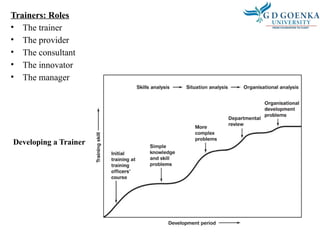
Trainers: Roles
• The trainer
• The provider
• The consultant
• The innovator
• The manager
Developing a Trainer
Identify the Training Needs of Employees:
1. Decide What You Are Trying To Achieve
2. Identify The Knowledge, Skills, And Abilities Needed To Meet Your Objectives
3. Figure Out What Employees Know
4. Talk To Employees
5. Talk To Managers
6. Decide On The Data Points That Are Valuable To Your Team
7. Evaluate Your Current Training Resources
8. Match Your Training To Your Needs
Conducting a Training Needs Assessment
Step 1: Identify the Business Need
Step 2: Perform a Gap Analysis
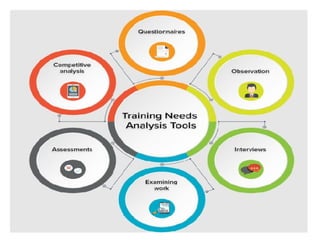
Gap analysis methods. Some gap analysis assessment tools are the following:
• HR records
• Individual interviews.
• Focus groups
• Surveys, questionnaires and self-assessments
• Observations
Step 3: Assess Training Options
• Solution to a problem
• Cost
Number of Employees Trained x Cost of Training = Total Cost of Training
• Return on investment
• Legal compliance
• Time
• Remaining competitive
Step 4: Report Training Needs and Recommend Training Plans
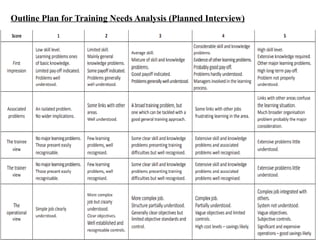
Outline Plan for Training Needs Analysis (Planned Interview)
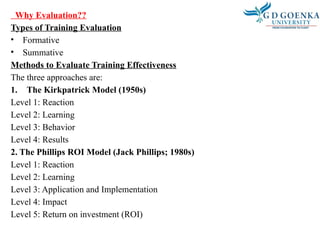
Why Evaluation??
Types of Training Evaluation
• Formative
• Summative
Methods to Evaluate Training Effectiveness
The three approaches are:
1. The Kirkpatrick Model (1950s)
Level 1: Reaction
Level 2: Learning
Level 3: Behavior
Level 4: Results
2. The Phillips ROI Model (Jack Phillips; 1980s)
Level 1: Reaction
Level 2: Learning
Level 3: Application and Implementation
Level 4: Impact
Level 5: Return on investment (ROI)
3. The CIPP Evaluation Model
• Context
• Input
• Process
• Product
The CIPP model aims to link evaluation with the decision-making that goes into
running a training course or program.
• Planning
• Structuring
• Implementing
• Reviewing
• Revising
Using CIPP as formative assessment
To use the four areas of evaluation before the program, these are the types of
questions you’d ask:
• Context: What do we need to do?
• Input: How should we approach training?
• Process: Are we on the right track?
• Product: Does this program have a successful track record?
Using CIPP as summative assessment
CIPP can also be used as a form of summative assessment, to identify what went
right and wrong in a training course or program. Here are some questions you
may ask:
• Context: Did the training address our needs?
• Input: Was the training well designed?
• Process: Did the training stay on the right track? Why? Why not?
• Product: How successful was the program in meeting our goals?

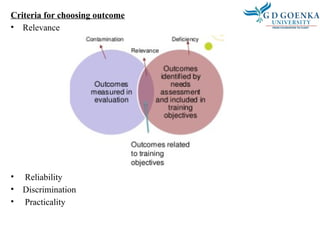
Criteria for choosing outcome
• Relevance
• Reliability
• Discrimination
• Practicality
Types of Evaluation Design
• Post test
• Pre test/post test with comparison group
• Time series
• Solomon four group
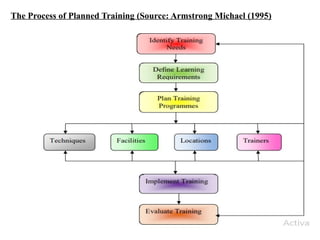
The Process of Planned Training (Source: Armstrong Michael (1995)
Unit_2_Training_in_Process of developmen

Unit_2_Training_in_Process of developmen

  • 1.
  • 2.
    Trainers: Roles • Thetrainer • The provider • The consultant • The innovator • The manager Developing a Trainer
  • 4.
    Identify the TrainingNeeds of Employees: 1. Decide What You Are Trying To Achieve 2. Identify The Knowledge, Skills, And Abilities Needed To Meet Your Objectives 3. Figure Out What Employees Know 4. Talk To Employees 5. Talk To Managers 6. Decide On The Data Points That Are Valuable To Your Team 7. Evaluate Your Current Training Resources 8. Match Your Training To Your Needs
  • 5.
    Conducting a TrainingNeeds Assessment Step 1: Identify the Business Need Step 2: Perform a Gap Analysis Gap analysis methods. Some gap analysis assessment tools are the following: • HR records • Individual interviews. • Focus groups • Surveys, questionnaires and self-assessments • Observations Step 3: Assess Training Options • Solution to a problem • Cost Number of Employees Trained x Cost of Training = Total Cost of Training • Return on investment • Legal compliance • Time • Remaining competitive Step 4: Report Training Needs and Recommend Training Plans
  • 7.
    Outline Plan forTraining Needs Analysis (Planned Interview)
  • 8.
    Why Evaluation?? Types ofTraining Evaluation • Formative • Summative Methods to Evaluate Training Effectiveness The three approaches are: 1. The Kirkpatrick Model (1950s) Level 1: Reaction Level 2: Learning Level 3: Behavior Level 4: Results 2. The Phillips ROI Model (Jack Phillips; 1980s) Level 1: Reaction Level 2: Learning Level 3: Application and Implementation Level 4: Impact Level 5: Return on investment (ROI)
  • 9.
    3. The CIPPEvaluation Model • Context • Input • Process • Product The CIPP model aims to link evaluation with the decision-making that goes into running a training course or program. • Planning • Structuring • Implementing • Reviewing • Revising
  • 10.
    Using CIPP asformative assessment To use the four areas of evaluation before the program, these are the types of questions you’d ask: • Context: What do we need to do? • Input: How should we approach training? • Process: Are we on the right track? • Product: Does this program have a successful track record? Using CIPP as summative assessment CIPP can also be used as a form of summative assessment, to identify what went right and wrong in a training course or program. Here are some questions you may ask: • Context: Did the training address our needs? • Input: Was the training well designed? • Process: Did the training stay on the right track? Why? Why not? • Product: How successful was the program in meeting our goals?
  • 11.
    Criteria for choosingoutcome • Relevance • Reliability • Discrimination • Practicality
  • 12.
    Types of EvaluationDesign • Post test • Pre test/post test with comparison group • Time series • Solomon four group
  • 13.
    The Process ofPlanned Training (Source: Armstrong Michael (1995)