UNIT-II
8086 ASSEMBLY LANGUAGE
PROGRAMMING
BY:
Ms. ZEENATH
DEPT. Of ECE
Contents at a glance:
• 8086 Instruction Set
• Assembler directives
• Procedures and macros.
8086 MEMORY INTERFACING:
• 8086 addressing and address decoding
• Interfacing RAM, ROM, EPROM to 8086
ASSEMBLER DIRECTIVES
• Assembler directives are the commands to the
assembler that direct the assembly process.
• They indicate how an operand is treated by the
assembler and how assembler handles the program.
• They also direct the assembler how program and data
should arrange in the memory.
• ALP’s are composed of two type of statements.
• The instructions which are translated to machine codes
by assembler.
• The directives that direct the assembler during
assembly process, for which no machine code is
generated.
1. ASSUME: Assume logical segment name
Syntax:
ASSUMEsegreg:segname,…segreg:segname
Ex: ASSUME CS:CODE
• ASSUME CS:CODE,DS:DATA,SS:STACK
2.DB: Define Byte
• The DB directive is used to reserve byte or bytes
of memory locations in the available memory.
• Syntax: Name of variable DB initialization value.
Ex: MARKS DB 35H,30H,35H,40H
• NAME DB “VARDHAMAN
3.DW: Define Word
• The DW directive serves the same purposes as
the DB directive, but it now makes the assembler
reserve the number of memory words(16-bit)
instead of bytes.
• Syntax: variable name DW initialization values.
Ex: WORDS DW 1234H,4567H,2367H
• WDATA DW 5 Dup(522h)
(or) Dup(?)
4. DD: Define Double:
• The directive DD is used to define a double
word (4bytes) variable.
• Syntax: variable name DD 12345678H Ex:
Data1 DD 12345678H
5. DQ: Define Quad Word
• This directive is used to direct the assembler
to reserve 4 words (8 bytes) of memory for
the specified variable and may initialize it with
the specified values.
• Syntax: Name of variable DQ initialize values.
Ex: Data1 DQ 123456789ABCDEF2H
6.DT: Define Ten Bytes
• The DT directive directs the assembler to
define the specified variable requiring 10
bytes for its storage and initialize the 10-bytes
with the specified values.
• Syntax: Name of variable DT initialize values.
Ex: Data1 DT 123456789ABCDEF34567H
7. END: End of Program
• The END directive marks the end of an ALP.
The statement after the directive END will be
ignored by the assembler.
8. ENDP: End of Procedure
• The ENDP directive is used to indicate the end of
procedure. In the AL programming the
subroutines are called procedures.
• Ex: Procedure Start
:
Start ENDP
9. ENDS: End of segment
• The ENDS directive is used to indicate the end
of segment. Ex: DATA SEGMENT
:
DATA ENDS
10. EVEN: Align on Even memory address
The EVEN directives updates the location counter to
the next even address. Ex: EVEN
Procedure Start
:
Start ENDP
– The above structure shows a procedure START that is
to be aligned at an even address.
11. EQU: Equate
• The directive EQU is used to assign a label
with a value or symbol. Ex: LABEL EQU 0500H
• ADDITION EQU ADD
12. EXTRN: External and public
• The directive EXTRN informs the assembler that the
names, procedures and labels declared after this
directive have been already defined in some other AL
modules.
• While in other module, where names, procedures and
labels actually appear, they must be declared public
using the PUBLIC directive.
• Ex: MODULE1 SEGMENT PUBLIC FACT FAR MODULE1
ENDS MODULE2 SEGMENT EXTRN FACT FAR MODULE2
END
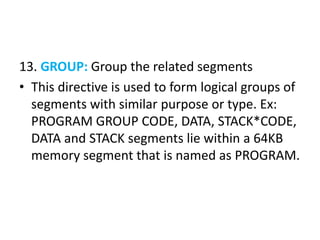
13. GROUP: Group the related segments
• This directive is used to form logical groups of
segments with similar purpose or type. Ex:
PROGRAM GROUP CODE, DATA, STACK*CODE,
DATA and STACK segments lie within a 64KB
memory segment that is named as PROGRAM.
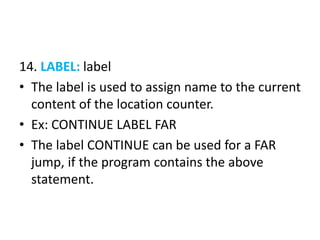
14. LABEL: label
• The label is used to assign name to the current
content of the location counter.
• Ex: CONTINUE LABEL FAR
• The label CONTINUE can be used for a FAR
jump, if the program contains the above
statement.
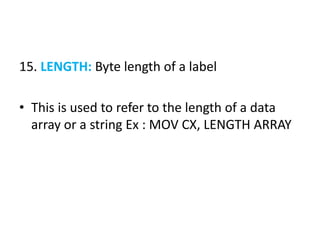
15. LENGTH: Byte length of a label
• This is used to refer to the length of a data
array or a string Ex : MOV CX, LENGTH ARRAY
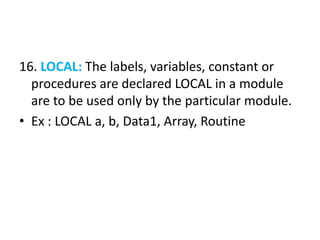
16. LOCAL: The labels, variables, constant or
procedures are declared LOCAL in a module
are to be used only by the particular module.
• Ex : LOCAL a, b, Data1, Array, Routine
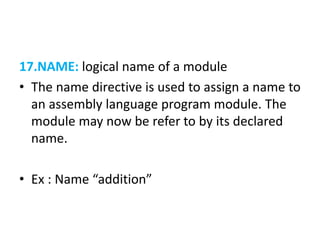
17.NAME: logical name of a module
• The name directive is used to assign a name to
an assembly language program module. The
module may now be refer to by its declared
name.
• Ex : Name “addition”
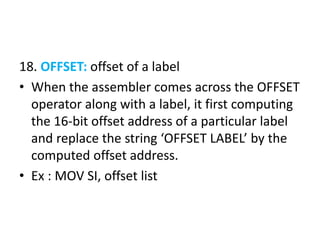
18. OFFSET: offset of a label
• When the assembler comes across the OFFSET
operator along with a label, it first computing
the 16-bit offset address of a particular label
and replace the string ‘OFFSET LABEL’ by the
computed offset address.
• Ex : MOV SI, offset list
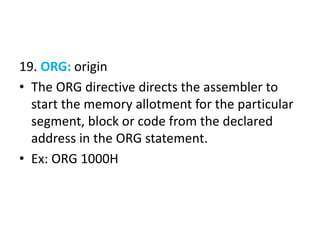
19. ORG: origin
• The ORG directive directs the assembler to
start the memory allotment for the particular
segment, block or code from the declared
address in the ORG statement.
• Ex: ORG 1000H
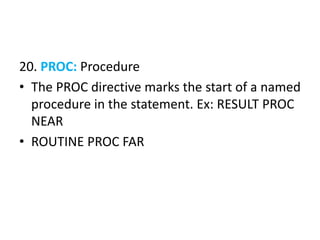
20. PROC: Procedure
• The PROC directive marks the start of a named
procedure in the statement. Ex: RESULT PROC
NEAR
• ROUTINE PROC FAR
21. PTR: pointer
• The PTR operator is used to declare the type
of a label, variable or memory operator.
• Ex : MOV AL, BYTE PTR [SI] MOV BX, WORD
PTR [2000H]
22. SEG: segment of a label
• The SEG operator is used to decide the
segment address of the label, variable or
procedure.
• Ex : MOV AX, SEG ARRAY MOV DS, AX
23. SEGMENT: logical segment
The segment directive marks the starting of a
logical segment
• Ex: CODE SEGMENT: CODE ENDS
24.SHORT: The SHORT operator indicates to the
assembler that only one byte is required to
code the displacement for jump.
• Ex : JMP SHORT LABEL
25. TYPE: The TYPE operator directs the
assembler to decide the data type of the
specified label and replaces the TYPE label by
the decided data type.
• For word variable, the data type is 2.
• For double word variable, the data type is 4.
For byte variable, the data type is 1.
• Ex : STRING DW 2345H, 4567H MOV AX, TYPE
STRING AX=0002H
26. GLOBAL: The labels, variables, constants or
procedures declared GLOBAL may be used by
other modules of the program.
• Ex : ROUTINE PROC GLOBAL.
27. FAR PTR: This directive indicates the assembler
that the label following FAR PTR is not available
within the same segment and the address of the
label is of 32-bits i.e 2-bytes of offset followed by
2-bytes of segment address.
• Ex : JMP FAR PTR LABEL
• 28. NEAR PTR: This directive indicates that the
label following NEAR PTR is in the same
segment and needs only 16-bit
• i.e 2-byte offset to address it Ex : JMP NEAR
PTR LABEL CALL NEAR PTR ROUTINE

unit-2.pptx

  • 1.
  • 2.
    Contents at aglance: • 8086 Instruction Set • Assembler directives • Procedures and macros. 8086 MEMORY INTERFACING: • 8086 addressing and address decoding • Interfacing RAM, ROM, EPROM to 8086
  • 3.
    ASSEMBLER DIRECTIVES • Assemblerdirectives are the commands to the assembler that direct the assembly process. • They indicate how an operand is treated by the assembler and how assembler handles the program. • They also direct the assembler how program and data should arrange in the memory. • ALP’s are composed of two type of statements. • The instructions which are translated to machine codes by assembler. • The directives that direct the assembler during assembly process, for which no machine code is generated.
  • 4.
    1. ASSUME: Assumelogical segment name Syntax: ASSUMEsegreg:segname,…segreg:segname Ex: ASSUME CS:CODE • ASSUME CS:CODE,DS:DATA,SS:STACK
  • 5.
    2.DB: Define Byte •The DB directive is used to reserve byte or bytes of memory locations in the available memory. • Syntax: Name of variable DB initialization value. Ex: MARKS DB 35H,30H,35H,40H • NAME DB “VARDHAMAN
  • 6.
    3.DW: Define Word •The DW directive serves the same purposes as the DB directive, but it now makes the assembler reserve the number of memory words(16-bit) instead of bytes. • Syntax: variable name DW initialization values. Ex: WORDS DW 1234H,4567H,2367H • WDATA DW 5 Dup(522h) (or) Dup(?)
  • 7.
    4. DD: DefineDouble: • The directive DD is used to define a double word (4bytes) variable. • Syntax: variable name DD 12345678H Ex: Data1 DD 12345678H
  • 8.
    5. DQ: DefineQuad Word • This directive is used to direct the assembler to reserve 4 words (8 bytes) of memory for the specified variable and may initialize it with the specified values. • Syntax: Name of variable DQ initialize values. Ex: Data1 DQ 123456789ABCDEF2H
  • 9.
    6.DT: Define TenBytes • The DT directive directs the assembler to define the specified variable requiring 10 bytes for its storage and initialize the 10-bytes with the specified values. • Syntax: Name of variable DT initialize values. Ex: Data1 DT 123456789ABCDEF34567H
  • 10.
    7. END: Endof Program • The END directive marks the end of an ALP. The statement after the directive END will be ignored by the assembler.
  • 11.
    8. ENDP: Endof Procedure • The ENDP directive is used to indicate the end of procedure. In the AL programming the subroutines are called procedures. • Ex: Procedure Start : Start ENDP
  • 12.
    9. ENDS: Endof segment • The ENDS directive is used to indicate the end of segment. Ex: DATA SEGMENT : DATA ENDS
  • 13.
    10. EVEN: Alignon Even memory address The EVEN directives updates the location counter to the next even address. Ex: EVEN Procedure Start : Start ENDP – The above structure shows a procedure START that is to be aligned at an even address.
  • 14.
    11. EQU: Equate •The directive EQU is used to assign a label with a value or symbol. Ex: LABEL EQU 0500H • ADDITION EQU ADD
  • 15.
    12. EXTRN: Externaland public • The directive EXTRN informs the assembler that the names, procedures and labels declared after this directive have been already defined in some other AL modules. • While in other module, where names, procedures and labels actually appear, they must be declared public using the PUBLIC directive. • Ex: MODULE1 SEGMENT PUBLIC FACT FAR MODULE1 ENDS MODULE2 SEGMENT EXTRN FACT FAR MODULE2 END
  • 16.
    13. GROUP: Groupthe related segments • This directive is used to form logical groups of segments with similar purpose or type. Ex: PROGRAM GROUP CODE, DATA, STACK*CODE, DATA and STACK segments lie within a 64KB memory segment that is named as PROGRAM.
  • 17.
    14. LABEL: label •The label is used to assign name to the current content of the location counter. • Ex: CONTINUE LABEL FAR • The label CONTINUE can be used for a FAR jump, if the program contains the above statement.
  • 18.
    15. LENGTH: Bytelength of a label • This is used to refer to the length of a data array or a string Ex : MOV CX, LENGTH ARRAY
  • 19.
    16. LOCAL: Thelabels, variables, constant or procedures are declared LOCAL in a module are to be used only by the particular module. • Ex : LOCAL a, b, Data1, Array, Routine
  • 20.
    17.NAME: logical nameof a module • The name directive is used to assign a name to an assembly language program module. The module may now be refer to by its declared name. • Ex : Name “addition”
  • 21.
    18. OFFSET: offsetof a label • When the assembler comes across the OFFSET operator along with a label, it first computing the 16-bit offset address of a particular label and replace the string ‘OFFSET LABEL’ by the computed offset address. • Ex : MOV SI, offset list
  • 22.
    19. ORG: origin •The ORG directive directs the assembler to start the memory allotment for the particular segment, block or code from the declared address in the ORG statement. • Ex: ORG 1000H
  • 23.
    20. PROC: Procedure •The PROC directive marks the start of a named procedure in the statement. Ex: RESULT PROC NEAR • ROUTINE PROC FAR
  • 24.
    21. PTR: pointer •The PTR operator is used to declare the type of a label, variable or memory operator. • Ex : MOV AL, BYTE PTR [SI] MOV BX, WORD PTR [2000H]
  • 25.
    22. SEG: segmentof a label • The SEG operator is used to decide the segment address of the label, variable or procedure. • Ex : MOV AX, SEG ARRAY MOV DS, AX
  • 26.
    23. SEGMENT: logicalsegment The segment directive marks the starting of a logical segment • Ex: CODE SEGMENT: CODE ENDS 24.SHORT: The SHORT operator indicates to the assembler that only one byte is required to code the displacement for jump. • Ex : JMP SHORT LABEL
  • 27.
    25. TYPE: TheTYPE operator directs the assembler to decide the data type of the specified label and replaces the TYPE label by the decided data type. • For word variable, the data type is 2. • For double word variable, the data type is 4. For byte variable, the data type is 1. • Ex : STRING DW 2345H, 4567H MOV AX, TYPE STRING AX=0002H
  • 28.
    26. GLOBAL: Thelabels, variables, constants or procedures declared GLOBAL may be used by other modules of the program. • Ex : ROUTINE PROC GLOBAL. 27. FAR PTR: This directive indicates the assembler that the label following FAR PTR is not available within the same segment and the address of the label is of 32-bits i.e 2-bytes of offset followed by 2-bytes of segment address. • Ex : JMP FAR PTR LABEL
  • 29.
    • 28. NEARPTR: This directive indicates that the label following NEAR PTR is in the same segment and needs only 16-bit • i.e 2-byte offset to address it Ex : JMP NEAR PTR LABEL CALL NEAR PTR ROUTINE