Prepared by
Dr.S.Chandramouli
Assistant Professor
Department of Commerce
SRMIST, Ramapuram
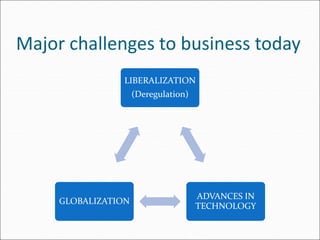
Major challenges to business today
LIBERALIZATION
(Deregulation)
ADVANCES IN
TECHNOLOGY
GLOBALIZATION
What is a market?
“A market consists of all the potential
customers sharing a particular need or want
who might be willing and able to engage in
exchange to satisfy that need or want”
Need, product, demographic, geographic
What is Marketing?
Identifying and satisfying human needs
Meeting ‘needs’ profitably
Examples??
Needs Wants Demands
What is Marketed?
1. Goods
2. Services
3. Events
4. Experiences
5. Persons
6. Places
7. Properties
8. Organizations
9. Information
10. Ideas
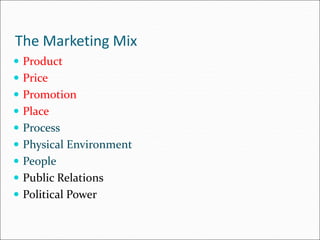
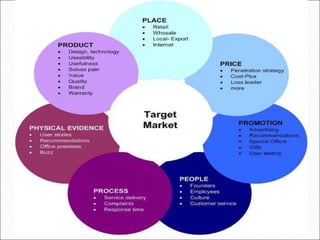
The Marketing Mix
 Product
 Price
 Promotion
 Place
 Process
 Physical Environment
 People
 Public Relations
 Political Power
Target Market, Positioning and
Segmenting….
As far as Customers are concerned there are three
elements to address-
 Customer value: Difference between the
values that the customer gains from
owning and using a product versus the
costs of obtaining the product.
• Customer satisfaction: The extent to
which a product’s perceived performance in
delivering value matches a buyer’s
expectations.
• Quality: the characteristics of a product or
service that bear on its ability to satisfy
stated or implied customer needs.
Marketing Management Philosophies
Agree or Disagree?
1. Production: consumers will favor products that are
available and highly affordable
2. Product: consumers favor products that offer the most
in quality, performance, and innovative features
3. Selling: consumers will not buy unless an organization
undertakes a large-scale selling and promotional effort
4. Marketing: determining the needs and wants of target
markets and delivering the desired satisfactions more
effectively and efficiently then the competitors
5. Societal marketing: generating customer
satisfaction and long-run societal well-being are the keys
to both achieving the company’s goals and fulfilling its
responsibilities
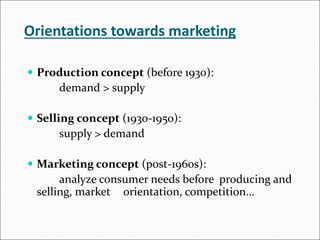
Orientations towards marketing
 Production concept (before 1930):
demand > supply
 Selling concept (1930-1950):
supply > demand
 Marketing concept (post-1960s):
analyze consumer needs before producing and
selling, market orientation, competition…
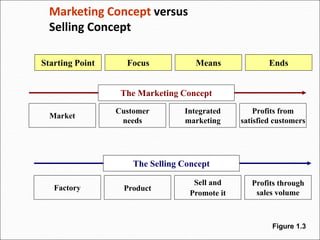
Marketing Concept versus
Selling Concept
Starting Point Focus Means Ends
Factory Product
Sell and
Promote it
Profits through
sales volume
The Selling Concept
Market
Customer
needs
Integrated
marketing
Profits from
satisfied customers
The Marketing Concept
Figure 1.3
Relationships
• Relationship marketing: the process of creating,
maintaining, and enhancing strong, value-laden relationships
with customers and other stakeholders.
Marketing Management Practice
Essentially Two Types
 Entrepreneurial marketing:
 Businesses started by individuals
 Creativity, drive, and perseverance are keys to
success
• Formulated marketing:
– Professional, disciplined approach
– Achieving a market orientation
Marketing Management
 What is marketing management?
« Marketing management is the process of planning
and executing the conception, pricing, promotion,
and distribution of ideas, goods, and services to
create exchanges that satisfy individual and
organizational goals » (Philip Kotler)
Marketing management has the task of influencing
the level, timing, and composition of demand in a
way that will help the organization achieve its
objectives.
Common marketing problems
 How can we identify and choose profitable market
segments?
 How can differentiate our offer from our competition?
 How should we react to competitors?
 How can we satisfy our customers and build brand
loyalty?
 How can we measure the effectiveness of an add
campaign, of Public Relations, of a promotion, etc…?
What is International Marketing?
“The performance of business activities designed to
plan, price, promote and direct the flow of company’s
goods and services to consumers or users in more than
one nation for a profit”- Philip R Cateora
 At the simplest level: Management process involving
the decision making of one or more marketing mix,
across national boundaries.
 At its most complex level: Involves establishment of
the forms manufacturing/processing facilities around
the world and coordinating marketing strategies
across the globe.
Levels of Marketing:
 Domestic
 International
 Global
Type of International Marketing:
 Export
 International
 Global
Environmental influences on IM
 Socio-cultural: Language/Religion/Social /Aesthetics
 Legal: Local/International/Home
 Economic:
Developed/Emerging/Underdeveloped/Currency
/Economic Cycles
 Political: Discriminatory/physical/Operational
restrictions
 Technological: Satellite commn, ISDN, WWW,Internet
 Sustainability:
Difference between International and
Domestic Marketing:….(contd)
7. Finance: many differing finance systems and
regulatory bodies
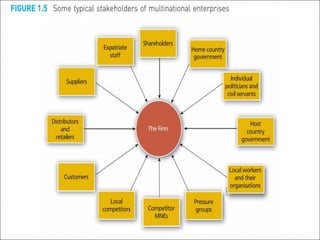
8. Stake holders: Commercial, home and host country
9. Business: Diverse rules, Culturally influenced
10. Control: Difficult to control and coordinate across
markets
Difference between International
and Domestic Marketing:
1. Culture: Often Diverse and Multicultural markets
2. Markets: widespread and fragmented
3. Data: difficult to obtain and often expensive
4. Politics: Stability and regime changes
5. Governments: laws and legislations
6. Economies: Varying level of development, currencies
and exchange rates
Cross cultural management
incompetencies: By Perlmutter
 Inability to find the right market niche
 Unwillingness to adapt
 Not having unique value added image in local market
products
 A vacillating commitment
 Assigning the wrong people
Cross cultural management incompetencies:
By Perlmutter… (contd)
 Picking the wrong partners/alliances
 Inability to manage local stakeholders: unions & Govt
 Developing mutual distrust and Lack of Respect
between HQ and the affiliates at different levels of the
management.
Case : How to sell Irrigation system?
 ABC International is a non-profit organization that sells
irrigation systems to subsistence farmers in Africa. The
customers are hard to reach. They live hours away from
major cities and many are illiterate. Even though, it is a
non-profit organization, ABC needs to build Brand Loyalty
which is difficult to build in a market where there is a lack
of trust in a foreign US Company. The other level of
Dilemma is given the level of illiteracy, how do they
educate the farmers to use equipment, and how do ABC get
its message across given a small budget they have for such
activities?
 How should ABC approach this market?
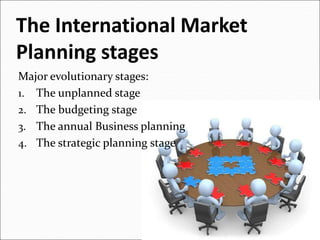
The International Market
Planning stages
Major evolutionary stages:
1. The unplanned stage
2. The budgeting stage
3. The annual Business planning
4. The strategic planning stage
The International Market
Planning process
 Understanding Stakeholders expecations
 Situational analysis
 Resources and capabilities (SWOT analysis-
Knowledge Management)
 Corporate aims and objectives
 Marketing strategies
 Implementation of the plan
 Control and feedback
Essential elements of the
International marketing plan
 Does the plan contain:
International analysis
 Assumption about the world economy and the
environment trends in the principle market?
 Details of historical performances( sales cost,
profitability)
 Forecast of future performance
 Identified opportunities and threats
Essential elements of the
International marketing plan
Company capability assessment
 Analysis of company strengths, weaknesses and future
capabilities in comparison with local and international
competition
International mission statement with:
 Long term aims and objectives to achieve them
 One yr marketing objective and individual strategies
Essential elements of the
International marketing plan
Operational plans
 Detailed country by country forecasts and targets
 Detailed country by country plans for all marketing
activities and coordinating with other functions like
manufacturing
 Detailed country by country plan on integration:
regionally and globally, if appropriate
Essential elements of the
International marketing plan
 Contingencies and control
 A summary of the critical factors for success
 An assessement of the likely competitor response
 A contingency component for when things do not go to
plan
 A control process for the feedback, evaluation and
taking corrective action.
International Trade Initiatives
 WTO-World Trade Organization (for need of
liberalization of international trade and tariff)
 IBRD- International Bank for Reconstruction and
development( for need of International Capital)
 IMF- International Monetary Fund( for need of
international liquidity)
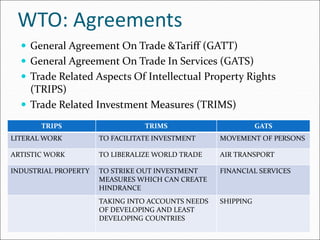
WTO: Agreements
 General Agreement On Trade &Tariff (GATT)
 General Agreement On Trade In Services (GATS)
 Trade Related Aspects Of Intellectual Property Rights
(TRIPS)
 Trade Related Investment Measures (TRIMS)
TRIPS TRIMS GATS
LITERAL WORK TO FACILITATE INVESTMENT MOVEMENT OF PERSONS
ARTISTIC WORK TO LIBERALIZE WORLD TRADE AIR TRANSPORT
INDUSTRIAL PROPERTY TO STRIKE OUT INVESTMENT
MEASURES WHICH CAN CREATE
HINDRANCE
FINANCIAL SERVICES
TAKING INTO ACCOUNTS NEEDS
OF DEVELOPING AND LEAST
DEVELOPING COUNTRIES
SHIPPING
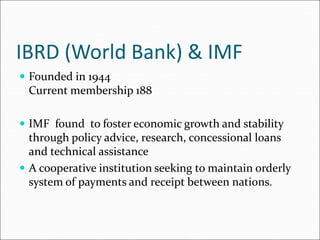
IBRD (World Bank) & IMF
 Founded in 1944
Current membership 188
 IMF found to foster economic growth and stability
through policy advice, research, concessional loans
and technical assistance
 A cooperative institution seeking to maintain orderly
system of payments and receipt between nations.
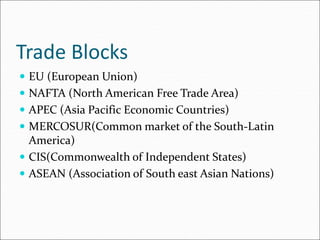
Trade Blocks
 EU (European Union)
 NAFTA (North American Free Trade Area)
 APEC (Asia Pacific Economic Countries)
 MERCOSUR(Common market of the South-Latin
America)
 CIS(Commonwealth of Independent States)
 ASEAN (Association of South east Asian Nations)

unit-1 international marketing.ppt

  • 1.
  • 2.
    Major challenges tobusiness today LIBERALIZATION (Deregulation) ADVANCES IN TECHNOLOGY GLOBALIZATION
  • 3.
    What is amarket? “A market consists of all the potential customers sharing a particular need or want who might be willing and able to engage in exchange to satisfy that need or want” Need, product, demographic, geographic What is Marketing? Identifying and satisfying human needs Meeting ‘needs’ profitably Examples?? Needs Wants Demands
  • 4.
    What is Marketed? 1.Goods 2. Services 3. Events 4. Experiences 5. Persons 6. Places 7. Properties 8. Organizations 9. Information 10. Ideas
  • 5.
    The Marketing Mix Product  Price  Promotion  Place  Process  Physical Environment  People  Public Relations  Political Power
  • 7.
    Target Market, Positioningand Segmenting….
  • 8.
    As far asCustomers are concerned there are three elements to address-  Customer value: Difference between the values that the customer gains from owning and using a product versus the costs of obtaining the product. • Customer satisfaction: The extent to which a product’s perceived performance in delivering value matches a buyer’s expectations. • Quality: the characteristics of a product or service that bear on its ability to satisfy stated or implied customer needs.
  • 9.
    Marketing Management Philosophies Agreeor Disagree? 1. Production: consumers will favor products that are available and highly affordable 2. Product: consumers favor products that offer the most in quality, performance, and innovative features 3. Selling: consumers will not buy unless an organization undertakes a large-scale selling and promotional effort 4. Marketing: determining the needs and wants of target markets and delivering the desired satisfactions more effectively and efficiently then the competitors 5. Societal marketing: generating customer satisfaction and long-run societal well-being are the keys to both achieving the company’s goals and fulfilling its responsibilities
  • 10.
    Orientations towards marketing Production concept (before 1930): demand > supply  Selling concept (1930-1950): supply > demand  Marketing concept (post-1960s): analyze consumer needs before producing and selling, market orientation, competition…
  • 11.
    Marketing Concept versus SellingConcept Starting Point Focus Means Ends Factory Product Sell and Promote it Profits through sales volume The Selling Concept Market Customer needs Integrated marketing Profits from satisfied customers The Marketing Concept Figure 1.3
  • 12.
    Relationships • Relationship marketing:the process of creating, maintaining, and enhancing strong, value-laden relationships with customers and other stakeholders.
  • 13.
    Marketing Management Practice EssentiallyTwo Types  Entrepreneurial marketing:  Businesses started by individuals  Creativity, drive, and perseverance are keys to success • Formulated marketing: – Professional, disciplined approach – Achieving a market orientation
  • 14.
    Marketing Management  Whatis marketing management? « Marketing management is the process of planning and executing the conception, pricing, promotion, and distribution of ideas, goods, and services to create exchanges that satisfy individual and organizational goals » (Philip Kotler) Marketing management has the task of influencing the level, timing, and composition of demand in a way that will help the organization achieve its objectives.
  • 15.
    Common marketing problems How can we identify and choose profitable market segments?  How can differentiate our offer from our competition?  How should we react to competitors?  How can we satisfy our customers and build brand loyalty?  How can we measure the effectiveness of an add campaign, of Public Relations, of a promotion, etc…?
  • 16.
    What is InternationalMarketing? “The performance of business activities designed to plan, price, promote and direct the flow of company’s goods and services to consumers or users in more than one nation for a profit”- Philip R Cateora  At the simplest level: Management process involving the decision making of one or more marketing mix, across national boundaries.  At its most complex level: Involves establishment of the forms manufacturing/processing facilities around the world and coordinating marketing strategies across the globe.
  • 17.
    Levels of Marketing: Domestic  International  Global
  • 18.
    Type of InternationalMarketing:  Export  International  Global
  • 19.
    Environmental influences onIM  Socio-cultural: Language/Religion/Social /Aesthetics  Legal: Local/International/Home  Economic: Developed/Emerging/Underdeveloped/Currency /Economic Cycles  Political: Discriminatory/physical/Operational restrictions  Technological: Satellite commn, ISDN, WWW,Internet  Sustainability:
  • 20.
    Difference between Internationaland Domestic Marketing:….(contd) 7. Finance: many differing finance systems and regulatory bodies 8. Stake holders: Commercial, home and host country 9. Business: Diverse rules, Culturally influenced 10. Control: Difficult to control and coordinate across markets
  • 21.
    Difference between International andDomestic Marketing: 1. Culture: Often Diverse and Multicultural markets 2. Markets: widespread and fragmented 3. Data: difficult to obtain and often expensive 4. Politics: Stability and regime changes 5. Governments: laws and legislations 6. Economies: Varying level of development, currencies and exchange rates
  • 22.
    Cross cultural management incompetencies:By Perlmutter  Inability to find the right market niche  Unwillingness to adapt  Not having unique value added image in local market products  A vacillating commitment  Assigning the wrong people
  • 23.
    Cross cultural managementincompetencies: By Perlmutter… (contd)  Picking the wrong partners/alliances  Inability to manage local stakeholders: unions & Govt  Developing mutual distrust and Lack of Respect between HQ and the affiliates at different levels of the management.
  • 24.
    Case : Howto sell Irrigation system?  ABC International is a non-profit organization that sells irrigation systems to subsistence farmers in Africa. The customers are hard to reach. They live hours away from major cities and many are illiterate. Even though, it is a non-profit organization, ABC needs to build Brand Loyalty which is difficult to build in a market where there is a lack of trust in a foreign US Company. The other level of Dilemma is given the level of illiteracy, how do they educate the farmers to use equipment, and how do ABC get its message across given a small budget they have for such activities?  How should ABC approach this market?
  • 25.
    The International Market Planningstages Major evolutionary stages: 1. The unplanned stage 2. The budgeting stage 3. The annual Business planning 4. The strategic planning stage
  • 26.
    The International Market Planningprocess  Understanding Stakeholders expecations  Situational analysis  Resources and capabilities (SWOT analysis- Knowledge Management)  Corporate aims and objectives  Marketing strategies  Implementation of the plan  Control and feedback
  • 29.
    Essential elements ofthe International marketing plan  Does the plan contain: International analysis  Assumption about the world economy and the environment trends in the principle market?  Details of historical performances( sales cost, profitability)  Forecast of future performance  Identified opportunities and threats
  • 30.
    Essential elements ofthe International marketing plan Company capability assessment  Analysis of company strengths, weaknesses and future capabilities in comparison with local and international competition International mission statement with:  Long term aims and objectives to achieve them  One yr marketing objective and individual strategies
  • 31.
    Essential elements ofthe International marketing plan Operational plans  Detailed country by country forecasts and targets  Detailed country by country plans for all marketing activities and coordinating with other functions like manufacturing  Detailed country by country plan on integration: regionally and globally, if appropriate
  • 32.
    Essential elements ofthe International marketing plan  Contingencies and control  A summary of the critical factors for success  An assessement of the likely competitor response  A contingency component for when things do not go to plan  A control process for the feedback, evaluation and taking corrective action.
  • 33.
    International Trade Initiatives WTO-World Trade Organization (for need of liberalization of international trade and tariff)  IBRD- International Bank for Reconstruction and development( for need of International Capital)  IMF- International Monetary Fund( for need of international liquidity)
  • 34.
    WTO: Agreements  GeneralAgreement On Trade &Tariff (GATT)  General Agreement On Trade In Services (GATS)  Trade Related Aspects Of Intellectual Property Rights (TRIPS)  Trade Related Investment Measures (TRIMS) TRIPS TRIMS GATS LITERAL WORK TO FACILITATE INVESTMENT MOVEMENT OF PERSONS ARTISTIC WORK TO LIBERALIZE WORLD TRADE AIR TRANSPORT INDUSTRIAL PROPERTY TO STRIKE OUT INVESTMENT MEASURES WHICH CAN CREATE HINDRANCE FINANCIAL SERVICES TAKING INTO ACCOUNTS NEEDS OF DEVELOPING AND LEAST DEVELOPING COUNTRIES SHIPPING
  • 35.
    IBRD (World Bank)& IMF  Founded in 1944 Current membership 188  IMF found to foster economic growth and stability through policy advice, research, concessional loans and technical assistance  A cooperative institution seeking to maintain orderly system of payments and receipt between nations.
  • 36.
    Trade Blocks  EU(European Union)  NAFTA (North American Free Trade Area)  APEC (Asia Pacific Economic Countries)  MERCOSUR(Common market of the South-Latin America)  CIS(Commonwealth of Independent States)  ASEAN (Association of South east Asian Nations)