AIRPORT OPERATIONS
UNIT-1
GREENFIELD AIRPORT
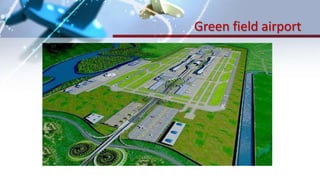
A greenfield airport is an aviation facility with greenfield project
characteristics. The designation reflects certain environmental
qualities (using previously undeveloped or empty greenfield
land, for example) and commissioning, planning and
construction processes that are generally carried out from
scratch. While a green field in nature is defined as a wide
expanse of natural land (meadow, prairie, grassland), here
greenfield denotes that a project lacks any constraints imposed
upon it by prior work or existing infrastructure
Green field airport
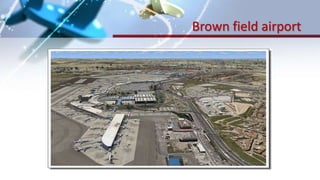
Brown field airport
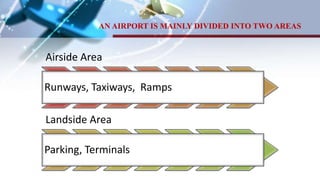
AN AIRPORT IS MAINLY DIVIDED INTO TWO AREAS
Airside Area
Runways, Taxiways, Ramps
Landside Area
Parking, Terminals
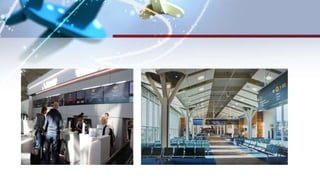
AIRPORT TERMINALAND PASSENGER TERMINAL
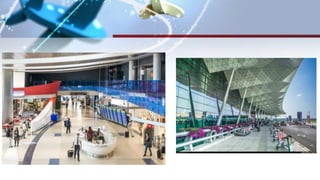
• An airport terminal is a building at an airport where passengers
transfer between ground transportation and the facilities that allow
them to board and disembark from an aircraft.
• Within the terminal, passengers purchase tickets, transfer their
luggage, and go through security. The buildings that provide access
to the airplanes (via gates) are typically called concourses.
However, the terms "terminal" and "concourse" are sometimes used
interchangeably, depending on the configuration of the airport.
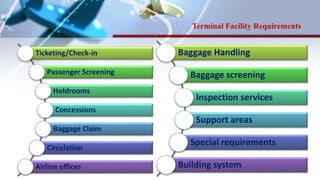
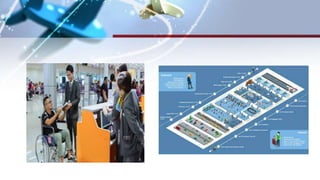
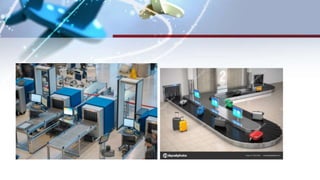
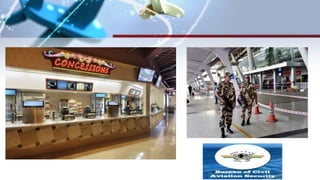
Terminal Facility Requirements
Ticketing/Check-in
Passenger Screening
Holdrooms
Concessions
Baggage Claim
Circulation
Airline offices
Baggage Handling
Baggage screening
Inspection services
Support areas
Special requirements
Building system
An air operator's certificate (AOC) is the approval
granted by a civil aviation authority (CAA) to
an aircraft operator to allow it to use aircraft for commercial
purposes. This requires the operator to have personnel,
assets, and system in place to ensure the safety of its
employees, and the general public. The certificate will list
the aircraft types, and registrations to be used, for what
purpose and in what area – specific airports or geographic
region.
AIR OPERATOR CERTIFICATE
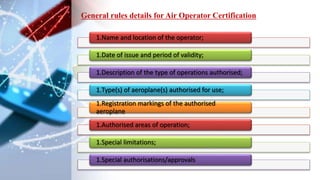
1.Name and location of the operator;
1.Date of issue and period of validity;
1.Description of the type of operations authorised;
1.Type(s) of aeroplane(s) authorised for use;
1.Registration markings of the authorised
aeroplane
1.Authorised areas of operation;
1.Special limitations;
1.Special authorisations/approvals
General rules details for Air Operator Certification
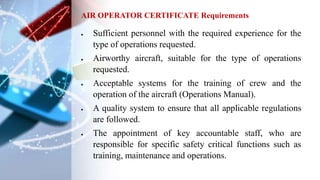
 Sufficient personnel with the required experience for the
type of operations requested.
 Airworthy aircraft, suitable for the type of operations
requested.
 Acceptable systems for the training of crew and the
operation of the aircraft (Operations Manual).
 A quality system to ensure that all applicable regulations
are followed.
 The appointment of key accountable staff, who are
responsible for specific safety critical functions such as
training, maintenance and operations.
AIR OPERATOR CERTIFICATE Requirements
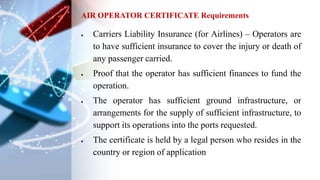
 Carriers Liability Insurance (for Airlines) – Operators are
to have sufficient insurance to cover the injury or death of
any passenger carried.
 Proof that the operator has sufficient finances to fund the
operation.
 The operator has sufficient ground infrastructure, or
arrangements for the supply of sufficient infrastructure, to
support its operations into the ports requested.
 The certificate is held by a legal person who resides in the
country or region of application
AIR OPERATOR CERTIFICATE Requirements
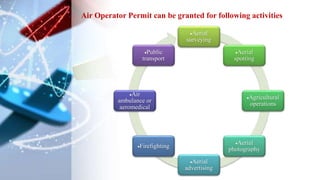
Aerial
surveying
Aerial
spotting
Agricultural
operations
Aerial
photography
Aerial
advertising
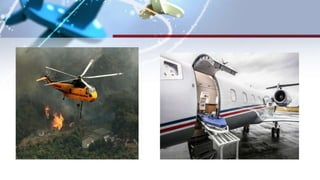
Firefighting
Air
ambulance or
aeromedical
Public
transport
Air Operator Permit can be granted for following activities
What are airport charges?
Airport charges are paid by airlines for the use of airport facilities. They include
aircraft landing, freight and other charges related to the use of airport infrastructure
such as runways and passenger terminals. Ultimately these charges are paid,
indirectly, by passengers and freight customers via the ticket price or freight
forwarding fee.
Charges are applied in different ways, depending on the service they cover.
Passenger charges are levied per passenger whilst other charges are applied per
aircraft landing or take-off.
AIRPORT CHARGES
Why is Europe involved?
Charges for the use of airport infrastructure can represent a significant expense for
airlines. In the European single market, there is no justification for airport charges to be
applied in a discriminatory manner, to the detriment or advantage of certain carriers. For
the European aviation market to work properly it is important that there be minimum
standards for charges at larger airports in order to ensure fair competition among
airlines. Such common standards, however, need to respect the different systems of
regulation which are in operation in the Member States and which might be designed to
compensate for the market power of the airport as the sole infrastructure provider at a
given city or in a given region.
AIRPORT CHARGES
Greater transparency
Non-discrimination
Consultation on charges between airports and
airlines
To help settle disputes over charges between
airports and airlines
AIRPORT CHARGES
• Emergency Hospital Facilities
• Providing Porterage Services and assistance with baggage
• Providing assistance for arranging transport, hotel/motel/guest house booking
• Baggage wrapping service using state of the art technology is available in the city
side as well as the check in area of International Terminals.
• The self-check-in facility available in the Terminals. You can select seats and
print your boarding pass using this facility.
AIRPORT FACILITY
• Free Wi-Fi facility is available for passengers at Domestic & International Terminal.
To connect to free wi-fi service, passengers should provide their mobile numbers as
login id’s. Once connected, this service enables the passengers to access the net.
• Passenger can place a request to concerned airline for a wheelchair while booking
tickets or can also contact the airline ticketing counter after reaching the airport for
the same
• Prayer room is available in the Security Hold Area at International Terminal for the
convenience of passengers.
• Both passengers & visitors can avail the facility of postal service at the Airport.
Counter is conveniently located at Domestic Departure level
AIRPORT FACILITY
• INTER TERMINAL TRANSFERS Free battery-operated vehicles and courtesy coaches
offering shuttle service for the convenience of transit passengers between Domestic &
International terminals.
• Child care rooms are available at Terminals for providing essentials to the child/infant
such as, feeding, changing of diapers etc.
• Passengers and tourists can avail currency exchange services with 2 foreign exchange
counters in Domestic Terminal and 5 counters in International Terminal.
• Automated Teller Machine (ATM) of various banks are conveniently located at
Domestic & International Terminals to extend selected banking services for travel
need.
AIRPORT FACILITY
• Lounges at multiple locations in the Domestic & International Departures of
Chennai Airport offers world class amenities including best of cuisines, plush
seating, complimentary Wi-Fi, wide range of National, International & Regional
dailies along with various magazines. Serving round the clock the lounges cater to
Airline CIP customers as well as passengers availing access through Priority Pass,
high-end credit cards and other loyalty cards.
AIRPORT FACILITY
• The words "hub" and "spoke" create a pretty vivid
image of how this system works. A hub is a central
airport that flights are routed through,
and spokes are the routes that planes take out of the
hub airport. Most major airlines have multiple
hubs. They claim that hubs allow them to offer
more flights for passengers.
• Today, most airlines have at least one
central airport that their flights have to go through.
From that hub, the spoke flights take passengers to
select destinations.
HUB AND SPOKE SYSTEM
• The main overarching ICAO policy on aircraft noise is
the Balanced Approach to Aircraft Noise Management,
adopted by the ICAO Assembly in its 33rd Session (2001) and
reaffirmed in all the subsequent Assembly Sessions
(reference: ICAO Resolution A39-1 Appendix C).
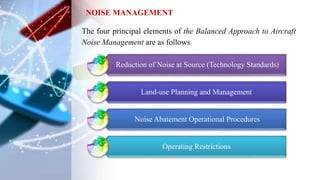
The four principal elements of the Balanced Approach to Aircraft
Noise Management are as follows
NOISE MANAGEMENT
The four principal elements of the Balanced Approach to Aircraft
Noise Management are as follows
NOISE MANAGEMENT
​Reduction of Noise at Source (Technology Standards)​
Land-use Planning and Management
Noise Abatement Operational Procedures​
Operating Restrictions

UNIT-1 A OPERATIONS PPT.pptx

  • 1.
  • 2.
    GREENFIELD AIRPORT A greenfieldairport is an aviation facility with greenfield project characteristics. The designation reflects certain environmental qualities (using previously undeveloped or empty greenfield land, for example) and commissioning, planning and construction processes that are generally carried out from scratch. While a green field in nature is defined as a wide expanse of natural land (meadow, prairie, grassland), here greenfield denotes that a project lacks any constraints imposed upon it by prior work or existing infrastructure
  • 3.
  • 4.
  • 5.
    AN AIRPORT ISMAINLY DIVIDED INTO TWO AREAS Airside Area Runways, Taxiways, Ramps Landside Area Parking, Terminals
  • 6.
    AIRPORT TERMINALAND PASSENGERTERMINAL • An airport terminal is a building at an airport where passengers transfer between ground transportation and the facilities that allow them to board and disembark from an aircraft. • Within the terminal, passengers purchase tickets, transfer their luggage, and go through security. The buildings that provide access to the airplanes (via gates) are typically called concourses. However, the terms "terminal" and "concourse" are sometimes used interchangeably, depending on the configuration of the airport.
  • 8.
    Terminal Facility Requirements Ticketing/Check-in PassengerScreening Holdrooms Concessions Baggage Claim Circulation Airline offices Baggage Handling Baggage screening Inspection services Support areas Special requirements Building system
  • 13.
    An air operator'scertificate (AOC) is the approval granted by a civil aviation authority (CAA) to an aircraft operator to allow it to use aircraft for commercial purposes. This requires the operator to have personnel, assets, and system in place to ensure the safety of its employees, and the general public. The certificate will list the aircraft types, and registrations to be used, for what purpose and in what area – specific airports or geographic region. AIR OPERATOR CERTIFICATE
  • 14.
    1.Name and locationof the operator; 1.Date of issue and period of validity; 1.Description of the type of operations authorised; 1.Type(s) of aeroplane(s) authorised for use; 1.Registration markings of the authorised aeroplane 1.Authorised areas of operation; 1.Special limitations; 1.Special authorisations/approvals General rules details for Air Operator Certification
  • 15.
     Sufficient personnelwith the required experience for the type of operations requested.  Airworthy aircraft, suitable for the type of operations requested.  Acceptable systems for the training of crew and the operation of the aircraft (Operations Manual).  A quality system to ensure that all applicable regulations are followed.  The appointment of key accountable staff, who are responsible for specific safety critical functions such as training, maintenance and operations. AIR OPERATOR CERTIFICATE Requirements
  • 16.
     Carriers LiabilityInsurance (for Airlines) – Operators are to have sufficient insurance to cover the injury or death of any passenger carried.  Proof that the operator has sufficient finances to fund the operation.  The operator has sufficient ground infrastructure, or arrangements for the supply of sufficient infrastructure, to support its operations into the ports requested.  The certificate is held by a legal person who resides in the country or region of application AIR OPERATOR CERTIFICATE Requirements
  • 17.
  • 21.
    What are airportcharges? Airport charges are paid by airlines for the use of airport facilities. They include aircraft landing, freight and other charges related to the use of airport infrastructure such as runways and passenger terminals. Ultimately these charges are paid, indirectly, by passengers and freight customers via the ticket price or freight forwarding fee. Charges are applied in different ways, depending on the service they cover. Passenger charges are levied per passenger whilst other charges are applied per aircraft landing or take-off. AIRPORT CHARGES
  • 22.
    Why is Europeinvolved? Charges for the use of airport infrastructure can represent a significant expense for airlines. In the European single market, there is no justification for airport charges to be applied in a discriminatory manner, to the detriment or advantage of certain carriers. For the European aviation market to work properly it is important that there be minimum standards for charges at larger airports in order to ensure fair competition among airlines. Such common standards, however, need to respect the different systems of regulation which are in operation in the Member States and which might be designed to compensate for the market power of the airport as the sole infrastructure provider at a given city or in a given region. AIRPORT CHARGES
  • 23.
    Greater transparency Non-discrimination Consultation oncharges between airports and airlines To help settle disputes over charges between airports and airlines AIRPORT CHARGES
  • 24.
    • Emergency HospitalFacilities • Providing Porterage Services and assistance with baggage • Providing assistance for arranging transport, hotel/motel/guest house booking • Baggage wrapping service using state of the art technology is available in the city side as well as the check in area of International Terminals. • The self-check-in facility available in the Terminals. You can select seats and print your boarding pass using this facility. AIRPORT FACILITY
  • 25.
    • Free Wi-Fifacility is available for passengers at Domestic & International Terminal. To connect to free wi-fi service, passengers should provide their mobile numbers as login id’s. Once connected, this service enables the passengers to access the net. • Passenger can place a request to concerned airline for a wheelchair while booking tickets or can also contact the airline ticketing counter after reaching the airport for the same • Prayer room is available in the Security Hold Area at International Terminal for the convenience of passengers. • Both passengers & visitors can avail the facility of postal service at the Airport. Counter is conveniently located at Domestic Departure level AIRPORT FACILITY
  • 26.
    • INTER TERMINALTRANSFERS Free battery-operated vehicles and courtesy coaches offering shuttle service for the convenience of transit passengers between Domestic & International terminals. • Child care rooms are available at Terminals for providing essentials to the child/infant such as, feeding, changing of diapers etc. • Passengers and tourists can avail currency exchange services with 2 foreign exchange counters in Domestic Terminal and 5 counters in International Terminal. • Automated Teller Machine (ATM) of various banks are conveniently located at Domestic & International Terminals to extend selected banking services for travel need. AIRPORT FACILITY
  • 27.
    • Lounges atmultiple locations in the Domestic & International Departures of Chennai Airport offers world class amenities including best of cuisines, plush seating, complimentary Wi-Fi, wide range of National, International & Regional dailies along with various magazines. Serving round the clock the lounges cater to Airline CIP customers as well as passengers availing access through Priority Pass, high-end credit cards and other loyalty cards. AIRPORT FACILITY
  • 28.
    • The words"hub" and "spoke" create a pretty vivid image of how this system works. A hub is a central airport that flights are routed through, and spokes are the routes that planes take out of the hub airport. Most major airlines have multiple hubs. They claim that hubs allow them to offer more flights for passengers. • Today, most airlines have at least one central airport that their flights have to go through. From that hub, the spoke flights take passengers to select destinations. HUB AND SPOKE SYSTEM
  • 29.
    • The mainoverarching ICAO policy on aircraft noise is the Balanced Approach to Aircraft Noise Management, adopted by the ICAO Assembly in its 33rd Session (2001) and reaffirmed in all the subsequent Assembly Sessions (reference: ICAO Resolution A39-1 Appendix C). The four principal elements of the Balanced Approach to Aircraft Noise Management are as follows NOISE MANAGEMENT
  • 30.
    The four principalelements of the Balanced Approach to Aircraft Noise Management are as follows NOISE MANAGEMENT ​Reduction of Noise at Source (Technology Standards)​ Land-use Planning and Management Noise Abatement Operational Procedures​ Operating Restrictions